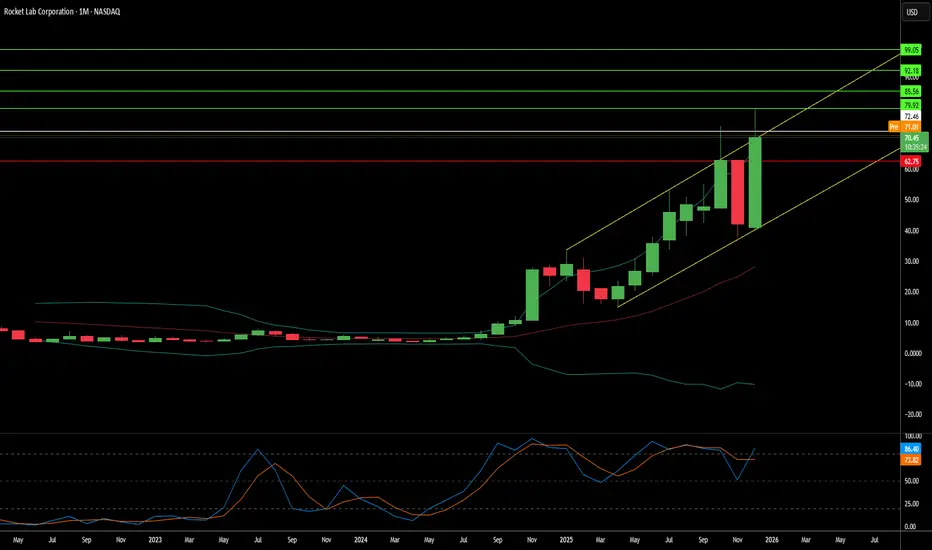
Can a Small-Sat Pioneer Become a Defense Superpower?Rocket Lab has transformed from a niche small-satellite launch provider into a strategic national security asset, closing 2025 with 21 successful Electron launches and a remarkable 175% stock surge. The company's evolution culminated in an $816 million Space Development Agency contract to build 18 satellites for hypersonic missile threat detection, signaling its emergence as a primary defense contractor. This vertical integration strategy positions Rocket Lab as a critical player in an era where supply chain sovereignty has become paramount for military readiness.
The technological centerpiece of Rocket Lab's 2026 ambitions is the Neutron rocket, a medium-lift vehicle capable of carrying 13,000 kilograms to low Earth orbit. Set for its maiden test flight in mid-2026, Neutron features the innovative "Hungry Hippo" fairing design and 3D-printed Archimedes engines, targeting the lucrative mega-constellation market currently dominated by SpaceX's Falcon 9. This technological leap, combined with over 550 global patents covering critical propulsion and structural innovations, creates a formidable intellectual property moat that competitors cannot easily replicate.
The financial trajectory underscores this transformation: analysts project 52.2% EPS growth for 2026, reaching $0.27 per share and dramatically outpacing traditional aerospace giants like Lockheed Martin (0.6%) and Northrop Grumman (-7.6%). A potential SpaceX IPO at $1.5 trillion valuation could trigger sector-wide revaluation, with Rocket Lab standing as the only publicly traded, vertically integrated alternative. Wall Street has responded accordingly, raising price targets to $90 as the company bridges the gap between startup agility and aerospace titan scale, with defense contracts poised to dominate its revenue mix.