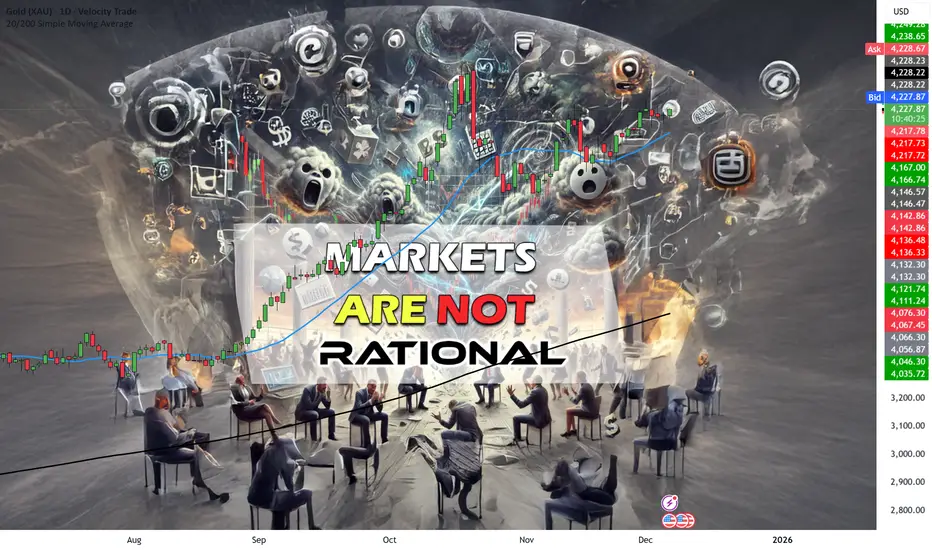
Why Markets Aren’t Always RationalWhy Markets Aren’t Always Rational
Have you ever scratched your head wondering why the stock market seems to defy logic?
Wars breakout – Markets rally such as the Dow Jones Futures
Currencies devalue – Markets rally.
Bad earnings come out – Markets rally.
Great news come out and markets crash.
Don’t worry; you’re not alone.
Traders everywhere experience that jaw-dropping moment when good news doesn’t lead to uptrends, correlations break down, or when the market’s behavior looks like one big, chaotic mess.
So, why do markets behave like this?
Let’s unpack the mystery.
The Market is One Cluster-Freak of Confusion
Let’s start with the truth no one wants to admit.
The market is not a perfect machine.
It’s not the textbook example of logic that economic theories might have you believe.
Correlations don’t work according to the book.
One day, gold and the dollar move in opposite directions.
The next day, they move in tandem. You’re left wondering if someone swapped the rule book for a comic strip.
And then there’s the disconnect between trends and fundamentals.
You dive into micro and macro analyses, only to find that a company with stellar earnings is trending down.
Meanwhile, a company with mediocre reports is rocketing to the moon.
Why? Because market participants aren’t robots.
They’re emotional, impulsive, and sometimes downright irrational.
They drive the markets with fear, greed and ego.
The market is less of a math equation and more of a mood swing.
Good News Doesn’t Always Mean Strong Uptrends
Here’s another slap in the face of logic:
Good news can sometimes trigger sell-offs.
A company beats earnings expectations, announces an exciting product, and yet—boom—the stock plummets.
What gives?
This happens because markets are driven by expectations, not just outcomes.
If the “good news” was already priced in, traders may sell to take profits.
Worse, if the news didn’t exceed sky-high expectations, the market might interpret it as a letdown.
Herd Mentality: Following the Wrong Crowd
Ever heard the phrase, “When in doubt, follow the herd”?
That’s exactly what many traders do—and it’s not always the smartest move.
Market trends often amplify irrational behavior.
If the market’s falling, traders sell in a panic. If it’s rallying, they buy in FOMO (fear of missing out).
These emotional reactions create an illusion of logic, but in reality, it’s chaos feeding on itself.
Real-life example? Meme stocks. Companies with no strong fundamentals suddenly became multi-billion-dollar rockets because traders on Reddit decided to collectively moonshot them.
Rationality?
Out the window.
How to Stay Sane in an Irrational Market
So, what can you do to navigate this madness? The key is to build your own strategy – Proven, profitable and consistent through MOST market environments.
Avoid getting swept up in market noise.
Understand market psychology.
Accept that emotions drive the market just as much as fundamentals do.
Be cautious with correlations. Test them, but don’t bet the farm on them. Remember, markets love to break their own rules.
Don’t rely solely on good news. Always ask yourself: Is this already priced in? What are the broader market expectations?
Think long-term.
The daily market irrationality tends to smooth out over time. Focus on the bigger picture rather than short-term hiccups.
FINAL WORDS:
When you have your edge – then the markets irrationality become irrelevant to your trading success.
Markets often appear irrational due to emotional participants and unpredictable trends.
Let’s sum up what we have covered:
Correlations don’t always follow the “rules.”
Good news doesn’t guarantee uptrends; expectations and psychology matter more.
Herd mentality amplifies irrational moves.
Stay grounded, think critically, and focus on long-term strategies.
The market may be a cluster-freak of confusion, but with the right mindset, you can navigate the chaos like a pro.
Now, let’s tackle that beast head-on!
Tradingtipsforbeginners
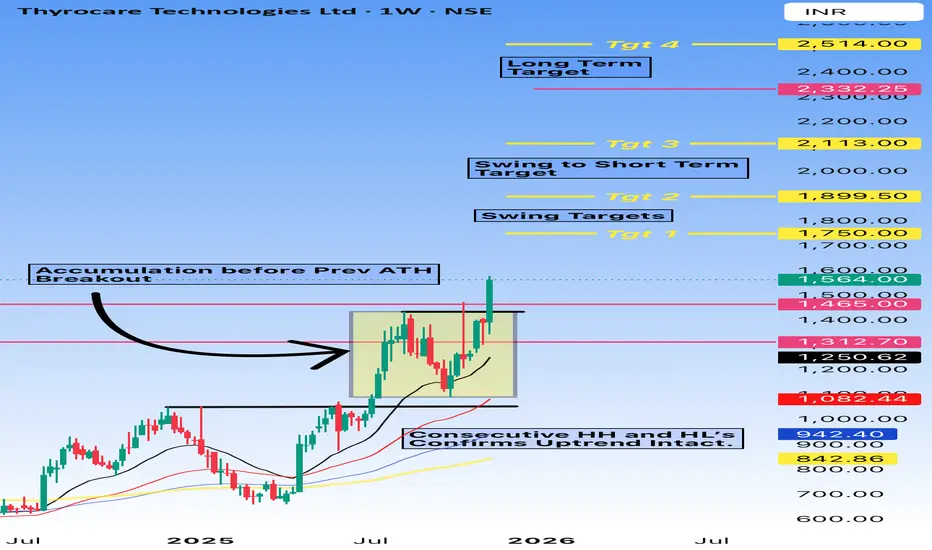
Thyrocare Long - ATH BreakoutThe Chart says it all.
Thyrocare is displaying strong #bullish #momentum, breaking out confidently after a solid period of #accumulation.
The structure is clean—consecutive higher highs and higher lows keep the #uptrend firmly intact.
Price has surged above key resistance levels, turning them into support, and is now marching toward multiple #swing and long-term #targets.
Overall, the chart reflects renewed strength, buyer dominance, and clear upside potential as the trend continues to build. 🚀📈
Levels and Targets in chart.
Disclaimer:
I am not a SEBI-registered advisor. The analysis shared is purely for educational and informational purposes and should not be considered investment or trading advice. Please consult a SEBI-registered financial advisor before making any investment decisions.
Trading and investing in the markets involve risk; you should perform your own research and due diligence.
9 Essential TIPS For Newbie Traders (Learn from my Mistakes!)
In the today's article, I will reveal trading secrets I wish I knew when I started trading.
1️⃣ Forget about becoming a pro quickly
Most of the traders believe, that you can learn how to trade easily and that it takes a very short period of time in order to master a profitable trading strategy.
The truth is, however, that trading is a long journey.
I spent more than 3 years, trying different strategies and looking for a profitable technique to trade. Once I found that, it took more than a year to polish a trading strategy and to learn how to apply that properly.
Be prepared to spend YEARS before you find a way to trade profitably.
2️⃣ Focus on One Strategy
While you are learning how to trade you will try different techniques, tools and strategies. And the thing is that newbies are trying multiple things simultaneously. The more strategies you try at once, the more setups you have on your chart. The more setups you have on your chart, the more complex and difficult is your trading.
Remember that in this game, your attention is the key.
You should meticulously study each and every trading setup.
For that reason, I highly recommend you to focus on one strategy, one approach, one technique. Test it, try it and look for a new one only when you realize that it doesn't work.
Here is the example how the same price chart can provide absolutely different trading opportunities depending on a trading strategy.
Price action pattern trader would recognize a lot of a patterns, while indicator based trader could spot absolutely different bullish and bearish signals.
Now, try to imagine how hard it would be to follow both strategies simultaneously.
3️⃣ Start with small capital that you can afford to lose
You will lose your first trading deposit and, probably, the second one and potentially the third one as well.
Losses are the only way to learn real trading. While you are on a demo account, you feel like a king, but once you start risking your savings, the perspective completely changes .
For that reason, make sure that you trade with an account that you can afford to lose. The fact of blowing such an account should be unpleasant, but that should not affect your daily life.
4️⃣ Use stop loss
I am doing trading coaching for more than 4 years.
What pisses me off is that the main reason of the substantial losses of my mentees is the absence of stop loss. Why can it be if naturally everyone: from your broker to Instagram trading gurus repeat that day after day.
Set stop loss, know in advance how much you risk per trade, and know the exact level on a price chart where you become wrong.
Imagine what could be your loss, if you shorted USDJPY and hold the trade while the market kept going against you.
5️⃣ Forget about getting rich quick
That is the iconic fallacy. I believe that around 90% of people who come in this game want to get rich quick , want easy money.
And no surprise, when I share a trading setup in my free telegram channel, and it loses I receive dozens of messages that I am a scammer.
People truly believe that professional trading implies 100% win rate and quick and easy money.
The truth is, traders, that trading is a very tough game. And with a good trading strategy, you have just a little statistical edge that will give you the profits that would slightly overcome your losses.
6️⃣ Train your eyes
Professional trading implies pattern recognition: it can be some technical indicators pattern, the price action or candlestick formation, etc.
Your main goal as a trader is to learn to identify these patterns.
Pattern recognition is a hard skill to acquire.
You should spend dozens of hours in front of the screen in order to train your eyes to identify certain patterns.
Here is how many patterns you would spot on GBPUSD chart, paying close attention.
7️⃣ Track and analyze your trades
Study all the trades that you take, especially the losing ones.
Look for mistakes, look for the reasons why a certain setup played out and why a certain one didn't. Journal your trades and make notes.
8️⃣ Don't use technical indicators
Newbies believe that technical indicators should do the work for them.
They are constantly looking for one or a bunch that will accurately show where the market will go.
However, I always say to my mentees that technical indicators make the chart messy and distract.
If you just started trading, focus on a naked chart, learn to analyze the market trend, key levels, classic price action patterns.
Learn to make accurate predictions relying on a price chart alone.
Only then add some technical indicators on your chart.
They won't do the work for you, but will help you to slightly increase the accuracy of a certain setup.
Above is the classic chart of a newbie trader.
A lot of indicators and a complete mess
The same chart would look much better without technical indicators.
9️⃣ Find a Mentor
There are hundreds of trading mentors on Instagram, YouTube, TradingView. Find the one with a trading style that you like.
Follow him, learn from his trading experience, listen to his trading recommendations.
11 years ago I found a guy on YouTube, his name was Jason.
I really liked his free teachings, and they were meaningful to me.
I decided to purchase his premium coaching program.
It was 200$ monthly - a huge amount of money for me at that time.
However, with his knowledge I saved a lot, I learned a lot of profitable techniques and tricks that helped me to become a professional forex trader.
Of course, this list could be much bigger.
The more I think about different subjects in trading, the more important tips come to my mind. However, I believe that the tips above are essential and I truly wish I knew all that before I started.
I hope that info will help you in your trading journey!
Good luck to you.
❤️Please, support my work with like, thank you!❤️
I am part of Trade Nation's Influencer program and receive a monthly fee for using their TradingView charts in my analysis.