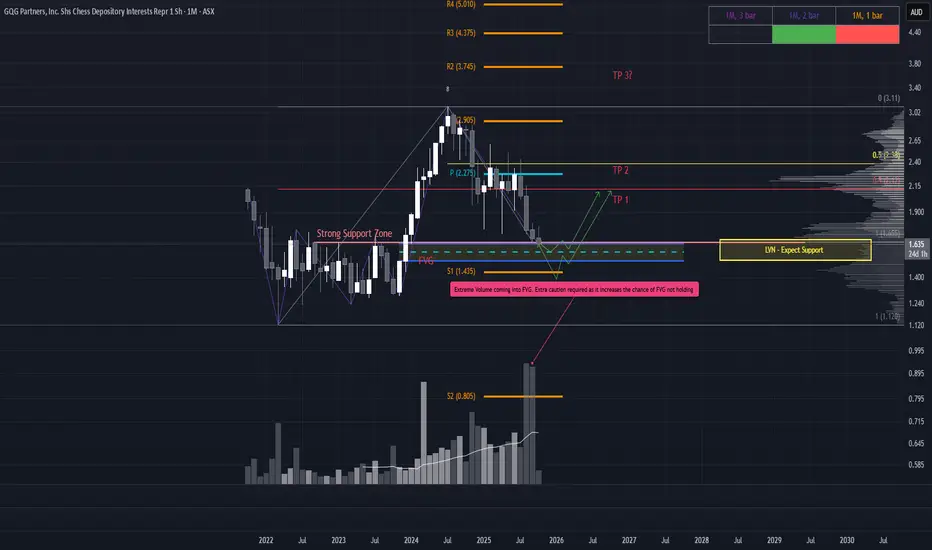
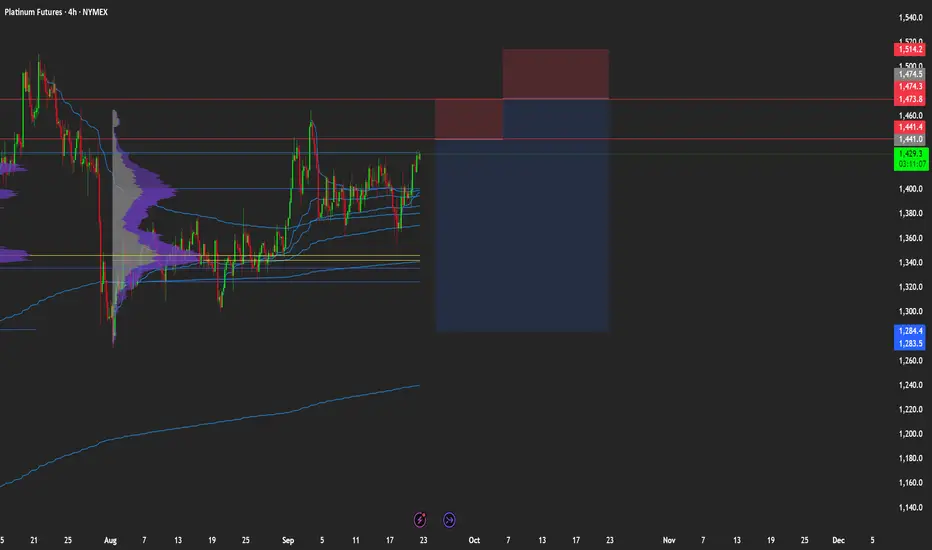
GQG Approaching Strategic Area of InterestGQG has pulled back sharply from the $3.12 high and is now approaching a key Fair Value Gap (FVG) that warrants close tracking. While the probability of this zone holding is reduced due to excessive volume pressure, the setup still offers potential for a favorable risk-to-reward trade, especially if structure and timing align.
Why the FVG Still Matters
Price is testing a major support zone formed by previous highs.
The area sits within a Low Volume Node (LVN), which may act as a barrier to price acceptance.
Proximity to the yearly S1 pivot opens the door for a classic fakeout scenario. Price could spike below the FVG, trap late shorts, stop out longs, and then close back above the pivot.
Trade Scenarios (Early Framework) Still developing, these are preliminary overlays to add to watchlist.
Scenario 1 – Less Likely
Price prints and closes a high-volume bullish monthly candle that tags the Equilibrium of the FVG.
If confirmed, entry would be on the open of the next monthly candle.
Scenario 2 – More Likely
Price pushes down to the yearly S1 pivot, then prints a bullish reversal candle.
Entry would be on the open of the next candle, contingent on structure and volume confirmation.
Targets
Initial target: Macro 50% retracement projected from ATH to ATL.
If price breaks and closes above this level, we could begin mapping for new highs, but for now, we take it one leg at a time.
This isn’t a rush setup, it’s a structure-first, and just being patient.
Volumeanalysis
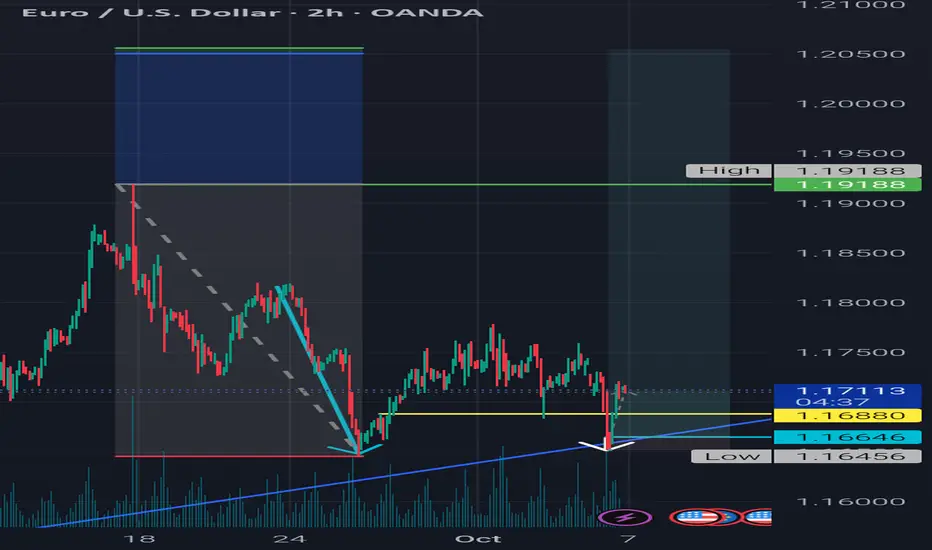
Momentum-Backed Retracement + Volume Retest | BadgerFX 📊 This setup establishes directional bias from the monthly chart (Current Bias: 📈 Bullish). The trade idea integrates momentum-driven retracements in line with this bias and validates continuation through structure and volume on the 15m.
📍 1.16880 confirmed the shift in structure, supported by volume, reinforcing alignment with the monthly trend. Final execution 🎯 relies on candlestick precision for entry timing.
⚠️ Disclaimer: The information shared here is for educational and entertainment purposes only and should not be considered financial advice.
BadgerFX 🦡 – Honey Badger Don’t Care
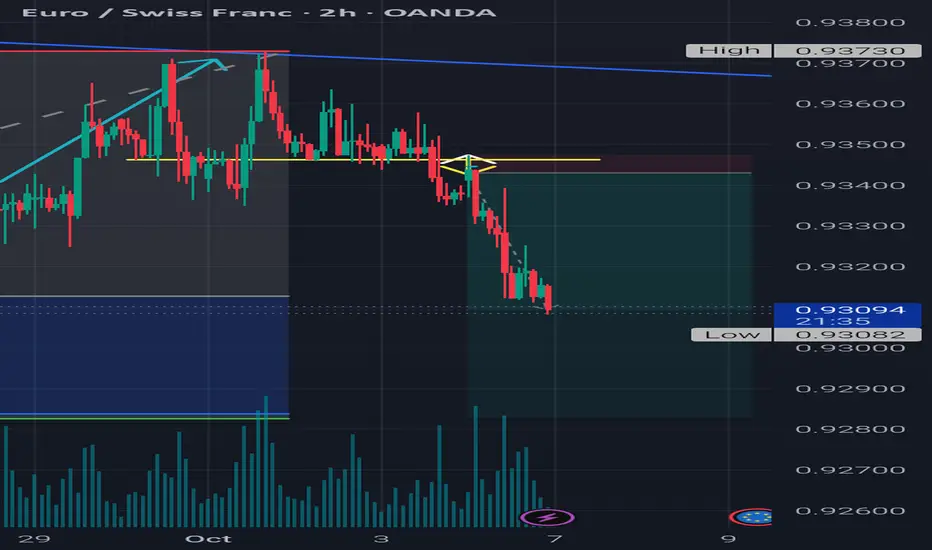
Momentum-Backed Retracement + Volume Retest | BadgerFX 📊 This setup establishes directional bias from the monthly chart (Current Bias: ). The trade idea integrates momentum-driven retracements in line with this bias and validates continuation through structure and volume on the 15m OANDA:EURCHF .
📍 0.93462 confirmed the shift in structure, supported by volume, reinforcing alignment with the monthly trend. Final execution 🎯 relies on candlestick precision for entry timing.
⚠️ Disclaimer: The information shared here is for educational and entertainment purposes only and should not be considered financial advice.
BadgerFX 🦡 – Honey Badger Don’t Care
EUR/JPY: Could This Demand Zone Spark the Next Bullish Move ?Price is testing a high-volume node at 173.450, where:
The AVWAP is acting as dynamic support
The Volume Profile shows strong accumulation
According to pattern analysis (based on historical data), similar setups delivered:
→ 8 wins out of 10 trades (80% win rate)
Not a guarantee — just a signal worth watching.
This is not financial advice. Past performance ≠ future results.
Smart Money Support/Resistance + ATAI Volume Analysis —PracticalApplication
When these two indicators work together — Smart Money Support/Resistance (Lite) and ATAI Volume Analysis with Price Action — the chart begins to speak a clearer language: one defines where the reaction zones form, and the other explains what happens inside them. The purpose is not prediction but understanding the balance between smart money pressure and retail momentum.
1. Parameter Alignment
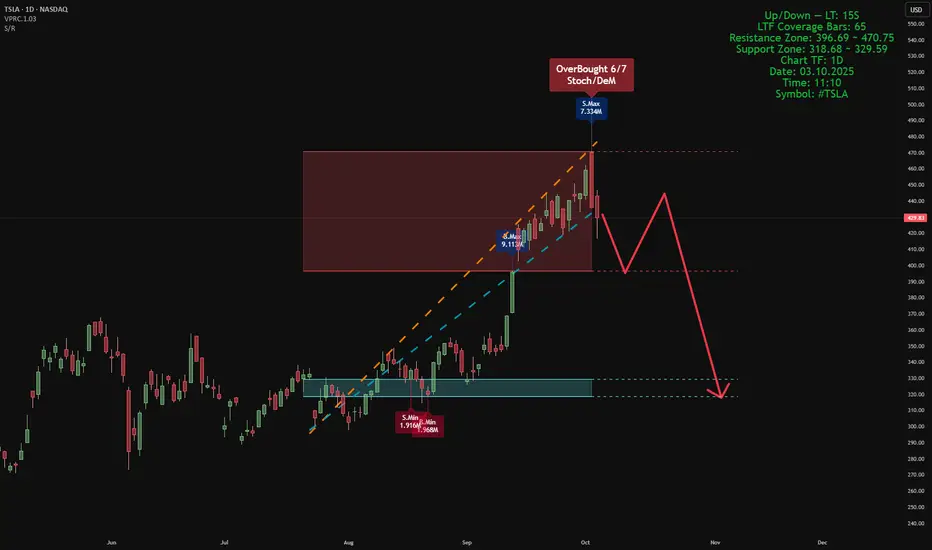
On the right side of the chart, the green info panel confirms that both indicators share identical configurations. In this example, the lookback period is set to 52, chosen deliberately because it must be smaller than the total number of LTF coverage bars (65). For the Smart Money Support/Resistance indicator, the projection is set to 26 — extending the detected zones forward without adding excessive visual noise. This alignment is crucial; mismatched parameters can desynchronize volume readings and structural boundaries.
2. Reading the Chart
In this sample chart, the upper red area represents a Smart Money resistance zone — a region of concentrated selling pressure detected from lower timeframe volume. Simultaneously, ATAI Volume Analysis signals an Overbought (6/7) condition, meaning multiple oscillators confirm exhaustion while seller volume (S.Max) begins to outweigh buyer volume (B.Min). This overlap suggests that liquidity has shifted and the prior bullish impulse is weakening. From here, price may consolidate within the zone or initiate a structured retracement toward the blue support area, previously defined by accumulation volume. The red projected path simply visualizes one potential structural scenario; it is not a prediction or trade signal.
3. Broader Context
This example serves only as a demonstration of how these two tools interact when properly tuned. Different assets and timeframes naturally yield unique structures and behaviors, yet the principle remains consistent: define the territory first with Smart Money Support/Resistance, then interpret market behavior within it using ATAI Volume Analysis.
This content is for educational purposes only — not financial advice. User feedback and practical observations play a key role in refining future versions of both indicators.
Market on Fire: S&P 500 & Nasdaq Rally Towards New HighsWe have a beautiful P-Shape volume profile formed at the top and we broke and closed above it.
The P-shape volume profile is bullish profile that is formed when large volumes are transacted at the highs meaning participants a willing to pay premium price . You can see the POC so close to the top of the VAH
I checked the CVD of the volume on a footprint chart and i see the volume has -ve Delta , which means alot of aggressive sellers transacted there trying to push the price down. Now that they are being squeezed slowly and start closing out their positions, it should fuel the uptrend. i entered the trade soon as we broke and closed above the value area.
Food for thought.. Who was willing to pay the high price to buy from the aggressive sellers?
DEFINITIONS
POC- point of control
VAH- Value area high
CVD- Cumulative Volume Delta
Target is the ExoFade area..Lets see how this trade goes
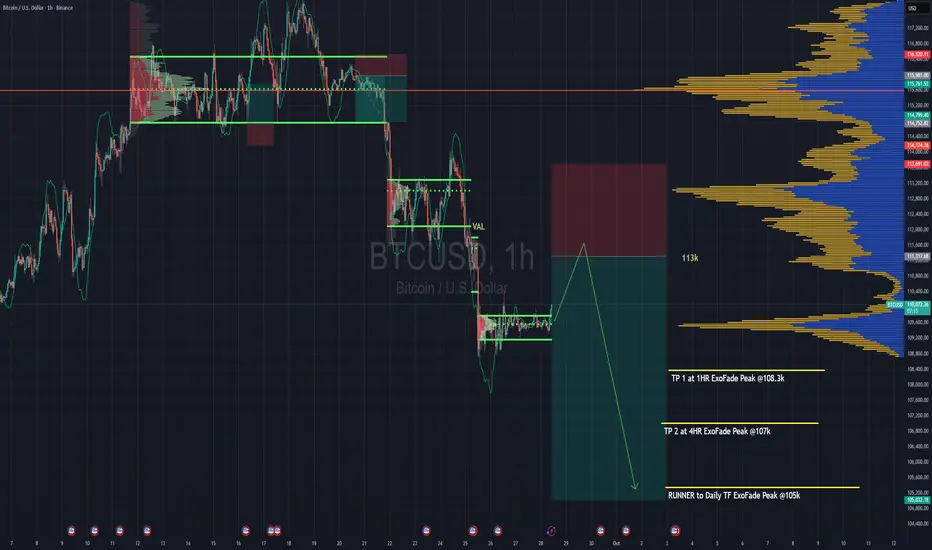
Looking to Short Bitcoin From Here : Winter Is Coming !!Looking to short BTC for a continuation of the downtrend.
Trend is your friend is what they say.
So we're basically going to wait for a pullback to 113k range then enter a sell.
The sell entry caters for both H4 & Daily timeframe trend, so it's a strong one.
The sell entry range also has the VAL of the last rotation we had from Sept 21st to Sept 24th when we finally broke down from it at 112k. That VAL should be a strong point for rejection, it'll be one of the places where we'll truly get to test the strength of the bears ( that's if we even make it that far )
TP targets are based on ExoFade peaks of the H1, H4 and Daily timeframe.. You can add the ExoFade to your charts to follow on your own charts as well.
VAL - Value Area Low of the volume profile
Strategy => Volume + Trend + Lots of coffee
JPY Futures - Can We Take Out The 3rd ExoFade PeakTo clear any confusing for those that dont know, 6J Futures aka JPY/USD, is the inverse of your regular USD/JPY. Got it?
It's currently in a strong uptrend, since the dollar is in a free fall.
We've been taking out the ExoFade peaks and the trend looks juicy. Taking the 3rd pullback bounce of a uptrend is not my favorite thing to do cos each time you get a bounce, the probably of the next of failing goes up significantly cos sellers need to feed their families too lol.
The first bounce in a new uptrend has a higher success rate and with much lower risk required.
The ExoFade peaks are great for setting price targets and prediction, and we can see the last 2 peaks we're successfully taken out. If the trends momentum stays intact, i expect us to take out the 3rd one as predicted.
London session is in a couple of hours, which will inject more volatility and we have unemployment news in the morning, which can disrupt the trend.
We'll see how it goes.
Crude Oil (H1) – Key Supply & Demand Scenarios I SEP/26/2025📌 Scenario 1: Bullish Continuation (High Probability)
Condition: Price holds above demand 64.7 – 64.8.
Entry signal: H1 bullish candle closes above 65.4 with volume → Buy.
TP: 66.0 – 66.2
SL: below 64.6
📌 Scenario 2: Pullback then Bounce
Condition: Price gets rejected at 65.3 – 65.4, pulls back to retest 64.7 – 64.8.
Entry signal: Pinbar / Bullish engulfing candle at demand zone.
TP: 65.4 → 66.0
SL: below 64.5
📌 Scenario 3: Bearish Correction
Condition: Price breaks below demand 64.7 – 64.8.
Entry signal: Retest of broken zone with bearish rejection → Sell.
TP: 63.8 – 64.0
SL: above 65.0
📌 Scenario 4: Deeper Reversal
Condition: Price breaks below 63.8 – 64.0.
Entry signal: Retest supply flip + bearish confirmation candle.
TP: 63.0 – 63.1
SL: above 64.2
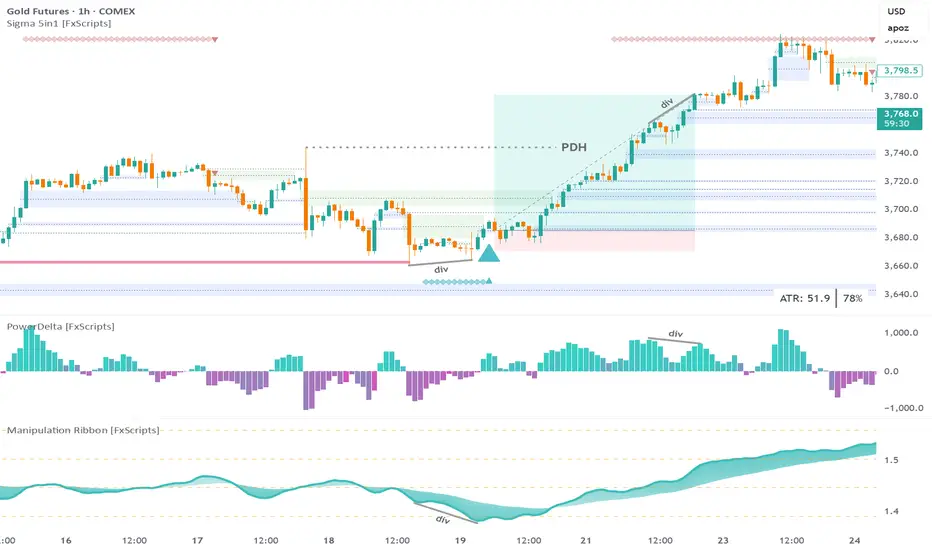
GC Futures 15m: 6.6:1 trade executed using Sigma Trading SystemStep 1: wait for a sweep of daily liquidity
Note: the sweep must be confirmed for any of the other confluences to be valid
Step 2: wait for a bullish marker to be drawn by the Reversal Print indicator
Tip: set an alert if you don’t want to spend all day staring at the chart
Step 3: look for a divergence with either the PowerDelta Oscillator or, in this case, the Manipulation Ribbon
Info: the Manipulation Ribbon detects areas of price manipulation by Market Makers vs areas where it is trading in a natural, price-driven state
Step 4: the entry is a tap of the most recent confirmed FVG
FYI: all the drawings on the main chart are created by the Sigma 5-in-1 indicator
SL: low of first candle that forms the entry FVG
Tip: for a more conservative approach the recent swing low could also be used
TP: bearish divergence with the PowerDelta Oscillator
Note: gold was at an all-time high so anything beyond the Previous Day High (PDH) posed a risk however for a more conservative approach you could exit half your position at the PDH
Gold Record Highs Under the Lens of ATAI VPA & VPRCGold Analysis Report
In recent days, as gold has reached new historical highs, two analytical tools have been used to assess the market conditions:
- ATAI Volume analysis with price action V 1.03
- ATAI Volume Pressure Analyzer (VPA)
It is important to emphasize that the gold market is heavily influenced by global economic and political events, and precise volume data is not publicly available. The only volume data considered here comes from OANDA. For this evaluation, a 70-day period has been chosen to study the broader behavioral and volume pattern of gold over the past two months.
Bull Trap Risk Detection (ATAI Volume analysis with price action V 1.03)
In this indicator, Bull Trap detection is based on the interaction of price behavior and order-flow volume. The logic is as follows:
1. Bull Sweep (False Breakout with Long Wick)
- If price exceeds the recent high (`high_level`) but closes back below it, and the upper wick of the candle makes up a sufficiently large fraction of the total range, then a Bull Sweep is detected.
- Formula:
upper_wick_ratio = (high - max(open, close)) / (high - low)
Condition: upper_wick_ratio >= trap_wick_threshold (e.g., 0.6)
2. Bull Break
- If the close is above the breakout level without a long wick, it is treated as a Bull Break.
3. Mismatch Condition
- If the candle is bullish (close > open) but delta ≤ 0 or seller ratio > 50%, then there is a mismatch between price action and order flow.
- Formula (simplified):
mismatchBull = (close > open) and (delta <= 0 or seller_ratio > 0.5)
4. Dominance Inversion
- If buyer volume ranks highest in the lookback window, but cumulative seller volume is greater than buyer volume while the candle is bullish, a dominance inversion occurs.
- Condition:
domInvBull = (rank_buy == 1) and (sum_sell > sum_buy) and (close > open)
5. Low Volume Breakout
- If a bullish breakout occurs with total volume less than the average total volume, then the breakout is flagged as low-volume.
- Condition:
lowVolBull = isBullBreak and (TF_tot < avg_tot)
The module assigns scores to these conditions:
- Sweep: +2
- Break: +1
- Mismatch: +2
- Dominance Inversion: +2
- Low-volume Break: +1
If total score ≥ trap_score_risk (default = 3), then a Bull Trap Risk is flagged. If, within `trap_confirm_bars`, price reverses and closes back below the breakout level, then Bull Trap Risk Confirmed is displayed.
Complementary View (ATAI Volume Pressure Analyzer – VPA)
The VPA indicator, with its left (C→B) and right (B→A) wings and offset capability, allows a parallel evaluation of flow balance. In the current gold chart, the right wing (B→A) reflects weakness on the buyers' side, reinforcing the Bull Trap risk detected by the previous indicator. This alignment strengthens the probability of a bearish scenario.
However, the extent of any downward path will depend on the pivotal price levels where the largest buy and sell volumes were registered over the past 70 days. These are represented by points B1 and S1, clustered around the 3409 USD level.
Notes
- On lower timeframes, accuracy in buy/sell volume calculation depends on the data window. Here, a 1-minute timeframe was selected, which provides ~74 days of buy/sell flow data.
- Gold remains highly sensitive to political and economic news globally.
- This analysis is based solely on mathematical calculations and volume/behavioral pattern recognition. It must not be interpreted as investment advice of any kind.
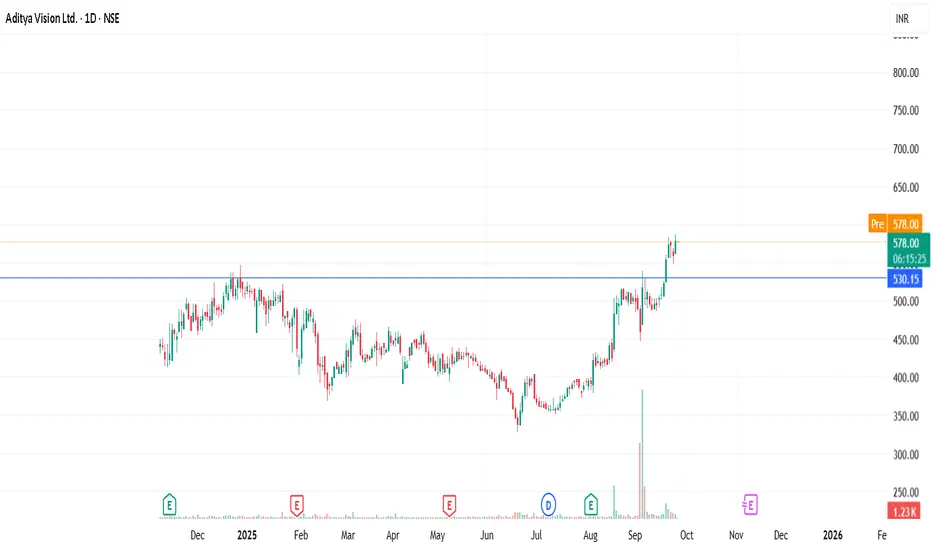
Aditya Vision Ltd. — Long Setup After BreakoutChart: Daily timeframe
Technical View
listing, the stock went through a long consolidation phase, forming a base.
Recently, price broke out above ₹530 resistance with strong volume, confirming institutional participation.
The breakout has been followed by healthy price action — higher highs & higher lows.
Volume during the breakout was significantly higher compared to the consolidation period, which adds conviction.
After breakout it is in consolidation zone.
Entry Zone: Around ₹560–580 (current breakout retest zone).
Long term target can be ₹700-800.
Stop loss is just below breakout line. Good risk reward ration stock.
This looks like a classic post-IPO consolidation breakout with volume confirmation. If retest holds, it offers a solid swing entry with favorable risk/reward.
Disclaimer:
This analysis is shared for educational and informational purposes only. It should not be considered financial advice or a recommendation to buy/sell any security. Trading and investing involve risks, and you should do your own research or consult with a qualified financial advisor before making decisions. Past performance does not guarantee future results.
GENERAL CONTEXTUSOIL remains in a short-term downtrend, capped by the H1 descending trendline.
Price just bounced from Demand zone ~61.85–62.00 (VAL) → showing buy-side reaction.
POC ~63.30 is the key magnet zone.
Supply zone ~63.90–64.00 (VAH) aligns with strong resistance.
📍 TRADING SCENARIOS
🟢 Scenario 1 – BUY at Demand zone (61.85–62.00 / VAL)
🔺 Conditions:
Price retests Demand zone (VAL).
Bullish reversal candles appear (Pin Bar / Engulfing M15–H1).
RSI > 30, bullish divergence confirmed.
🔹 Reason:
VAL often acts as strong support.
Confluence with Demand zone → high probability of bounce.
🎯 TP: 63.30 (POC) → 63.90 (VAH)
🛑 SL: below 61.70
🟡 Scenario 2 – SELL reaction at Supply zone (63.90–64.00 / VAH)
🔺 Conditions:
Price retests Supply zone + VAH.
Strong rejection forms (Bearish Pin Bar / Engulfing).
RSI > 70 or MACD losing momentum.
🔹 Reason:
VAH often works as distribution/profit-taking zone.
Aligns with Supply zone, high chance of pullback.
🎯 TP: 63.30 (POC) → 62.00 (VAL)
🛑 SL: above 64.20
🔴 Scenario 3 – SELL if breakdown below 61.80 (VAL)
🔺 Conditions:
H1 candle closes below 61.80.
Retest of VAL fails from below.
🔹 Reason:
Losing VAL → downtrend continuation.
Price likely seeks lower lows.
🎯 TP: 61.20 → 60.50
🛑 SL: above 62.20
⚠️ Scenario 4 – BUY breakout above 64.00 (VAH)
🔺 Conditions:
H1 candle closes firmly above 64.00.
Pullback holds above 63.90.
🔹 Reason:
Breakout of VAH + Supply zone confirms strong bullish momentum.
Could trigger a deeper rebound.
🎯 TP: 65.20 → 66.00
🛑 SL: below 63.60
📌 SUMMARY
The 61.85–62.00 (VAL/Demand zone) is the best BUY zone.
The 63.90–64.00 (VAH/Supply zone) is a potential SELL zone.
Overall bias remains bearish, but short-term bounce toward POC 63.30 is possible.
Strict risk management is required as crude oil tends to be highly volatile.
Disclaimer: This analysis is provided for educational and informational purposes only and does not constitute financial advice. Trading involves risk, and you should only trade with money you can afford to lose. Always do your own research before making any investment decisions.
Sellers in Control AfterEUR/USD hit a major resistance zone between 1.18500 – 1.19000, which aligns with the Monthly Volume Profile resistance area. Price has rejected this zone with lower highs and decreasing volume — a classic bearish signal.
This setup suggests that a Wave 4 correction may be underway, with potential to target 1.15500 and even 1.14500 if selling pressure accelerates.
Disclaimer: This analysis is for educational purposes only and does not constitute financial advice. Always conduct your own research and manage your risk appropriately.
BWP Setup: Support Holding, Momentum BuildingKeeping it simple here. Price has established a strong base between $3.20 and $3.70, showing clear signs of accumulation. All major trend indicators have just turned up, suggesting momentum is building.
Trade Plan
Entry: Current levels offer a solid technical foundation
Target: Initial TP around $4.20
Risk Management: Respect the All-Time High (ATH) resistance zone
Trailing Strategy: Trail stop losses below each new swing low to stay aligned with the trend
Explaining the Lower Timeframe Function and Its Role in Trading Introduction
Candlesticks on higher timeframes summarize long periods of trading activity, but they hide the internal balance of buying and selling. A daily candle, for instance, may show only a strong close, while in reality buyers and sellers may have fought much more evenly. To uncover this hidden structure, Pine Script offers the requestUpAndDownVolume() function, which retrieves up-volume, down-volume, and delta from a chosen lower timeframe (LTF).
Function in Practice
By applying this function, traders can measure how much of a move was supported by genuine buying pressure and how much came from selling pressure. The function works across timeframes: when analyzing a daily chart, one can select a one-minute or one-second LTF to see how the volume was distributed within each daily bar . This approach reveals details that are invisible on the higher timeframe alone.
Helper for Data Coverage
Lower-timeframe data comes with strict limitations. A one-second chart may only cover a few hours of history, while a one-minute chart can stretch much further back. To make this limitation transparent, a helper was implemented in our code: it shows explicitly how far the available LTF data extends . Instead of assuming full coverage, the trader knows the exact portion of the higher bar that is represented.
//══════════════
// Volume — Lower TF Up/Down
//══════════════
int global_volume_period = input.int(20, minval=1, title="Global Volume Period", tooltip="Shared lookback for ALL volume calculations (e.g., averages/sums).", group=grpVolume)
bool use_custom_tf_input = input.bool(true, "Use custom lower timeframe", tooltip="Override the automatically chosen lower timeframe for volume calculations.", group=grpVolume)
string custom_tf_input = input.timeframe("1", "Lower timeframe", tooltip="Lower timeframe used for up/down volume calculations.", group=grpVolume)
import TradingView/ta/10 as tvta
resolve_lower_tf(bool useCustom, string customTF) =>
useCustom ? customTF :
timeframe.isseconds ? "1S" :
timeframe.isintraday ? "1" :
timeframe.isdaily ? "5" : "60"
get_up_down_volume(string lowerTf) =>
= tvta.requestUpAndDownVolume(lowerTf)
var float upVolume = na
var float downVolume = na
var float deltaVolume = na
string lower_tf = resolve_lower_tf(use_custom_tf_input, custom_tf_input)
= get_up_down_volume(lower_tf)
upVolume := u_tmp
downVolume := d_tmp
deltaVolume := dl_tmp
//──── LTF coverage counter — counts chart bars with valid Up/Down (non-na) 〔Hazel-lite〕
var int ltf_total_bars = 0
var int last_valid_bar_index = na // new: remember the bar_index of the last valid LTF bar
if not na(deltaVolume)
ltf_total_bars += 1
last_valid_bar_index := bar_index
int ltf_safe_window = ltf_total_bars
var label ltf_cov_label = na // label handle for the “coverage” marker
Use in Strategy Development
Because both the main function and the helper for data coverage have been implemented in our work, we use the Hazel-nut BB Volume strategy here as a practical example to illustrate the subject. This strategy serves only as a framework to show how lower-timeframe volume analysis affects higher-timeframe charts. In the following sections, several charts will be presented and briefly explained to demonstrate these effects in practice.
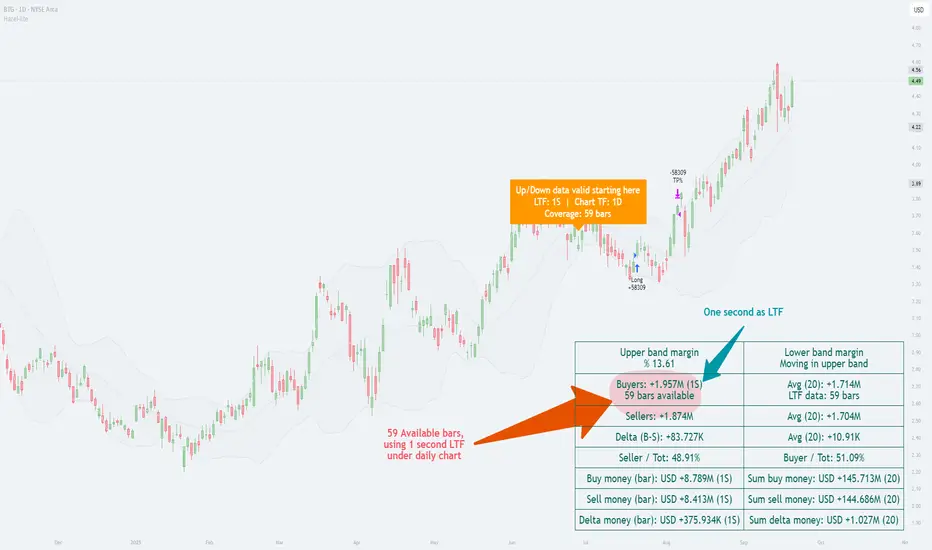
In this example, the daily chart is used as the main timeframe, while a one-second lower timeframe (LTF) has been applied to examine the internal volume distribution. The helper clearly indicates that only 59 one-second bars are available for this daily candle. This is critical, because it shows the analysis is based on a partial window of intraday data rather than a full day.
The up/down volume split reveals that buyers accounted for about 1.957 million units versus sellers with 1.874 million, producing a positive delta of roughly +83,727. In percentage terms, buyers held a slight edge (≈51%), while sellers were close behind (≈49%). This near balance demonstrates how the daily candle’s bullish appearance was built on only a modest dominance by buyers.
By presenting both the margin values (e.g., upper band margin 13.61%) and the absolute money flow, the chart connects higher-timeframe Bollinger Band context with the micro-timeframe order flow. The annotation “Up/Down data valid starting here” reinforces the importance of the helper: it alerts the user that valid LTF volume coverage begins from a specific point, preventing misinterpretation of missing data.
In short, this chart illustrates how choosing a very fine LTF (1 second) can reveal subtle buyer–seller dynamics, while at the same time highlighting the limitation of short data availability. It is a practical case of the principle described earlier—lower-timeframe insight enriches higher-timeframe context, but only within the boundary of available bars.
Analysis with One-Minute LTF
In this chart, the daily timeframe remains the base, but the lower timeframe (LTF) has been shifted to one minute. The helper indicates that data coverage extends across 353 daily bars, a much deeper historical window than in the one-second example. This means we can evaluate buyer/seller balance over nearly a full year of daily candles rather than just a short slice of history.
The up/down split shows buyers at ≈2.019M and sellers at ≈1.812M, producing a positive delta of +206,223. Here, buyers hold about 52.7%, compared to sellers at 47.3%. This stronger bias toward buyers contrasts with the previous chart, where the one-second LTF produced only a slim delta of +83,727 and ratios closer to 51%/49%.
Comparison with the One-Second LTF Chart
Data coverage: 1s gave 59 daily bars of usable history; 1m extends that to 353 bars.
Delta magnitude: 1s produced a modest delta (+83k), reflecting very fine-grained noise; 1m smooths those micro-fluctuations into a larger, clearer delta (+206k).
Interpretation: The 1s chart highlighted short-term balance, almost evenly split. The 1m chart, backed by longer history, paints a more decisive picture of buyer strength.
Key Takeaway
This comparison underscores the trade-off: the lower the LTF, the higher the detail but the shorter the history; the higher the LTF, the broader the historical coverage but at the cost of microscopic precision. The helper function bridges this gap by making the coverage explicit, ensuring traders know exactly what their analysis is built on.
Impact of TradingView Plan Levels
Another factor shaping the use of this function is the user’s access to data. TradingView accounts differ in how much intraday history they provide and which intervals are unlocked.
◉ On the free plan, the smallest available interval is one minute, with a few months of intraday history.
◉ Paid plans unlock second-based charts, but even then, history is measured in hours or days, not months.
◉ Higher tiers extend the number of bars that can be loaded per chart, which becomes relevant when pulling large volumes of lower-timeframe data into higher-timeframe studies
Conclusion
With requestUpAndDownVolume(), it becomes possible to see how each symbol behaves internally across different timeframes. The helper function makes clear where the data stops, preventing misinterpretation. By applying this setup within strategies like Hazel-nut BB Volume, one can demonstrate how changing the lower timeframe directly alters the picture seen on higher charts. In this way, the function is not just a technical option but a bridge between detail and context.
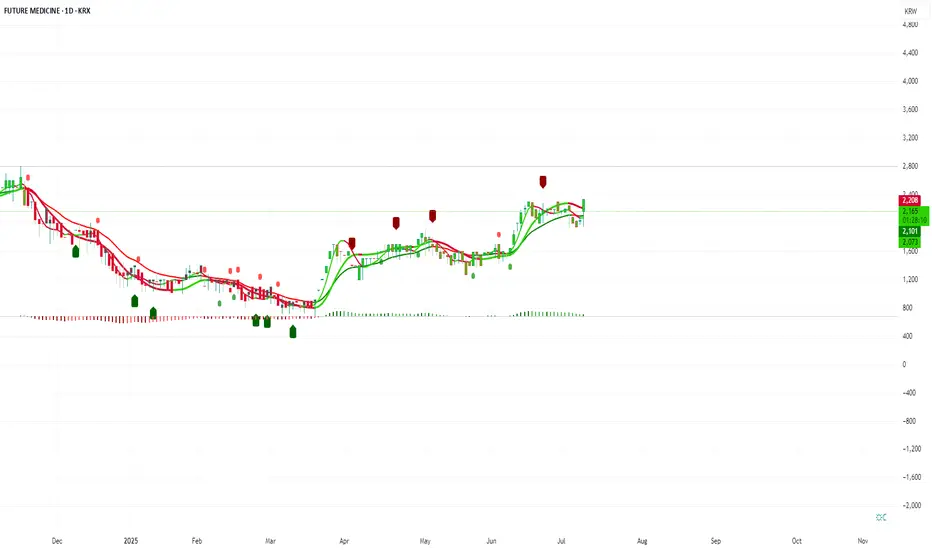
Walk This Way...This S. Korean company focuses on treatment of cystic fibrosis and chronic kidney disease, et al. Future Medicine, Limited.
Godspeed to this company as they search for cures for primary biliary cirrhosis; colorectal, prostate, and lung cancers and rheumatoid arthritis, et al. They target metabolic cancers, inflammatory and autoimmune diseases, to produce anticancer drugs, anti-fibrotics and antiviral remedies. Not only persistent, but painful diseases, as well. Who on earth wouldn't want this company to succeed ?
Selling Volume has completely Dried-up and the stock is in the process of setting Higher-Lows. MACD, StochasticsRSI, Rate-of-Change, and %r are all additive tenets of confirmation for the astute and intrepid investor.
Go Long.... it's at the 20... the 10... the 5... and Touchdown
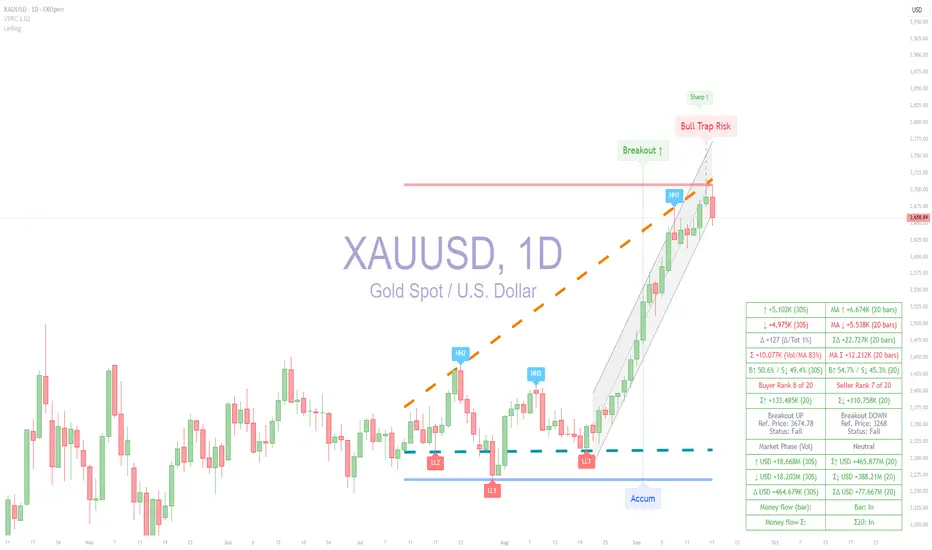
Gold Analysis using ATAI Volume Pressure AnalyzerIntroduction:
In this analysis, we use the ATAI Volume Pressure Analyzer indicator , which is based on the logic of separating buy/sell volume. The indicator retrieves volume data from a lower timeframe and reconstructs it on the host timeframe. This is achieved using the internal function, TradingView/ta/10 → tvta.requestUpAndDownVolume(lowerTF) , which extracts Up Volume, Down Volume, and Delta from the selected lower timeframe, enabling aggregation and evaluation of market pressure. One-tick data provides the highest precision but is limited in historical coverage; conversely, higher timeframes provide more historical depth but with relative accuracy.
In this daily chart, to calculate 20-period volume averages, the lowest timeframe that both preserved relative accuracy and provided sufficient historical data for 20 candles was 30 seconds , which was selected. This choice is reflected in the corresponding rows of the left and right columns of the HUD panel. It should be noted that in the gold market, the actual traded contract volume is not centrally available; therefore, the volume used in this method is based on tick volume (the count of price changes within each bar) . This serves as a proxy for activity and order flow intensity rather than absolute turnover. Accordingly, aggregates and deltas are interpreted on a relative basis and used to identify acceleration, volume spikes, and breakouts alongside price structure.
Trendlines and Market Direction
Beyond volume-based calculations, the indicator also visualizes directional bias through adaptive trendlines. The dotted orange and turquoise lines are drawn from successive pivot highs and lows over a 50-bar window, effectively capturing the slope of price movement. In the chart, these diagonals clearly reveal the transition: price has broken out of a mid-range accumulation zone and established a sequence of higher highs and higher lows, confirming a structural uptrend.
Complementing this, the blue horizontal line marks the base of the prior accumulation (support), while the red line highlights the resistance level at the top. The breakout above this framework, supported by bullish volume ratios shown in the HUD, validates that the market has shifted from neutrality into a sustained upward trend.
Labels and Market Conditions
The labels displayed on the chart — such as Accum, Breakout ↑, Sharp ↑, and Bull Trap Risk — are derived from explicit quantitative rules inside the indicator. These rules combine price levels, buy/sell volume deltas, and moving aggregates. Below, each label is explained with both its coding logic and its mathematical interpretation in plain language.
Accum (Accumulation)
Logic: |Δ| < ε ∧ Var(ΣV) → min
Meaning: The difference between buy and sell volume (Δ) is close to zero, and the variance of total volume ΣV is minimal over the chosen window. In simple terms, this marks a balanced market where buyers and sellers are matched, forming a neutral accumulation zone.
Breakout ↑
Logic: Pt > max(Pacc) ∧ Δ > 0 ∧ ΣV20 ↑
Meaning: The closing price Pt breaks above the maximum price of the accumulation zone (Pacc), while buy volume is greater than sell volume (Δ > 0), and the 20-bar aggregate volume ΣV20 is increasing. In simple terms, this confirms that buyers dominate and the market is breaking upward with sufficient volume support.
Sharp ↑
Logic: ΔP / Δt > θ
Meaning: The slope of price change (ΔP per unit time) exceeds a defined threshold θ. In simple terms, this indicates an accelerated move upward — a breakout with unusually strong momentum.
Bull Trap Risk
Logic: Pt < Pbreakout ∧ Δ ↓ ∧ ΣV20 ↓
Meaning: After an initial breakout, the price Pt falls back below the breakout level, while buy volume weakens (Δ decreases) and the 20-bar aggregate volume ΣV20 declines. In simple terms, this signals that the breakout has lost support and may have trapped buyers — hence the label Bull Trap Risk.
Trendlines and Guidance
The dotted trendlines are constructed from the slope of price and aligned with recent pivot highs (HH) and lows (LL). Mathematically, the slope is defined as:
m = (P_pivot2 − P_pivot1) / (t2 − t1)
where P_pivot are the price levels at successive pivots, and t are their bar indices. A positive slope (m > 0) indicates an upward trend, while m < 0 indicates a downward trend.
In this chart, the slope of the mid-band is clearly positive, and the label HH1 is printed at the breakout of the upper boundary. This confirms that the market has transitioned out of a ranging phase and into a structural uptrend characterized by higher highs and higher lows.
Horizontal Lines
The horizontal guidance lines (support and resistance) are calculated from the extremes over the last N = 50 bars:
S = min(P_t), R = max(P_t) for t ∈
The blue line marks support at the lowest low, and the red line marks resistance at the highest high. Together, these dynamic references highlight where order flow has historically concentrated and provide anchors for interpreting future price reactions.
Each of these labels therefore reflects a mathematical condition expressed both in code and in statistical terms. Together they describe a sequence of phases: balanced accumulation, directional breakout, acceleration, and potential failure traps. This structured approach translates raw volume and price data into actionable signals.
Conclusion: XAUUSD Market Outlook
The recent chart action combines signals from the ATAI Volume Pressure Analyzer with a secondary tool, the 20-period Linear Regression channel. This multi-tool perspective highlights the importance of cross-validation in market analysis.
Key Observations
- Volume Pressure Analyzer Signals: After a strong breakout and sharp upward momentum, the indicator has now triggered the label Bull Trap Risk . This label reflects weakening buy-side dominance, declining delta values, and a potential failure of the breakout to sustain order-flow support.
- Linear Regression (20-period): The regression channel illustrates a clear ascending path starting from the former accumulation zone. The latest red candle has closed outside the channel to the downside, confirming a loss of alignment with the prior uptrend.
- Structural Divergence: The combination of volume weakness (as flagged by VPRC) and structural channel break creates a divergence. Price remains elevated but lacks the necessary buy-side reinforcement, raising the probability of a correction or a full trend reversal.
Interpretation
This scenario indicates a transition risk: from a sharp bullish phase into either a corrective pullback or a potential distribution phase. The decisive factor remains the behavior of buyers and sellers in the next candles — whether buyers can reclaim the channel or sellers consolidate control.
Disclaimer
This XAUUSD analysis has been conducted using the ATAI Volume Pressure Analyzer indicator in conjunction with the supporting Linear Regression (20-period) tool. It does not constitute any form of financial advice regarding buying, selling, or holding positions. The analysis solely illustrates the dynamics of buyer and seller behavior in the market.
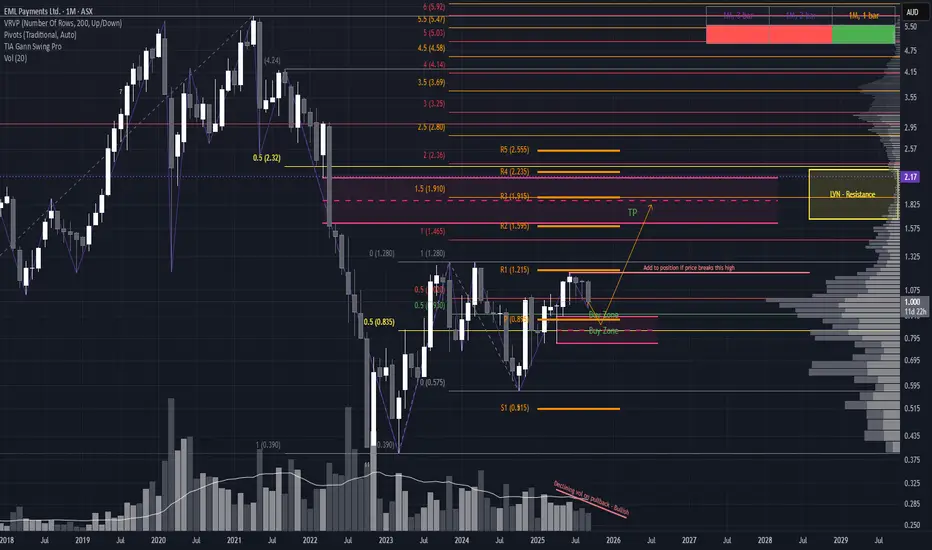
Small-Cap Setup with Big PotentialAnother promising setup is forming on EML. As always, keep in mind this is a small-cap play, so risk management is key. While the monthly uptrend isn’t yet fully established, the current structure offers multiple trade scenarios worth watching.
Trade Scenarios
1. Conservative Breakout Entry For those preferring confirmation, a long entry could be triggered on a clean break and close above $1.195 (as highlighted on the chart).
Stop Loss: Below the newly formed swing low
Target: $1.825, where notable resistance resides
2. Ideal Pullback Entry The optimal setup would be a pullback into a strong Area of Interest, supported by:
50% range retracement
Yearly pivot
Demand structure from the large April wick
If price forms a hammer/bullish candle in this zone, it could signal a high-probability reversal and offer a strong entry point.
SL placement depends on candle structure, but should invalidate below the demand zone
🎯 TP remains at $1.825, aligning with historical resistance