Order Blocks Zones with Signalsโ OVERVIEW
โOrder Blocks Zones with Signalsโ is a technical analysis tool that automatically identifies Order Blocks (OB) and optionally Fair Value Gaps (FVG) on the chart.
The script visualizes these zones as colored rectangles, offering full customization of style, transparency, and signal display.
It also generates entry and exit signals (Break & Exit) that can serve as confirmations in strategies based on price action and market structure.
Thanks to flexible candle size filters and rich visual options, the indicator maintains chart clarity and readability.
โ CONCEPTS
Order Blocks (OB) are key zones on the chart where significant price movements previously occurred โ areas where large market participants (institutions, so-called smart money) initiated or closed positions.
An OB is the last candle that followed the prior trend before the market reversed (e.g., for a Bullish OB: the last bearish candle before a pivot low and a strong upward impulse).
The script detects these levels using local price pivots, analyzing candle direction to filter out less significant movements.
FVG (Fair Value Gaps) represent areas of imbalance between buyers and sellers โ price gaps formed by a sharp impulse where full trading did not occur due to one-sided order dominance (e.g., excess buy or sell orders).
Why combine OB and FVG in one indicator?
Combining OB and FVG analysis is essential because these phenomena often occur sequentially in the institutional market cycle:
1. Order Block โ institutions enter the market in the OB zone, absorbing orders and building positions.
2. Strong impulse โ after smart money entry, a rapid price move creates an FVG (imbalance gap).
3. Retest โ price naturally returns to these zones (OB or FVG), drawn by unfilled orders and the search for equilibrium.
Such areas strongly attract price, as they represent not only historical institutional levels but also open โholesโ in the order book. Retests of OB and FVG are ideal entry opportunities with high reaction probability (rebound or breakout). The indicator combines these two interconnected elements, enabling comprehensive market structure analysis in a single tool.
Order Blocks are labeled as:
Bullish OB โ demand zones, often accumulation areas before an upmove.
Bearish OB โ supply zones, signaling potential impulse end or correction start.
โ FEATURES
Order Block Detection (OB Detection):
- Automatic identification of demand and supply zones based on pivots.
- OB is the last candle aligned with the prior trend, just before the market reversal โ precisely identified through candle sequence analysis around the pivot.
- OB zones appear with a delay equal to Pivot Length (default 10 bars).
- Break signals trigger when a candleโs body (close) fully pierces the zone, causing the zone to disappear immediately (e.g., close < low of Bullish OB โ Break Down and zone deletion).
- Minimum size filtering via OB Size Multiplier.
- Option to create OB without wicks (Include Wicks in OB): when disabled, OB zones are based solely on candle bodies (open/close), ignoring wicks (high/low).
Fair Value Gap Detection (FVG Detection):
- Optional, with enable/disable capability.
- FVG are detected without delay โ immediately upon gap occurrence.
- Size filtering via Candle Size Period and FVG Size Multiplier.
Customizable Styling:
- Separate colors and border styles (Solid / Dashed / Dotted) for each zone type.
- Adjustable transparency and border thickness.
- Unified color for box, border, and signal of the same type.
Breakout and Exit Signals:
- Break Up โ triggered when a candleโs close breaks above a Bearish OB, causing the zone to disappear.
- Break Down โ triggered when a candleโs close breaks below a Bullish OB, causing the zone to disappear.
- Exit Up / Exit Down โ temporary exit from the zone without full breakout (price leaves the zone but doesnโt close beyond it). Signal type selection: Break, Exit, or Both.
- Alerts: built-in alerts for all signal types โ triggered automatically on candle close confirming breakout or exit from OB.
โ HOW TO USE
Adding to chart: import the code into Pine Editor and run the script on TradingView.
Settings configuration:
- Pivot Length: controls swing detection sensitivity and OB display delay (default 10).
- Include Wicks in OB: enabled (default) โ OB includes wicks; disabled โ OB uses bodies only.
- Size Filter: adjust Candle Size Period and OB/FVG Size Multiplier to filter out small zones.
- Colors & Styles: set colors, styles, and transparency for each zone type.
- Signal Type: choose which signals to display (Break, Exit, or Both).
Signal interpretation:
- OB Break Up: price closes above Bearish OB โ zone disappears โ potential bullish continuation.
- OB Break Down: price closes below Bullish OB โ zone disappears โ potential bearish continuation.
- Exit Signals: price leaves the zone temporarily without breakout โ often signals impending reversal or pullback.
Tips:
- Use OB signals alongside other indicators like RSI, MACD, SMI, or trend filters.
- Order Blocks from higher timeframes (e.g., 4H, 1D) carry greater significance and reaction strength.
- Remember: FVG are detected immediately, OB with delay โ a complementary approach!
โ APPLICATIONS
- Smart Money Concepts (SMC): use OB zones as dynamic support and resistance levels. In an uptrend, look for buy opportunities in bullish OBs, which price often retests before further gains. Combining with RSI, MACD, or Fibonacci levels enhances zone significance, confirming institutional demand.
- Breakout Trading: trade based on OB breakout signals. A buy signal after breaking a bearish OB may indicate a strong upward impulse, especially if supported by rising MACD or RSI above 50. Similarly for sell signals after Break Down.
- Reversal Zones: Exit signals may indicate the end of a move or correction. Safest to use in alignment with higher-timeframe trend and confirmed by another indicator (e.g., RSI divergence, Fibonacci levels).
- Confluence Analysis: combine OB and FVG for deeper market structure and equilibrium insight. When an Order Block overlaps or borders an FVG, we get confluence of two institutional phenomena โ OB (smart money entry) + FVG (imbalance) โ making these areas particularly strong price magnets, increasing retest and reaction probability.
โ NOTES
- FVG can be fully disabled for a cleaner chart view.
- In consolidation periods, signals may appear more frequently โ always confirm with additional trend filters.
- Works on all markets and timeframes (crypto, forex, indices, stocks).
Search in scripts for "fvg"
Predator UAV๐ฉ๏ธ Predator UAV โ Indicator Overview
Predator UAV is a multi-module market structure & execution assistant.
Think of it as 4 sensors on a drone, each scanning a different layer of price:
Module What it Sees Why it Matters
Module 1 Swing Structure (ZigZag) Trend direction & key levels
Module 2 FVGs, Imbalances, Targets, D/W/M levels Liquidity & objectives
Module 3 Swing Labels + Candle Patterns Entry timing & confirmation
Module 4 VWAP + Slope Dashboard Intraday bias & strength
You can turn any module ON/OFF independently.
๐งฉ MODULE 1 โ ZigZag Swing High / Low (Market Structure)
What it does
Detects Swing Highs (HH / LH) and Swing Lows (HL / LL)
Draws:
Horizontal structure levels
ZigZag connections
Broken vs respected levels
Shows current swing direction in a mini table
How to use it
Bullish structure โ higher lows forming
Bearish structure โ lower highs forming
Best used for:
Bias filtering
Stop placement
Avoiding counter-trend trades
๐ก Pro tip:
If price breaks a swing level and holds โ structure shift confirmed.
๐งฑ MODULE 2 โ FVGs, Imbalances, Targets & HTF Levels (Liquidity Engine)
This is the core execution intelligence.
A๏ธโฃ Fair Value Gaps (FVGs)
Bullish FVG โ price inefficiency below price
Bearish FVG โ inefficiency above price
Options:
Extend none / limited / default
Limit number on chart
Show midpoint equilibrium
Usage
Price returning into FVG = high-probability reaction zone
Best entries = FVG + structure + VWAP bias
B๏ธโฃ Imbalances
Based on strong displacement candles
Shows where price moved too fast
Usage
Often aligns with:
Breakouts
Stop runs
Momentum continuation
C๏ธโฃ Swing Targets
Automatically marks next logical target
Swing Highs for longs
Swing Lows for shorts
Usage
Use as:
Take-profit zones
Partial exits
Trail stop reference
D๏ธโฃ Previous Day / Week / Month Highs & Lows
Institutional liquidity magnets
Extremely effective on indices & forex
Usage
Expect:
Rejections
Stop hunts
Reversals near these levels
๐ MODULE 3 โ Swing Labels + Candle Patterns (Entry Timing)
This module answers: WHEN to enter?
Swing Labels
HH / HL / LH / LL printed directly on chart
Candle Patterns Detected
Hammer
Inverted Hammer
Bullish Engulfing
Bearish Engulfing
Hanging Man
Shooting Star
Each label includes:
Pattern name
Tooltip explanation (educational)
Usage
Never trade patterns alone
Best when combined with:
FVG
VWAP
Structure level
๐ MODULE 4 โ VWAP with Slope Dashboard (Bias & Strength)
This is your intraday compass.
What it shows
Session VWAP
VWAP slope (numeric + angle)
Direction:
โ Bullish
โ Bearish
โ Neutral
Strength:
Weak
Moderate
Strong
How to read it
Above VWAP + positive slope โ long bias
Below VWAP + negative slope โ short bias
Flat slope โ scalp only or wait
๐ก Pro tip:
Strong VWAP slope + FVG pullback = A-grade setup.
๐ฏ COMPLETE TRADING TUTORIAL (Step-by-Step)
Step 1 โ Determine Bias
Use Module 1 + Module 4
Structure bullish?
VWAP slope bullish?
โ
If aligned โ look for longs
โ If mixed โ reduce size or wait
Step 2 โ Identify POI (Point of Interest)
Use Module 2
Bullish:
Bullish FVG
Prior swing low
VWAP pullback
Bearish:
Bearish FVG
Prior swing high
VWAP rejection
Step 3 โ Wait for Entry Confirmation
Use Module 3
Look for:
Engulfing
Hammer / Shooting star
Swing HL / LH confirmation
Step 4 โ Define Targets
Use Next Target
Or Previous Day / Week Highs
Partial TP near first liquidity pool
Step 5 โ Risk Management
SL beyond:
FVG boundary
Swing high/low
Trail using:
VWAP
Structure breaks
๐ง Best Timeframes
Purpose TF
Bias 15m / 30m
Setup 5m
Entry 1mโ3m
Scalping VWAP + FVG only
โ ๏ธ Common Mistakes to Avoid
โ Trading every FVG
โ Ignoring VWAP slope
โ Counter-trend without confirmation
โ Overloading chart (turn unused modules off)
๐ Final Thought
Predator UAV is not a signal generator.
Itโs a decision-support system โ when multiple modules align, probability shifts in your favor.
Smart Money Concepts [XoRonX]# Smart Money Concepts (SMC) - Advanced Trading Indicator
## ๐ Deskripsi
**Smart Money Concepts ** adalah indicator trading komprehensif yang menggabungkan konsep Smart Money Trading dengan berbagai alat teknikal analisis modern. Indicator ini dirancang untuk membantu trader mengidentifikasi pergerakan institusional (smart money), struktur pasar, zona supply/demand, dan berbagai sinyal trading penting.
Indicator ini mengintegrasikan multiple timeframe analysis, order blocks detection, fair value gaps, fibonacci retracement, volume profile, RSI multi-timeframe, dan moving averages dalam satu platform yang powerful dan mudah digunakan.
---
## ๐ฏ Fitur Utama
### 1. **Smart Money Structure**
- **Internal Structure** - Struktur pasar jangka pendek untuk entry presisi
- **Swing Structure** - Struktur pasar jangka panjang untuk trend analysis
- **BOS (Break of Structure)** - Konfirmasi kelanjutan trend
- **CHoCH (Change of Character)** - Deteksi potensi reversal
### 2. **Order Blocks**
- **Internal Order Blocks** - Zona demand/supply jangka pendek
- **Swing Order Blocks** - Zona demand/supply jangka panjang
- Filter otomatis berdasarkan volatilitas (ATR/Range)
- Mitigation tracking (High/Low atau Close)
- Customizable display (jumlah order blocks yang ditampilkan)
### 3. **Equal Highs & Equal Lows (EQH/EQL)**
- Deteksi otomatis equal highs/lows
- Indikasi liquidity zones
- Threshold adjustment untuk sensitivitas
- Visual lines dan labels
### 4. **Fair Value Gaps (FVG)**
- Multi-timeframe FVG detection
- Auto threshold filtering
- Bullish & Bearish FVG boxes
- Extension control
- Color customization
### 5. **Premium & Discount Zones**
- Premium Zone (75-100% dari range)
- Equilibrium Zone (47.5-52.5% dari range)
- Discount Zone (0-25% dari range)
- Auto-update berdasarkan swing high/low
### 6. **Fibonacci Retracement**
- **Equilibrium to Discount** - Fib dari EQ ke discount zone
- **Equilibrium to Premium** - Fib dari EQ ke premium zone
- **Discount to Premium** - Fib full range
- Reverse option
- Show/hide lines
- Custom colors
### 7. **Volume Profile (VRVP)**
- Visible Range Volume Profile
- Point of Control (POC)
- Value Area (70% volume)
- Auto-adjust rows
- Placement options (Left/Right)
- Width customization
### 8. **RSI Multi-Timeframe**
- Monitor 3 timeframes sekaligus
- Overbought/Oversold signals
- Visual table display
- Color-coded signals (Red OB, Green OS)
- Customizable position & size
### 9. **Moving Averages**
- 3 Moving Average lines
- Pilihan tipe: EMA, SMA, WMA
- Automatic/Manual period mode
- Individual color & width settings
- Cross alerts (MA vs MA, Price vs MA)
### 10. **Multi-Timeframe Levels**
- Support up to 5 different timeframes
- Previous high/low levels
- Custom line styles
- Color customization
### 11. **Candle Color**
- Color candles berdasarkan trend
- Bullish = Green, Bearish = Red
- Optional toggle
---
## ๐ ๏ธ Cara Penggunaan
### **A. Setup Awal**
1. **Tambahkan Indicator ke Chart**
- Buka TradingView
- Klik "Indicators" โ "My Scripts" atau paste code
- Pilih "Smart Money Concepts "
2. **Pilih Mode Display**
- **Historical**: Tampilkan semua struktur (untuk backtesting)
- **Present**: Hanya tampilkan struktur terbaru (clean chart)
3. **Pilih Style**
- **Colored**: Warna berbeda untuk bullish/bearish
- **Monochrome**: Tema warna abu-abu
---
### **B. Penggunaan Fitur**
#### **1. Smart Money Structure**
**Internal Structure (Real-time):**
- โ
Aktifkan "Show Internal Structure"
- Pilih tampilan: All, BOS only, atau CHoCH only
- Gunakan untuk entry timing presisi
- Filter confluence untuk mengurangi noise
**Swing Structure:**
- โ
Aktifkan "Show Swing Structure"
- Pilih tampilan struktur bullish/bearish
- Adjust "Swings Length" (default: 50)
- Gunakan untuk konfirmasi trend utama
**Tips:**
- BOS = Konfirmasi trend continuation
- CHoCH = Warning untuk possible reversal
- Tunggu price retest ke order block setelah BOS
---
#### **2. Order Blocks**
**Setup:**
- โ
Aktifkan Internal/Swing Order Blocks
- Set jumlah blocks yang ditampil (1-20)
- Pilih filter: ATR atau Cumulative Mean Range
- Pilih mitigation: Close atau High/Low
**Cara Trading:**
1. Tunggu BOS/CHoCH terbentuk
2. Identifikasi order block terdekat
3. Wait for price pullback ke order block
4. Entry saat price respek order block (rejection)
5. Stop loss di bawah/atas order block
6. Target: swing high/low berikutnya
**Color Code:**
- ๐ต Light Blue = Internal Bullish OB
- ๐ด Light Red = Internal Bearish OB
- ๐ต Dark Blue = Swing Bullish OB
- ๐ด Dark Red = Swing Bearish OB
---
#### **3. Equal Highs/Lows (EQH/EQL)**
**Setup:**
- โ
Aktifkan "Equal High/Low"
- Set "Bars Confirmation" (default: 3)
- Adjust threshold (0-0.5, default: 0.1)
**Interpretasi:**
- EQH = Liquidity di atas, kemungkinan sweep lalu dump
- EQL = Liquidity di bawah, kemungkinan sweep lalu pump
- Biasanya smart money akan grab liquidity sebelum move besar
**Trading Strategy:**
- Wait for EQH/EQL formation
- Anticipate liquidity grab
- Entry setelah sweep dengan konfirmasi (order block, FVG, CHoCH)
---
#### **4. Fair Value Gaps (FVG)**
**Setup:**
- โ
Aktifkan "Fair Value Gaps"
- Pilih timeframe (default: chart timeframe)
- Enable/disable auto threshold
- Set extension bars
**Cara Trading:**
1. Bullish FVG = Support zone untuk buy
2. Bearish FVG = Resistance zone untuk sell
3. Price tends to fill FVG (retest)
4. Entry saat price kembali ke FVG
5. Partial fill = valid, full fill = invalidated
**Tips:**
- FVG + Order Block = High probability setup
- Multi-timeframe FVG lebih kuat
- Unfilled FVG = strong momentum
---
#### **5. Premium & Discount Zones**
**Setup:**
- โ
Aktifkan "Premium/Discount Zones"
- Zones akan auto-update berdasarkan swing high/low
**Interpretasi:**
- ๐ข **Discount Zone** = Area BUY (price murah)
- โช **Equilibrium** = Neutral (50%)
- ๐ด **Premium Zone** = Area SELL (price mahal)
**Trading Strategy:**
- BUY dari discount zone
- SELL dari premium zone
- Avoid trading di equilibrium
- Combine dengan structure confirmation
---
#### **6. Fibonacci Retracement**
**Setup:**
- Pilih Fib yang ingin ditampilkan:
- Equilibrium to Discount
- Equilibrium to Premium
- Discount to Premium
- Toggle show lines
- Enable reverse jika perlu
- Custom colors
**Key Levels:**
- 0.236 = Shallow retracement
- 0.382 = Common retracement
- 0.5 = 50% golden level
- 0.618 = Golden ratio (penting!)
- 0.786 = Deep retracement
**Cara Pakai:**
- 0.618-0.786 = Ideal entry zone dalam trend
- Combine dengan order blocks
- Wait for confirmation candle
---
#### **7. Volume Profile (VRVP)**
**Setup:**
- โ
Aktifkan "Show Volume Profile"
- Set jumlah rows (10-100)
- Adjust width (5-50%)
- Pilih placement (Left/Right)
- Enable POC dan Value Area
**Interpretasi:**
- **POC (Point of Control)** = Harga dengan volume tertinggi = magnet
- **Value Area** = 70% volume = fair price range
- **Low Volume Nodes** = Weak support/resistance
- **High Volume Nodes** = Strong support/resistance
**Trading:**
- POC acts as support/resistance
- Price tends to return to POC
- Breakout dari Value Area = momentum
---
#### **8. RSI Multi-Timeframe**
**Setup:**
- โ
Aktifkan "Show RSI Table"
- Set 3 timeframes (default: chart, 5m, 15m)
- Set RSI period (default: 14)
- Set Overbought level (default: 70)
- Set Oversold level (default: 30)
- Pilih posisi & ukuran table
**Interpretasi:**
- ๐ข **OS (Oversold)** = RSI โค 30 = Kondisi jenuh jual
- ๐ด **OB (Overbought)** = RSI โฅ 70 = Kondisi jenuh beli
- **-** = Neutral zone
**Trading Strategy:**
1. Multi-timeframe alignment = strong signal
2. OS + Bullish structure = BUY signal
3. OB + Bearish structure = SELL signal
4. Divergence RSI vs Price = reversal warning
**Contoh:**
- TF1: OS, TF2: OS, TF3: OS + Price di discount zone = STRONG BUY
---
#### **9. Moving Averages**
**Setup:**
- Pilih MA Type: EMA, SMA, atau WMA (berlaku untuk ketiga MA)
- Pilih Period Mode: Automatic atau Manual
- Set period untuk MA 1, 2, 3 (default: 20, 50, 100)
- Custom color & width per MA
- โ
Enable Cross Alerts
**Interpretasi:**
- **Golden Cross** = MA fast cross above MA slow = Bullish
- **Death Cross** = MA fast cross below MA slow = Bearish
- Price above all MAs = Strong uptrend
- Price below all MAs = Strong downtrend
**Trading Strategy:**
1. MA1 (20) = Short-term trend
2. MA2 (50) = Medium-term trend
3. MA3 (100) = Long-term trend
**Entry Signals:**
- Price bounce dari MA dalam trend = continuation
- MA cross dengan konfirmasi structure = entry
- Multiple MA confluence = strong support/resistance
**Alerts Available:**
- MA1 cross MA2/MA3
- MA2 cross MA3
- Price cross any MA
---
#### **10. Multi-Timeframe Levels**
**Setup:**
- Enable HTF Level 1-5
- Set timeframes (contoh: 5m, 1H, 4H, D, W)
- Pilih line style (solid/dashed/dotted)
- Custom colors
**Cara Pakai:**
- Previous high/low dari HTF = strong S/R
- Breakout HTF level = significant move
- Multiple HTF levels confluence = major zone
---
### **C. Trading Setup Combination**
#### **Setup 1: High Probability Buy (Bullish)**
1. โ
Swing structure: Bullish BOS
2. โ
Price di Discount Zone
3. โ
Pullback ke Bullish Order Block
4. โ
Bullish FVG di bawah
5. โ
RSI Multi-TF: Oversold
6. โ
Price bounce dari MA
7. โ
POC/Value Area support
8. โ
Fibonacci 0.618-0.786 retracement
**Entry:** Saat price reject dari order block dengan confirmation candle
**Stop Loss:** Below order block
**Target:** Swing high atau premium zone
---
#### **Setup 2: High Probability Sell (Bearish)**
1. โ
Swing structure: Bearish BOS
2. โ
Price di Premium Zone
3. โ
Pullback ke Bearish Order Block
4. โ
Bearish FVG di atas
5. โ
RSI Multi-TF: Overbought
6. โ
Price reject dari MA
7. โ
POC/Value Area resistance
8. โ
Fibonacci 0.618-0.786 retracement
**Entry:** Saat price reject dari order block dengan confirmation candle
**Stop Loss:** Above order block
**Target:** Swing low atau discount zone
---
#### **Setup 3: Liquidity Grab (EQH/EQL)**
1. โ
Identifikasi EQH atau EQL
2. โ
Wait for liquidity sweep
3. โ
Konfirmasi dengan CHoCH
4. โ
Order block terbentuk setelah sweep
5. โ
Entry saat retest order block
---
### **D. Tips & Best Practices**
**Risk Management:**
- Selalu gunakan stop loss
- Risk 1-2% per trade
- Risk:Reward minimum 1:2
- Jangan over-leverage
**Confluence adalah Kunci:**
- Minimal 3-4 konfirmasi sebelum entry
- Lebih banyak konfirmasi = higher probability
- Quality over quantity
**Timeframe Analysis:**
- HTF (Higher Timeframe) = Trend direction
- LTF (Lower Timeframe) = Entry timing
- Align dengan HTF trend
**Backtesting:**
- Gunakan mode "Historical"
- Test strategy di berbagai market condition
- Record dan analyze hasil
**Market Condition:**
- Trending market = Follow BOS, use order blocks
- Ranging market = Use premium/discount zones, EQH/EQL
- High volatility = Wider stops, wait for clear structure
**Avoid:**
- Trading di equilibrium zone
- Entry tanpa konfirmasi
- Fighting the trend
- Overleveraging
- Emotional trading
---
## ๐ Recommended Settings
### **For Scalping (1m - 5m):**
- Internal Structure: ON
- Swing Structure: OFF
- Order Blocks: Internal only
- RSI Timeframes: 1m, 5m, 15m
- MA Periods: 9, 21, 50
### **For Day Trading (15m - 1H):**
- Internal Structure: ON
- Swing Structure: ON
- Order Blocks: Both
- RSI Timeframes: 15m, 1H, 4H
- MA Periods: 20, 50, 100
### **For Swing Trading (4H - D):**
- Internal Structure: OFF
- Swing Structure: ON
- Order Blocks: Swing only
- RSI Timeframes: 4H, D, W
- MA Periods: 20, 50, 200
---
## โ ๏ธ Disclaimer
Indicator ini adalah alat bantu analisis teknikal. Tidak ada indicator yang 100% akurat. Selalu:
- Lakukan analisa fundamental
- Gunakan proper risk management
- Praktik di demo account terlebih dahulu
- Trading memiliki resiko, trade at your own risk
---
## ๐ Version Info
**Version:** 5.0
**Platform:** TradingView Pine Script v5
**Author:** XoRonX
**Max Labels:** 500
**Max Lines:** 500
**Max Boxes:** 500
---
## ๐ Updates & Support
Untuk update, bug reports, atau pertanyaan:
- Check documentation regularly
- Test new features in replay mode
- Backup your settings before updates
---
## ๐ Learning Resources
**Recommended Study:**
1. Smart Money Concepts (SMC) basics
2. Order blocks theory
3. Liquidity concepts
4. ICT (Inner Circle Trader) concepts
5. Volume profile analysis
6. Multi-timeframe analysis
**Practice:**
- Start with higher timeframes
- Master one concept at a time
- Keep a trading journal
- Review your trades weekly
---
**Happy Trading! ๐๐**
_Remember: The best indicator is your own analysis and discipline._
cd_full_poi_CxOverview
This indicator tracks the price in 16 different time frames (optional) in order to answer the question of where the current price has reacted or will react.
It appears on the chart and in the report table when the price approaches or touches the fvg or mitigations (order block / supply-demand), the rules of which will be explained below.
In summary, it follows the fvg and mitigations in the higher timeframe than the lower timeframe.
Many traders see fvg or mitigates as an point of interest and see the high, low swept in those zones as a trading opportunity. Key levels, Session high/lows and Equal high and lows also point of interest.
If we summarise the description of the point of interest ;
1- Fair value gaps (FVG) (16 time frames)
2- Mitigation zones (16 time frames)
3- Previous week, day, H4, H1 high and low levels
4- Sessions zones (Asia, London and New York)
5- Equal high and low levels are in indicator display.
Details:
1- Fair Value Gaps : It is simply described as a price gap and consists of a series of 3 candles. The reaction of the price to the gap between the 1st and 3rd candle wicks is observed.
The indicator offers 3 options for marking. These are :
1-1- โColours are unimportantโ: candle colours are not considered for marking. Fvg formation is sufficient.(Classical)
1-2- โFirst candle opposite colourโ : when a price gap occurs, the first candle of a series of 3 candles must be opposite.
For bullish fvg : bearish - bullish - free
For Bearish fvg : bullish - bearish - free
1-3- โAll same colourโ : all candles in a series of 3 candles must be the same direction.
For bullish fvg: bullish - bullish - bullish
For bearish fvg : bearish - bearish โ bearish
Examples:
2- Mitigation zones: Opposite candles with a fvg in front of them or candles higher/lower than the previous and next candle and with the same colour as the fvg series are marked.
Examples :
3- Previous week, day, H4, H1 high and low levels
4- Sessions regions (Asia, London and New York)
5- Equal high and low levels:
Annotation: Many traders want to see a liquidity grab on the poi, then try to enter the trade with the appropriate method.
Among the indicators, there is also the indication of grabs/swepts that occur at swing points. It is also indicated when the area previously marked as equal high/low is violated (grab).
At the end, sample setups will be shown to give an idea about the use of the indicator.
Settings:
- The options to be displayed from the menu are selected by ticking.
- 1m, 2m, 3m, 5m, 5m, 10m, 15m, 30m, h1, h4, h4, h6, h8, h12, daily, weekly, monthly and quarterly, 16 time zones in total can be displayed.
- The โCollapse when the price touches mitigateโ tab controls whether to collapse the box as the price moves into the inner region of the mitigate. If not selected, the size of the mitigate does not change.
- โApproach limit =(ATR / n)โ tab controls how close the price is to the fvg or mitigate. Instant ATR(10) value is calculated by dividing by the entered โnโ value.
- All boxes and lines are automatically removed from the screen when the beyond is closed.
- Colour selections, table, text features are controlled from the menu.
- Sessions hours are set as standard hours, the user can select special time zones. Timezone is set to GMT-4.
- On the candle when the price touches fvg or mitigate, the timeframe information of the POI is shown in the report table together with the graphical representation.
The benefits and differences :
1- We can evaluate the factors we use for setup together.
2- We are aware of what awaits us in the high time frame in the following candles.
3- It offers the user the opportunity to be selective with different candle selection options in fvg selection.
4- Mitige areas are actually unmitige areas because they have a price gap in front of them. The market likes to retest these areas.
5- Equal high/low zones are the levels that the price creates to accumulate liquidity or fails to go beyond (especially during high volume hours). Failure or crossing of the level may give a reversal or continuation prediction.
Sample setup 1:
Sample setup 2:
Sample setup 3:
Cheerful tradesโฆ
Enjoyโฆ
One for AllOne for All (OFA) - Complete ICT Analysis Suite
Version 3.3.0 by theCodeman
๐ Overview
One for All (OFA) is a comprehensive TradingView indicator designed for traders who follow Inner Circle Trader (ICT) concepts. This all-in-one tool combines essential ICT analysis featuresโsessions, kill zones, previous period levels, and higher timeframe candles with Fair Value Gaps (FVGs) and Volume Imbalances (VIs)โinto a single, highly customizable indicator. Whether you're a beginner learning ICT concepts or an experienced trader refining your edge, OFA provides the visual structure needed for precise market analysis and execution.
โจ Key Features
- ๐ท๏ธ Customizable Watermark**: Display your trading identity with customizable titles, subtitles, symbol info, and full style control
- ๐ Trading Sessions**: Visualize Asian, London, and New York sessions with high/low lines, range boxes, and open/close markers
- ๐ฏ Kill Zones**: Highlight 5 critical ICT kill zones with precise timing and visual boxes
- ๐ Previous Period H/L**: Track Daily, Weekly, and Monthly highs/lows with customizable styles and lookback periods
- ๐ Higher Timeframe Candles**: Display up to 5 HTF timeframes with OHLC trace lines, timers, and interval labels
- ๐ FVG & VI Detection**: Automatically detect and visualize Fair Value Gaps and Volume Imbalances on HTF candles
- โ๏ธ Universal Timezone Support**: Works globally with GMT-12 to GMT+14 timezone selection
- ๐จ Full Customization**: Control colors, styles, visibility, and layout for every feature
๐ How to Use
Watermark Setup
The watermark overlay helps you identify your charts and maintain focus on your trading principles:
1. Enable/disable watermark via "Show Watermark" toggle
2. Customize the title (default: "Name") to display your trading name or account identifier
3. Set up to 3 subtitles (default: "Patience", "Confidence", "Execution") as trading reminders
4. Choose position (9 locations available), size, color, and transparency
5. Toggle symbol and timeframe display as needed
Use Case: Display your trading principles or account name for multi-monitor setups or content creation.
Trading Sessions Analysis
Sessions define market character and liquidity availability:
1. Enable "Show All Sessions" to visualize all three sessions
2. Adjust timezone to match your local market (default: UTC-5 for EST)
3. Customize session times if needed (defaults cover standard hours)
4. Enable session range boxes to see consolidation zones
5. Use session high/low lines to identify key levels for the current session
6. Enable open/close markers to track session transitions
Use Case: Identify which session you're trading in, track session highs/lows for liquidity, and anticipate session transition volatility.
Kill Zones Trading
Kill zones are ICT's high-probability trading windows:
1. Enable individual kill zones or use "Show All Kill Zones"
2. **Asian Kill Zone** (2000-0000 GMT): Early positioning and smart money accumulation
3. **London Kill Zone** (0300-0500 GMT): European market opening volatility
4. **NY AM Kill Zone** (0930-1100 EST): Post-NYSE open expansion
5. **NY Lunch Kill Zone** (1200-1300 EST): Midday consolidation or manipulation
6. **NY PM Kill Zone** (1330-1600 EST): Afternoon positioning and closes
7. Customize colors and times to match your trading style
8. Set max days display to control historical visibility (default: 30 days)
Use Case: Focus entries during high-probability windows. Watch for liquidity sweeps at kill zone openings and institutional positioning.
Previous Period High/Low Levels
Previous period levels act as magnetic price targets and support/resistance:
1. Enable Daily (PDH/PDL), Weekly (PWH/PWL), or Monthly (PMH/PML) levels individually
2. Set lookback period (how many previous periods to display)
3. Choose line style: Solid (current emphasis), Dashed (standard), or Dotted (subtle)
4. Customize colors per timeframe for visual hierarchy
5. Adjust line width (1-5) for visibility preference
6. Enable gradient effect to fade older periods
7. Position labels left or right based on chart layout
8. Customize label text for your preferred notation
Use Case: Identify key levels where price is likely to react. Daily levels work on intraday timeframes, Weekly on daily charts, Monthly for swing trading.
Higher Timeframe (HTF) Candles
HTF candles reveal the larger market context while trading lower timeframes:
1. Enable up to 5 HTF slots simultaneously (default: 5m, 15m, 1H, 4H, Daily)
2. Choose display mode: "Below Chart" (stacked rows) or "Right Side" (compact column)
3. Customize timeframe, colors (bull/bear), and titles for each slot
4. **OHLC Trace Lines**: Visual lines connecting HTF candle levels to chart bars
5. **HTF Timer**: Countdown showing time remaining until HTF candle close
6. **Interval Labels**: Display day of week (Daily+) or time (intraday) on each candle
7. For Daily candles: Choose open time (Midnight, 8:30, 9:30) to match your market structure preference
Use Case: Trade lower timeframes while respecting higher timeframe structure. Watch for HTF candle closes to confirm directional bias.
FVG & VI Detection
Fair Value Gaps and Volume Imbalances highlight inefficiencies that price often revisits:
1. **Fair Value Gaps (FVGs)**: Detected when HTF candle wicks don't overlap between 3 consecutive candles
- Bullish FVG: Gap between candle 1 high and candle 3 low (green box by default)
- Bearish FVG: Gap between candle 1 low and candle 3 high (red box by default)
2. **Volume Imbalances (VIs)**: Similar detection but focuses on body gaps
- Bullish VI: Gap between candle 1 close and candle 3 open
- Bearish VI: Gap between candle 1 open and candle 3 close
3. Enable FVG/VI detection per HTF slot individually
4. Customize colors and transparency for each imbalance type
5. Boxes appear on chart at formation and remain visible as retracement targets
**Use Case**: Identify high-probability retracement zones. Price often returns to fill FVGs and VIs before continuing the trend. Use as entry zones or profit targets.
๐จ Customization
OFA is built for flexibility. Every feature includes extensive customization options:
Visual Customization
- **Colors**: Independent color control for every element (sessions, kill zones, lines, labels, FVGs, VIs)
- **Transparency**: Adjust box and label transparency (0-100%) for clean charts
- **Line Styles**: Choose Solid, Dashed, or Dotted for previous period lines
- **Sizes**: Control text size, line width, and box borders
- **Positions**: Place watermark in 9 positions, labels left/right
Layout Control
- **HTF Display Mode**: "Below Chart" for detailed analysis, "Right Side" for space efficiency
- **Drawing Limits**: Set max days for sessions/kill zones to manage chart clutter
- **Lookback Periods**: Control how many previous periods to display (1-10)
- **Gradient Effects**: Enable fading for older previous period lines
Timing Adjustments
- **Timezone**: Universal GMT offset selector (-12 to +14) for global markets
- **Session Times**: Customize each session's start/end times
- **Kill Zone Times**: Adjust kill zone windows to match your market's characteristics
- **Daily Open**: Choose Midnight, 8:30, or 9:30 for Daily HTF candle open time
๐ก Best Practices
1. Start Simple: Enable one feature at a time to learn how each element affects your analysis
2. Match Your Timeframe: Use Daily levels on intraday charts, Weekly on daily charts, HTF candles one or two levels above your trading timeframe
3. Kill Zone Focus: Concentrate your trading activity during kill zones for higher probability setups
4. HTF Confirmation: Wait for HTF candle closes before committing to directional bias
5. FVG/VI Entries: Look for price to return to unfilled FVGs/VIs for entry opportunities with favorable risk/reward
6. Customize Colors: Use a consistent color scheme that matches your chart theme and reduces visual fatigue
7. Reduce Clutter: Disable features you're not actively using in your current trading plan
8. Session Context: Understand which session controls the marketโtrade with session direction or anticipate reversals at session transitions
โ๏ธ Settings Guide
OFA organizes settings into logical groups for easy navigation:
- **โโโ WATERMARK โโโ**: Title, subtitles, position, style, symbol/timeframe display
- **โโโ SESSIONS โโโ**: Enable/disable sessions, times, colors, high/low lines, boxes, markers
- **โโโ KILL ZONES โโโ**: Individual kill zone toggles, times, colors, max days display
- **โโโ PREVIOUS H/L - DAILY โโโ**: Daily high/low lines, style, color, lookback, labels
- **โโโ PREVIOUS H/L - WEEKLY โโโ**: Weekly high/low lines, style, color, lookback, labels
- **โโโ PREVIOUS H/L - MONTHLY โโโ**: Monthly high/low lines, style, color, lookback, labels
- **โโโ HTF CANDLES โโโ**: Global display mode, layout settings
- **โโโ HTF SLOT 1-5 โโโ**: Individual HTF configuration (timeframe, colors, title, FVG/VI detection, trace lines, timer, interval labels)
Each setting includes tooltips explaining its function. Hover over any input for detailed guidance.
๐ Final Notes
One for All (OFA) represents a complete ICT analysis toolkit in a single indicator. By combining watermark customization, session visualization, kill zone highlighting, previous period levels, and higher timeframe candles with FVG/VI detection, OFA eliminates the need for multiple indicators cluttering your chart.
**Version**: 3.3.0
**Author**: theCodeman
**Pine Script**: v6
**License**: Mozilla Public License 2.0
Start with default settings to learn the indicator's structure, then customize extensively to match your personal trading style. Remember: tools provide information, but your edge comes from disciplined execution of a proven strategy.
Happy Trading! ๐
Forever ModelForever Model is a comprehensive trading framework that visualizes market structure through Fair Value Gaps (FVGs), Smart Money Technique (SMT) divergences, and order block confirmations. The indicator identifies potential price rotations by tracking internal liquidity zones, correlation breaks between assets, and confirmation signals across multiple timeframes.
Designed for clarity and repeatability, the model presents a structured visual logic that supports manual analysis while maintaining flexibility across different assets and timeframes. All components are non-repainting, ensuring historical accuracy and reliable backtesting.
Description
The model operates through a three-part sequence that forms the visual foundation for identifying potential market rotations:
Fair Value Gaps (FVGs)
FVGs are price imbalances detected on higher timeframesโareas where price moved rapidly between candles, leaving an inefficiency that may be revisited. The indicator identifies both bullish and bearish FVGs, displaying them with color-coded levels that extend until mitigated.
: Chart showing FVG detection with colored lines indicating bullish (green) and bearish (red) gaps
Smart Money Technique (SMT)
SMT detects divergence between the current chart asset and a correlated pair. When one asset makes a higher high while the other forms a lower high (or vice versa), it indicates a potential shift in delivery. The indicator draws visual lines connecting these divergence points and can filter SMTs to only display those occurring within FVG ranges.
: Chart showing SMT divergence lines between two correlated assets with labels indicating the pair name]
Order Block Confirmations (OB)
When price confirms a signal by crossing a pivot level, an Order Block is created. The confirmation line extends from the pivot point, labeled as "OB+" for bullish signals or "OB-" for bearish signals. The latest OB extends to the current bar, while previous OBs remain fixed at their confirmation points.
: Chart showing OB confirmation lines with OB+ and OB- labels at confirmation points]
Key Features
Higher Timeframe (HTF) Detection
FVGs are detected on a higher timeframe than the current chart, with automatic HTF selection based on the current timeframe or manual override options. This ensures that internal liquidity zones are identified from the appropriate structural context.
External Range Liquidity (ERL)
Tracks the latest higher timeframe pivot highs and lows, marking external liquidity levels that may be revisited. ERL levels are displayed as horizontal lines with optional labels, providing context for potential continuation targets.
: Chart showing ERL lines at recent HTF pivot points
Signal Creation and Confirmation System
The model creates pending signals when FVG levels are mitigated. Signals confirm when price closes beyond a pivot level, creating the OB confirmation line. Stop levels are automatically calculated from the maximum (bearish) or minimum (bullish) price between signal creation and confirmation.
SMT Filtering Options
Display all SMTs or only those within FVG ranges
Require SMT for signal confirmation (optional filter)
Automatic or manual SMT pair selection
Support for both correlated and inverse correlated pairs
Directional Bias Filter
Filter FVG detection to show only bullish bias, bearish bias, or both. This allows analysts to align with higher timeframe structure or focus on unidirectional setups.
Confirmation Line Management
Toggle to extend only the latest confirmation line or all confirmation lines
Transparent label backgrounds with colored text (red for bearish, green for bullish)
Automatic cleanup of old confirmation lines (keeps last 50)
Labels positioned at line end (latest) or middle (older lines)
Position Sizing Calculator
Optional position sizing based on account balance, risk percentage or fixed amount, and instrument-specific contract sizes. Supports prop firm calculations and can display position size, entry, and stop levels in the dashboard.
Information Dashboard
A customizable floating table displays:
Current timeframe and HTF
Remaining time in current bar
Current bias direction
Latest confirmed signal details (type, size, entry, stop)
Pending signal status
The dashboard can be repositioned, resized, and styled to match your preferences.
Special Range Creation
When signals confirm, the model can automatically create special range levels from stop prices. These levels persist on the chart as important reference points, even after mitigation, serving as potential reversal zones for future signals.
Label and Visualization Controls
Toggle FVG labels on/off
Toggle confirmation lines on/off
Customizable colors for bullish and bearish FVGs
ERL color customization
SMT line width adjustment
Order Flow Integration (Optional)
The indicator includes optional Open Interest (OI) based special range detection, allowing integration with order flow analysis for enhanced context.
Technical Notes
All components are non-repaintingโonce formed, they remain on the chart
FVGs cannot be mitigated on their creation bar
Signal-based special ranges persist even after mitigation (important stop levels)
SMT detection supports both HTF and chart timeframe modes
Maximum 50 confirmation lines are maintained for performance
The model is designed to work across all asset classes and timeframes, providing a consistent framework for identifying potential market rotations through the interaction of internal liquidity, correlation breaks, and confirmation signals, this does not constitute as trading advice, past performance is no indication of future performance , this is entirely done for entertainment and educational purposes
My script// @version=6
indicator("ORB-FVG-Sweep Alert", overlay=true)
start = input.session("2300-2330", title="ORB session UTC")
level = input.float(2.0, "Min FVG size ($)")
// ---- ORB box ----
t = time(timeframe.period, start)
inRange = not na(t)
h = ta.valuewhen(inRange, high, 0)
l = ta.valuewhen(inRange, low, 0)
plot(inRange ? h : na, color=color.gray, style=plot.style_linebr)
plot(inRange ? l : na, color=color.gray, style=plot.style_linebr)
// ---- FVG detection (simplified) ----
fvg = (high < low and close < open ) or (low > high and close > open )
plotshape(fvg and math.abs(high -low ) >= level, style=shape.triangleup, location=location.belowbar, color=color.green, size=size.tiny, title="Bull FVG")
plotshape(fvg and math.abs(low -high ) >= level, style=shape.triangledown,location=location.abovebar, color=color.red, size=size.tiny, title="Bear FVG")
// ---- Sweep of ORB high/low ----
sweepHigh = high > h and close < h and high <= h
sweepLow = low < l and close > l and low >= l
plotshape(sweepHigh, style=shape.arrowdown, location=location.abovebar, color=color.maroon, size=size.small, title="Sweep High")
plotshape(sweepLow, style=shape.arrowup, location=location.belowbar, color=color.green, size=size.small, title="Sweep Low")
// ---- Combined alert condition ----
alertcondition(sweepHigh and fvg, title="Short setup", message="ORB sweep+FVG short")
alertcondition(sweepLow and fvg, title="Long setup", message="ORB sweep+FVG long")
cd_sfp_CxGeneral:
This indicator is designed to assist users who trade the Swing Failure Pattern ( SFP ).
In technical literature (various definitions exist), an SFP is a situation where the price violates a previous swing level but fails to close beyond that level.
โข (Liquidity Sweep)
โข (Buyer or seller dominance)
โข (Stop hunt)
โข (Turtle Soup)
The general strategy is built upon seeking trade opportunities after an SFP is formed and conviction is established that the market direction has changed.
Components used to gather confirmation:
โข Determining Bias: Periodic SAR
โข Obtaining Breakout/Reversal Confirmation: Change in State Delivery (CISD)
โข Defining the Buyer/Seller Block (Supply/Demand Zones): Mitg Blocks (Mitigation Blocks), FVG (Fair Value Gaps), and Standard Deviation Projection
โข Key Levels: Previous HTF (Higher Time Frame) levels
โข Setting Targets: Standard Deviation Projection
โข Trade Management: Anchored VWAP and opposing blocks
โข Time-Based Context: Session Killzone times
โข Notifications: An alarm/alert system will be utilized to stay informed.
________________________________________
Details:
Swing and Swing Failure Pattern:
Swing Sweep Types (Liquidity Sweep):
1. Single
2. Consecutive (The liquidity of the entity that swept the liquidity is being swept)
Bias Determination
We need to filter out the numerous SFPs that occur across all time frames. Our first strong filter will be the Bias. We will only look for trades aligned with our bias.
We will use Periodic SAR (Stop and Reverse) to determine the bias. We compare the price with the SAR value from a Higher Time Frame than the one we are trading on.
โข Price > SAR => Bullish Bias
โข Price < SAR => Bearish Bias
Depending on the pair, H1 SAR may be chosen for scalp trades, and Daily/Weekly SAR for intraday and swing trades.
Key Levels
Strategies looking for trades after a liquidity grab generally state that the sweep / stop hunt movement should occur at a significant price level.
The most fundamental Key Level levels are (User can customize):
โข Previous Week High & Low
โข Previous Day High & Low
โข Previous H4 High & Low
โข Previous H1 High & Low
โข Asia Killzone High & Low
โข London Killzone High & Low
โข New York Killzone High & Low
โข Monday Range High & Low values
We will prefer SFP formations that occur when these levels are swept. When Key Levels are violated, an information label appears on the screen.
Blocks / Zones
To strengthen our hand, we will use three types of blocks/zones, either with Key Levels or separately. When an SFP structure is formed in these areas (along with bias and breakout confirmation), our expectation is for the price to continue in our desired direction. These regions are:
1. Mitigation Blocks (Mtg)
o (Details can be found in the cd_VWAP_mtg_Cx indicator)
o In short: A second candle, following a bullish candle, crosses its high but fails to close above it. We call this a sweep / SFP. When the price, which was expected to go to the low, instead makes a new high/close, an Mtg block is formed. (Buyers are dominant)
2. FVGs (Fair Value Gaps)
o We use classic FVG structures.
3. Standard Deviation Projection Boxes
o When we get an SFP structure + breakout confirmation (CISD), we use the Standard Deviation Projection to determine our profit-taking and take-profit levels.
o Based on the idea that the price often respects the range between -2 and -2.5 of the projection values, we box this range and use it as our area of interest. (Our expectation is for the price to reverse after reaching this target).
o Let's mark it on the chart.
Confirmation
To summarize what has been explained so far: we look for the price to form an SFP structure in levels/zones we deem important, aligned with our bias, and for the breakout to be confirmed with a CISD.
No single component is strong on its own, but the success rate increases when they occur together.
We observe the following as additional confirmation along with the CISD: a new Mtg block forming in the direction of the breakout, high-volume movement (with FVG and a large body), and respect for VWAPs, the resistance/support line, and the defense block.
Additional Confirmations with Breakouts:
โข Defence block, new mtg and VWAP
โข Resistance / Support Line:
Indicator Signals
The indicator marks all formed sweeps, selected key levels, blocks, the projection, and CISD confirmations on the screen. The candle where the CISD confirmation occurs is indicated by an arrow.
โข Arrows with double short lines signify a CISD that follows an SFP occurring at a Key Level.
โข All other CISD candle indications are shown with single-line arrows.
Trade Management
When selecting profit targets in trades (preferably), the projection, opposing blocks, and structures that have formed are taken into account. Do not neglect to look at the structures that have formed against you when entering a trade.
Menu Settings:
โข For Mtg blocks, the trading timeframe or a higher timeframe can be selected.
โข FVGs formed in the current timeframe are displayed when the price creates an SFP (in "Fvg" option).
โข Deviation boxes are displayed when the price creates an SFP (in box).
โข The SAR HTF setting (H1) for scalp trades may vary depending on the pair. Users trying trades on higher timeframes should increase the HTF setting.
o Example: If you are looking for a trade with an SFP structure on H1, the SAR HTF setting should be H4 or higher.
โข VWAP lines are refreshed starting from the candle that executed the sweep when the price forms an SFP. The only setting to adjust is the source selection setting (hlc3 is selected).
โข Time frames and Killzone / Special Zone settings for Key Levels can be changed/should be checked.
Alarms / Alerts:
The conditions that will trigger an alert can be selected from the menu.
โข To receive an alert aligned with the bias, the "Alignment with bias" checkbox must be selected.
โข The alert should be set on the timeframe where you plan to enter the trade.
โข The display options do not affect the alarm conditions. (Example: FVGs are monitored even when the menu selection is "off").
โข If the necessary conditions are met, the alarm is triggered on the new candle that opens after the CISD confirmation.
โข The alarm will not be triggered more than once at the same Key Level.
The user can preferably select alerts:
โข Bias-aligned or Bias-independent
โข Sweep (without waiting for CISD)
โข Sweep + CISD (without looking for other conditions)
โข Sweep + Key Level + CISD (the swept level is a Key Level)
โข Sweep + Mtg / Fvg / Dev. + CISD (SFP formed in any of the blocks)
โข Sweep + Mtg + CISD (SFP formed in the Mtg block)
โข Sweep + Fvg + CISD (SFP formed inside the FVG)
โข Sweep + Deviation Box + CISD (SFP formed inside the Dev. Box)
โข Sweep + Key Level + Mtg / Fvg / Dev. + CISD (SFP formed simultaneously at a Key Level and any of the blocks)
Trade Example:
โข Conditions: Bias-aligned + Sweep + Mtg/Fvg/Dev (at least one) + CISD
โข Extra Confirmations: Respect for the Defense Block + Respect for VWAP
โข Target (TP): Projection between -2 and -2.5
I welcome your thoughts and suggestions regarding my indicator, which I believe will be successful in the long run by adhering to uncompromising risk management and a strict trading plan.
Happy Trading!
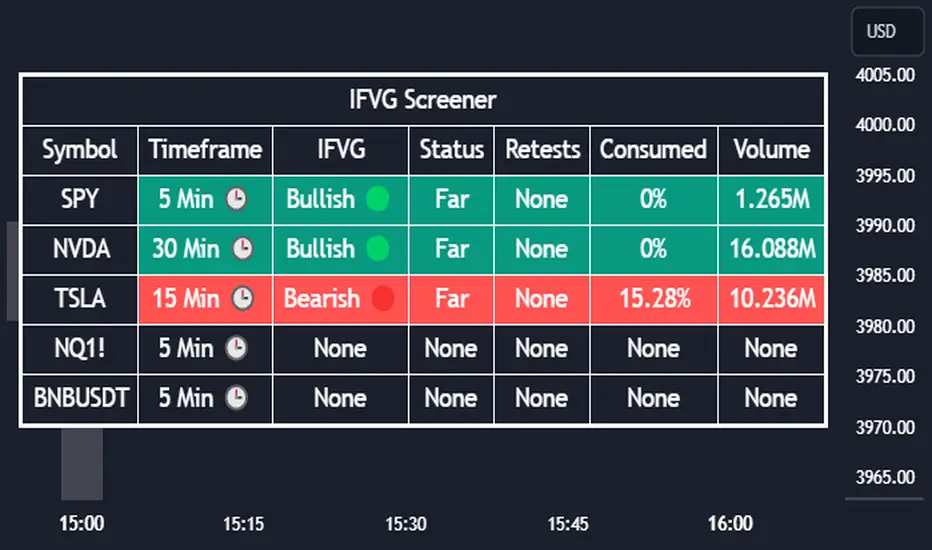
IFVG ExtendedThis indicator identifies and visualizes "Imbalance Fair Value Gaps" (IFVGs) on a price chart. It highlights these gaps, tracks their evolution, and signals when they are "filled" or "invalidated" by price action. The script is quite advanced, using custom types, arrays, and dynamic drawing.
1. Types and Variables
Custom Types:
lab: Stores label information (x, y, direction).
fvg: Stores Fair Value Gap data, including its boundaries, direction, state, labels, and other properties.
Arrays:
Four arrays track bullish and bearish FVGs, and their "invalidated" (filled) versions.
Signals:
Boolean variables to store if a bullish or bearish signal is triggered.
2. User Inputs and Parameters
Display Settings:
How many recent FVGs to show, signal preference (close or wick), ATR multiplier for gap size filtering, and colors for bullish/bearish/midline.
3. Chart Data
Price Data:
Open, high, low, close, and ATR (Average True Range) are stored for use in calculations.
4. Functions
label_maker:
Draws an up or down arrow label at a given point, colored for bullish or bearish.
fvg_manage:
Checks if any FVGs in the array have been "invalidated" (i.e., price has crossed their boundary). If so, moves them to the invalidated array.
inv_manage:
Manages invalidated FVGs, checking if a signal should be fired (i.e., price has reacted to the gap). Also removes old FVGs.
send_it:
Draws the FVGs and their labels on the chart, using boxes and lines for visualization.
5. Main Logic and Visualization
FVG Detection:
On each bar, checks for new bullish or bearish FVGs based on price action and ATR filter.
Adds new FVGs to the appropriate array.
FVG Management:
Updates the arrays, moves invalidated FVGs, and checks for signals.
Drawing:
On the last bar, clears all previous drawings and redraws the current FVGs and their labels.
6. Alerts
Alert Conditions:
Sets up alerts for when a bullish or bearish IFVG signal is triggered, so users can be notified.
Summary
In short:
This script automatically finds and tracks "Imbalance Fair Value Gaps" on your chart, highlights them, and alerts you when price interacts with them in a significant way. It uses advanced Pine Script features to manage and visualize these zones dynamically, helping traders spot potential reversal or continuation points based on gap theory
ICT Master Suite [Trading IQ]Hello Traders!
Weโre excited to introduce the ICT Master Suite by TradingIQ, a new tool designed to bring together several ICT concepts and strategies in one place.
The Purpose Behind the ICT Master Suite
There are a few challenges traders often face when using ICT-related indicators:
Many available indicators focus on one or two ICT methods, which can limit traders who apply a broader range of ICT related techniques on their charts.
There aren't many indicators for ICT strategy models, and we couldn't find ICT indicators that allow for testing the strategy models and setting alerts.
Many ICT related concepts exist in the public domain as indicators, not strategies! This makes it difficult to verify that the ICT concept has some utility in the market you're trading and if it's worth trading - it's difficult to know if it's working!
Some users might not have enough chart space to apply numerous ICT related indicators, which can be restrictive for those wanting to use multiple ICT techniques simultaneously.
The ICT Master Suite is designed to offer a comprehensive option for traders who want to apply a variety of ICT methods. By combining several ICT techniques and strategy models into one indicator, it helps users maximize their chart space while accessing multiple tools in a single slot.
Additionally, the ICT Master Suite was developed as a strategy . This means users can backtest various ICT strategy models - including deep backtesting. A primary goal of this indicator is to let traders decide for themselves what markets to trade ICT concepts in and give them the capability to figure out if the strategy models are worth trading!
What Makes the ICT Master Suite Different
There are many ICT-related indicators available on TradingView, each offering valuable insights. What the ICT Master Suite aims to do is bring together a wider selection of these techniques into one tool. This includes both key ICT methods and strategy models, allowing traders to test and activate strategies all within one indicator.
Features
The ICT Master Suite offers:
Multiple ICT strategy models, including the 2022 Strategy Model and Unicorn Model, which can be built, tested, and used for live trading.
Calculation and display of key price areas like Breaker Blocks, Rejection Blocks, Order Blocks, Fair Value Gaps, Equal Levels, and more.
The ability to set alerts based on these ICT strategies and key price areas.
A comprehensive, yet practical, all-inclusive ICT indicator for traders.
Customizable Timeframe - Calculate ICT concepts on off-chart timeframes
Unicorn Strategy Model
2022 Strategy Model
Liquidity Raid Strategy Model
OTE (Optimal Trade Entry) Strategy Model
Silver Bullet Strategy Model
Order blocks
Breaker blocks
Rejection blocks
FVG
Strong highs and lows
Displacements
Liquidity sweeps
Power of 3
ICT Macros
HTF previous bar high and low
Break of Structure indications
Market Structure Shift indications
Equal highs and lows
Swings highs and swing lows
Fibonacci TPs and SLs
Swing level TPs and SLs
Previous day high and low TPs and SLs
And much more! An ongoing project!
How To Use
Many traders will already be familiar with the ICT related concepts listed above, and will find using the ICT Master Suite quite intuitive!
Despite this, let's go over the features of the tool in-depth and how to use the tool!
The image above shows the ICT Master Suite with almost all techniques activated.
ICT 2022 Strategy Model
The ICT Master suite provides the ability to test, set alerts for, and live trade the ICT 2022 Strategy Model.
The image above shows an example of a long position being entered following a complete setup for the 2022 ICT model.
A liquidity sweep occurs prior to an upside breakout. During the upside breakout the model looks for the FVG that is nearest 50% of the setup range. A limit order is placed at this FVG for entry.
The target entry percentage for the range is customizable in the settings. For instance, you can select to enter at an FVG nearest 33% of the range, 20%, 66%, etc.
The profit target for the model generally uses the highest high of the range (100%) for longs and the lowest low of the range (100%) for shorts. Stop losses are generally set at 0% of the range.
The image above shows the short model in action!
Whether you decide to follow the 2022 model diligently or not, you can still set alerts when the entry condition is met.
ICT Unicorn Model
The image above shows an example of a long position being entered following a complete setup for the ICT Unicorn model.
A lower swing low followed by a higher swing high precedes the overlap of an FVG and breaker block formed during the sequence.
During the upside breakout the model looks for an FVG and breaker block that formed during the sequence and overlap each other. A limit order is placed at the nearest overlap point to current price.
The profit target for this example trade is set at the swing high and the stop loss at the swing low. However, both the profit target and stop loss for this model are configurable in the settings.
For Longs, the selectable profit targets are:
Swing High
Fib -0.5
Fib -1
Fib -2
For Longs, the selectable stop losses are:
Swing Low
Bottom of FVG or breaker block
The image above shows the short version of the Unicorn Model in action!
For Shorts, the selectable profit targets are:
Swing Low
Fib -0.5
Fib -1
Fib -2
For Shorts, the selectable stop losses are:
Swing High
Top of FVG or breaker block
The image above shows the profit target and stop loss options in the settings for the Unicorn Model.
Optimal Trade Entry (OTE) Model
The image above shows an example of a long position being entered following a complete setup for the OTE model.
Price retraces either 0.62, 0.705, or 0.79 of an upside move and a trade is entered.
The profit target for this example trade is set at the -0.5 fib level. This is also adjustable in the settings.
For Longs, the selectable profit targets are:
Swing High
Fib -0.5
Fib -1
Fib -2
The image above shows the short version of the OTE Model in action!
For Shorts, the selectable profit targets are:
Swing Low
Fib -0.5
Fib -1
Fib -2
Liquidity Raid Model
The image above shows an example of a long position being entered following a complete setup for the Liquidity Raid Modell.
The user must define the session in the settings (for this example it is 13:30-16:00 NY time).
During the session, the indicator will calculate the session high and session low. Following a โraidโ of either the session high or session low (after the session has completed) the script will look for an entry at a recently formed breaker block.
If the session high is raided the script will look for short entries at a bearish breaker block. If the session low is raided the script will look for long entries at a bullish breaker block.
For Longs, the profit target options are:
Swing high
User inputted Lib level
For Longs, the stop loss options are:
Swing low
User inputted Lib level
Breaker block bottom
The image above shows the short version of the Liquidity Raid Model in action!
For Shorts, the profit target options are:
Swing Low
User inputted Lib level
For Shorts, the stop loss options are:
Swing High
User inputted Lib level
Breaker block top
Silver Bullet Model
The image above shows an example of a long position being entered following a complete setup for the Silver Bullet Modell.
During the session, the indicator will determine the higher timeframe bias. If the higher timeframe bias is bullish the strategy will look to enter long at an FVG that forms during the session. If the higher timeframe bias is bearish the indicator will look to enter short at an FVG that forms during the session.
For Longs, the profit target options are:
Nearest Swing High Above Entry
Previous Day High
For Longs, the stop loss options are:
Nearest Swing Low
Previous Day Low
The image above shows the short version of the Silver Bullet Model in action!
For Shorts, the profit target options are:
Nearest Swing Low Below Entry
Previous Day Low
For Shorts, the stop loss options are:
Nearest Swing High
Previous Day High
Order blocks
The image above shows indicator identifying and labeling order blocks.
The color of the order blocks, and how many should be shown, are configurable in the settings!
Breaker Blocks
The image above shows indicator identifying and labeling order blocks.
The color of the breaker blocks, and how many should be shown, are configurable in the settings!
Rejection Blocks
The image above shows indicator identifying and labeling rejection blocks.
The color of the rejection blocks, and how many should be shown, are configurable in the settings!
Fair Value Gaps
The image above shows indicator identifying and labeling fair value gaps.
The color of the fair value gaps, and how many should be shown, are configurable in the settings!
Additionally, you can select to only show fair values gaps that form after a liquidity sweep. Doing so reduces "noisy" FVGs and focuses on identifying FVGs that form after a significant trading event.
The image above shows the feature enabled. A fair value gap that occurred after a liquidity sweep is shown.
Market Structure
The image above shows the ICT Master Suite calculating market structure shots and break of structures!
The color of MSS and BoS, and whether they should be displayed, are configurable in the settings.
Displacements
The images above show indicator identifying and labeling displacements.
The color of the displacements, and how many should be shown, are configurable in the settings!
Equal Price Points
The image above shows the indicator identifying and labeling equal highs and equal lows.
The color of the equal levels, and how many should be shown, are configurable in the settings!
Previous Custom TF High/Low
The image above shows the ICT Master Suite calculating the high and low price for a user-defined timeframe. In this case the previous dayโs high and low are calculated.
To illustrate the customizable timeframe function, the image above shows the indicator calculating the previous 4 hour high and low.
Liquidity Sweeps
The image above shows the indicator identifying a liquidity sweep prior to an upside breakout.
The image above shows the indicator identifying a liquidity sweep prior to a downside breakout.
The color and aggressiveness of liquidity sweep identification are adjustable in the settings!
Power Of Three
The image above shows the indicator calculating Po3 for two user-defined higher timeframes!
Macros
The image above shows the ICT Master Suite identifying the ICT macros!
ICT Macros are only displayable on the 5 minute timeframe or less.
Strategy Performance Table
In addition to a full-fledged TradingView backtest for any of the ICT strategy models the indicator offers, a quick-and-easy strategy table exists for the indicator!
The image above shows the strategy performance table in action.
Keep in mind that, because the ICT Master Suite is a strategy script, you can perform fully automatic backtests, deep backtests, easily add commission and portfolio balance and look at pertinent metrics for the ICT strategies you are testing!
Lite Mode
Traders who want the cleanest chart possible can toggle on โLite Modeโ!
In Lite Mode, any neon or โglowโ like effects are removed and key levels are marked as strict border boxes. You can also select to remove box borders if thatโs what you prefer!
Settings Used For Backtest
For the displayed backtest, a starting balance of $1000 USD was used. A commission of 0.02%, slippage of 2 ticks, a verify price for limit orders of 2 ticks, and 5% of capital investment per order.
A commission of 0.02% was used due to the backtested asset being a perpetual future contract for a crypto currency. The highest commission (lowest-tier VIP) for maker orders on many exchanges is 0.02%. All entered positions take place as maker orders and so do profit target exits. Stop orders exist as stop-market orders.
A slippage of 2 ticks was used to simulate more realistic stop-market orders. A verify limit order settings of 2 ticks was also used. Even though BTCUSDT.P on Binance is liquid, we just want the backtest to be on the safe side. Additionally, the backtest traded 100+ trades over the period. The higher the sample size the better; however, this example test can serve as a starting point for traders interested in ICT concepts.
Community Assistance And Feedback
Given the complexity and idiosyncratic applications of ICT concepts amongst its proponents, the ICT Master Suiteโs built-in strategies and level identification methods might not align with everyone's interpretation.
That said, the best we can do is precisely define ICT strategy rules and concepts to a repeatable process, test, and apply them! Whether or not an ICT strategy is trading precisely how you would trade it, seeing the model in action, taking trades, and with performance statistics is immensely helpful in assessing predictive utility.
If you think we missed something, you notice a bug, have an idea for strategy model improvement, please let us know! The ICT Master Suite is an ongoing project that will, ideally, be shaped by the community.
A big thank you to the @PineCoders for their Time Library!
Thank you!
Star SMC and Price action [ARule]This script is a Smart Money Concepts (SMC) + Price Action + VWAP + Swing Zones indicator.
It detects and draws:
โ
Fair Value Gaps (FVG)
โ
Imbalances (HTF FVG)
โ
BOS / CHoCH (Market Structure)
โ
Internal & Swing Structure
โ
Order Blocks (Internal + Swing)
โ
Equal High / Equal Low (EQH / EQL)
โ
Premium / Discount Zones
โ
Multi-Timeframe High & Low levels
โ
VWAP trend filter
โ
Swing High / Low zones with volume/count filter
โ
Alerts for all major SMC events
๐ Basically:
๐ โAll-in-one institutional trading indicatorโ
โ
1) HTF FVG / Imbalance System (First Part)
This part:
Uses multiple higher timeframes:
5m, 15m, 1H, 4H, 1D, 1W
Detects imbalance (FVG-like gaps)
Draws boxes on chart
Marks mitigated zones
Adds labels like: 5m, 15m, 1H etc.
Logic:
An imbalance forms when:
current high < previous low (gap down)
or
current low > previous high (gap up)
Then it draws a box ๐ฆ
โ
2) Mitigation Logic (Very Important)
Your script checks when FVG is filled:
Options:
Wick filled
Body filled
Half filled
None
Example:
"Wick filled" => low <= imb.open
Meaning:
๐ Price touched the FVG โ mark as mitigated.
โ
3) Smart Money Concepts (SMC Core)
This huge section detects:
๐น BOS (Break of Structure)
When price breaks previous swing high/low.
๐น CHoCH (Change of Character)
Trend reversal signal.
Example:
Uptrend โ break low โ CHoCH bearish
Downtrend โ break high โ CHoCH bullish
โ
4) Internal vs Swing Structure
Internal Structure:
Small moves (lower timeframe)
Fast signals โก
Swing Structure:
Major trend structure
Strong signals ๐ช
You can enable/disable both in settings.
โ
5) Order Blocks (OB)
Detected when structure breaks.
Two types:
๐ข Bullish OB
๐ด Bearish OB
Logic:
Script finds last opposite candle before BOS/CHoCH.
Then draws OB box ๐ฆ
Also checks mitigation:
close > OB high โ bearish OB broken
close < OB low โ bullish OB broken
โ
6) Equal High / Equal Low (Liquidity)
Detects liquidity zones:
EQH = Equal High
EQL = Equal Low
Logic:
If two highs/lows are close within ATR threshold.
Used for:
๐ Liquidity grab / stop hunt zones.
โ
7) Fair Value Gaps (FVG) โ Another System
This is separate from HTF imbalance.
Condition:
currentLow > high โ bullish FVG
currentHigh < low โ bearish FVG
Draws 2 boxes per FVG.
โ
8) Premium / Discount Zones
Based on latest swing high & low:
Premium zone = top 50%
Discount zone = bottom 50%
Equilibrium = middle
Used in SMC for entries.
โ
9) Multi-Timeframe High/Low Levels
Draws:
Previous Day High/Low
Previous Week High/Low
Previous Month High/Low
โ
10) VWAP Filter (Your Added Block)
You added:
VWAP Line
vwapValue = ta.vwap(close)
Trend Filter
Bullish โ price above VWAP
Bearish โ price below VWAP
ATM / ITM / OTM logic
atm_condition = abs(close - vwap) <= 25
Meaning:
ATM = price near VWAP
ITM / OTM = based on VWAP direction
๐ก This is NOT real option ATM โ it's a conceptual filter.
โ
11) Swing High / Low Zones (Last Part)
This part:
Detects swing highs & lows using pivot logic
Creates zones (boxes)
Counts touches or volume inside zone
Filters strong zones
Example:
More touches = stronger support/resistance
More volume = institutional interest
โ
What makes this script powerful ๐
It combines:
Concept Purpose
FVG / Imbalance Institutional gaps
BOS / CHoCH Trend change
Order Blocks Smart money zones
EQH/EQL Liquidity
Premium/Discount Entry zones
VWAP Trend filter
Swing Zones Support/Resistance
๐ This is almost like ICT + SMC + Volume + VWAP hybrid.
โ
If you want, I can help you:
I can:
โ
Simplify this script (remove heavy parts)
โ
Add NIFTY / BANKNIFTY option logic
โ
Add Buy/Sell signals
โ
Add scanner (BOS + VWAP + FVG)
โ
Add dashboard table
โ
Optimize performance (reduce lag)
โ
Convert VWAP โ real ATM strike logic
โ
Explain any part line-by-line
FDAX MarrellFDAX ONR + Range/Trend Confirm + 15m FVG (CET) โ Indicator Description
This indicator is designed for FDAX traders who trade 15m Fair Value Gaps (FVG) using 1m confirmation (CISD/SMC execution) and want to avoid getting chopped in range days.
What it does
Overnight Range (ONR) module (00:00โ08:55 CET)
Draws the Overnight box.
Calculates and displays key ON metrics:
ONR โ overnight range size
Score โ overnight directional efficiency (how โone-wayโ the move was)
Loc โ where price closed inside the overnight range (close location)
Flags a Pre-Range bias when overnight behavior suggests a higher probability of a choppy/session-range environment.
Range vs Trend confirmation (European open logic)
Builds the Opening Range (OR30) box (09:00โ09:30 CET).
Tracks TR60 (09:00โ10:00 CET) for early volatility expansion.
Confirms the session state:
WAIT โ no confirmation yet
CONFIRMED RANGE โ conditions point to a balanced/choppy day
CONFIRMED TREND โ volatility expansion and acceptance outside OR indicates a trending day
15m FVG overlays
Plots 15m FVG zones (bullish/bearish) as clean extending boxes.
Optional filters:
Show FVGs only when CONFIRMED TREND (to avoid taking FVGs in chop).
Hide FVGs inside the EQ zone (mid-range) to reduce low-quality setups.
Why itโs useful
Range days are where most stop streaks happen when trading FVG + 1m confirmation. This indicator helps you:
Identify when the market is likely to be balanced/choppy
Wait for trend confirmation before taking aggressive FVG plays
Focus only on high-probability FVG locations aligned with session conditions
Best use
Use the indicator on FDAX (EUREX) with 15m / 5m context and execute on 1m.
Prioritize FVGs during CONFIRMED TREND and be selective (or reduce size) during WAIT / CONFIRMED RANGE.
If you want, I can also write a shorter โTradingView public script styleโ description (2โ3 lines + bullet features), or a more marketing/premium description for your community.
ููุงุณุชุฑ
Detailed Description โ Fibonacci Cluster Zones + OB + FVG (AR34)
This script is an advanced multi-layer confluence system developed under the AR34 Trading Framework, designed to identify high-accuracy reversal zones, liquidity imbalances, institutional footprints, and trend direction using a unified analytic engine.
It combines Fibonacci mathematics, Smart Money Concepts, market structure, and smart trend signals to produce precise, reliable trading zones.
โธป
๐ถ 1 โ Fibonacci Retracement Zones + Custom Smart Levels
The script calculates the highest and lowest prices over a selected lookback period to generate key Fibonacci retracement levels:
โข 0.236
โข 0.382
โข 0.500
โข 0.618
โข 0.786
โข 1.000
You can also add up to three custom Fibonacci levels (0.66, 0.707, 0.88 or any value you want).
โ Each level is drawn as a horizontal line
โ Optional label display for every level
โ Color and activation fully customizable
These levels help identify pullback zones and potential turning points.
โธป
๐ถ 2 โ True Fibonacci Cluster Detection
The script automatically identifies Cluster Zones, which occur when:
1. A Fibonacci level
2. An Order Block
3. A Fair Value Gap
all overlap in the same price range.
When all three conditions align, the script prints a CLUSTER marker in yellow.
These zones represent:
โข High-probability reversal areas
โข Strong institutional footprints
โข Highly reactive price levels
โธป
๐ถ 3 โ Automatic Order Block (OB) Detection
The indicator detects Order Blocks based on structural candle behavior:
โข Bearish candle โ followed by bullish
โข Price interacts with a Fibonacci level
โข Area aligns with institutional order flow
When detected, the OB is marked for easy visualization.
โธป
๐ถ 4 โ Fair Value Gap (FVG) Mapping
The script scans for liquidity imbalances using the classic FVG logic:
โข low > high
When an FVG exists, it draws a green liquidity box.
This highlights:
โข Gaps left by institutional moves
โข High-value return zones
โข Efficient price retracement levels
โธป
๐ถ 5 โ Fibonacci Extension Projections
The script calculates extension targets using:
โข 1.272
โข 1.618
โข 2.000
These are drawn as dashed teal lines and help forecast:
โข Breakout continuation targets
โข Wave extension objectives
โข Take-profit areas
โธป
๐ถ 6 โ Smart Trend Signal (EMA-200 Engine)
Trend direction is determined using the EMA 200:
โข Price above EMA โ uptrend
โข Price below EMA โ downtrend
A green or red signal icon appears only when the trend flips, reducing noise and improving clarity.
This helps detect:
โข Trend shifts early
โข Cleaner entries and exits
โข Trend-based filtering
โธป
๐ถ 7 โ Four-EMA Multi-Trend System
The indicator includes optional visualization of four moving averages:
โข EMA 20 โ Short-term
โข EMA 50 โ Medium-term
โข EMA 100 โ Long-term
โข EMA 200 โ Major trend
All are fully customizable (length + color + visibility).
โธป
๐ถ 8 โ Dynamic Negative Fibonacci Levels (Green Only)
When enabled, the script calculates deep retracement zones using:
โข โ0.23
โข โ0.75
โข โ1.20
These negative Fibonacci levels are drawn in green and help identify:
โข Deep liquidity capture points
โข Hidden structural supports
โข Potential reversal bottoms
โธป
๐ถ 9 โ Complete User Control
Users maintain full control over:
โ Enabling/disabling OB detection
โ Enabling/disabling FVG detection
โ Activating custom Fibonacci levels
โ Showing or hiding labels
โ Selecting timeframe for Fib calculations
โ Adjusting moving average parameters
โ Activating dynamic Fibonacci
The script is designed to be flexible, scalable, and suitable for any trading style.
โธป
๐ฏ Summary
This indicator is a powerful all-in-one analytical system that merges:
โ Fibonacci Mathematics
โ Smart Money Concepts (OB + FVG)
โ Trend-based filtering
โ Institutional cluster detection
โ Dynamic extensions + retracements
โ Multi-EMA trend mapping
ุดุฑุญ ุงูุณูุฑุจุช ุจุงูุชูุตูู โ Fibonacci Cluster Zones + OB + FVG (AR34)
ูุฐุง ุงูุณูุฑุจุช ูู ูุธุงู
ุชุญููู ุงุญุชุฑุงูู ู
ุชูุงู
ู ู
ู ุชุทููุฑ AR34 Framework ูุฌู
ุน ุจูู ุฃููู ุฃุฏูุงุช ุงูุชุฏุงูู ุงูุญุฏูุซุฉ ูู ู
ุคุดุฑ ูุงุญุฏุ ูููุฏู ุฅูู ูุดู ู
ูุงุทู ุงูุงูุนูุงุณ ุงููููุฉุ ูุงูุชุฌู
ูุน ุงูุฐููุ ูุงูุงุชุฌุงู ุงูุนุงู
ุ ุจุงุณุชุฎุฏุงู
ู
ุฒูุฌ ุนูู
ู ู
ู ููุจููุงุชุดู + ุงูุณูููุฉ + ุงูุงุชุฌุงู.
ูุนู
ู ูุฐุง ุงูู
ุคุดุฑ ุจุฃุณููุจ Confluence Trading ุจุญูุซ ูุฏู
ุฌ ุนุฏุฉ ู
ุฏุงุฑุณ ู
ุฎุชููุฉ ูู ุทุจูุฉ ูุงุญุฏุฉ ูุชุญุฏูุฏ ู
ูุงุทู ุงูุงูุนูุงุณ ูุงูุงุฑุชุฏุงุฏ ูุงูุงุฎุชุฑุงู ุจุฏูุฉ ุนุงููุฉ.
โธป
๐ถ 1 โ ู
ูุงุทู ููุจููุงุชุดู (Retracement) + ุงูููุงุณุชุฑ ุงูุฐูู
ูููู
ุงูู
ุคุดุฑ ุจุญุณุงุจ ุฃุนูู ูุฃุฏูู ุณุนุฑ ุฎูุงู ุนุฏุฏ ู
ุญุฏุฏ ู
ู ุงูุดู
ูุน (Retracement Length) ุซู
ูุฑุณู
ู
ุณุชููุงุช ููุจููุงุชุดู ุงูููุงุณูููุฉ:
โข 0.236
โข 0.382
โข 0.500
โข 0.618
โข 0.786
โข 1.000
ู
ุน ุฅู
ูุงููุฉ ุฅุถุงูุฉ 3 ู
ุณุชููุงุช ุฎุงุตุฉ ู
ู ุงุฎุชูุงุฑู (0.66 โ 0.707 โ 0.88 ูุบูุฑูุง).
โ๏ธ ูู ู
ุณุชูู ูุชู
ุฑุณู
ู ุจุฎุท ู
ุณุชูู
โ๏ธ ูุธูุฑ ุจุฌุงูุจู ุฑูู
ุงูู
ุณุชูู ุฅุฐุง ุชู
ุชูุนูู ุฎูุงุฑ Show Fib Labels
โ๏ธ ูู
ูู ุชุบููุฑ ููููุ ููู
ุชูุ ูุชูุนููู ุญุณุจ ุฑุบุจุชู
โธป
๐ถ 2 โ ูุงุดู ุงูููุงุณุชุฑ ุงูุญูููู (Cluster Detection)
ุงูููุงุณุชุฑ ููุนุชุจุฑ ุฃููู ู
ูุงุทู ุงูุงุฑุชุฏุงุฏ ูู ุงูุชุญููู ุงูููู.
ุงูุณูุฑุจุช ูุญุฏุฏ ุงูููุงุณุชุฑ ุนูุฏู
ุง ุชุชุฏุงุฎู 3 ุนูุงุตุฑ ู
ุน ู
ุณุชูู ููุจููุงุชุดู:
1. ู
ุณุชูู ููุจููุงุชุดู ู
ูู
2. Order Block
3. Fair Value Gap
ุฅุฐุง ุงุฌุชู
ุนุช ุงูุซูุงุซุฉ ูู ููุณ ุงูู
ูุทูุฉุ ูุชู
ุฑุณู
ูุง ุจุงูููู ุงูุฃุตูุฑ ูุชุธูุฑ ููู
ุฉ CLUSTER.
ูุฐุง ูุนุทูู:
โข ุฃููู ู
ูุทูุฉ ุงูุนูุงุณ
โข ุฃุนูู ุฏูุฉ ูู ุชุญุฏูุฏ ููุงุท ุงูุฏุฎูู
โข ู
ูุงุทู ุฐุงุช ุณูููุฉ ู
ุฑุชูุนุฉ
โธป
๐ถ 3 โ ุฏู
ุฌ Order Blocks ุชููุงุฆูุงู
ููุชุดู ุงูู
ุคุดุฑ ุงูู OB ุงูุญูููู ุจุงุณุชุฎุฏุงู
ุดุฑูุท ุญุฑูุฉ ุงูุดู
ูุน:
โข bearish candle โ bullish candle
โข ุงูุณุนุฑ ูู
ุณ ู
ุณุชูู ููุจููุงุชุดู
โข ู
ูุทูุฉ ู
ุญุชู
ูุฉ ูุชุฌู
ูุน ุงูู
ุคุณุณุงุช
ุฅุฐุง ุชุญููุช ุงูุดุฑูุท ูุธูุฑ OB ุจุงูููู ุงูุฃุญู
ุฑ.
โธป
๐ถ 4 โ ุฏู
ุฌ Fair Value Gaps (FVG)
ููุชุดู ุงููุฌูุงุช ุงูุณุนุฑูุฉ ุจูู ุงูุดู
ุนุชูู ุงูุฃููู ูุงูุซุงูุซุฉ:
โข low > high
ููููู
ุจุฑุณู
ุจููุณ ุฃุฎุถุฑ ุญูู ุงููุฌูุฉ (FVG Zone).
ูุณุงุนุฏู ุนูู ู
ุนุฑูุฉ:
โข ู
ูุงุทู ุงุฎุชูุงู ุงูุณูููุฉ
โข ุฃูุฏุงู ุงูุณุนุฑ ุงููุงุฏู
ุฉ
โข ู
ูุงุทู โุงูุนูุฏุฉโ ุงูู
ุญุชู
ูุฉ
โธป
๐ถ 5 โ ุงู
ุชุฏุงุฏุงุช ููุจููุงุชุดู (Fibonacci Extensions)
ูููู
ุจุญุณุงุจ ุงูุงู
ุชุฏุงุฏุงุช ู
ู ู
ุณุชููุงุช:
โข 1.272
โข 1.618
โข 2.0
ููุธูุฑูุง ุจุฎุทูุท ู
ุชูุทุนุฉ (Teal Color).
ูุฐู ุงูู
ุณุชููุงุช ู
ูู
ุฉ ูุชููุน:
โข ุฃูุฏุงู ุงุฎุชุฑุงู
โข ู
ูุงุทู TP
โข ุงู
ุชุฏุงุฏ ู
ูุฌุงุช ุงูุณุนุฑ
โธป
๐ถ 6 โ ุฅุดุงุฑุฉ ุงูุงุชุฌุงู ุงูุฐููุฉ (Smart Trend Engine โ EMA200)
ูุนุชู
ุฏ ุนูู EMA 200 ูุชุญุฏูุฏ ุงูุงุชุฌุงู ุงูุนุงู
:
โข ุฅุฐุง ุงูุณุนุฑ ููู EMA200 โ ุงุชุฌุงู ุตุงุนุฏ
โข ุฅุฐุง ุงูุณุนุฑ ุชุญุช EMA200 โ ุงุชุฌุงู ูุงุจุท
ููุธูุฑ ุงูู
ุคุดุฑ:
๐ข ุณูู
ุฃุฎุถุฑ ุนูุฏ ุชุญูู ุงูุงุชุฌุงู ูุตุนูุฏ
๐ด ุณูู
ุฃุญู
ุฑ ุนูุฏ ุชุญูู ุงูุงุชุฌุงู ููุจูุท
ู
ูุฒุฉ ุงูุชุญูู ููุท ุนูุฏ ุชุบููุฑ ุงูุงุชุฌุงู (No Noise).
โธป
๐ถ 7 โ ุฃุฑุจุน ู
ููููุงุช ุงุญุชุฑุงููุฉ (EMA 20 โ 50 โ 100 โ 200)
ุงูู
ุคุดุฑ ูุนุฑุถ ุงูู
ููููุงุช ุงูุฃุฑุจุนุฉ ุงูุฃุณุงุณูุฉ:
โข EMA 20 โ ุงุชุฌุงู ูุตูุฑ
โข EMA 50 โ ู
ุชูุณุท
โข EMA 100 โ ุทููู
โข EMA 200 โ ุงูุงุชุฌุงู ุงูุฑุฆูุณู
ู
ุน ุฅู
ูุงููุฉ:
โข ุชุบููุฑ ุงูููู
โข ุชุบููุฑ ุงูุทูู
โข ุฅุฎูุงุฆูุง ูุฅุธูุงุฑูุง
โธป
๐ถ 8 โ ููุจููุงุชุดู ุงูุฏููุงู
ููู (Dynamic Green Fib)
ู
ูุฒุฉ ูููุฉ ุฌุฏุงู ุชุธูุฑ ููุท ุนูุฏ ุชูุนูููุง.
ุชุญุณุจ ุฃุนูู ูุฃุฏูู ุณุนุฑ ูู Lookback Period ุซู
ุชุฑุณู
ู
ุณุชููุงุช ุณูุจูุฉ:
โข โ0.23
โข โ0.75
โข โ1.20
ูุฐู ุงูู
ุณุชููุงุช ุชุธูุฑ ูุฎุทูุท ุฎุถุฑุงุก ุชุญุช ุงูุณุนุฑ ูุชุณุชุฎุฏู
ูู:
โข ุชุญุฏูุฏ ู
ูุงุทู ุงูุงูุนูุงุณ ุงูู
ุฎููุฉ
โข ุฑุตุฏ ุงูุฏุนู
ุงูุฏููุงู
ููู
โข ุงูุชุดุงู ุงูููุนุงู ุงูู
ุญุชู
ูุฉ
โธป
๐ถ 9 โ ุงูู
ุฑููุฉ ุงููุงู
ูุฉ ููู
ุณุชุฎุฏู
ุงูู
ุคุดุฑ ูุณู
ุญ ูู ุงูุชุญูู
ุจูู ุดูุก:
โ๏ธ ุชูุนูู/ุฅูุบุงุก ุงูู OB
โ๏ธ ุชูุนูู/ุฅูุบุงุก ุงูู FVG
โ๏ธ ุชูุนูู/ุฅูุบุงุก ู
ุณุชููุงุช ููุจููุงุชุดู
โ๏ธ ุฅุถุงูุฉ ู
ุณุชููุงุช ู
ุฎุตุตุฉ
โ๏ธ ุงุฎุชูุงุฑ ุงููุฑูู
ุงูู
ุณุชุฎุฏู
โ๏ธ ุชุบููุฑ ุงูุฃููุงู
โ๏ธ ุงูุชุญูู
ูู ุงูุงุชุฌุงู ูุงูู
ููููุงุช
โธป
๐ฏ ุงูุฎูุงุตุฉ
ูุฐุง ุงูุณูุฑุจุช ูุนู
ู ููุธุงู
ุชุญูููู ู
ุชูุงู
ู ูุฌู
ุน:
โ๏ธ ููุจููุงุชุดู
โ๏ธ ุงูุณูููุฉ ุงูู
ุคุณุณูุฉ (OB + FVG)
โ๏ธ ุงูุงุชุฌุงู ุงูุฐูู
โ๏ธ ุงูููุงุณุชุฑ ุงูุงุญุชุฑุงูู
โ๏ธ ุงูู
ููููุงุช
โ๏ธ ููุจููุงุชุดู ุงูุฏููุงู
ููู
Fair Value Gap DetectorHow this indicator works:
It detects two types of FVGs:
Bullish FVG: Occurs when the low of the current candle is higher than the high of the candle from 2 bars ago (creates an upward gap)
Bearish FVG: Occurs when the high of the current candle is lower than the low of the candle from 2 bars ago (creates a downward gap)
Features:
Allows users to toggle both bullish and bearish FVG detection independently
Customizable colors for both bullish (default green) and bearish (default red) FVGs
Visualizes FVGs using:
Boxes that highlight the gap area (with 80% transparency)
Labels that mark each FVG ("Bull FVG" or "Bear FVG")
Visual representation:
Bullish FVGs are marked with green boxes and downward-pointing labels
Bearish FVGs are marked with red boxes and upward-pointing labels
This indicator can be useful for :
Identifying potential areas where price might return to
Finding potential support and resistance zones
Understanding market structure and momentum shifts
Inversion Fair Value Gap Screener | Flux Charts๐ GENERAL OVERVIEW
Introducing our new Inverse Fair Value Gap Screener! This screener can provide information about the latest Inverse Fair Value Gaps in up to 5 tickers. You can also customize the algorithm that finds the Inverse Fair Value Gaps and the styling of the screener.
Features of the new Inverse Fair Value Gap (IFVG) Screener :
Find Latest Inverse Fair Value Gaps Across 5 Tickers
Shows Their Information Of :
Latest Status
Number Of Retests
Consumption Percent
Volume
Customizable Algorithm / Styling
๐ HOW DOES IT WORK ?
A Fair Value Gap generally occur when there is an imbalance in the market. They can be detected by specific formations within the chart. An Inverse Fair Value Gap is when a FVG becomes invalidated, thus reversing the direction of the FVG.
IFVGs get consumed when a Close / Wick enters the IFVG zone. Check this example:
This screener then finds Fair Value Gaps across 5 different tickers, and shows the latest information about them.
Status ->
Far -> The current price is far away from the IFVG.
Approaching โฌ๏ธ/โฌ๏ธ -> The current price is approaching the IFVG, and the direction it's approaching from.
Inside -> The price is currently inside the IFVG.
Retests -> Retest means the price tried to invalidate the IFVG, but failed to do so. Here you can see how many times the price retested the IFVG.
Consumed -> IFVGs get consumed when a Close / Wick enters the IFVG zone. For example, if the price hits the middle of the IFVG zone, the zone is considered 50% consumed.
Volume -> Volume of a IFVG is essentially the volume of the bar that broke the original FVG that formed it.
๐ฉUNIQUENESS
This screener can detect latest Inverse Fair Value Gaps and give information about them for up to 5 tickers. This saves the user time by showing them all in a dashboard at the same time. The screener also uniquely shows information about the number of retests and the consumed percent of the IFVG, as well as it's volume. We believe that this extra information will help you spot reliable IFVGs easier.
โ๏ธSETTINGS
1. Tickers
You can set up to 5 tickers for the screener to scan Fair Value Gaps here. You can also enable / disable them and set their individual timeframes.
2. General Configuration
FVG Zone Invalidation -> Select between Wick & Close price for FVG Zone Invalidation.
IFVG Zone Invalidation -> Select between Wick & Close price for IFVG Zone Invalidation. This setting also switches the type for IFVG consumption.
Zone Filtering -> With "Average Range" selected, algorithm will find FVG zones in comparison with average range of last bars in the chart. With the "Volume Threshold" option, you may select a Volume Threshold % to spot FVGs with a larger total volume than average.
FVG Detection -> With the "Same Type" option, all 3 bars that formed the FVG should be the same type. (Bullish / Bearish). If the "All" option is selected, bar types may vary between Bullish / Bearish.
Detection Sensitivity -> You may select between Low, Normal or High FVG detection sensitivity. This will essentially determine the size of the spotted FVGs, with lower sensitivities resulting in spotting bigger FVGs, and higher sensitivities resulting in spotting all sizes of FVGs.
ICT Pro [KTY]Hi, I'm Kim Thank You ๐
KTY = Kim Thank You (๊น๋กํ)
ใICT Proใ๐
Essential ICT tools for Smart Money trading.
5 core features to identify institutional order flow and high-probability trade setups.
โโโโโโโโโโโโโโโโโโโโโโโโโโโโโโโ
๐ก NEW TO THIS INDICATOR?
Open Settings and hover over the (i) icon on each feature for detailed tooltips.
Check the ๐ User Guide section at the bottom of Settings for quick reference.
โโโโโโโโโโโโโโโโโโโโโโโโโโโโโโโ
๐ FEATURES
โโโโโโโโโโโโโโโโโโโโโโโโโโโโโโโ
โ
Order Block (OB)
Price zones where Smart Money executed large buy/sell orders, acting as strong support/resistance levels.
- Bullish OB: Last bearish candle before an up move โ Support
- Bearish OB: Last bullish candle before a down move โ Resistance
๐ Box Display Info
- Vol: Volume at OB formation
- (%): Upper/Lower volume balance ratio
- Closer to 100% = Balanced buy/sell
- Lower = Strong one-sided order flow โ Stronger S/R zone
๐ OB Body Lines
- Dotted lines showing candle body position within OB
- Use for precise entry points
โโโโโโโโโโโโโโโโโโโโโโโโโโโโโโโ
โ
Liquidity Zone
Areas where stop-loss orders are clustered around swing highs/lows, becoming targets for Smart Money.
- Buyside Liquidity: Stop-losses above highs where shorts get liquidated
- Sellside Liquidity: Stop-losses below lows where longs get liquidated
- Liquidity Sweep: Price hunts stops then reverses sharply
๐ Box Display Info
- (%): Relative size compared to recent volume
- Higher = More stop orders clustered
- More likely to be a major target for Smart Money
๐ก Quick reversal after liquidity break = Reversal signal
โโโโโโโโโโโโโโโโโโโโโโโโโโโโโโโ
โ
Fair Value Gap (FVG)
A gap created when price moves rapidly between 3 candles, where price tends to return to fill this zone.
- Bullish FVG: Forms during sharp rallies โ Acts as support on pullbacks
- Bearish FVG: Forms during sharp drops โ Acts as resistance on bounces
- CE (Consequent Encroachment): 50% level of FVG, key reaction level
๐ Box Display Info
- (%): Relative size compared to recent volume
- Higher = FVG formed by stronger move
- Acts as stronger S/R zone
๐ก FVG overlapping with OB = Higher reliability
โโโโโโโโโโโโโโโโโโโโโโโโโโโโโโโ
โ
Market Structure
Analyzes price swing highs/lows to identify current trend and reversal points.
- CHoCH (Change of Character): Trend reversal signal - first sign of direction change
- BOS (Break of Structure): Trend continuation signal - structure break in existing direction
โ๏ธ Structure Options
- INTERNAL: Short-term structure (fast reaction, more signals)
- EXTERNAL: Long-term structure (slower reaction, higher reliability)
- ALL: Display both internal + external structure
๐ก CHoCH = Look for reversal | BOS = Trend continues
โโโโโโโโโโโโโโโโโโโโโโโโโโโโโโโ
โ
Trend Candles
Candle colors change based on market structure (BOS/CHoCH) direction.
- Bullish Color: After bullish structure break
- Bearish Color: After bearish structure break
๐ก Color change = Potential trend shift
๐ก Quickly identify overall market direction at a glance
โโโโโโโโโโโโโโโโโโโโโโโโโโโโโโโ
๐ HIGHER RELIABILITY SETUPS
โโโโโโโโโโโโโโโโโโโโโโโโโโโโโโโ
- Higher timeframe = More reliable signals
- Multiple features pointing to same price zone
(e.g. OB + FVG overlap = Strong confluence)
- Trend Candles + Market Structure direction aligned
- Quick reversal after Liquidity sweep
โโโโโโโโโโโโโโโโโโโโโโโโโโโโโโโ
๐ก TRADING TIPS
โโโโโโโโโโโโโโโโโโโโโโโโโโโโโโโ
1. Identify Liquidity targets first
2. Wait for price to reach OB or FVG zone
3. Confirm with Market Structure (CHoCH/BOS)
4. Enter at OB body lines or FVG CE level
5. Stop loss below/above the zone
โโโโโโโโโโโโโโโโโโโโโโโโโโโโโโโ
โ ๏ธ DISCLAIMER
This indicator is for educational purposes only.
Not financial advice. Always do your own research.
Past performance does not guarantee future results.
ICT Flow Matrix [Ultimate]๐ Overview
ICT Flow Matrix is a comprehensive, all-in-one Smart Money Concepts (SMC) indicator built for traders who follow ICT (Inner Circle Trader) methodology. This indicator consolidates over 15 institutional trading concepts into a single, highly customizable toolโeliminating chart clutter from multiple indicators while providing deep market structure analysis.
Whether you're identifying liquidity pools, tracking order flow, or timing entries during ICT Macro windows, this indicator delivers institutional-grade analysis directly on your chart.
Pro Tip: use with ICT Market Regime Detector for clear language reads on everything.
โก Key Features
๐ฏ Price Delivery Arrays (PDAs)
Fair Value Gaps (FVG) โ Automatic detection with customizable mitigation tracking (Wick Touch, 50% CE, Full Close)
Inverse FVGs (iFVG) โ Identifies when FVGs fail and flip, creating new tradeable zones
Order Blocks (OB) โ Last opposing candle before impulsive moves with adjustable impulse strength
Breaker Blocks (BB) โ Automatically generated when Order Blocks fail
Rejection Blocks (RB) โ Strong wick rejections indicating institutional defense
Volume Imbalances (VIMB) โ Gaps between candle bodies showing aggressive institutional activity
๐ Market Structure & Liquidity
Market Structure Shifts (MSS) โ Real-time detection of bullish/bearish structure breaks
Equal Highs/Lows (EQH/EQL) โ Liquidity pools where stop losses accumulate
Buy-Side/Sell-Side Liquidity (BSL/SSL) โ Swing point liquidity levels with sweep detection
Premium/Discount Zones โ Visual shading showing institutional buying/selling areas
OTE Zone (61.8%-79%) โ Optimal Trade Entry zone for high-probability entries
โฐ Time-Based Analysis
ICT Macro Times โ All nine 30-minute algorithmic windows (02:45, 03:45, 04:45, 09:45, 10:45, 13:45, 14:45, 15:15, 15:45 NY Time)
Killzone Sessions โ Asia, London, NY AM, NY PM with customizable times
Session Opens โ Weekly, Monthly, Daily opening prices
Previous Period H/L โ PDH/PDL, PWH/PWL, PMH/PML levels
๐ Dealing Ranges
Multi-Timeframe Ranges โ 21-Day, 3-Day, Daily dealing ranges
Session Ranges โ Asia, London, NY dealing ranges with equilibrium
Fibonacci Structure โ 0%, 50% (EQ), 100% levels with P/D shading
๐ฏ๏ธ HTF Orderflow
Higher Timeframe Candles โ Display up to 6 HTF candles with auto-timeframe selection
Candle Timer โ Countdown to next HTF candle close
O/H/L Reference Lines โ Current HTF open, high, low levels extended on chart
๐จ Visual Customization
5 Theme Presets โ Dark Pro, Light Clean, Neon, Classic, Custom
Full Color Control โ Customize every element individually
Zone Styles โ Filled or Border Only options
Mitigation Effects โ Visual fade when zones are mitigated
๐ Smart Dashboard
Real-Time Status โ Structure bias, zone position, active session, OTE status
Confluence Score โ Algorithmic scoring when multiple concepts align
Zone Counters โ Active FVG, OB, BB, RB, VIMB, liquidity levels
3 Display Modes โ Minimal, Compact, Detailed
๐ Comprehensive Alert System
40+ Alert Conditions including:
FVG/OB/BB/RB/VIMB formation
Liquidity sweeps (EQH, EQL, BSL, SSL)
Market Structure Shifts
OTE zone entry
Macro time windows
Session opens
High confluence zones
Combo alerts (Macro + Confluence)
๐ How To Use
For Swing/Position Traders:
Enable HTF Orderflow to identify dominant trend direction
Use Dealing Ranges (3D, 21D) to find premium/discount zones
Look for OB/FVG confluence in discount (longs) or premium (shorts)
Confirm with MSS for trend alignment
For Day/Intraday Traders:
Mark the Asian Range during pre-market
Wait for London or NY AM Killzone
Enter during ICT Macro windows when price reaches FVG/OB in OTE zone
Target opposite liquidity (BSL for longs, SSL for shorts)
Confluence Trading:
Dashboard shows real-time confluence score
Score โฅ 3 indicates multiple ICT concepts aligned
Higher scores = higher probability setups
โ๏ธ Recommended Settings
Trading Style FVG Max OB Max History Bars HTF Candles
Scalping 3-5 2-3 100-200 3-4 Day Trading 5-8 3-5 200-400 4-5
Swing Trading 8-12 5-8 400-800 5-6
๐ฏ Best Practices
โ
Do:
Use HTF bias before taking LTF entries
Wait for Macro time windows for highest probability
Combine MSS + FVG/OB + OTE for A+ setups
Let mitigated zones fade (use Mitigation Fade setting)
โ Avoid:
Trading against HTF structure
Entries outside Killzones (lower probability)
Ignoring liquidity targets
Over-cluttering chart (disable unused features)
๐ Version History
v6.0 (Current)
Complete rewrite in PineScript v6
Added ICT Macro Times with bracket/background styles
Enhanced confluence detection algorithm
Improved HTF candle rendering with multiple styles
Added Inverse FVG detection
Session-based Dealing Ranges
Performance optimizations
40+ alert conditions
โ ๏ธ Disclaimer
This indicator is a technical analysis tool designed to visualize ICT/SMC concepts. It does not provide financial advice or guarantee profitable trades. Past performance is not indicative of future results. Always use proper risk management and trade responsibly.
๐ฌ Support & Feedback
If you find this indicator valuable, please leave a comment or boost! Your feedback helps improve future updates.
Questions? Drop a comment belowโI actively respond to all questions about the indicator's features and usage.
SMC Alpha Engine [PhenLabs]๐ SMC Alpha Engine
Version: PineScriptโข v6
๐ Description
The SMC Alpha Engine is a comprehensive Smart Money Concepts indicator that automates institutional trading pattern recognition. Built for traders who understand that confluence is king, this indicator stacks multiple SMC elements together and scores them in real-time, allowing you to focus exclusively on high-probability setups.
Rather than manually tracking HTF bias, market structure, liquidity levels, order blocks, and fair value gaps separately, the SMC Alpha Engine consolidates everything into a unified scoring system. When enough factors align, you get a signal. When they donโt, you wait. This systematic approach removes emotion and subjectivity from SMC trading.
The indicator is designed around one core principle: only trade when the probabilities are stacked in your favor. By requiring multiple confluence factors before generating signals, it filters out the noise and keeps you focused on setups that institutional traders actually care about.
๐ Points of Innovation
Automated confluence scoring system that evaluates 6 distinct SMC factors in real-time
HTF-to-LTF bias alignment ensuring trades flow with institutional direction
Intelligent liquidity sweep detection using wick-ratio analysis for confirmation
ATR-based FVG quality filtering that eliminates noise and shows only significant imbalances
Anti-spam signal logic preventing overtrading during volatile market conditions
Session-aware killzone integration timing entries with institutional activity windows
๐ง Core Components
HTF Bias Engine: Analyzes higher timeframe swing structure to establish directional bias using pivot high/low comparisons
Market Structure Module: Detects BOS (Break of Structure) and CHoCH (Change of Character) with real-time confirmation
Premium/Discount Calculator: Dynamically maps price zones relative to recent swing range equilibrium
Liquidity Tracker: Monitors swing points as liquidity targets and identifies sweep events with rejection confirmation
POI Detector: Identifies valid Order Blocks with displacement requirements and Fair Value Gaps with ATR filtering
Confluence Scorer: Aggregates all factors into bull/bear scores displayed on real-time dashboard
๐ฅ Key Features
Multi-timeframe analysis combining HTF directional bias with LTF precision entries
Customizable confluence threshold from 1 (low filter) to 5 (sniper mode)
Three killzone sessions: London (02:00-05:00), NY AM (08:30-11:00), NY PM (13:30-16:00)
Flexible mitigation options for OBs and FVGs: Wick, Close, 50%, or None
Visual structure labeling for BOS and CHoCH events on chart
Real-time info dashboard showing all current market conditions and scores
Built-in alert conditions for BOS, liquidity sweeps, and high-confluence signals
๐จ Visualization
Premium Zone: Red-tinted box above equilibrium indicating sell-side interest areas
Discount Zone: Green-tinted box below equilibrium indicating buy-side interest areas
Equilibrium Line: Dotted gray line marking the 50% level of current range
Order Blocks: Color-coded boxes (green for bullish, red for bearish) showing institutional candles
Fair Value Gaps: Teal boxes for bullish FVGs, maroon boxes for bearish FVGs
Killzone Backgrounds: Blue (London), Orange (NY AM), Purple (NY PM) session highlighting
Info Table: Top-right dashboard displaying HTF bias, LTF trend, zone, killzone status, and scores
๐ Usage Guidelines
HTF Settings
HTF Timeframe - Default: 60 - Controls higher timeframe for directional bias
HTF Swing Length - Default: 10, Range: 3+ - Determines pivot sensitivity for HTF trend
Market Structure Settings
LTF Swing Length - Default: 3, Range: 1-10 - Controls swing detection sensitivity
Show BOS/CHoCH - Default: Off - Toggles structure labels on chart
Show Strong/Weak Points - Default: Off - Displays swing point classifications
POI Settings
Show Valid Order Blocks - Default: Off - Displays OBs that caused displacement
Show Unmitigated FVGs - Default: On - Shows active fair value gaps
Filter FVG by ATR - Default: On - Only shows FVGs larger than 0.5x ATR
OB Mitigation Type - Options: Wick, Close, None - Determines when OBs are invalidated
FVG Mitigation Type - Options: Wick, Close, 50%, None - Determines when FVGs are filled
Confluence Settings
Minimum Score for Signal - Default: 4, Range: 1-5 - Required confluence level for entries
Show Entry Signals - Default: On - Toggles LONG/SHORT labels on chart
โ
Best Use Cases
Trend continuation trades during active killzone sessions with HTF alignment
Discount zone entries on bullish HTF bias with recent liquidity sweep below
Premium zone shorts on bearish HTF bias after liquidity grab above recent highs
Reversal identification following CHoCH with POI confluence in optimal zone
Filtering existing strategy signals by requiring minimum confluence score
โ ๏ธ Limitations
HTF bias detection requires sufficient price history for accurate pivot identification
Liquidity sweep detection depends on wick-ratio settings and may miss some events
Order blocks require displacement confirmation which may exclude some valid zones
Confluence scoring is probabilistic and does not guarantee profitable outcomes
Killzone times are based on EST/EDT and require timezone adjustment for other regions
Signal spam prevention may delay valid signals by up to 10 bars after previous signal
๐ก What Makes This Unique
Unified SMC Framework: Combines all major SMC concepts into one cohesive indicator rather than requiring multiple tools
Objective Scoring System: Removes subjectivity by quantifying confluence into measurable scores
Institutional Timing Integration: Built-in killzone awareness ensures signals align with high-volume sessions
Quality Filtering: ATR-based FVG filtering and displacement-required OBs eliminate low-quality setups
Anti-Overtrading Logic: Smart signal spacing prevents emotional trading during choppy conditions
๐ฌ How It Works
Step 1: HTF Bias Determination
Analyzes higher timeframe pivot highs and lows
Compares consecutive pivots to identify HH/HL (bullish) or LH/LL (bearish) sequences
Establishes directional filter that all signals must respect
Step 2: LTF Structure Mapping
Detects swing points on execution timeframe
Identifies BOS when price closes beyond confirmed swing level
Recognizes CHoCH when structure break occurs against current trend
Step 3: Confluence Calculation
Awards +1 for HTF bias alignment
Awards +1 for active killzone timing
Awards +1 for optimal zone positioning (discount for longs, premium for shorts)
Awards +1 for price at unmitigated POI
Awards +1 for recent liquidity sweep in trade direction
Awards +1 for recent supportive structure break
Step 4: Signal Generation
Compares total score against user-defined minimum threshold
Requires candle confirmation (bullish close for longs, bearish close for shorts)
Applies 10-bar spacing filter to prevent signal clustering
๐ก Note:
This indicator is designed for traders already familiar with Smart Money Concepts. While it automates detection and scoring, understanding why each factor matters will significantly improve your ability to filter signals and manage trades effectively. Use the minimum confluence setting to match your risk tolerance, higher values mean fewer but higher-quality signals.
SNIPER ORB V4SNIPER ORB V4
### What It Does
Draws 5/15/30 minute Opening Range Breakout levels with confirmation patterns.
### Session Times
| Session | Hours (ET) |
|---------|------------|
| London | 3:00 - 9:30 |
| New York | 9:30 - 17:00 |
### Levels Drawn
| Level | Color Default | Purpose |
|-------|---------------|---------|
| 5m ORB H/L | Blue | Scalp levels |
| 15m ORB H/L | Cyan | Swing levels |
| 30m ORB H/L | Purple | **Primary levels** |
| Targets 1x-3x | Green/Red | Profit targets |
### Signals
| Signal | Meaning | Priority |
|--------|---------|----------|
| `ORBโ` | Confirmed breakout up | โญโญ |
| `ORBโ` | Confirmed breakout down | โญโญ |
| `RTโ` | Retest long entry | โญโญโญ **BEST** |
| `RTโ` | Retest short entry | โญโญโญ **BEST** |
| `FVGโ` | FVG zone long | โญโญโญ |
| `FVGโ` | FVG zone short | โญโญโญ |
| `ABS` | Absorption (caution) | โ ๏ธ Warning |
| `FK!` | Fakeout detected | โ Avoid |
### FVG Zones (Blue Boxes)
- **Bullish FVG** = Gap below price โ Support zone
- **Bearish FVG** = Gap above price โ Resistance zone
- **Best Entry** = Price touches FVG + Engulfing candle
### Bar Colors
| Color | Meaning |
|-------|---------|
| Bright Green | Bullish breakout confirmed |
| Bright Red | Bearish breakout confirmed |
| Light Green | Bullish retest entry |
| Light Red | Bearish retest entry |
### Info Table Key
| Field | Green = Good | Yellow/Orange = Caution |
|-------|--------------|-------------------------|
| Volume | HIGH VOL | Normal |
| Body | STRONG (70%+) | Normal/Weak |
| Status | BROKE HIGH/LOW | IN RANGE |
### Quick Trade Plan
```
LONG:
1. Wait for 30m ORB to complete
2. Watch for ORBโ breakout
3. WAIT for pullback to ORB High
4. Enter on RTโ or FVGโ signal
5. SL = Below 30m ORB Low
6. TP = Target 1x or 2x
SHORT:
1. Wait for 30m ORB to complete
2. Watch for ORBโ breakout
3. WAIT for pullback to ORB Low
4. Enter on RTโ or FVGโ signal
5. SL = Above 30m ORB High
6. TP = Target 1x or 2x
```
---
ES Multi-Timeframe SMC Entry SystemOverviewThis is a comprehensive Smart Money Concepts (SMC) trading strategy for ES1! (E-mini S&P 500) futures that provides simultaneous buy and sell signals across three timeframes: Daily, Weekly, and Monthly. It incorporates your complete entry checklists, confluence scoring system, and automated risk management.Core Features1. Multi-Timeframe Signal Generation
Daily Signals (D) - For intraday/swing trades (1-3 day holds)
Weekly Signals (W) - For swing trades (3-10 day holds)
Monthly Signals (M) - For position trades (weeks to months)
All three timeframes can trigger simultaneously (pyramiding enabled)
2. Smart Money Concepts ImplementationOrder Blocks (OB)
Automatically detects bullish and bearish order blocks
Bullish OB = Down candle before strong impulse up
Bearish OB = Up candle before strong impulse down
Validates freshness (< 10 bars = higher quality)
Visual boxes displayed on chart
Fair Value Gaps (FVG)
Identifies 3-candle imbalance patterns
Bullish FVG = Gap between high and current low
Bearish FVG = Gap between low and current high
Tracks unfilled gaps as targets/entry zones
Auto-removes when filled
Premium/Discount Zones
Calculates 50-period swing range
Premium = Upper 50% (short from here)
Discount = Lower 50% (long from here)
Deep zones (<30% or >70%) for higher quality setups
Visual shading: Red = Premium, Green = Discount
Liquidity Sweeps
Sell-Side Sweep (SSL) = False break below lows โ reversal up
Buy-Side Sweep (BSL) = False break above highs โ reversal down
Marked with yellow labels on chart
Valid for 10 bars after occurrence
Break of Structure (BOS)
Identifies when price breaks recent swing high/low
Confirms trend continuation
Marked with small circles on chart
3. Confluence Scoring SystemEach timeframe has a 10-point scoring system based on your checklist requirements:Daily Score (10 points max)
HTF Trend Alignment (2 pts) - 4H and Daily EMAs aligned
SMC Structure (2 pts) - OB in correct zone with HTF bias
Liquidity Sweep (1 pt) - Recent SSL/BSL occurred
Volume Confirmation (1 pt) - Volume > 1.2x 20-period average
Optimal Time (1 pt) - 9:30-12 PM or 2-4 PM ET (avoids lunch)
Risk-Reward >2:1 (1 pt) - Built into exit strategy
Clean Price Action (1 pt) - BOS occurred
FVG Present (1 pt) - Near unfilled fair value gap
Minimum Required: 6/10 (adjustable)Weekly Score (10 points max)
Weekly/Monthly Alignment (2 pts) - W and M EMAs aligned
Daily/Weekly Alignment (2 pts) - D and W trends match
Premium/Discount Correct (2 pts) - Deep zone + trend alignment
Major Liquidity Event (1 pt) - SSL/BSL sweep
Order Block Present (1 pt) - Valid OB detected
Risk-Reward >3:1 (1 pt) - Built into exit
Fresh Order Block (1 pt) - OB < 10 bars old
Minimum Required: 7/10 (adjustable)Monthly Score (10 points max)
Monthly/Weekly Alignment (2 pts) - M and W trends match
Weekly OB in Monthly Zone (2 pts) - OB in deep discount/premium
Major Liquidity Sweep (2 pts) - Significant SSL/BSL
Strong Trend Alignment (2 pts) - D, W, M all aligned
Risk-Reward >4:1 (1 pt) - Built into exit
Extreme Zone (1 pt) - Price <20% or >80% of range
Minimum Required: 8/10 (adjustable)4. Entry ConditionsDaily Long Entry
โ
Daily score โฅ 6/10
โ
4H trend bullish (price > EMAs)
โ
Price in discount zone
โ
Bullish OB OR SSL sweep OR near bullish FVG
โ
NOT during avoid times (lunch/first 5 min)Daily Short Entry
โ
Daily score โฅ 6/10
โ
4H trend bearish
โ
Price in premium zone
โ
Bearish OB OR BSL sweep OR near bearish FVG
โ
NOT during avoid timesWeekly Long Entry
โ
Weekly score โฅ 7/10
โ
Weekly trend bullish
โ
Daily trend bullish
โ
Price in discount
โ
Bullish OB OR SSL sweepWeekly Short Entry
โ
Weekly score โฅ 7/10
โ
Weekly trend bearish
โ
Daily trend bearish
โ
Price in premium
โ
Bearish OB OR BSL sweepMonthly Long Entry
โ
Monthly score โฅ 8/10
โ
Monthly trend bullish
โ
Weekly trend bullish
โ
Price in DEEP discount (<30%)
โ
Bullish order block presentMonthly Short Entry
โ
Monthly score โฅ 8/10
โ
Monthly trend bearish
โ
Weekly trend bearish
โ
Price in DEEP premium (>70%)
โ
Bearish order block present5. Automated Risk ManagementPosition Sizing (Per Entry)
Daily: 1.0% account risk per trade
Weekly: 0.75% account risk per trade
Monthly: 0.5% account risk per trade
Formula:
Contracts = (Account Equity ร Risk%) รท (Stop Points ร $50)
Minimum = 1 contractStop Losses
Daily: 12 points ($600 per contract)
Weekly: 40 points ($2,000 per contract)
Monthly: 100 points ($5,000 per contract)
Profit Targets (Risk:Reward)
Daily: 2:1 = 24 points ($1,200 profit)
Weekly: 3:1 = 120 points ($6,000 profit)
Monthly: 4:1 = 400 points ($20,000 profit)
Example with $50,000 AccountDaily Trade:
Risk = $500 (1% of $50k)
Stop = 12 points ร $50 = $600
Contracts = $500 รท $600 = 0.83 โ 1 contract
Target = 24 points = $1,200 profit
Weekly Trade:
Risk = $375 (0.75% of $50k)
Stop = 40 points ร $50 = $2,000
Contracts = $375 รท $2,000 = 0.18 โ 1 contract
Target = 120 points = $6,000 profit
Monthly Trade:
Risk = $250 (0.5% of $50k)
Stop = 100 points ร $50 = $5,000
Contracts = $250 รท $5,000 = 0.05 โ 1 contract
Target = 400 points = $20,000 profit
6. Visual Elements on ChartKey Levels
Previous Daily High/Low - Red/Green solid lines
Previous Weekly High/Low - Red/Green circles
Previous Monthly High/Low - Red/Green crosses
Equilibrium Line - White dotted line (50% of range)
Zones
Premium Zone - Light red shading (upper 50%)
Discount Zone - Light green shading (lower 50%)
SMC Markings
Bullish Order Blocks - Green boxes with "Bull OB" label
Bearish Order Blocks - Red boxes with "Bear OB" label
Bullish FVGs - Green boxes with "FVGโ"
Bearish FVGs - Red boxes with "FVGโ"
Liquidity Sweeps - Yellow "SSL" (down) or "BSL" (up) labels
Break of Structure - Small lime/red circles
Entry Signals
Daily Long - Small lime triangle โฒ with "D" below price
Daily Short - Small red triangle โผ with "D" above price
Weekly Long - Medium green triangle โฒ with "W" below price
Weekly Short - Medium maroon triangle โผ with "W" above price
Monthly Long - Large aqua triangle โฒ with "M" below price
Monthly Short - Large fuchsia triangle โผ with "M" above price
7. Information TablesConfluence Score Table (Top Right)
โโโโโโโโโโโโฌโโโโโโโโโฌโโโโโโโโโฌโโโโโโโโโ
โ TF โ SCORE โ STATUS โ SIGNAL โ
โโโโโโโโโโโโผโโโโโโโโโผโโโโโโโโโผโโโโโโโโโค
โ ๐ DAILY โ 7/10 โ โ PASS โ ๐ผ โ
โ ๐ WEEKLYโ 6/10 โ โ WAIT โ โ โ
โ ๐ MONTH โ 9/10 โ โ PASS โ ๐ฝ โ
โโโโโโโโโโโโดโโโโโโโโโดโโโโโโโโโดโโโโโโโโโค
โ P&L: $2,450 โ
โโโโโโโโโโโโโโโโโโโโโโโโโโโโโโโโโโโโโโโ
Green scores = Pass (meets minimum threshold)
Orange/Red scores = Fail (wait for better setup)
๐ผ = Long signal active
๐ฝ = Short signal active
โ = No signal
Entry Checklist Table (Bottom Right)
โโโโโโโโโโโโโโโโฌโโโโ
โ CHECKLIST โ โ โ
โโโโโโโโโโโโโโโโผโโโโค
โ โ DAILY โ โ โ
โ HTF Trend โ โ โ
โ Zone โ โ โ
โ OB โ โ โ
โ Liq Sweep โ โ โ
โ Volume โ โ โ
โ โ WEEKLY โ โ โ
โ W/M Align โ โ โ
โ Deep Zone โ โ โ
โ โ MONTHLY โ โ โ
โ M/W/D Align โ โ โ
โ Zone: Discountโ โ
โโโโโโโโโโโโโโโโดโโโโ
Green โ = Condition met
Red โ = Condition not met
Real-time updates as market conditions change
8. Alert SystemIndividual Alerts:
"Daily Long" - Triggers when daily long setup appears
"Daily Short" - Triggers when daily short setup appears
"Weekly Long" - Triggers when weekly long setup appears
"Weekly Short" - Triggers when weekly short setup appears
"Monthly Long" - Triggers when monthly long setup appears
"Monthly Short" - Triggers when monthly short setup appears
Combined Alerts:
"Any Long Signal" - Catches any bullish opportunity (D/W/M)
"Any Short Signal" - Catches any bearish opportunity (D/W/M)
Alert Messages Include:
๐ผ/๐ฝ Direction indicator
Timeframe (DAILY/WEEKLY/MONTHLY)
Current confluence score
WorldCup Dashboard + Institutional Sessionsยฉ 2025 NewMetaโข โ Educational use only.
# Full, Premium Description
## WorldCup Dashboard + Institutional Sessions
**A trade-ready, intraday framework that combines market structure, real flow, and institutional timing.**
This toolkit fuses **Institutional Sessions** with a **priceโvolume decision engine** so you can see *who is active*, *where value sits*, and *whether the drive is real*. You get: **CVD/Delta**, volume-weighted **Momentum**, **Aggression** spikes, **FVG (MTF)** with nearest side, **Daily Volume Profile (VAH/POC/VAL)**, **ATR regime**, a **24h position gauge**, classic **candle patterns**, IBH/IBL + **first-hour โtrue closeโ** lines, and a **10-vote confluence scoreboard**โall in one view.
---
## Whatโs inside (and how to trade it)
### ๐ Institutional Sessions (Sydney โข Tokyo โข London โข New York)
* Session boxes + a highlighted **first hour**.
* Plots the **true close** (first-hour close) as a running line with a label.
**Use:** Many desks anchor risk to this print. Above = bullish bias; below = bearish. **IBH/IBL** breaks during London/NY carry the most signal.
### ๐ CVD / Delta (Flow)
* Net buyer vs seller pressure with smooth trend state.
**Use:** **Rising CVD + acceptance above mid/POC** confirms continuation. Bearish price + rising CVD = caution (possible absorption).
### โก Volume-Weighted Momentum
* Momentum adjusted by participation quality (volume).
**Use:** Momentum>MA and >0 โ trend drive is โrealโ; <0 and falling โ distribution risk.
### ๐ฅ Aggression Detector
* ROC ร normalized volume ร wick factor to flag **forceful** candles.
**Use:** On spikes, avoid fading blindlyโwait for pullbacks into **aligned FVG** or for aggression to cool.
### ๐ฆ๐ช Fair Value Gaps (with MTF)
* Detects up to 3 recent FVGs and marks the **nearest** side to price.
**Use:** Trend pullbacks into **bullish FVG** for longs; bounces into **bearish FVG** for shorts. Optional threshold to filter weak gaps.
### ๐งญ 24h Gauge (positioning)
* Shows current price across the 24h lowโขhigh with a mid reference.
**Use:** Above mid and pushing upper third = momentum continuation setups; below mid = sell the rips bias.
### ๐งฑ Daily Volume Profile (manual per day)
* **VAH / POC / VAL** derived from discretized rows.
**Use:** **POC below** supports longs; **POC above** caps rallies. Fade VAH/VAL in ranges; treat them as break/hold levels in trends.
### ๐ ATR Regime
* **ATR vs ATR-avg** with direction and regime flag (**HIGH / NORMAL / LOW**).
**Use:** HIGH โ give trades room & favor trend following. LOW โ fade edges, scale targets.
### ๐ฏ๏ธ Candle Patterns (contextual, not standalone)
* Engulfings, Morning/Evening Star, 3 Soldiers/Crows, Harami, Hammer/Shooting Star, Double Top/Bottom.
**Use:** Only with session + flow + momentum alignment.
### ๐ค PriceโVolume Classification
* Labels each bar as **continuation**, **exhaustion**, **distribution**, or **healthy pullback**.
**Use:** Align continuation reads with trend; treat โPriceโ + Volโโ as a caution flag.
### ๐งช Confluence Scoreboard & B/S Meter
* Ten elements vote: ๐ต bull, โช neutral, ๐ฃ bear.
**Use:** Execution filterโtake setups when the boardโs skew matches your trade direction.
---
## Playbooks (actionable)
**Trend Pullback (Long)**
1. London/NY active, Momentumโ, CVDโ, price above 24h mid & POC.
2. Pullback into **nearest bullish FVG**.
3. Invalidate under FVG low or **true-close** line.
4. Targets: IBH โ VAH โ 24h high.
**Range Fade (Short)**
1. Asia/quiet regime, **Priceโ + Volโ** into **VAH**, ATR low.
2. Nearest FVG bearish or scoreboard skew bearish.
3. Invalidate above VAH/IBH.
4. Targets: POC โ VAL.
**News/Impulse**
Aggression spike? Donโt chase. Let it pull back into the aligned FVG; require CVD/Momentum agreement before entry.
---
## Alerts (included)
* **Bull/Bear Confluence โฅ 7/10**
* **Intraday Target Achieved** / **Daily Target Achieved**
* **Session True-Close Retests** (Sydney/Tokyo/London/NY)
*(Keep alerts โOnce per barโ unless you specifically want intrabar triggers.)*
---
## Setup Tips
* **UTC**: Choose the reference that matches how you track sessions (default UTC+2).
* **Volume threshold**: 2.0ร is a strong baseline; raise for noisy alts, lower for majors.
* **CVD smoothing**: 14โ24 for scalps; 24โ34 for slower markets.
* **ATR lengths**: Keep defaults unless your asset has a persistent regime shift.
---
## Why this framework?
Because **timing (sessions)**, **truth (flow)**, and **location (value/FVG)** together beat any single signal. You get *who is trading*, *how strong the push is*, and *where risk lives*โon one screenโso execution is faster and cleaner.
---
**Disclaimer**: Educational use only. Not financial advice. Markets are riskyโbacktest and size responsibly.
Multi-TF ๐### Multi-Timeframe Analysis (MTF-Analysis)
**Overview**
The Multi-Timeframe Analysis indicator is a powerful visualization tool designed for traders who incorporate multi-timeframe (MTF) strategies into their decision-making process. It overlays compact, customizable candle representations from up to four higher timeframes directly on your chart, positioned to the right of the last bar for quick reference. This allows you to monitor price action, momentum via EMAs, and key levels like Fair Value Gaps (FVGs) across multiple resolutions without switching charts. Built with efficiency in mind, it supports automatic timeframe detection, real-time updates, and a clean, non-intrusive design that enhances your trading workflow.
Ideal for day traders, swing traders, and scalpers, this indicator helps identify alignments between timeframes, spot potential reversals or continuations, and validate entries/exits based on higher-timeframe context. It leverages Pine Script v6 for smooth performance, with optimizations to handle up to 5000 bars back and extensive drawing limits.
**Key Features**
- **Multi-Timeframe Candle Display**: Renders recent candles (configurable from 5 to 100 per timeframe) from selected higher timeframes (e.g., 5m, 15m, 1H, 4H) as compact bars with customizable width, spacing, and padding. Bullish and bearish candles are color-coded for instant recognition.
- **Automatic Timeframe Adaptation**: When enabled, the indicator intelligently selects complementary timeframes based on your chart's resolution (e.g., on a 1m chart, it might show 5m, 15m, and 1H). Manual overrides are available for full control.
- **EMA Overlays**: Plots EMA9, EMA21, and EMA50 on each MTF section using a user-defined source (e.g., OHLC/4, close). EMAs can be dashed for clarity and enabled/disabled per timeframe, helping to gauge momentum and trend strength.
- **Fair Value Gaps (FVGs)**: Detects bullish (+FVG) and bearish (-FVG) gaps with a configurable lookback length (5-50 bars). Gaps are visualized as dotted boxes extending from the candle, highlighting potential support/resistance zones or imbalances.
- **Time Labels and Debugging**: Displays timestamp labels under every fourth candle for chronological context. A debug mode expands spacing and adds detailed labels (e.g., OHLC, volume, EMA values) for testing and verification.
- **Customization Options**: Extensive inputs for colors (bodies, wicks, EMAs, FVGs), label sizes/styles, and layout ensure seamless integration with your chart theme. Supports futures symbols with a time offset adjustment.
- **Performance Optimizations**: Uses arrays for efficient data management, clears drawings on realtime updates or timeframe changes, and limits buffer sizes to prevent overload.
**How to Use**
1. Add the indicator to your chart via TradingView's "Indicators" menu.
2. Configure timeframes: Enable/disable up to four TFs and set the number of candles to display. Use "Auto Timeframe" for smart defaults.
3. Adjust EMAs: Select the source type and toggle per TF to focus on relevant momentum signals (e.g., EMA9 crossovers for short-term trades).
4. Enable FVGs: Activate per TF and tweak the length to suit your market (shorter for volatile assets, longer for trends).
5. Fine-tune appearance: Modify padding, candle width, and colors to avoid clutter. Use debug mode during setup.
6. Interpret: Align your chart's price action with MTF candlesโlook for confluence in trends, FVGs filling as support/resistance, or EMA alignments for high-probability setups.
**Input Settings**
- **General**: Hour offset for time adjustments (useful for futures).
- **Timeframes**: Enable TFs 1-4, select resolutions (e.g., "5m"), and set candle counts. Auto mode simplifies this.
- **FVG/iFVG**: Toggle per TF, customize colors and detection length.
- **EMA**: Enable per TF, choose source, colors, and dashed style.
- **Candle Appearance**: Bull/bear colors for bodies/wicks, width/spacing/padding, label size/color.
- **Debug**: Expands view for detailed inspection.
**Notes**
- This indicator is non-repainting and updates in realtime, but performance may vary on lower timeframes with many candlesโreduce counts if needed.
- FVGs are calculated locally on recent bars for efficiency; historical gaps beyond the buffer aren't shown.
- Compatible with all symbols, but best on volatile markets like forex, crypto, or indices.
- Feedback welcomeโupdates may include more MA types or advanced FVG filters.
Enhance your edge with multi-timeframe insightsโtry MTF-Analysis today!
MirPapa_Library_ICTLibrary "MirPapa_Library_ICT"
GetHTFoffsetToLTFoffset(_offset, _chartTf, _htfTf)
โโGetHTFoffsetToLTFoffset
@description Adjust an HTF offset to an LTF offset by calculating the ratio of timeframes.
โโParameters:
โโโโ _offset (int) : int The HTF bar offset (0 means current HTF bar).
โโโโ _chartTf (string) : string The current chartโs timeframe (e.g., "5", "15", "1D").
โโโโ _htfTf (string) : string The High Time Frame string (e.g., "60", "1D").
@return int The corresponding LTF bar index. Returns 0 if the result is negative.
IsConditionState(_type, _isBull, _level, _open, _close, _open1, _close1, _low1, _low2, _low3, _low4, _high1, _high2, _high3, _high4)
โโIsConditionState
@description Evaluate a condition state based on type for COB, FVG, or FOB.
Overloaded: first signature handles COB, second handles FVG/FOB.
โโParameters:
โโโโ _type (string) : string Condition type ("cob", "fvg", "fob").
โโโโ _isBull (bool) : bool Direction flag: true for bullish, false for bearish.
โโโโ _level (int) : int Swing level (only used for COB).
โโโโ _open (float) : float Current bar open price (only for COB).
โโโโ _close (float) : float Current bar close price (only for COB).
โโโโ _open1 (float) : float Previous bar open price (only for COB).
โโโโ _close1 (float) : float Previous bar close price (only for COB).
โโโโ _low1 (float) : float Low 1 bar ago (only for COB).
โโโโ _low2 (float) : float Low 2 bars ago (only for COB).
โโโโ _low3 (float) : float Low 3 bars ago (only for COB).
โโโโ _low4 (float) : float Low 4 bars ago (only for COB).
โโโโ _high1 (float) : float High 1 bar ago (only for COB).
โโโโ _high2 (float) : float High 2 bars ago (only for COB).
โโโโ _high3 (float) : float High 3 bars ago (only for COB).
โโโโ _high4 (float) : float High 4 bars ago (only for COB).
@return bool True if the specified condition is met, false otherwise.
IsConditionState(_type, _isBull, _pricePrev, _priceNow)
โโIsConditionState
@description Evaluate FVG or FOB condition based on price movement.
โโParameters:
โโโโ _type (string) : string Condition type ("fvg", "fob").
โโโโ _isBull (bool) : bool Direction flag: true for bullish, false for bearish.
โโโโ _pricePrev (float) : float Previous price (for FVG/FOB).
โโโโ _priceNow (float) : float Current price (for FVG/FOB).
@return bool True if the specified condition is met, false otherwise.
IsSwingHighLow(_isBull, _level, _open, _close, _open1, _close1, _low1, _low2, _low3, _low4, _high1, _high2, _high3, _high4)
โโIsSwingHighLow
@description Public wrapper for isSwingHighLow.
โโParameters:
โโโโ _isBull (bool) : bool Direction flag: true for bullish, false for bearish.
โโโโ _level (int) : int Swing level (1 or 2).
โโโโ _open (float) : float Current bar open price.
โโโโ _close (float) : float Current bar close price.
โโโโ _open1 (float) : float Previous bar open price.
โโโโ _close1 (float) : float Previous bar close price.
โโโโ _low1 (float) : float Low 1 bar ago.
โโโโ _low2 (float) : float Low 2 bars ago.
โโโโ _low3 (float) : float Low 3 bars ago.
โโโโ _low4 (float) : float Low 4 bars ago.
โโโโ _high1 (float) : float High 1 bar ago.
โโโโ _high2 (float) : float High 2 bars ago.
โโโโ _high3 (float) : float High 3 bars ago.
โโโโ _high4 (float) : float High 4 bars ago.
@return bool True if swing condition is met, false otherwise.
AddBox(_left, _right, _top, _bot, _xloc, _colorBG, _colorBD)
โโAddBox
@description Draw a rectangular box on the chart with specified coordinates and colors.
โโParameters:
โโโโ _left (int) : int Left bar index for the box.
โโโโ _right (int) : int Right bar index for the box.
โโโโ _top (float) : float Top price coordinate for the box.
โโโโ _bot (float) : float Bottom price coordinate for the box.
โโโโ _xloc (string) : string X-axis location type (e.g., xloc.bar_index).
โโโโ _colorBG (color) : color Background color for the box.
โโโโ _colorBD (color) : color Border color for the box.
@return box Returns the created box object.
Addline(_x, _y, _xloc, _color, _width)
โโAddline
@description Draw a vertical or horizontal line at specified coordinates.
โโParameters:
โโโโ _x (int) : int X-coordinate for start (bar index).
โโโโ _y (int) : float Y-coordinate for start (price).
โโโโ _xloc (string) : string X-axis location type (e.g., xloc.bar_index).
โโโโ _color (color) : color Line color.
โโโโ _width (int) : int Line width.
@return line Returns the created line object.
Addline(_x, _y, _xloc, _color, _width)
โโParameters:
โโโโ _x (int)
โโโโ _y (float)
โโโโ _xloc (string)
โโโโ _color (color)
โโโโ _width (int)
Addline(_x1, _y1, _x2, _y2, _xloc, _color, _width)
โโParameters:
โโโโ _x1 (int)
โโโโ _y1 (int)
โโโโ _x2 (int)
โโโโ _y2 (int)
โโโโ _xloc (string)
โโโโ _color (color)
โโโโ _width (int)
Addline(_x1, _y1, _x2, _y2, _xloc, _color, _width)
โโParameters:
โโโโ _x1 (int)
โโโโ _y1 (int)
โโโโ _x2 (int)
โโโโ _y2 (float)
โโโโ _xloc (string)
โโโโ _color (color)
โโโโ _width (int)
Addline(_x1, _y1, _x2, _y2, _xloc, _color, _width)
โโParameters:
โโโโ _x1 (int)
โโโโ _y1 (float)
โโโโ _x2 (int)
โโโโ _y2 (int)
โโโโ _xloc (string)
โโโโ _color (color)
โโโโ _width (int)
Addline(_x1, _y1, _x2, _y2, _xloc, _color, _width)
โโParameters:
โโโโ _x1 (int)
โโโโ _y1 (float)
โโโโ _x2 (int)
โโโโ _y2 (float)
โโโโ _xloc (string)
โโโโ _color (color)
โโโโ _width (int)
AddlineMid(_type, _left, _right, _top, _bot, _xloc, _color, _width)
โโAddlineMid
@description Draw a midline between top and bottom for FVG or FOB types.
โโParameters:
โโโโ _type (string) : string Type identifier: "fvg" or "fob".
โโโโ _left (int) : int Left bar index for midline start.
โโโโ _right (int) : int Right bar index for midline end.
โโโโ _top (float) : float Top price of the region.
โโโโ _bot (float) : float Bottom price of the region.
โโโโ _xloc (string) : string X-axis location type (e.g., xloc.bar_index).
โโโโ _color (color) : color Line color.
โโโโ _width (int) : int Line width.
@return line or na Returns the created line or na if type is not recognized.
GetHtfFromLabel(_label)
โโGetHtfFromLabel
@description Convert a Korean HTF label into a Pine Script timeframe string via handler library.
โโParameters:
โโโโ _label (string) : string The Korean label (e.g., "5๋ถ", "1์๊ฐ").
@return string Returns the corresponding Pine Script timeframe (e.g., "5", "60").
IsChartTFcomparisonHTF(_chartTf, _htfTf)
โโIsChartTFcomparisonHTF
@description Determine whether a given HTF is greater than or equal to the current chart timeframe.
โโParameters:
โโโโ _chartTf (string) : string Current chart timeframe (e.g., "5", "15", "1D").
โโโโ _htfTf (string) : string HTF timeframe (e.g., "60", "1D").
@return bool True if HTF โฅ chartTF, false otherwise.
CreateBoxData(_type, _isBull, _useLine, _top, _bot, _xloc, _colorBG, _colorBD, _offset, _htfTf, htfBarIdx, _basePoint)
โโCreateBoxData
@description Create and draw a box and optional midline for given type and parameters. Returns success flag and BoxData.
โโParameters:
โโโโ _type (string) : string Type identifier: "fvg", "fob", "cob", or "sweep".
โโโโ _isBull (bool) : bool Direction flag: true for bullish, false for bearish.
โโโโ _useLine (bool) : bool Whether to draw a midline inside the box.
โโโโ _top (float) : float Top price of the box region.
โโโโ _bot (float) : float Bottom price of the box region.
โโโโ _xloc (string) : string X-axis location type (e.g., xloc.bar_index).
โโโโ _colorBG (color) : color Background color for the box.
โโโโ _colorBD (color) : color Border color for the box.
โโโโ _offset (int) : int HTF bar offset (0 means current HTF bar).
โโโโ _htfTf (string) : string HTF timeframe string (e.g., "60", "1D").
โโโโ htfBarIdx (int) : int HTF bar_index (passed from HTF request).
โโโโ _basePoint (float) : float Base point for breakout checks.
@return tuple(bool, BoxData) Returns a boolean indicating success and the created BoxData struct.
ProcessBoxDatas(_datas, _useMidLine, _closeCount, _colorClose)
โโProcessBoxDatas
@description Process an array of BoxData structs: extend, record volume, update stage, and finalize boxes.
โโParameters:
โโโโ _datas (array) : array Array of BoxData objects to process.
โโโโ _useMidLine (bool) : bool Whether to update the midline endpoint.
โโโโ _closeCount (int) : int Number of touches required to close the box.
โโโโ _colorClose (color) : color Color to apply when a box closes.
@return void No return value; updates are in-place.
BoxData
โโFields:
โโโโ _isActive (series bool)
โโโโ _isBull (series bool)
โโโโ _box (series box)
โโโโ _line (series line)
โโโโ _basePoint (series float)
โโโโ _boxTop (series float)
โโโโ _boxBot (series float)
โโโโ _stage (series int)
โโโโ _isStay (series bool)
โโโโ _volBuy (series float)
โโโโ _volSell (series float)
โโโโ _result (series string)
LineData
โโFields:
โโโโ _isActive (series bool)
โโโโ _isBull (series bool)
โโโโ _line (series line)
โโโโ _basePoint (series float)
โโโโ _stage (series int)
โโโโ _isStay (series bool)
โโโโ _result (series string)