LC - Adaptative MACD 1.0MACD that doesn't depend on any period. Is based on Elliot Cycles and It takes different levels of elliot cycles to form the MACD.
Search in scripts for "macd"

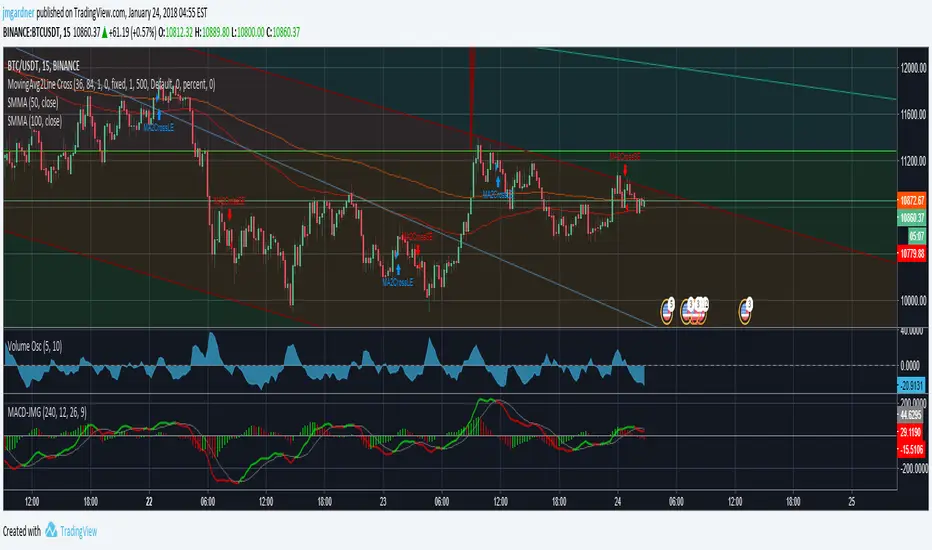
MacD Convergence/DivergenceI made this script to get a line (or histogram) of the macd and the signal (macd + signal), the principle remains the same as with a standard macd. You can notice that the divergences are present, and that the interpretation does not change, personally, I use ema band, which helps me to confirm the tendencies and to detect divergences!

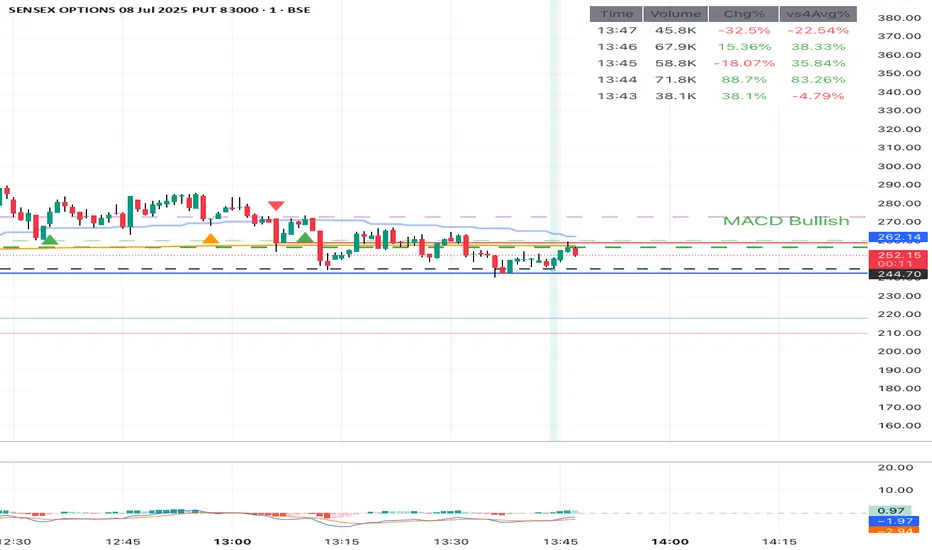
MACD Trend StatusOverview:
The Dynamic MACD Trend Status indicator is a sophisticated yet easy-to-interpret tool designed to provide instant, color-coded insights into the current MACD momentum and trend strength directly on your chart. Unlike traditional MACD indicators that clutter your main price panel, this indicator distills complex MACD calculations into a single, prominent text label, ideal for quick confirmations and fast-paced trading.
It features two distinct logic modes, allowing you to customize its sensitivity and confirmation level, making it adaptable to various market conditions and trading styles.
Key Features & How It Works:
Two Selectable Logic Modes:
This indicator offers a unique dropdown setting (Logic Selection) to switch between two powerful MACD interpretation algorithms:
a) Option 3 (Robust) - (Default)
This is the most stringent and reliable mode, designed to filter out market noise and highlight only strong, accelerating trends. It declares a "Bullish" or "Bearish" status when ALL of the following conditions are met:
Bullish: MACD Line is above Signal Line AND MACD Histogram is positive AND MACD Histogram is increasing (momentum is accelerating) AND both MACD Line and Signal Line are above the Zero Line (confirming an overall uptrend).
Bearish: MACD Line is below Signal Line AND MACD Histogram is negative AND MACD Histogram is decreasing (momentum is accelerating) AND both MACD Line and Signal Line are below the Zero Line (confirming an overall downtrend).
Neutral: If none of the above strong conditions are met, indicating sideways movement, weakening momentum, or a transition phase.
b) Option 4 (Simplified + Enhanced)
This mode offers a more responsive signal while still providing a clear distinction for exceptionally strong moves. It determines status based on:
"MACD Bullish +" (Super Bullish): If all the rigorous conditions of "Option 3 (Robust) - Bullish" are met. This provides an immediate visual cue of extreme bullish strength within the simpler logic.
"MACD Bearish +" (Super Bearish): If all the rigorous conditions of "Option 3 (Robust) - Bearish" are met. This highlights exceptional bearish strength.
"MACD Bullish": MACD Line is above Signal Line AND MACD Histogram is positive (basic bullish momentum).
"MACD Bearish": MACD Line is below Signal Line AND MACD Histogram is negative (basic bearish momentum).
"MACD Neutral": If none of the above conditions are met.
Instant Color-Coded Status:
The indicator provides clear visual feedback through dynamic text colors:
Green: "MACD Bullish" (Standard Bullish)
Red: "MACD Bearish" (Standard Bearish)
Gray: "MACD Neutral" (Choppy/Unclear)
Blue: "MACD Bullish +" (Enhanced Strong Bullish - when using Option 4)
Fuchsia/Purple: "MACD Bearish +" (Enhanced Strong Bearish - when using Option 4)
(Note: Colors for "+" signals are customizable in the code if you wish)
Unobtrusive Display:
The status is displayed in a transparent, discreet table positioned at the middle-right of your main chart panel. This avoids cluttering the top corners or the indicator sub-panel, keeping your price action clear.
Ideal Use Cases:
Quick Confirmation: Rapidly confirm your trade ideas with a glance at the MACD's underlying momentum.
Scalping & Day Trading: The instant visual feedback is invaluable for fast-paced short-term strategies.
Momentum Filtering: Use it to filter trades, ensuring you're entering when MACD momentum is in your favor.
Complementary Tool: Designed to work hand-in-hand with your primary analysis (price action, support/resistance, other indicators). It's not intended as a standalone signal but as a powerful re-confirmation tool.
Customization Options:
MACD Settings: Adjust Fast Length, Slow Length, and Signal Length.
Logic Selection: Toggle between "Option 3 (Robust)" and "Option 4 (Simplified)" for different sensitivities.
Show Status Text: Toggle the visibility of the status text On/Off.
Text Size: Choose from "tiny", "small", "normal", "large", "huge" for optimal visibility.
Important Disclaimer:
This indicator is a technical analysis tool and should be used as part of a comprehensive trading strategy. It is not financial advice. Trading in financial markets involves substantial risk, and you could lose money. Always perform your own research and risk management.
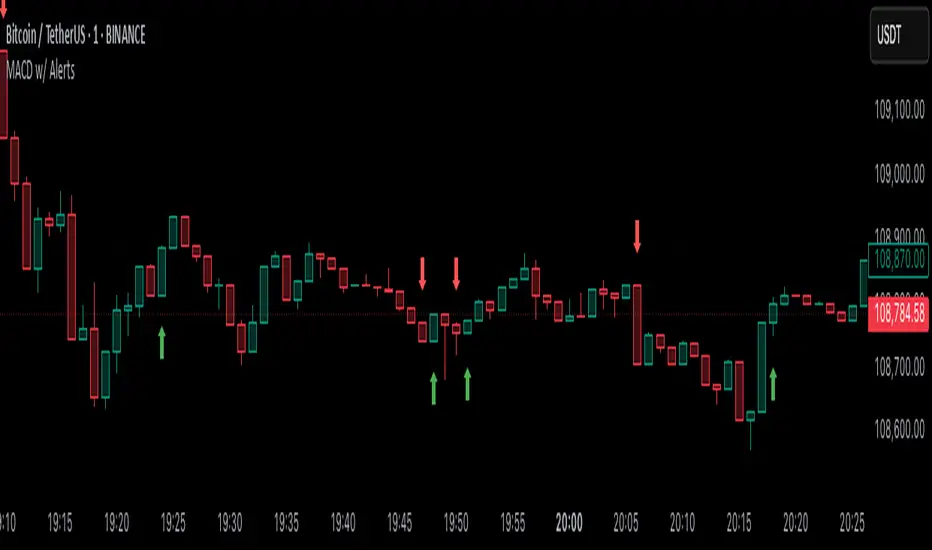
MACD Crossover with Price Action and AlertsThe MACD should use the default parameters (12, 26, 9) for fast EMA, slow EMA, and signal EMA, respectively, applied to the Close price. Instead of simple MACD crossovers, the indicator should analyze price action in relation to the MACD histogram to generate signals. Specifically: 1. BUY signal: Generate a buy signal (an up arrow displayed below the low of the signal bar in green color) when the MACD histogram crosses above zero AND the price action shows a bullish engulfing pattern (the current candle's body completely engulfs the previous candle's body). 2. SELL signal: Generate a sell signal (a down arrow displayed above the high of the signal bar in red color) when the MACD histogram crosses below zero AND the price action shows a bearish engulfing pattern (the current candle's body completely engulfs the previous candle's body). The arrows should be non-repainting, meaning that once an arrow is plotted on a bar, it should not disappear or change position as the chart updates. The indicator should also plot the MACD line, signal line, and histogram using their default calculations. The MACD line should be blue, the signal line should be orange, and the histogram should be displayed using green bars for positive values and red bars for negative values. The indicator should also have customizable inputs for the MACD fast EMA period, slow EMA period, signal EMA period and engulfing pattern check enabled/disabled. If engulfing pattern check disabled, the indicator will generate signals based only on MACD histogram crossing zero.
MACD+ Divergences [CryptoSmart] By IgnotusIndicator Description: MACD+ Divergence
---
Overview
The MACD+ Divergence is an enhanced version of the classic MACD (Moving Average Convergence Divergence) indicator, meticulously crafted by CryptoSmart. This proprietary tool integrates advanced divergence detection, Top Dog Trading MOM (Momentum) and DAD (Direction as Decision) variations, and unique background shading to provide traders with a comprehensive view of market momentum, trend direction, and potential reversals.
This indicator is not just a standard MACD; it incorporates a unique configuration aligned with a proprietary trading strategy developed by CryptoSmart. Its settings and code are restricted to preserve the integrity and effectiveness of the strategy. Traders can leverage this powerful tool to identify high-probability trade setups without constantly monitoring the charts.
---
Key Features
- Proprietary MACD Calculation:
- MACD line calculated using user-defined fast, slow, and signal lengths.
- Supports both Exponential Moving Averages (EMA) and Simple Moving Averages (SMA).
- Includes optimized settings for Top Dog Trading MOM and DAD variations for structured momentum and directional analysis.
- Dynamic Coloring:
- MACD histogram changes color dynamically based on its direction and position relative to the zero line:
- Green/Lime: Increasing momentum above the zero line.
- Red/Maroon: Decreasing momentum below the zero line.
- MACD line and signal line adapt their colors to reflect directional trends.
- Background Shading:
- Background color highlights key conditions:
- Lime: Bullish momentum or upward DAD direction.
- Red: Bearish momentum or downward DAD direction.
- Provides an intuitive visual cue for market sentiment.
- Advanced Divergence Detection:
- Identifies regular and hidden divergences in:
- MACD Histogram.
- MACD Line.
- MOM (Momentum).
- DAD (Direction as Decision).
- Regular divergences indicate potential trend reversals, while hidden divergences suggest trend continuation.
- Divergences are plotted as lines and labeled with clear markers (`R` for regular and `H` for hidden).
- Customizable Inputs:
- Enable or disable specific features, such as:
- Displaying regular or hidden divergences.
- Showing divergence labels.
- Using Top Dog Trading MOM and DAD variations.
- Adjustable offset for divergence markers ensures realistic entry points.
- Comprehensive Alert System:
- Alerts notify traders of key events, including:
- MACD line crossing the signal line.
- Divergence formations (regular and hidden).
- Changes in DAD direction (upward or downward).
- Alerts ensure traders don’t miss critical trading opportunities.
- Unique Configuration:
- Built with a proprietary configuration integrating a proven trading strategy.
- Parameters and logic are fine-tuned to deliver precise signals.
- Restricted code ensures alignment with the proprietary strategy.
- Aesthetic Enhancements:
- Clean and professional design with customizable colors and line styles.
- Optional histogram outlines for better visibility.
---
How It Works
1. MACD Calculation:
- MACD line = Difference between fast and slow moving averages.
- Signal line = Smoothed version of the MACD line.
- Histogram = Difference between the MACD line and signal line.
2. Divergence Logic:
- Fractals identify local highs and lows in the MACD histogram, MACD line, MOM, and DAD.
- Regular divergences occur when price makes a higher high/lower low, but the MACD indicator does not confirm the move.
- Hidden divergences occur when price makes a lower high/higher low, but the MACD indicator confirms the trend continuation.
3. Background Shading:
- Background color changes based on the direction of the MACD histogram or DAD line, providing a quick visual reference for market bias.
4. Alerts:
- Alerts trigger when specific conditions are met, such as divergences forming or the MACD line crossing the signal line.
---
Inputs
- Standard MACD Settings:
- Fast Length: Default = 12
- Slow Length: Default = 26
- Signal Smoothing: Default = 9
- Top Dog Trading Settings:
- Fast Length: Default = 5
- Slow Length: Default = 20
- Signal Smoothing: Default = 30
- Visualization Options:
- Enable/Disable Top Dog Trading MOM and DAD.
- Show regular or hidden divergences.
- Display divergence labels.
- Background shading for momentum/direction.
- Offset Adjustment:
- Adjust divergence markers to align with realistic entry points.
---
Usage
- Trend Reversals:
- Use regular divergences to identify potential trend reversals.
- Trend Continuation:
- Use hidden divergences to confirm ongoing trends.
- Entry/Exit Points:
- Combine divergence signals with MACD crossovers for precise entry and exit points.
- Market Sentiment:
- Monitor background shading to gauge overall market bias.
---
Tips for Traders
Combine with Other Indicators:
- Use this indicator alongside support/resistance levels, candlestick patterns, or volume analysis for confirmation.
Adjust Parameters:
- Experiment with different fast, slow, and signal lengths to suit your trading style and timeframe.
Focus on Divergences:
- Pay close attention to divergence signals, as they often precede significant price movements.
Use Alerts:
- Enable alerts to stay informed about key events without constantly monitoring the chart.
---
Why Choose MACD+ Divergence ?
This indicator stands out due to its unique integration of a proprietary trading strategy, ensuring reliable and actionable signals. The inclusion of Top Dog Trading MOM and DAD variations adds precision, while the advanced divergence detection and alert system make it an indispensable tool for traders seeking an edge in the markets.
---
Restrictions
To maintain the integrity and effectiveness of the MACD+ Divergence , its configuration and code are restricted. This ensures alignment with the proprietary strategy developed by CryptoSmart, delivering consistent and accurate results.
---
Conclusion
The **MACD+ Divergence ** is a cutting-edge tool that combines traditional MACD analysis with advanced divergence detection and proprietary enhancements. Its unique configuration and restricted code ensure it remains a powerful and reliable resource for traders. Whether you’re looking for trend reversals, continuations, or overall market sentiment, this indicator provides the insights needed to make informed trading decisions.
---
Disclaimer
This indicator is for educational and informational purposes only. Trading involves risk, and past performance is not indicative of future results. Always conduct your own research and consult with a financial advisor before making trading decisions.

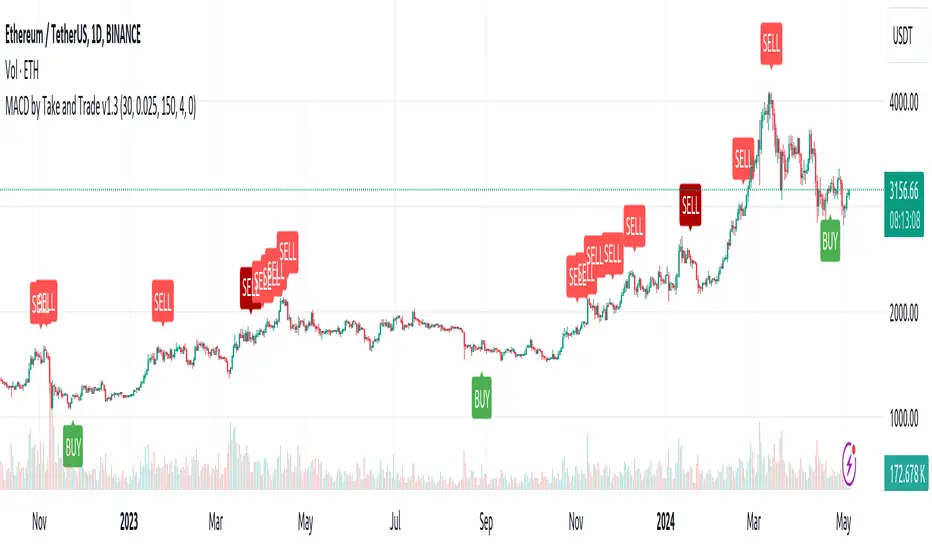
MACD by Take and TradeImproved version of MACD with asymmetrical BUY and SELL approaches.
This indicator is based on popular MACD one, but with some "tricks" designed to make it more applicable to the rapidly changing crypto market.
Key benefits:
Dynamic auto-adjusted threshold to filter out weak signals
Highlighted BUY/SELL signals with divergence (if a signal is accompanied by divergence, for example, price makes a new high while macd has a second high below the first, this signal is considered stronger and will be highlighted in a darker color)
Boost BUY signals on very slow market in accumulation phase
Not symmetric! It uses 2 different signal lines, which allows to obtain SELL signals earlier comparing to classic MACD approach
Classic concept of MACD
Classic MACD, in its simplest case, consists of two lines - macd line and signal line. Macd line is a difference between so-called "fast" and "slow" EMA lines (there are just a Exponential Moving Average lines with different windows: "12" for fast and "26" for slow). Signal line is just a smoothed "macd" line.
When macd line crosses signal line from bottom to up and intersection point < 0, this is "BUY" signal. And vise versa, when macd line crosses signal line from top to bottom, and intersection point > 0, this is "SELL" signal.
Parameters used in default configuration of classic MACD indicator:
Fast line: EMA-12
Slow line: EMA-26
Signal line: EMA-9
Problem of classic concept
Classic MACD indicator usually gives not bad "BUY" signals, especially if using them not for operational trading but for "investment" strategy. But "SELL" signalls usually generated too late. Simply because the market tends to fall much faster than it rises.
Possible solution (the main feature of our version of MACD)
To make indicator react faster on SELL condition, while still keeping it reliable for BUY signals, we decided to use two signal lines . Faster than default signal line (with window=6) for BUY signals and much faster than default (with window=2) for SELL signals.
This approach allowed us to receive sell signals earlier and exit deals on more favorable prices. Trade off of this change - is the number of SELL signals - there were more of them. However, this does not matter, since we receive the very first sell signal with a "very fast signal line" much earlier than with classic indicator settings.
Parameters we use in our improved MACD indicator:
Fast line: EMA-12
Slow line: EMA-24
Faster signal line: EMA-6
Much faster signal line: EMA-2
Removing noise (false triggerings)
Other drawback of classic MACD - it generates a lot of "weak" (false) signals. This signals are generated when macd crosses signal line much close to zero-line. And usually there are a lot of such intersections.
To remove this kind of noise, we added a trigger threshold, which by default is equal to 2.5% of the average asset price over a long period of time. Due to the link to the average price, this threshold automatically takes a specific value for each trading pair. Threshold 2.5% works perfect for all trading pairs for 1D timeframe. For other timeframes user can (and maybe will want) change it.
Boost weak BUY signals in a prolonged bear market
Signals on bearish stage are usually very weak, because there is no volatility, and no price impulse. And such signals will be filtered out as "noise" - see above. But this time is perfect time to buy! Therefore, we further boost the buy signals in a prolonged bear market so that they can pass through the filter and appear on the chart. Bearish period is the best time to invest!
Developed by Take and Trade. Enjoy using it!
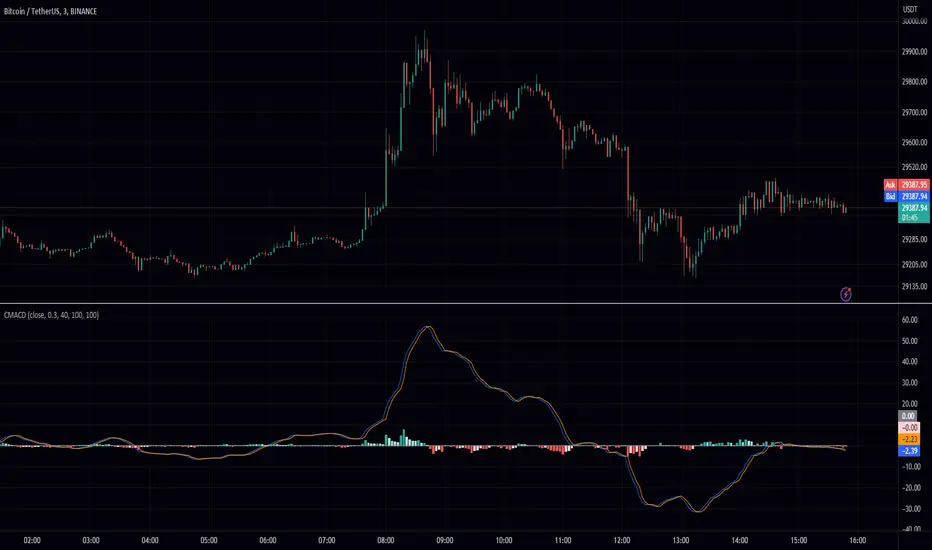
MACD Chebyshev (CMACD)Introducing the Advanced MACD Chebyshev Indicator
Enhanced Convergence Divergence with Gate Compressor for Improved Trading Signals
Introduction
We are excited to introduce a new, advanced Moving Average Convergence Divergence (MACD) indicator that we've developed, called the MACD Chebyshev (CMACD). This innovative indicator uses the dominant period to determine the frequency of the band pass and employs a delayed version of the signal for better convergence divergence. To further enhance the quality of the signals, we've incorporated a gate compressor in the histogram. In this blog post, we will provide an extensive overview of the CMACD indicator, detailing its features and explaining how it works.
The MACD Chebyshev Indicator
The CMACD indicator is based on the well-known MACD indicator, which is a popular technical analysis tool for identifying potential trend reversals in financial markets. The MACD indicator calculates the difference between two Exponential Moving Averages (EMAs) and plots a histogram to represent the convergence and divergence between these EMAs. The CMACD indicator builds on this concept by using the Chebyshev Type I and Type II Moving Averages, which offer superior smoothing and reduced lag compared to traditional EMAs.
The main components of the CMACD indicator are:
1. Signal Line (Blue Line)
2. Delay Line (Orange Line)
3. Histogram (Green and Red bars)
4. Zero Line (Gray Line)
The indicator calculates the difference between the two Chebyshev Moving Averages and plots the histogram based on this difference. The histogram bars change color depending on whether they are above or below the zero line and whether they are growing or falling.
Custom Functions and Features
The CMACD indicator includes several custom functions and features that set it apart from the standard MACD indicator:
1. Dominant Period: The CMACD indicator uses the dominant period to determine the frequency of the band pass. This ensures that the indicator is more responsive to the current market conditions, as it adapts to the dominant cycle in the price data.
2. Delayed Signal: The CMACD indicator employs a delayed version of the signal to provide better convergence divergence. This helps to reduce false signals and improve the accuracy of the indicator.
3. Ripple: The Ripple parameter allows users to adjust the smoothing factor of the Chebyshev Moving Averages. This can be customized to suit individual trading preferences and strategies.
4. Gate Compressor: The CMACD indicator incorporates a gate compressor in the histogram. This unique feature allows users to specify a Percent Rank for the gate signal level, a Gate Ratio, and a Knee Type (either "hard" or "soft"). The gate compressor works by reducing the amplitude of the histogram bars when their absolute value is below the specified threshold. This helps to filter out noise and improve the clarity of the signals generated by the indicator.
Color Scheme
The CMACD indicator features an intuitive color scheme for easy interpretation of the histogram:
1. Green Bars (Above Zero Line): The histogram bars are green when they are above the zero line. The darker green color indicates a growing bar, while the lighter green color represents a falling bar.
2. Red Bars (Below Zero Line): The histogram bars are red when they are below the zero line. The darker red color indicates a growing bar, while the lighter red color represents a falling bar.
Conclusion
The MACD Chebyshev (CMACD) indicator is an innovative and powerful tool for technical analysis, offering superior performance compared to the standard MACD indicator. With its advanced features, such as the dominant period, delayed signal, ripple adjustment, and gate compressor, the CMACD indicator provides more accurate and reliable trading signals. Incorporate the CMACD indicator into your trading strategy today and experience the enhanced convergence divergence for better trading decisions.
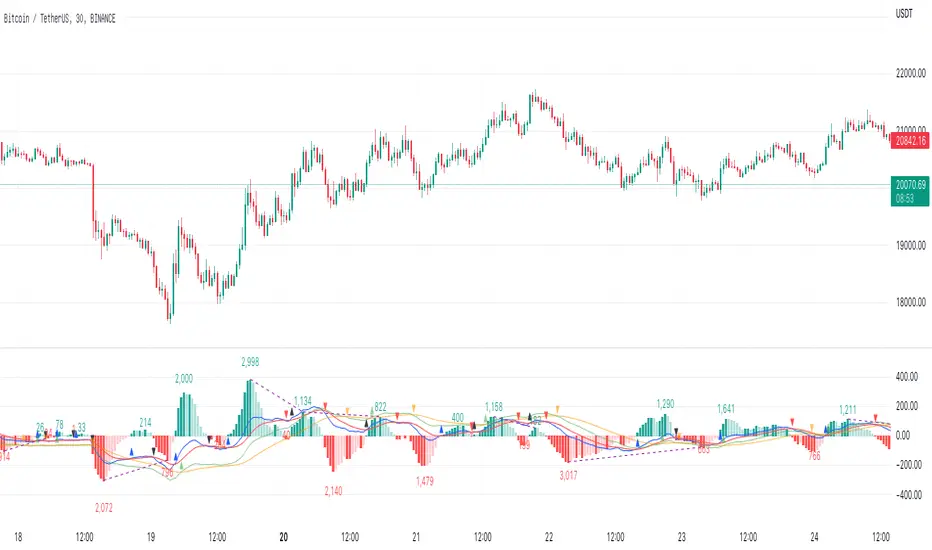
MACD XDThis indicator is based on the classic MACD indicator, and with the following additional features:
1. Another set of MACD and signal lines (green and orange) is added for analyzing a bigger trend in a higher time frame. The default set of MACD and signal lines (red and blue) are used for the smaller trend (current time frame).
2. Small upward and downward triangles are added to mark the golden and death crosses of MACD and signal lines: Blue and red triangles (buy and sell signals) - golden and death crosses of MACD and signal lines for the smaller trend (current time frame), green and orange triangles (buy and sell signals) - golden and death crosses of MACD and signal lines for the bigger trend (a higher time frame).
3. The total areas of histograms above and below the MACD zero axis are calculated and shown by the numbers next to the histogram. This information can be used to analyze the top and bottom divergences of the smaller trend (current time frame).
4. A line connecting peaks of adjacent positive or negative histograms is drawn when top and bottom divergences occur, which indicates a potential trend reversal.
This indicator can be used in the following way: after a golden cross occurs in the bigger trend (green arrow), a death cross in the smaller trend (red arrow) may lead to a potential long entry at the pull back of the bigger up trend; after a death cross occurs in the bigger trend (orange arrow), a golden cross in the smaller trend (blue arrow) may lead to a potential short entry at the pull back of the bigger down trend. Note that in general, golden crosses occur when MACD and signal lines are above the zero axis means a higher high will be made, and death crosses occur when MACD and signal lines are below the zero axis means a lower low will be made. On the contrary, golden crosses occurring below the zero axis or death crosses occurring above the zero axis may only lead to a potential pull back in a trend.
本指标基于经典的MACD指标,适合与缠论指标结合使用:
1. 加入第二组MACD线和信号线,适用于辅助判断缠论中的线段背离。
2. 加入计算直方图(红绿柱子)面积的部分,有助于判断缠论中的笔背离。
3. 标注出两组MACD线与信号线的金叉死叉,以及用特殊颜色表示零轴上方金叉和零轴下方死叉的情况。
4. 用直线标注出顶底背离发生的情况,利于准确分辨和判断。
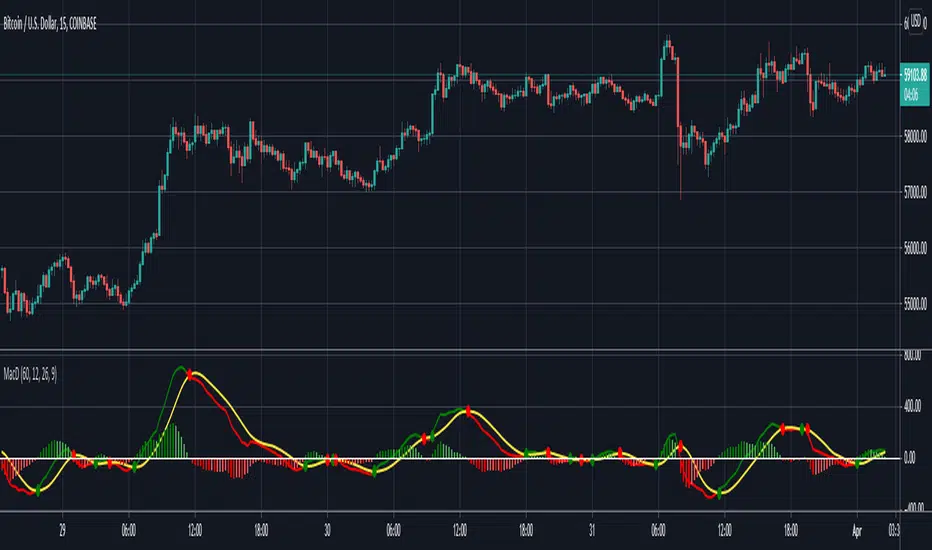
MACD Multi-Timeframe IndicatorHello everyone, this is indicator has always been my go-to MACD indicator for many years. It is such a beautiful easy to understand indicator. You can also view different timeframe resolutions which is helpful. When the MACD crosses up the signal line it is green, and when it crosses below the signal line it is red. The signal line is the constant yellow line. MACD histogram is dark green when increasing buying momentum, and you'll see the green get lighter when buy momentum is decreasing. As well, MACD histogram is dark red when increasing sell momentum, and you'll see the red get lighter when sell momentum is decreasing. I hope you guys love this macd design. Happy trading!
The MACD indicator can be used in many ways but my favorite way to use MACD by itself is by going long when macd < 0 & macd crosses above signal line, and going short when macd > 0 & macd crosses below signal line. I added those alerts for anyone interested.
MACD Trend & Momentum Dashboard (Weighted, 3 TFs)This indicator provides a multi-timeframe MACD trend and momentum dashboard that works independently of your current chart timeframe. It displays MACD zero-line bias and MACD-vs-Signal trend state across three user-selectable timeframes, using clear color-coded cells for instant visual interpretation. A weighted scoring system combines all six signals into a single market bias classification (Strong Bullish → Strong Bearish). This helps traders quickly understand higher- and lower-timeframe alignment, market regime, and overall trend quality. Ideal for trend- and momentum-followers who want a clean, actionable market overview at a glance.

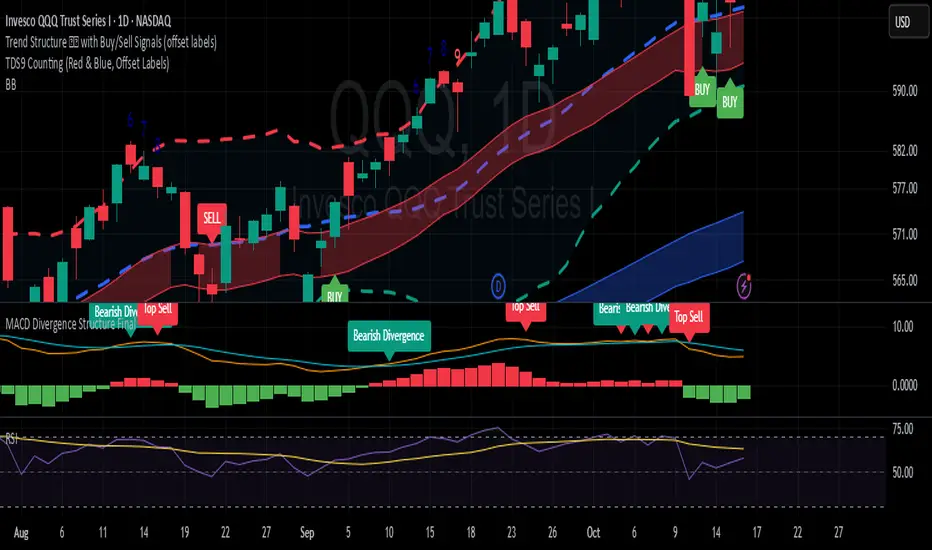
MACD Divergence StructureMACD Divergence Structure Final
This indicator enhances the classic MACD by automatically detecting and labeling key divergence structures. It highlights bullish and bearish divergences, as well as potential sell tops and disappearing tops, directly on the chart. By combining EMA‑based MACD calculations with dynamic label plotting, it provides traders with clear, actionable signals to anticipate possible trend reversals or momentum shifts. Designed for flexibility and clarity, it helps traders quickly spot hidden market structure changes without cluttering the chart.
MACD - Calculated with VWMAThe only difference from the classic MACD is that this one is calculated with VWMA instead of sma.
Why do I prefer it?
Classic MACD does not include volume.
But MACD - VWMA includes volume as well.
How to use it?
Whatever you do with MACD, you can do with this.
However, if my other indicators meet the conditions, I check MACD - VWMA and if I see that Macd is above the signal, I open the position to buy etc. even if it is below zero.
Again, if my other indicators meet the conditions, I use this method.
Enjoy it!

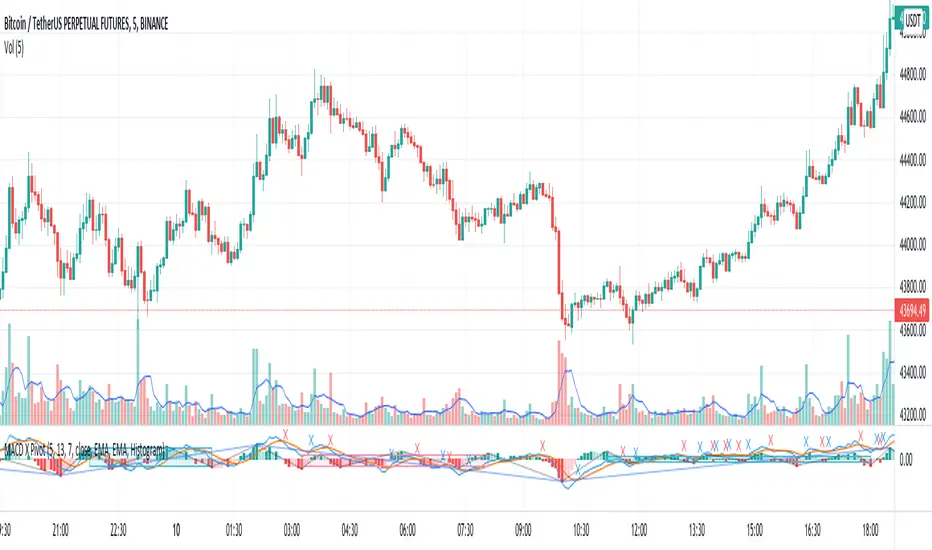
MACD X PivotThe Theory of Entanglement (缠论) is one of the most widely studied trading theories in China, but it is much less known among traders outside. Fractals, strokes, line segments and pivots are basic elements in the Theory of Entanglement. This indicator, MACD X Pivot, applies the concept of strokes, line segment and pivot to the classic MACD indicator and provides a good indication of the exact turning point of a trend based on MACD divergence. Also see a related indicator for applying the Theory of Entanglement on the price chart:
Relations between stroke, line segment and pivot:
• Stroke: Connecting two adjacent top and bottom fractals with at least one candlestick in between.
• Line segment: Consists of an odd number of strokes, at least three strokes are required, and the first three strokes must have overlapping parts.
• Pivot: The part of a trend type at a certain level that is overlapped by at least three consecutive sub-level trend types.
List of drawings on the chart:
1. Blue and red crosses: golden and death crosses between MACD and signal lines.
1. Gray lines: Strokes at the current level.
2. Blue lines: Strokes at a higher level, also line segments at the current level.
3. Blue shaded rectangles: Bullish pivot.
4. Red shaded rectangles: Bearish pivot.
How to use the indicator:
1. The golden cross and death cross between the MACD and signal lines: Blue cross: MACD line crosses up the signal line - buy signal; Red cross: MACD line crosses down the signal line: sell signal.
2. For the bullish blue pivot, the 2nd low (higher low) provides a good indication of the exact turning point from a bearish to bullish trend.
3. For the bearish red pivot, the 2nd high (lower high) provides a good indication of the exact turning point from a bullish to bearish trend.
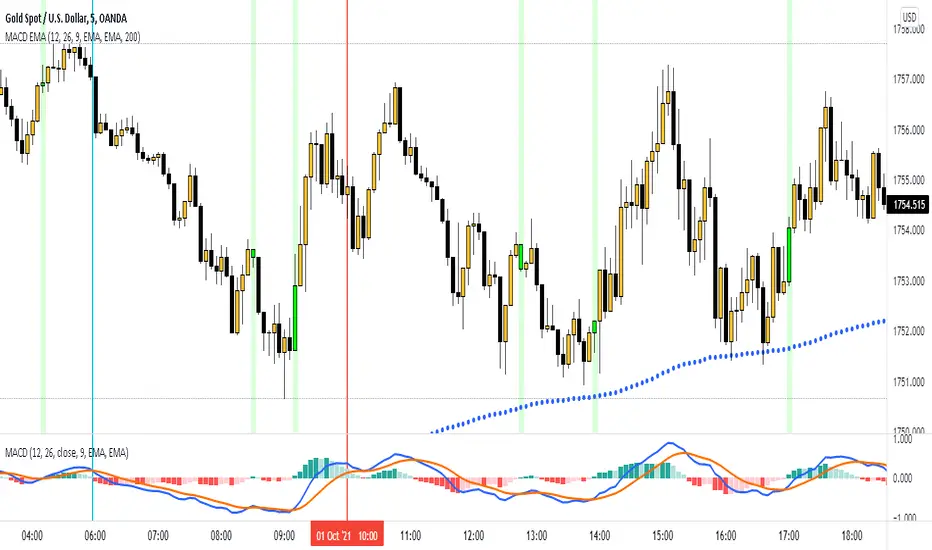
MACD EMA (by WJ)NOTE:
// MACD AND EMA CODE TAKEN FROM DEFAULT INDICATOR
// I HAVE ONLY MADE SOME ADJUSTMENTS FOR VISUAL AID
// I MADE THIS FOR MY OWN USE BUT HAVE DECIDED TO PUBLISH AND SHARE IN CASE ANYBODY WANTS TO USE IT
MACD EMA:
Bar colour and background colour
Buy signal shows when MACD does crossover below 0 line while above EMA (default 200)
Sell signal shows when MACD does crossover above 0 line while below EMA (default 200)
Alert notifications included
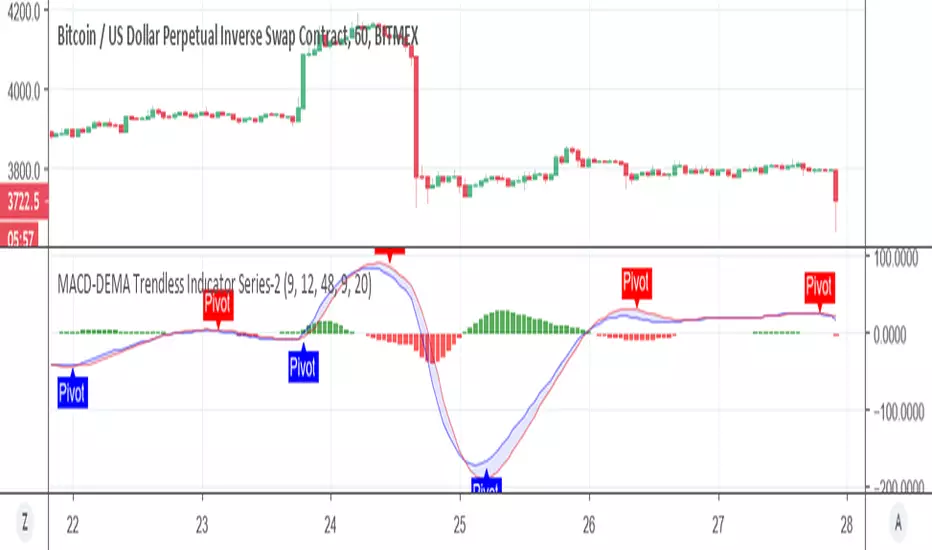
MACD-DEMA Trendless Indıcator Series-2Using This script of MACD DEMA
we play little to add pivot point to the macd so we can get the trend of it better:)
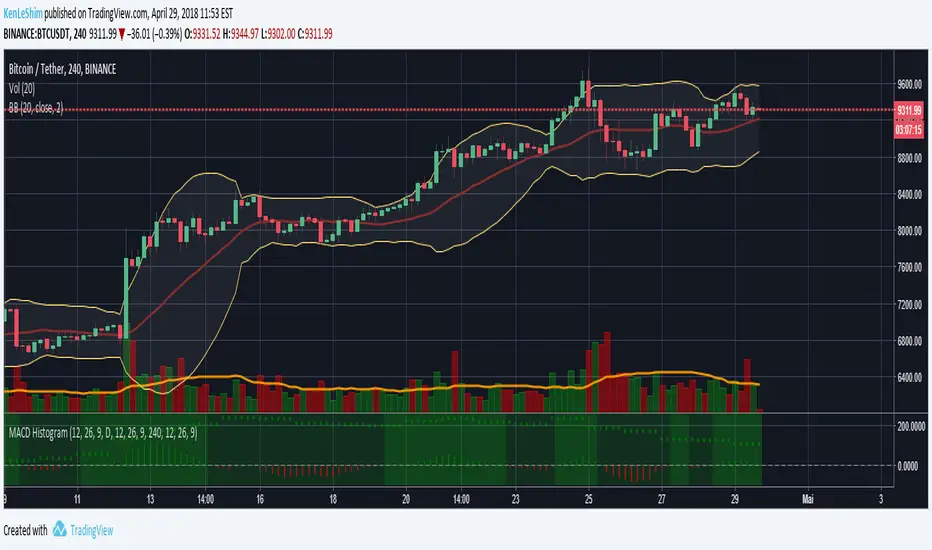
MACD Histogram Multi-TimeframeThe MACD-Histogram represents the difference between the MACD (i.e., the between the two EMAs) and the signal line (i.e., the 9-day EMA of the MACD). The histogram is positive (i.e., above the zero line) when the MACD is above the signal line and negative when the MACD is below the signal line.
HOW IS IT USED ?
A bullish crossover occurs when the MACD histogram is negative and a bearish cross over occurs when the MACD histogram is negative.
I added the possibility to add on the chart a 2nd timeframe for confirmation.
If you found this script useful, a tip is always welcome... :)
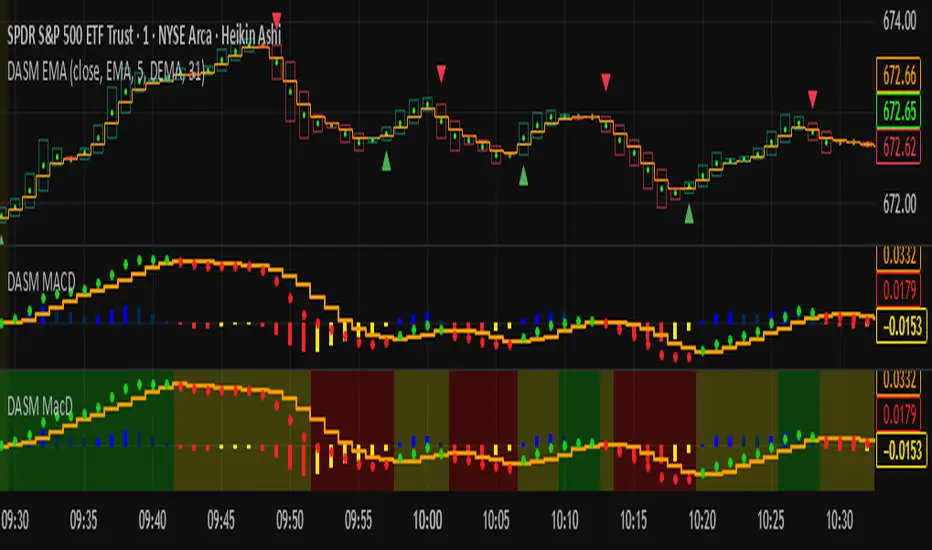
DASM MACDMACD rules:
The main trend is bullish when the MACD is above the zero line, and bearish when it’s below.
The histogram shows when a trend starts and when it’s losing strength.
The background color highlights the trend direction.
The EMA is easy to read — green means buy, red means sell.
For scalping, it’s best used during high-volume hours (9:30–11:00 New York time).
MACD (Buy & Sell signals)This file uses the original code of the MACD and adds a Buy Sell signal when the MACD cuts the signal
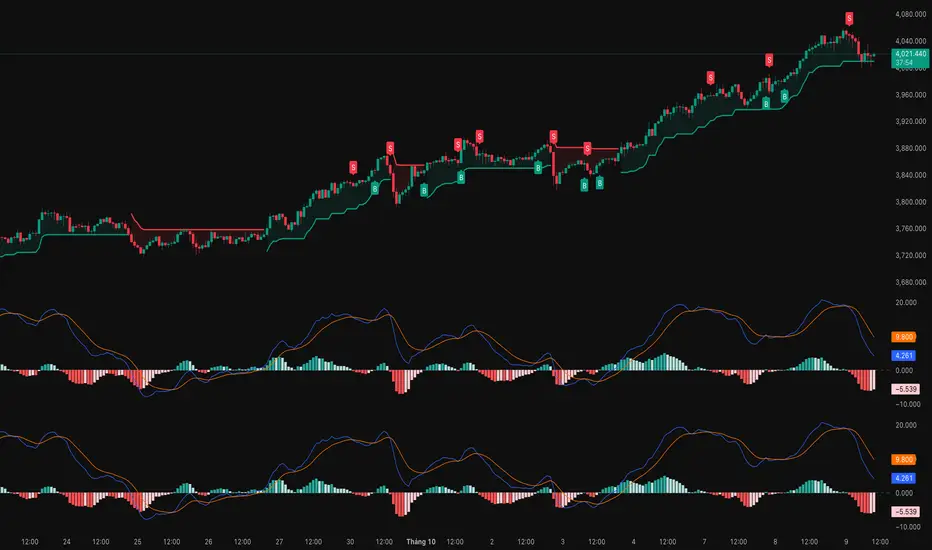
MACD Diff SignalWhen the MACD Absolute Histogram is above a threshold (set by nth lowest absolute histogram value in the rolling window) the indicator produces the MACD Histogram level, otherwise it produces 0. This Indicator is good for identifying bullish or bearish momentum.

MACD x SuperTrend with trailing stoplossThis trading strategy is based on MACD crossover and crossunder. It uses the supertrend to identify the trend it is trading on and takes trades accordingly. You can use the built in risk to reward ratio parameter through the settings of the indicator for your desired R/R
My goal in creating this indicator was to learn about risk management. This indicator will put up a stop-loss and take profit target according to the entry point it shows.
This indicator showed me the best results on BTC at 5min price chart. I'm new to trading so, do your own due diligence

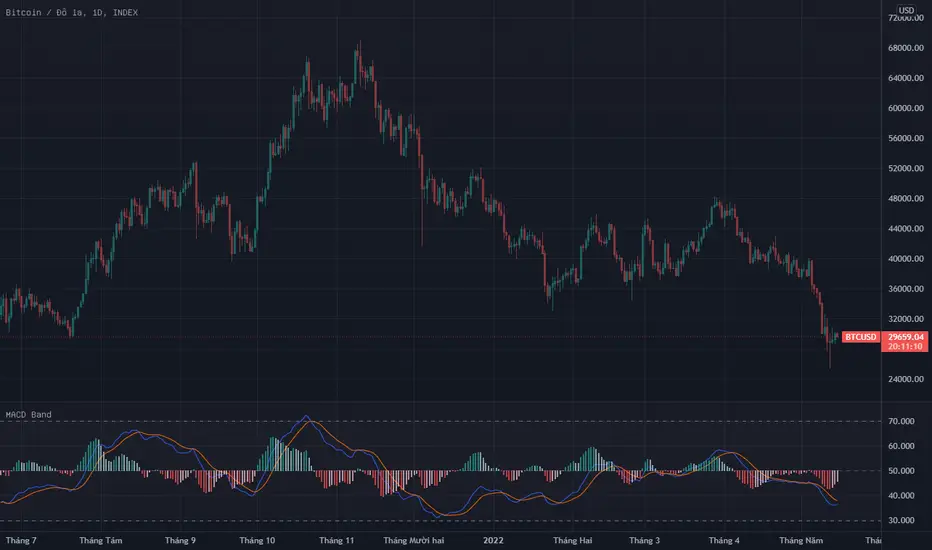
MACD in BANDSMy idea is to make the MACD histogram oscillating in a range from 0-100 just like the RSI .
I did it successfully, but compared to normal MACD histogram it is too low and hard to see because most values just fluctuate slightly above or below 50. So I'm happy and grateful to anyone who can offer guidance.
Image:
MACD for WA1) I updated MACD formula to work with the Elliott Wave Principle
2) I changed the standard parameters and indicator’s display type as default for use in Wave Analysis
1) Актуализировал формулу MACD для работы по Волновому Принципу Эллиотта
2) Изменил по умолчанию стандартные параметры и вид отображения индикатора для использования в Волновом Анализе
