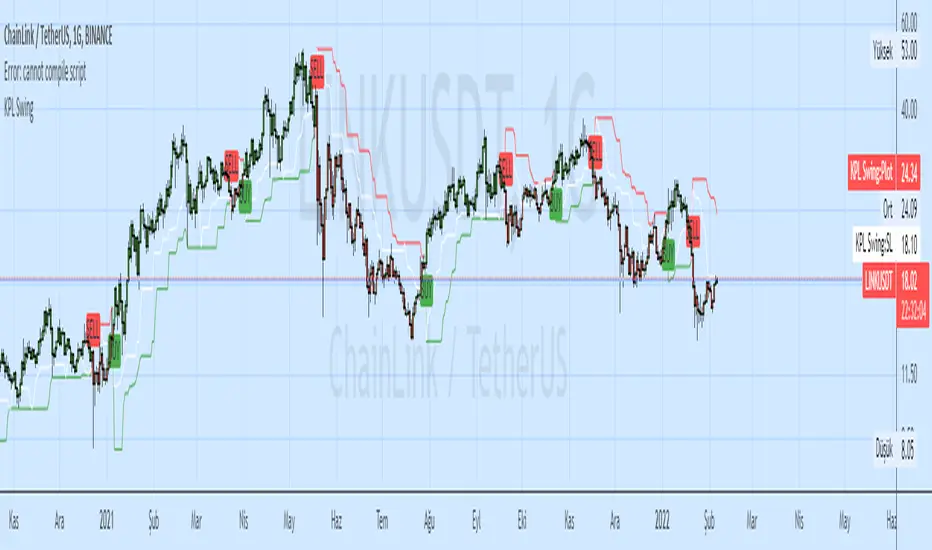
Accurate Swing Trading + Support Resistance MTF (EN)Swing trading setup based on volume and support restistance. use buy main signal for large trend change and for swing trade use buy Pine Script® indicatorby saurebh33329
High Breakout PRO - Huy Hoang Trader # High Breakout PRO - Huy Hoang Trader - Strategy Description ## 🚀 Overview **High Breakout PRO** is a professional-grade Trend Following strategy designed to capture major market moves while strictly managing risk. Built on the core philosophy of "Price Action Breakouts," this script enhances the classic Donchian Channel breakout method with modern risk management tools like the **Hybrid Exit** and **EMA Trend Filter**. This strategy is optimized for **Gold (XAUUSD)**, **Bitcoin (BTC)**, and **Major Stocks (AAPL, AMZN)** on **H4 and Daily** timeframes. ## 💎 Key Features 1. **Trend Filter (EMA):** Only takes long positions when the price is above the 200-period EMA. This filters out counter-trend noise and significantly improves winning probability. 2. **Hybrid Exit Mechanism ("Holy Grail"):** A unique dynamic trailing stop that combines: * **Price Structure:** Uses the lowest low of the last Y bars (Donchian Support). * **Volatility:** Uses ATR-based trailing (Chandelier Exit logic). * *Logic:* The system automatically chooses the **tighter** (higher) stop level between the two, ensuring you lock in profits rapidly during strong volatility while giving the trade room to breathe during accumulation. 3. **Professional Visuals:** A refined "Wealth & Earth" themes (Gold/Silver/Brown) specifically designed to reduce eye strain and provide clear, professional signal visibility without chart clutter. ## 🛠 Strategy Logic ### entry rules * **Breakout:** Price closes above the Highest High of the last `X` bars (Default: 20). * **Trend Confirmation:** Closing Price > EMA 200 (Configurable). ### Exit Rules * **Dynamic Stop Loss:** The trade is closed when price breaches the **Hybrid Trailing Stop**. * The Trailing Stop never moves down. It only moves up as price increases. * It effectively adapts to both slow-grinding trends and explosive spikes. ## ⚙️ Best Settings (Recommended) * **Timeframe:** H4 (Swing Trading) or Daily (Position Trading). * **Entry Period (X):** 20 * **Exit Period (Y):** 10 * **Trend Filter:** ON (EMA 200) * **Risk Management:** Hybrid Mode (ATR Multiplier 3.0) ## ⚠️ Disclaimer This strategy follows trends. It may experience drawdowns during choppy/sideways markets. Always use proper risk management (position sizing) and backtest on your specific asset before live trading. --- *Developed by Antigravity. Empowering traders with institutional-grade tools.* Contact for work: www.facebook.com Pine Script® strategyby ngohuyhoanghcm15
Support & Resistance Automated📌 Support and Resistance Automated (Pivot-Based) Support and Resistance Automated is a lightweight and fully automated indicator that plots key support and resistance levels using pivot highs and pivot lows. It helps traders quickly identify important price reaction zones without manual drawing. This indicator is especially useful for price-action traders, swing traders, and intraday traders who rely on clean charts and objective levels. 🔍 How It Works Pivot Highs → Resistance Levels Pivot Lows → Support Levels Each detected pivot creates a horizontal dotted line that extends forward, allowing you to observe how price reacts over time. Once a level is formed, it is kept permanently on the chart — no repainting, no disappearing levels. ⚙️ Customizable Settings You can easily adjust: Left & Right Pivot Bars – control how strong a pivot must be Line Extension Length Line Width Support & Resistance Colors Show / Hide Pivot Highs and Pivot Lows independently This flexibility allows the indicator to adapt to intraday, swing, or higher-timeframe analysis. ✅ Key Features ✔ Fully automatic support & resistance detection ✔ Based on proven pivot-point logic ✔ No repainting ✔ Clean, minimal chart appearance ✔ Unlimited support & resistance levels ✔ Works on all timeframes & instruments 📈 Best Use Cases Identifying key demand and supply zones Planning entries, targets, and stop-losses Confluence with price action, RSI, moving averages Breakout and rejection-based strategiesPine Script® indicatorby sameer_thorappa82
Bar-Close Confirmed SupertrendOverview This indicator is a Supertrend-style trend follower that confirms direction changes only after a bar closes. Trend flips are determined using the previous bar’s close relative to the bands, which helps avoid intrabar changes during live candles. How it works Computes ATR (Average True Range) Builds upper/lower bands using ATR and a multiplier Updates trend direction only when a prior candle confirms a break of the band Confirmation logic (bar-close based) Trend direction is updated using conditions based on the previous candle, such as: close > upper → confirm uptrend close < lower → confirm downtrend Because signals are confirmed on the prior bar, trend changes and markers are displayed only when confirmation exists. Signals Uptrend confirmation: prior candle closes above the upper band → bullish marker Downtrend confirmation: prior candle closes below the lower band → bearish marker Inputs ATR Length (default 10) ATR Multiplier (default 3.0) Notes This script is intended for bar-close workflows. Behavior and responsiveness may differ across markets and timeframes depending on volatility and chosen settings.Pine Script® strategyby AIScripts16
Quality-Controlled Trend StrategyOverview This strategy demonstrates a clean, execution-aware trend framework with fully isolated risk management. Entry conditions and risk logic are intentionally separated so risk parameters can be adjusted without altering signal behavior. All calculations are evaluated on confirmed bars to ensure backtest behavior reflects real-time execution. Design intent Many scripts mix entries and exits in ways that make results fragile or misleading. This strategy focuses on structural clarity by enforcing: confirmed-bar logic only fixed and transparent risk handling consistent indicator calculations one position at a time It is intended as a baseline framework rather than an optimized system. Trading logic (high level) Trend context EMA 50 vs EMA 200 defines directional bias Entry Price alignment with EMA 50 RSI used as a momentum confirmation, not as an overbought/oversold signal Risk management Stop-loss based on ATR Fixed risk–reward structure Risk logic is isolated from entry logic Editing risk without affecting signals All stop-loss and take-profit calculations are handled in a dedicated block. Users can adjust: ATR length stop-loss multiplier risk–reward ratio without modifying entry conditions. This allows controlled experimentation while preserving signal integrity. Usage notes Results vary by market, timeframe, and volatility conditions. This script is provided for testing and educational purposes and should be validated across multiple symbols and forward-tested before use in live environments. Pine Script® strategyby AIScripts21
MDZ Strategy v4.2 - Multi-factor trend strategyWhat This Strategy Does MDZ (Momentum Divergence Zones) v4.2 is a trend-following strategy that enters long positions when multiple momentum and trend indicators align. It's designed for swing trading on higher timeframes (2H-4H) and uses ATR-based position management. The strategy waits for strong trend confirmation before entry, requiring agreement across five different filters. This reduces trade frequency but aims to improve signal quality. Entry Logic A long entry triggers when ALL of the following conditions are true: 1. EMA Stack (Trend Structure) Price > EMA 20 > EMA 50 > EMA 200 This "stacked" alignment indicates a strong established uptrend 2. RSI Filter (Momentum Window) RSI between 45-75 (default) Confirms momentum without entering overbought territory 3. ADX Filter (Trend Strength) ADX > 20 (default) Ensures the trend has sufficient strength, not a ranging market 4. MACD Confirmation MACD line above signal line Histogram increasing (momentum accelerating) 5. Directional Movement +DI > -DI Confirms bullish directional pressure Exit Logic Positions are managed with ATR-based levels: ParameterDefaultDescriptionStop Loss2.5 × ATRBelow entry priceTake Profit6.0 × ATRAbove entry priceTrailing Stop2.0 × ATROptional, activates after entry The default configuration produces a 1:2.4 risk-reward ratio. Presets The strategy includes optimized presets based on historical testing: PresetTimeframeNotes1H Standard1 HourMore frequent signals2H Low DD2 HourConservative settings3H Optimized3 HourBalanced approach4H Swing4 HourWider stops for swing tradesCustomAnyFull manual control Select "Custom" to adjust all parameters manually. Inputs Explained EMAs Fast EMA (20): Short-term trend Slow EMA (50): Medium-term trend Trend EMA (200): Long-term trend filter RSI Length: Lookback period (default 14) Min/Max: Entry window to avoid extremes ADX Min ADX: Minimum trend strength threshold Risk Stop Loss ATR: Multiplier for stop distance Take Profit ATR: Multiplier for target distance Trail ATR: Trailing stop distance (if enabled) Session (Optional) Filter entries by time of day Recommended OFF for 3H+ timeframes What's Displayed Info Panel (Top Right) Current preset Trend status (Strong/Wait) ADX, RSI, MACD readings Position status Risk-reward ratio Stats Panel (Top Left) Net P&L % Total trades Win rate Profit factor Maximum drawdown Chart EMA lines (20 blue, 50 orange, 200 purple) Green background during strong uptrend Triangle markers on entry signals Important Notes ⚠️ This is a long-only strategy. It does not take short positions. ⚠️ Historical results do not guarantee future performance. Backtests show what would have happened in the past under specific conditions. Markets change, and any strategy can experience drawdowns or extended losing periods. ⚠️ Risk management is your responsibility. The default settings risk 100% of equity per trade for backtesting purposes. In live trading, appropriate position sizing based on your risk tolerance is essential. ⚠️ Slippage and commissions matter. The backtest includes 0.02% commission and 1 tick slippage, but actual execution costs vary by broker and market conditions. Best Practices Test on your specific market — Results vary significantly across different instruments Use appropriate position sizing — Never risk more than you can afford to lose Combine with your own analysis — No indicator replaces understanding market context Paper trade first — Validate the strategy matches your trading style before risking capital Alerts Two alerts are available: MDZ Long Entry: Fires when all entry conditions are met Uptrend Started: Fires when EMA stack first aligns bullish Methodology This strategy is based on the principle that trend continuation has better odds than reversal when multiple timeframe momentum indicators agree. By requiring five independent confirmations, it filters out weak setups at the cost of fewer total signals. The ATR-based exits adapt to current volatility rather than using fixed pip/point targets, which helps the strategy adjust to different market conditions. Questions? Leave a comment below.Pine Script® strategyby VolForgeUpdated 20
Weekly Swing Trading Signals - DP V1.0This script generates swing trading signals on weekly charts based on 200 SMA and RSI values.Pine Script® indicatorby QuantAlphaIN16
Average Directional Index infoAverage Directional Index (ADX) is a technical indicator created by J. Welles Wilder that measures trend strength (not direction!). Values range from 0 to 100. This indicator is a supplementary tool for assessing whether trend strategies are worthwhile, monitoring changes in trend strength and avoiding weak, choppy movements Value Interpretation: 0-25: Weak trend or sideways market 25-50: Moderate to strong trend 50-75: Very strong trend 75-100: Extremely strong trend (rare) Important: ADX does not indicate trend direction (up/down), only its strength! This script indicator includes additional features: 1. ADX Plot (purple line) Basic ADX value showing current trend strength. 2. ADX Trend Analysis (arrows) The script compares current ADX with its 10-period moving average with ±5% tolerance: ↑ (green): ADX rising → trend strengthening ↓ (red): ADX falling → trend weakening ⮆ (gray): ADX stable → trend strength unchanged 3. Information Table Displays current ADX value with trend arrow in the top-right corner. Parameters to Configure Smoothing (default: 14) - Indicator smoothing period Lower values (e.g., 7): more sensitive, more signals Higher values (e.g., 21): more stable, less noise Indicator Length (default: 14) - Period for calculating directional movement (+DI/-DI) Wilder's standard value is 14 Trend Length (default: 10) - Period for moving average to analyze ADX dynamics Determines how quickly changes in trend strength are detected Practical Application ✅ Strategy 1: Trend Strength Filter 1. ADX > 25 → look for positions aligned with the trend 2. ADX < 25 → avoid trend strategies, consider oscillators ✅ Strategy 2: Entries on Strengthening Trend 1. ADX crosses above 25 + arrow ↑ → trend gaining momentum 2. Combine with other indicators (e.g., EMA) for direction confirmation ✅ Strategy 3: Exhaustion Warning 1. ADX > 50 + arrow ↓ → strong trend may be exhausting 2. Consider profit protection or trailing stopPine Script® indicatorby Jawortrader5
Average True Range % infoATR% is a modified version of the classic Average True Range indicator that displays price volatility as a percentage of the instrument's value, rather than in absolute values. This allows you to easily compare the volatility of different assets (e.g., Bitcoin vs Tesla stock) regardless of their price. Main Features 1. ATR% Chart The red line shows the average volatility from the last N candles (default 14), expressed as a percentage. For example: ATR% = 2.5% means that the average daily move is approximately 2.5% of the asset's value Higher values = greater volatility (higher profit potential, but also greater risk) Lower values = lower volatility (calmer market) 2. Volatility Trend Analysis The indicator automatically detects whether volatility is rising, falling, or stable: Up arrow (↑) - volatility is rising (price becomes more "nervous") Down arrow (↓) - volatility is falling (market is calming down) Horizontal arrow (⮆) - volatility is stable (within ±3% of the moving average) 3. Information Table In the upper right corner of the chart you will see Current ATR% value and Trend arrow with color coding: - Green = rising volatility - Red = falling volatility - Gray = stable volatility Parameters to Configure Indicator Length (default: 14) - How many candles back to include in calculations: Lower values (5-10): more sensitive to sudden changes, reacts faster Higher values (20-30): more smoothed, shows long-term volatility picture Trend Length (default: 10) - Period to analyze whether volatility is rising/falling: Lower values: faster trend change signals Higher values: more reliable, but slower signals Sample Interpretations ATR% Volatility Asset Type/Situation < 1% Very low Stable blue-chip stocks, calm market 1-3% Low-medium Typical stocks, normal conditions 3-5% Medium-high Volatile stocks, cryptocurrencies at rest 5-10% High Cryptocurrencies, penny stocks > 10% Extremely high Market panic, crash, pump & dumpPine Script® indicatorby Jawortrader5
VWAP Entry Assistant (v1.0)Description: Anchored VWAP with a lightweight assistant for VWAP reversion trades. It shows the distance to VWAP, an estimated hit probability for the current bar, the expected number of bars to reach VWAP, and a recommended entry price. If the chance of touching VWAP is low, the script suggests an adjusted limit using a fraction of ATR. The VWAP line is white by default, and a compact summary table appears at the bottom-left. Educational tool. Not financial advice. Not affiliated with TradingView or any exchange. Always backtest before use.Pine Script® indicatorby Seaman88Updated 41
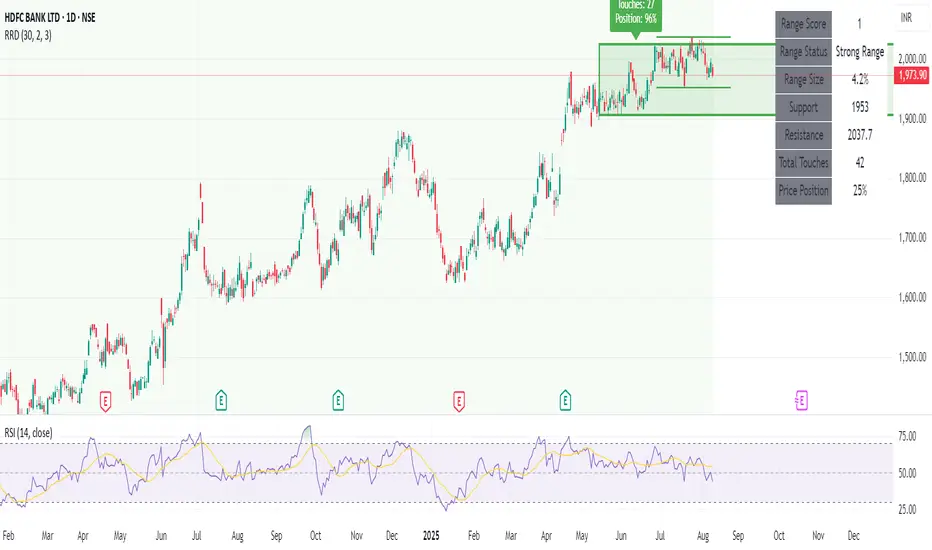
Recent Range DetectorOverview The Recent Range Detector is a specialized indicator designed to identify when an asset is currently range-bound, providing traders with clear support and resistance levels for range trading strategies. Unlike traditional indicators that focus on trend detection, this tool specifically answers the question: "Is the price range-bound right now, and what are the exact trading levels?" Key Features ✅ Smart Range Detection - Uses a multi-factor scoring system to identify legitimate ranges ✅ Dynamic Support/Resistance Levels - Automatically calculates and displays key trading levels ✅ Range Quality Scoring - Provides confidence levels (Strong/Moderate/Weak Range) ✅ Touch Validation - Counts actual price touches to confirm range reliability ✅ Breakout Detection - Alerts when price exits the established range ✅ Visual Clarity - Clean boxes, lines, and labels for easy interpretation How It Works The indicator analyses recent price action using three core metrics: Touch Quality (40%) - How many times price has respected support/resistance levels Containment Quality (40%) - What percentage of recent bars stayed within the range Recent Respect (20%) - Whether the latest price action confirms the range These combine into a Range Score (0-1) that determines range strength and reliability. Settings & Parameters Range Lookback Period (Default: 15) Number of bars to analyse for range detection Shorter periods = more responsive to recent ranges Longer periods = more stable, fewer false signals Range Tolerance (Default: 2.0%) Tolerance for price touches around exact highs/lows Lower values = stricter range requirements Higher values = more flexible range detection Minimum Touches (Default: 3) Required number of support/resistance touches for valid range Higher values = more confirmed ranges, fewer signals Lower values = more sensitive, earlier detection Visual Options Show Range Box: Displays the range boundaries Show Support/Resistance Lines: Extends levels into the future Understanding the Output Range Score (0.000 - 1.000) 0.7+ = Strong Range (Green) - High confidence range trading setup 0.5-0.7 = Moderate Range (Yellow) - Decent range with some caution 0.3-0.5 = Weak Range (Orange) - Low confidence, be careful <0.3 = Not Ranging - Avoid range trading strategies Range Status Classifications Strong Range - Perfect for range trading strategies Moderate Range - Good range with normal risk Weak Range - Marginal range, use smaller positions Not Ranging - Price is trending or too choppy for range trading Key Metrics in Info Table Range Size (%) - Size of the range relative to price level 5-15% = Ideal range size for most strategies <5% = Tight range, lower profit potential >15% = Wide range, higher profit potential but more risk Support/Resistance Levels - Exact price levels for entries/exits Use these as your key trading levels Support = potential buy zone Resistance = potential sell zone Total Touches - Number of times price respected the levels 3-5 touches = Newly formed range 6-10 touches = Well-established range 10+ touches = Very strong, reliable range Price Position (%) - Current location within the range 0-20% = Near support (potential long opportunity) 80-100% = Near resistance (potential short opportunity) 40-60% = Middle of range (wait for better entry) Visual Elements Range Box Green Box = Strong Range (Score ≥ 0.7) Yellow Box = Moderate Range (Score 0.5-0.7) Orange Box = Weak Range (Score 0.3-0.5) Support/Resistance Lines - Horizontal lines showing exact trading levels - Extend into the future for forward guidance - Colour matches the range strength Background Colouring - Subtle background tint during range periods - Helps quickly identify ranging vs trending markets Breakout Signals - 📈 RANGE BREAK UP - Price breaks above resistance - 📉 RANGE BREAK DOWN - Price breaks below support - Only appears for confirmed ranges (Score ≥ 0.5) Trading Applications Range Trading Strategy 1. Look for Range Score ≥ 0.5 2. Buy near support (Price Position 0-20%) 3. Sell near resistance (Price Position 80-100%) 4. Set stops just outside the range 5. Exit on breakout signals Breakout Strategy 1. Identify strong ranges (Score ≥ 0.7) 2. Wait for volume-confirmed breakout 3. Enter in breakout direction 4. Use previous resistance as support (or vice versa) Market Context - Strong ranges often occur after trending moves - Use higher timeframes to confirm overall market structure - Combine with volume analysis for better entries/exits Best Practices What to Look For ✅ Range Score ≥ 0.5 for trading consideration ✅ Multiple touches (5+) for confirmation ✅ Clear price rejection at levels ✅ Reasonable range size (5-15% for most assets) ✅ Recent price respect of boundaries What to Avoid ❌ Trading ranges with Score < 0.3 ❌ Very tight ranges (<3% size) - low profit potential ❌ Ranges with only 1-2 touches - not confirmed ❌ Ignoring breakout signals ❌ Trading against the higher timeframe trend Alerts Available - Range Detected - New range formation - Range Break Up - Upward breakout - Range Break Down - Downward breakout - Range Ended - Range condition ended Timeframe Recommendations - Daily Charts - Best for swing trading ranges - 4H Charts - Good for intermediate-term ranges - 1H Charts - Suitable for day trading ranges - Lower Timeframes - May produce more noise Conclusion The Recent Range Detector eliminates guesswork in range identification by providing objective, quantified range analysis. It's particularly valuable for traders who prefer range-bound strategies or need to identify when trending strategies should be avoided. Remember: No indicator is perfect. Always combine with proper risk management, volume analysis, and broader market context for best results. Disclaimer This indicator is for educational purposes only and should not be considered as financial advice. Trading involves risk, and past performance does not guarantee future results. Always conduct your own research and consider your risk tolerance before making any trading decisions.Pine Script® indicatorby eggubonda148
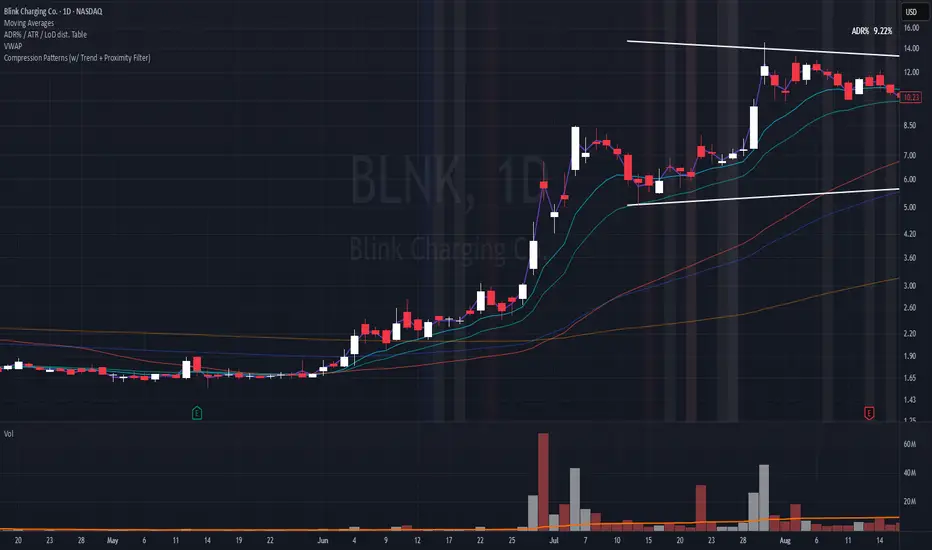
Compression Patterns (w/ Trend + Proximity Filter)🧠 Description: This indicator identifies high-probability price compression patterns within trending environments — a setup prized by experienced swing and day traders alike. It combines the classic NR4, NR7, 2-Bar NR, 3-Bar NR, and Inside Day formations with a powerful trend filter and proximity logic to deliver clear, focused signals. 🔍 What's Inside: ▪️ Compression Patterns The core of this tool lies in the logic of price compression. These patterns signal the market taking a breath — volatility contracts, volume dries up, and price coils like a spring. When this happens in the right context, the next move is often explosive. NR4 / NR7: Narrowest range in 4 or 7 bars — excellent for spotting the quiet before the storm. 2-Bar NR / 3-Bar NR: These identify the tightest consecutive 2 or 3-day ranges over the past 20 days — contextually rare and powerful. Inside Day: A simple but highly effective consolidation pattern, especially when it clusters around key moving averages. ▪️ Trend Filter (EMA Stack) You could say this is where most indicators fall apart — no context. This one doesn’t make that mistake. Signals only fire when the 10 EMA > 20 EMA > 50 EMA, and price is above the 20 EMA. That’s a strong, established uptrend — the only environment where breakouts are statistically favourable. Why? Because trend following works. It may not give you fixed daily returns, but it’s the only strategy with theoretically infinite profit potential. You risk little, trade less, and position yourself for rare but massive moves. That’s the edge. ▪️ Proximity Filter (1 ATR to EMA) We’ve added another layer of discipline. Signals only fire when price is: Within 1 ATR of the 10 EMA (if price is above it), or Within 1 ATR of the 20 EMA (if price is below the 10 EMA) This ensures you’re not chasing. You’re waiting for tight, controlled pullbacks into dynamic support — exactly where institutions add size, not exit. ⚙️ Fully Customisable: Toggle visibility of each pattern Custom colours and transparency for label & background Adjustable ATR length and multiplier Change label text if needed (useful for translations or tweaks) 🎯 Ideal Use Case: Swing trading off the daily chart Day trading with VWAP/MACD filters (in alternate versions) Supplementing price action strategies 🔚 Final Word: This isn’t an “everything scanner.” It’s a discerning sniper scope for traders who wait patiently for clean trends, tight consolidations, and perfect proximity — then strike. Pine Script® indicatorby LordRobrecht86
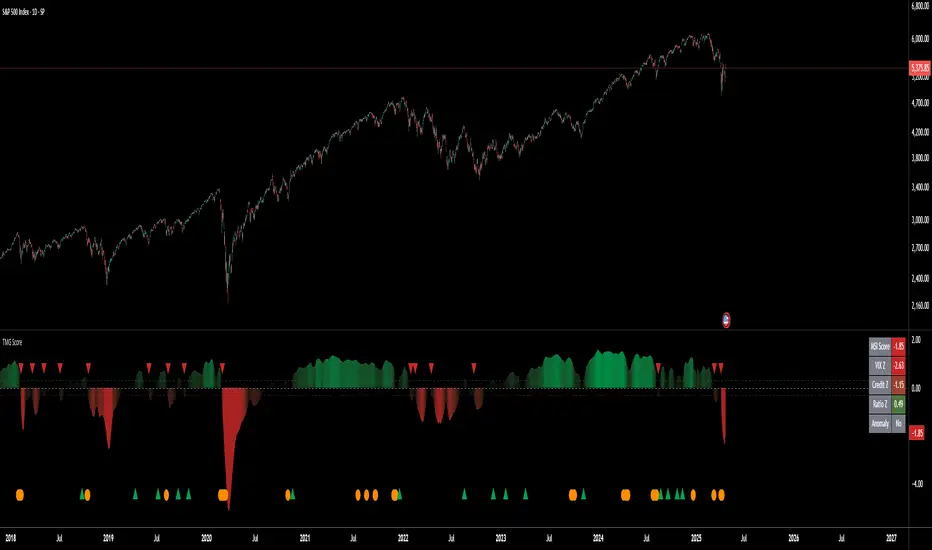
Triad Macro Gauge__________________________________________________________________________________ Introduction __________________________________________________________________________________ The Triad Macro Gauge (TMG) is designed to provide traders with a comprehensive view of the macroeconomic environment impacting financial markets. By synthesizing three critical market signals— VIX (volatility) , Credit Spreads (credit risk) , and the Stocks/Bonds Ratio (SPY/TLT) —this indicator offers a probabilistic assessment of market sentiment, helping traders identify bullish or bearish macro conditions. Holistic Macro Analysis: Combines three distinct macroeconomic indicators for multi-dimensional insights. Customization & Flexibility: Adjust weights, thresholds, lookback periods, and visualization styles. Visual Clarity: Dynamic table, color-coded plots, and anomaly markers for quick interpretation. Fully Consistent Scores: Identical values across all timeframes (4H, daily, weekly). Actionable Signals: Clear bull/bear thresholds and volatility spike detection. Optimized for timeframes ranging from 4 hour to 1 week , the TMG equips swing traders and long-term investors with a robust tool to navigate macroeconomic trends. __________________________________________________________________________________ Key Indicators __________________________________________________________________________________ VIX (CBOE:VIX): Measures market volatility (negatively weighted for bearish signals). Credit Spreads (FRED:BAMLH0A0HYM2EY): Tracks high-yield bond spreads (negatively weighted). Stocks/Bonds Ratio (SPY/TLT): Evaluates equity sentiment relative to treasuries (positively weighted). __________________________________________________________________________________ Originality and Purpose __________________________________________________________________________________ The TMG stands out by combining VIX, Credit Spreads, and SPY/TLT into a single, cohesive indicator. Its unique strength lies in its fully consistent scores across all timeframes, a critical feature for multi-timeframe analysis. Purpose: To empower traders with a clear, actionable tool to: Assess macro conditions Spot market extremes Anticipate reversals __________________________________________________________________________________ How It Works __________________________________________________________________________________ VIX Z-Score: Measures volatility deviations (inverted for bearish signals). Credit Z-Score: Tracks credit spread deviations (inverted for bearish signals). Ratio Z-Score: Assesses SPY/TLT strength (positively weighted for bullish signals). TMG Score: Weighted composite of z-scores (bullish > +0.30, bearish < -0.30). Anomaly Detection: Identifies extreme volatility spikes (z-score > 3.0). All calculations are performed using daily data, ensuring that scores remain consistent across all chart timeframes. __________________________________________________________________________________ Visualization & Interpretation __________________________________________________________________________________ The script visualizes data through: A dynamic table displaying TMG Score , VIX Z, Credit Z, Ratio Z, and Anomaly status, with color gradients (green for positive, red for negative, gray for neutral/N/A). A plotted TMG Score in Area, Histogram, or Line mode , with adaptive opacity for clarity. Bull/Bear thresholds as horizontal lines (+0.30/-0.30) to signal market conditions. Anomaly markers (orange circles) for volatility spikes. Crossover signals (triangles) for bull/bear threshold crossings. The table provides an immediate snapshot of macro conditions, while the plot offers a visual trend analysis. All values are consistent across timeframes, simplifying multi-timeframe analysis. __________________________________________________________________________________ Script Parameters __________________________________________________________________________________ Extensive customization options: Symbol Selection: Customize VIX, Credit Spreads, SPY, TLT symbols Core Parameters: Adjust lookback periods, weights, smoothing Anomaly Detection: Enable/disable with custom thresholds Visual Style: Choose display modes and colors __________________________________________________________________________________ Conclusion __________________________________________________________________________________ The Triad Macro Gauge by Ox_kali is a cutting-edge tool for analyzing macroeconomic trends. By integrating VIX, Credit Spreads, and SPY/TLT, TMG provides traders with a clear, consistent, and actionable gauge of market sentiment. Recommended for: Swing traders and long-term investors seeking to navigate macro-driven markets. __________________________________________________________________________________ Credit & Inspiration __________________________________________________________________________________ Special thanks to Caleb Franzen for his pioneering work on macroeconomic indicator blends – his research directly inspired the core framework of this tool. __________________________________________________________________________________ Notes & Disclaimer __________________________________________________________________________________ This is the initial public release (v2.5.9). Future updates may include additional features based on user feedback. Please note that the Triad Macro Gauge is not a guarantee of future market performance and should be used with proper risk management. Past performance is not indicative of future results.Pine Script® indicatorby Ox_kali57
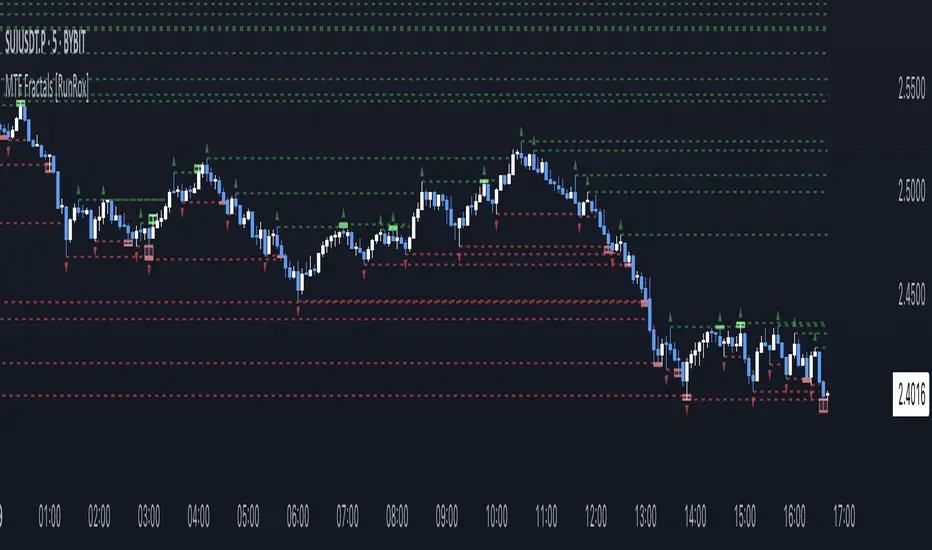
MTF Fractals [RunRox]🔽 MTF Fractals is a powerful indicator designed to visualize fractals from multiple timeframes directly on your chart, highlight liquidity sweeps at these fractal levels, and provide several additional features we’ll cover in detail below. We created this indicator because we couldn’t find a suitable tool that met our specific needs on TradingView. Therefore, we decided to develop a valuable indicator for the entire TradingView community, combining simplicity and versatility. ⁉️ WHAT IS A FRACTALS? In trading, a fractal is a technical analysis pattern composed of five consecutive candles, typically highlighting local market turning points. Specifically, a fractal high is formed when a candle’s high is higher than the highs of the two candles on either side, whereas a fractal low occurs when a candle’s low is lower than the lows of the two adjacent candles on both sides. Traders use fractals as reference points for identifying significant support and resistance levels, potential reversal areas, and liquidity zones within price action analysis. Below is a screenshot illustrating clearly formed fractals on the chart. 📙 FRACTAL FORMATION Here’s how fractals form depending on your chosen setting (3, 5, 7, or 9): ▶️ 3-bar fractal – forms when the central candle is higher (for highs) or lower (for lows) than one candle on each side. ▶️ 5-bar fractal – forms when the central candle is higher or lower than two candles on both sides. ▶️ 7-bar fractal – forms when the central candle is higher or lower compared to the three candles on each side. ▶️ 9-bar fractal – forms similarly but requires four candles on each side, making the fractal significantly more reliable and robust. A higher number of bars ensures stronger fractal levels, highlighting more significant potential reversal points on the chart. Now that we’ve covered the theory behind fractal formation, let’s explore the indicator’s functionality in more detail. Below, I’ll explain each feature clearly and illustrate how you can effectively utilize this indicator in your trading. 🕐 MULTI-TIMEFRAME FRACTALS We realized that displaying fractals only from the current timeframe isn’t always convenient, so we’ve introduced Multi-Timeframe Fractals into this indicator. Now you can easily display fractals from higher timeframes directly on your current chart, providing you with broader market context and clearer trading signals. Fractals from Current Timeframe – Fractals identified directly on the chart’s current timeframe. Fractals from Higher Timeframes – Fractals sourced from higher timeframes and displayed clearly on your current chart for enhanced market perspective. 📈 FRACTAL LINES Since fractals represent areas of high liquidity, we’ve added an option to extend fractal levels horizontally as Fractal Lines across your chart. This feature allows you to clearly visualize critical liquidity areas from higher timeframes, directly on your current timeframe chart, as demonstrated in the screenshot below. With this approach, you can clearly visualize significant fractal levels from higher timeframes directly on your current chart - for example, projecting fractals from the 1-hour (1H) timeframe onto a 3-minute (3m) chart. ✅ This helps you easily identify critical liquidity areas and potential reversal zones without the need to switch between multiple timeframes. 💰 LIQUDITY SWEEP (LIQUDITY GRAB) To enhance your trading experience, we’ve introduced a feature that clearly identifies liquidity sweeps of fractal levels. A Liquidity Sweep occurs when a candle closes beyond a fractal line, leaving a wick that pierces through it, signaling that liquidity has been collected at this level. Below, you’ll find two examples illustrating this functionality: ▶️ Fractal lines from the current timeframe ▶️ Fractal lines projected from higher timeframes The first example illustrates liquidity being swept from fractals on the current timeframe . Here, the candle clearly closes beyond the fractal line, leaving a wick through it. This indicates a liquidity sweep at the fractal level, visually highlighting a potential reversal or continuation opportunity directly on your chart. In the second example, fractals from the higher timeframe are projected onto your current chart. When a candle on your current timeframe closes beyond an HTF fractal line - leaving a wick through this level - the indicator highlights it clearly. This signals to traders a potential reversal zone, indicating that liquidity has been swept, and price may reverse or significantly react from this area. You can also enable the display of additional labels on the chart. These labels clearly mark liquidity sweeps at fractal levels, making it easier to visually identify potential reversal points directly on your chart. ⚙️ SETTINGS Below are the indicator settings with detailed explanations for each parameter. 🔷 Bars in Fractal – Number of candles to the right and left required to form a fractal. 🔷 Fractal Timeframe – Select the timeframe from which you want to display fractals on the current chart. 🔷 Max Age, bars – Number of bars during which the fractal will remain active. 🔷 Show Fractal Line – Display or hide fractal lines. 🔷 Line Style – Choose the style of the line displayed on the chart. 🔷 Line Width – Thickness of the fractal line. 🔷 High Fractal – Style and color of bearish fractals. 🔷 Low Fractal – Style and color of bullish fractals. 🔷 Fractal Label Size – Select the size of fractal labels. 🔷 Show Sweep Labels – Option to display labels when a liquidity sweep occurs. 🔷 Label Color – Color and transparency of the area marked on the chart during a sweep. 🔷 Shade Sweep Area – Show or hide the sweep area shading. 🔷 Area Color – Color and transparency settings for the sweep area. 🔶 We’d love to hear your feedback and any suggestions for additional features you’d like to see in this indicator. We’ll be happy to consider your ideas and continue improving the indicator!Pine Script® indicatorby RunRox1111741
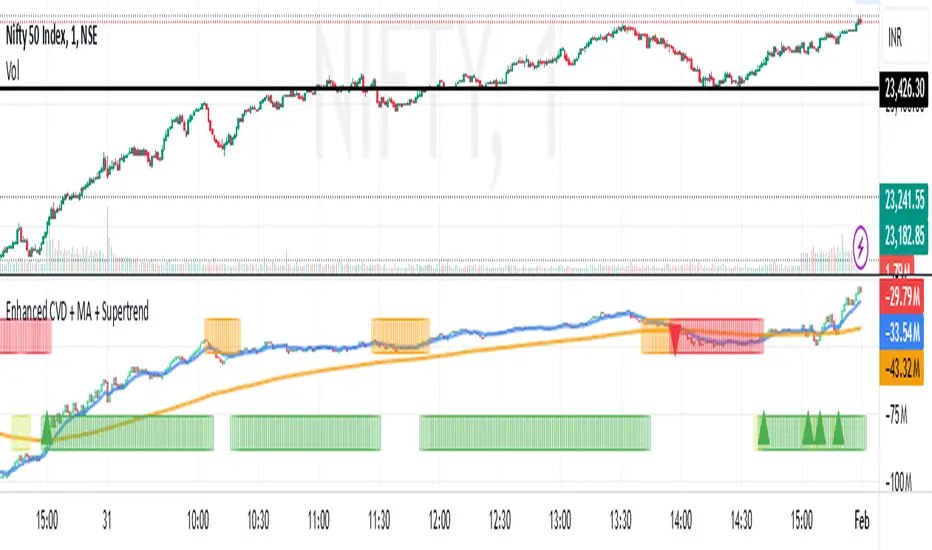
Enhanced Cumulative Volume Delta + MAThe Enhanced Cumulative Volume Delta (CVD) indicator is designed to help traders analyze the cumulative buying and selling pressure in the market by examining the delta between the up and down volume. By tracking this metric, traders can gain insights into the strength of a trend and potential reversals. This indicator uses advanced volume analysis combined with customizable moving averages to provide a more detailed view of market dynamics. How to Use This Indicator: Volume Delta Visualization: The indicator plots the cumulative volume delta (CVD) using color-coded candles, where teal represents positive delta (buying pressure) and soft red represents negative delta (selling pressure). Moving Averages: Use the moving averages to smooth the CVD data and identify long-term trends. You can choose between SMA and EMA for each of the three available moving averages. The first and third moving averages are typically used for short-term and long-term trend analysis, respectively, while the second moving average can serve as a medium-term filter. Arrow Markers: The indicator will display arrows (green triangle up for crossing above, red triangle down for crossing below) when the CVD volume crosses the 3rd moving average. You can control the visibility of these arrows through the input parameters. Volume Data: The indicator provides error handling in case no volume data is available for the selected symbol, ensuring that you're not misled by incomplete data. Practical Applications: Trend Confirmation: Use the CVD and moving averages to confirm the overall trend direction and strength. Positive delta and a rising CVD can confirm an uptrend, while negative delta and a falling CVD indicate a downtrend. Volume Breakouts: The arrows marking when the CVD crosses the 3rd moving average can help you spot potential volume breakouts or reversals, making them useful for entry or exit signals. Volume Divergence: Pay attention to divergences between price and CVD, as these can often signal potential trend reversals or weakening momentum. Pine Script® indicatorby amit16aksUpdated 44420
Fibonacci-Only StrategyFibonacci-Only Strategy This script is a custom trading strategy designed for traders who leverage Fibonacci retracement levels to identify potential trade entries and exits. The strategy is versatile, allowing users to trade across multiple timeframes, with built-in options for dynamic stop loss, trailing stops, and take profit levels. Key Features: Custom Fibonacci Levels: This strategy calculates three specific Fibonacci retracement levels: 19%, 82.56%, and the reverse 19% level. These levels are used to identify potential areas of support and resistance where price reversals or breaks might occur. The Fibonacci levels are calculated based on the highest and lowest prices within a 100-bar period, making them dynamic and responsive to recent market conditions. Dynamic Entry Conditions: Touch Entry: The script enters long or short positions when the price touches specific Fibonacci levels and confirms the move with a bullish (for long) or bearish (for short) candle. Break Entry (Optional): If the "Use Break Strategy" option is enabled, the script can also enter positions when the price breaks through Fibonacci levels, providing more aggressive entry opportunities. Stop Loss Management: The script offers flexible stop loss settings. Users can choose between a fixed percentage stop loss or an ATR-based stop loss, which adjusts based on market volatility. The ATR (Average True Range) stop loss is multiplied by a user-defined factor, allowing for tailored risk management based on market conditions. Trailing Stop Mechanism: The script includes an optional trailing stop feature, which adjusts the stop loss level as the market moves in favor of the trade. This helps lock in profits while allowing the trade to run if the trend continues. The trailing stop is calculated as a percentage of the difference between the entry price and the current market price. Multiple Take Profit Levels: The strategy calculates seven take profit levels, each at incremental percentages above (for long trades) or below (for short trades) the entry price. This allows for gradual profit-taking as the market moves in the trade's favor. Each take profit level can be customized in terms of the percentage of the position to be closed, providing precise control over exit strategies. Strategy Backtesting and Results: Realistic Backtesting: The script has been backtested with realistic account sizes, commission rates, and slippage settings to ensure that the results are applicable to actual trading scenarios. The backtesting covers various timeframes and markets to ensure the strategy's robustness across different trading environments. Default Settings: The script is published with default settings that have been optimized for general use. These settings include a 15-minute timeframe, a 1.0% stop loss, a 2.0 ATR multiplier for stop loss, and a 1.5% trailing stop. Users can adjust these settings to better fit their specific trading style or the market they are trading. How It Works: Long Entry Conditions: The strategy enters a long position when the price touches the 19% Fibonacci level (from high to low) or the reverse 19% level (from low to high) and confirms the move with a bullish candle. If the "Use Break Strategy" option is enabled, the script will also enter a long position when the price breaks below the 19% Fibonacci level and then moves back up, confirming the break with a bullish candle. Short Entry Conditions: The strategy enters a short position when the price touches the 82.56% Fibonacci level and confirms the move with a bearish candle. If the "Use Break Strategy" option is enabled, the script will also enter a short position when the price breaks above the 82.56% Fibonacci level and then moves back down, confirming the break with a bearish candle. Stop Loss and Take Profit Logic: The stop loss for each trade is calculated based on the selected method (fixed percentage or ATR-based). The strategy then manages the trade by either trailing the stop or taking profit at predefined levels. The take profit levels are set at increments of 0.5% above or below the entry price, depending on whether the position is long or short. The script gradually exits the trade as these levels are hit, securing profits while minimizing risk. Usage: For Fibonacci Traders: This script is ideal for traders who rely on Fibonacci retracement levels to find potential trade entries and exits. The script automates the process, allowing traders to focus on market analysis and decision-making. For Trend and Swing Traders: The strategy's flexibility in handling both touch and break entries makes it suitable for trend-following and swing trading strategies. The multiple take profit levels allow traders to capture profits in trending markets while managing risk. Important Notes: Originality: This script uniquely combines Fibonacci retracement levels with dynamic stop loss management and multiple take profit levels. It is not just a combination of existing indicators but a thoughtful integration designed to enhance trading performance. Disclaimer: Trading involves risk, and it is crucial to test this script in a demo account or through backtesting before applying it to live trading. Users should ensure that the settings align with their individual risk tolerance and trading strategy. Pine Script® strategyby Kinji21333200
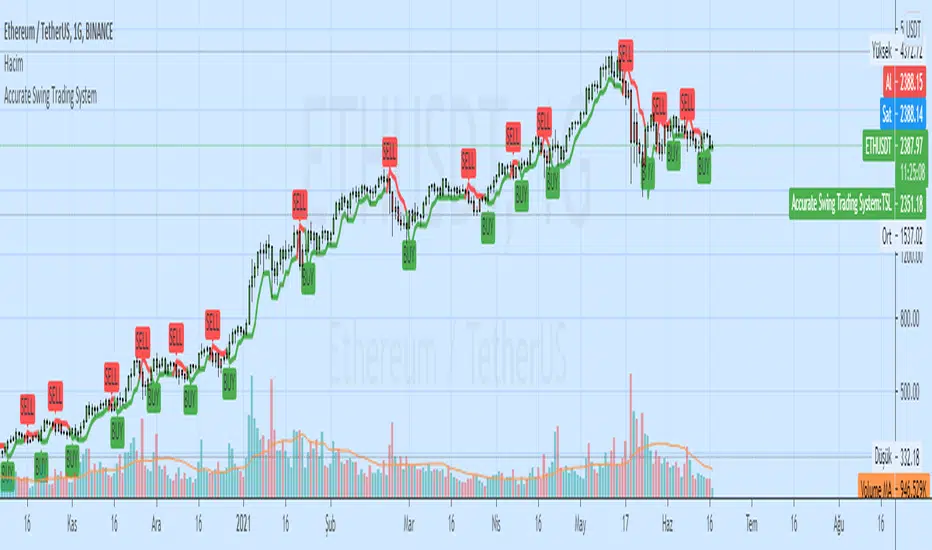
Accurate Swing Trading SystemAccurate Swing Trading SystemPine Script® indicatorby ceyhunUpdated 150150 6.1 K
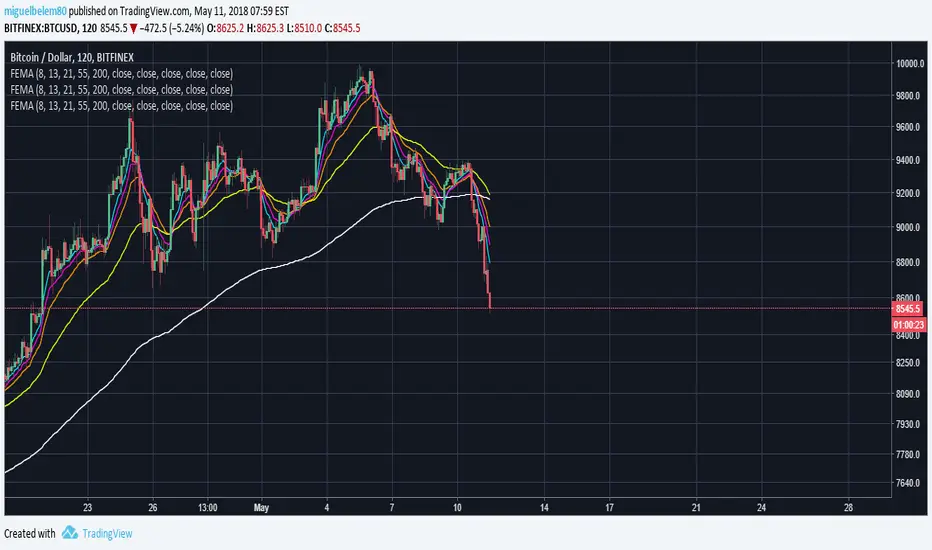
Five Moving Averages Swing TradingPhilakone's Swing Trading Strategy Example ChartPine Script® indicatorby SyferCV88