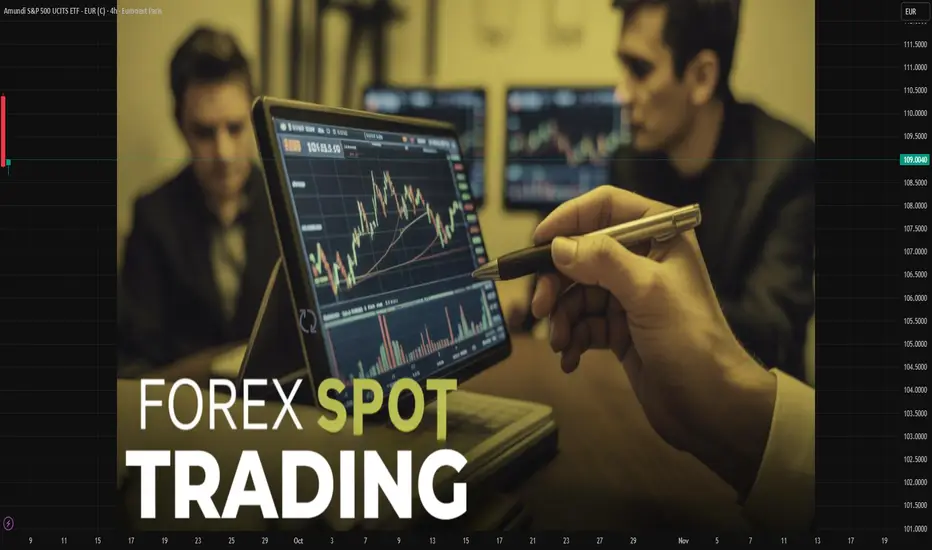
Spot Forex Trading1. Introduction to Spot Forex Trading
In the world of global finance, foreign exchange (Forex) stands as the largest and most liquid market. With a daily trading volume surpassing $7.5 trillion (as per the Bank for International Settlements), the Forex market dwarfs equities, bonds, and commodities
Key stats
About AMUNDI INDEX SOLUTIONS
Home page
Inception date
Mar 22, 2018
Structure
Luxembourg SICAV
Replication method
Synthetic
Dividend treatment
Capitalizes
Primary advisor
Amundi Luxembourg SA
ISIN
LU1681049018
This fund closed on January 10, 2019.
Related funds
Classification
What's in the fund
Exposure type
Electronic Technology
Technology Services
Finance
Stock breakdown by region
Top 10 holdings
Impact of Currency Fluctuations on Global TradeIntroduction
Global trade is the lifeline of the modern economy. It connects countries, industries, and consumers across borders, enabling the exchange of goods, services, capital, and technology. However, at the core of every international transaction lies a critical factor that often gets overloo
OPEC and Global Oil Market StabilityIntroduction
The global oil market is one of the most critical pillars of the world economy. Oil is not only a major source of energy but also a raw material for industries, transportation, and even household consumption. Prices of oil influence inflation, trade balances, and even the geopolitical
Role of WTO in International TradeIntroduction
International trade is the backbone of the global economy. Countries depend on each other for raw materials, technology, consumer goods, and services. To ensure that this complex web of exchanges remains smooth, fair, and beneficial for all, there must be rules, institutions, and mecha
Globalization & Its Impact on World TradeIntroduction
Globalization is one of the most powerful forces shaping our modern world. It refers to the increasing interconnectedness of economies, cultures, societies, and political systems across borders. Over the past few decades, globalization has accelerated, driven by technological progress,
Derivatives & Hedging Strategies1. Introduction
Financial markets are dynamic and uncertain. Prices of stocks, commodities, currencies, and interest rates fluctuate every second, influenced by factors such as economic policies, geopolitical tensions, supply-demand imbalances, and investor sentiment. For businesses, investors, and
See all ideas
Displays a symbol's price movements over previous years to identify recurring trends.
Frequently Asked Questions
An exchange-traded fund (ETF) is a collection of assets (stocks, bonds, commodities, etc.) that track an underlying index and can be bought on an exchange like individual stocks.
AMSPF trades at 132.93 USD today, its price has risen 13.40% in the past 24 hours. Track more dynamics on AMSPF price chart.
AMSPF net asset value is 136.06 today — it's risen 4.07% over the past month. NAV represents the total value of the fund's assets less liabilities and serves as a gauge of the fund's performance.
AMSPF assets under management is 3.68 B USD. AUM is an important metric as it reflects the fund's size and can serve as a gauge of how successful the fund is in attracting investors, which, in its turn, can influence decision-making.
Since ETFs work like an individual stock, they can be bought and sold on exchanges (e.g. NASDAQ, NYSE, EURONEXT). As it happens with stocks, you need to select a brokerage to access trading. Explore our list of available brokers to find the one to help execute your strategies. Don't forget to do your research before getting to trading. Explore ETFs metrics in our ETF screener to find a reliable opportunity.
AMSPF invests in stocks. See more details in our Analysis section.
AMSPF expense ratio is 0.15%. It's an important metric for helping traders understand the fund's operating costs relative to assets and how expensive it would be to hold the fund.
No, AMSPF isn't leveraged, meaning it doesn't use borrowings or financial derivatives to magnify the performance of the underlying assets or index it follows.
No, AMSPF doesn't pay dividends to its holders.
AMSPF trades at a premium (0.45%).
Premium/discount to NAV expresses the difference between the ETF’s price and its NAV value. A positive percentage indicates a premium, meaning the ETF trades at a higher price than the calculated NAV. Conversely, a negative percentage indicates a discount, suggesting the ETF trades at a lower price than NAV.
AMSPF shares are issued by SAS Rue la Boétie
AMSPF follows the S&P 500. ETFs usually track some benchmark seeking to replicate its performance and guide asset selection and objectives.
The fund started trading on Mar 22, 2018.
The fund's management style is passive, meaning it's aiming to replicate the performance of the underlying index by holding assets in the same proportions as the index. The goal is to match the index's returns.