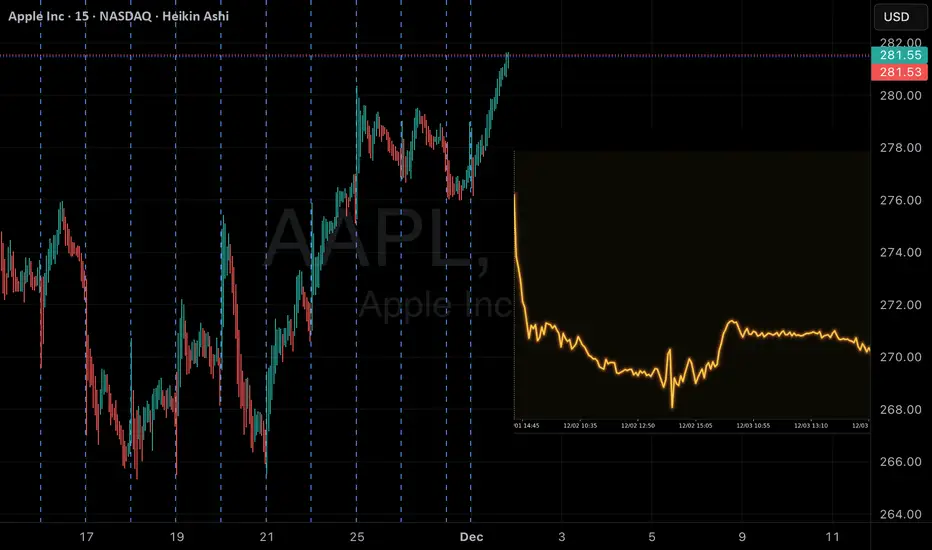
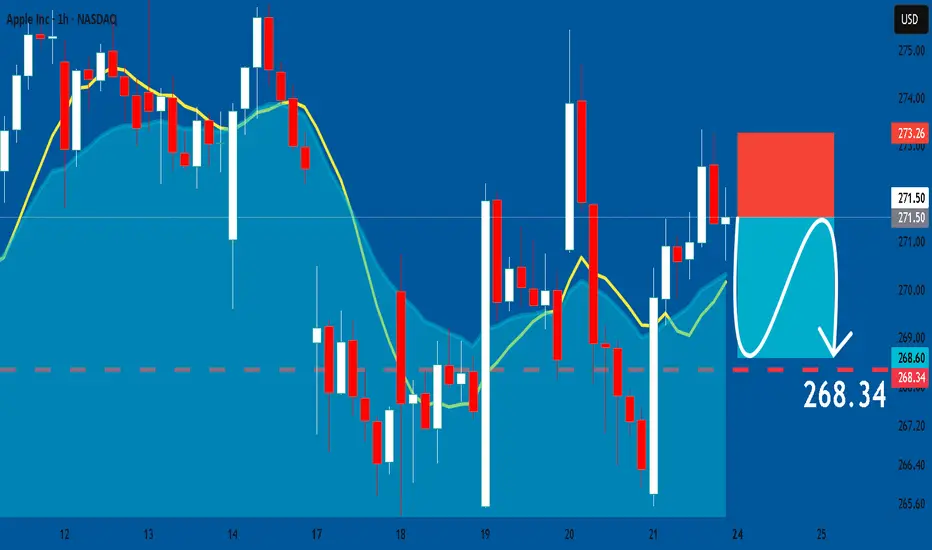
APPLE: Bullish Continuation & Long Signal
APPLE
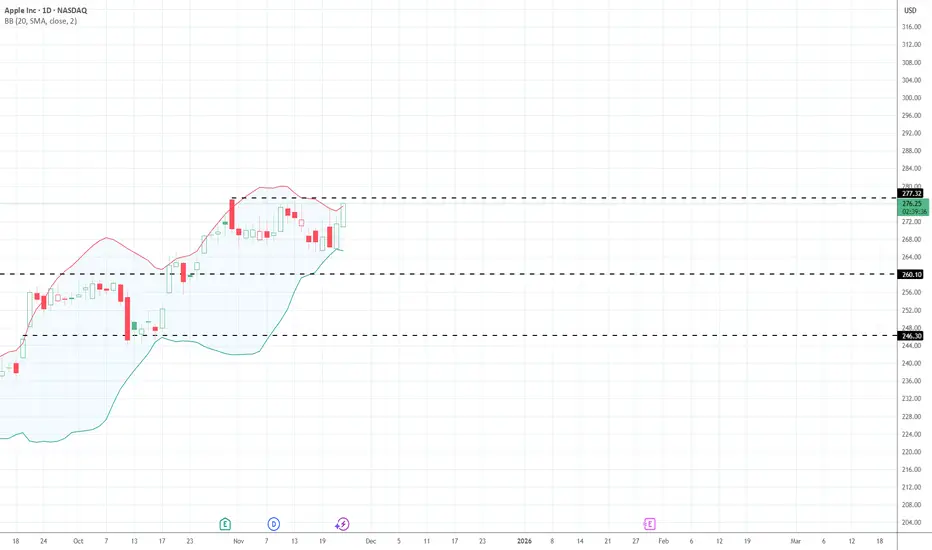
- Classic bullish pattern
- Our team expects retracement
SUGGESTED TRADE:
Swing Trade
Buy EURUSD
Entry - 278.78
Stop- 276.72
Take - 282.17
Our Risk - 1%
Start protection of your profits from lower levels
Disclosure: I am part of Trade Nation's Influencer program and receive a monthly fee for using their TradingView charts in my analysis.
❤️ Please, support our work with like & comment! ❤️
Trade ideas
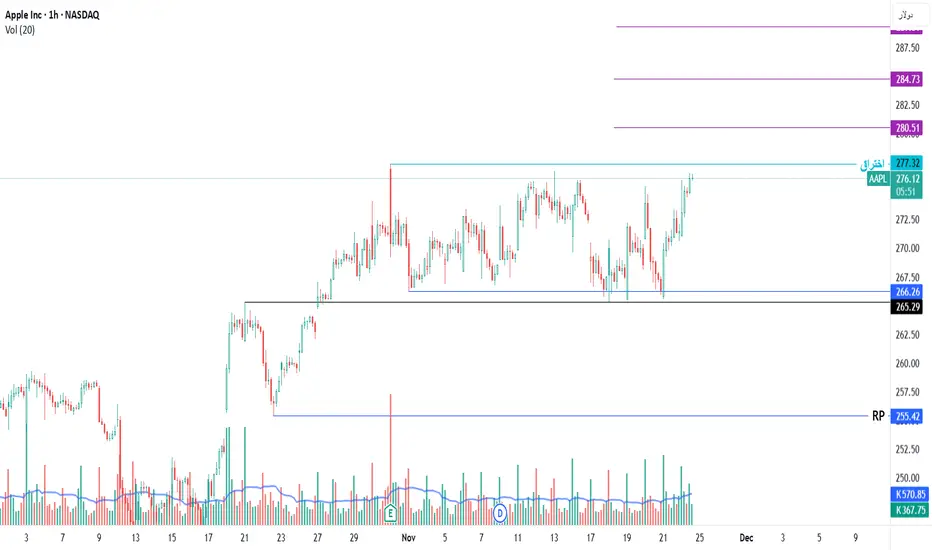
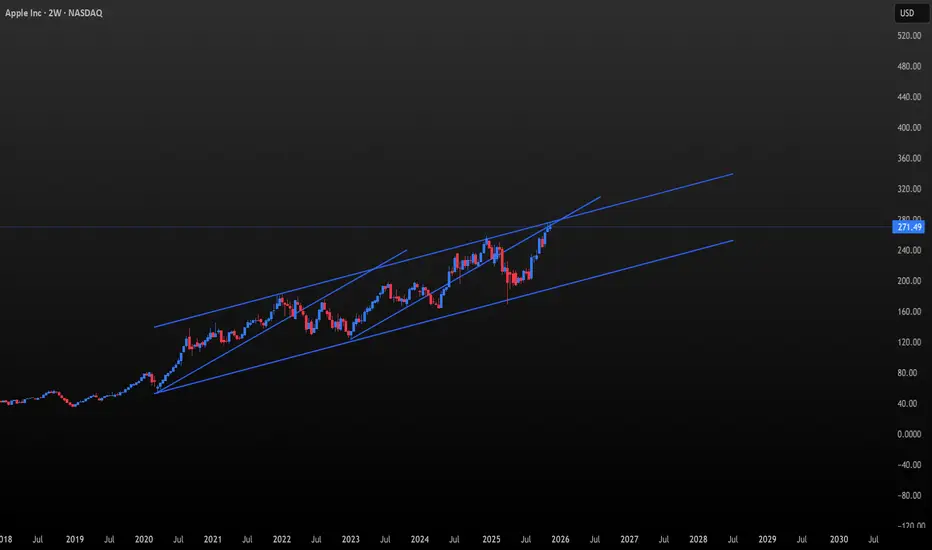
AAPL worth watching into the new yearApple Inc. has been rising steadily recently due to high iPhone demand and strong services growth (among other things), but it just hit the ceiling of a massive channel that goes back multiple years. This stock is worth watching into Christmas and the new year as it is likely to pull back or consolidate into the holidays.
Global Market Time Zone Arbitrage1. What Is Time Zone Arbitrage?
Time zone arbitrage refers to exploiting temporary mispricing in financial instruments caused by non-overlapping market hours. For example:
The U.S. market closes when the Asian markets are asleep.
The European market opens before the U.S., but after Asia has already moved.
Commodity futures in the U.S. may reflect global sentiment before Asian equity markets reopen.
These gaps create windows where prices adjust with a delay, allowing arbitrageurs to act quickly and capture profits.
The concept relies on the fact that markets, although globally integrated, respond to information at different times, and liquidity varies across sessions. This gives rise to price distortions that can be exploited for profit.
2. Why Time Zone Differences Create Arbitrage Opportunities
Several factors contribute to these opportunities:
A. Information Lag
When important economic data or geopolitical news is released during the closing hours of one market, the impact may not be priced into another market until it opens. Examples:
U.S. Federal Reserve announcements occur late in Asian hours.
European inflation data releases affect U.S. futures before cash markets open.
Traders who act early benefit from this information time lag.
B. Liquidity Imbalances
Liquidity varies across time zones. For example:
Asian markets often have lower liquidity for U.S.-linked ETFs.
Pre-market and after-hours trading in U.S. equities is less liquid, leading to wider spreads.
European market open tends to see high liquidity as it overlaps with Asian close.
Lower liquidity often leads to temporary distortions in pricing, ideal for arbitrage strategies.
C. Market Sentiment Spillover
Global sentiment travels through markets based on opening times:
Asian sell-offs usually influence the European open.
European movements influence U.S. futures.
U.S. closing trends flow into the next Asian session.
This chain reaction allows traders to anticipate moves and position themselves accordingly.
D. Different Valuation Models Across Regions
Investors in different regions may weigh information differently.
For example:
U.S. tech stocks heavily influence global sentiment, but Asian tech ETFs priced in local currencies may react with a delay.
European energy companies may react differently to U.S. crude price moves than American companies.
These valuation differences create price gaps.
3. Types of Time Zone Arbitrage
1. Cross-Market Equity Arbitrage
This involves using price movements in one market to predict movements in another.
Example:
U.S. NASDAQ falls 3% overnight.
Asian tech-heavy indices like Nikkei or Hang Seng tend to gap down at open.
Traders position themselves early to capture the expected gap.
2. ETF–Underlying Asset Arbitrage
Many global ETFs trade in the U.S., even when their underlying markets are closed.
Example:
The iShares MSCI Japan ETF (EWJ) trades in U.S. hours.
If EWJ falls after the Tokyo Stock Exchange closes, traders anticipate Tokyo will open lower.
Institutions buy or short the ETF after hours, then hedge positions when the underlying market opens.
3. Currency-Futures Arbitrage
Foreign exchange markets operate 24/5, but liquidity shifts across regions.
Example:
Strong U.S. economic data strengthens the USD late in U.S. hours.
Asian markets may adjust sharply at open using this new information.
Futures on currency pairs (e.g., JPY/USD) can show early reactions that are not yet reflected in related equity markets.
4. Commodity–Equity Arbitrage
Commodities like gold, oil, and copper trade nearly 24/7.
Copper price drops in the U.S. session might not immediately reflect in mining stocks in Australia until their market opens.
These mismatches create short-term arbitrage chances.
5. Index Futures vs. Cash Market Arbitrage
Index futures trade almost continuously, while cash equity markets operate only during specific hours.
Example:
S&P 500 futures drop at 2 AM during Asian hours.
Asian markets react immediately.
U.S. cash market does not reflect this drop until the New York open.
This delay produces opportunities for traders watching futures across time zones.
4. Practical Examples of Time Zone Arbitrage
A. U.S. Market Influence on Asia
Let’s say:
U.S. S&P 500 closes down 2% due to weak jobs data.
Asian markets are closed during the news release.
Asia opens and gaps down dramatically.
Traders monitoring U.S. data can pre-position in futures or ADRs (American Depositary Receipts).
B. European Market Influence on U.S. Pre-Market
Suppose:
ECB announces an unexpected rate cut at 12:45 PM CET.
U.S. markets are still hours from opening.
U.S. futures move first, followed by cash markets during the opening bell.
Knowledgeable traders arbitrage these price changes before U.S. markets react fully.
C. Gold Arbitrage Between U.S. and Asian Markets
Gold is priced globally, but miners operate regionally.
Example:
COMEX Gold drops at midnight Indian time.
Indian gold-linked equities and ETFs adjust only at market open.
This lag is a profitable window.
5. Risks In Time Zone Arbitrage
While lucrative, the strategy carries risks:
A. Unexpected News Before Market Open
Markets can reverse due to:
Overnight geopolitical events
Emergency press conferences
Central bank surprises
These can eliminate expected gaps.
B. Currency Volatility
When arbitraging international assets, currency swings can cut or reverse profits.
C. Liquidity Risks
After-hours markets often have:
Low volume
Wider spreads
High slippage
This makes execution tricky.
D. Overcrowding of Trades
Institutions and algorithms aggressively exploit these inefficiencies. When too many traders take the same position, the arbitrage window closes quickly.
6. Why Time Zone Arbitrage Still Exists Today
Despite globalization, arbitrage opportunities persist because:
Not all markets operate 24/7.
Retail sentiment spreads slower than institutional news.
Economic data releases are timed for specific countries.
Policy decisions occur during local business hours.
ETFs allow price discovery even when cash markets are shut.
These structural features ensure that time zone arbitrage will continue to remain relevant.
7. Conclusion
Global market time zone arbitrage is a sophisticated trading strategy that leverages asynchronous market hours, delayed price adjustments, and global sentiment flows. While technology has reduced many inefficiencies, markets still respond locally to global news at different times, and liquidity remains uneven across sessions. By understanding how information travels from Asia to Europe to the U.S. and back again, traders can identify profitable windows where prices have not fully adjusted.
However, success in time zone arbitrage requires speed, precision, risk management, and a deep understanding of global macroeconomics. For well-prepared traders, it remains a valuable tool for capturing short-term profits in an interconnected yet time-segmented financial world.
AAPL Weekly Put Play – High-Probability Reversal Setup AAPL Weekly Signal | 2025-12-01
Instrument: AAPL
Signal Type: Weekly Swing
Direction: BUY PUTS (SHORT)
Confidence: 58%
Conviction Level: Speculative
Expiry: 2025-12-05 (4 days)
Recommended Strike: $280.00
Entry Price: $1.24 (midpoint)
Profit Target 1: $2.48 (100% gain)
Profit Target 2: $3.72 (200% gain)
Stop Loss: $0.62 (50% loss)
Position Size: 2% of portfolio (speculative due to low conviction)
Weekly Momentum: NEUTRAL (+0.82%)
Options Flow: Bearish (High Put/Call Ratio, 1.78)
Risk Level: HIGH – low confidence, short expiry, high theta decay, overbought RSI
Analysis Summary:
Katy AI Prediction: Downward trend from $281.12 → $278.32 (-1.05%), with 78% of predictions below current price. Average target $277.71 (-1.21%).
Technical: Extremely overbought (RSI 83.8), VWAP support $277.96, near weekly high (96% range).
News/Market Context: Neutral to slightly negative; Silver squeeze and rising yields create pressure.
Options Flow: Institutional puts heavily bought; maximum volume at $228 put.
Key Notes:
Weekly directional guidance suggested BUY CALLS, but Katy AI shows strong bearish trajectory.
Extreme caution due to low AI confidence (50%) and short expiry.
Consider partial profits at Target 1 to mitigate theta decay.
Stop loss at 50% to limit downside.
What others are not going to tell ou about Bitcoin [weekly analy📉 Bitcoin Correction & Crypto Market Analysis — Dec 2025
YouTubers, I have a channel on Trading View — don’t forget to subscribe! In this video, I share my thoughts on Bitcoin and why I call the recent move a correction, not a meltdown. Many holders are upset, but as I’ve shown in previous videos, Bitcoin formed five Elliott Waves, broke a trend line, and went parabolic — faster than most could catch.
What I Cover:
Bitcoin price testing the SMA & EMA on weekly and daily charts
Why a rising wedge suggests the price could go lower before moving up
Analysis of XRP and its potential double top formation
Overview of major forex pairs, including Euro/USD and Aussie Kiwi
Technical check on S&P 500 & major stocks: Microsoft, Meta, Amazon, Tesla, and Apple
My realistic take on bullish vs. bearish possibilities — 60% bearish, 40% bullish for stocks
Guidance on how to read charts carefully and avoid hype-driven decisions
⚠️ Disclaimer: This is not financial advice. I’m sharing my personal analysis and ideas — do your own research before making any decisions.
Subscribe and stay tuned if you want to learn real market insights and profit from careful technical analysis.
Overview of Global Financial Markets1. Structure and Types of Financial Markets
Financial markets are broadly classified into capital markets, money markets, and derivatives markets.
Capital markets are designed for long-term funding and include the equity markets, where companies raise capital by issuing shares, and the bond markets, where governments and corporations raise funds through debt instruments. Equity markets, such as the New York Stock Exchange (NYSE) and the London Stock Exchange (LSE), provide platforms for investors to trade shares, influencing corporate governance and investment flows. Bond markets, by contrast, serve as a critical tool for raising long-term financing at relatively lower costs.
Money markets deal with short-term debt instruments, generally with maturities of less than one year. These include Treasury bills, commercial papers, and certificates of deposit. Money markets provide liquidity management tools for governments, financial institutions, and corporations. Their importance is particularly highlighted during periods of financial stress, where central banks often intervene to stabilize short-term interest rates.
Derivative markets involve financial instruments whose value is derived from underlying assets such as stocks, bonds, currencies, or commodities. Derivatives include futures, options, and swaps, which are extensively used for hedging risks or speculative purposes. These markets play a crucial role in risk management but also introduce complexities and systemic risks, as observed during the 2008 financial crisis.
2. Key Components and Participants
Global financial markets comprise a variety of participants, including retail investors, institutional investors, banks, insurance companies, hedge funds, and sovereign wealth funds. Institutional investors often dominate trading volumes and have significant influence over market movements due to the scale of their investments. Central banks, as regulators and participants, shape market expectations through monetary policies, liquidity management, and intervention in currency and bond markets.
Financial intermediaries, such as investment banks, brokers, and asset managers, facilitate market operations by providing liquidity, price discovery, and risk management services. Their role is critical in connecting borrowers and lenders, particularly in capital markets, ensuring efficient allocation of resources.
3. Role of Global Financial Markets
Global financial markets perform several vital economic functions:
Capital Allocation – They enable businesses, governments, and other entities to mobilize resources for productive investments. Efficient allocation ensures that capital flows to the most promising sectors, fostering innovation, economic growth, and employment generation.
Price Discovery – Through the interaction of supply and demand, financial markets determine prices for financial instruments, which reflect market expectations, risk perceptions, and macroeconomic conditions.
Liquidity Creation – Markets provide mechanisms for investors to convert assets into cash quickly, offering flexibility and reducing financial frictions.
Risk Management – Derivative markets allow participants to hedge against adverse price movements, interest rate fluctuations, or currency risks, thus mitigating potential financial losses.
Economic Indicators – Market movements serve as barometers for economic health. Equity indices, bond yields, and commodity prices provide real-time signals about investor sentiment, inflation expectations, and economic stability.
4. Globalization and Interconnectedness
In the contemporary era, financial markets are highly globalized, interconnected, and technologically driven. Events in one region can trigger ripple effects worldwide. For example, a liquidity crisis in the U.S. can influence bond yields in Europe, stock markets in Asia, and currency valuations globally. Cross-border capital flows, foreign direct investments, and multinational financial institutions have intensified this interdependence.
Globalization has brought efficiency and opportunities but also systemic risks. Financial contagion, where crises spread across countries, is a notable concern. The 2008 Global Financial Crisis demonstrated how interlinked markets, complex derivatives, and excessive leverage can transmit shocks globally, emphasizing the need for coordinated regulatory oversight.
5. Technological Advancements
Technological innovation has revolutionized financial markets. Electronic trading platforms, algorithmic trading, and high-frequency trading (HFT) have increased trading speed, liquidity, and accessibility. Retail investors can now access global markets with minimal friction, and data analytics provide insights for better investment decisions.
Blockchain technology and cryptocurrencies represent another transformative trend, introducing decentralized financial systems that operate independently of traditional banks. While these innovations present new opportunities, they also pose regulatory and risk management challenges, particularly regarding security, volatility, and legal frameworks.
6. Regulatory Framework
Financial markets operate under stringent regulations to ensure transparency, stability, and investor protection. Regulatory bodies like the U.S. Securities and Exchange Commission (SEC), European Securities and Markets Authority (ESMA), and the Securities and Exchange Board of India (SEBI) establish rules governing market conduct, disclosure norms, and financial reporting.
Global coordination among regulators is critical, especially in derivative markets and cross-border capital flows, to prevent market manipulation, systemic risk, and financial crises. International bodies such as the International Monetary Fund (IMF), Bank for International Settlements (BIS), and the Financial Stability Board (FSB) facilitate dialogue, set standards, and monitor global financial stability.
7. Current Trends and Challenges
Global financial markets face several emerging trends and challenges:
Rising Market Volatility – Geopolitical tensions, trade wars, and economic uncertainty contribute to unpredictable price swings, affecting investor confidence.
Sustainable and ESG Investing – Environmental, social, and governance (ESG) considerations are increasingly shaping investment decisions. Green bonds, ESG-focused funds, and socially responsible investing (SRI) are gaining prominence.
Monetary Policy Impact – Central banks’ policies, including interest rate changes and quantitative easing, have profound effects on asset prices, liquidity, and capital flows.
Cybersecurity and Fraud Risks – With digitization, financial markets are vulnerable to cyberattacks, hacking, and data breaches, necessitating robust cybersecurity protocols.
Climate and Environmental Risks – Climate change and environmental events can disrupt financial markets by affecting insurance, commodity prices, and investment returns.
8. Conclusion
Global financial markets are complex, dynamic, and interconnected systems that facilitate capital formation, risk management, and economic growth. Their evolution is shaped by technological innovation, regulatory frameworks, globalization, and changing investor preferences. While offering opportunities for wealth creation and efficient capital allocation, they also pose systemic risks, requiring prudent oversight, risk management, and adaptive strategies.
Understanding the interplay of market structures, participants, and external factors is crucial for investors, policymakers, and businesses navigating this intricate landscape. As the world becomes increasingly interconnected, the stability, transparency, and efficiency of global financial markets will remain vital for sustaining economic development and financial resilience worldwide.
#1 Rocket Booster Strategy: Stop the Noise. Catch the Breakouts🚀 The Rocket Booster Strategy: Stop the Noise. Catch the Breakouts. Win Big.
In the markets, real opportunities don’t come from hype.
They don’t come from fake gurus shouting “Buy Nvidia!”
They don’t come from chasing whatever stock is trending on social media.
Real opportunities come from price action, institutional sentiment, and clean structure — not noise.
And that’s exactly why I developed the Rocket Booster Strategy.
🔥 Why Breakouts Matter
When price hits new highs, above the 50 EMA, and above the 200 EMA, something powerful is happening behind the scenes:
👉 Institutions are buying.
Pension funds… hedge funds… asset managers… smart money.
They move the markets — not retail traders.
So when price stays above both major EMAs and pushes to new highs, it signals:
strong momentum
strong sentiment
strong money flow
…and usually a small intraday correction before the next jump.
That’s your opportunity window.
🚫 The Fake Guru Problem
Every day online:
❌ Someone says Nvidia is the “next big buy.”
❌ Someone screams that AI stocks will pump forever.
❌ Someone gives you a hot tip with zero framework.
Let’s be honest:
Nvidia is NOT the magical buy everyone claims.
AI hype is fading.
The cycle is shifting.
You either evolve — or get liquidated with the crowd.
🚀 Enter: The Rocket Booster Strategy
This strategy cuts out noise, hype, and emotions.
It focuses on pure market structure and sentiment accuracy.
✔ Rocket Booster Rules
For a valid Rocket Booster setup:
Price MUST be above the 50 EMA
Price MUST be above the 200 EMA
Price MUST gap up OR break out into new highs
Once these conditions align, you check the 4-hour chart for a clean breakout.
When sentiment is in the right season and the pattern confirms…
you get explosive new-high buying opportunities.
🎯 Why This Strategy Works
Because it follows the truth:
📌 Institutions buy strength.
📌 Uptrends create new highs — not sideways markets.
📌 Breakouts show where money is flowing right now.
📌 EMAs filter out all the noise and hype.
This is not about predicting the future.
This is about following strength while others chase stories.
Rocket boost this content to learn more
Disclaimer:Trading is risky please use a simulation trading account
before you trade with real money
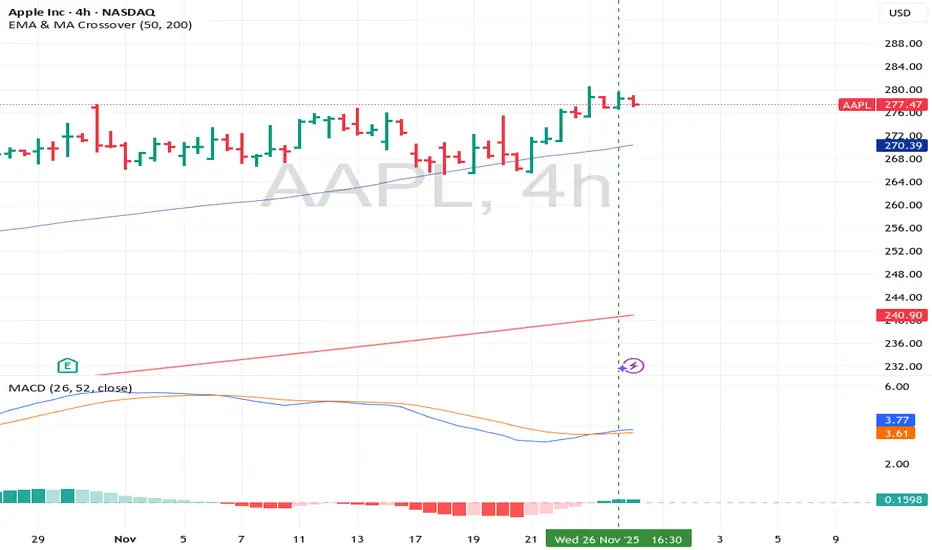
AAPL Stock: 1-Week Trade Setup | Key Levels explainedIn this video, I break down a complete 1-week trade opportunity for AAPL (Apple Inc.) using technical analysis. We look at chart pattern formation, MACD signals, and important support/resistance levels to track. I also provide a clear entry zone, stop-loss placement, and potential upside targets for short-term traders.
Current AAPL chart pattern forming
MACD crossover and momentum analysis
Key support & resistance levels
My entry plan, stop loss, and target zones
Short-term outlook for the next 5 trading days
Risk management tips for Apple stock
📌 Why watch this?
If you’re planning a 1-week trade on AAPL, this video gives you a data-driven plan with clear technical signals.
The Falling Apple: Apple’s Descent Into the 2026 Bear CycleApple has arrived at a rare point where Natural Law and fundamentals speak in unison.
The geometry of its long-term cycle and the internal condition of its business now deliver the same message: the arc that carried Apple through its 2020–2025 ascent has reached its structural boundary.
This is the moment where the cycle turns — the moment the Apple begins to fall.
1. Geometry: The 1×2 Monthly Angle Has Been Hit
Apple has been riding a clean, disciplined 1×2 monthly trend since the March 23, 2020 low.
Price has now risen to the top rail of that 1×2 channel, the same line that capped major moves in the past.
2. The Weekly Angle (2023-2025) Has Also Hit Its Own Ceiling
A faster internal angle begins from the January 3, 2023 low.
This weekly angle represents Apple’s internal rhythm — the speed of its secondary cycle.
Apple is now touching both:
the top of the long-term monthly angle, and
the top of the short-term accelerated weekly angle
at the same time.
These two angles intersect the first week of 2026,
Please see Monthly Version of chart Below:
A. Speed & Acceleration — The Internal Engine Stalls
The internal motion beneath Apple’s advance is no longer confirming the new highs.
Speed has weakened into the rally, forming a clear lower high even as price presses into the top of the 1×2 monthly angle.
This is the signature of a late-cycle move — higher prices carried by diminishing force.
Acceleration reveals the same condition.
It peaked earlier in the cycle and is now fading, unable to match the strength of prior expansions.
When acceleration rolls over while Speed is already declining, the trend has lost its ability to compound momentum.
Together, Speed and Acceleration show a market moving upward while its engine slows beneath it.
This is the exhaustion phase: motion compresses, angles converge, and the structure prepares to turn.
Please see Daily Chart
B. Daily Motion — The Fast Angle Breaks
On the daily chart, the internal structure has already failed.
The steep 1×1 angle — where each trading day rises one dollar — has broken decisively.
This is the fastest rhythm Apple can sustain, and losing it confirms a short-term top.
Speed follows the same message.
It has slipped beneath the median line, signaling that the drive powering this advance has weakened even as price tests multi-year resistance.
Acceleration is the most urgent tell.
It is sharply negative at the highs, a signature that momentum has collapsed beneath the surface.
Acceleration always turns first; price only acknowledges it later.
Together, the break of the 1×1 angle, the median failure in Speed, and the deeply negative Acceleration show a market losing force as it presses into long-term resistance.
The short-term engine has stalled at the exact moment the monthly cycle reaches its ceiling.
Please see Timing Chart:
Apple’s major swings have not been random.
The timing chart shows a consistent rhythm: the dominant changes in trend occur in January and December, forming a repeating cadence across the 2020–2025 cycle.
January 2022 — Major top
January 2023 — Major low
December 2024 — Major Top
Dec /Jan — **Forecasted Top
This creates a temporal cycle where Apple’s trend turns at the opening and closing of the Gregorian calendar — a natural point where momentum resets and the prior cycle completes.
Fundamentals Now Confirm What Geometry Already Shows
Price is not just rising into resistance —
it is rising into resistance while the fundamentals weaken.
a. Revenue Growth Has Stalled
Apple’s total revenue has been flat to slightly negative for nearly two years.
iPhone sales are no longer growing
Services growth has slowed
Mac and iPad units are in multi-year decline
This is the key disconnect:
**Price is making new highs
The business is not.
b. Valuation Has Doubled While Growth Has Halved
Apple now trades at:
31–34× forward earnings
Versus a historical long-term range of 16–20×
Apple is being valued like a high-growth AI company,
even though its earnings are stagnating.
This kind of valuation expansion always shows up as price hugging the upper rail of the long arc.
c. No Real AI Cycle (Yet)
Apple is pricing in an AI future it has not yet earned:
No major AI product cycle
No cloud AI leadership
No LLM ecosystem
No new growth vector
The chart reflects pure thematic flow, not fundamental acceleration.
With new leadership at the helm of Apple and a replacement from TIm cook is found. the stock may go though an adjustment period as well, as Apple tries to re fidn its identify again
d. Buybacks Are Manufacturing the Slope
Apple has spent $600+ billion on buybacks.
That is what creates the smooth, steady 1×2 slope —
but when buybacks meet revenue stagnation, price eventually reaches a point where geometry = fundamental limit.
We are exactly at that point.
e. Leadership Transition — A Coming Shift
Apple is approaching a leadership transition.
Tim Cook’s successor has not yet been named, but the change is forthcoming — and with it comes an inevitable period of adjustment.
As Apple prepares for a new era of leadership, the company will need to reaffirm its identity and strategic direction.
Markets tend to price this uncertainty early, especially when it coincides with the completion of a major structural cycle.
A shift at the top reinforces the broader message of the chart:
Apple is entering a phase of transition — in leadership, in momentum, and in market cycle.
5. When Natural Law and Fundamentals Agree, the Move Is Significant
Price is not hitting resistance in isolation.
It is hitting resistance with weakening internals:
Slowing revenue
Stretched valuation
Compressed consumer demand
No new product cycle
Buybacks masking the slowdown
Leadership Transition
SUMMARY
Apple has reached a structural and fundamental limit.
The long-term 1×2 monthly angle is touched.
The 2023 weekly angle converges at the same point.
$270 natural resistance is met precisely as time and price square.
Internally, revenue growth has stalled, valuation has stretched beyond its cycle, consumer demand continues to soften, and new leadership at the helm of Apple.
In short, Apple stands at the threshold of the 2026 Bear Cycle.
Nana Hermes —
All Things Move by Measure.
Apple bull flag setup points to breakout potential this week
Current Price: $267.69
Direction: LONG
Confidence Level: 68%
Targets:
- T1 = $272.50
- T2 = $277.00
Stop Levels:
- S1 = $265.00
- S2 = $263.00
**Wisdom of Professional Traders:**
Several professional traders are flagging Apple as a standout in the large-cap tech space right now. The collective trader consensus from multiple analyses points to Apple holding up better than peers, showing a defined bull flag structure and testing key levels that could open the door to a bullish breakout. Looking at the way these traders combine technical setups with current momentum, there’s shared focus on a push through upper resistance zones, with pullbacks being seen as opportunities rather than warnings.
**Key Insights:**
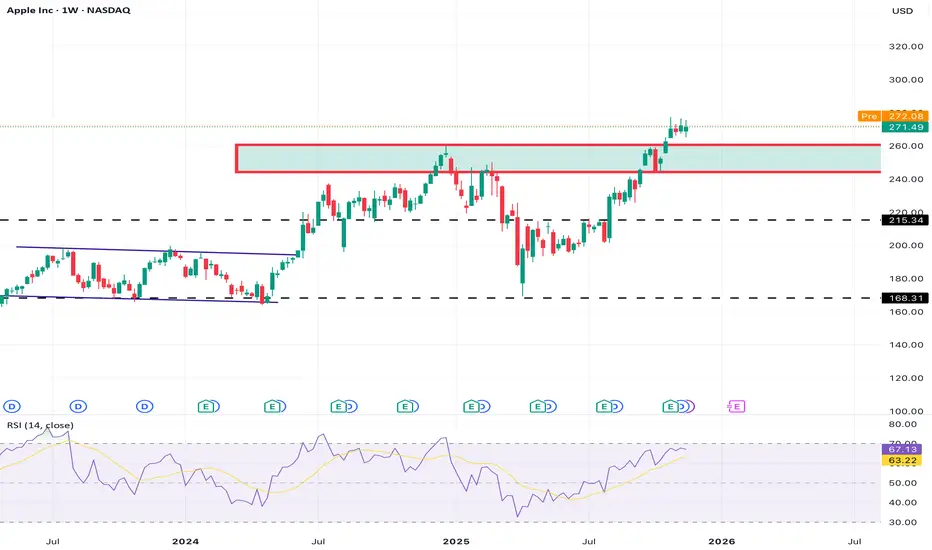
Here’s what’s driving this call — many traders have made note of Apple's ability to hold above multiple layers of support, often citing $269–$270 as a key pivot zone. The $272.50 mark comes up repeatedly as a short-term upside magnet, with $277–$277.32 flagged as the breakout area that could accelerate price action. This aligns with bullish momentum seen on the daily timeframe, where patterns like the bull flag just above prior highs tend to bring in additional buyers.
What I’m also noticing is the split between cautious macro sentiment and strong single-stock setups. While broader indices have been choppy, Apple’s relative strength is standing out to several traders, and that’s worth paying attention to when identifying outperformers for the week. The key point here is that Apple is not trading in sync with general market softness; instead, it's finding bids at every dip toward well-watched support levels.
**Recent Performance:**
This all played out in last week’s price action — Apple gained ground and closed notably higher on strong days, while managing to minimize losses on market down days. Several instances showed Apple bouncing off intraday supports to recover by session end, a clear sign of accumulation in the $265–$269 range. That resilience has been especially visible over the past five trading sessions, with multiple tests of intermediate resistance not leading to pronounced selling.
**Expert Analysis:**
Multiple traders have pointed to the $274–$275 zone as being critical for momentum confirmation, with one layer of consensus forming around waiting for a clean break to target $277+. Another frequently cited setup is entering early on confirmation of strength above $272.50, using tight stops just under $265 to limit downside risk. Several also remarked that only Apple and Alphabet are still holding above their 55-day moving averages out of the “Magnificent Seven,” underscoring Apple's relative positioning.
**News Impact:**
While there’s no single market-moving headline changing Apple’s fundamentals this week, the backdrop of tech sector rotation is relevant. The chatter around upcoming product cycle demand, potential boosts from seasonal shopping trends, and resilience despite chip supply cost hikes from suppliers like TSM is giving traders more confidence to lean bullish. Additionally, Apple’s role as a major index weight means its breakout could influence broader market sentiment positively.
**Trading Recommendation:**
Here’s my take — at $267.69 and with support layers close by, I favor initiating a long with entries above $269, tightening risk with S1 at $265 and S2 at $263. The near-term upside objective sits at T1 $272.50, with strength through that level opening a path toward T2 $277 for this week. This setup offers a good risk-reward profile due to tight stop placement and identifiable upside catalysts. Sizing should be moderate given the mid-range confidence, but the technical backdrop favors the long side as long as price remains above $263.
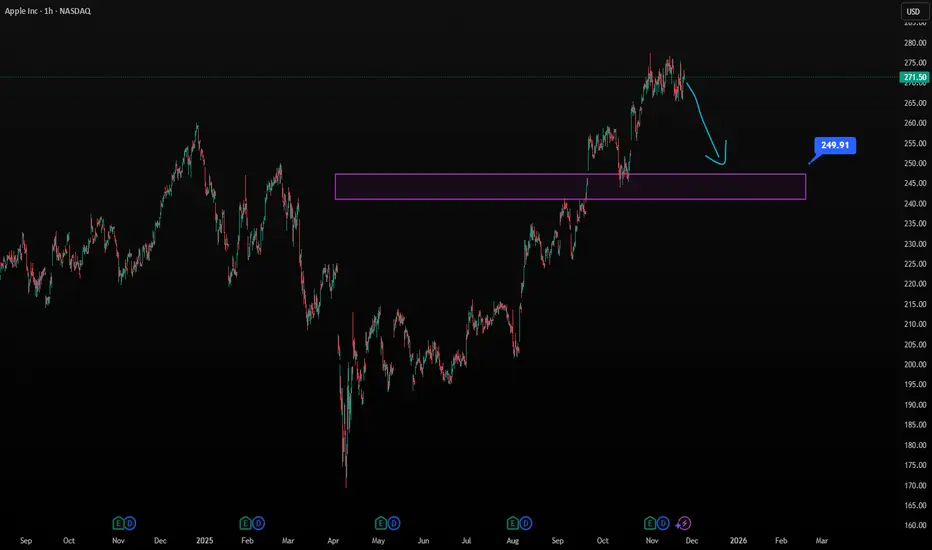
Midterm Stock Forecast for APPLENASDAQ:AAPL 's H1 chart suggests a midterm pullback from $271 toward $250 as trend strength softens. Technically, momentum indicators show divergence after a steady climb. Fundamentally, stable services revenue supports the stock, but softer global device demand may limit upside near term. A correction to $250 would align price with fair-value zones.
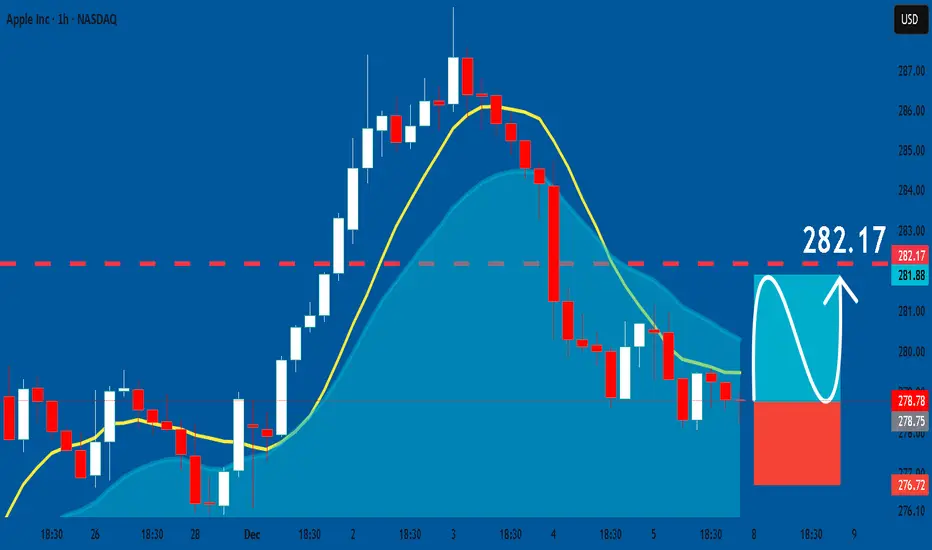
APPLE: Trading Signal From Our Team
APPLE
- Classic bearish formation
- Our team expects pullback
SUGGESTED TRADE:
Swing Trade
Short APPLE
Entry - 271.49
Sl - 273.26
Tp - 268.34
Our Risk - 1%
Start protection of your profits from lower levels
Disclosure: I am part of Trade Nation's Influencer program and receive a monthly fee for using their TradingView charts in my analysis.
❤️ Please, support our work with like & comment! ❤️
Is Apple Stock $APPL About To Crash Hard?Apple. Yes, one of the most liquid, most loved, and most worshipped stocks on the planet is about to teach retail traders a very expensive lesson. And no, you don’t need fundamentals, Bloomberg breaks, or Tim Cook whispers. You just need supply and demand imbalances, price action… and a little patience — the hardest skill ever created by nature.
Let’s dive into why AAPL could drop like a stone straight into the next monthly demand level. And yes… smaller timeframes can turn us into absolute dummies, so today I’ll save you from yourself.
Apple. The king of liquidity. The heavyweight champion of market capitalization. The stock that every beginner wants to buy… usually at the worst possible moment, of course.
And today, we’re going to talk about what really matters for the next years — the monthly supply and demand structure, not the tiny little M15 candles that make us behave like confused chickens.
Why Apple Is Setting Up a Major Drop (Again)
AAPL has been in a long-term bullish trend for years, but what many traders forget is this:
👉 Rallies eventually need to correct.
👉 Big imbalances act like magnets.
👉 Smaller timeframe “signals” make people behave like total dummies.