GOOGL OutlookQuick expectations for GOOGL
Buying around $276.43 - $296.62, area will most likely hold, if we even get to see it again in the near future.
If we come back to $237.01 - $253.84 liquidate all you got and get GOOGL, if the macro economics permit it and we don't break down because of rate hikes or other stuff.
Watch for that Santa Rally.
Enjoy.
Alphabet Inc. Shs A Cert Deposito Arg Repr 0.01724138 Shs
No trades
Market insights
Investing in Gold: A Comprehensive Analysis1. Why Invest in Gold?
Gold offers several compelling reasons for investment. Primarily, it acts as a hedge against inflation. During periods when the purchasing power of fiat currencies declines, gold prices generally rise, preserving wealth. For example, during the 1970s, the US experienced high inflation, and gold prices surged dramatically.
Additionally, gold provides protection during economic and geopolitical uncertainty. In times of financial crises, such as the 2008 global recession, investors flocked to gold as a safe-haven asset. Gold is not tied to any single country’s economy, making it a globally recognized store of value.
Diversification is another key reason. Financial advisors often suggest including gold in an investment portfolio to reduce overall risk. Unlike stocks or bonds, gold has a low or negative correlation with other asset classes, which means its value can remain stable or even rise when other investments falter.
2. Forms of Gold Investment
Investors can access gold through various channels, each with unique advantages and considerations:
Physical Gold: This includes gold bars, coins, and jewelry. Physical gold provides tangible ownership and a psychological sense of security. However, it requires safe storage and insurance, and liquidity can sometimes be a concern.
Gold ETFs (Exchange-Traded Funds): These funds track gold prices and are traded on stock exchanges. They offer a convenient and liquid way to invest without dealing with physical gold. They typically have lower transaction costs compared to buying physical gold.
Gold Mutual Funds: These invest in gold mining companies or gold-related assets. They offer exposure to gold without owning it directly and can generate returns through dividends and capital appreciation.
Gold Futures and Options: These are derivatives that allow investors to speculate on future gold prices. They can provide significant leverage but carry high risk, making them suitable only for experienced investors.
Digital Gold: This is a modern form of investment where investors can buy gold online in small quantities. It offers convenience and security without the need for physical storage.
3. Factors Influencing Gold Prices
Gold prices are influenced by a combination of macroeconomic, geopolitical, and market-specific factors. Understanding these drivers can help investors make informed decisions:
Inflation and Interest Rates: Gold is often inversely related to interest rates. When real interest rates (adjusted for inflation) are low or negative, gold becomes more attractive, driving up prices.
Currency Movements: Gold is priced in US dollars globally. A weaker dollar makes gold cheaper for other currency holders, often increasing demand. Conversely, a stronger dollar can suppress gold prices.
Geopolitical Risks: Wars, conflicts, and political instability can increase demand for gold as a safe-haven asset.
Central Bank Policies: Central banks around the world hold significant gold reserves. Changes in their buying or selling behavior can impact global prices.
Supply and Demand: Gold mining production, recycling, and industrial demand (especially in jewelry and technology) influence supply and demand dynamics.
4. Benefits of Investing in Gold
Investing in gold provides multiple advantages:
Wealth Preservation: Gold has historically maintained its value over centuries, protecting investors from currency depreciation and economic downturns.
Portfolio Diversification: It reduces overall portfolio risk due to its low correlation with stocks and bonds.
Liquidity: Gold is globally recognized and can be quickly sold or exchanged for cash in most markets.
Inflation Hedge: Gold tends to retain purchasing power during periods of rising prices.
Safe Haven During Crises: It is considered a stable investment during financial and geopolitical turmoil.
5. Risks of Investing in Gold
Despite its advantages, gold investment carries certain risks:
Price Volatility: Although gold is less volatile than stocks, it can still experience short-term price fluctuations due to market sentiment or speculative activity.
No Income Generation: Unlike stocks or bonds, gold does not provide dividends or interest. Returns depend solely on price appreciation.
Storage and Security Concerns: Physical gold requires secure storage and insurance, which can incur additional costs.
Market Timing Risk: Buying gold at a peak can result in temporary losses if prices decline before an investor exits.
6. Strategies for Investing in Gold
Successful gold investment requires careful planning and strategy:
Long-Term Investment: Investors seeking stability can buy and hold gold for the long term to hedge against inflation and economic uncertainty.
Diversification: Allocate a portion of the portfolio to gold alongside equities, bonds, and real estate to balance risk. Many advisors recommend 5–15% of a portfolio in gold.
Dollar-Cost Averaging: Buying gold in regular intervals, regardless of price, can mitigate the impact of short-term volatility.
Monitoring Macroeconomic Trends: Keeping track of inflation rates, interest rates, currency movements, and geopolitical events can help in timing investments.
Combining Physical and Paper Gold: A combination of physical gold for security and ETFs or mutual funds for liquidity can optimize returns while managing risks.
7. Conclusion
Gold remains a timeless investment vehicle with unique advantages. It offers protection against inflation, acts as a hedge during economic and geopolitical instability, and provides diversification to investment portfolios. While gold does not generate income, its long-term value preservation and liquidity make it a preferred choice for conservative investors. Understanding the forms of gold investment, factors influencing its price, and implementing strategic approaches can help investors leverage gold effectively for wealth protection and growth.
Whether through physical ownership, digital platforms, or financial instruments, gold remains an essential component of a balanced investment strategy. By carefully assessing individual financial goals, risk tolerance, and market conditions, investors can harness the enduring appeal of gold to safeguard and grow their wealth.
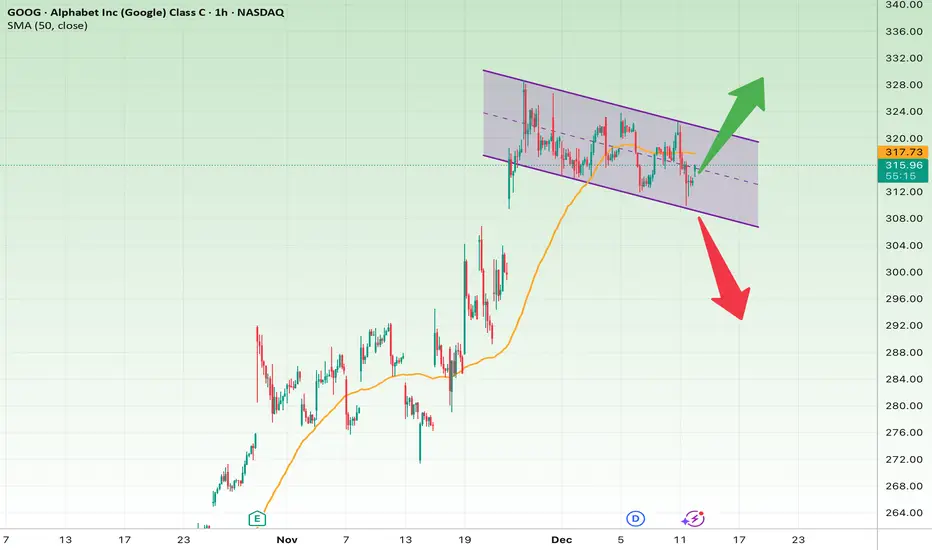
Technical Analysis of GOOG (1H Timeframe)The price is currently oscillating inside a short-term descending channel. Multiple touches on both the upper and lower boundaries increase the pattern’s reliability. The SMA50 is positioned slightly above the price and is acting as resistance for now.
This structure suggests that the market is trapped between two scenarios and is likely to experience a breakout or breakdown soon.
Bullish Scenario
If the price breaks above the channel resistance (around 319–320) and closes a confirming candle above it:
Targets
• Target 1 → 323
• Target 2 → 327–328 (full channel breakout)
• Target 3 → 332
Stop-Loss
• A close below 313
Bullish Reasons
• EMA/SMA are beginning to flatten and may shift back upward
• Price action at the channel bottom signals active demand
• A bullish reversal pattern often forms after a short-term descending channel
Bearish Scenario
If the price breaks below the channel support at 310:
Targets
• Target 1 → 304–305
• Target 2 → 298–300
• Target 3 → 292
Stop-Loss
• A close back above 316–317
Bearish Reasons
• The MA50 is currently acting as resistance
• The descending channel has strong validity
• Multiple rejections at the channel top
Quick Summary
• GOOG is compressed inside a short-term descending channel.
• Break above 320 → continuation of the bullish move.
• Break below 310 → deeper correction likely.
• For now, the market is in a neutral to slightly bearish stance.
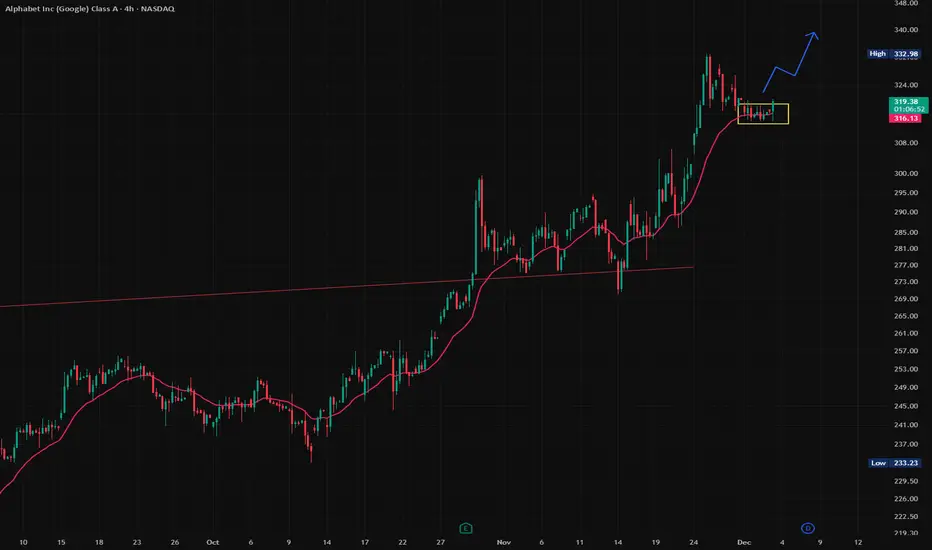
GOOGL - Searching for a new high=======
Volume
=======
-slight increase
==========
Price Action
==========
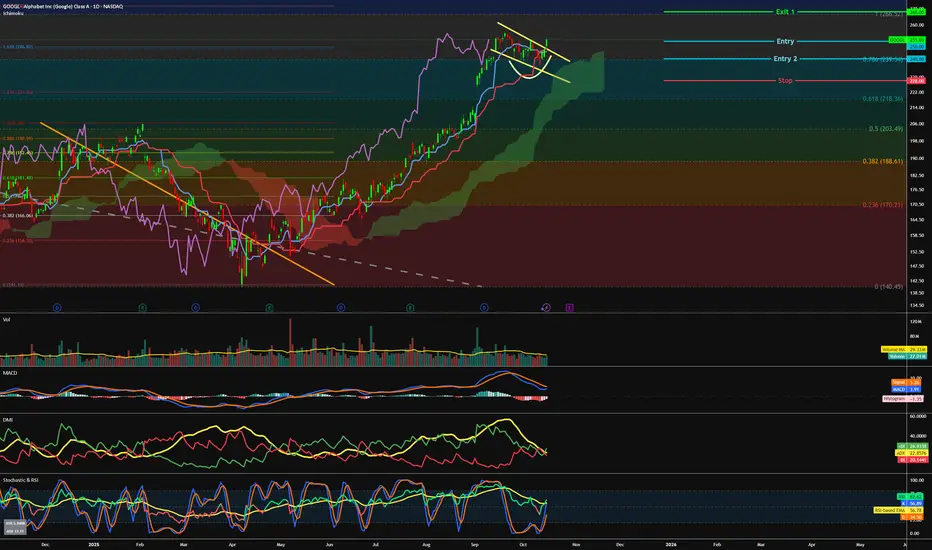
- Bullish flag noticed and px broke out of flag
- Rounding bottom
- Weak selling pressure
=================
Technical Indicators
=================
- Ichimoku
>>> price above cloud
>>> Green kumo expanding
>>> Tenken + Chiku - above clouds and sloping upwards
>>> Kijun - Above clouds and sloping upwards
=========
Oscillators
=========
- MACD turning bullish
- DMI turning bullish
- StochRSI, bullish, crossed and within band
=========
Conclusion
=========
- short to long term breakout swing
- price may reverse at current level, to enter spot or wait for pullback at entry 2.
GOOG: 5-Wave Top Completed, A-B-C Pullback Toward 288-300GOOG – Elliott Wave: 5-Wave Top Completed, A–B–C Pullback Toward 288–300 (Blue Box)
Primary Count favors a bullish continuation after Wave C completes
Summary:
GOOG has likely completed a clean 5-wave impulse near 328–330, and is now forming a standard A–B–C corrective pattern.
The primary expectation is a short-term bounce (Wave B) followed by a deeper pullback into the 288–300 Blue Box, where bulls may regain control and start the next upward trend leg.
Primary Count (5–3–5):
Wave A: Initial decline from the 328 top. Holding above 305–308 short-term support.
Wave B: Expected rebound toward 320–324 (lower high + resistance zone). Seen as a counter-trend rally.
Wave C: High-probability target at 288–300 (Blue Box), 50% retracement, Equal Legs (A = C), Prior structure support. If this zone holds → bulls regain control → next trend leg starts.
Alternative Count:
If Wave C breaks below 280, the A–B–C structure becomes invalid, and GOOG likely enters a larger-degree correction, targeting: 265–270 (0.618 retracement). Potential extension toward 250 in a deeper correction wave
Key Levels:
Resistance: 320–324 (Wave B), 330 (invalidates correction → new impulse wave)
Support: 305–308 (A-wave support)
Major Buy Zone: 288–300 (Blue Box)
Invalidation: Break below 280
Structure Notes:
Impulse (1–5) completed with Wave 3 strongest
Wave 4 alternation vs Wave 2 is clean
Momentum divergence into Wave (5) top
MACD & RSI support corrective phase
Price still above 200-day SMA → long-term bullish trend intact
Disclaimer: This analysis is for educational purposes only and is not investment advice. Please do your own research (DYOR) before making any trading decisions.
GOOGL Calls Alert: Bullish Momentum Building📊 GOOGL Trading Information — Weekly (12/11)
Recommendation: BUY CALLS
Confidence: 60% (Medium)
Conviction: MEDIUM
Expiry: 12/19 (8 days)
🧠 Why CALLS?
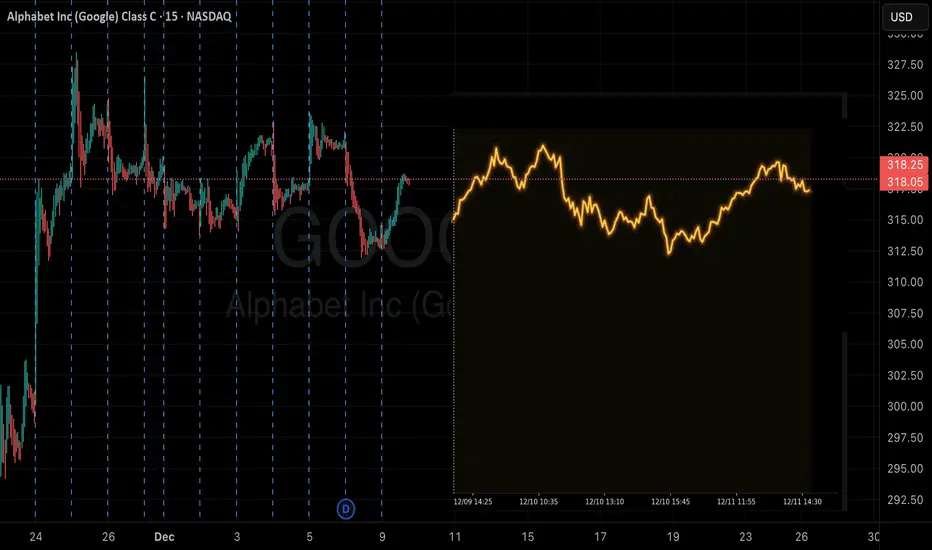
Katy AI Forecast
Predicts move to $315.63 (+1.25%)
Peak expected around $318.31 (+2.10%)
Smooth upward momentum into Friday morning
Technical Picture
Current price: $311.75
MACD shows bullish divergence
VWAP: $316.09 → upside room
Week position: 46.7% of range → upside runway intact
News / Flow
Mixed news: EU fine (bearish), Fortnite return (bullish)
PCR 1.43 → put-heavy (potential for squeeze)
Weak bearish flow mainly hedging, not directional
💰 Trade Setup
Strike: $312.50 CALL
Entry: $5.55 – $5.65
Target 1: $8.40
Target 2: $11.20
Stop Loss: $3.36
Position Size: 3%
Risk Level: 🟠 Moderate
⚠️ Notes
Katy AI confidence is low (50%) → monitor closely
Regulatory news may cause unexpected volatility
Weekly momentum is neutral → timing matters
Consider scaling in instead of full entry
📝 Quick Summary
GOOGL shows early-week consolidation with bullish momentum forming. Katy AI and technicals agree on a push toward $315–318. Bearish options flow increases the upside squeeze potential. Calls favored for this weekly setup.
Global Trading Economics Risk1. Macroeconomic Risks in Global Trade
Macroeconomic risks arise from changes in global economic conditions. These are the most common risks that affect trade flows, demand, profits, and investment decisions.
a) Economic Slowdowns and Recessions
When major economies like the US, China, or the EU slow down, global trade demand drops sharply. Lower consumer spending reduces imports, companies cut production, and global supply chains weaken. Recessions also increase unemployment, reduce investment, and cause businesses to delay expansion.
b) Inflation Risk
High inflation increases production costs, reduces the purchasing power of consumers, and forces central banks to raise interest rates. When interest rates rise:
borrowing costs go up
companies reduce investment
currency values fluctuate
export and import dynamics shift
Countries with high inflation become less competitive in global markets.
c) Interest Rate Risk
Central banks around the world adjust interest rates to control inflation, stabilize the currency, or stimulate growth. Higher interest rates strengthen a country’s currency, making exports expensive and imports cheaper. Lower interest rates weaken the currency and stimulate exports. These fluctuations directly impact global trade volumes and profitability.
2. Currency Risk in Global Trade
Currency risk is one of the biggest challenges in international trade. Because transactions usually happen in global currencies like USD, EUR, or GBP, sudden changes in exchange rates can create huge gains or losses.
a) Exchange Rate Volatility
If a country's currency depreciates suddenly, its exports become cheaper globally, but its imports become costly. On the other hand, a strong currency makes exports expensive and reduces foreign demand.
b) Currency Wars
Sometimes countries intentionally devalue their currency to boost exports. This creates competitive tension between nations and increases uncertainty for international traders.
c) Hedging Challenges
Companies use forex instruments (like forward contracts, options, and swaps) to protect themselves from currency movements. But hedging itself carries costs and complexity.
3. Geopolitical and Political Risks
Political instability and geopolitical conflicts are major sources of global trading risk. Any disruption in political relations impacts trade policies, supply routes, and investor confidence.
a) Trade Wars
Trade wars happen when countries impose tariffs and sanctions on each other’s imports. The US-China trade war is a clear example, with tariffs creating uncertainty for businesses and raising costs for consumers.
b) Conflicts and Wars
Geopolitical conflicts disrupt supply chains, increase commodity prices (especially oil and gas), and restrict trade routes. For example:
Middle East conflicts disrupt crude oil supply.
Russia–Ukraine conflict affected global wheat, gas, and fertilizer markets.
c) Policy Changes
Government decisions such as new taxes, export restrictions, sanctions, or regulatory reforms can abruptly change trade conditions.
d) Political Instability
Countries with unstable governments experience disruptions in production, currency fluctuations, investment losses, and lower international trust.
4. Supply Chain and Logistics Risks
Global trade depends on efficient supply chains. Any disruption can cause shortages, delays, and increased costs.
a) Shipping Delays and Container Shortages
Events such as port congestion, strikes, and logistical bottlenecks lead to delivery delays and higher freight costs.
b) Natural Disasters
Earthquakes, floods, cyclones, and pandemics can shut down ports, factories, and production hubs, affecting global supply networks.
c) Supply Chain Dependencies
Many countries depend heavily on specific nations for essential goods like semiconductors, crude oil, food, and pharmaceuticals. Disruptions in these supply hubs can impact global trade stability.
d) Transportation Risk
Breakdowns in transportation networks—such as railway issues, air cargo restrictions, or shipping route closures—cause massive trade disruptions.
5. Regulatory and Compliance Risks
International trade is heavily regulated. Countries follow trade agreements, tariffs, environmental rules, and safety standards.
a) Tariff Risk
Changes in customs duties, import taxes, and trade barriers can alter the profitability of cross-border sales.
b) Trade Agreement Risk
Countries may withdraw from agreements (like Brexit), renegotiate tariffs, or impose new conditions.
c) Compliance Risk
Businesses must follow:
environmental standards
labor laws
product quality rules
customs documentation
Non-compliance leads to fines, shipment delays, or bans.
6. Technological Risks in Global Trading Economics
Technology plays a critical role in modern trade, but it also introduces new risks.
a) Cybersecurity Threats
Hackers target:
financial transactions
supply chain software
logistics systems
digital shipping documents
A cyberattack can halt operations and compromise sensitive data.
b) Automation and AI Risks
Automation increases efficiency but also creates job losses and inequality. Over-reliance on AI systems can escalate risks if they malfunction.
c) Digital Trade Barriers
Countries sometimes restrict data transfers or impose digital taxes, affecting companies operating globally.
7. Commodity Market Risks
Global trade heavily depends on commodities like crude oil, natural gas, metals, and agricultural produce.
a) Price Volatility
Commodity prices fluctuate due to demand-supply imbalances, geopolitical tensions, weather conditions, or speculation. High volatility affects production costs and profit margins.
b) Resource Dependency
Countries dependent on a single commodity face extreme risk when prices fall (e.g., oil-exporting nations during a crude price crash).
8. Environmental and Climate Risks
Climate change is becoming one of the most significant long-term global trading risks.
a) Extreme Weather
Storms, droughts, and floods disrupt trade, damage crops, and shut down industries.
b) Carbon Taxes and Emission Rules
Global environmental regulations are changing how companies operate. Carbon taxes increase costs for exporters, especially in energy-intensive industries.
c) Sustainability Pressure
Consumers and governments demand eco-friendly production. Companies that fail to adapt face loss of market access.
9. Global Financial Market Risks
Financial markets influence trade through stock market performance, liquidity conditions, and investor sentiment.
a) Credit Risk
Companies and governments rely on global financing. Liquidity crises or credit downgrades increase borrowing costs.
b) Banking Risk
Banking collapses or regulatory failures impact trade finance, currency markets, and investor confidence.
10. Risk Management in Global Trading Economics
Companies and investors use several strategies to manage global trading risks:
Hedging using futures, options, and swaps
Diversifying markets and suppliers
Setting up supply chain redundancies
Political risk insurance
Strong financial planning
Digital security systems
Scenario analysis and stress testing
Effective risk management ensures long-term stability and profitability in global trade.
Conclusion
Global trading economics risks are unavoidable in today’s interconnected world. They emerge from economic cycles, political tensions, currency movements, supply chain disruptions, commodity volatility, and environmental changes. For traders, investors, and businesses, understanding these risks and adopting effective risk-management strategies is crucial to surviving and succeeding in global markets.
GOOGL Weekly Momentum Signal — Bullish Bias with CautionGOOGL Weekly Signal | 2025-12-09
BUY CALLS
Confidence: 58% (Low Conviction)
Risk Level: High — use small size
🔢 Options Setup
Strike: $317.50 (ATM)
Expiry: 2025-12-12 (3 days)
Entry Range: $4.25 – $4.30
Target 1: $6.38
Target 2: $7.50
Stop Loss: $2.85
Position Size: 2% of portfolio
📊 Market Conditions
Price: $317.81
Weekly Momentum: Bullish +1.15%
VWAP Support: $316.86
Volume: 0.1× normal (light)
Put/Call Ratio: 0.76 (bullish flow)
🤖 Katy AI
Trend: Neutral
Confidence: 50%
Slight upward bias to $319.58 (+0.56%)
📰 News Sentiment
Strong Google Cloud AI partnership news
Gemini user growth positive
Sector-wide tech/AI bullish momentum
⚠️ Key Notes
Low conviction → reduce size
Short expiry → fast decay
Light volume → possible whipsaws
ESG Investing and Green Finance1. Understanding ESG: Environmental, Social, and Governance
ESG investing involves evaluating companies not only on financial performance but also on how well they manage environmental, social, and governance risks and opportunities. It helps investors identify sustainable businesses that are better positioned for long-term growth.
1.1 The Environmental Component (E)
This dimension examines how a company impacts the planet. Key factors include:
Carbon emissions and climate impact
Energy efficiency and renewable energy usage
Waste management and recycling
Water usage and conservation
Biodiversity protection
Investors focus on whether a company has strategies to reduce climate risk, comply with environmental regulations, and transition towards greener operations.
1.2 The Social Component (S)
This pillar evaluates a company's relationship with people—employees, customers, suppliers, and communities. It includes:
Labor rights, wages, and workplace safety
Diversity, equity, and inclusion (DEI)
Customer privacy and data protection
Human rights across supply chains
Community development and social welfare initiatives
Companies with strong social practices tend to have better employee retention, improved brand reputation, and lower legal risks.
1.3 The Governance Component (G)
Governance is about the ethical and transparent management of a company. Criteria include:
Board independence and diversity
Shareholder rights and protections
Anti-corruption policies
Executive compensation linked to performance
Transparent reporting and accountability
Good governance reduces the chances of scandals, fraud, and mismanagement, making the company a safer long-term investment.
2. ESG Investing in Practice
2.1 ESG Screening Methods
Investors use different strategies to integrate ESG:
Negative Screening: Excludes harmful industries (tobacco, weapons, coal).
Positive Screening: Selects companies with high ESG scores.
Best-in-Class Selection: Chooses top performers in each sector.
Integration Approach: Combines ESG data into financial analysis.
Active Ownership: Investors influence companies through voting and engagement.
2.2 ESG Ratings and Data Providers
Agencies like MSCI, Sustainalytics, Refinitiv, and S&P Global provide ESG scores. These ratings help investors compare companies and assess risks.
2.3 Why ESG Investing Is Growing Rapidly
Several forces are driving global adoption:
Climate change concerns
Government regulations and carbon policies
Demand from millennials and Gen-Z investors
Corporate transparency and pressure from stakeholders
Better long-term risk-adjusted returns
Research shows that companies with high ESG performance often deliver higher resilience during economic downturns and more stable cash flows.
3. Green Finance: Capital for a Sustainable Future
Green finance refers to financial instruments and investments specifically designed to support environmentally friendly projects. While ESG investing evaluates companies broadly, green finance channels capital exclusively toward environmental sustainability.
3.1 Key Components of Green Finance
Green Bonds
These are debt instruments where funds are used for climate or environmental projects such as solar plants, wind farms, green buildings, or pollution reduction.
They are issued by governments, corporations, and global institutions.
Green Loans
Loans provided to businesses for sustainable and energy-efficient projects.
Sustainability-Linked Bonds (SLBs)
Interest rates vary depending on a company’s achievement of sustainability targets such as emission reductions.
Climate Funds
Investment pools dedicated to renewable energy, carbon reduction, and environmental innovation.
Carbon Markets and Credits
Companies purchase carbon credits to offset emissions, promoting global decarbonization.
Green Banks
Specialized financial institutions supporting low-carbon infrastructure.
3.2 Priority Sectors in Green Finance
Green finance focuses on sectors with high environmental impact:
Renewable energy (solar, wind, hydro)
Electric mobility and battery technologies
Green buildings and energy-efficient infrastructure
Waste management and recycling
Water treatment and desalination
Sustainable agriculture
Climate adaptation and resilience projects
4. How ESG and Green Finance Work Together
While ESG investing evaluates a broad spectrum of ethical factors, green finance is narrowly targeted at environmental impact. Yet, both frameworks complement each other:
ESG encourages companies to adopt sustainable behavior, improving overall corporate responsibility.
Green finance provides funding for environmentally beneficial projects.
Together, they push global markets toward decarbonization, resource efficiency, and ethical governance.
For example, an energy company with strong ESG scores may issue green bonds to finance its transition from coal to renewable energy. Institutional investors, looking for sustainable portfolios, buy these bonds—creating a cycle of positive environmental impact and financial returns.
5. Benefits of ESG Investing and Green Finance
5.1 For Investors
Better risk management (climate, legal, and reputational).
Potential for long-term stable returns.
Alignment with future regulatory trends.
Access to innovative sectors like clean energy and sustainable tech.
5.2 For Companies
Lower cost of capital due to ESG-focused investors.
Stronger brand identity and customer loyalty.
Enhanced operational efficiency through sustainable practices.
Better compliance with environmental regulations.
5.3 For Society and the Environment
Reduced carbon emissions and pollution.
Promotion of clean energy and green technologies.
Improved labor conditions and community welfare.
More ethical and transparent corporate behavior.
6. Challenges and Criticisms
Despite rapid growth, ESG and green finance face several obstacles.
6.1 Greenwashing
Some companies exaggerate sustainability claims to attract investors. This undermines trust and calls for stricter reporting standards.
6.2 Lack of Standardization
Different ESG rating agencies use different methodologies, leading to inconsistent scores.
6.3 Data Quality Issues
Many companies do not disclose complete or accurate ESG data.
6.4 Balancing Returns vs Sustainability
Some investors believe ESG restrictions may limit short-term profits. However, long-term benefits are increasingly evident.
7. The Future Outlook
ESG investing and green finance are expected to dominate global markets.
Key trends include:
Mandatory climate disclosures by companies
Rise of sustainable index funds and ETFs
Growth in green bond markets
AI-driven ESG analytics
Government incentives for clean energy
Integration of biodiversity and natural capital into finance
Financial institutions, governments, and corporations are aligning capital flows with sustainability goals such as the Paris Agreement and UN SDGs.
Conclusion
ESG investing and green finance mark a new era where profits and purpose converge. Investors are no longer satisfied with traditional financial metrics; they want companies to deliver long-term value while safeguarding the environment and society. ESG frameworks help identify responsible businesses, and green finance mobilizes capital for sustainable projects. Together, they build a financial ecosystem that promotes resilience, ethical conduct, and environmental protection. As global challenges intensify, ESG and green finance will continue shaping the future of economic development—driving the world towards a greener, more inclusive, and more sustainable future.
The Crucial Role of Global Trade1. Economic Growth and Development
The most immediate and apparent role of global trade is its contribution to economic growth. Trade enables countries to specialize in producing goods and services in which they have a comparative advantage—a concept introduced by economist David Ricardo. Comparative advantage means that countries can produce certain products more efficiently than others. For instance, a country with abundant fertile land may focus on agriculture, while a technologically advanced nation may concentrate on electronics or software development. By exchanging these goods and services, countries can maximize efficiency and output, leading to higher GDPs and improved living standards.
Global trade also promotes industrial diversification. By participating in international markets, nations are incentivized to develop new industries, upgrade technology, and improve infrastructure. Emerging economies, such as China and India, have leveraged trade to transform their economic landscapes, moving from agrarian-based systems to industrial and service-driven economies within decades. Furthermore, trade contributes to employment generation by creating new jobs in export-oriented sectors and associated industries like logistics, finance, and technology.
2. Access to Goods and Services
Global trade allows countries to access products that may be unavailable or too expensive domestically. This enhances consumer choice and ensures that people benefit from goods that would otherwise be out of reach. For example, tropical fruits like bananas or coffee can be enjoyed in regions with cold climates because of trade. Similarly, high-tech gadgets, pharmaceuticals, and machinery are often imported from countries with advanced technological capabilities.
By facilitating access to a broader range of goods and services, global trade also promotes competition. Domestic producers must innovate and improve quality to remain competitive against international competitors, ultimately benefiting consumers through better products and lower prices.
3. Technological Advancement and Innovation
Trade is not only about goods and services; it also facilitates the transfer of knowledge and technology. When countries engage in international trade, they often adopt new production techniques, management practices, and innovations from their trading partners. This exchange fosters technological diffusion, which can accelerate industrialization and modernization.
Multinational corporations (MNCs) play a pivotal role in this process. Through foreign direct investment (FDI), MNCs bring in advanced technology, management expertise, and capital, stimulating local economies and raising productivity. For instance, the entry of foreign automotive companies into emerging markets has often led to the adoption of cutting-edge manufacturing techniques, quality standards, and research and development capabilities in those regions.
4. Enhancing International Relations
Global trade serves as a bridge between nations, fostering interdependence and cooperation. Countries that trade extensively are less likely to engage in conflict because their economies are mutually connected. This concept, often referred to as the "commercial peace theory," suggests that trade creates incentives for diplomatic resolution of disputes rather than resorting to military action.
Trade agreements and regional blocs, such as the European Union (EU), the North American Free Trade Agreement (NAFTA), now replaced by the United States-Mexico-Canada Agreement (USMCA), and the Association of Southeast Asian Nations (ASEAN), exemplify how economic interdependence can strengthen political and strategic relationships. These agreements provide frameworks for conflict resolution, promote political dialogue, and encourage harmonization of regulations and standards.
5. Global Supply Chains and Economic Resilience
In the modern global economy, trade underpins complex supply chains that span multiple continents. These supply chains allow producers to source raw materials from one country, manufacture components in another, and assemble final products elsewhere. Such interconnections increase efficiency, reduce costs, and enable countries to respond flexibly to demand fluctuations.
However, global trade also exposes economies to vulnerabilities, as seen during the COVID-19 pandemic when disruptions in supply chains caused shortages of essential goods worldwide. Despite these challenges, trade networks remain crucial for resilience, as they allow countries to diversify suppliers, maintain reserves, and adapt to changing conditions.
6. Reduction of Poverty and Inequality
Global trade has a significant role in poverty reduction, particularly in developing countries. Export-oriented growth strategies can create jobs, increase wages, and raise living standards. For instance, the export-led manufacturing boom in East Asia lifted millions of people out of poverty over the past few decades. By participating in global markets, developing nations can generate revenue to invest in education, healthcare, and infrastructure, creating a virtuous cycle of growth and development.
Moreover, trade can help reduce income inequality between nations by offering poorer countries opportunities to integrate into the global economy. While domestic inequality may persist, global trade can level the playing field by enabling developing countries to compete internationally and improve their citizens’ economic prospects.
7. Cultural Exchange and Global Understanding
Beyond economics, global trade promotes cultural exchange. The movement of goods, services, and people leads to the diffusion of ideas, lifestyles, and traditions. Products such as fashion, cuisine, music, and art often cross borders alongside commerce, fostering cultural appreciation and understanding. In a world facing global challenges such as climate change and pandemics, mutual understanding and cooperation are essential, and trade acts as a conduit for building these bridges.
8. Challenges and Considerations
While global trade offers immense benefits, it is not without challenges. Trade imbalances, protectionism, unfair competition, and exploitation of labor are pressing concerns. Additionally, overreliance on global markets can expose economies to external shocks, such as financial crises, political instability, or natural disasters in trading partner countries. Sustainable and fair trade practices, along with robust regulatory frameworks, are essential to ensure that trade remains a force for inclusive and long-term development.
Conclusion
Global trade is a fundamental driver of economic prosperity, technological advancement, cultural exchange, and international cooperation. It enables countries to specialize, innovate, and access a wider variety of goods and services. It promotes peace, enhances resilience through interconnected supply chains, and has the potential to reduce poverty and inequality worldwide. However, the benefits of trade must be balanced with policies that mitigate risks, ensure fairness, and promote sustainable development.
In the contemporary era, where globalization defines economic and social landscapes, the crucial role of global trade cannot be overstated. It remains not just an economic mechanism but a vital force shaping the trajectory of human progress, international relations, and global well-being.
GOOGL Market Preview – December 5GOOGL is heading into tomorrow’s session sitting inside a rising structure that has now stalled under the 319–323 supply zone. Price has been grinding higher for days, but today’s sharp rejection showed the first sign of buyers losing momentum. At the same time, the lower trendline continues to hold cleanly, creating a pressure zone where a breakout or breakdown becomes more likely.
Structure Outlook (1H Trend View)
GOOGL has been respecting a gradual uptrend from the 311–313 support area. That zone has acted as the primary accumulation level each time sellers pushed down. But the big story is overhead: the 319–323 supply has rejected every attempt to break higher. Each test created fast selling wicks and stalled momentum.
Price is now compressing between:
* The rising trendline below
* A heavy, sticky supply box above
This creates a squeeze that usually leads to a decisive move. Until GOOGL reclaims 320–323, upside remains limited.
15M SMC View
What Today’s Price Action Means
the CHoCH and BOS marks tell the full story. The BOS into demand was strong, but the CHoCH did not turn into real continuation. Price spent most of the afternoon moving sideways under the red SMC zone — a sign of hesitation.
Bearish signs:
* Repeated rejection from 319–320
* SMC sell zone holding perfectly
* EMAs flattening to slightly downward
* Volume fading on each bounce
Bullish signs:
* Buyers defended the 315–316 demand area
* No clean breakdown beneath the trendline
* Liquidity resting above 320 that could be swept
Overall → buyers are still present, but they aren’t strong enough yet to force a breakout.
GEX Read for Tomorrow
GEX layout gives clear directional boundaries:
* Call walls: 320 → 322.5 → 327.5
* Highest positive GEX: near 320
* PUT support: 315 → 312.5 → 310
* Dealer bias: Calls only 19% (mixed-to-neutral)
* If GOOGL can take out 320, dealer hedging can accelerate a push toward 322.5 and 325.
* If it fails again, price flows naturally back toward 315–312.5, which aligns with the SMC demand zone.
This setup favors whichever boundary breaks first.
What I Expect on December 5:
Unless buyers show unusually strong momentum, GOOGL is more likely to stay range-bound or lean slightly bearish into tomorrow. The inability to reclaim the 319–320 zone today suggests sellers still have a grip.
Upside scenario:
If GOOGL breaks and holds above 320, mo
mentum can squeeze into 322.5 and potentially 325. Liquidity above 320 creates room for a continuation sweep.
Downside scenario (slightly higher probability):
If GOOGL rejects 319–320 again or loses 315 support, the structure favors a drift toward 313–312.5. Breaking that level exposes 310 as the next liquidity pocket.
My Bias:
neutral-to-bearish unless GOOGL can reclaim 320 with conviction. The combination of structure, SMC flow, and GEX resistance suggests the upside remains capped until buyers show real strength.
Quick Trade Thoughts (Not Financial Advice)
Bullish plan:
Break and retest above 320
Target 322.5 → 325
Invalidation: failure to hold the breakout
Bearish plan:
Reject 319–320
Target 315 → 313 → 312.5
Best RR is always near the top of the range
Avoid trading the middle of the wedge — it’s where GOOGL chops and kills prethetmium.
Disclaimer:
This outlook is for educational discussion only. It reflects a technical perspective on market structure and options positioning. Always trade your own plan and manage your risk.
GOOG - Strong Buy (Since COVID) 6 HRGOOG continues its 3 wave movement that started just following Covid. It recently completed the A wave of Circle 3 and now appears to want to retrace to just below 300 before continuing its climb to 865 next year. The current B wave is difficult to measure probability - given its exuberance (volume) and the tendency to alternate with the more protracted drop from circle 1 to circle 2, I suspect the B wave may complete quickly.
Google - A major correction starts now!🚽Google ( NASDAQ:GOOGL ) is now creating a top:
🔎Analysis summary:
Over the course of the past couple of months, we witnessed a major rally on Google of about +100%. This rally was totally expected, following the underlying bullish rising channel. But with the current retest of the trendline, Google is heading for a major correction.
📝Levels to watch:
$300 and $200
SwingTraderPhil
SwingTrading.Simplified. | Investing.Simplified. | #LONGTERMVISION
Quant signals V3 GOOG Katy AI 1M Forecast: Bearish Drift AheadGOOG QuantSignals Katy 1M Prediction 2025-12-02
QuantSignals Katy AI Stock Analysis
Analyzed 1 stock(s): GOOG
GOOG Analysis:
Current Price: $318.32
Final Prediction: $316.01 (-0.73%)
30min Target: $315.65 (-0.84%)
Trend: BEARISH
Confidence: 54.9%
Volatility: 21.3%
Summary: Generated 0 trade signals from 1 successful analyses out of 1 symbols.
GOOG - Preparing to Run AgainIt would appear GOOG is finishing a corrective "B" wave and will soon turn upward for a "C" Wave toward a target of 364.
Note that there is a zone from 339 to 349 where we might see an early reversal down to a Wave 4. It appears to want to move toward its trend line though, which would require a slightly extended run. Be cautious in this zone.
GOOG Generally moves in a corrective pattern (ABC) upward and downward, which introduces volatility, but overall, I have about 70% confidence in this move once the current B wave finishes .
November's Tech Shake-Up: Google vs. Nvidia DivergenceNovember marked the widest divergence yet between Google and Nvidia NASDAQ:NVDA . Nvidia’s pullback wasn’t just routine profit-taking—markets started pricing in a strategic shift by hyperscalers potentially moving away from GPU-only AI stacks. This narrative could dilute Nvidia’s moat, while bolstering demand for diversified AI infrastructure players like Google.
📊 GOOGL Setup: Strong Fundamentals, Strategic Support
Google remains fundamentally strong and technically well-supported. With earnings resilience and infrastructure independence, NASDAQ:GOOGL may outperform if tech rotation accelerates. The stock is sitting above a clear demand zone, offering a calculated risk-reward play.
🔔 Trade Idea
Entry Zone: $252 – $256 (support area)
Take Profit 1: $292
Take Profit 2: $327
Stop Loss: $225
📌 This aligns with multi-month support and potential breakout continuation.
Risks and Opportunities in the Global MarketOpportunities in the Global Market
Market Expansion and Revenue Growth
One of the primary opportunities in the global market is access to a much larger customer base. Companies can transcend domestic limitations and tap into emerging markets where consumer demand is growing rapidly. For example, markets in Asia, Africa, and Latin America offer a burgeoning middle class eager for goods, services, and technology, presenting massive revenue potential for multinational corporations. By diversifying geographically, businesses can reduce dependence on a single economy and enhance growth prospects.
Diversification of Investments
Global markets allow investors to diversify their portfolios across countries, sectors, and asset classes. Diversification reduces exposure to localized economic shocks and political instability. For instance, investing in equities, bonds, or commodities in different regions can balance risks arising from currency fluctuations, interest rate changes, or domestic policy shifts. This strategic allocation of resources can improve the risk-return profile of investments significantly.
Access to Innovation and Technology
Global integration fosters technological exchange and innovation. Companies can leverage global research and development networks, access advanced manufacturing technologies, and adopt best practices from international competitors. For emerging economies, collaboration with global firms can accelerate industrialization, improve efficiency, and enhance product quality. Likewise, global partnerships in sectors like artificial intelligence, renewable energy, and biotechnology create opportunities for breakthrough innovations that can reshape entire industries.
Economies of Scale and Cost Efficiency
Operating in the global market enables companies to achieve economies of scale. Large-scale production and sourcing from multiple countries often reduce costs, improve margins, and increase competitiveness. For instance, technology firms may design products in one country, source components from another, and sell worldwide, optimizing both production costs and logistics. Additionally, access to cheaper labor and raw materials in developing economies can further enhance profitability.
Financial and Capital Access
Global financial markets provide businesses and governments with access to diverse funding sources. Companies can raise capital through international stock exchanges, global bonds, or foreign direct investment. Governments can finance infrastructure and development projects through international loans or aid. This access to global capital allows for ambitious projects and long-term strategic investments that would otherwise be unattainable.
Strategic Partnerships and Alliances
The global market encourages cross-border collaborations. Strategic alliances, joint ventures, and mergers allow companies to enter new markets more efficiently and share risks. Partnerships with local firms also help navigate regulatory environments, cultural differences, and logistical challenges. Collaborative ventures often drive innovation, improve market penetration, and enhance brand credibility in foreign markets.
Risks in the Global Market
Economic Volatility and Financial Crises
Global markets are highly interconnected, making them susceptible to economic volatility. A crisis in one major economy can ripple across borders, affecting trade, investment, and employment worldwide. The 2008 financial crisis and the COVID-19 pandemic demonstrated how quickly global shocks can destabilize markets. Currency devaluations, stock market crashes, and sudden shifts in capital flows are persistent risks for investors and multinational companies.
Political and Geopolitical Risks
Political instability, trade disputes, and geopolitical tensions pose significant risks. Conflicts, sanctions, or changes in government policies can disrupt supply chains, inflate costs, and limit market access. For instance, trade wars between major economies may lead to tariffs, export restrictions, and reduced demand for goods. Political risk is particularly relevant for companies investing in emerging markets, where governance structures may be less predictable.
Regulatory and Compliance Challenges
Global operations require navigating a complex web of regulations, including taxation, labor laws, environmental standards, and data protection. Non-compliance can result in legal penalties, reputational damage, or operational shutdowns. Differences in regulations across countries also make standardization difficult, increasing operational costs and complexity. Companies must continuously monitor regulatory developments to mitigate compliance risks effectively.
Currency and Exchange Rate Risks
Engaging in international trade and investment exposes companies and investors to currency risk. Exchange rate fluctuations can impact profit margins, investment valuations, and competitiveness. For example, a strengthening domestic currency can make exports more expensive, reducing sales abroad. Conversely, a weakening currency may inflate the cost of imported raw materials. Hedging strategies, while useful, do not eliminate currency risk entirely.
Supply Chain Disruptions
Global supply chains are vulnerable to natural disasters, pandemics, labor strikes, and geopolitical tensions. Disruptions can delay production, increase costs, and reduce customer satisfaction. For example, the COVID-19 pandemic revealed the fragility of just-in-time supply chains, prompting companies to reconsider sourcing strategies and inventory management. Dependence on specific regions for critical components increases operational risks.
Technological and Cybersecurity Risks
While global markets offer access to technology, they also expose businesses to cybersecurity threats. Data breaches, intellectual property theft, and cyberattacks can lead to financial loss, reputational damage, and legal liabilities. Rapid technological changes also create the risk of obsolescence; companies that fail to innovate may lose competitive advantage. Protecting digital infrastructure and continuously adapting to technological trends is critical for global operations.
Cultural and Market Risks
Entering new markets involves understanding local consumer behavior, culture, and preferences. Misreading these factors can result in product failures, marketing missteps, and brand damage. Companies must adapt strategies to local contexts while balancing global standardization. Failure to address cultural sensitivities can hinder market acceptance and growth.
Balancing Risks and Opportunities
Navigating the global market requires a careful balance between seizing opportunities and mitigating risks. Strategies for achieving this balance include:
Diversification: Spread investments across multiple countries, sectors, and currencies.
Risk Management: Implement financial hedging, insurance, and contingency planning.
Strategic Alliances: Collaborate with local partners to reduce market entry risks.
Technology and Innovation: Invest in digital infrastructure, cybersecurity, and R&D.
Compliance and Governance: Maintain robust regulatory compliance and ethical standards.
Agility and Adaptation: Be flexible in responding to geopolitical, economic, and market changes.
Conclusion
The global market is a dynamic landscape characterized by immense opportunities and significant risks. Companies and investors that can navigate these complexities stand to gain from expanded markets, innovation, cost efficiencies, and diversified revenue streams. However, economic volatility, political uncertainties, regulatory complexities, and technological risks demand careful planning, proactive risk management, and strategic foresight. The key to success lies in balancing the pursuit of growth with robust safeguards, leveraging both global connectivity and local insight. In an increasingly interconnected world, the ability to adapt and innovate while managing risk will define the long-term winners in the global market.
GOOGLHow to become successful in forex and stock trading: 1.Master fundamentals and technical analysis. 2,Build and follow a solid trading plan. 3.Apply strict risk management (1–2% rule). 4.Stay disciplined—control fear and greed. 5.Record and analyze every trade. 6.Focus on high-quality setups only. 7.Diversify across assets and markets. 8.Keep evolving—study, adapt, and grow daily.
Google (GOOGL): Bullish Reversal in Play – Eyeing $237 TargetBullish Engulfing and Fibonacci Channel Support
Last week’s green candle on the weekly chart of NASDAQ:GOOGL has engulfed the main body of the previous red candle, signaling a potential trend reversal. Moreover, the price has respected a key support level within the Fibonacci channel, further strengthening the bullish sentiment.
Key Observations:
Fibonacci Channel:
The stock is moving well within an upward Fibonacci channel, indicating a healthy uptrend.
Current support is holding at the midline, confirming buyers' interest at this level.
Bullish Candle Formation:
A clear bullish engulfing candle pattern has formed, a strong reversal signal.
Upside Potential:
Based on Fibonacci extensions and channel resistance, the next major target lies at $237, offering a ~20% upside from the current levels.
Moving Averages:
The price is trading above key moving averages (20, 50, and 200-week), reinforcing a strong bullish outlook.
What to Watch:
Volume confirmation will be crucial to validate this move.
Keep an eye on the support at $173.96 and $167.59 (short-term MAs) to manage risk effectively.
💡 Trade Idea:
A breakout above $196 could provide a clear signal to ride this uptrend. Consider trailing stops as the stock approaches $237 to lock in gains.
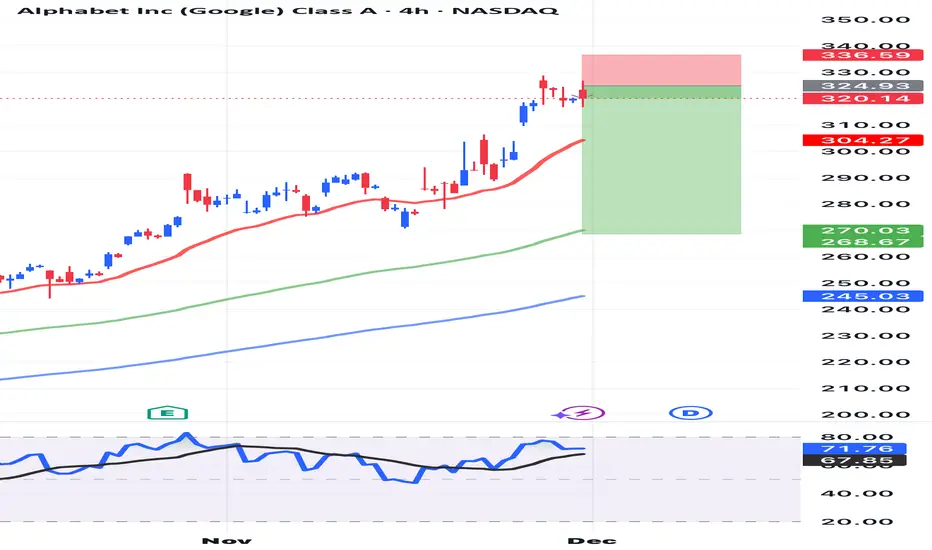
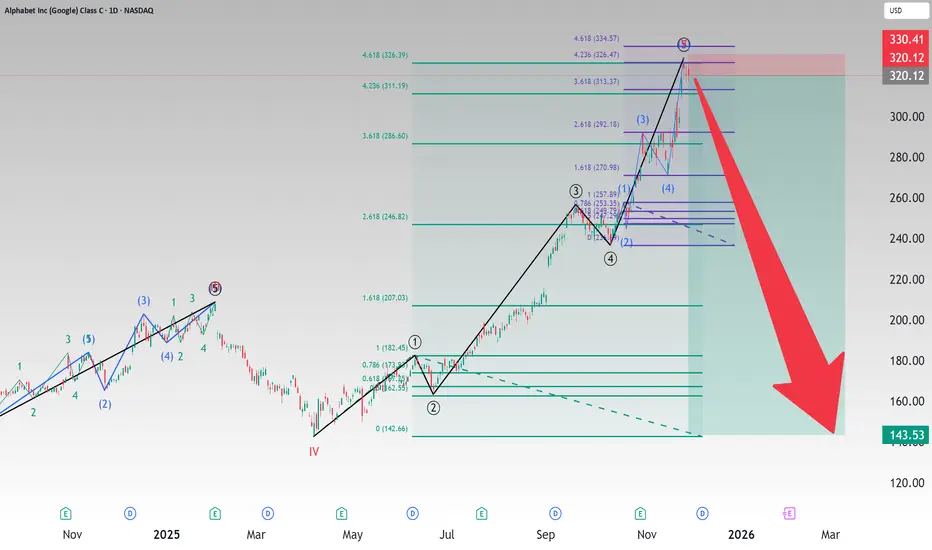
Google Short: 5-waves completion with Fibonacci ExtensionsOver here, I want to discuss the possibility that Google has peaked. I know that I am going against Berkshire Hathaway. But then, we can really confirm if the latest decision is really made by Warren Buffett given that he has also recently announced his retirement? And Charlie Munger is no longer with him.
Of course, I've always given my analysis based on Wester TA (chart patterns), Japanese TA (Candlesticks), and Elliott Waves. And over here, I present to you the potential 5-waves that might have completed on Google. And that is supported by 2 Fibonacci extensions:
1. From Primary Wave 1 across the entire wave, and
2. From Intermediate Wave 1 of 5 across entire Primary Wave 5.
But these are not certainties but probabilities and most importantly, risk-reward.
For this idea, the stop is most important: slightly above the All-time-high: $328.67. I would say that you can put the stop at $329 or $330. If Google goes beyond and makes new ATH, then this idea can be trashed.
The take profit is at the previous wave 4 of a higher degree, or the low made on 7th April 2025: $142.66.
Good luck!