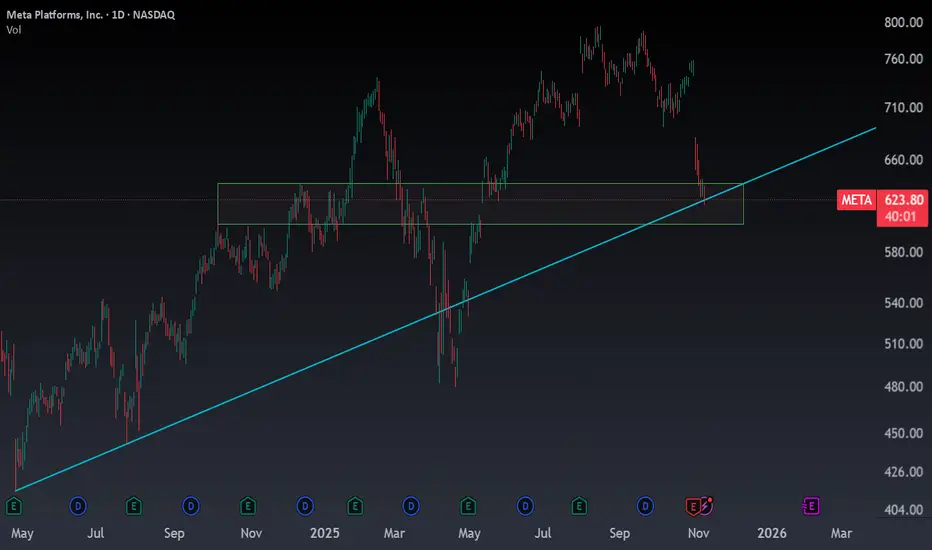
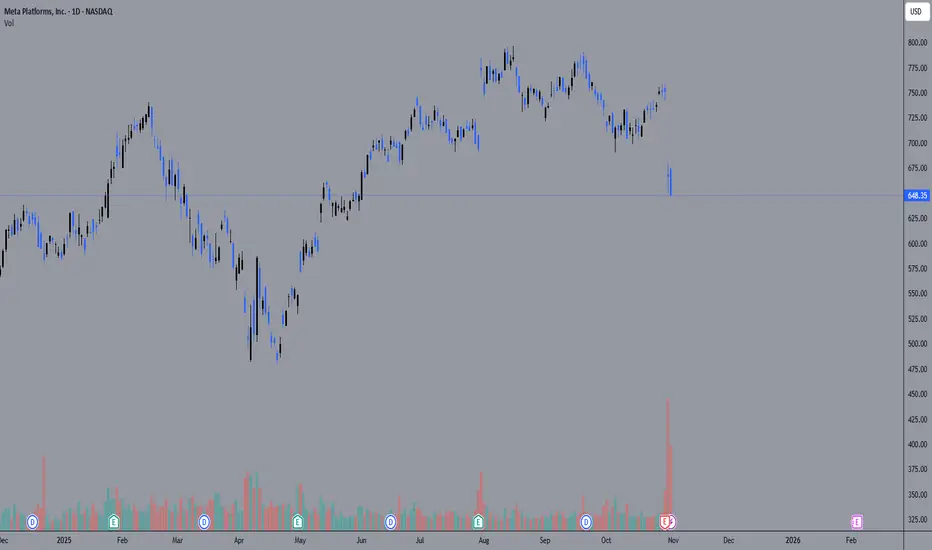
META : Buyers Stepping In After a Sharp Drop!META has shown a strong rejection from the recent lows, suggesting buyers are defending key Zone. If momentum continues, we might see a corrective push up before the next major move. Watch the 640–650 area for signs of exhaustion.
Disclosure: We are part of Trade Nation's Influencer program and receive a monthly fee for using their TradingView charts in our analysis.
Meta Platforms Inc Shs A Cert Deposito Arg Repr 0.041666666 Shs
No trades
Trade ideas
META: Relief-Bounce coming (RSI under 30 on the daily)I can see a relief-bounce for META coming. Everytime we had an RSI under 30 in the last couple of years we got such a bounce.
This is by the way not to say that the correction could not ultimately go deeper on the weekly. So clearly, if you want to trade this on a higher timeframe, have your stop-loss in place.
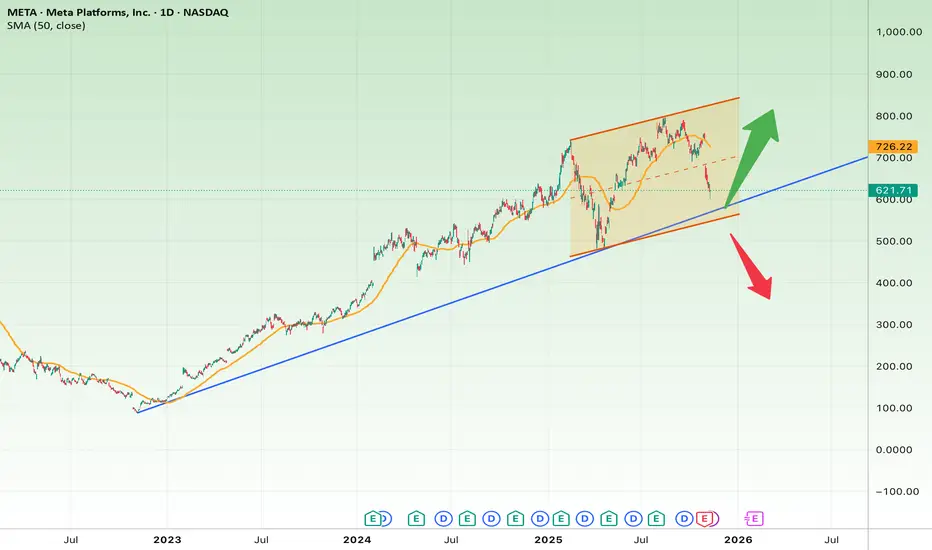
META - Approaching a Key Support ZoneOn the daily chart, META stock has been trading within a rising short-term channel after a strong uptrend from early 2023 to mid-2024. The price is now around $620, approaching the main long-term uptrend line (blue) drawn from the 2023 lows — a critical level that also aligns with the 50-day moving average (SMA50).
Bullish Scenario:
If META holds the $600–$630 support zone and forms a bullish reversal candle, a rebound toward $725 and potentially $800 could follow. This would confirm the continuation of the long-term uptrend.
Bearish Scenario:
If the trendline fails and the price closes below $580, a deeper correction toward $500 is likely. Such a breakdown would indicate the start of a medium-term consolidation phase.
Summary:
The $600 zone is the critical decision point — the line between trend continuation and correction.
As long as META trades above this level, the broader market structure remains bullish.
$META: LONG SIDE OPPORTUNITY NASDAQ:META : Although it may seem incredible, the head and shoulders pattern TARGET has been reached. The stock has lost 24% of its value since hitting an all-time high in early August. The 14-period RSI indicates clear oversold conditions. Friday's hammer candlestick, combined with significant volume, is signaling a potential long-side opportunity.
META Crashed By -12% Should You Buy It?Am so humbled because i believe
i have learned how to find
the best opportunities to trade.
But i have to tell you that these
trading ideas are not
a promise for you to make money
The reason i have to tell you this
is because the spirit of becoming a trader
comes with a lot of humility.
You will notice the "gurus"
marketing to you."How to make $$$"
this is a trap dont fall for it.
It has taken me 8 years!! to master trading
and let me tell you
am still learning
Let me tell you why am still learning
its called risk management
every time the economy is doing bad
the banks decide to increase the cost
of borrowing capital.
This means if you where used to risking
only lets say -10%
after the banks increase the price of borrowing you may
have to adjust your emotions to be ready to risk
-20% per trade. Thats the reason why
you have to be humble no matter
what you are going through.
As you begin your trading journey.
It wont be easy,
Another thing that will keep you humble
is dealing with lagging indicators.
This will mean sometimes you will
have to hold your position during consolidation
periods. or flat markets.
developing your own trading skill
will be the key to your trading journey
but learning from other traders and
not to copy them will help you as well.
am always scared to share my ideas
because i dont know if you will understand
and if you will use the proper risk management
strategies.
One time i spoke with a friend of mine
and every time i spoke to him about trading i left with
a bad feeling...this is why i dont tell
people about trading anymore.
If they ask i always try to change the topic
to business such as becoming a marketeer
on the streets or market place.
I usually say this.
"Am like a marketeer the only
difference is that am using a computer."
I dont give stock tips
or what to buy...nothing!!
i just say that
and leave them hanging in the air.
i want to protect my trading mindset
and am not going to allow
anyone inside this mind including you
the only thing i
can safely show you
is the MACD indicator its my safety net.
its not my main tool but
it shows you that the buyers are stepping.
This price action you are seeing
on this hourly chart is called the
morning star pattern.
This crash is an opportunity to buy this
stock at a discount.
Full disclosure am not participating in this
buying of NASDAQ:META
This idea is just a personal analysis of the price action.
Trade safe.
Rocket boost this content to learn more.
Disclaimer: Trading is risky please learn risk
management and profit taking strategies.
Also feel free to use a simulation trading
account before you trade with real money.
Be patient to jump onto MetaMeta completed its grand cycle 3 on elliot wave structure and entering onto wave 4 now. Wave 4 typically retraces to 0.618 or 0.5 levels of wave 3 which is the zone marked in the box.
That zone is also a demand zone and 500 level is the long standing trend line level. If you are eyeing an entry, be patiend and wait for the right level.
As the famous adage goes, dont catch a falling knife.
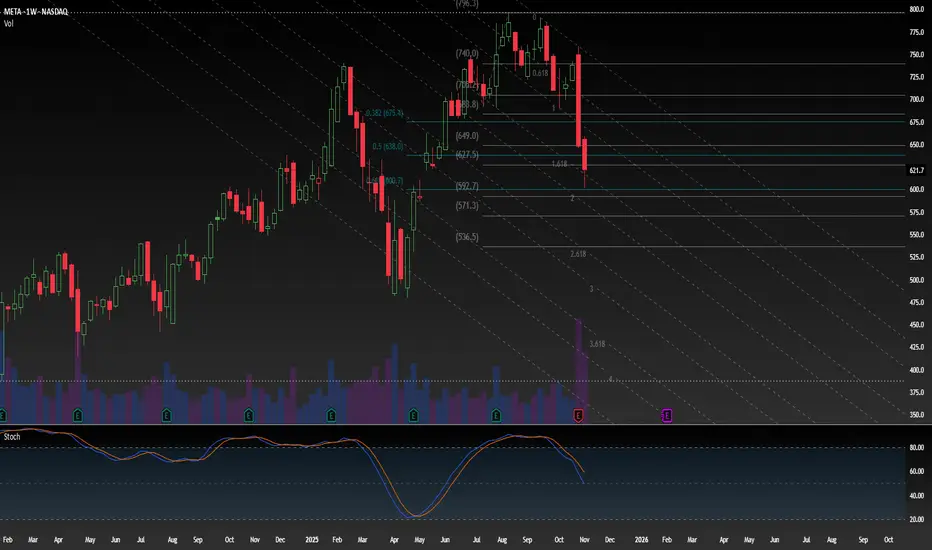
META: Next Long Term Buy Following a disappointing earnings report, Meta (META) dropped more than 10% in post-market trading, decisively breaking through several key support levels. My primary support zones are typically derived from anchored VWAPs (Volume-Weighted Average Prices), which help identify where institutional buyers may step in to defend trend continuation. However, what’s becoming increasingly concerning is the decisive break below both major VWAPs — one anchored to the previous all-time high and another from the “tariff crash” lows.
This type of price action reflects broad-based weakness and a shift in market structure, suggesting that META may be entering a deeper corrective phase. The loss of both VWAPs indicates that long-term buyers are no longer in control of the trend, and that liquidity pockets beneath recent price levels could become magnets for further downside.
From a technical perspective, the current setup points toward a potential cascading move lower into the 0.618 Fibonacci retracement zone, which also aligns with multiple unfilled gaps on the chart. These confluence zones often act as high-probability areas for price stabilization or reversal, particularly when accompanied by a sentiment washout or capitulation event.
Moving forward, I’ll be closely monitoring the sub-$600 area as a potential longer-term accumulation zone. This region not only coincides with that Fibonacci retracement but could also mark the completion of a higher-degree corrective structure within the broader uptrend. Once price stabilizes, I plan to develop a detailed Elliott Wave projection to map out the next impulsive leg higher — ideally one that reestablishes META’s leadership role among the large-cap tech names.
In summary, while short-term weakness appears dominant, the upcoming retracement could offer an attractive buying opportunity for patient investors, provided the broader market context and technical structure begin to realign in favor of the bulls.
Meta — Back to the FutureNASDAQ:META After testing the strong support zone around $707–710,
NASDAQ:META shows signs of a potential rebound — the same zone that triggered a rally in July.
Technical view:
• Price bounced from a high-volume area (VRVP) and closed above HMA(9) near $709.
• MACD lines are converging, suggesting a possible bullish crossover ahead.
• Next resistance levels: $729 → $743 → $785.
• As long as price stays above $710, the recovery scenario remains valid.
NASDAQ:META might be setting up for a multi-wave rebound toward the upper resistance zone —
a “Back to the Future” moment as bulls try to reclaim lost momentum.
⚠️ Key risk: prolonged consolidation below $710 could delay the move.
An Elevator To The 700th FloorGood evening fellas,
Let's first talk about the earnings report that sent this thing into a spiral towards the downside. They had diluted their earnings to make it worse than the actual EPS which I believe came in at $7.25.
That being said, no matter the result of the earnings, we are just looking for an opportunistic set up.
Right now, META runs the social media game with Facebook and Instagram. The amount of resources, shopping, content, etc. between these 2 is astounding. Not to mention, AI now plays a big factor in driving more user traffic.
I don't foresee META going anywhere and actually, I predict that META will be over $1000 per share by 2026-2027 and it will present another opportunity for a stock split.
Anyways, let's talk about a shorter time frame. Within 2 weeks. We are far extended on the downside and RSI is oversold. We also have a GAP and funny enough, that GAP happens to be at the nice round number of 700.
I think tomorrow, Friday the 7th of November is going to present a buying opportunity at the bottom and over the weekend the banks will step in to buy META cheap.
I'm planning to add a couple of lottery ticket positions tomorrow, likely targeting the 650 calls expiring on Friday 11/14.
Thanks for reading.
$META Spotting a Potential Reversal After a 20% Dip Alright, let’s keep it short and sweet! Meta (META) is at $624.35 after a 20%+ drop from its peak, but the chart’s upward trendline is still intact, hinting at a potential reversal. That dip to the $623-$625 support zone
Stay optimistic—this could be the start of a sweet comeback!
This is not investment advice—just a market analysis for tracking purposes. Always do your own research before making any moves!
Meta Could Be OversoldMeta Platforms plunged after its last quarterly report on October 29, but some traders may think the social-media giant is oversold.
The first pattern on today’s chart is the May 23 weekly close of $627.06. Prices tested and held the level on Tuesday and Wednesday, which could make some traders think support is emerging.
Second, stochastics recently fell to its lowest level since February 2022. Wilder’s Relative Strength Index (RSI) reached its lowest level since November 2022. Those readings may suggest that oversold conditions have occurred.
Third, the stock is below its 200-day simple moving average (SMA) for the first time since May 1.
Finally, META is an active underlier in the options market. That could help traders take positions with calls and puts.
TradeStation has, for decades, advanced the trading industry, providing access to stocks, options and futures. If you're born to trade, we could be for you. See our Overview for more.
Past performance, whether actual or indicated by historical tests of strategies, is no guarantee of future performance or success. There is a possibility that you may sustain a loss equal to or greater than your entire investment regardless of which asset class you trade (equities, options or futures); therefore, you should not invest or risk money that you cannot afford to lose. Online trading is not suitable for all investors. View the document titled Characteristics and Risks of Standardized Options at www.TradeStation.com . Before trading any asset class, customers must read the relevant risk disclosure statements on www.TradeStation.com . System access and trade placement and execution may be delayed or fail due to market volatility and volume, quote delays, system and software errors, Internet traffic, outages and other factors.
Securities and futures trading is offered to self-directed customers by TradeStation Securities, Inc., a broker-dealer registered with the Securities and Exchange Commission and a futures commission merchant licensed with the Commodity Futures Trading Commission). TradeStation Securities is a member of the Financial Industry Regulatory Authority, the National Futures Association, and a number of exchanges.
Options trading is not suitable for all investors. Your TradeStation Securities’ account application to trade options will be considered and approved or disapproved based on all relevant factors, including your trading experience. See www.TradeStation.com . Visit www.TradeStation.com for full details on the costs and fees associated with options.
Margin trading involves risks, and it is important that you fully understand those risks before trading on margin. The Margin Disclosure Statement outlines many of those risks, including that you can lose more funds than you deposit in your margin account; your brokerage firm can force the sale of securities in your account; your brokerage firm can sell your securities without contacting you; and you are not entitled to an extension of time on a margin call. Review the Margin Disclosure Statement at www.TradeStation.com .
TradeStation Securities, Inc. and TradeStation Technologies, Inc. are each wholly owned subsidiaries of TradeStation Group, Inc., both operating, and providing products and services, under the TradeStation brand and trademark. When applying for, or purchasing, accounts, subscriptions, products and services, it is important that you know which company you will be dealing with. Visit www.TradeStation.com for further important information explaining what this means.
META - At SupportWell, theoretically META is just getting to the support cluster and competing a Crab Pattern. It may be respected and push the price higher, but if... If the markets forget of the poor results and of the fear that AI Rally is actually no more than another bubble... The best way to wait a bit and just see
Just my humble opinion
Meta - The major triangle rejection!💡Meta ( NASDAQ:META ) will reverse soon:
🔎Analysis summary:
Just a couple of months ago we witnessed a textbook all time high break and retest on Meta. This retest was followed by a major rejection higher and the second retest of the triangle resistance trendline. Therefore, Meta is very likely to create another rejection.
📝Levels to watch:
$750 and $500
SwingTraderPhil
SwingTrading.Simplified. | Investing.Simplified. | #LONGTERMVISION
How International Payment Gateways Work1. What is an International Payment Gateway?
An international payment gateway is an online service that authorizes and processes payments between a buyer and a seller across different countries. It acts as a digital intermediary that connects the merchant’s website to the acquiring bank (merchant’s bank) and issuing bank (customer’s bank).
For instance, when a customer in India buys a product from a U.S.-based e-commerce store, the payment gateway securely transmits the payment data, verifies it, converts the currency if needed, and ensures the funds are transferred to the merchant after validation.
In simple terms, the gateway ensures that cross-border payments are fast, safe, and compliant with global financial regulations.
2. The Role of a Payment Gateway
The primary role of an international payment gateway is to:
Authorize transactions between buyers and sellers.
Encrypt sensitive financial data to prevent fraud.
Convert currencies based on real-time exchange rates.
Integrate with multiple payment methods like credit/debit cards, digital wallets, and bank transfers.
Comply with regional financial laws such as PCI DSS (Payment Card Industry Data Security Standard) and anti-money laundering (AML) regulations.
3. How the Process Works – Step-by-Step
The process behind international payment gateways might seem complex, but it typically follows these major steps:
Step 1: Customer Initiates Payment
A buyer chooses a product or service on an online platform and proceeds to checkout. At this point, they select a payment method — credit/debit card, PayPal, or other options supported by the merchant’s gateway.
Step 2: Encryption and Data Transmission
When the buyer submits payment information, the gateway encrypts sensitive details (like card numbers and CVV codes) using SSL (Secure Socket Layer) or TLS (Transport Layer Security) technology. This ensures that data remains confidential during transmission.
Step 3: Authorization Request
The gateway sends the encrypted data to the acquiring bank (the merchant’s bank), which then forwards it to the card network (Visa, Mastercard, etc.) and ultimately to the issuing bank (the customer’s bank).
Step 4: Verification and Approval
The issuing bank checks whether the customer has sufficient balance and whether the transaction looks legitimate. Based on this assessment, the bank either approves or declines the transaction.
Step 5: Authorization Response
The approval or decline message is sent back through the same route — from the issuing bank to the card network, then to the acquiring bank, and finally to the payment gateway, which updates the merchant’s website.
Step 6: Settlement
If approved, the funds are debited from the customer’s account and transferred to the merchant’s account (after deducting applicable fees). Currency conversion happens here if it’s an international transaction.
Step 7: Confirmation
The customer receives a confirmation message that the payment has been successful, and the merchant can now proceed to deliver the goods or services.
This entire process usually happens within a few seconds — showcasing how efficient modern financial technology has become.
4. Key Technologies Behind Payment Gateways
International payment gateways rely on several core technologies to ensure seamless operations:
Encryption: Protects sensitive payment data from hackers.
Tokenization: Converts card details into a unique token that can be reused safely without storing real card data.
Fraud Detection Systems: Uses AI and machine learning algorithms to identify suspicious transactions.
3D Secure Authentication: Adds an extra layer of protection for online card payments (e.g., “Verified by Visa” or “Mastercard SecureCode”).
APIs (Application Programming Interfaces): Allow integration between merchant websites and payment processors.
Blockchain (Emerging Trend): Some gateways use blockchain for transparent and faster cross-border settlements.
5. Currency Conversion and Exchange Rates
One of the biggest challenges in international payments is currency conversion. Payment gateways automatically convert the transaction amount from the customer’s currency to the merchant’s preferred currency using real-time foreign exchange rates.
However, they also charge a foreign transaction fee or FX markup, which varies depending on the gateway provider and bank partnerships.
For example:
If a customer in Europe buys a $100 item from a U.S. store, the payment gateway converts euros to dollars based on the current exchange rate, then processes the transaction accordingly.
6. Security and Compliance
Security is the cornerstone of international payment gateways. Since they handle sensitive financial data, they must comply with strict global standards:
PCI DSS Compliance: Mandates secure storage and transmission of card data.
KYC (Know Your Customer): Ensures that businesses and users are verified to prevent fraud.
AML (Anti-Money Laundering) Regulations: Prevents illicit financial activities.
GDPR (General Data Protection Regulation): Protects data privacy for European users.
Additionally, many gateways employ multi-factor authentication (MFA) and real-time fraud monitoring systems to safeguard users.
7. Examples of International Payment Gateways
Some leading international payment gateways include:
PayPal: One of the oldest and most trusted gateways supporting 200+ countries.
Stripe: Popular among developers for its flexible APIs and multi-currency support.
Razorpay & PayU (India): Offer international transaction capabilities with local compliance.
2Checkout (now Verifone): Handles global payments with multiple currency options.
Amazon Pay & Apple Pay: Focus on convenience and mobile payment integration.
Each gateway differs in transaction fees, integration options, and supported currencies.
8. Challenges in International Payments
Despite technological advances, international payment gateways face several challenges:
Currency Fluctuations: Exchange rate volatility affects transaction costs.
Regulatory Barriers: Each country has unique financial laws.
High Transaction Fees: Cross-border payments can be expensive for small businesses.
Payment Fraud and Chargebacks: Increased risk due to international nature of transactions.
Integration Complexity: Businesses must ensure compatibility with multiple payment systems.
9. The Future of International Payment Gateways
The future of global payment gateways is being shaped by innovation and digital transformation. Some emerging trends include:
Blockchain-based Payments: Faster and cheaper cross-border transactions.
AI-Powered Fraud Detection: Real-time identification of anomalies.
CBDCs (Central Bank Digital Currencies): Government-backed digital currencies will integrate into gateways.
Embedded Finance: Payment solutions built directly into apps and online stores.
Seamless Multi-Currency Wallets: Allowing users to hold, convert, and pay in different currencies easily.
10. Conclusion
International payment gateways are the backbone of global digital commerce. They simplify complex financial processes, connect different banking systems, and ensure that transactions happen securely and efficiently across borders. From a customer’s click on “Pay Now” to the merchant receiving funds, gateways manage countless tasks — encryption, verification, conversion, and compliance — in just seconds.
As e-commerce continues to expand globally, these gateways will become even more critical, evolving with technology and regulation to create a truly borderless financial ecosystem where anyone, anywhere, can transact confidently.
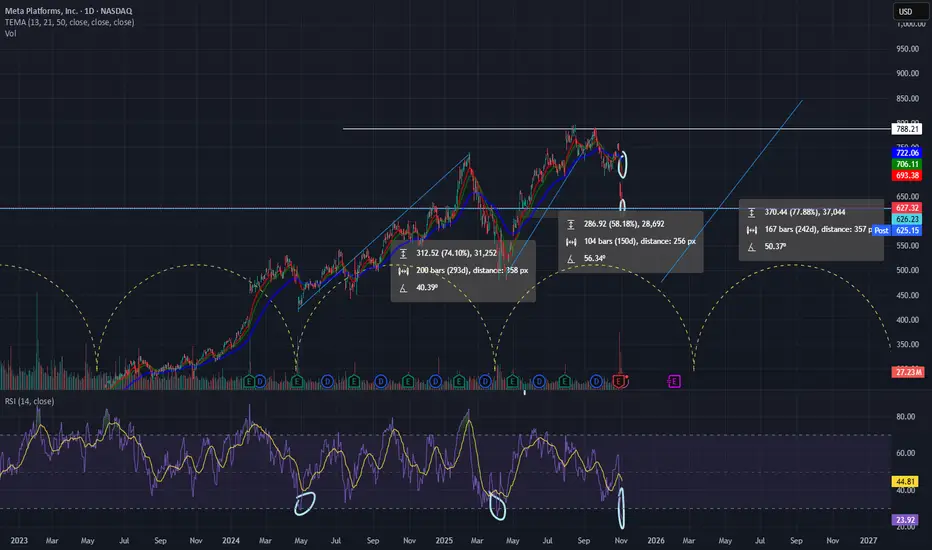
META Cycle Analysis – Possible Macro Bottom FormingMETA just hit a major technical confluence zone around $620–625, aligning with previous cycle lows and a deeply oversold RSI (~24).
Every prior RSI flush at this level (2023, early 2024) has marked the start of a new multi-month leg higher.
The current structure mirrors META’s past rhythm — roughly 8–9-month accumulation–expansion cycles.
If this pattern holds, we could be looking at the early phase of the next uptrend targeting the $780–840 zone by mid-2026.
Volume shows heavy post-earnings capitulation, but selling pressure is easing, and buyers are starting to defend support.
Short-term confirmation would come with a close above $650–670, flipping the short-term trend.
📊 Outlook:
Support: $620
Resistance: $670 / $706 / $788
RSI: Oversold, early reversal signals forming
Bias: Neutral → Bullish if $670 reclaims
Cycles, symmetry, and RSI all suggest META might be setting up for its next expansion phase.
META watch $634-641: Semi-Major Support may hold Earnings DUMP META apparently disappointed with its last earnings report.
Approaching a "Semi-Major" support zone at $634.32-641.88
Look for a clean bounce or look lower like $600 for next try.
.
This is a followup to my TOP CALL given by Dual Goldens:
Hit BOOST and FOLLOW for more such PRECISE and TIMELY charts.
========================================================
META Great opportunity for longs, target to 1000
For Swing or Options Tradersw w/ at least 12 month expiration:
Surprise bear bar with follow-up, expect a few legs lower, expect a typical bottom wedge near left shoulder
Great consolidation zone ~ 600, also Big Round Number = magnet
Near 100 weekly EMA, needs to re-test that
Near Trendline of Bull Channel
Target: Long-term Measured move from 600 to 800 leads to 1000
META Buy Opportunity – KZDZ ModelMETA Game Plan – KZDZ Model
📊 Market Sentiment
On 29/10, the FED lowered rates by 25BPS, as expected. However, Powell’s remarks added uncertainty around further cuts in December, stating that future decisions will be data-dependent.
One FED member dissented, preferring no cut this cycle — a notable shift from September’s unanimous decision.
Following this, rate-cut expectations dropped from 95% to 68%, sparking short-term bearish sentiment as traders took profits and hedged exposure.
Despite this volatility, the mid-to-long term outlook remains bullish given the broader liquidity cycle and easing policy stance.
📈 Fundamental
META earnings missed expectations, triggering a sharp sell-off. While short-term sentiment is bearish, the long-term outlook remains supported by ongoing AI development initiatives.
📈 Technical Analysis
1-Hit oversold RSI on the daily timeframe.
2-Retraced to the 0.5 Fibonacci equilibrium zone (≈ $640).
3-Tested a major HTF Key Zone around $625, signaling potential accumulation.
📘 Model in Use – Key Zone with Discount Zone (KZDZ Model)
The KZDZ Model identifies areas where discounted Fibonacci levels align with strong HTF liquidity zones, offering high-probability reversal opportunities.
1️⃣ Identify HTF Key Zone
2️⃣ Align with Discount Zone (0.5–0.75 range)
3️⃣ Look for confirmation structure on LTF
4️⃣ Execute and manage risk accordingly
📌 Game Plan
Scenario 1 (Black Path): Watch for price to hit $625 and close above $640 (daily). Upon confirmation, plan to buy C640 options targeting $680–$700.
Scenario 2 (Red Path): If price fails to reclaim $640, monitor for a deeper move to $560, then look for weekly rejection above that zone. Entry via C560 options, targeting $620–$700.
🎯 Setup Trigger
Scenario 1 → Daily close above $640 after retesting $625.
Scenario 2 → Weekly close above $560 zone.
📋 Trade Management
Scenario 1: Buy C640 Calls → take profits at $680–$700.
Scenario 2: Buy C560 Calls → partial profits $620–$640, rest at $680–$700.
Move stop to breakeven after first target is hit.
💬If this META breakdown supports your outlook, like, comment, and follow.
For deeper sentiment and strategy updates, subscribe to my Substack free access available.
⚠️ This analysis is for educational purposes only and does not constitute financial advice. Always conduct your own research before trading or investing.
The META drop explainedSo what happend to META last week:
I see a lot of you wondering what happend to the stock and what caused the drop.
The answer is simple. The EPS was not so good.
We can see on the chart that the EPS is only 1.05 and that they expected 6.723 . That is a chance of -84.38%.
So for that big of a chance this is a small drop.
The Reason:
So the reason that this happend is because they need to pay some extra in taxes.
The tax that they need to pay is around 15,9 billion dollar.
This is because Trump has passed some tax laws that state that big companies need to pay taxes on profits that they have made outside of the US.
This is only a one time tax that they need to pay and the reason that they are doing this is because they want to avoid companies to do tax evation and book more profits outside of the US.
What we also do need to know is that made up profits outside of the US are being re-evaluated and that they need to pay tax on a portion of that profit because the see a portion of it as domestic assets.
What we need to keep in mind:
What we need to keep in mind here is that the EPS only dropped because of this tax and that there are people saying that the EPS without this tax would have been around 7.25 . So a good boost from what the analysist are expecting of META.
So you could see this as a big discount you get on the stock price.