Microsoft Corp Shs Cert Deposito Arg Repr 0.03333333 Shs
No trades
Trade ideas
$MSFT Bottom $455 oversold $425NASDAQ:MSFT Is a predictable machine $455 is the bottom margin for error could drop $425 in oversold situation.
All their fundamentals align and show the same pattern every time.
typically around this time we should see a dip which finds support at the last wave's highs.
there really isnt more explanation needed for this...
unless... we have a yen carry trade unwind.. that's a different story..
MSFT Swing Buy Setup — Multi-Factor Bullish Confirmation📈 MSFT QuantSignals V3 Swing Analysis | 2025-12-08
MSFT Swing Signal — 2025-12-08
• Direction: BUY CALLS
• Confidence: 65%
• Horizon: 18 days → 2025-12-26 expiry
• Strike Focus: $460.00
• Entry Range: $33.70
• Target 1: $49.80
• Stop Loss: $23.50
• 1W Move: +1.49%
• 2W Move: +2.15%
• Volume: 1.0× vs prior swing
• Swing Range: $480.08 – $492.30
⚠️ Moderate Risk: Consider reducing position size due to moderate confidence.
🎯 TRADE RECOMMENDATION
Direction: BUY CALLS
Confidence Level: 65% (MEDIUM)
Conviction: Medium
⚠️ KATY–LLM CONFLICT DETECTED
Conflict: Direction
LLM Recommendation: BUY CALLS
Katy AI Chart Prediction: BUY PUTS (-1.40% predicted move)
Katy Confidence: 50%
Proceed with caution — signals do not fully align.
🧠 ANALYSIS SUMMARY
Katy AI Outlook
Predicts STRONG_BULLISH trajectory targeting $520+ within 3 weeks
Driven by earnings momentum + AI leadership catalysts
Technical Analysis
Resistance: $493.50 (today’s high)
Support: $482.87 (VWAP)
Trading near 90% of swing range → potential breakout
Bullish divergence across momentum indicators
No major candlestick reversal patterns detected
Market Context
Overall Market: STRONG BULLISH
SPY: Bullish
QQQ: Bullish
Strong alignment with tech-sector momentum.
News Sentiment
Bullish — MSFT featured in favorable TA articles
Instacart x ChatGPT partnership strengthens MSFT AI dominance
Options Flow
PCR 1.31 → bearish-leaning flow
Heavy volume at $420 puts suggests hedging rather than bearish direction
Low theta decay ideal for swings
Risk Level: MODERATE
Watch for clean breakout above $493.50.
💰 TRADE SETUP
Expiry: 2025-12-26 (18 days)
Recommended Strike: $460.00 (0.881 delta — balanced)
Entry Range: $33.10–$34.30 (use exact real-time bid/ask)
Target 1: $49.80 (+50%)
Target 2: $66.40 (+100%)
Stop Loss: $23.50 (-30%)
Position Size: 3% of portfolio
Quant signals MSFT Weekly PUT: Institutional Bearish MomentumDirection: BUY PUTS (SHORT)
Confidence: 65% (Medium)
Strike: $475.00
Entry Price: $4.10
Target 1: $6.15 (50% gain)
Target 2: $8.20 (100% gain)
Stop Loss: $2.87 (30% loss)
Expiry: 2025-12-05 (2 days)
Position Size: 2% of portfolio
Weekly Momentum: BEARISH (-2.82%)
Options Flow: Bearish (PCR 18.23) – heavy institutional put buying
Technical: Oversold RSI 5.2, session low $475.28, resistance $493.50
News: Microsoft lowers AI software sales quotas – negative catalyst
Risk: Medium – Katy AI conflicts (neutral-to-bullish), high gamma risk
MSFT Weekly PUT Signal #2
Direction: BUY PUTS (SHORT)
Confidence: 65% (Medium)
Strike: $482.50
Entry Price: $3.30
Target 1: $4.95 (50% gain)
Target 2: $6.60 (100% gain)
Stop Loss: $2.31 (30% loss)
Expiry: 2025-12-05 (2 days)
Position Size: 3% of portfolio
Weekly Momentum: NEUTRAL (+0.08%)
Options Flow: Bearish (PCR 14.10) – heavy institutional put buying
Technical: Overbought RSI 85.2, weekly high $493.50, support $475.20
News: Negative AI sales catalyst
Risk: Medium – Katy AI conflicts (bullish prediction), requires active management
Microsoft (NASDAQ: $MSFT) Drops as AI Sales Miss Targets Microsoft (NASDAQ: NASDAQ:MSFT ) slid more than 2% after a report from The Information claimed that the company had reduced growth targets for its AI products because sales teams failed to meet expectations. The report highlighted that several Azure sales units missed ambitious quotas tied to Foundry—Microsoft’s enterprise AI platform used to build and manage autonomous AI agents. According to the report, less than 20% of salespeople in one U.S. Azure division hit the 50% Foundry growth target, while another team initially faced a quota requiring them to double sales.
Microsoft quickly refuted the claims, stating that The Information conflated growth projections with internal quotas. The company emphasized that “aggregate sales quotas for AI products have not been lowered,” reaffirming the strength and ambition of its broader AI roadmap. Despite the clarification, the stock reacted sharply, reflecting heightened sensitivity around AI monetization as enterprise adoption continues to lag expectations.
Although AI is transforming workflows and offering automation opportunities, the adoption curve for enterprise-scale AI agents remains slower compared to consumer AI breakthroughs. Competitors including Google, Amazon, Anthropic, Salesforce, and OpenAI all face similar challenges as traditional organizations navigate data integration, reliability issues, and operational risk.
Technical Outlook
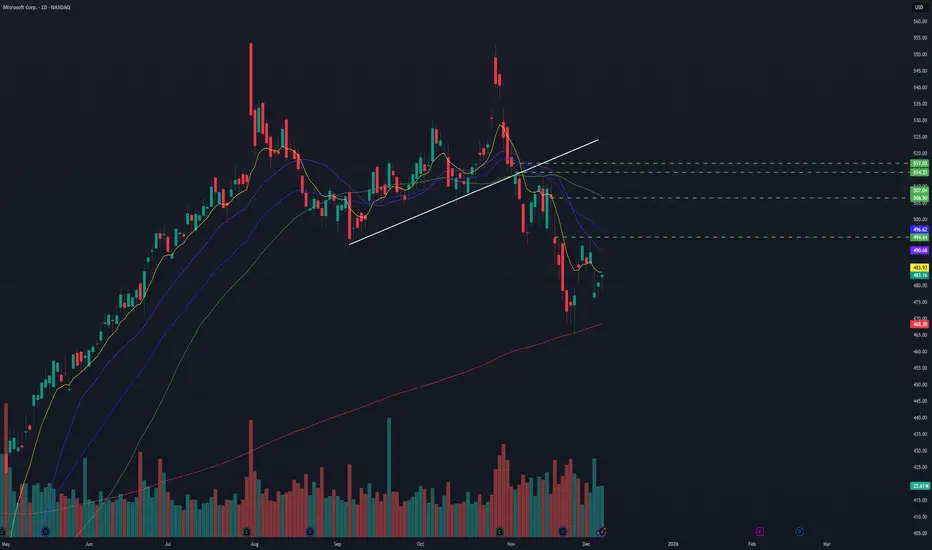
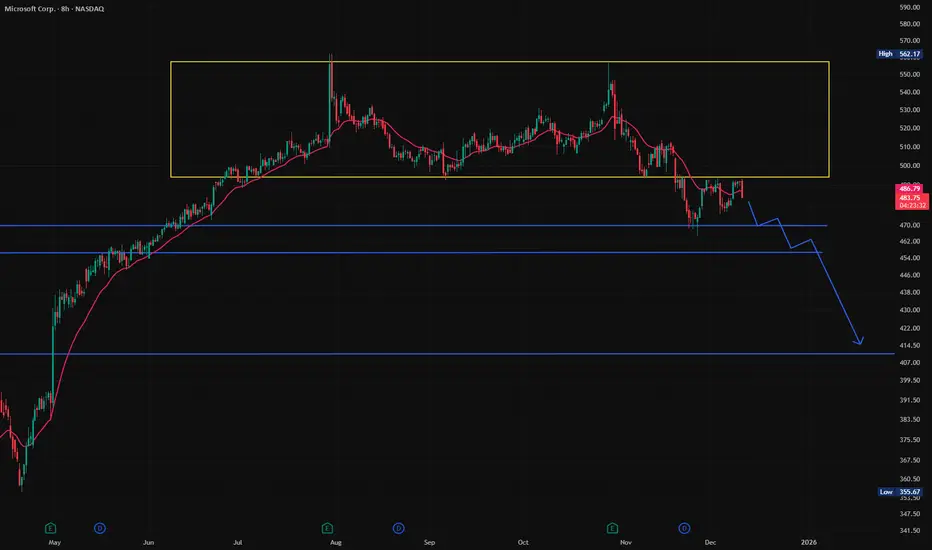
From the chart, MSFT has pulled back sharply from its $555 resistance zone and is now retesting a key support level around $465. This area aligns with previous structure and may act as short-term demand. A breakdown below $465 opens room for a deeper decline toward the $450 level. However, holding this support could trigger a rebound back toward the $555 region. Momentum remains neutral-bearish, with price sitting below the recent swing highs.
MSFT PullbackPattern Identified: Bearish Double Top pattern confirmed on Microsoft ( NASDAQ:MSFT ) with neckline break and clear measured move objectives. Neckline Break Triggers Measured Move to Gap Fill.
Key Confluence:
First Top: Initial rejection
Second Top: Failed breakout, lower high
Neckline: Support connecting swing lows between tops
Confirmation: Neckline break & retest completed
Measured Move Calculation:
TP1: Distance from highest top to neckline, projected onto the breakout zone = $430
TP2: Gap fill zone from May 1st, 2025 = $400
SL: Above Neckline at previous confirmation
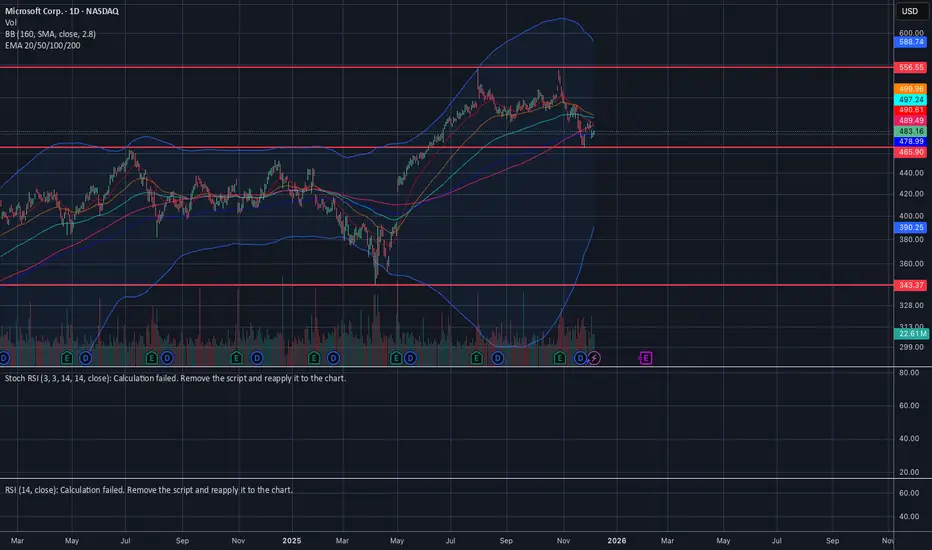
MSFT: Next Long Term Buy ZoneMicrosoft has staged a strong rally since the April tariff-related selloff, rebounding significantly but ultimately failing to set a new meaningful high in October. While the company’s earnings have remained relatively strong, it is still a publicly traded stock and therefore susceptible to broader market conditions that could trigger a pullback.
After my analysis on META identified a strong trade/buy zone around $600 and below, I’ve noticed a very similar setup forming on Microsoft, one that could present an excellent buying opportunity if a deeper drop materializes.
From a purely technical standpoint, using volume-based tools, I see several reasons to be prepared for a potentially larger pullback in this stock.
To start, I’ve marked two major zones to outline the volume-price action: the first is the consolidation range before the tariff driven decline, and the second is the volume profile of the subsequent uptrend.
You’ll notice that price broke out of the previous consolidation range without any meaningful retracement back into that fair value zone, essentially melting up. This creates thin structural support that can easily give way if meaningful sell-side pressure emerges.
Secondly, price has failed twice above the Value Area High of the uptrend’s fair value range near $538. These failures resulted in a failed auction that drove price to the opposite end of the range at $472. What concerns me most is the rejection at the Point of Control (the most heavily traded zone), highlighted in blue. Price reacted sharply from that level, forming a resistance zone that has not been reclaimed, an indication of potential weakness.
Third, price is now losing the uptrend anchored VWAP from the previous swing low. In my view, this is a major support level that typically signals trend continuation, where buyers should be stepping in to defend price. That is not occurring. If price breaks below the Value Area Low where the most recent swing low sits I would be concerned about a possible waterfall move that could bring price back into previous support zones.
If such a drop does occur, I will not panic. Instead, I will recognize it as a potential major buying opportunity in a fundamentally strong and profitable company one that could represent nearly a 25% decline from the highs.
Only time will tell..
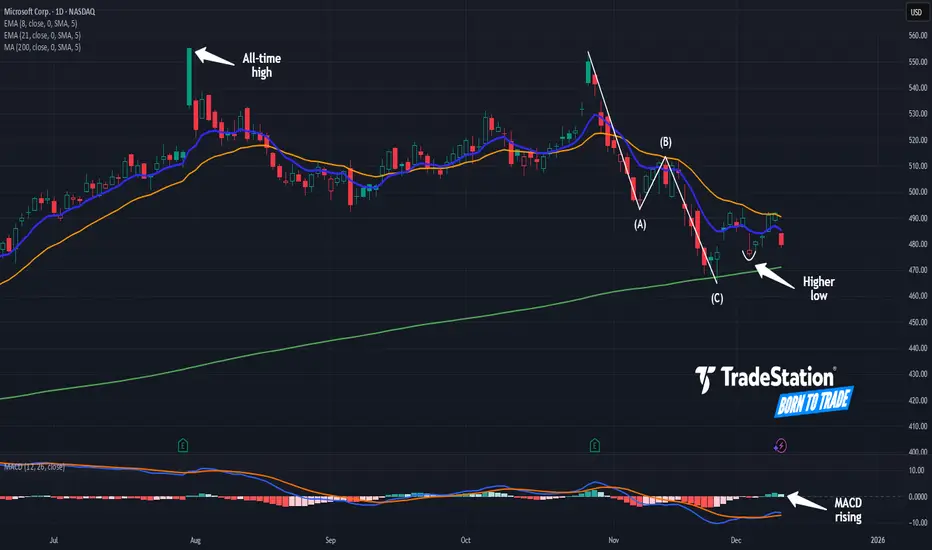
Microsoft May Be TurningMicrosoft struggled in November, but some traders may think it’s turning this month.
Consider the slide after MSFT jumped in late October. MACD was falling throughout the period, giving bulls little opportunity for a rally despite strong quarterly results.
However, a few things seem to the changing.
First, MACD has turned higher. That may suggest that short-term momentum has grown more bullish.
Second, the software giant tested and held its 200-day simple moving average. That may confirm its longer-term uptrend remains intact.
Third, prices made a higher low this month compared with late November.
Next, the pullback may be viewed as a finished A-B-C corrective wave. Completion of that pattern could mark an end to the selling pressure.
Finally, MSFT is an active underlier in the options market. (Its average daily volume of 328,000 contracts ranks 11th in the S&P 500, according to TradeStation data.) That may help traders take positions with calls and puts.
TradeStation has, for decades, advanced the trading industry, providing access to stocks, options and futures. If you're born to trade, we could be for you. See our Overview for more.
Past performance, whether actual or indicated by historical tests of strategies, is no guarantee of future performance or success. There is a possibility that you may sustain a loss equal to or greater than your entire investment regardless of which asset class you trade (equities, options or futures); therefore, you should not invest or risk money that you cannot afford to lose. Online trading is not suitable for all investors. View the document titled Characteristics and Risks of Standardized Options at www.TradeStation.com . Before trading any asset class, customers must read the relevant risk disclosure statements on www.TradeStation.com . System access and trade placement and execution may be delayed or fail due to market volatility and volume, quote delays, system and software errors, Internet traffic, outages and other factors.
Securities and futures trading is offered to self-directed customers by TradeStation Securities, Inc., a broker-dealer registered with the Securities and Exchange Commission and a futures commission merchant licensed with the Commodity Futures Trading Commission). TradeStation Securities is a member of the Financial Industry Regulatory Authority, the National Futures Association, and a number of exchanges.
Options trading is not suitable for all investors. Your TradeStation Securities’ account application to trade options will be considered and approved or disapproved based on all relevant factors, including your trading experience. See www.TradeStation.com . Visit www.TradeStation.com for full details on the costs and fees associated with options.
Margin trading involves risks, and it is important that you fully understand those risks before trading on margin. The Margin Disclosure Statement outlines many of those risks, including that you can lose more funds than you deposit in your margin account; your brokerage firm can force the sale of securities in your account; your brokerage firm can sell your securities without contacting you; and you are not entitled to an extension of time on a margin call. Review the Margin Disclosure Statement at www.TradeStation.com .
TradeStation Securities, Inc. and TradeStation Technologies, Inc. are each wholly owned subsidiaries of TradeStation Group, Inc., both operating, and providing products and services, under the TradeStation brand and trademark. When applying for, or purchasing, accounts, subscriptions, products and services, it is important that you know which company you will be dealing with. Visit www.TradeStation.com for further important information explaining what this means.
MSFT LongBroader Market Structure
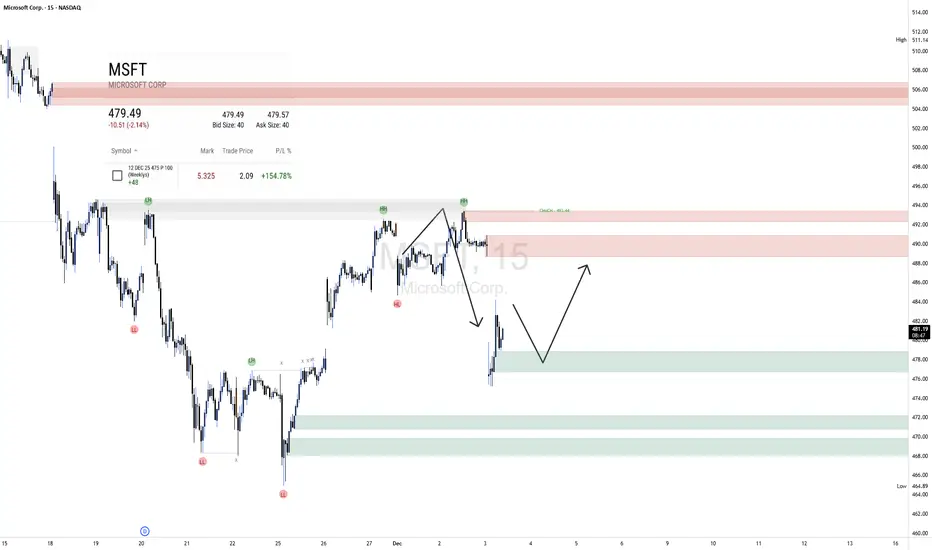
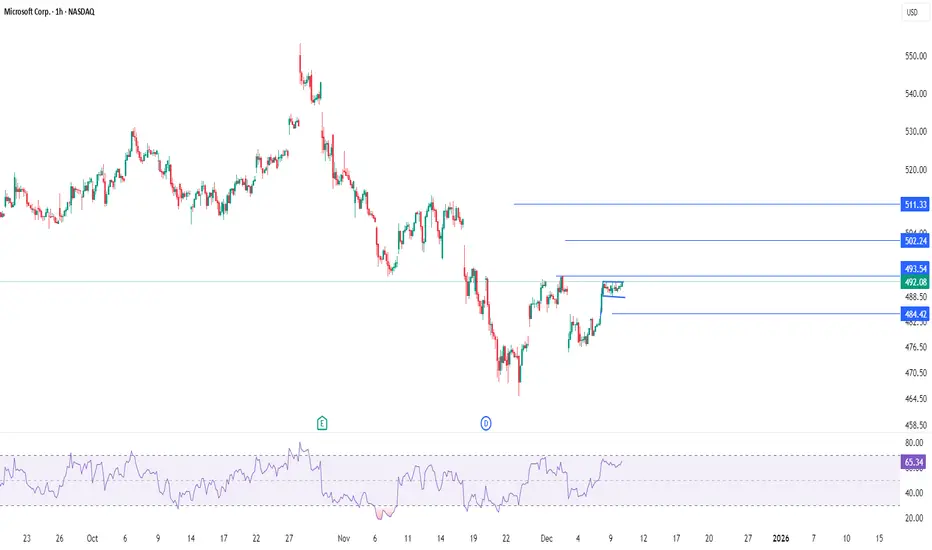
MSFT on the 15-minute chart is in a short-term uptrend following a sequence of higher lows and higher highs from the $464 area. The key structural shift occurred when price printed a CHoCH at $492.44, breaking above the previous swing high and confirming bullish intent. Before that, the market had transitioned from lower lows into a clear higher-low structure, signaling accumulation before expansion. The recent drop from the $492–$494 supply is corrective, not impulsive, which suggests we’re seeing a pullback rather than a reversal unless demand fails.
Supply & Demand Zones
The upper supply around $492–$494 has shown clear weakness for buyers; price rejected immediately with strong momentum and multiple wicks showing absorption and aggressive selling. Higher up, the major supply at $504–$507 remains a strong distribution zone where price previously dropped sharply, indicating institutional control. On the demand side, the closest zone at $478–$475 is fresh and unmitigated; buyers stepped in with strength from that area earlier, producing a decisive rally and ultimately the CHoCH. A deeper demand below $470–$466 is even more important because it initiated the entire trend shift and contains protected lows.
Price Action in the Marked Region
Price is currently declining from supply and pushing toward the green demand region. The move down is controlled rather than impulsive, indicating sell-side momentum is fading as it approaches prior buyer interest. The marked projection makes sense: a dip into $478–$475 would allow liquidity collection before a bounce toward the $488–$492 supply above. If demand holds, expect responsive buying with a clean bullish engulfing candle or long-wick rejection.
Trade Bias, Direction & Invalidation
The bias for now is bullish, looking for a pullback to demand and continuation upward. The expected direction is a retest of $478–$475 followed by a rally toward $488–$492.
A key invalidation level is a clean 15-minute close below $475—if that level breaks, sellers likely target the deeper $470–$466 demand, and the bullish thesis weakens significantly.
Momentum & Candle Behavior
Momentum currently favors sellers in the short term, but the drop is stepping rather than impulsive, suggesting exhaustion into demand. Look for a shift in candle behavior—such as a bullish engulfing bar, absorption wick, or displacement candle—to confirm buyer strength returning.
QS V3 Weekly Call Opportunity – MSFT Bullish TrendMSFT Weekly Signal | 2025-12-05
MSFT Weekly Call Option
Direction: Buy Calls (Long / Bullish)
Strike: $482.50
Entry Price: $5.62 – $5.70
Profit Target 1: $8.90 (≈60% gain)
Profit Target 2: $11.20 (≈100% gain)
Stop Loss: $3.90 (≈30% loss)
Expiry: Dec 12, 2025 (7 days)
Position Size: 2% of portfolio
Confidence: 58%
Rationale: Katy AI predicts upward trajectory to ~$497 by Friday; MACD bullish divergence suggests potential multi-day reversal.
Risk Notes: High – Friday expiration with gamma effects; low VIX may reduce premium capture. Monitor actively.
Emerging Market vs Developed Market1. Definitions
Developed Markets
Developed markets are countries with high economic maturity, advanced financial systems, strong institutions, and stable political environments. Their characteristics include high GDP per capita, industrial sophistication, deep capital markets, and steady (though slower) economic growth. Examples include USA, UK, Canada, Japan, Germany, France, Australia, and Singapore.
Emerging Markets
Emerging markets are economies transitioning from developing to developed status. They show rapid industrialization, expanding middle-class populations, improving institutions, and increasing integration with global markets. Examples include India, China, Brazil, Indonesia, South Africa, Mexico, Turkey, and Vietnam.
2. Key Characteristics
2.1 Economic Growth
Emerging Markets:
Faster GDP growth, driven by urbanization, industrial expansion, rising consumption, digital adoption, and favorable demographics. Annual growth often ranges from 4–7%.
Developed Markets:
Slower but stable growth, typically 1–3%, due to market maturity, ageing demographics, and saturated industries.
Implication: EMs offer growth potential; DMs offer stability.
2.2 Income Levels and Living Standards
Developed Markets:
High income, advanced infrastructure, strong social welfare systems, high productivity.
Emerging Markets:
Lower but rapidly rising incomes, infrastructure still developing, large segments transitioning to formal economy.
2.3 Financial Markets and Institutions
Developed Markets:
Deep, liquid, and highly regulated financial markets. Stock exchanges (e.g., NYSE, NASDAQ, LSE) exhibit high transparency and strong corporate governance.
Emerging Markets:
Growing markets but with lower liquidity, higher volatility, and varying investor protections. Institutional reforms are ongoing.
2.4 Currency Stability
Developed Markets:
Stable currencies, low inflation, credible central banks.
Emerging Markets:
More prone to currency fluctuations, inflation spikes, and external shocks due to reliance on imported commodities and foreign capital.
2.5 Political and Regulatory Environment
Developed Markets:
Predictable policies, rule of law, strong regulatory systems.
Emerging Markets:
More political uncertainty, policy shifts, regulatory inconsistencies. However, some EMs like India are rapidly improving regulatory transparency.
2.6 Demographics
Emerging Markets:
Young, expanding populations — a positive for long-term consumption and labor supply.
Developed Markets:
Ageing populations — leading to higher healthcare spending, slower consumption growth, and labor shortages.
3. Opportunities in Emerging vs Developed Markets
3.1 Investment Opportunities
Emerging Markets
Higher returns due to rapid growth.
Sectors like technology, fintech, manufacturing, renewable energy, and infrastructure show exceptional potential.
Underpenetrated markets allow companies to grow at scale.
Developed Markets
Stable and predictable returns.
Strong corporate governance and reduced risk of fraud or systemic failures.
Advanced industries like AI, biotechnology, cloud computing, clean tech, and high-end manufacturing.
3.2 Consumer Market Potential
EMs have massive, growing middle classes. Consumption is expected to double in many EMs in the next two decades.
DMs have saturated markets, with growth reliant on innovation rather than new customers.
3.3 Capital Flows
Investors often chase high growth in EM equities, debt, and startups.
DMs attract long-term, stable institutional capital due to reliability of returns.
4. Risks in Emerging vs Developed Markets
4.1 Market Volatility
Higher in EMs, due to currency risks, political events, commodity dependence, and lower liquidity.
DMs show lower volatility thanks to robust financial systems.
4.2 Geopolitical and Policy Risks
EMs often face elections, reforms, or geopolitical pressures that can shift markets abruptly.
DMs are more predictable, although events like Brexit or US political gridlocks still create uncertainty.
4.3 Currency and Inflation Risks
EM currencies can depreciate sharply in global stress periods.
DMs maintain low inflation and strong central bank credibility.
4.4 Structural Challenges
EMs face challenges like corruption, weak judiciary, infrastructure gaps, and bureaucratic hurdles.
DMs deal with challenges like high public debt, low productivity growth, and ageing populations.
5. Comparative Overview
5.1 Growth vs Stability
Emerging markets = growth, opportunity, volatility
Developed markets = stability, safety, lower returns
5.2 Innovation and Technology Adoption
DMs lead in innovation due to research ecosystems.
EMs leapfrog technology — e.g., India’s digital payments boom, China’s e-commerce leadership.
5.3 Trade and Globalization
EMs are increasingly integrated into global supply chains.
DMs dominate global trade policies, IMF, World Bank, and monetary influence (USD, Euro, Yen).
5.4 Corporate Structures
DMs have multinationals with global footprints.
EMs are producing new giants (e.g., Reliance, Tata, Alibaba, BYD, Samsung).
6. Examples
Emerging Markets
India: Fastest-growing major economy, tech innovation, digital transformation.
China: Manufacturing hub, consumption growth.
Brazil: Natural resources, agriculture economy.
Indonesia & Vietnam: Manufacturing and consumption boom.
Developed Markets
USA: World’s largest and most innovative economy.
Japan: High-tech industries, strong institutions.
Germany: Industrial powerhouse.
UK & Canada: Stable financial systems.
7. Which Is Better for Investors?
Emerging Markets Are Ideal If You Want:
High long-term growth potential
Exposure to rising consumption
High-return equity opportunities
Portfolio diversification
Developed Markets Are Ideal If You Want:
Safety and predictability
Lower volatility
Strong governance
Blue-chip stability
Best Strategy:
A balanced portfolio that mixes both — e.g., EM for growth + DM for stability — provides optimal long-term results.
8. Conclusion
Emerging and developed markets represent two ends of the global economic spectrum. Emerging markets offer high growth, rising consumer demand, innovation, and long-term opportunities, but with higher risks and volatility. Developed markets deliver stability, security, and robust institutions, though with slower growth.
Understanding the differences helps investors, businesses, and policymakers choose the right strategies. In today’s interconnected world, both market types are essential components of global economic progress. A combination of the dynamism of emerging markets and the reliability of developed markets provides a balanced and powerful approach to global investment and economic engagement.
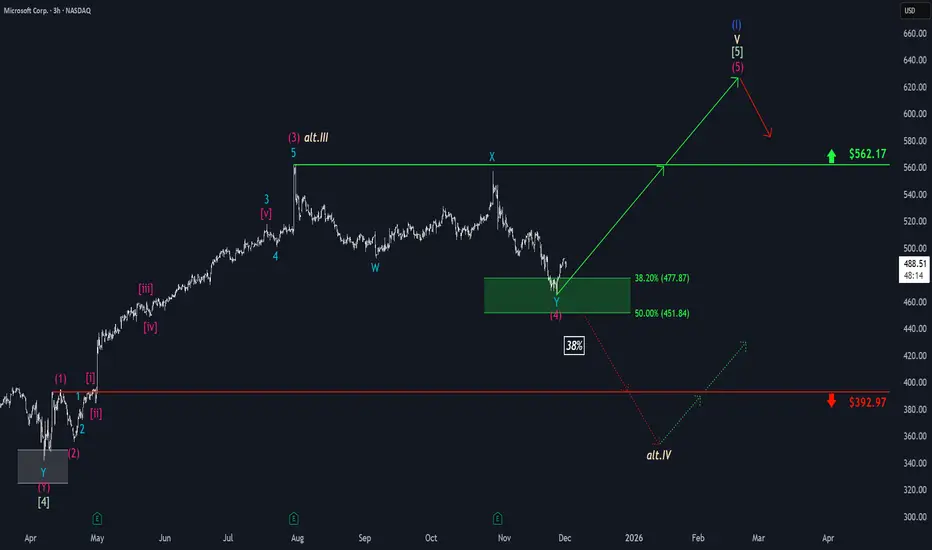
Microsoft: Target Zone Hit!Microsoft has reached our green Long Target Zone between $451.84 and $477.87 as anticipated. In the meantime, the stock has successfully completed the magenta wave (4) and has since broken out of the Target Zone to the upside. We now expect further gains as wave (5) unfolds, targeting a move above the resistance at $562.17, where the larger blue wave (I) is expected to conclude. After that, we anticipate a pronounced correction phase. However, there remains a 38% chance that MSFT could break down through the Target Zone and fall below the support at $392.97. In this case, we would reclassify the last significant high at $562.17 as the top of the beige wave alt.III and prepare for a new low in wave alt.IV .
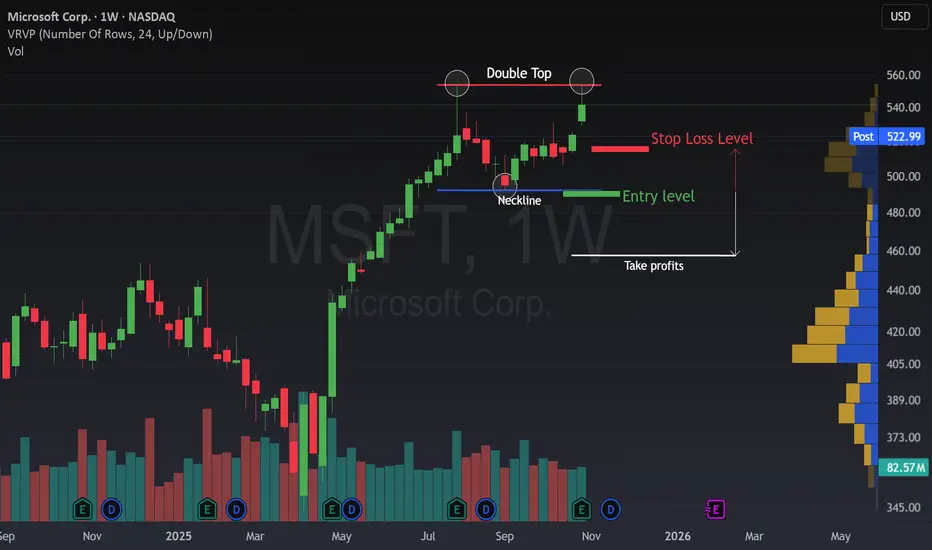
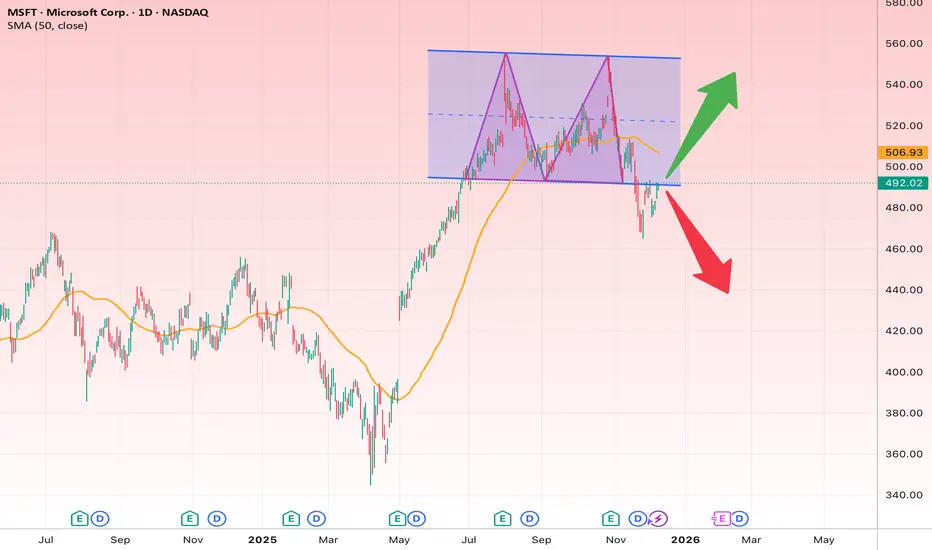
A Double Top in MSFT has just appeared.The weekly chart of Microsoft (MSFT) is showing a potential Double Top formation, a classic sign that bullish momentum might be losing strength .
🔹 Bullish Scenario: As long as the price stays above the blue neckline , the uptrend remains intact. Buyers are still in control, and a clear breakout above the recent highs could trigger a move into new all-time highs.
🔹 Bearish Scenario: If the price breaks below the neckline , it could confirm the Double Top setup and open the door for short opportunities.
NASDAQ:MSFT is standing at a critical decision point, will the stock continue its strong rally, or is this the first sign of exhaustion before a larger pullback?
💬 What do you think, are we about to see another breakout, or is the beginning of a deeper correction?
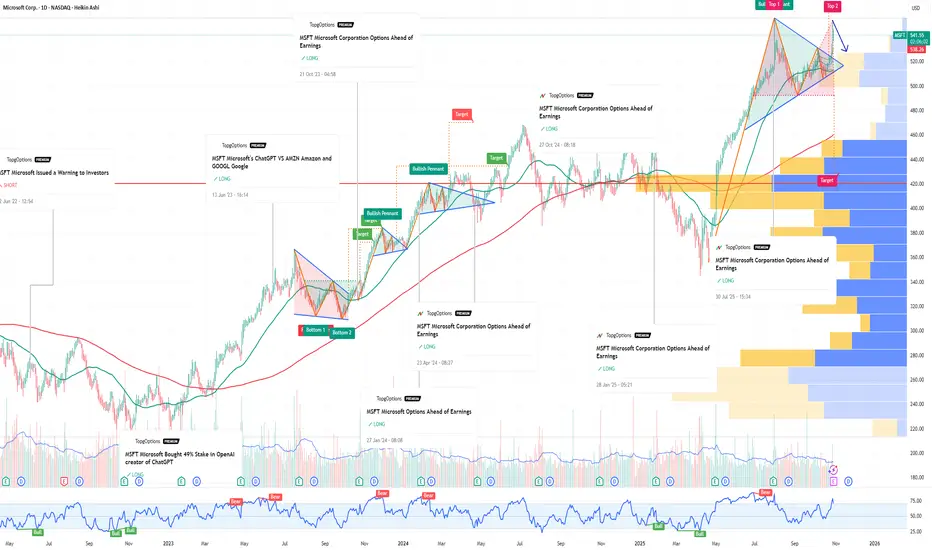
MSFT Microsoft Corporation Options Ahead of EarningsIf you haven`t bought MSFT before the rally:
Now analyzing the options chain and the chart patterns of MSFT Microsoft Corporation prior to the earnings report this week,
I would consider purchasing the 550usd strike price Puts with
an expiration date of 2025-12-19,
for a premium of approximately $26.70.
If these options prove to be profitable prior to the earnings release, I would sell at least half of them.
$MSFT double top into resistance is a loud sell signalGM traders — just re-entered a NASDAQ:MSFT short. The double top into resistance was a loud “sell” signal for me.
Fundamental backdrop is lining up too: several outlets citing Reuters/enterprise checks say Microsoft cut AI sales growth targets after reps missed quotas and customers were slower to adopt “AI agents.” That reads as near-term demand friction for parts of Copilot/agent monetization.
Even if Azure remains strong, this kind of headline is a sentiment hit — it suggests the AI revenue ramp may be bumpier than bulls were pricing in.
MSFT – Buying The Weekly AI Support With Defined RiskMSFT – Buying The Weekly AI Support With Defined Risk
Symbol: MSFT
Timeframe: 1W
On the weekly chart, Microsoft remains in a long-term uptrend. After a strong multi-year rally driven by cloud and AI, price has pulled back from recent highs and is now trading around the $492.02 zone, which coincides with a key liquidity area where former resistance has turned into support. This zone is highlighted on my chart as a blue demand area.
Fundamentally, Q1 FY26 came in strong: EPS at $4.13 vs $3.65 consensus and revenue at $77.67B, with Microsoft Cloud up 26% YoY to $49.1B and Intelligent Cloud up 28% YoY to $30.9B. At the same time, capital expenditures jumped 74% YoY to $34.9B as the company invests heavily in AI infrastructure, including a $17.5B plan in India (2026–2029) and additional multi-billion commitments in Canada. The chart is essentially pricing the balance between this aggressive AI spending and very strong profitability.
According to the external data I use, current price is around $492.02, with a scenario range that includes a lower bound at $447, a conservative upside around $560, and higher projections well above that level. I use these levels to build a simple, asymmetric swing plan on the weekly structure.
Bias: BUY
Entry: 492.02 (around current market levels)
Take Profit: 560.00
Stop Loss: 447.00
The idea is to participate in the prevailing long-term bullish trend while keeping risk strictly defined. The 560 target sits below the main analyst consensus (around 632) and the average external projection (around 643.76), so I consider it a conservative first objective rather than an aggressive moonshot.
The setup remains valid as long as price holds above the $447 area on a weekly closing basis. A sustained breakdown below that zone would, in my view, signal that the market is repricing Microsoft’s heavy AI capex and rich valuation more aggressively, invalidating this bullish bias. Key catalysts include upcoming Fed decisions (AI trades are very rate-sensitive), macro data on inflation and employment, and any updates from management on AI monetization or capex guidance.
This is my personal, hypothetical trading plan on MSFT, based on the levels and data mentioned above. It is not meant to be copied blindly: position sizing, timing and risk tolerance are individual decisions.
Disclaimer / Avvertenza
Le informazioni fornite hanno esclusivamente finalità informative e didattiche e non costituiscono in alcun modo consulenza finanziaria, investimento personalizzato, sollecitazione al pubblico risparmio o raccomandazione all’acquisto o alla vendita di strumenti finanziari. Ogni decisione di investimento o di trading è sotto la piena ed esclusiva responsabilità del lettore. I mercati finanziari comportano un elevato livello di rischio e le performance passate non sono garanzia di risultati futuri.
Microsoft at a Breaking Point: Is This Pullback a Trap?Microsoft has broken down from a distribution range / double top zone and is now forming a critical pullback retesting the broken support. This area will determine the medium-term direction.
Bearish Scenario (More Likely)
Rejection from 505–510:
• Target 1: 480
• Target 2: 455
• Target 3: 430
• Stop-loss: Daily close above 515
Bullish Scenario
If price closes above 515:
• Target 1: 525
• Target 2: 545
• Stop-loss: Close below 500
Short Fundamental View
• Strong position in AI, cloud, and enterprise software.
• Copilot and Azure growth remain strong.
• But valuation is stretched at highs, increasing correction risk.
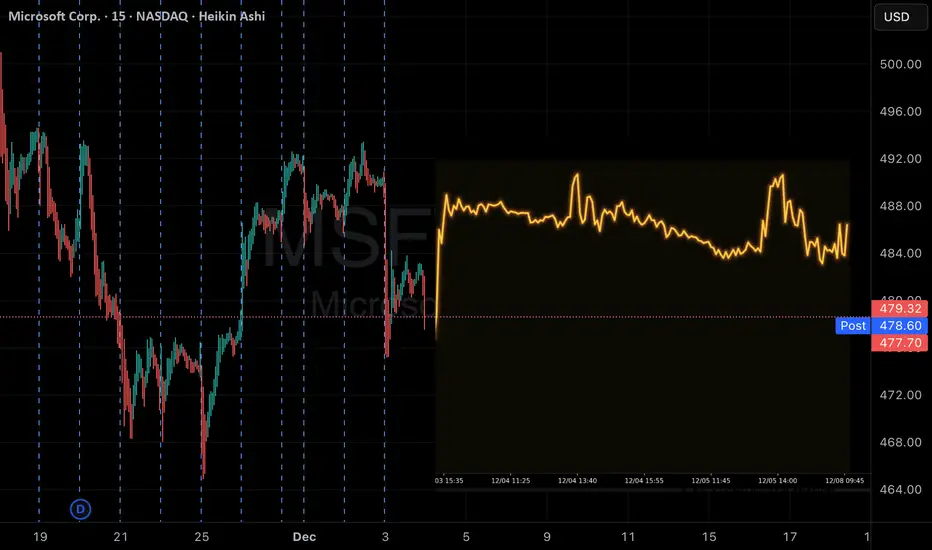
MSFT shortBroader Market Structure
MSFT on the 15-minute timeframe shows an overall bullish trend leading into December, characterized by a sequence of higher highs and higher lows. This trend shifts when price forms a lower high near approximately 493–494 and subsequently breaks the prior swing low around 487, which constitutes a clear CHoCH. This downward break signals that buyers have lost control of the short-term structure and that the market is now vulnerable to a deeper pullback or a transition into a bearish phase. After that downside move, price recovers sharply and breaks back above the internal swing near 488, forming a short-term bullish BOS. However, the most recent price action shows price rejecting from a fresh lower-timeframe high at roughly 491–492, suggesting another potential CHoCH to the downside if it clears the most recent local low.
Supply and Demand Zones (short descriptive paragraphs)
The supply zone around 492–494 is proving to be strong; price dropped sharply from this level earlier, indicating sellers stepped in decisively. When price revisited this zone, it again showed hesitation and rejection, confirming that supply remains active. On the demand side, the area near 482–484 previously held well, with buyers stepping in aggressively and producing a strong impulsive leg upward. That strength makes the demand below price a valid rebound area; however, its strength will degrade if price returns too frequently or approaches it with heavy bearish momentum.
Price Action Within the Marked Region
Inside the highlighted region on the right side of your chart, price has formed a lower high beneath the 491–492 supply ceiling and is now drifting sideways with slight bearish pressure. This indicates that price is respecting nearby supply and failing to push higher. If current momentum continues, price is likely to pull back into the 485–486 area first, and if that fails, extend deeper toward the 482–484 demand. Should the demand zone hold, a bounce back toward 490 would be expected; if it fails, the downside opens further.
Current Trade Bias, Expected Direction & Invalidation
Bias is mildly bearish in the short term due to the rejection at supply and the emerging lower-high structure. Expected direction is a move down into 485–486, and potentially deeper into the 482–484 demand zone. The key invalidation level for the bearish view is a clean break above 492. If price closes above that level with momentum, it negates the downside structure and reopens bullish continuation.
Momentum & Candle Behavior
Momentum currently favors sellers; candles near the top show upper wicks, hesitation, and loss of upward drive. No aggressive bullish engulfing or displacement candles are present at the moment, reinforcing the possibility of further downside before buyers regain control.
Trading Global Assets: An Overview1. Types of Global Assets
Global assets can be broadly classified into several categories:
Equities (Stocks): International stocks allow investors to participate in the growth of companies worldwide. For example, investing in technology firms in the U.S., consumer goods companies in Europe, or emerging market businesses in Asia can provide diversified exposure to global economic trends. Stocks are typically traded on exchanges like the NYSE, NASDAQ, London Stock Exchange, or Tokyo Stock Exchange.
Bonds: Sovereign and corporate bonds issued by foreign governments or companies offer opportunities for income generation and portfolio diversification. For instance, U.S. Treasury bonds are considered safe-haven assets, whereas emerging market bonds may offer higher yields but higher risks.
Currencies (Forex): The foreign exchange market is the largest financial market in the world, with daily trading volumes exceeding $6 trillion. Investors trade currency pairs, such as EUR/USD or USD/JPY, to speculate on exchange rate movements or hedge against currency risks. Forex trading is highly liquid and operates 24 hours, providing constant opportunities for global traders.
Commodities: Gold, oil, silver, and agricultural products are traded globally through futures and spot markets. Commodities are influenced by global supply-demand dynamics, geopolitical tensions, and economic growth trends. For instance, oil prices may react to conflicts in the Middle East, while gold often acts as a safe haven during financial instability.
Derivatives: Options, futures, and swaps allow investors to speculate on the price movement of underlying global assets or hedge existing positions. For example, currency futures can protect multinational companies from adverse currency fluctuations, while equity derivatives can help traders leverage their market positions.
ETFs and Mutual Funds: Global exchange-traded funds (ETFs) and international mutual funds pool investor capital to invest in multiple international assets, providing diversification with relatively lower costs. These funds can focus on specific countries, regions, sectors, or themes, such as emerging markets, technology, or green energy.
2. Benefits of Trading Global Assets
Trading global assets offers several strategic advantages:
Diversification: Investing in multiple countries reduces reliance on a single economy or currency. For example, if the U.S. market underperforms, gains in Asia or Europe can offset losses.
Growth Opportunities: Emerging markets often experience higher growth rates compared to developed economies, offering potential for higher returns.
Hedging Against Domestic Risks: Global investments can protect portfolios from domestic inflation, interest rate changes, or political instability. For instance, holding foreign bonds or currencies may offset domestic stock market volatility.
Access to Innovative Sectors: Some sectors or companies may be dominant in specific regions, such as technology in the U.S., renewable energy in Europe, or manufacturing in China. Global trading allows investors to access these growth drivers.
3. Challenges and Risks in Global Asset Trading
While the opportunities are compelling, trading global assets carries specific risks:
Currency Risk: Investments denominated in foreign currencies are exposed to exchange rate fluctuations. A strong domestic currency can erode returns when foreign earnings are converted back.
Political and Regulatory Risks: Changes in government policies, regulations, or trade restrictions can impact asset prices. For instance, sudden capital controls in an emerging market can limit liquidity and access to investments.
Market Liquidity and Volatility: Some global markets, especially in developing countries, may have lower liquidity, leading to higher volatility and transaction costs.
Time Zone Differences: Global trading requires monitoring markets across different time zones, which can be challenging for individual traders. Major market sessions in New York, London, Tokyo, and Sydney affect liquidity and price movements.
Economic and Geopolitical Factors: Global macroeconomic events, such as interest rate changes, recessions, or conflicts, significantly influence asset prices. Commodity-dependent economies, for example, are vulnerable to fluctuations in oil or metal prices.
4. Trading Strategies for Global Assets
Investors and traders employ various strategies to navigate global markets:
Fundamental Analysis: Evaluating macroeconomic indicators, company earnings, interest rates, inflation, and geopolitical conditions helps investors identify undervalued assets and long-term growth opportunities.
Technical Analysis: Traders use price charts, trends, and technical indicators to forecast market movements. Technical analysis is particularly common in currency, commodity, and equity trading.
Arbitrage: Exploiting price differences of the same asset across multiple markets can generate risk-free or low-risk profits. For example, currency or commodity arbitrage takes advantage of exchange rate discrepancies.
Hedging: Corporations and institutional investors use derivatives like options, futures, and swaps to protect against price fluctuations, currency volatility, or interest rate changes.
Thematic and Sectoral Investing: Targeting specific global trends such as renewable energy, artificial intelligence, or emerging market consumerism allows investors to capitalize on long-term growth themes.
5. Role of Technology in Global Trading
Advancements in technology have revolutionized global asset trading:
Electronic Trading Platforms: Online brokerages and trading platforms enable retail and institutional investors to access international markets instantly.
Algorithmic Trading: Automated trading systems analyze market data and execute trades based on pre-set rules, improving efficiency and reducing emotional bias.
Mobile and Cloud Technology: Traders can monitor portfolios, execute orders, and analyze markets from anywhere in real-time.
Data Analytics and AI: Advanced analytics provide insights into market trends, risk management, and predictive modeling for better decision-making.
6. Regulatory Considerations
Trading global assets requires understanding and compliance with international laws and regulations. Each country has specific rules regarding foreign ownership, taxation, reporting, and trading practices. Regulatory bodies, such as the U.S. Securities and Exchange Commission (SEC), European Securities and Markets Authority (ESMA), and local central banks, govern trading activities to ensure transparency and investor protection. Investors must also be aware of tax implications for capital gains, dividends, and foreign income.
7. Conclusion
Trading global assets opens a world of opportunities for diversification, growth, and risk management. It allows investors to participate in the performance of companies, currencies, commodities, and financial instruments across continents. However, it requires careful consideration of risks, including currency fluctuations, geopolitical instability, regulatory differences, and market volatility. A well-structured approach—combining fundamental and technical analysis, leveraging technology, and adhering to risk management principles—can help investors navigate the complexities of global markets successfully.
In the modern financial landscape, globalization, technology, and innovative financial instruments have made global asset trading more accessible than ever. For long-term investors, it offers exposure to growth engines around the world. For traders, it provides opportunities to capitalize on short-term market inefficiencies. Understanding the dynamics of global economics, market psychology, and risk management is essential for anyone aiming to succeed in this interconnected financial ecosystem.
Microsoft: Overvalued but Still Bullish - Watching the 400–450Microsoft NASDAQ:MSFT
1. Quick Trade Plan (for those who want levels first) 🎯
Market Bias: Long term bullish, but in a late phase of the cycle.
Strategy: Don’t chase highs; buy the correction.
📌 Buy Zones
Primary Buy Zone: 400–450 USD
Strong support cluster and the preferred accumulation zone.
Aggressive Early Entries:
450–470 on sharp dips, but main focus remains 400–450.
⛔ Invalidation Level
345 USD
A break below this level invalidates the mid term bullish structure.
🎯 Take Profit Targets
TP1: ~600
TP2: 680–720
Potential completion of the final fifth wave.
🧭 For Current Holders
Continue holding while above 345.
Use a protective stop below 345 if trading shares.
Options traders may hedge instead.
🆕 For New Buyers
Avoid entering near ATHs.
Wait for the 400–450 pullback.
Use 345 as your hard-risk level.
2. Fundamental Overview: Great Business, Clearly Overvalued 💼📊
Microsoft has delivered very stable mid-teens growth for years:
Revenue growth: 15–17 percent annually
EPS growth: also 15–20 percent annually
Last 3 quarters: EPS +9–12 percent, revenue in the same range
This is a mature mega-cap, not a hyper-growth name.
⚠️ Buybacks Stopped
Company regularly bought back shares for six years
Stopped in March 2023 and hasn’t resumed
This removes a major EPS-boosting engine
📉 Valuation (Peter Lynch style)
EPS growth ≈ 15 percent
P/E ≈ 30
Stock trades at ~2x its fundamental fair value
Conclusion:
Amazing business. Predictable. Cash generative. 🔥
But fundamentally overpriced and in the late stage of its growth curve.
3. Technical Picture: Still Bullish, but Late in the Cycle 📐📈
📅 Long Term Channel Since 2010
Price has stayed inside a massive uptrend channel for 14+ years.
As long as MSFT remains inside it, the primary trend stays bullish.
📏 200-Day Moving Average
MSFT consistently bounces from the 200d MA on the weekly.
That keeps the structural bull trend intact.
🌊 Elliott Wave Context
Currently in the 5th sub-wave of a larger 3rd wave
Upside still possible
Potential final wave targets: 600–700
⏳ What Comes After
Once this major wave completes:
Expect a multi-year sideways cycle (5–7 years) as the market distributes the massive positions accumulated since 2009.
4. Current Structure: A Correction Is Likely Before New Highs 🔄
We already saw an A–B–C correction, but structure suggests another A–B–C, forming a zigzag, before the final move higher.
🎯 Why 400–450 Is the Key Zone
Major liquidity & support cluster
Aligns with channel midline and prior consolidation
Perfect area for a 5th wave launch
If MSFT hits 400–450 and bounces → 600–700 is back on the table.
5. What To Do Based on Your Situation 🧭
✔️ If You Already Hold MSFT
Stay in the trade while above 345
Expect volatility
You can hedge or use a stop below 345
🟦 If You Want to Enter
Don’t FOMO near the highs ❌
Wait for a pullback into 400–450
Start with partial size, add on confirmation
345 = hard stop
⚡ If You Trade Short Term
Shorts are counter-trend
Treat every drop as a tactical move, not a macro reversal
Unless 345 breaks
6. Final Thoughts ✨
Microsoft is still in a powerful long term uptrend, but:
Fundamentally overvalued
Technically late stage of its long cycle
Likely to give a clean buyable correction
Best accumulation zone: 400–450
Invalidation: 345
Upside targets: 600–700
It’s a “buy the dip, not the rip” market for MSFT.
Not financial advice — manage risk according to your plan.