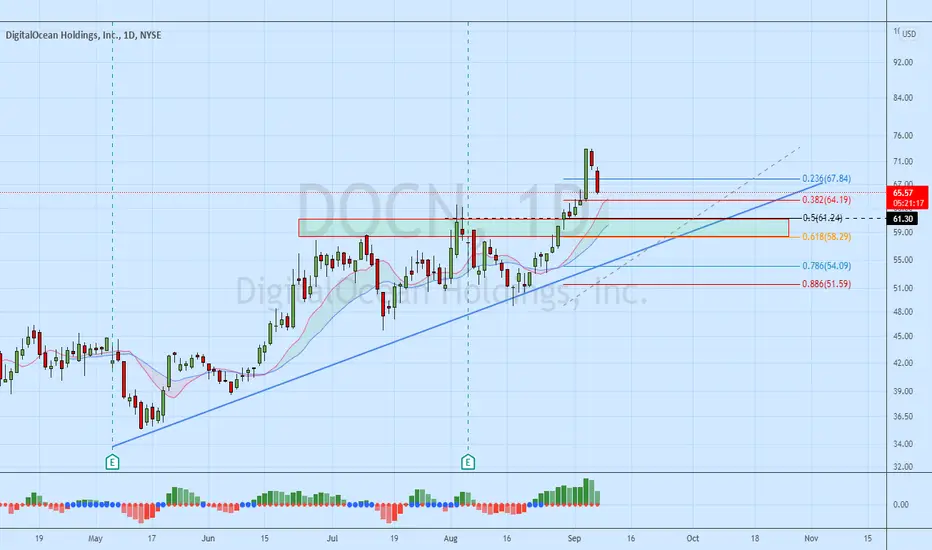
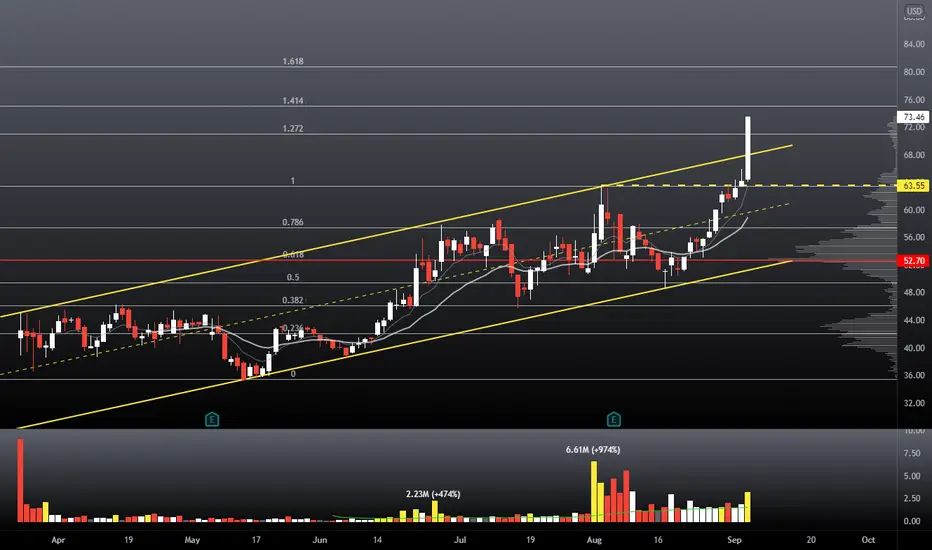
DOCN at crucial support. Digital ocean has hit a crucial support.
With a h&s pattern formed in the last two weeks of Feb, it broke the neck-line Yesterday and has since hit its h&s pt of $71.50.
- This is also a crucial support level of a channel which was created throughout the first couple if quarters since IPO.
- The 6 month RSI has also re-entered its buy zone below 30%
- MACD support touched.
- Possible double bottom here as well - PT of $98.
- Gap to fill at $130
All PTs on chart
Trade ideas
The Top 3 Elements Found In All Good Trading PlansHey everyone! 👋
This month, in preparation for the new year, we have been theming our posts around the concept of building a solid trading plan. Our first post asked you to think about the kinds of factors that can predict long term success. Our second post looked at why trading plans are so important. Both of these posts you can find linked at the end 👇
Having talked about the *what* and the *why*, it’s time to talk about the *how*.
Today we will be taking a look at the top 3 elements found in all good trading plans!
1️⃣ Element 1: Every good trading plan knows why it wins.
In trading, there are two variables that matter: Bat Rate, and Win / Loss.
► Bat Rate describes what percentage of the time a trade ends up as a win. A trader with a 90% bat rate wins 9 out of every 10 trades.
► Win / Loss describes how big the average win is, relative to the average loss. A trader with a 0.5 Win / Loss takes losses twice the size of his wins.
If you multiply these numbers together, you will get an “Expected Value”.
For example, a trader with a Bat Rate of 50% (wins half of the time) and a Win / Loss of 1 (Losses the same size as wins) is a perfectly “Breakeven” trader.
In order to make money in the long term, all you need to do is make the multiplication of these values be a positive value. The breakeven trader above only needs to win 51% of trades to begin making money, if his W/L remains constant.
☝🏽To get these numbers into positive “expected value” territory, every good trading plan needs to devise a way to systematically find trading opportunities that it thinks have an edge. The inputs of this system are completely up to the trader, but they are typically rooted in repeating price patterns, fundamental observations, macro trends, or other patterns and cycles. Backtesting can be useful here for getting a general idea of whether or not an idea for a trading strategy has borne out to be true over time.
In short, no matter what it looks like, good trading plans identify their edge before risking capital. Why start a business without a business plan?
2️⃣ Element 2: Every good trading plan takes into account the emotional character of the trader.
This is the hardest element to quantify, but also arguably one of the most important pieces of a good written trading plan - the ability to work around a trader’s individual strengths and weaknesses. This is less important for banks and hedge funds, as decisions are typically made with oversight, but for retail traders, there is no-one around to temper your personal flaws.
You can do whatever you want! - but it’s a double edged sword of responsibility that your trading plan needs to prepare you for.
In short, you can best get an idea of where you are emotionally weakest by looking at your trading history. Nobody can do this for you, so it requires quite a bit of self-awareness. However, the rewards of removing emotional risk from a trading plan make it worth the effort.
😱 All trading is based on fear. You need to understand which fear is stronger - the fear of missing out, or the fear of losing capital. Figure out which is stronger, and plan accordingly.
Just because you understand a certain strategy and other people make money trading it, doesn’t mean that you will be able to. Executing with 100% consistency at 30% efficiency is more important than finding a strategy with 100% efficiency that you can only trade with 10% consistency. Make life easy on yourself!
3️⃣ Element 3: Every good trading plan outlines risk.
Whether you have one thousand dollars or one billion dollars, ignoring risk is a sure way to experience massively increased monetary and emotional volatility, which can have a huge negative impact on long term profitability. Here are a few simple-to-implement mechanisms that Banks, Hedge Funds, and Prop Firms use to reduce risk significantly - good trading plans don’t skip these.
💵 Total Account Stop
Exactly what it sounds like: once you lose a certain percentage of your capital, you stop trading, liquidate your positions, and assess what went wrong. Only once you’re satisfied that you have fixed the issue are you allowed to re-enter the market. In the industry, this number is commonly 10%.
💵 Per Theme Risk
This ensures that you aren’t too concentrated on a single “bet”, even if the bet is spread across multiple instruments. For example, if you own multiple companies in the same sector, their performance will likely be correlated to some degree even if they have different products or services. Adding a hard cap to this type of risk can massively reduce risky or over concentrated allocations.
💵 Per Position Risk
Many successful Professional Traders and Hedge Funds use the concept of “Free Capital” in order to manage risk. “Free Capital” is the amount of money in hard dollars that makes up the buffer between an account’s current equity, and the total account stop number.
For example, If a currency trader at a bank has a 10% total account stop out, and runs a $10,000,000 currency book, then he can really only “lose” $1,000,000 before his bosses pull him aside to have a talk. His “Free Capital” is $1,000,000. He will then size his positions to where he only risks 1-5% of his Free Capital per trade. This way, he has room to be wrong a minimum of 20 times in a row before any negative consequences come his way. Implementing a “free capital” risk limit per position ensures that you have a TON of room for error.
Yes, this typically prevents you from doubling your account overnight, but again, that isn’t the goal. Long term profitability is.
Some people call this per position risk “one R” (one risk unit).
☝🏽Whatever it looks like, including a plan for managing your risk is essential for *actually* managing your risk. If these plans aren’t written out and acted upon, they’re also a lot easier to ignore.
🙏🏽 Thanks for reading; we are looking forward to making 2022 a record setting year with you. 📈
If you got something out of this, make sure to share it with a friend, so they can also go into 2022 a better trader! 🍀
- The TradingView Team ❤️❤️
a few outcomes, both are bullish!🚀docn bottom is near! but theres still a few outcomes here. If it respects its history, We will see a bounce here and continue higher.
but a possible outcome is a dip into previous trend channel, then breakout once it bounces off that. Like the title says, both are good setups for longs, we just have to play it right. Thats the hard part of course ! 🤑
like and follow for more 💘
DOCN - Another Great Name To Buy, But Not HereDOCN looks like it could be a really winner in time, but right here it is a dangerous recently added stock.
It is showing bearish divergence on D RSI and looks to be forming a head and shoulders or some kind of breakdown pattern. RSI currently testing the centre point so good chance a downtrend is coming.
First I will be looking to see how impulsive the down trend will be.
It it is reasonable gentle to the downside then I will consider to buy when RSI overbought.
I will not be shorting.
Not advice
CITRON is giving a GREAT LONG opportunity with $DOCNCitron following swing trading strategy idea
The demand for shares of the company still looks higher than the supply.
These and other conditions can cause a rise in the share price in the next days.
So I opened a long position from $52,60;
take-profit — $57,43/MOC;
stop-loss — $50,98.
Do not view this idea as a recommendation for trading or investing. It is published only to introduce my own vision.
Always do your own analysis before making deals. When you use any materials, do not rely on blind trust.
You should remember that isolated deals do not give systematic profit, so trade/invest using a developed strategy.
If you like my content, you can subscribe to the news and receive my fresh ideas.
Thanks for being with me!
DOCN rising wedge quick tradeQuick trade on NYSE:DOCN rising wedge forming.
Possible breakout to the downside, so I'm taking profit at 58.80 and set a stop loss as per chart, unless we get breakout to the upside.
Disclaimer: The information is not intended to be and do not constitute financial advice, investment advice, trading advice or any other advice or recommendation of any sort.
Long term hold opportunityDigital Ocean is a cloud computing company that's gaining real traction with small and medium businesses due to their managed services.
Compared to AWS their simplicity and ease of use is what makes them very developer orientated.
Remember, startups have limited resources and many time a dedicated site reliably engineer that can manage kubernetes and deployments on AWS is just too expensive to hire.
This is where Digital Ocean comes in where for lower fees they offer managed services and end-to-end documentation so developers can focus most of their time on building products not configuring servers.
I love the service ,and I'm looking to long term hold this as the total addressable market share is big and growing
IPO of $DOCN just happened and I'm very bullish on this stockOnly if the right pattern appears.
Like Roblox which broke down and is finding a lower pirce of $64 rather then the $70 during its IPO.
So for Digital Ocean on a Friday - I think we will see the same, the market is working thru all this negative news making holding on another IPO - a much easier option.
I would watch these levels to see an opportunity to enter into $DOCN once it settles and finds its base in the next week or so.