AAPL Chart AnalysisHi!
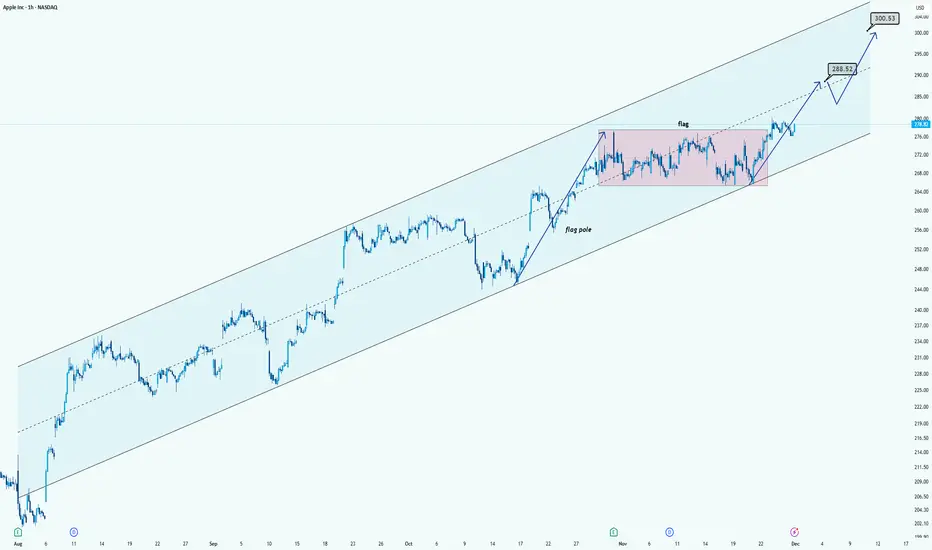
AAPL is trading inside a clean long-term ascending channel, showing a strong uptrend. Recently, the price formed a bullish flag (pink zone) after a sharp move up. The breakout above the flag signals continuation of the trend.
The chart projects two key upside levels:
$288.52 as the first target (flag breakout objective / mid-channel resistance)
$300.53 as the second target (upper channel boundary + psychological level)
As long as price stays above the flag range and respects the channel, the bullish structure remains intact.
Trade ideas
APPLE Just formed its Cycle Top. Best sell opportunity is here.Almost 3 months ago (September 19, see chart below), we gave a buy signal on Apple Inc. (AAPL), which recently hit our final $290 Target:
This week we go back to the long-term 1W time-frame as the Bullish Leg (green) since the April 07 bottom just hit the top (Higher Highs trend-line) of its 4-year Channel Up.
The 2023 Bullish Leg also peaked on its 1.236 Fibonacci extension and eventually corrected back to its 1W MA50 (blue trend-line), hitting its 0.382 Fibonacci retracement level at the same time. The 2022 and early 2025 Bearish Legs even broke below the 1W MA50 and bottomed after a minimum -32.05% decline. The April 2025 bottom even hit the 1W MA200 (orange trend-line).
All of those Channel Up (Cycle) Tops have taken place while the 1W RSI broke above the overbought level (70.00). This has already taken place since last week and we also se the 1W MACD to start reversing, which is something that has also happened every time after a Top.
Based on all the above evidence (1.236 Fib hit, Channel Up top hit, 1W RSI overbought, 1W MACD reversing), we expect Apple to start a long-term correction (Bear Cycle), technically the new Bearish Leg of the 4-year Channel Up and initially make contact with the 1W MA50 and the 0.382 Fibonacci retracement level at $236.00. If the price closes a 1W candle below the 1W MA50, then we expect a second Target to be fulfilled at the bottom of the Channel Up at $200, below the 1W MA200 but still almost -32.00% from the top.
The most efficient long-term buy signal is perhaps given by the 1W RSI again, when it hits the 33.20 Support. Use that to time your buy entry accordingly.
---
** Please LIKE 👍, FOLLOW ✅, SHARE 🙌 and COMMENT ✍ if you enjoy this idea! Also share your ideas and charts in the comments section below! This is best way to keep it relevant, support us, keep the content here free and allow the idea to reach as many people as possible. **
---
💸💸💸💸💸💸
👇 👇 👇 👇 👇 👇
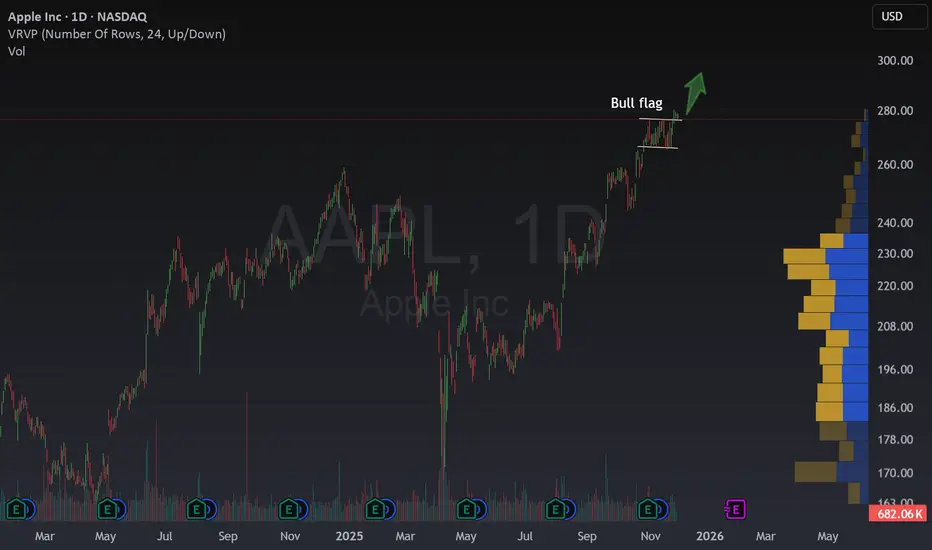
How To Trade a Bull Flag and The AAPL OpportunityHow To Trade a Bull Flag and The AAPL Opportunity
Have you ever felt stuck waiting for the perfect trade?
Apple just gave us a rare gift. After a strong rally, the price stopped and drew two parallel lines, each with two clear touches. This is what we call a bull flag. It looks simple, but it means a lot.
What Does This Pattern Tell Us?
A bull flag warns us that the market paused to take profits . It is a sign the bulls are resting, but planning to push again .
We got confirmation!
Apple made new highs, breaking out in a surprising way. The price pulled back, giving careful traders a low-risk chance to join.
This rarely happens so quickly.
If price drops below the bull flag, that’s a mega bearish sign, and a stop-loss is a must .
Above , there’s no clear limit. If stats play out, the move could be 5% or more in just a few days.
Why Is This Setup Special?
This is not our first bull flag. Recently, NYSE:JNJ flashed one and rallied 7% fast.
NYSE:LLY had an even bigger run, jumping 27% in under a month , and it still hasn’t stopped.
Bull flags are really simple but rare. If you find one, wait for confirmation, manage risk, and be ready to act fast.
In my profile, you will find guides to spot and trade bull flags easily , turning tough moments into real opportunities.
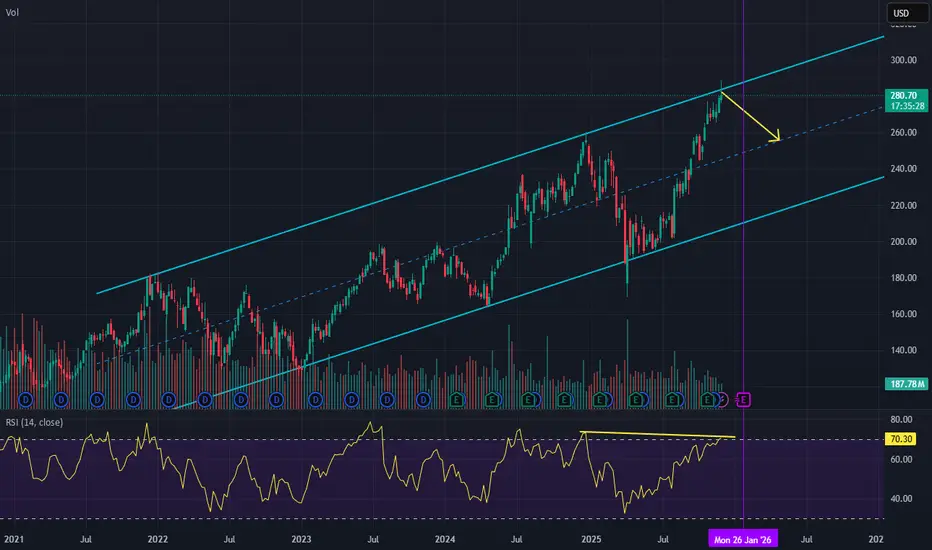
Apple - This stock will collapse!🥊Apple ( NASDAQ:AAPL ) is reversing right now:
🔎Analysis summary:
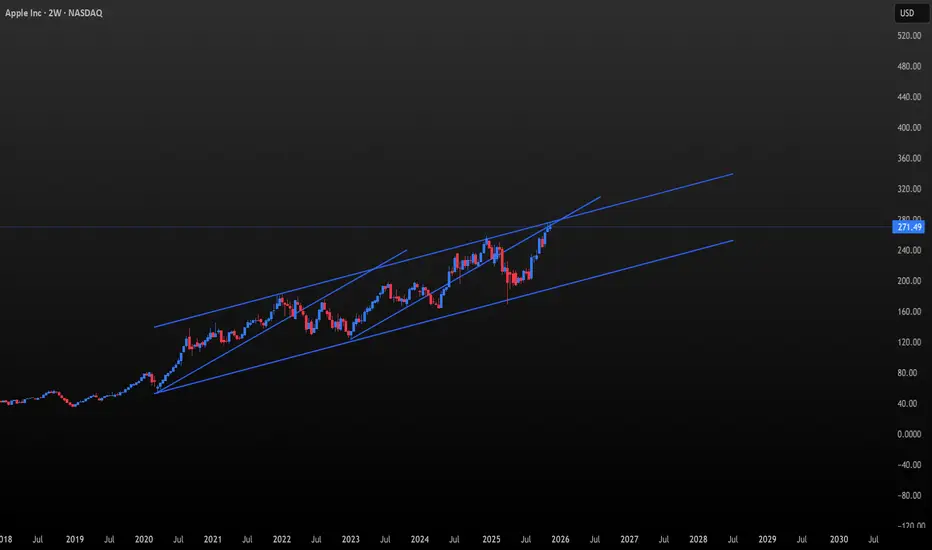
Starting back five years ago, Apple established a major rising channel pattern. Following this channel, Apple recently created a textbook +40% move higher. But with the current retest of resistance, we will certainly see another pullback of -30% in the near future.
📝Levels to watch:
$250
SwingTraderPhil
SwingTrading.Simplified. | Investing.Simplified. | #LONGTERMVISION
let's buy appleMy analysis is purely technical, supported by multiple factors:
1) We've been within an ascending channel for several months now, specifically since August. This gives us a sense of the market's general trend and allows us to identify potential retracement zones.
2) Subsequently, we can observe a descending structural pattern between October 29th and November 25th, which we can consider an accumulation zone, given the previous bullish performance in the preceding months.
3) The accumulation just described has been stopped numerous times in a specific zone that we consider resistance deriving from a psychological round number (275.00), the area described and the area colored purple.
4) As we can see, our accumulation zone has been broken upward, significantly increasing trading volumes and confirming the breakout.
5) This breakout has continued the momentum started by the November 21 candlestick until the end of the December 3 impulse. This causes a huge imbalance between buyers and sellers.
6) In my opinion, this equilibrium will be restored once a retracement of approximately 61.8% (from the Fibonacci retracement level) is made from the impulse described previously, which coincidentally is in the same zone as the psychological round number, both at the bottom of the main channel and as the last point at the top of the accumulation zone.
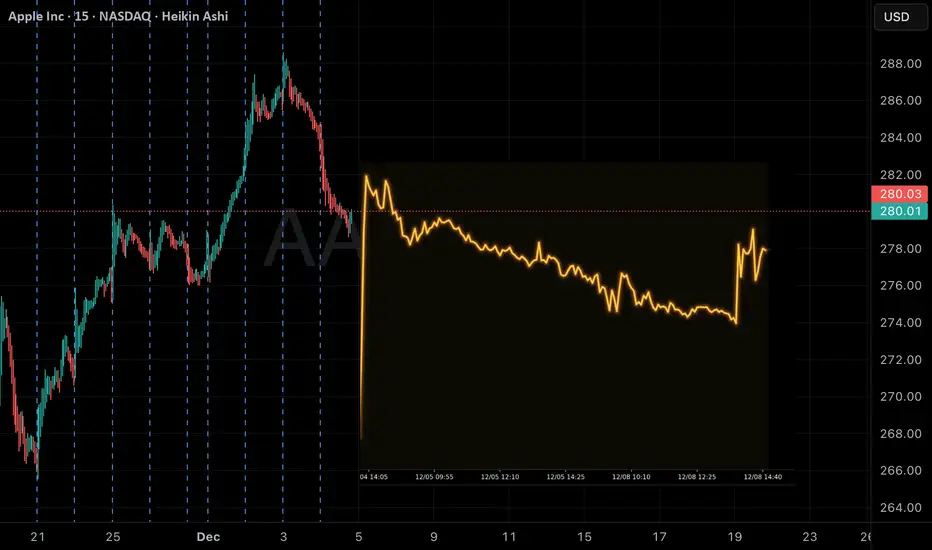
APPLE The Target Is DOWN! SELL!
My dear subscribers,
This is my opinion on the APPLE next move:
The instrument tests an important psychological level 278.82
Bias - Bearish
Technical Indicators: Supper Trend gives a precise Bearish signal, while Pivot Point HL predicts price changes and potential reversals in the market.
Target - 274.28
About Used Indicators:
On the subsequent day, trading above the pivot point is thought to indicate ongoing bullish sentiment, while trading below the pivot point indicates bearish sentiment.
Disclosure: I am part of Trade Nation's Influencer program and receive a monthly fee for using their TradingView charts in my analysis.
———————————
WISH YOU ALL LUCK
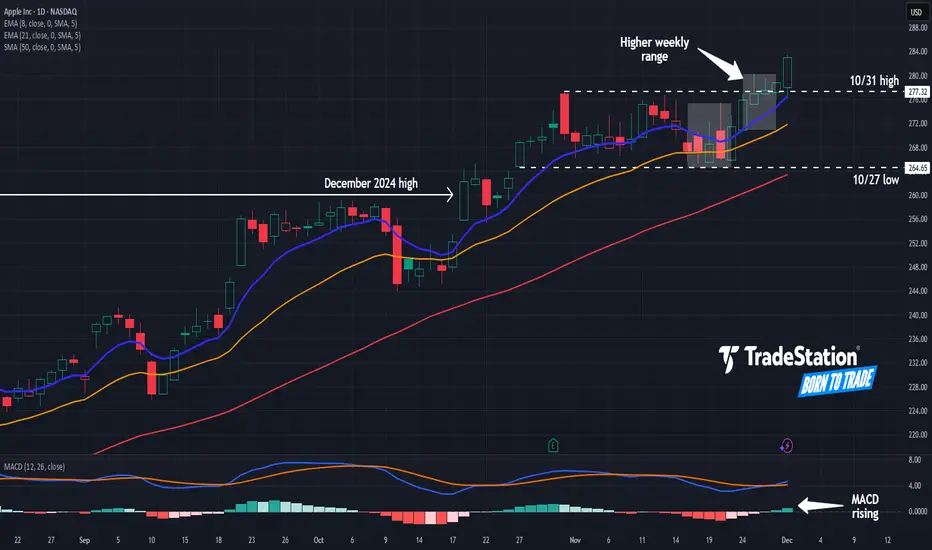
Apple May Be AcceleratingApple spent November quietly consolidating, and it may be accelerating in December.
The first pattern on today’s chart is the $260.10 level, a previous all-time high from December 2024. AAPL crossed above that price in late October and has remained there since, which could mean old resistance has broken.
Second, the smartphone giant made a weekly low of $264.65 on October 27. It’s remained above that level since. That may suggest that new support has been established.
Third, last week’s range featured a higher high and a higher low relative to the previous week. The stock also closed above a previous high of $277.32 from October 31.
Such price action is potentially consistent with a gradual breakout.
Next, the stock is above its 50-day simple moving average and its 8-day exponential moving average (EMA) is above its 21-day EMA. MACD is also rising. Those signals may reflect a bullish trend.
Finally, AAPL is a highly active underlier in the options market. (Its average daily volume of 808,100 contracts ranks fifth in the S&P 500, according to TradeStation data.) That may help traders take positions with calls and puts.
TradeStation has, for decades, advanced the trading industry, providing access to stocks, options and futures. If you're born to trade, we could be for you. See our Overview for more.
Past performance, whether actual or indicated by historical tests of strategies, is no guarantee of future performance or success. There is a possibility that you may sustain a loss equal to or greater than your entire investment regardless of which asset class you trade (equities, options or futures); therefore, you should not invest or risk money that you cannot afford to lose. Online trading is not suitable for all investors. View the document titled Characteristics and Risks of Standardized Options at www.TradeStation.com . Before trading any asset class, customers must read the relevant risk disclosure statements on www.TradeStation.com . System access and trade placement and execution may be delayed or fail due to market volatility and volume, quote delays, system and software errors, Internet traffic, outages and other factors.
Securities and futures trading is offered to self-directed customers by TradeStation Securities, Inc., a broker-dealer registered with the Securities and Exchange Commission and a futures commission merchant licensed with the Commodity Futures Trading Commission). TradeStation Securities is a member of the Financial Industry Regulatory Authority, the National Futures Association, and a number of exchanges.
Options trading is not suitable for all investors. Your TradeStation Securities’ account application to trade options will be considered and approved or disapproved based on all relevant factors, including your trading experience. See www.TradeStation.com . Visit www.TradeStation.com for full details on the costs and fees associated with options.
Margin trading involves risks, and it is important that you fully understand those risks before trading on margin. The Margin Disclosure Statement outlines many of those risks, including that you can lose more funds than you deposit in your margin account; your brokerage firm can force the sale of securities in your account; your brokerage firm can sell your securities without contacting you; and you are not entitled to an extension of time on a margin call. Review the Margin Disclosure Statement at www.TradeStation.com .
TradeStation Securities, Inc. and TradeStation Technologies, Inc. are each wholly owned subsidiaries of TradeStation Group, Inc., both operating, and providing products and services, under the TradeStation brand and trademark. When applying for, or purchasing, accounts, subscriptions, products and services, it is important that you know which company you will be dealing with. Visit www.TradeStation.com for further important information explaining what this means.
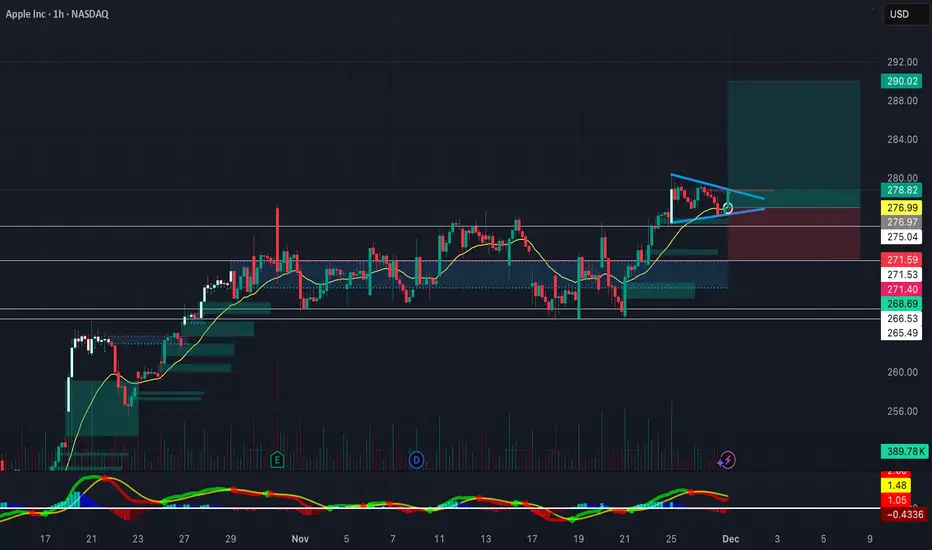
AAPL FlaggingNASDAQ:AAPL Flagging on the hourly, bouncing right off the 20-day EMA, expecting a push upwards to 280. If bulls can hold 280, looking for a move to the 286+ area. Watching this setup closely for a swing. Until then, some RSI-based supply and demand zones to keep an eye on, watching closely
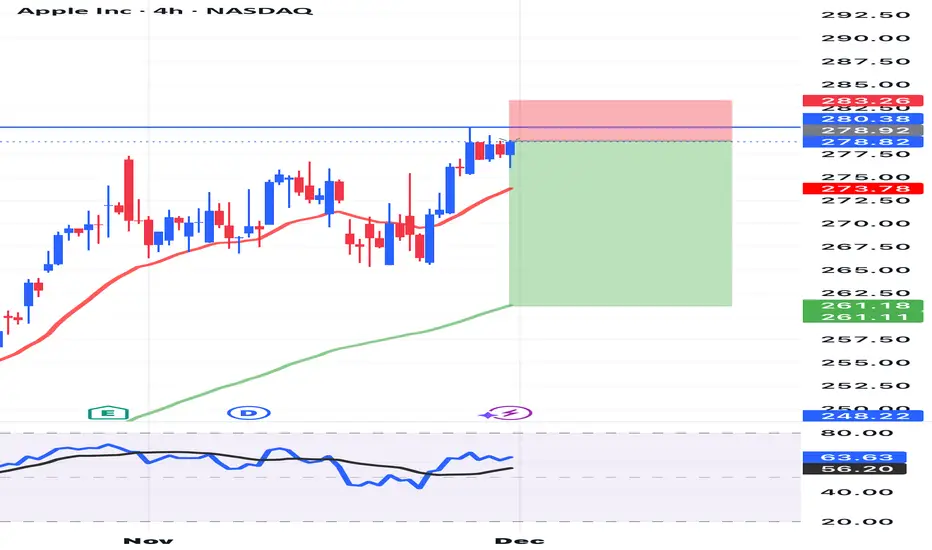
AAPL SELLERS WILL DOMINATE THE MARKET|SHORT
AAPL SIGNAL
Trade Direction: short
Entry Level: 278.86
Target Level: 262.87
Stop Loss: 289.53
RISK PROFILE
Risk level: medium
Suggested risk: 1%
Timeframe: 6h
Disclosure: I am part of Trade Nation's Influencer program and receive a monthly fee for using their TradingView charts in my analysis.
✅LIKE AND COMMENT MY IDEAS✅
AAPL Outlook — Dec 1 to Dec 5AAPL Outlook — Dec 1 to Dec 5
(Price Action + Multi-Timeframe Story + GEX for Options Traders)
Weekly timeframe
The weekly chart still holds its long-term uptrend, but you can tell momentum is cooling off. The candles are getting smaller as price pushes toward the upper trendline, which usually means buyers are running into an area where profit-taking becomes more attractive. Nothing bearish yet—just a sign that the push is losing steam.
Daily timeframe
The daily view fits that slowdown perfectly. Price is sitting right inside a supply zone that was created during the last big push. Ever since AAPL entered this zone, the market hasn’t shown a strong follow-through candle. Instead, it’s been chopping inside 276–280.
The first little shift in character already appeared, which tells you sellers are at least testing the waters.
The weekly hints “momentum is fading,” and the daily basically confirms, “yes, we’re stuck under some pressure.”
1-Hour timeframe
Dropping into the 1H makes the battle more obvious. Price keeps rejecting the same ceiling near 279–280 again and again. Even though the trendline from below is still supporting the move, the highs are getting slightly lower each attempt. That’s usually the first sign that buyers are defending, but they’re not dominating anymore.
So now all three timeframes are telling the same story:
Uptrend intact → momentum slowing → pressure at the top.
15-Minute timeframe
The 15m chart is where you can really see how tight things have become.
Price is compressing right underneath that ceiling. Volume is tapering off, candles are getting smaller, and every bounce looks weaker than the last.
This kind of behavior usually means the market is coiling up for a move—either a clean breakout above 280 or a release to the downside if the base around 277.50 gives out.
The smaller the timeframe, the more it reveals what the bigger timeframes were already hinting.
Where GEX Fits Into All of This (the real edge)
Now here’s where everything clicks:
All timeframes point to the same resistance near 279–280.
When you overlay the options data, the biggest call wall also sits right there. That’s the level where dealers hedge the most aggressively, which naturally creates resistance—and it just so happens to line up with the zones that the charts have already shown.
Below that, the negative gamma area starts opening up around 276–274.
This means that if price slips under that base, dealers shift into selling hedges, which increases volatility and makes pullbacks move faster.
So the charts show the structure…
GEX shows the “fuel” behind the structure.
That’s why I like combining them: the price action tells the story, and GEX tells you who’s on the other side of the trade.
Trading Bias for the Week (Options + Price Action)
Upside idea
Only valid if 280 breaks clean. If that happens, the next magnet is around 282.5 where the next batch of calls cluster.
Downside idea
If 277.50 cracks, the move usually releases toward 276, then 274.
That lines up with both the lower timeframe CHoCH and the negative gamma pocket.
Final Thoughts
Each timeframe is showing the same thing, just in different levels of detail: the trend is still healthy, but buyers are clearly struggling at the top. GEX reinforces why price behaves that way and gives option traders the roadmap for the week.
Disclaimer:
This is not financial advice. This is just my personal market observation and for educational use only.
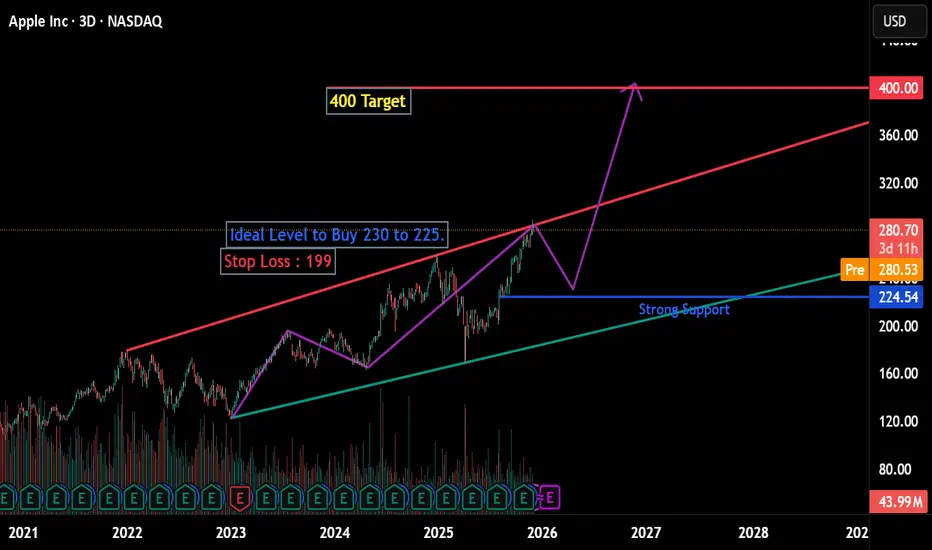
Apple : It is awaiting correctionCurrently it is at head to correction.
according to my chart reading.
ideal buy entry after correction to 225-230 if decline and come to those levels.
Target 400
SL : Below 199.
Manage your Risk .
I don't have anything to see to buy at current price.
And also I am not in favor of Short Sell.
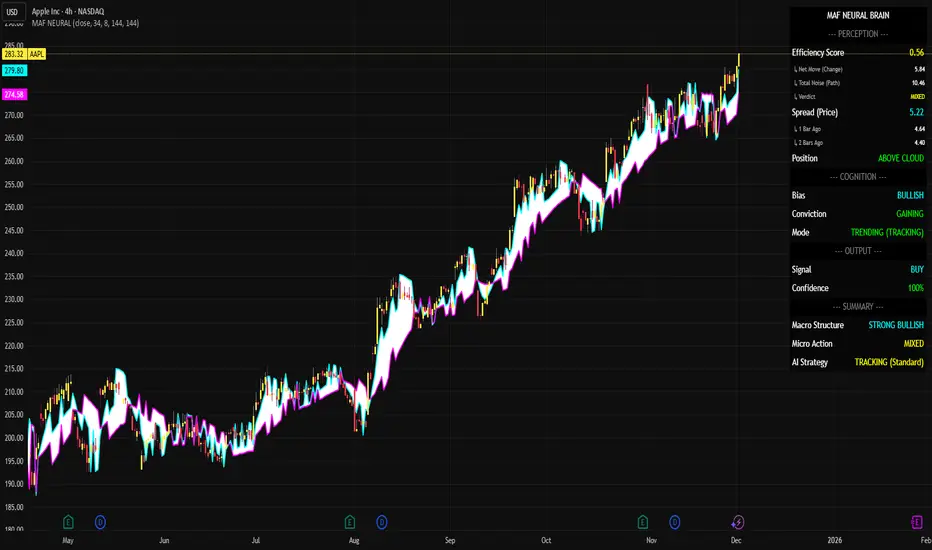
AAPL Listen to the "BRAIN"1. The "Breathing" Cloud (Changing Thickness)
The changing thickness of the White Cloud is the most important visual cue. Think of it as the "Lungs" of the Trend.
Expansion (Thickening Cloud):
What it means: The "Fast Core" (Cyan) is pulling away from the "Slow Core" (Magenta).
Analysis: This indicates Momentum Acceleration. The market is moving faster than its baseline. This is a "High Confidence" phase where you want to be aggressively holding or adding to positions.
On Chart: You can see massive expansions during the rallies (May, June, Oct). The cloud gets huge, signaling a "Power Trend".
Contraction (Thinning Cloud):
What it means: The cores are converging (pinching together).
Analysis: This indicates Momentum Deceleration or Consolidation. The market is "exhaling" or taking a rest.
On Chart: Notice how the cloud gets very thin before the trend either reverses or explodes again. A thin cloud is a "Decision Point".
2. Dashboard Analysis (The "Brain")
The Dashboard confirms what the Cloud is showing visually:
Spread (Price): 5.77: This is a Wide Spread.
Verdict: The trend is currently Expanded. It is not in a "compression" phase; it is in a "run" phase.
Efficiency Score: 0.56 (MIXED):
Verdict: While the trend is up, the price action isn't a straight line. It's a bit "choppy" or "grinding" (Mixed). It's not a "Clean Trend" (0.8+), but it's not "Noise" (<0.3) either.
AI Strategy: TRACKING (Standard):
Verdict: Because the trend is Strong (Wide Spread) but the action is Mixed, the AI decides the best course of action is simply to Track it. Don't get shaken out by the wiggles, but don't be too aggressive. Just trail your stop.
Summary
Current Status: STRONG BULLISH TREND. Action: HOLD. The Cloud is thick (High Momentum), and the Dashboard is signaling "Strong Bullish". Even though the Efficiency is "Mixed" (some minor chop), the sheer width of the cloud protects you from getting stopped out prematurely. Ride the expansion.
AAPL — WEEK 49 TREND REPORTNASDAQ:AAPL — WEEK 49 TREND REPORT
Ticker: NASDAQ:AAPL — 12/02/2025 @ 286.19$
Timeframe: WEEKLY
This is a reactive structural classification of NASDAQ:AAPL based on the weekly chart as of this timestamp. Price conditions are evaluated as they stand — nothing here is predictive or forward-assumptive.
⸻
1) Current Trend Condition
• Trend Duration: +22 weeks (Bullish)
• Trend Reversal Level (Bearish): 265.7$
• Trend Reversal Level (Bearish Confirmation): 241.24$
• Pullback Support: 237.27$
⸻
2) Structure Health
• Retracement Phase:
Uptrend (operating above 78.6%)
• Position Status:
Healthy (price above both structural layers)
⸻
3) Temperature
Warming Phase
⸻
4) Momentum
Bullish
⸻
5) Market Sentiment
Bullish
⸻
Author’s Note
This analysis is fully reactive, not predictive. Market conditions, trend structure, and behavior are classified as they appear in real time. The objective is to identify where directional shifts first occurred, where structural integrity remains intact, and where it would begin to weaken if key levels were breached.
Predictive analysis projects outcomes that do not exist yet. Without price confirmation, prediction is built on baseless assumptions. This framework avoids that entirely by responding only to verified structural changes and live conditions.
The levels shown simply identify where the current trend structure first shifted and where it would begin to lose integrity if breached. Recognizing these boundaries allows for clearer interpretation of market behavior without relying on forward guarantees, speculative projections, or unsupported assumptions.
⸻
Methodology Overview
This classification framework evaluates directional conditions using internal trend-interpretation logic that references price behavior relative to its structural layers. These relationships are used to identify when price movement aligns with the framework’s criteria for directional phases, transition points, or regime shifts. Visual elements or structural labels reflect these internal interpretations, rather than explicit trading signals or preset indicator crossovers. This framework is observational only and does not imply future outcomes.
AAPL Alert: High-Risk Short & Explosive Call Opportunities This AAPL Weekly Signals | 2025-12-04
Short-Term Speculative PUT (2-Day Expiry)
Direction: PUT (Short)
Strike: $265.00
Entry: $0.03
Target 1 / 2: $0.05 / $0.08
Stop Loss: $0.01
Confidence: 56% (Low / Speculative)
Momentum: Neutral, bearish bias (-0.02% 1W)
Flow: Bearish, PCR 1.76
Risk: High – very small position (1% max) recommended
Notes: Katy AI shows 71% prediction points below current price, overriding weekly “BUY CALLS” guidance. High gamma risk.
Medium-Term CALL (8-Day Expiry)
Direction: CALL (Long)
Strike: $280.00
Entry: $3.30
Target 1 / 2: $5.00 / $6.50
Stop Loss: $2.00
Confidence: 57% (Low)
Momentum: Neutral (-0.13% 1W), MACD bullish divergence
Flow: Neutral, PCR 0.81
Risk: Moderate – position size 2%
Notes: Katy AI shows consistent upward trajectory to $283–$285 range. Conflict with weekly momentum; tight stop recommended.
AAPLHow to become successful in forex and stock trading: 1.Master fundamentals and technical analysis. 2,Build and follow a solid trading plan. 3.Apply strict risk management (1–2% rule). 4.Stay disciplined—control fear and greed. 5.Record and analyze every trade. 6.Focus on high-quality setups only. 7.Diversify across assets and markets. 8.Keep evolving—study, adapt, and grow daily.
The Falling Apple: Apple’s Descent Into the 2026 Bear CycleApple has arrived at a rare point where Natural Law and fundamentals speak in unison.
The geometry of its long-term cycle and the internal condition of its business now deliver the same message: the arc that carried Apple through its 2020–2025 ascent has reached its structural boundary.
This is the moment where the cycle turns — the moment the Apple begins to fall.
1. Geometry: The 1×2 Monthly Angle Has Been Hit
Apple has been riding a clean, disciplined 1×2 monthly trend since the March 23, 2020 low.
Price has now risen to the top rail of that 1×2 channel, the same line that capped major moves in the past.
2. The Weekly Angle (2023-2025) Has Also Hit Its Own Ceiling
A faster internal angle begins from the January 3, 2023 low.
This weekly angle represents Apple’s internal rhythm — the speed of its secondary cycle.
Apple is now touching both:
the top of the long-term monthly angle, and
the top of the short-term accelerated weekly angle
at the same time.
These two angles intersect the first week of 2026,
Please see Monthly Version of chart Below:
A. Speed & Acceleration — The Internal Engine Stalls
The internal motion beneath Apple’s advance is no longer confirming the new highs.
Speed has weakened into the rally, forming a clear lower high even as price presses into the top of the 1×2 monthly angle.
This is the signature of a late-cycle move — higher prices carried by diminishing force.
Acceleration reveals the same condition.
It peaked earlier in the cycle and is now fading, unable to match the strength of prior expansions.
When acceleration rolls over while Speed is already declining, the trend has lost its ability to compound momentum.
Together, Speed and Acceleration show a market moving upward while its engine slows beneath it.
This is the exhaustion phase: motion compresses, angles converge, and the structure prepares to turn.
Please see Daily Chart
B. Daily Motion — The Fast Angle Breaks
On the daily chart, the internal structure has already failed.
The steep 1×1 angle — where each trading day rises one dollar — has broken decisively.
This is the fastest rhythm Apple can sustain, and losing it confirms a short-term top.
Speed follows the same message.
It has slipped beneath the median line, signaling that the drive powering this advance has weakened even as price tests multi-year resistance.
Acceleration is the most urgent tell.
It is sharply negative at the highs, a signature that momentum has collapsed beneath the surface.
Acceleration always turns first; price only acknowledges it later.
Together, the break of the 1×1 angle, the median failure in Speed, and the deeply negative Acceleration show a market losing force as it presses into long-term resistance.
The short-term engine has stalled at the exact moment the monthly cycle reaches its ceiling.
Please see Timing Chart:
Apple’s major swings have not been random.
The timing chart shows a consistent rhythm: the dominant changes in trend occur in January and December, forming a repeating cadence across the 2020–2025 cycle.
January 2022 — Major top
January 2023 — Major low
December 2024 — Major Top
Dec /Jan — **Forecasted Top
This creates a temporal cycle where Apple’s trend turns at the opening and closing of the Gregorian calendar — a natural point where momentum resets and the prior cycle completes.
Fundamentals Now Confirm What Geometry Already Shows
Price is not just rising into resistance —
it is rising into resistance while the fundamentals weaken.
a. Revenue Growth Has Stalled
Apple’s total revenue has been flat to slightly negative for nearly two years.
iPhone sales are no longer growing
Services growth has slowed
Mac and iPad units are in multi-year decline
This is the key disconnect:
**Price is making new highs
The business is not.
b. Valuation Has Doubled While Growth Has Halved
Apple now trades at:
31–34× forward earnings
Versus a historical long-term range of 16–20×
Apple is being valued like a high-growth AI company,
even though its earnings are stagnating.
This kind of valuation expansion always shows up as price hugging the upper rail of the long arc.
c. No Real AI Cycle (Yet)
Apple is pricing in an AI future it has not yet earned:
No major AI product cycle
No cloud AI leadership
No LLM ecosystem
No new growth vector
The chart reflects pure thematic flow, not fundamental acceleration.
With new leadership at the helm of Apple and a replacement from TIm cook is found. the stock may go though an adjustment period as well, as Apple tries to re fidn its identify again
d. Buybacks Are Manufacturing the Slope
Apple has spent $600+ billion on buybacks.
That is what creates the smooth, steady 1×2 slope —
but when buybacks meet revenue stagnation, price eventually reaches a point where geometry = fundamental limit.
We are exactly at that point.
e. Leadership Transition — A Coming Shift
Apple is approaching a leadership transition.
Tim Cook’s successor has not yet been named, but the change is forthcoming — and with it comes an inevitable period of adjustment.
As Apple prepares for a new era of leadership, the company will need to reaffirm its identity and strategic direction.
Markets tend to price this uncertainty early, especially when it coincides with the completion of a major structural cycle.
A shift at the top reinforces the broader message of the chart:
Apple is entering a phase of transition — in leadership, in momentum, and in market cycle.
5. When Natural Law and Fundamentals Agree, the Move Is Significant
Price is not hitting resistance in isolation.
It is hitting resistance with weakening internals:
Slowing revenue
Stretched valuation
Compressed consumer demand
No new product cycle
Buybacks masking the slowdown
Leadership Transition
SUMMARY
Apple has reached a structural and fundamental limit.
The long-term 1×2 monthly angle is touched.
The 2023 weekly angle converges at the same point.
$270 natural resistance is met precisely as time and price square.
Internally, revenue growth has stalled, valuation has stretched beyond its cycle, consumer demand continues to soften, and new leadership at the helm of Apple.
In short, Apple stands at the threshold of the 2026 Bear Cycle.
Nana Hermes —
All Things Move by Measure.
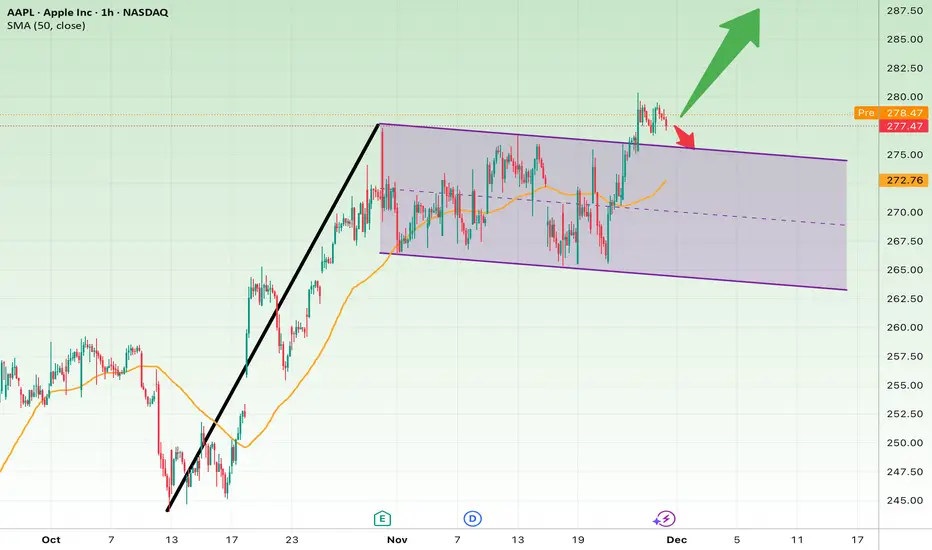
AAPL Breaks Out: Bull Flag Targets Point to $287–$295!After a strong rally (black trendline), AAPL entered a descending corrective channel, which looks like a classic bull flag pattern.
Now the price is breaking above the upper boundary of the channel, suggesting that the correction may be over.
Bullish Scenario (More likely now)
If the price holds above the channel, continuation upward is expected.
Bullish Targets:
• $282
• $287
• $295 (extended target)
Bearish Scenario (Failed breakout)
If price falls back inside the channel, the correction resumes.
Bearish Targets:
• $273
• $268
• $262 (major support)
Stop Loss
• Long: Below $274
• Short: Above $280.50
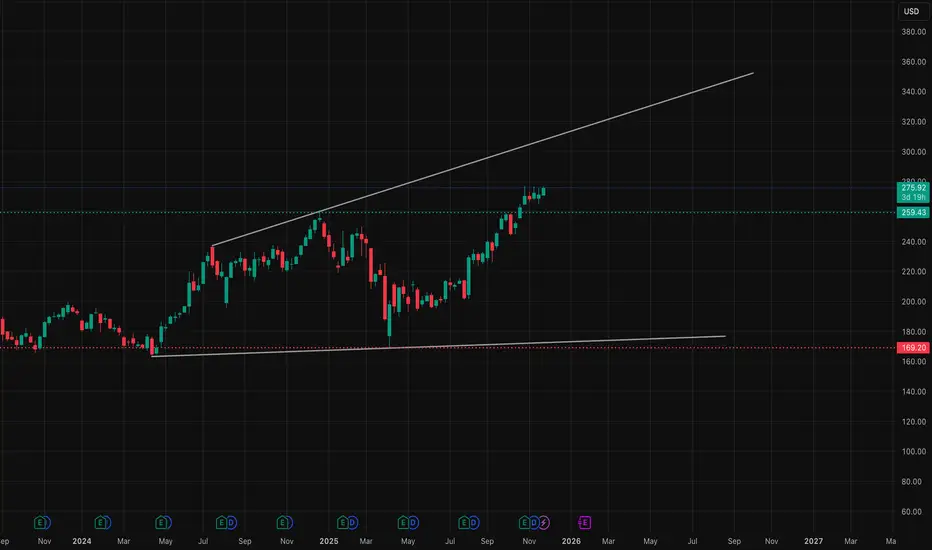
AAPL - Correction ahead?Bearish Scenario for AAPL (4H Analysis)
AAPL is currently trading at an extended level after a steep multi-week rally. The structure is forming a potential rising wedge, which typically signals trend exhaustion and an increased risk of a corrective move.
Key Breakdown Trigger
A confirmed break below 270 USD (4H close) would invalidate the current short-term uptrend and open the door for a deeper correction.
Downside Levels to Watch
260–262 USD
First major support zone. A retest here would be a normal pullback in the broader uptrend.
248–250 USD
Weekly orderblock + strong horizontal support.
If price reaches this zone, increased buying interest is likely — but if it fails, downside pressure accelerates.
237 USD
High-confluence structural level.
This is the most probable target in a more significant correction.
223–224 USD (Weekly Low)
Only relevant if the market enters a broader risk-off phase.
Bearish Confluence Factors
Sharp overextension from mid-trend support
Momentum weakening after parabolic move
Declining volume while making new highs
Rising wedge structure tightening
Summary
AAPL remains bullish on higher timeframes, but the risk of a larger corrective move is elevated. Losing 270 USD would likely trigger a multi-level retracement toward 260 → 250 → 237.
Apple bull flag setup points to breakout potential this week
Current Price: $267.69
Direction: LONG
Confidence Level: 68%
Targets:
- T1 = $272.50
- T2 = $277.00
Stop Levels:
- S1 = $265.00
- S2 = $263.00
**Wisdom of Professional Traders:**
Several professional traders are flagging Apple as a standout in the large-cap tech space right now. The collective trader consensus from multiple analyses points to Apple holding up better than peers, showing a defined bull flag structure and testing key levels that could open the door to a bullish breakout. Looking at the way these traders combine technical setups with current momentum, there’s shared focus on a push through upper resistance zones, with pullbacks being seen as opportunities rather than warnings.
**Key Insights:**
Here’s what’s driving this call — many traders have made note of Apple's ability to hold above multiple layers of support, often citing $269–$270 as a key pivot zone. The $272.50 mark comes up repeatedly as a short-term upside magnet, with $277–$277.32 flagged as the breakout area that could accelerate price action. This aligns with bullish momentum seen on the daily timeframe, where patterns like the bull flag just above prior highs tend to bring in additional buyers.
What I’m also noticing is the split between cautious macro sentiment and strong single-stock setups. While broader indices have been choppy, Apple’s relative strength is standing out to several traders, and that’s worth paying attention to when identifying outperformers for the week. The key point here is that Apple is not trading in sync with general market softness; instead, it's finding bids at every dip toward well-watched support levels.
**Recent Performance:**
This all played out in last week’s price action — Apple gained ground and closed notably higher on strong days, while managing to minimize losses on market down days. Several instances showed Apple bouncing off intraday supports to recover by session end, a clear sign of accumulation in the $265–$269 range. That resilience has been especially visible over the past five trading sessions, with multiple tests of intermediate resistance not leading to pronounced selling.
**Expert Analysis:**
Multiple traders have pointed to the $274–$275 zone as being critical for momentum confirmation, with one layer of consensus forming around waiting for a clean break to target $277+. Another frequently cited setup is entering early on confirmation of strength above $272.50, using tight stops just under $265 to limit downside risk. Several also remarked that only Apple and Alphabet are still holding above their 55-day moving averages out of the “Magnificent Seven,” underscoring Apple's relative positioning.
**News Impact:**
While there’s no single market-moving headline changing Apple’s fundamentals this week, the backdrop of tech sector rotation is relevant. The chatter around upcoming product cycle demand, potential boosts from seasonal shopping trends, and resilience despite chip supply cost hikes from suppliers like TSM is giving traders more confidence to lean bullish. Additionally, Apple’s role as a major index weight means its breakout could influence broader market sentiment positively.
**Trading Recommendation:**
Here’s my take — at $267.69 and with support layers close by, I favor initiating a long with entries above $269, tightening risk with S1 at $265 and S2 at $263. The near-term upside objective sits at T1 $272.50, with strength through that level opening a path toward T2 $277 for this week. This setup offers a good risk-reward profile due to tight stop placement and identifiable upside catalysts. Sizing should be moderate given the mid-range confidence, but the technical backdrop favors the long side as long as price remains above $263.
AAPL At a Critical Decision Zone! Breakout or Pullback Coming?Weekly timeframe
AAPL has been grinding steadily higher for months, forming a clean bullish structure with higher lows and higher highs. Buyers have full control on the weekly chart.
But now price is pushing directly into a long-term ascending trendline that has rejected multiple times in the past. Every time AAPL reached this area, momentum slowed and sellers stepped in.
This is late-stage in the weekly move, not the beginning.
If buyers can break and close above this trendline, we could see a strong expansion move. If not, this is the perfect spot for a weekly pullback.
Daily timeframe
The daily still shows bullish continuation with multiple BOS confirmations on the way up. However, price is now inside a supply zone where the last selloff started.
You can already see hesitation candles forming, smaller bodies, and wicks on top. That usually signals exhaustion.
If daily closes weak here, a retracement back toward 270–268 makes sense. If buyers hold above 275 and push out of this supply zone, continuation toward 280+ opens up.
1 Hour timeframe
Very interesting behavior here.
We saw:
* liquidity sweep above recent highs
* a quick rejection
* price stalling under short-term resistance
This is often the “fake first push” before the market decides direction.
For bulls, we need a clean reclaim and hold above 276.
For bears, losing 273 opens the door for 270–268 retest.
Right now, momentum is slowing.
GEX View
GEX levels support this zone as a decision point:
* heavy CALL walls around 280
* strong PUT support around 270–268
* highest positive GEX slightly above current price
That means market makers have incentive to pin AAPL between these levels until direction becomes clear.
A breakout above the 280 GEX wall could trigger momentum.
A breakdown toward 270 would be absorbed by PUT support first.
My thoughts
Trend is still bullish overall, but location is risky for new longs. This is where smart money takes profit or waits for confirmation.
If buyers fail to break this weekly trendline soon, we could see a pullback. If they break it, AAPL has room to run fast because there's very little resistance above.
This week should decide the next bigger move.
Key levels
Bullish above:
276
280
Targets:
282.5
285
Bearish below:
273
270
Targets:
268
265
Conclusion
AAPL is sitting at a major decision zone across all timeframes. Trend favors bulls, but the location suggests caution. Watch 276 and 273 — whichever breaks first likely sets the next move.
Disclaimer:
This analysis is for educational purposes only and does not constitute financial advice. Always do your own research and manage your risk before trading.