
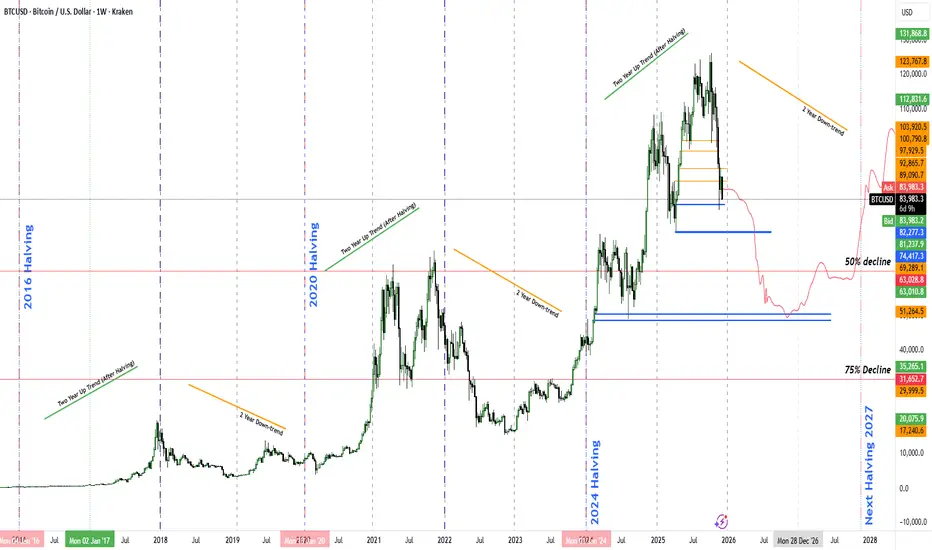
I’ve noticed a consistent pattern in Bitcoin’s cycles. Since 2016, BTC tends to rally for about two years after each halving, then spend the following two years trading sideways or drifting lower as it approaches the next halving. Based on that framework, we are now entering the consolidation phase ahead of the 2028 halving. I expect a period of sideways movement and a possible pullback toward the 51K area before the market slowly trends upward again. Ultimately, I anticipate another aggressive bull run either just before or shortly after the 2028 halving.
On the fundamental side, rising energy costs are becoming a major factor. Electricity demand is climbing rapidly because of AI infrastructure, especially high-power GPU clusters that consume large amounts of energy. Mining difficulty is increasing, hardware costs are rising, and overall operational expenses are becoming heavier. This suggests that by the next halving, mining will only make economic sense if Bitcoin trades at much higher price levels. To stay profitable, miners would likely need BTC well above 100K, which naturally creates long-term upward pressure as production costs tighten supply.
This type of cycle also lines up with what I believe is happening behind the scenes. I believe markets are manipulated, especially in assets with limited supply like Bitcoin. A lower BTC price during this phase would be ideal for major accumulators such as the US government, which has already shown interest in holding Bitcoin on its balance sheet. Cheaper prices allow large players to accumulate quietly. Once they have accumulated a meaningful amount, I expect the market to be allowed to trade significantly higher. Combined with rising energy costs, this could push BTC into a future where prices remain elevated and volatility gradually decreases compared to what we see today.
On the fundamental side, rising energy costs are becoming a major factor. Electricity demand is climbing rapidly because of AI infrastructure, especially high-power GPU clusters that consume large amounts of energy. Mining difficulty is increasing, hardware costs are rising, and overall operational expenses are becoming heavier. This suggests that by the next halving, mining will only make economic sense if Bitcoin trades at much higher price levels. To stay profitable, miners would likely need BTC well above 100K, which naturally creates long-term upward pressure as production costs tighten supply.
This type of cycle also lines up with what I believe is happening behind the scenes. I believe markets are manipulated, especially in assets with limited supply like Bitcoin. A lower BTC price during this phase would be ideal for major accumulators such as the US government, which has already shown interest in holding Bitcoin on its balance sheet. Cheaper prices allow large players to accumulate quietly. Once they have accumulated a meaningful amount, I expect the market to be allowed to trade significantly higher. Combined with rising energy costs, this could push BTC into a future where prices remain elevated and volatility gradually decreases compared to what we see today.

Disclaimer
The information and publications are not meant to be, and do not constitute, financial, investment, trading, or other types of advice or recommendations supplied or endorsed by TradingView. Read more in the Terms of Use.
Disclaimer
The information and publications are not meant to be, and do not constitute, financial, investment, trading, or other types of advice or recommendations supplied or endorsed by TradingView. Read more in the Terms of Use.