
For much of the past decade, Nvidia has stood at the centre of a profound technological shift. Its chips underpin the modern artificial-intelligence ecosystem, and the company has become one of the most influential constituents of global equity markets. Yet after an extraordinary run, a combination of technical signals and slowing market dynamics suggests the stock may be approaching a period of consolidation.
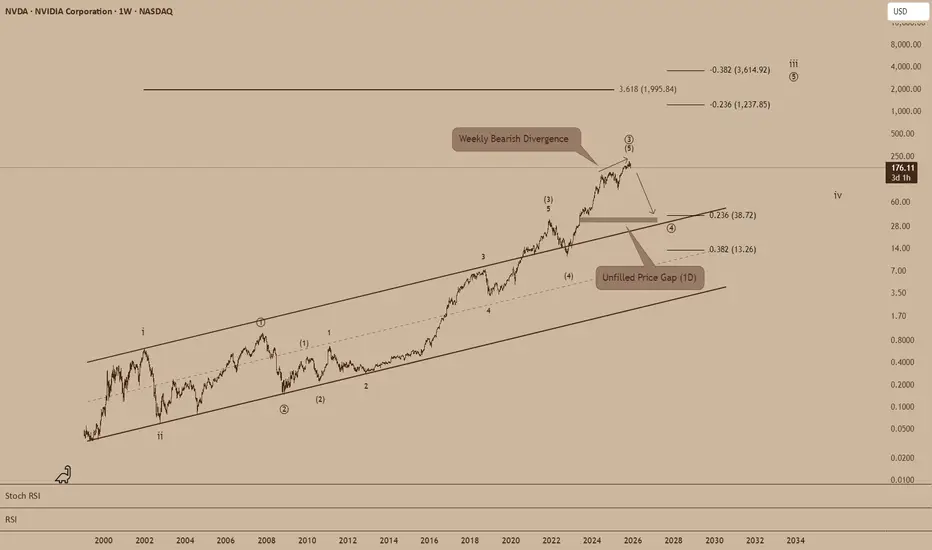
Long-term price analysis shows Nvidia’s shares have risen within a broad upward channel since the early 2000s, a structure that has guided each major expansion and subsequent correction. The most recent advance fuelled by unprecedented demand for AI-related hardware has carried the stock to the upper edge of this decades-long formation.
A Mature Price Structure Meets Waning Momentum
Technical readings indicate the current rally may be nearing exhaustion. The share price has formed a completed five-wave structure at the upper boundary of its long-term channel, accompanied by a notable bearish divergence on weekly momentum indicators. Such developments are typically associated with the late stages of a major trend.
If this marks the completion of a long-running impulsive phase, the stock may be entering a corrective chapter. The first substantial support appears near $38, aligning with earlier congestion zones and a shallow retracement level. A deeper drawdown could expose the gap left by previous trading and a secondary support area closer to $13, where the lower channel boundary intersects longer-term Fibonacci projections.
This would be consistent with the type of multi-quarter pause usually seen between major structural waves in extended growth cycles.
Underlying Strength, but With Signs of Normalisation
Despite these technical signals, Nvidia’s business remains fundamentally strong. Demand for AI accelerators continues to drive high revenue and margin levels, and the company retains a dominant position in the market for large-scale compute.
However, several trends suggest that the exceptional conditions of recent years are beginning to moderate.
Valuations and Expectations
Nvidia trades at valuations well above its historical norms. Consensus estimates still point to healthy growth, but some analysts question whether current multiples fully account for the natural deceleration that follows rapid capacity build-outs among cloud providers.
A More Balanced AI Investment Environment
The initial wave of infrastructure spending by hyperscale operators has eased, shifting from aggressive expansion towards more measured investment cycles. While the long-term trajectory for AI remains constructive, the sector’s near-term capital intensity appears to be flattening.
Emerging Competitive Pressures
Rivals such as AMD are gaining traction in certain segments, while large technology companies continue developing internal AI chips to reduce dependence on external suppliers. Nvidia’s leadership remains intact, though the competitive field is broadening.
Policy and Regulatory Considerations
Export restrictions on high-performance semiconductors and heightened regulatory attention in the US have added another layer of uncertainty. These challenges are not existential, but they contribute to a more complex environment than the one that propelled the company’s recent surge.
A Period of Rebalancing Rather Than Reversal
Taken together, the technical and fundamental perspectives point to a market that may be re-evaluating the pace, not the direction of Nvidia’s long-term story. The company remains one of the key beneficiaries of the AI era, but the alignment of slowing momentum, stretched valuations and maturing investment cycles suggests that the share price may face a period of consolidation.
For investors with a longer horizon, such an adjustment could eventually offer an attractive entry point. For now, the signals imply that Nvidia’s next phase may be characterised less by acceleration and more by moderation.
Long-term price analysis shows Nvidia’s shares have risen within a broad upward channel since the early 2000s, a structure that has guided each major expansion and subsequent correction. The most recent advance fuelled by unprecedented demand for AI-related hardware has carried the stock to the upper edge of this decades-long formation.
A Mature Price Structure Meets Waning Momentum
Technical readings indicate the current rally may be nearing exhaustion. The share price has formed a completed five-wave structure at the upper boundary of its long-term channel, accompanied by a notable bearish divergence on weekly momentum indicators. Such developments are typically associated with the late stages of a major trend.
If this marks the completion of a long-running impulsive phase, the stock may be entering a corrective chapter. The first substantial support appears near $38, aligning with earlier congestion zones and a shallow retracement level. A deeper drawdown could expose the gap left by previous trading and a secondary support area closer to $13, where the lower channel boundary intersects longer-term Fibonacci projections.
This would be consistent with the type of multi-quarter pause usually seen between major structural waves in extended growth cycles.
Underlying Strength, but With Signs of Normalisation
Despite these technical signals, Nvidia’s business remains fundamentally strong. Demand for AI accelerators continues to drive high revenue and margin levels, and the company retains a dominant position in the market for large-scale compute.
However, several trends suggest that the exceptional conditions of recent years are beginning to moderate.
Valuations and Expectations
Nvidia trades at valuations well above its historical norms. Consensus estimates still point to healthy growth, but some analysts question whether current multiples fully account for the natural deceleration that follows rapid capacity build-outs among cloud providers.
A More Balanced AI Investment Environment
The initial wave of infrastructure spending by hyperscale operators has eased, shifting from aggressive expansion towards more measured investment cycles. While the long-term trajectory for AI remains constructive, the sector’s near-term capital intensity appears to be flattening.
Emerging Competitive Pressures
Rivals such as AMD are gaining traction in certain segments, while large technology companies continue developing internal AI chips to reduce dependence on external suppliers. Nvidia’s leadership remains intact, though the competitive field is broadening.
Policy and Regulatory Considerations
Export restrictions on high-performance semiconductors and heightened regulatory attention in the US have added another layer of uncertainty. These challenges are not existential, but they contribute to a more complex environment than the one that propelled the company’s recent surge.
A Period of Rebalancing Rather Than Reversal
Taken together, the technical and fundamental perspectives point to a market that may be re-evaluating the pace, not the direction of Nvidia’s long-term story. The company remains one of the key beneficiaries of the AI era, but the alignment of slowing momentum, stretched valuations and maturing investment cycles suggests that the share price may face a period of consolidation.
For investors with a longer horizon, such an adjustment could eventually offer an attractive entry point. For now, the signals imply that Nvidia’s next phase may be characterised less by acceleration and more by moderation.

Disclaimer
The information and publications are not meant to be, and do not constitute, financial, investment, trading, or other types of advice or recommendations supplied or endorsed by TradingView. Read more in the Terms of Use.
Disclaimer
The information and publications are not meant to be, and do not constitute, financial, investment, trading, or other types of advice or recommendations supplied or endorsed by TradingView. Read more in the Terms of Use.