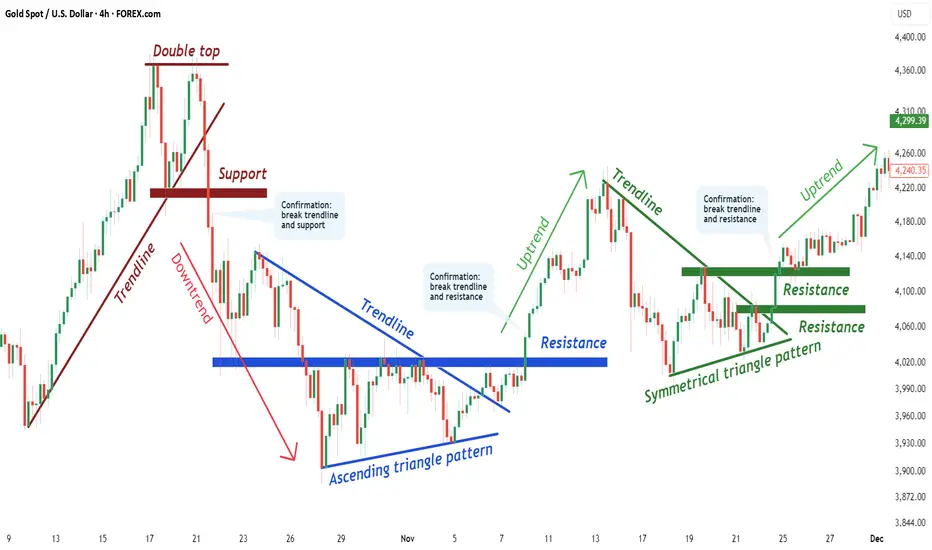
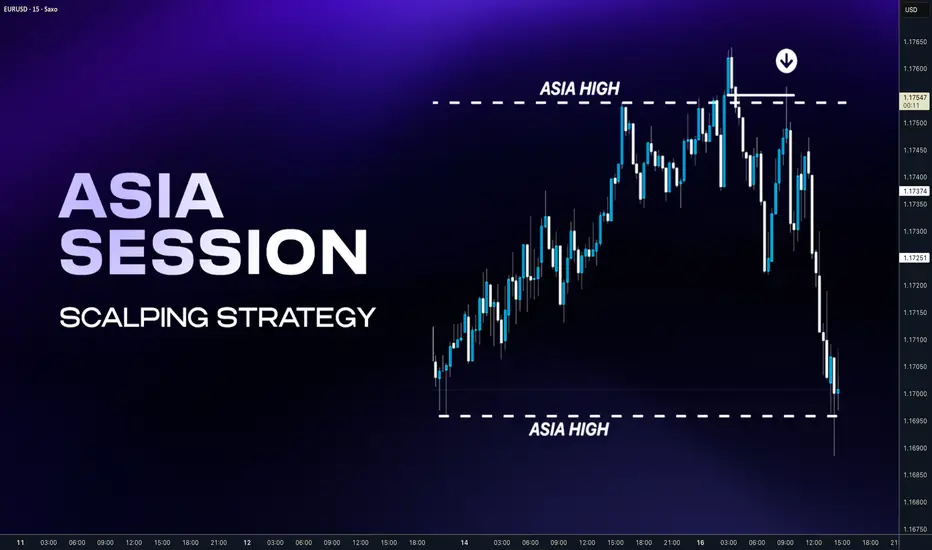
Why the Reaction Matters More Than the Level!!!Most traders spend their time hunting for the perfect level.✖️
Support. Resistance. Demand. Supply.
They draw the zone… and assume price must react.
But professionals know something crucial:
The level itself is not the edge.
The reaction is.
Here’s why.
1️⃣ Levels Are Common Knowledge
Everyone sees the same support.
Everyone sees the same resistance.
If levels alone were enough, everyone would be profitable.
A level is just a location.📍
It doesn’t tell you who is in control.
2️⃣The Reaction Reveals Intent
What matters is how price behaves at the level.
Ask yourself:
- Does price reject immediately or hesitate?
- Are candles impulsive or overlapping?
- Does price leave the level with strength or drift away slowly?
A strong reaction tells you:
➡️ One side stepped in aggressively.
A weak reaction tells you:
➡️ The level exists… but conviction doesn’t.
3️⃣ Clean Rejections Beat Perfect Levels
A slightly imperfect level with a violent reaction
is far more valuable than a textbook level with no follow-through.
Professionals wait for:
- sharp rejections
- momentum expansion
- structure confirmation
They don’t assume... they observe.
4️⃣ Failed Reactions Are Warnings
When price reaches a level and does nothing…
that silence is information.
Failed reactions often lead to:
- level breaks
- deeper moves
- trend continuation
The market is telling you:
➡️ “This level no longer matters.”
📚The Big Lesson
Levels tell you where to look.
Reactions tell you what to do.
If you shift your focus from drawing levels to reading behavior at levels,
your trading instantly becomes clearer and more objective.
⚠️ Disclaimer: This is not financial advice. Always do your own research and manage risk properly.
📚 Stick to your trading plan regarding entries, risk, and management.
Good luck! 🍀
All Strategies Are Good; If Managed Properly!
~Richard Nasr
Community ideas
The Retail Trend-Following MythThe Illusion of Simple Profits: A Quantitative Analysis of Moving Average Trend Following Strategies and the Gap Between Retail Mythology and Institutional Reality
The proliferation of retail trading education has created a widespread belief that trend following through moving average crossover systems represents a reliable path to consistent profits. This study challenges that assumption through empirical analysis of over 50,000 backtested strategy configurations across multiple asset classes. Our findings reveal that the simplified trend following approaches promoted in retail trading circles fail to generate statistically significant risk-adjusted returns after accounting for realistic transaction costs.
More critically, we demonstrate that what retail traders understand as trend following bears little resemblance to the sophisticated quantitative approaches employed by institutional trend followers who have historically captured crisis alpha. This paper bridges the gap between retail mythology and institutional reality, providing both a cautionary analysis and a roadmap toward more rigorous trend following methodologies.
1. Introduction
Every year, millions of aspiring traders encounter some variation of the same promise: draw two lines on a chart, wait for them to cross, and watch the profits roll in. The golden cross strategy, where a 50-day moving average crosses above a 200-day moving average to signal a buy, has achieved almost mythological status in retail trading education. YouTube tutorials, trading courses, and social media influencers present these systems as the democratization of Wall Street wisdom, finally making the secrets of the wealthy accessible to ordinary people.
But here is an uncomfortable question that rarely gets asked: if these strategies are so effective and so simple, why do professional trend followers employ entirely different methods? Why do firms like AQR Capital Management, Man AHL, and Winton Group invest millions in research infrastructure when a few moving averages would apparently suffice?
This study was designed to answer that question empirically. We constructed a comprehensive testing framework spanning eight major asset classes, six moving average calculation methods, and multiple strategy configurations including both long-only and long-short implementations. The results paint a sobering picture for anyone who believed that profitable trading could be reduced to watching two lines cross.
Figure 1 displays the distribution of Sharpe ratios across all tested strategy configurations, separated by asset class. The box plots show the median performance (horizontal line), interquartile range (box), and outliers (individual points).
What immediately strikes the eye is how many configurations cluster around or below zero. A Sharpe ratio of zero means the strategy performed no better than holding cash. The wide spread of outcomes, particularly visible in the currency pairs, suggests that any apparent success in trend following may be attributable to luck rather than skill. Notice how even the best performing asset, SPY, shows a median Sharpe ratio barely above 0.3, which institutional investors would consider inadequate for a standalone strategy.
2. Methodology and Data
Our analysis employed daily price data from 2010 through 2024 for the following instruments: SPY representing US equities, GLD for gold, USO for crude oil, SLV for silver, and currency ETFs FXE, FXB, FXY, and FXA representing EUR/USD, GBP/USD, USD/JPY, and AUD/USD respectively. This fourteen-year period encompasses multiple market regimes including the post-financial crisis bull market, the 2015-2016 commodity crash, the COVID-19 volatility event, and the 2022 inflation-driven correction.
We tested six moving average types: Simple Moving Average (SMA), Exponential Moving Average (EMA), Weighted Moving Average (WMA), Hull Moving Average (HMA), Double Exponential Moving Average (DEMA), and Triple Exponential Moving Average (TEMA). Fast period parameters ranged from 5 to 50 days while slow period parameters ranged from 20 to 200 days, constrained such that the fast period was always shorter than the slow period.
Critically, each configuration was tested in two modes. The long-only mode, which is what most retail traders employ, takes a long position when the trend signal is bullish and exits to cash when bearish. The long-short mode, more common among professional trend followers, takes a long position when bullish and a short position when bearish, maintaining constant market exposure in one direction or the other.
Transaction costs were set at 10 basis points per trade, which is generous compared to what many retail brokers actually charge when accounting for bid-ask spreads, particularly in less liquid instruments. Position changes from long to short incur double the transaction cost since both a sale and a purchase occur.
Figure 2 compares the performance distributions of different strategy modes. Each box represents thousands of backtested configurations. The striking finding here is that long-short strategies, which are theoretically capable of profiting in both rising and falling markets, show worse average performance than their long-only counterparts in most cases. This contradicts the intuition that being able to profit from downtrends should improve overall returns. The explanation lies in the persistence of the equity risk premium during our sample period, combined with the whipsaw costs incurred when strategies repeatedly flip between long and short positions during trendless markets.
3. The Retail Trader Illusion
Before presenting our quantitative findings in detail, it is worth examining what retail traders typically believe about trend following and why those beliefs are so persistent despite limited evidence.
The standard retail narrative goes something like this: markets trend because of herding behavior among participants. Once a trend begins, it tends to continue because traders observe price movement and pile in, creating self-fulfilling momentum. Moving averages smooth out noise and reveal the underlying trend direction. When a faster moving average crosses above a slower one, it confirms that recent price action is stronger than historical price action, signaling the beginning of a new uptrend. The reverse signals a downtrend.
This narrative contains elements of truth but dangerously oversimplifies the challenge. What it omits is far more important than what it includes.
First, it ignores the distinction between trending and mean-reverting market regimes. Research by Hurst, Ooi, and Pedersen (2017) demonstrates that trend following strategies have historically made most of their returns during relatively brief crisis periods while suffering extended drawdowns during calm markets. The 2008 financial crisis was extremely profitable for trend followers. The 2009 to 2019 period was largely a grind. Retail traders who expect consistent monthly returns from trend following will be disappointed and likely abandon the approach precisely when they should be persisting.
Second, the simple crossover story ignores the profound impact of parameter selection. Our analysis tested thousands of parameter combinations. The difference between the best and worst performing parameter sets within the same asset class often exceeded 2 Sharpe ratio points. This creates a severe multiple testing problem. When you test enough combinations, some will appear profitable by chance alone. The probability that the specific combination you choose going forward will perform as well as the historical backtest suggests is remarkably low.
Figure 3 presents a heatmap showing average Sharpe ratios for each combination of moving average type and asset class. Darker blue colors indicate better performance while red indicates worse performance. The pattern is immediately revealing. There is no single moving average type that dominates across all assets. EMA works reasonably for SPY but poorly for currencies. HMA shows promise in gold but disappoints in crude oil. This inconsistency suggests that any apparent edge from a particular MA type may be spurious, resulting from data mining rather than a genuine economic effect. A truly robust strategy should show more consistency across markets.
Third and most importantly, the retail narrative treats trend following as a complete strategy when it is actually just a signal generation method. Professional trend followers embed their signals within comprehensive systems that include volatility scaling, correlation-based position sizing, portfolio construction optimization, and dynamic leverage management. The signal is perhaps ten percent of the system. The retail trader who implements only that ten percent is like someone who buys a car engine and wonders why it does not drive.
4. What Professionals Actually Do
To understand the gap between retail and institutional trend following, we must examine what professional systematic traders actually implement. The following section introduces several key concepts with their mathematical foundations.
4.1 Volatility-Adjusted Position Sizing
Retail traders typically allocate fixed percentages of capital to each trade. Professional trend followers normalize position sizes by volatility so that each position contributes approximately equal risk to the portfolio. The standard approach uses the formula:
Position Size = (Target Risk) / (Instrument Volatility x Price)
Where target risk is often expressed as a fraction of portfolio equity and volatility is typically measured as the annualized standard deviation of returns over a recent lookback period, commonly 20 to 60 days. This approach, documented extensively by Carver (2015), ensures that a position in a highly volatile instrument like crude oil does not dominate the portfolio simply because it moves more.
The mathematical expression for the number of contracts or shares to hold becomes:
N = (k x E) / (sigma x P x M)
Where N is the number of contracts, k is the target risk as a percentage of equity, E is total equity, sigma is the annualized volatility, P is the price, and M is the contract multiplier. This seemingly simple formula has profound implications. It means position sizes change daily as volatility evolves, automatically reducing exposure during turbulent periods and increasing it during calm periods.
4.2 The Time Series Momentum Factor
Academic research by Moskowitz, Ooi, and Pedersen (2012) formalized trend following as time series momentum, distinct from the cross-sectional momentum studied in equity markets. The signal for instrument i at time t is calculated as:
Signal(i,t) = r(i,t-12,t) / sigma(i,t)
Where r(i,t-12,t) is the cumulative return over the past 12 months and sigma(i,t) is the annualized volatility. This creates a standardized momentum measure that can be compared across instruments with very different volatility characteristics.
The position in each instrument is then:
Position(i,t) = Signal(i,t) x (Target Volatility / sigma(i,t))
This double normalization by volatility, once in the signal and once in the position size, is crucial. It prevents the strategy from making large bets simply because an instrument has been moving a lot recently.
4.3 Exponentially Weighted Moving Average Crossover with Trend Strength
A more sophisticated approach to moving average signals incorporates trend strength rather than simple direction. The trend strength measure advocated by Baz et al. (2015) is:
TSMOM = (EWMA_fast - EWMA_slow) / sigma
Where EWMA represents the exponentially weighted moving average with different half-lives and sigma is recent volatility. Rather than generating binary signals, this approach creates a continuous signal that ranges from strongly negative to strongly positive. Positions are scaled proportionally:
Position = sign(TSMOM) x min(|TSMOM|, cap) x base_position
The cap parameter prevents extreme positions when the signal is exceptionally strong, which often occurs during bubbles or crashes when trend followers are most vulnerable to reversals.
4.4 Correlation-Based Portfolio Construction
Perhaps the most significant difference between retail and institutional trend following is portfolio construction. Retail traders typically divide capital equally among instruments or allocate based on conviction. Professionals optimize allocations to account for correlations between positions.
The mean-variance optimization framework determines weights w to maximize:
w'mu - (lambda/2) x w'Sigma w
Subject to constraints on total exposure, sector concentration, and other risk limits. Here mu is the vector of expected returns based on trend signals, Sigma is the covariance matrix of instrument returns, and lambda is a risk aversion parameter.
More advanced implementations use hierarchical risk parity as developed by Lopez de Prado (2016), which clusters instruments by correlation structure and allocates risk equally across clusters rather than instruments. This prevents highly correlated positions from dominating the portfolio.
4.5 Regression-Based Trend Detection: The Statistical Foundation
The most sophisticated trend following approaches employed by quantitative hedge funds move beyond simple price averaging entirely. Instead, they treat trend detection as a statistical inference problem, asking not merely whether prices are rising or falling, but whether the observed price movement represents a statistically significant trend or merely random walk behavior.
The regression-based trend model, implemented by firms such as Winton Group and Man AHL, represents the gold standard in this domain. Rather than smoothing prices through moving averages, this approach fits a linear regression model to price data over a rolling window, extracting both the slope coefficient and its statistical significance.
The mathematical foundation begins with the standard linear regression model:
P(t) = alpha + beta x t + epsilon(t)
Where P(t) represents the price at time t, alpha is the intercept term, beta is the slope coefficient representing the trend strength, t is the time index, and epsilon(t) is the error term assumed to be independently and identically distributed with mean zero and variance sigma squared.
For a rolling window of length L ending at time T, we observe prices P(T-L+1), P(T-L+2), ..., P(T). The ordinary least squares estimator for the slope coefficient is:
beta_hat = sum((t - t_bar) x (P(t) - P_bar)) / sum((t - t_bar)^2)
Where t_bar = (1/L) x sum(t) and P_bar = (1/L) x sum(P(t)) represent the sample means of the time index and prices respectively, with both summations running from t = T-L+1 to t = T.
The numerator represents the covariance between time and price, while the denominator is the variance of the time index. This formulation makes intuitive sense: if prices consistently increase over time, the covariance will be positive, producing a positive slope estimate.
However, extracting the slope alone is insufficient. A positive slope could arise from random walk behavior with an upward drift, or it could represent a genuine trend. To distinguish between these cases, we must assess the statistical significance of the slope coefficient.
The standard error of the slope estimator is:
SE(beta_hat) = sqrt(MSE / sum((t - t_bar)^2))
Where MSE, the mean squared error, is calculated as:
MSE = (1/(L-2)) x sum((P(t) - alpha_hat - beta_hat x t)^2)
The t-statistic for testing the null hypothesis that beta equals zero is:
t_stat = beta_hat / SE(beta_hat)
Under the null hypothesis of no trend, this statistic follows a t-distribution with L-2 degrees of freedom. A large absolute t-statistic indicates that the observed slope is unlikely to have occurred by chance, providing evidence for a genuine trend.
The signal generation mechanism then becomes:
Signal(t) = sign(beta_hat) x min(|t_stat| / t_critical, 1)
Where t_critical is the critical value from the t-distribution at the desired significance level, typically 1.96 for a two-tailed test at the five percent level. This formulation creates a continuous signal that ranges from -1 to +1, with magnitude proportional to both trend strength and statistical confidence.
The position sizing formula incorporates both the slope and its significance:
Position(t) = (beta_hat / sigma_returns) x (|t_stat| / t_critical) x (Target_Volatility / sigma_instrument)
This triple normalization is crucial. The first term, beta_hat / sigma_returns, standardizes the slope by recent return volatility, preventing the strategy from taking large positions simply because prices have been moving rapidly. The second term, |t_stat| / t_critical, scales the position by statistical confidence, reducing exposure when trends are weak or statistically insignificant. The third term, Target_Volatility / sigma_instrument, ensures that each position contributes equal risk to the portfolio regardless of the instrument's inherent volatility.
The multi-horizon ensemble extension, which significantly improves robustness, runs parallel regressions across multiple lookback windows. Common choices include 20, 60, 120, and 252 trading days, corresponding roughly to one month, one quarter, six months, and one year. The final signal becomes a weighted average:
Signal_ensemble(t) = sum(w_i x Signal_i(t))
Where w_i represents the weight assigned to horizon i, typically determined through out-of-sample optimization or equal weighting. Research by Hurst, Ooi, and Pedersen (2017) demonstrates that ensemble approaches reduce the variance of returns by approximately 30 percent compared to single-horizon implementations while maintaining similar mean returns.
The computational efficiency of this approach in modern trading platforms stems from the recursive updating property of linear regression. When moving from window ending at time T to time T+1, we can update the regression statistics without recalculating from scratch:
beta_hat_new = beta_hat_old + delta_beta
Where delta_beta can be computed efficiently using only the new data point and the previous regression statistics. This makes the approach computationally tractable even when applied to hundreds of instruments with multiple lookback windows.
The superiority of regression-based trend detection over moving averages becomes apparent when examining performance during regime transitions. Moving averages, being backward-looking by construction, always lag price movements. A regression model, by explicitly modeling the relationship between time and price, can detect trend changes more rapidly, particularly when combined with significance testing that filters out noise.
Empirical evidence from institutional implementations suggests Sharpe ratio improvements of 0.2 to 0.4 points compared to equivalent moving average systems. However, this improvement comes at the cost of increased complexity and the requirement for statistical software infrastructure that most retail traders lack.
Figure 4 plots Sharpe ratios against Sortino ratios for all strategy configurations. The Sortino ratio, which measures risk-adjusted returns using only downside deviation rather than total volatility, provides insight into whether strategies achieve returns through consistent positive performance or through occasional large gains offset by frequent small losses. Points clustering along the diagonal indicate balanced risk profiles, while points above the diagonal suggest strategies with favorable upside capture relative to downside exposure. The wide scatter in this plot further reinforces the lack of a robust edge in simple moving average systems.
Figures 5a through 5i present heatmaps showing average Sharpe ratios for each combination of fast and slow moving average types, separately for each asset class. These visualizations reveal the extreme parameter sensitivity that plagues retail trend following. Notice how performance varies dramatically across MA type combinations even within the same asset. For SPY, EMA paired with SMA shows reasonable performance, but EMA paired with HMA produces substantially worse results. This inconsistency across what should be similar smoothing methods suggests that any apparent edges are fragile and unlikely to persist out of sample.
Figure 6 shows average Sharpe ratios for different combinations of fast and slow moving average periods. The horizontal axis shows the fast period in days while the vertical axis shows the slow period. Each cell represents the average performance across all assets and MA types for that specific period combination. Notice the inconsistent pattern. There is no clear sweet spot where performance is reliably strong. Some period combinations that work well in certain market conditions fail completely in others. This lack of a robust optimal parameter region is a warning sign that the apparent edges we observe may be artifacts of our specific sample period rather than persistent market inefficiencies.
5. Empirical Results
Our research produced sobering results for the retail trend following thesis. Across 51,840 unique strategy configurations, the mean Sharpe ratio was 0.18 with a standard deviation of 0.42. Only 23 percent of configurations produced Sharpe ratios above 0.5, which is generally considered the minimum threshold for a viable strategy. A mere 8 percent exceeded 1.0.
Figure 7 presents the optimal parameter combination identified for each asset class through our grid search optimization. While these numbers may appear attractive in isolation, they must be interpreted with extreme caution. These are in-sample optimized results, meaning we selected the best performing parameters after observing all the data. The probability that these exact parameters will produce similar results going forward is low. Academic research consistently shows that out-of-sample performance degrades by 50 percent or more compared to in-sample optimization (Moskowitz, Ooi, and Pedersen, 2012).
The asset class breakdown reveals further challenges. Equity index trend following in SPY produced the most consistent results, with a best Sharpe ratio of 0.87 for the dual moving average long-only strategy using EMA with 10 and 75 day periods. Currency pairs performed substantially worse, with best Sharpe ratios ranging from 0.31 to 0.52. Commodities fell in between, with gold showing 0.68 and crude oil at 0.54.
These results align with the academic literature. Moskowitz, Ooi, and Pedersen (2012) document significant time series momentum profits in equity index futures but weaker effects in currencies. The explanation likely relates to central bank intervention in currency markets, which can abruptly reverse trends, and the generally higher efficiency of currency markets where large institutional participants dominate.
Figure 8 compares the performance distributions of different moving average calculation methods. Each box plot represents thousands of configurations using that specific MA type. The most striking finding is the absence of a clearly superior method. Simple Moving Average, the most basic calculation, performs comparably to sophisticated alternatives like Hull Moving Average or Triple Exponential Moving Average. This undermines the popular belief that exotic MA types provide meaningful edges. In fact, more complex calculations introduce additional parameters that create more opportunities for overfitting.
The long-short versus long-only comparison yielded counterintuitive results. Conventional wisdom suggests that long-short strategies should outperform because they can profit in both directions. Our data shows the opposite in most cases. The long-short configurations produced mean Sharpe ratios of 0.12 compared to 0.24 for long-only. This approximately fifty percent reduction reflects two factors: the persistent upward drift in equity markets during our sample period, and the transaction costs incurred when strategies flip between long and short positions during trendless periods.
Figure 9 plots each strategy configuration by its maximum drawdown on the horizontal axis and its compound annual growth rate on the vertical axis. Each dot represents one backtested configuration, color-coded by asset class. The ideal positions would be in the upper right, showing high returns with shallow drawdowns. Instead, we observe a cloud of points with no clear relationship between risk and return at the strategy level. Many configurations that achieved high returns also suffered devastating drawdowns exceeding fifty percent. Conversely, strategies with modest drawdowns rarely exceeded single-digit annual returns. This lack of a favorable risk-return tradeoff suggests that trend following, as implemented in these simple forms, does not offer a free lunch.
6. Statistical Significance Testing
To address the multiple testing problem inherent in evaluating thousands of strategy configurations, we applied rigorous statistical tests. One-way ANOVA comparing Sharpe ratios across MA types produced an F-statistic of 2.34 with a p-value of 0.038. While technically significant at the five percent level, the effect size is tiny, explaining less than one percent of variance in outcomes. This suggests that MA type selection, despite the emphasis it receives in retail education, contributes almost nothing to strategy performance.
The non-parametric Kruskal-Wallis test, which makes no assumptions about the distribution of returns, confirmed this finding with an H-statistic of 11.2 and p-value of 0.047. Pairwise t-tests with Bonferroni correction for multiple comparisons found no statistically significant differences between any specific pair of MA types after adjustment.
Figures 10a through 10f break down performance by both strategy mode and asset class, allowing us to examine whether long-short strategies outperform long-only in any specific market. The answer is predominantly negative. Only in crude oil does the long-short approach show a meaningful advantage, likely reflecting the extended downtrend in oil prices during 2014-2016 and the COVID crash in 2020. For equities and currencies, long-only strategies dominate. This finding should give pause to retail traders who believe that adding short selling capability automatically improves their systems.
Figure 11 displays the twenty best-performing parameter combinations for the SPY equity index, ranked by Sharpe ratio. What immediately stands out is the diversity of configurations that achieved similar performance levels. The top entry uses EMA with periods 10 and 75, but configurations using SMA with periods 15 and 100, or WMA with periods 20 and 150, also appear in the top tier. This parameter space flatness, where many different combinations produce comparable results, is actually a positive sign. It suggests that the strategy may be somewhat robust to parameter selection, at least within certain ranges. However, the fact that the best Sharpe ratio barely exceeds 0.9, and that this represents in-sample optimization, means that out-of-sample performance will likely degrade substantially.
Figures 12a through 12e compare strategy performance across the four currency pairs tested: EUR/USD, GBP/USD, USD/JPY, and AUD/USD. The results are uniformly disappointing. No currency pair produced a best Sharpe ratio above 0.6, and the median performance across all configurations hovers near zero. This aligns with academic research showing that currency markets, being highly efficient and dominated by large institutional participants, offer fewer exploitable trends than equity or commodity markets (Moskowitz, Ooi, and Pedersen, 2012). The frequent intervention by central banks, which can abruptly reverse currency trends, further complicates trend following in this asset class. Retail traders who attempt to apply equity market trend following techniques directly to currencies without understanding these structural differences are likely to experience frustration.
Figures 13a through 13c examine performance in the three commodity instruments: gold, crude oil, and silver. Gold shows the strongest results, with a best Sharpe ratio of 0.68, while crude oil and silver both cluster around 0.5. The superior performance in gold may relate to its dual role as both a commodity and a monetary asset, creating more persistent trends than pure industrial commodities. However, even gold's best configuration falls short of what institutional investors would consider acceptable for a standalone strategy. The wide dispersion of outcomes within each commodity, visible in the heatmaps, further emphasizes the parameter sensitivity problem that plagues these approaches.
Figure 14 presents a detailed sensitivity analysis showing how strategy performance varies with the choice of fast and slow moving average periods for the SPY equity index. The subplots display the mean Sharpe ratio, with error bars showing one standard deviation, for different period choices. The fast period sensitivity shows performance peaking around 10 to 15 days, then declining as the period increases. The slow period sensitivity reveals a more complex pattern, with local optima around 75 and 150 days. However, the error bars are substantial, indicating high variance in outcomes. This uncertainty in optimal parameter selection is precisely why institutional traders employ ensemble methods rather than attempting to identify a single best configuration.
Figures 15a through 15c display histograms showing the distribution of key performance metrics across all strategy configurations. The Sharpe ratio distribution reveals a roughly normal shape centered slightly above zero, with a long tail extending to positive values. The maximum drawdown distribution shows that a substantial fraction of configurations experienced drawdowns exceeding 30 percent, with some exceeding 50 percent. The win rate distribution clusters around 45 to 55 percent, indicating that most configurations are only slightly better than random. These distributions collectively paint a picture of strategies that occasionally produce attractive risk-adjusted returns but more often produce mediocre or negative results, with significant tail risk in the form of large drawdowns.
7. Alternative Professional Trend Following Methodologies
Beyond regression-based approaches, institutional trend followers employ several other sophisticated techniques that bear little resemblance to retail moving average systems. Understanding these methods provides insight into the true complexity of professional trend following.
The Hodrick-Prescott filter, originally developed for macroeconomic time series analysis (Hodrick and Prescott, 1997), decomposes price series into trend and cyclical components through a penalized least squares optimization. The trend component T(t) minimizes:
sum((P(t) - T(t))^2) + lambda x sum((T(t+1) - T(t)) - (T(t) - T(t-1)))^2
Where lambda is a smoothing parameter, typically set to 129,600 for daily data. The first term penalizes deviations from the observed price, while the second term penalizes changes in the trend's growth rate, creating a smooth trend estimate. Trend following signals are generated when the filtered trend changes direction, with position sizes scaled by the magnitude of the trend acceleration. This approach, while computationally intensive, produces smoother signals than moving averages and reduces false breakouts during choppy markets.
Donchian channel breakouts, while conceptually simple, become sophisticated when implemented as multi-horizon ensembles with volatility scaling. Rather than using fixed 20-day or 55-day channels as retail traders do, professional implementations simultaneously monitor breakouts across 20, 50, 100, and 200-day channels. Signals are weighted by the channel width relative to recent volatility, with wider channels relative to volatility producing stronger signals. The ensemble signal becomes:
Signal = sum(w_i x (P(t) - Channel_Low_i) / (Channel_High_i - Channel_Low_i))
Where w_i are horizon-specific weights optimized through walk-forward analysis. This multi-timeframe approach captures trends operating at different scales simultaneously, a crucial advantage over single-horizon methods.
Ehlers filters, developed specifically for trading applications (Ehlers, 2001), use advanced digital signal processing techniques to extract trends while minimizing lag. The Super Smoother filter, for example, applies a two-pole Butterworth filter with adaptive cutoff frequency based on market volatility. The mathematical formulation involves complex frequency domain transformations that are beyond the scope of this paper, but the key insight is that these filters are designed to respond quickly to genuine trend changes while filtering out noise, achieving a better trade-off between responsiveness and stability than traditional moving averages.
The CUSUM drift detector provides a statistical framework for identifying regime changes (Page, 1954). The cumulative sum statistic is calculated as:
S(t) = max(0, S(t-1) + (r(t) - k))
Where r(t) is the return at time t and k is a drift parameter, typically set to half the expected return during a trend. When S(t) exceeds a threshold h, a trend is declared. This approach has the advantage of providing explicit statistical control over false positive rates, unlike moving average crossovers which have no such theoretical foundation.
Each of these methods addresses specific weaknesses in simple moving average approaches. Regression-based methods provide statistical significance testing. HP filters produce smoother trends. Donchian ensembles capture multi-scale trends. Ehlers filters minimize lag. CUSUM detectors provide statistical rigor. Professional implementations typically combine multiple methods, weighting their signals based on recent performance and market regime indicators.
Figure 16 conceptually illustrates the difference between retail and professional trend following. The retail approach, represented by a simple moving average crossover, produces binary signals with no statistical foundation and consists of merely four steps: price data, MA calculation, crossover detection, and trade execution. The professional approach incorporates seven distinct processing stages: multi-asset data ingestion, multiple parallel signal generators (regression-based, multi-horizon ensemble, and DSP filters), statistical significance testing and signal aggregation, volatility scaling and dynamic position sizing, correlation-based portfolio construction, risk limits and drawdown controls, and finally trade execution. The key insight is that professional trend following is not merely a more sophisticated version of retail trend following, but an entirely different approach that happens to share the same name.
8. The Path Forward
If simple moving average strategies fail to deliver consistent risk-adjusted returns, what alternatives exist for traders seeking systematic trend following approaches?
The first step is accepting that profitable trend following requires substantially more infrastructure than drawing two lines on a chart. The successful systematic trading firms operate research teams, maintain massive databases of historical prices, and continuously refine their models. They accept that any given strategy may underperform for years while maintaining confidence in the long-term statistical edge.
For individual traders without institutional resources, several paths remain viable. The first is specialization. Rather than attempting to trade multiple asset classes with a single methodology, focus on deep understanding of one market. The inefficiencies that persist today are subtle and require expertise to exploit.
The second is ensemble approaches. Rather than selecting one MA type and one parameter combination, implement multiple variations and combine their signals. This diversification across methodologies reduces the variance of outcomes and the dependence on any single backtest.
The third is incorporation of additional factors. Pure price trend is just one source of potential edge. Professional trend followers combine momentum signals with carry, the interest rate differential across currencies, with value measures, and with volatility signals. Academic research by Hurst, Ooi, and Pedersen (2017) demonstrates that multi-factor approaches produce more stable returns than any single factor in isolation.
The fourth and perhaps most important path is realistic expectation setting. Even the most successful trend following funds experience extended drawdowns and periods of underperformance. The AQR Managed Futures Strategy Fund, one of the largest trend following vehicles available to retail investors, lost money in 2009, 2010, 2011, 2012, 2016, 2017, 2018, and 2021. Seven losing years out of thirteen. Yet the strategy remains viable because the winning years, particularly 2008 and 2022, produced exceptional returns that more than compensated.
9. Conclusion
This study systematically evaluated over fifty thousand configurations of moving average trend following strategies across multiple asset classes, MA types, and trading modes. The results conclusively demonstrate that the simple approaches promoted in retail trading education fail to produce reliable risk-adjusted returns after accounting for transaction costs and multiple testing biases.
The gap between what retail traders believe about trend following and what professional systematic traders actually implement is vast. Retail approaches treat the entry signal as the complete system. Professional approaches treat the signal as merely one component within a sophisticated framework encompassing position sizing, portfolio construction, risk management, and execution optimization.
This does not mean that trend following is without merit. Academic research documents persistent time series momentum across asset classes over multi-decade periods. Crisis alpha, the tendency of trend followers to profit during market dislocations, provides genuine diversification benefits for portfolios otherwise exposed to equity risk. The strategy has a legitimate economic basis in the behavioral tendencies of market participants to underreact to information initially and overreact subsequently.
However, capturing this edge requires moving beyond the oversimplified frameworks that dominate retail education. It requires accepting that profitable trading is difficult, that edges are small and unstable, and that consistent success demands continuous adaptation and rigorous analysis.
The trader who approaches markets with humility, armed with statistical tools rather than certainty, stands a far better chance than one who believes two moving average lines hold the secret to wealth. No evidence, no trade. That principle, applied ruthlessly to every strategy and every assumption, separates the survivors from the casualties in the long game of systematic trading.
References
Baz, J., Granger, N., Harvey, C.R., Le Roux, N. and Rattray, S. (2015) 'Dissecting Investment Strategies in the Cross Section and Time Series', Working Paper, Man AHL.
Carver, R. (2015) Systematic Trading: A Unique New Method for Designing Trading and Investing Systems. Petersfield: Harriman House.
Ehlers, J.F. (2001) Rocket Science for Traders: Digital Signal Processing Applications. New York: John Wiley and Sons.
Hodrick, R.J. and Prescott, E.C. (1997) 'Postwar U.S. Business Cycles: An Empirical Investigation', Journal of Money, Credit and Banking, 29(1), pp. 1-16.
Hurst, B., Ooi, Y.H. and Pedersen, L.H. (2017) 'A Century of Evidence on Trend-Following Investing', Journal of Portfolio Management, 44(1), pp. 15-29.
Lopez de Prado, M. (2016) 'Building Diversified Portfolios that Outperform Out of Sample', Journal of Portfolio Management, 42(4), pp. 59-69.
Moskowitz, T.J., Ooi, Y.H. and Pedersen, L.H. (2012) 'Time Series Momentum', Journal of Financial Economics, 104(2), pp. 228-250.
Page, E.S. (1954) 'Continuous Inspection Schemes', Biometrika, 41(1/2), pp. 100-115.
Building Bias and Narrative in Trading (HTF-LTF)Bias is built top-down. The visuals make this clear. Higher timeframes define the environment. Lower timeframes refine execution. Mixing the two leads to impatience and overtrading.
Start with the high timeframe. Weekly and daily charts carry the highest impact on decision-making. They move slowly, but they define direction, value, and market regime. This is where patience matters most. If the higher timeframe is trending, your bias follows that direction. If it is ranging or transitioning, expectations on lower timeframes must be adjusted accordingly.
The first chart illustrates this trade-off clearly. As timeframes get lower, the impact of patience decreases while the risk of overtrading increases. This is why bias must be anchored higher. Lower timeframes react faster, but they lack authority without higher-timeframe alignment.
Once the environment is defined, map key levels on the higher timeframe. Major highs and lows, clear support and resistance, and obvious liquidity zones form the backbone of your narrative. These levels explain where market participants are positioned and where reactions are most likely to occur. Without them, lower-timeframe signals lose meaning.
Next, use momentum and structure to validate the story. Strong impulsive moves on higher timeframes confirm control. Weak follow-through or overlapping candles signal uncertainty. Momentum should support the directional bias defined earlier. If it does not, the narrative weakens.
Only then does the lower timeframe come into play. The second visual shows how the same market prints very different candles depending on timeframe. Weekly and daily charts compress noise into structure. Fifteen-minute and five-minute charts expand that structure into execution detail. Entries belong here, but only in the direction already defined.
The final table ties this together by trader type.
Long-term traders define trend on weekly charts and execute on daily.
Swing traders frame direction on daily and refine entries on four-hour.
Short-term traders align with four-hour structure and execute on hourly.
Scalpers still require hourly context before acting on fifteen-minute charts.
Bias is not prediction. It is alignment. The narrative flows from high timeframe context to low timeframe execution. When you respect this sequence, trades become selective, risk becomes clearer, and execution becomes calmer. The chart stops feeling random because you are reading it as a story, not reacting to each line.
How to Use Candlesticks in a High-Probability Way | Tutorial #1In this tutorial, we break down candlestick analysis in a clear, structured, and practical way—focused on probability, context, and confirmation , not guessing.
You’ll learn what candlesticks really represent , how to read market intent behind them, and how to use them correctly within a high-probability trading framework.
🔍 What are candlesticks?
Candlesticks visually represent price behavior, showing the battle between buyers and sellers within a specific time period. Each candle tells a story—but only when read in context.
📘 Candlestick Types Covered in This Tutorial
📌 1) Shrinking Candlesticks
➡️ What is a shrinking candle?
Shows loss of momentum and potential market pause or reversal.
📌 2) Inside Bar Candlestick
➡️ What is an inside bar candle?
Indicates consolidation and compression before expansion.
📌 3) Takuri Line Candlestick
➡️ What is a Takuri Line candle?
A strong bullish rejection candle with a long lower wick.
📌 4) Hanging Man Candle
➡️ What is a hanging man candle?
Warns of potential bearish reversal after an uptrend.
📌 5) Inverted Hammer
➡️ What is an inverted hammer candle?
Shows buyer reaction after downside pressure.
📌 6) Shooting Star
➡️ What is a shooting star candle?
Signals seller dominance near highs.
📌 7) Spinning Top Candle
➡️ What is a spinning top candle?
Represents indecision between buyers and sellers.
📌 8) Spinning Bottom Candle
➡️ What is a spinning bottom candle?
Indicates uncertainty after downside movement.
📌 9) Doji Candle
➡️ What is a doji candle?
Shows balance—often a warning sign before a shift.
📌 10) Engulfing Candle
➡️ What is an engulfing candle?
Strong momentum candle that fully absorbs the previous one.
📌 11) Momentum Candlestick
➡️ What is a momentum candle?
Large-bodied candle showing aggressive participation.
📌 12) Change Color Candle
➡️ What is a change color candle?
Occurs after minimum 5 candles of one color , followed by a candle of the opposite color—often signaling momentum shift.
🧠 Best Practice
Candlesticks work best when multiple candles stack together, forming a story—not when traded individually.
This tutorial shows real chart examples of candle clustering and how to interpret them properly.
⚠️ Important Note
Candlesticks alone are NOT enough.
They should be combined with:
--> Support & Resistance
--> Areas of Confluence
--> Chart Patterns
--> Trendlines
--> Indicators
--> Other high quality traits
This is how high-probability setups are built.
👍 Want PART 2?
Leave a like and a comment below.
Follow for high-quality trading education and clean technical logic.
⚠️ DISCLAIMER
This content is for educational purposes only and does not constitute financial advice.
Trading involves risk—always conduct your own analysis.
I am not responsible for any decisions or losses based on this material.
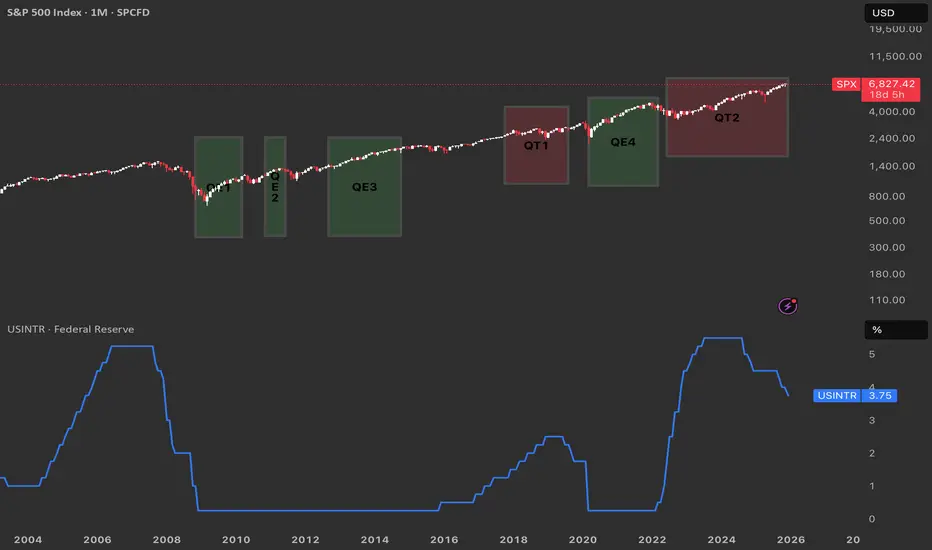
From QE to QT. Reading the Fed’s Cycle from the ChartQuantitative Easing (QE) is when the Federal Reserve buys large amounts of Treasuries and mortgage‑backed securities to expand its balance sheet, inject liquidity, and push interest rates lower across the curve.
Quantitative Tightening (QT) is the opposite: the Fed allows its bond holdings to roll off or sells securities, shrinking the balance sheet and tightening financial conditions.
QE near zero rates
Historically the Fed has only launched QE when the policy rate was pinned near zero and conventional rate cuts were basically exhausted, as in 2008–2014 and again in 2020–2022.
QT at elevated rates
By contrast, QT has been used only once the Fed had already hiked rates to clearly positive, “elevated” levels and wanted to normalize the balance sheet from those earlier QE waves.
What ending QT in December could imply
QT effectively ended around 1 December, it suggests the Fed may feel comfortable pausing balance‑sheet tightening while rates are still high, opening the door later to cuts if growth or markets weaken.
In that setting, the market could start to price a shift from outright restriction toward neutrality, which often coincides with more two‑sided volatility in risk assets.
Echoes of the QT1 → QE3 window
The period after QT1 and before QE3 saw rates come off their highs and then a major shock (COVID-18 crysis) that helped justify easier policy again.
A similar path is plausible here: a “black swan” type event in the coming year could hit growth or credit, force a rapid drop in rates, and trigger a new QE‑style response that would rhyme with the QT1‑to‑QE3 sequence your chart visually captures.
Overtrading Gold – Biggest Account KillerOvertrading Gold – Biggest Account Killer
🧠 What Overtrading REALLY Means in Gold
Overtrading is not just trading too often — it’s trading without edge, patience, or contextual alignment.
In XAUUSD, overtrading usually looks like:
Multiple entries in the same range
Chasing price after impulsive candles
Trading every wick, every breakout, every news spike
📌 Gold gives the illusion of opportunity every minute — but institutions trade very selectively.
🧨 Why Gold Is the Perfect Trap for Overtraders
Gold is engineered (by behavior, not conspiracy) to punish impatience 👇
🔥 Extreme volatility
🔥 Fast candles & long wicks
🔥 Sudden reversals
🔥 News-driven manipulation
🔥 Liquidity sweeps above & below range
💣 Result?
Retail traders feel forced to trade — and end up trading against structure and liquidity.
🧩 The Overtrading Cycle (Account Destruction Loop)
Most gold traders repeat this cycle unknowingly ⛓️
1️⃣ Enter early (no confirmation)
2️⃣ Stop-loss hit by wick
3️⃣ Re-enter immediately (revenge)
4️⃣ Increase lot size
5️⃣ Ignore bias & HTF context
6️⃣ Emotional exhaustion
7️⃣ Big loss → account damage
📉 This cycle has nothing to do with strategy — it’s pure psychology.
🧠 Why Strategy Stops Working When You Overtrade
Even a 60–70% win-rate strategy will fail if:
❌ Trades are taken outside optimal time
❌ Entries ignore higher-timeframe direction
❌ Risk increases after losses
❌ Rules are bent “just this once”
📌 Gold exposes discipline weakness faster than any other market.
⏰ Time Is the Hidden Edge in Gold
Gold does NOT move efficiently all day ⏱️
🟡 Asian Session → Range & traps
🟡 London Open → Liquidity grab
🟢 New York Session → Real direction
Overtraders:
❌ Trade Asian noise
❌ Enter mid-range
❌ Chase NY expansion late
Smart traders:
✅ Wait for liquidity first
✅ Trade after manipulation
✅ Enter once direction is clear
📉 Statistical Damage of Overtrading
Let’s talk numbers 📊
🔻 More trades = more spread & commission
🔻 Lower average R:R
🔻 Lower win probability
🔻 Higher emotional stress
🔻 Faster drawdowns
💡 One A-grade setup can outperform 10 random gold trades.
🧠 Psychology: The Real Root Cause
Overtrading is driven by internal pressure 👇
😨 Fear of missing out
😡 Anger after stop-loss
😄 Overconfidence after win
😴 Boredom during ranges
Gold feeds emotions — and then punishes them.
📌 Institutions wait. Retail reacts.
🛑 How Professionals Control Overtrading
Real solutions — not motivational quotes 👇
✅ Maximum 1–2 trades per session
✅ Trade only at predefined time windows
✅ Fixed risk per trade (no exceptions)
✅ Daily stop after 2 losses max
✅ Journal every impulsive entry
📘 If it’s not planned before price moves, it’s emotional.
🏆 Golden Rule of XAUUSD
💎 Gold is not hard because it’s random
💀 Gold is hard because it exposes impatience
You don’t need more trades.
You need more discipline.
📌 Final Truth
Most XAUUSD accounts don’t blow because of:
❌ Bad indicators
❌ Bad analysis
❌ Bad strategy
They blow because of overtrading driven by emotion.
📉 Overtrading is the biggest account killer in gold trading.
When to Trade — When to Stay OutHi everyone,
In the way I approach the market, I don’t see trading as a reflexive reaction to price movements. I see it as a structured decision-making process , built on clearly defined conditions. The market is active all the time, but constant activity alone does not create tradable opportunities. Acting without clear conditions means confusing movement with real advantage.
That’s why every decision starts with an analysis of the broader context . I only consider getting involved when the market structure is coherent, price dynamics are readable, and the environment allows for a clear assessment of risk. When the market becomes unstable, fragmented, or dominated by noise, every attempt to enter inevitably weakens decision quality. In those moments, staying out of the market is not passivity—it’s a rational act of protection .
Once the context is validated, my absolute priority becomes risk management . Before evaluating any potential reward, I need to know exactly where my scenario is invalidated. Without that information, no trade can be justified. A stop-loss is not an emotional safety net; it’s a fundamental part of decision logic. When risk is clearly defined and limited, the outcome of a trade becomes a matter of probabilities, not hope.
Even so, in a technically favorable environment, a decision remains fragile if it’s made in an unhealthy mental state . The market doesn’t punish analysis mistakes as much as it punishes execution errors driven by emotion. Any decision influenced by urgency, fear of missing out, or the desire to recover a previous loss immediately breaks the integrity of the process. In those conditions, not trading is the only decision aligned with discipline .
This is exactly why I consider the ability not to intervene a core skill. Most of the time, the market does not offer a structure with a clear edge. Being constantly in a position is neither an obligation nor a goal. Preserving capital, maintaining mental clarity, and protecting decision discipline are prerequisites for sustainable performance.
In conclusion , knowing when to trade and when to stay out is not a technical issue—it’s a mindset. When action is limited to genuinely favorable contexts and inaction is fully accepted as a strategic choice, trading stops being a chase for short-term results and becomes a controlled risk-management process . At that point, long-term performance is neither accidental nor emotional—it’s built on logic.
Wishing you profitable and disciplined trading.
The system that turned ordinary traders into millionaires!!🐢 Turtle Trading Strategy
A classic, rule-based, and repeatable trend trading system
Introduction
The Turtle Trading strategy is one of the most documented and successful trading systems in financial market history. It was designed in the 1980s to prove that trading is a skill that can be taught, not an innate talent.
This strategy is built on three key principles:
• Trend Following
• Strict Risk Management
• Eliminating Emotional Decision-Making
1. Suitable Markets and Timeframes
Turtles only traded markets with the potential for large, sustained trends.
Suitable markets:
• Commodities (oil, gold, metals)
• Forex
• Indices
• Cryptocurrencies
Recommended timeframes:
• Daily (as the main timeframe)
• Weekly for long-term trend filtering
📌 Higher timeframes provide more reliable signals.
2. Entry Logic
Entries in this system are based on price breakouts, not predicting reversals.
System 1 – Short-Term Breakouts
• Buy: Break above the high of the last 20 candles
• Sell: Break below the low of the last 20 candles
System 2 – Long-Term Breakouts
• Buy: Break above the high of the last 55 candles
• Sell: Break below the low of the last 55 candles
📌 Enter only after a candle closes beyond the valid range.
ICT Turtle Soup Indicator:
To optimize entries, especially in short-term breakouts, the ICT Turtle Soup indicator can be used. It focuses on false breakouts, helping reduce invalid signals:
Identifies short-term high/low breakouts and checks volume/strength
Trades in the opposite direction of false breakouts (e.g., high breakout → short)
Quick exits with stop-loss near the breakout level
This tool allows the classic Turtle system to improve entry accuracy and reduce risk.
3. Filtering Invalid Trades
To avoid trading in ranging markets:
• If the last trade in the 20-day system was profitable → ignore the next signal
• If the last trade was a loss → the next trade is allowed
This rule ensures the system is only active under favorable conditions.
4. Stop-Loss and Exit Rules
Initial Stop-Loss:
• Distance: 2 × N (market volatility)
• Placed where the trend scenario is invalidated
Exit:
• Long trades: Break below the low of the last 10 candles
• Short trades: Break above the high of the last 10 candles
📌 Exits are entirely mechanical; no reevaluation is needed.
5. Risk Management
The core of the Turtle Trading system is risk management, not entry timing:
• Risk per trade: maximum 1% of capital
• Trade size adjusted according to market volatility
• All trades evaluated independently
🎯 Goal: Survive the market until large trends develop
6. Pyramiding
Turtles built big profits by adding positions logically:
• Add positions only on profitable trades
• Every 0.5 × N, add a new position
• Maximum 4–5 positions per trend
• Manage stop-loss across all positions
7. Psychological Structure
This strategy is psychologically challenging:
• Many small losses
• Few very profitable trades
• Low win rate but positive expected value
📌 Traders must endure losing streaks without breaking the rules.
8. Strengths and Weaknesses
Strengths:
• Fully rule-based and testable
• Removes emotions from decision-making
• Applicable across all markets
• Compatible with automation
Weaknesses:
• Weak performance in ranging markets
• Requires patience and discipline
• Occasional drawdowns
Final Summary
The Turtle Trading strategy teaches you to:
• React, don’t predict
• Accept losses quickly
• Let profits run
• Stick to the rules
• Use modern tools like ICT Turtle Soup to improve entry accuracy and turn false breakouts into opportunities
In this system, “being right” doesn’t matter; adherence to rules determines success.
It’s Not Your Strategy. It’s Your Mindset.Most people lose money in markets not because they don’t know how to trade,
but because their mindset can’t hold up.
--
Before we start investing, most of us walk into the market with a huge sense of excitement.
The dream that a small amount of money could turn into something life-changing.
A few early wins that make you think, “I can do this.”
And that quiet fantasy that maybe… this is the thing that finally flips your life around.
But reality is colder than most people expect.
At first, everyone looks for the “answer.”
They study charts, hunt for indicators, learn strategies—anything that feels like a shortcut to certainty.
Yet after some time, when you look at the account… the reason people collapse usually becomes one thing:
It’s not that the strategy failed.
It’s that the mindset broke first.
--
Now, the market looks simple on the surface: it goes up or it goes down.
And because of that, early on, it’s totally possible to have a streak where you “get the direction right” a few times just by luck.
When those experiences stack up, people start thinking:
“Trading is easy.”
“I just need this one indicator.”
Of course, there are phases where certain indicators work beautifully.
But the moment you believe the chart has a single “correct answer,” the real problem begins.
The reason a few lucky wins can feel like “proof” is tied to psychology.
Psychology calls this Reward Reinforcement .
In simple terms: when you get rewarded by coincidence, your brain stores it as “the right answer.”
For example, imagine you use an indicator and—by chance—you win three trades in a row.
Your brain immediately starts telling you:
“This indicator works. I’ve found the edge.”
But the market doesn’t hand out answer sheets.
Markets move in probabilities, and even the same setup can produce a different outcome each time.
Yet for beginners, a few early wins can make a probability game feel like a “skill” game.
And that illusion becomes the starting point for almost every mistake that follows.
--
Before you begin trading seriously, take a moment to look at the table above.
Do you see those loss rates for retail traders and day traders?
There are markets and products where, out of 100 people who trade, 80+ end up losing money.
I’m not showing this to scare you.
I’m showing it because it’s reality you need to know before you start.
※ The samples/periods/products differ, but the conclusion is the same:
short-term retail trading—especially with leverage—ends in losses for the majority.
--
Let me ask you one simple question.
When you take a loss, what’s the very first thought that shows up in your head?
“It's fine—I’ll just make it back quickly. Let me trade off my feel.”
“Why did I lose? Did I follow my rules? Let me review this calmly.”
Which one should you choose?
People who choose #2 tend to survive.
People who choose #1 slowly get pushed out of the market.
--
Now let’s say Bitcoin hits RSI oversold, and it looks like “it can’t go much lower.”
Yes—Bitcoin often shows a short bounce when RSI reaches oversold.
But what happened overall?
We went through a move that dropped roughly -35% from the high.
So can we honestly say: “RSI oversold = guaranteed rebound” is a good strategy?
Probably not.
Even after oversold readings, price still broke lower five different times .
And no matter how well you try to manage risk, there’s a high chance your mindset breaks first in that process.
--
Because beginners usually follow a pattern like this:
“Oversold = it should bounce” → first entry
A small bounce → “I was right” → confidence goes up
Breaks the low again → panic between stopping out or averaging down
Re-enter → breaks the low again
What remains isn’t just “loss.”
What remains is shaken judgment.
In markets, loss is dangerous—
but shaken judgment is even worse.
Once your judgment is shaken, the next trade stops being a probability game and becomes an emotion game.
--
Here’s the one conclusion you should take from this:
The problem isn’t RSI.
The problem is the beginner mindset that tries to find “the answer” with one indicator.
RSI is a tool—nothing more.
But most people use it like an answer key.
“Oversold means it must bounce.”
“It shouldn’t drop from here.”
“This time is different.”
The moment those thoughts enter your head, you stop trading analysis and start trading certainty .
And trading certainty is exactly what breaks your mindset the moment a stop loss hits.
--
Once your mindset cracks, the chart stops being a place to find truth—
and becomes a place to find excuses.
Beginners keep changing indicators for a simple reason:
not because the indicator is bad, but because they don’t want to face the loss.
Changing indicators creates the feeling of “I found the cause.”
And that feeling creates: “Next time will be fine.”
That feeling pushes you back into another entry.
But one thing never changes:
There are no rules.
So the same mistakes repeat.
1) Do you want to be right once?
2) Or do you want your account to stay alive?
Even if you’re right sometimes, you still need to survive long enough to catch the next opportunity.
Please don’t forget that.
--
What beginners must think about first
Even with a 60% win rate, a max losing streak of 5 trades can happen.
Even with a 70% win rate, a max losing streak of 4 trades can happen.
So what happens if every time you stop out, your account drops -20% or -30%?
The answer is simple:
A few consecutive stop-outs can make your account unable to survive.
For example, even a trader with a 70% win rate can still experience around a 4-loss streak over 100 trades.
If your stop loss is -20%, then 4 consecutive losses isn’t “just -80%.”
four times means: 0.8×0.8×0.8×0.8 ≈ 0.41
So you’re left with roughly 41% of your original capital.
That’s not a “dip.” That’s losing more than half.
If your stop loss is -30%, it’s even worse.
You’re left with roughly 24% of your original capital.
Here’s the scary point:
This doesn’t happen because your win rate is low.
It happens because losing streaks are natural in a probability game—even with a high win rate.
That’s why you shouldn’t bet big based on “this one is definitely right.”
You should assume losing streaks will happen and minimize the damage of a single stop-out.
A simple, realistic approach is to keep your risk per trade around 3% of your total capital.
If you risk -3% per loss, then even a 5-loss streak is around a -14% drawdown.
That may still shake you—but it usually doesn’t create enough pressure to blow up the account with revenge trades.
On the other hand, if you risk 10% per trade, then after 5 consecutive losses you’re left with only about 59% of your capital.
At that point, people don’t “analyze the chart.”
They start forcing the market to make sense because they’re desperate to recover.
In the end, most beginners fail for a simple reason:
Not because the signal was wrong,
but because they started with sizing that can’t survive consecutive losses.
--
So here are the three points beginners must lock in first:
A. Set stop-loss rules statistically—not emotionally
Stop losses shouldn’t be based on “I feel like it.”
They must be set so you can survive even when losing streaks hit.
B. Before you enter, think “invalidation,” not “certainty”
Not “This must bounce because the indicator says so,”
but “If this level breaks, my idea is wrong.”
C. Build a structure that can handle consecutive losses
Markets rarely move in a clean straight line.
They shake, trap, shake again… and then move.
So you must design for streaks , not a single loss.
--
One last piece of advice:
The goal of trading isn’t to make one huge win.
It’s to build a structure that doesn’t blow up.
I understand the desire for life-changing money.
But the numbers are already there: even with a high win rate, losing streaks are inevitable.
Again— even someone with a 70% win rate can very realistically see a 4-loss streak in 100 trades.
If your stop is -20% or -30% each time… recovery becomes extremely difficult.
--
Trading should be treated like a business.
If you’re a business owner, you don’t “go all-in” in a way that one mistake can kill the entire company.
A business owner thinks like this:
“Can we survive if revenue dips this month?”
“Can we handle fixed costs if customers drop?”
“Can we recover even in the worst case?”
Trading is the same.
What matters isn’t being right on one trade—
it’s building an account that stays alive even when you’re wrong multiple times in a row.
But beginners do the exact opposite:
When they win, they size up.
When they lose, they size up even more.
Why?
Because they want to make money fast.
And when they lose, they want to get it back fast.
Remember: from that moment, trading stops being analysis and becomes emotion.
And emotional traders are the market’s favorite opponent.
Set your goal as survival first—not profits.
Keep your risk small but consistent.
Enter based on invalidation, not certainty.
Build a system that doesn’t break under losing streaks.
Even if you only do those three things, you can avoid the trap that destroys most beginners: revenge trading.
The people who win long-term aren’t the ones who predict charts best—
they’re the ones who build a structure that doesn’t die.
Starting today, stop chasing “the answer,”
and start trading your rules.
That’s the moment the chart stops being a tool that shakes you—
and becomes a probability business you can actually run.
Thank you for reading.
--
If this post helped you even a little, feel free to leave a Boost (🚀) and a short comment (💬).
It helps me understand what’s genuinely useful, and it gives me strong motivation to keep posting better education and analysis.
And if you’d like, hit Follow so you don’t miss the next post.
Why Traders Lose More Money on Monday MorningsWhy Traders Lose More Money on Monday Mornings
A trader opens a position at 9:35 AM on Monday. An hour later, closes with a stop loss. Same trader, same strategy, but Wednesday afternoon. Opposite result.
Coincidence? No.
The market changes not just in price. It changes in mood, speed, and aggression of participants. And this depends on time.
Monday Morning: When Emotions Rule
The weekend is over. Traders have accumulated news, opinions, fears. The first hour of trading resembles a crowd at a sale. Everyone wants to enter first.
The problem is decisions are made on emotions, not analysis. Volatility spikes. Spreads widen. False breakouts happen more often.
Research shows: Monday brings traders the highest proportion of losing trades for the week. Psychology works against you from the start.
Asian Session vs American
At 3 AM Moscow time, Tokyo opens. Movements are smooth, predictable. Ranges are narrow.
Then London joins. Speed increases. Volumes triple.
New York adds chaos. From 4:30 PM to 6:00 PM MSK, the market becomes a battlefield. US news overlaps with European position closures.
Different sessions require different psychology. Asia loves patience. Europe demands speed. America tests nerves.
Friday Afternoon: Trap for the Greedy
By Friday, traders are tired. More decisions made than the entire week. Willpower reserves are depleted.
After lunch, many just want to close the week. Mass position closing begins. Trends break. Patterns stop working.
But the most dangerous thing: the desire to "recover for the week." A trader sees the last chance to fix results. Enters risky trades. Increases lot size.
Broker statistics confirm: Friday after 3 PM MSK collects more stop losses than any other time.
Ghost Hours
There are periods when the market technically works, but better not to trade.
From 10 PM to 2 AM MSK, America closed, Asia still sleeping. Liquidity drops. One large order can move price 20 pips.
European lunch time (1 PM-2 PM MSK) is also treacherous. Volumes freeze. Price marks time. Then suddenly shoots in any direction without reason.
Trading these hours resembles fishing in an empty pond. You can sit long and catch nothing.
How Time Affects Your Thinking
Fatigue accumulates. In the morning you analyze each trade. By evening you just click on the chart.
Biorhythms dictate concentration. Peak performance for most people falls at 10 AM-12 PM. After lunch comes a decline. By 5 PM, risk assessment ability drops 30%.
Add caffeine, sleep deprivation, personal problems. Your state changes perception of the same situation on the chart.
Wednesday: The Golden Middle
Statistics say: Wednesday gives the most stable results.
Monday emotions passed. Friday fatigue hasn't arrived yet. Market works in normal mode without surprises.
Most professional traders concentrate activity right in the middle of the week. Less noise, more patterns.
Find Your Time
No universal recipe exists. Some trade Asian session excellently. Others catch New York volatility.
Keep a journal not just on trades, but on time. Mark when you make the best decisions. When you make impulsive mistakes.
After a month you'll see a pattern. Perhaps your brain works clearer in the evening. Or Mondays really bring only losses.
Adapt your schedule to biology, not to the desire to trade 24/7.
Time as a Filter
Experienced traders use time as an additional entry filter.
Good setup on Monday morning? Skip it. Same setup on Wednesday? Take it.
Buy signal at 11 PM? Wait for Tokyo opening. No point risking with low liquidity.
Time doesn't cancel strategy. But it adds probability in your favor.
What the Numbers Say
Data from thousands of accounts show clear patterns:
Monday: minus 2-3% to average profitability
Tuesday-Thursday: stable results
Friday: minus 1-2% after 3 PM
Night sessions: unprofitable for 78% of traders
London-New York overlap: maximum profit for scalpers
Numbers don't lie. Psychology is real.
Final Word
You can have the best strategy in the world. But if you trade at the wrong time, results will be average.
The market doesn't change. People trading in it change. Their fatigue, fear, greed, inattention.
Time of day and day of week determine who is in the market now and in what state. And this determines how price will move.
Choose trading time as carefully as you choose entry point. Many traders add time filters to their strategies or use indicators that help track session activity.
How to Use S & R in a High-Probability Way | Tutorial #1❓ What is Support & Resistance?
Support and Resistance are key price levels where the market has previously shown strong reactions, often leading to reversals, pauses, or continuations.
🧩 Key Traits of High-Quality Support & Resistance
✔ Multiple rejections ( minimum 2 , more is better)
✔ Level has acted as both support and resistance
✔ Recently respected by price (close to the left structure)
✔ Recently formed level (fresh in market memory)
✔ Strong and impulsive move away from the level
✔ Very obvious level (can be spotted within seconds)
📌 Note:
Not all traits are required.
The more traits align, the higher the probability.
⚠️ Important
Support & Resistance alone is not enough .
High-probability setups come from combining S&R with:
🕯 Candlestick confirmation
🧠 Area of confluence
📐 Chart patterns
⏱ Multi-timeframe alignment
📊 Other high-quality technical factors
👍 Want PART 2?
Leave a like and a comment below.
📈 Follow for high-quality trading education and clean technical logic.
⚠️ DISCLAIMER
This content is for educational purposes only and does not constitute financial advice.
Trading involves risk—always conduct your own analysis.
I am not responsible for any decisions or losses based on this material.
The Anatomy of an Overextended Market MoveMarket Context: When Momentum Accelerates
Markets periodically enter phases where price accelerates rapidly, often driven by a combination of macro catalysts, positioning imbalances, and behavioral feedback loops. In such environments, momentum can appear self-reinforcing: higher prices attract more participation, which in turn pushes prices even higher. While these phases can feel decisive and convincing, they also introduce an important analytical question — is the move being accepted by the market, or is it simply expanding faster than structure can support?
This distinction matters because strong momentum does not automatically imply durability. In fact, the most aggressive moves often carry the seeds of their own instability, particularly when price begins to disconnect from commonly observed reference points such as volatility envelopes, prior value zones, and resting order clusters.
The recent advance examined in this case study provides a clear example of this dynamic: a structurally bullish resolution followed by a sharp acceleration that raises legitimate questions about sustainability.
Pattern Resolution Versus Move Sustainability
Classical chart patterns are useful because they describe how markets transition from balance to imbalance. A double bottom, for example, reflects a failed attempt by sellers to extend lower prices, followed by renewed demand. Once the neckline is cleared, the pattern is considered resolved.
However, pattern resolution only explains directional bias — it does not guarantee how price will behave after the breakout.
In practice, many pattern completions coincide with:
Early participants reducing exposure
Profit-taking activity near projected objectives
New positioning that is more sensitive to short-term adverse movement
As a result, the completion of a pattern can sometimes mark the end of a clean directional phase rather than the beginning of an extended one. This is especially relevant when the breakout is followed by aggressive price expansion rather than gradual acceptance.
Volatility Expansion and the Bollinger Band Framework
Bollinger Bands® are commonly misunderstood as directional indicators. In reality, they function as volatility envelopes, providing context for how far price has deviated from its recent mean.
When price trades:
Outside the upper band
After a gap higher
And remains extended for multiple sessions
it signals volatility expansion, not necessarily trend continuation.
From a statistical perspective, such conditions indicate that price has moved beyond its recent distribution range. From a behavioral perspective, they often reflect:
Late participation
Emotional decision-making
Reduced liquidity on one side of the market
None of these imply that price must reverse immediately. What they do imply is that the informational risk of continuation increases, while the probability of mean reversion back toward equilibrium also rises.
Mean Reversion as a Structural Tendency
Mean reversion is not a prediction tool. It is a structural tendency observed across liquid markets, driven by the constant interaction between:
Value discovery
Liquidity provision
Inventory management by participants
When price moves “too far, too fast,” it stretches these mechanisms. Liquidity providers become more selective, directional participants begin to manage exposure, and resting orders closer to the mean regain relevance.
Importantly, mean reversion does not require a bearish narrative. It simply reflects the market’s natural inclination to revisit areas where participation was previously deeper and more balanced.
In this context, mean reversion should be viewed as a risk consideration, not a directional conviction.
Order-Flow Structure
A key element of this case study is the alignment between classical technical projections and observable order-flow structure, described here through the lens of UnFilled Orders (UFOs).
UFOs represent areas where prior activity suggests the presence of resting interest that has not yet been fully executed. These zones often coincide with:
Prior consolidations
Structural inflection points
Pattern-derived objectives
In the current structure:
o An upper zone near 1.18350 aligns with:
The projected objective of the resolved pattern
UFO resistance
Likely areas of trade closure and sell on-field activity
o A lower zone near 1.16875 aligns with:
UFO support
Areas where price previously attracted participation
A logical mean reversion destination
The importance of these zones lies not in their precision, but in their confluence. When multiple frameworks point to the same areas, they tend to attract attention from a broader range of participants.
Why Overextended Moves Become Fragile
Overextended markets often appear strongest right before they become most sensitive. This is because:
Positioning becomes one-sided
Liquidity thins as fewer participants are willing to transact at extremes
Small shifts in order flow can have outsized impact
In such conditions, price does not need a major catalyst to retrace. It often only needs:
A pause in aggressive buying
Routine profit-taking
A minor shift in expectations
This fragility is what makes mean reversion a relevant consideration after sharp extensions, even within broader bullish structures.
Illustrative Trade Framework (Case Study Only)
To translate these concepts into a practical framework, consider the following illustrative structure, presented strictly as a case study.
o Context
Price has resolved a bullish pattern
Volatility has expanded sharply
Price is trading outside the upper Bollinger Band
o Area of Interest - Upper reference zone near 1.18350, where:
Pattern objectives converge
UFO resistance is present
Trade closure activity is likely
o Mean Reversion Reference - Lower zone near 1.16875, aligned with:
Buy UFO support
Prior participation
The statistical mean
o Risk Definition
Invalidation occurs if price demonstrates acceptance above the resistance zone rather than rejection
This framework highlights an important principle: mean reversion trades are defined by risk first, not by direction. They require patience, flexibility, and a clear understanding of when the underlying premise no longer applies.
Standard and Micro Contracts
This case study can be examined using both standard and micro futures contracts, which offer different exposure profiles while referencing the same underlying market. Understanding their basic specifications is essential, particularly when volatility expands and mean reversion risk increases.
o Standard Futures Contract (6E)
Minimum price fluctuation (tick): 0.000050 per Euro increment = $6.25
Typical margin characteristics: ~$2,700 per contract
o Micro Futures Contract (M6E)
Minimum price fluctuation (tick): 0.0001 per euro = $1.25
Typical margin characteristics: ~$270 per contract
Margin requirements are dynamic, not fixed. They are influenced by market volatility, exchange risk controls, and clearing firm policies.
From a risk-management perspective, the availability of both standard and micro contracts enables traders to align position size with conviction and uncertainty, rather than forcing binary exposure decisions.
Risk Management Considerations
Mean reversion setups carry unique risks. Unlike momentum trades, they often involve entering against recent price direction, which requires:
Smaller position sizing
Wider tolerance for initial adverse movement
Strict invalidation criteria
It is also important to distinguish between being early and being wrong. Overextended markets can remain extended longer than expected. Risk management exists to ensure that such scenarios do not result in disproportionate losses.
Ultimately, the objective is not to capture every retracement, but to participate selectively when structure, volatility, and order-flow context align.
Data Consideration
When charting futures, the data provided could be delayed. Traders working with the ticker symbols discussed in this idea may prefer to use CME Group real-time data plan on TradingView: www.tradingview.com - This consideration is particularly important for shorter-term traders, whereas it may be less critical for those focused on longer-term trading strategies.
General Disclaimer
The trade ideas presented herein are solely for illustrative purposes forming a part of a case study intended to demonstrate key principles in risk management within the context of the specific market scenarios discussed. These ideas are not to be interpreted as investment recommendations or financial advice. They do not endorse or promote any specific trading strategies, financial products, or services. The information provided is based on data believed to be reliable; however, its accuracy or completeness cannot be guaranteed. Trading in financial markets involves risks, including the potential loss of principal. Each individual should conduct their own research and consult with professional financial advisors before making any investment decisions. The author or publisher of this content bears no responsibility for any actions taken based on the information provided or for any resultant financial or other losses.
Mistakes I am Making In Implementing My Own Forex Trading PlanI know that we all want to see material of Forex Trading plans that actually work and bring in profit. We don't want to waste our time with what doesn't work.
Still, in this video I am talking about my lack of discipline in applying my own Forex trading plan which made me lose focus and get into a losing streak.
My Win/Loss ratio is still better, my balance is still above its initial amount, but to me all that is not important. Many people are result oriented, I am not. I am process oriented.
I need to trust my process. If I think that I have a solid Forex trading plan then I should follow it. If I am making changing to it then the plan needs changing.
My next steps are as follows:
1) Stop trading the Demo account and use the Replay Feature of TradingView to get more experience in implementing my own plan. With this action point, I will also discover if the current plan is profitable or if it needs changes.
2) Back to Education: I found a new Forex Educational Resource that I want to check out, and see if there is anything of that value there. This resource seems to be going deeper into SMC and teaches advanced areas to better understand liquidity.
I hope this video is helpful and a good reminder of the importance of discipline in Forex trading.
How to Use Chart Patterns in a High-Probability Way Tutorial #1In this tutorial, I explain how to use chart patterns in a structured and high-probability way, focusing on confirmation, market logic, and clean execution.
WHAT IS A CHART PATTERN?
A chart pattern is a visual representation of price behavior that forms due to market psychology, supply and demand, and repeated trader reactions.
Chart patterns help identify potential continuations or reversals when confirmed correctly.
CHART PATTERNS COVERED IN THIS TUTORIAL
1.) Double Top
2.) Ascending Triangle Pattern
3.) Symmetrical Triangle Pattern
WHAT IS A DOUBLE TOP?
A Double Top is a bearish reversal pattern formed after an uptrend.
Price fails to break a resistance level twice, signaling buyer exhaustion and a potential shift in control from buyers to sellers.
WHAT IS AN ASCENDING TRIANGLE PATTERN?
An Ascending Triangle is a bullish continuation pattern characterized by higher lows pressing against a flat resistance level.
It reflects increasing buyer strength and often leads to a breakout once resistance is broken with confirmation.
WHAT IS A SYMMETRICAL TRIANGLE PATTERN?
A Symmetrical Triangle represents consolidation, where higher lows and lower highs compress price action.
The breakout direction defines the next impulsive move once volatility expands.
GENERAL STEP-BY-STEP PROCESS
1.) Identify the chart pattern on the chart
(Unconfirmed structure forming)
2.) Draw the key trendlines and neckline
(Support and resistance define structure validity)
3.) Wait for a break of BOTH the trendline and the neckline
(This confirms the chart pattern)
4.) Move to a lower timeframe and look for an entry
(Trade in the direction of the confirmed breakout using clean price action)
If you want PART 2 , leave a like and a comment.
Follow for high-quality trading education and clean technical logic.
DISCLAIMER
This content is for educational purposes only and does not constitute financial advice.
Trading involves risk. Always conduct your own analysis.
I am not responsible for any decisions or losses based on this material.
MASTERING RISK MANAGEMENT: THE SURVIVAL SYSTEM FOR TRADERSRisk management is not just a safety net; it is the specific system used to control losses and protect your trading capital. Without a strict risk plan, even a highly profitable strategy will eventually fail. A few bad trades should never have the power to wipe out your account.
WHY IT IS CRUCIAL
Markets are inherently unpredictable. No matter how good the analysis is, probabilities dictate that losses will occur. Risk management:
1. Protects against emotional trading (fear and greed).
2. Ensures long-term survival so you can stay in the game long enough to be profitable.
3. Stabilizes your equity curve, avoiding massive drawdowns.
OUR CORE RISK RULES
1. PER TRADE RISK LIMIT
Never risk more than 0.7% to 2% of your total account balance on a single trade. This ensures that a losing streak does not destroy your capital.
Example:
If you have a $10,000 account, your maximum risk per trade should be between $70 and $200.
2. DAILY LOSS LIMIT
Do not open too many positions simultaneously. You must have a hard stop for the day. Your total daily loss limit should be a maximum of 15% of your portfolio. If you hit this limit, stop trading immediately for the day to prevent emotional revenge trading.
KEY TOOLS FOR RISK CONTROL
Use a Risk Calculator to automate your position sizing. Do not guess your lot size.
Stop Loss (SL): An order that automatically exits a losing trade at a specific price. This is your insurance policy. Never trade without it.
Take Profit (TP): An order that locks in gains at predefined levels.
Risk-to-Reward Ratio (RRR):
Always aim for 1:2 or better. This means if you are risking 50 pips/5%, your target should be at least 100 pips/10%. With a 1:2 ratio, you can be wrong 50% of the time and still be profitable.
ADVANCED TACTIC: MOVING STOP-LOSS TO ENTRY (BREAK-EVEN)
Moving the Stop-Loss to the Entry price is a technique used to eliminate risk exposure in an active trade. It involves adjusting your stop loss level to the exact price where you entered the market.
Why do this?
If the trade reverses against you after moving to entry, you lose $0. You have eliminated the risk while keeping the potential for profit open.
ADVANCED TACTIC: CLOSING PART OF A TRADE (PARTIALS)
You do not have to close 100% of a trade at once. Closing a portion (partial closing) is vital for managing psychology and banking revenue.
By taking profits on 50% or 75% of a position, you lock in gains immediately. You can then leave the remaining portion of the trade running to catch a larger trend with zero stress, as you have already banked profit.
COMING UP NEXT
In the next article, we will be diving into Types of Traders & Their Risk Management Styles
Disclaimer: This content is for educational purposes only and does not constitute financial advice. Trading involves significant risk.
- Tuffy (Team Mubite)
#RiskManagement #CapitalProtection #TradingSurvival #RiskReward
Risk Control, Risk Assessment, Risk ManagementWhy do the professionals make consistently high incomes from trading stocks?
They always control and manage their risk. They use the candlestick patterns as support and resistance levels and allow the stock to "breathe" within a range they have determined is a natural price movement up and down within a tight consolidation, which is what the professionals prefer to trade.
Professionals do mitigate risk on huge-lot orders over 1 million - 5 million shares or higher. They may use Option Puts, e-minis, futures, or spots--whatever they decide for that specific stock trade they have entered and are holding with the intent of having HFTs gap or run the stock upward at market open.
Professionals calculate their risk versus the Run Gain Potential for that individual stock. This provides the Risk vs. Profit gain that can be estimated with a high degree of accuracy.
When you trade any stock, if the stop loss placement makes you nervous, do not tighten the stop loss order price.
Instead, find a lower risk stock with good support very close to your entry price.
This Week’s US Data (15-20 Dec): Stocks & Bitcoin1. Jobs report (NFP, unemployment, wages) 👷♂️
Very good / hawkish for Fed
NFP: > 250k new jobs.
Unemployment rate: ≤ 4.0%.
Average hourly earnings YoY: ≥ 4.0%.
Typical read: economy still strong, “higher for longer” rates; can pressure stocks short term and is usually negative for BTC as real yields/UST bid up.
Clearly bad / dovish for Fed
NFP: < 100k new jobs, or negative revision cluster.
Unemployment rate: ≥ 4.4–4.5%.
Wage growth YoY: ≤ 3.5%.
Typical read: cooling labor market, more cuts priced; generally supportive for equities and often bullish BTC via liquidity/risk-on narrative.
2. Retail sales 🛒
Good demand signal
Headline/control retail sales: ≥ +0.5% MoM and broad-based.
Read: consumer still spending, growth backdrop OK; modestly positive for cyclicals but can keep the Fed cautious, mixed for BTC.
Weak demand signal
Headline/control retail sales: ≤ 0.0% MoM or negative, especially if previous month revised down.
Read: demand softening, recession whispers; increases cut odds, usually net bullish indices if not catastrophic, mildly bullish BTC.
3. CPI / core CPI 🔥
Too hot
Headline CPI YoY: > 3.0–3.2%.
Core CPI YoY: > 3.0% or core monthly ≥ 0.3–0.4%.
Read: disinflation stalling; markets re‑price fewer cuts, UST yields pop, typically negative for high‑beta stocks and BTC.
Comfortably cool
Headline CPI YoY: ≤ 2.7–2.8%.
Core CPI YoY: ≤ 2.7–2.8%, monthly core around 0.2%.
Read: inflation close to “mission accomplished”; supportive for risk assets and usually good for BTC as real yields drift lower.
4. Core PCE 🔥
Hawkish
Core PCE YoY: ≥ 3.0% or re‑accelerating vs prior print.
Read: Fed’s preferred gauge still too high; bearish for duration, a headwind for growth stocks and BTC.
Conclusion for this week: markets are set up for reaction, not trend-building, and thin year-end liquidity means moves can overshoot in both directions.
Who Moved the Price? #1 – GOLD🧠 WHO REALLY MOVES THE MARKET? (GOLD)
This is how the market truly moves —
not because of candlesticks alone.
📌 Strong bullish pressure in this example was created by the alignment of multiple trader groups:
📐 Support & Resistance traders
📊 Chart pattern traders
📉 Trendline traders
🔄 Pullback traders
📈 Moving average traders
🔥 When different types of traders enter in the same direction, price accelerates.
Candlesticks only reflect what has already happened.
Behind every candle are real people making decisions — buyers and sellers.
🧠 To truly understand the market, think in terms of buyers and sellers, not indicators.
👍 Want PART 2?
Leave a like and a comment below.
📈 Follow for high-quality trading education and clean technical logic.
⚠️ DISCLAIMER
This content is for educational purposes only and does not constitute financial advice.
Trading involves risk—always conduct your own analysis.
I am not responsible for any decisions or losses based on this material.
Understand Asia Session & Conquer London SetupsAsia is the “setup session.” Price often builds a tight box, prints equal highs and lows, and leaves obvious resting liquidity. London loves to raid that liquidity because it’s easy fuel. But before we go to the concept of how to trade it's also good to know why it is created. We already know that FX markets are controlled by CLS Market maker. Do we know it 100% ? No, but they trade almost 7 Trillion daily volume which is almost entire daily FX volume. This company is aggregator the many other bigger ones, they are collecting the orders during the the Asia and processes continuous settlement, during the next day the liquidity is found on the markets. (Im not promoting or something like that, this is institutional player which 99.9% of use here will not have access) Thats where they destroy most less informed traders, not purposely but their work is so effective that small % of traders succeed in this game.
🧩 Simplicity of the concept
You don't trade in the Asia session, Let Asia build the trap , Let price raid one side. Wait for proof it’s done raiding Enter on the retrace, not in the raid and trade contininuation during the London. In the scalping version . You can trader just one side of Asia range to the other side. This requires precisions on lower timeframes. Im planning to explain this later in the next post. For now let's do continuation setups during the London Session.
📌 Asian Session
Low volatility & accumulation phase — the market usually consolidates inside a tight range after the previous New York close. If the Asia session is trending, London will be continuation setup.
📌 London Session
The highest-probability setups often occur during this session.
If Asia was tight range, London usually manipulates the Asian range sweeping stops above or below then reverses and starts the true daily move. London will be Reversal setup. Often sets the daily high or low of the day
❌ Don't overthink it you need to understand HTF Bias
I you dont have HTF Bias your win ration will decrease, you will be frustrated and than you will typically jump to another strategy, like you did it already many times.
⁉️ Always start with question - Where is the liquidity
Always follow the Daily / Weekly candle close. Yes Daily and Weekly !! Even when you are trading intraday. You intraday trades must be within HTF flow. IT means you will not have a trade every day if you want hight win rate. You must be patient.
📈 Continuation
If todays daily candle closed above previous days high and its still not reaching the key level, then liquidity is above todays high. Why ? Because people have intentions to sell highs to early, so and price will most likely go there. So we are bullish. Bullish Close 📈 Reversal
If todays candle wicked above previous day high, but closed below , then we can expect liquidity is below Previous days low. Why? Because mostl likely traders entered fake high break out they put SL below days low. It's signs of reversal. Yes that simple it is. For more details scroll down and find my posts about Daily Bias.
🧩 4 X Potential Frameworks
If you drill what I will show you bellow you will see it on the charts happening at least 2 times a week. If you apply this to the 3 pairs. You got 6 high probability setups . Add patience and risk management = You will conquer the forex trading
🧪 London Continuation Bearish setup
•Narrative: Asia did the manipulation → London does the continuation.
• Asia session already made a manipulation into a key level
• Price displaced away from that level
• CIOD / OB on M15 or H1 before London open • H1: Asia runs above the stops above H1 high into a key level
• It gets rejected and followed by order block and displacement
• At London open, price retraces into M15 premium key level and continues in the same direction
❌Invalidation: the manipulation high/low from Asia session
🧪 London Continuation Bullish setup
• Narrative: Asia did the manipulation → London does the continuation.
• Asia session already made a manipulation into a key level
• Price displaced away from that level
• CIOD / OB on M15 or H1 before London open • H1: Asia runs bellow the stops above H1 high into a key level
• It gets rejected and followed by order block and displacement
• At London open, price retraces into M15 discount key level and continues in the same direction
❌Invalidation: the manipulation high/low from Asia session
🧪 London Reversal Bearish setup
• Narrative: London performs the manipulation → price reverses.
• Asia session consolidates near a higher timeframe key level
• London open initiates the manipulation into the key level
• Price reject at the key level and created M15 order block • H1: Asia consolidates Bellow Key Level
• London opens, price runs Asia high into that Key Level
• M15 breaks down → Change in order flow → clean short setup
• Target: higher timeframe draw on liquidity (e.g., previous day low)
❌Invalidation: the London session high (manipulation point)
🧪 London Reversal Bullish setup
• Narrative: London performs the manipulation → price reverses.
• Asia session consolidates near a higher timeframe key level
• London open initiates the manipulation into the key level
• Price reject at the key level and created M15 order block • H1: Asia consolidates above the Key Level
• London opens, price runs Asia high into that Key Level
• M15 breaks up → Change in order flow → clean short setup
• Target: higher timeframe draw on liquidity (e.g., previous day low)
❌Invalidation: the London session low (manipulation point)
‼️ In trading, you make most money by making precisely best decisions and controlling your risk. Hence understanding the different probabilistic scenarios we can start focusing on quality over quantity by avoiding lower probability conditions. The aim is to improve our decision making process by knowing when it's better to trade and when not.
❌ Low Probability London Session Conditions
• After a series of 3 consecutive bullish daily candles - Avoid Longs.
• After a series of 3 consecutive bearish daily candles - Avoid Shorts.
• After FOMC event that produces an extreme range.
• Ahead of NFP and CPI data release
• Multiple high and medium impact news events.
• The Asian Range is has been trending and is larger than 40 pips.
• If the Asian Range is not visually consolidating.
• Absence of a candle range
✅ High Probability London Session Conditions
• The market has recently reacted off of Daily /H4 key level
• The Asian Range is visually a consolidating and smaller than 40 pips.
• Presence of a clean visual candle range
• Presence of a higher timeframe key level.
• Clean higher timeframe draw on liquidity.
✅ High Probability Intraday Setups
The highest importance is placed on the H TF Daily or 4h direction:
• Clean orderflow.
• Clean higher timeframe draw on liquidity and directional bias.
• Strong price based narrative.
• Strong time based narrative.
• 4h candle range
• 4h Key level.
• Key time
❌ Common mistakes (quick and painful)
Trading every day, even when Asia is messy and wide
Entering during the sweep instead of after displacement
Stop too tight inside noise instead of beyond the actual swept point
Ignoring higher timeframe bias and wondering why London runs you over
Not journaling screenshots of the sweep + confirmation + entry (then you “feel” like it works, but you don’t know)
---------------------------
I promised myself I’d become the person I once needed the most as a beginner. Below are links to a powerful lessons I shared on Tradingview. Hope it can help you avoid years of trial and error I went thru.
📊 Sharpen your trading Strategy
⚙️ 100% Mechanical System - Complete Strategy
🔁 Daily Bias – Continuation
🔄 Daily Bias – Reversal
🧱 Key Level – Order Block
📉 How to Buy Lows and Sell Highs
🎯 Dealing Range – Enter on pullbacks
💧 Liquidity – Basics to understand
🕒 Timeframe Alignments
🚫 Market Narratives – Avoid traps
🐢 Turtle Soup Master – High reward method
🧘 How to stop overcomplicating trading
🕰️ Day Trading Cheat Code – Sessions
🇬🇧 London Session Trading
🔍 SMT Divergence – Secret Smart Money signal
📐 Standard Deviations – Predict future targets
🎣 Stop Hunt Trading
🧠 Level Up your Mindset
🛕 Monk Mode – Transition from 9–5 to full-time trading
⚠️ Trading Enemies – Habits that destroy success
🔄 Trader’s Routine – Build discipline daily
💪 Get Funded - $20 000 Monthly Plan
🧪 Winning Trading Plan
🛡️ Risk Management
🏦 Risk Management for Prop Trading
📏 Risk in % or Fixed Position Size
🔐 Risk Per Trade – Keep consistency
Never stop learning
David Perk aka Dave FX Hunter ⚔️
Derivatives Market Made EasyWhat Is the Derivatives Market?
A derivative is a financial contract whose value depends on the price movement of another asset, known as the underlying asset. This underlying asset can be stocks, stock indices, commodities (like gold or crude oil), currencies, interest rates, or even cryptocurrencies. Unlike the cash market, where investors buy or sell the actual asset, in the derivatives market traders deal with contracts linked to the asset’s price.
For example, instead of buying 100 shares of a company, a trader may buy a futures or options contract based on that company’s share price. The value of the derivative changes as the price of the underlying asset moves.
Why Do Derivatives Exist?
Derivatives serve three main purposes:
Hedging (Risk Management)
Derivatives help businesses and investors protect themselves against adverse price movements. For instance, a farmer can lock in a price for crops using futures contracts, reducing uncertainty. Similarly, an investor can use options to protect a stock portfolio from market falls.
Speculation (Profit Opportunities)
Traders use derivatives to profit from price movements without owning the underlying asset. Because derivatives allow leverage, even small price changes can lead to significant gains (or losses).
Price Discovery and Market Efficiency
Derivatives markets help determine future prices based on current information and expectations, improving transparency and efficiency in financial markets.
Key Types of Derivatives
The derivatives market mainly consists of four instruments, but futures and options are the most widely used.
1. Futures Contracts
A futures contract is an agreement to buy or sell an underlying asset at a fixed price on a specified future date. Both buyer and seller are obligated to fulfill the contract.
For example, if a trader believes that crude oil prices will rise, they may buy a crude oil futures contract. If prices rise, the trader profits; if prices fall, the trader incurs a loss. Futures are standardized contracts traded on exchanges and require margin deposits.
2. Options Contracts
Options give the buyer the right, but not the obligation, to buy or sell an asset at a predetermined price before or on a specific date.
Call Option: Right to buy the asset
Put Option: Right to sell the asset
The buyer pays a premium to the seller (writer) of the option. Options are popular because they limit risk for buyers while offering flexible strategies for different market conditions.
3. Forwards
Forward contracts are similar to futures but are customized agreements traded over-the-counter (OTC). They are mostly used by institutions and corporations for hedging.
4. Swaps
Swaps involve exchanging cash flows or financial instruments, such as interest rate swaps or currency swaps. These are mainly used by large financial institutions.
Understanding Leverage and Margin
One of the most important features of the derivatives market is leverage. Leverage allows traders to control a large contract value with a relatively small amount of capital, known as margin.
For example, instead of paying the full value of ₹10 lakh worth of shares, a trader may only need to deposit ₹1 lakh as margin to trade a derivatives contract. While leverage magnifies profits, it also magnifies losses, making risk management crucial.
Role of Exchanges and Regulation
Derivatives are traded on regulated exchanges such as NSE and BSE in India or CME and NYSE globally. Exchanges standardize contracts, ensure transparency, and reduce counterparty risk through clearing corporations. Regulatory bodies monitor these markets to protect investors and maintain stability.
Common Participants in the Derivatives Market
Hedgers: Use derivatives to reduce risk
Speculators: Seek profits from price movements
Arbitrageurs: Exploit price differences between markets
Each participant plays a role in providing liquidity and efficiency to the market.
Advantages of the Derivatives Market
Efficient risk management
Lower capital requirement due to leverage
Ability to profit in rising, falling, or sideways markets
High liquidity and transparency
Risks Involved in Derivatives Trading
Despite its benefits, the derivatives market carries risks:
High leverage can cause rapid losses
Requires strong discipline and knowledge
Market volatility can lead to margin calls
Emotional trading can result in poor decisions
Therefore, education and risk control are essential before entering derivatives trading.
Derivatives Market for Beginners
For beginners, it is advisable to start with basic instruments like index futures or simple options strategies. Understanding the underlying asset, contract specifications, and risk-reward profile is critical. Paper trading and small position sizes help build confidence and experience.
Conclusion
The derivatives market may appear complicated, but at its foundation, it is simply a tool for managing risk and taking advantage of price movements. By understanding basic concepts such as futures, options, leverage, and hedging, anyone can grasp how derivatives work. When used wisely and responsibly, derivatives can be powerful financial instruments. However, they demand discipline, knowledge, and proper risk management. With the right approach, the derivatives market becomes not only easy to understand but also a valuable part of the modern financial system.
Cross-Border Payments: The Future of Global Money MovementUnderstanding Cross-Border Payments
At its core, a cross-border payment occurs when the payer and the recipient are located in different countries and the transaction involves at least two different currencies or financial systems. Examples include an Indian exporter receiving payment from a US buyer, a migrant worker sending money to family back home, or a multinational company paying overseas suppliers.
Unlike domestic payments, cross-border payments must navigate differences in currencies, banking regulations, time zones, compliance standards, and settlement systems. This makes them slower, costlier, and more complicated than local transactions.
How Cross-Border Payments Work
Traditional cross-border payments are typically processed through correspondent banking networks. In this system, banks maintain relationships with foreign banks (correspondent banks) to facilitate international transfers. When a payment is initiated, it may pass through multiple intermediary banks before reaching the final beneficiary. Each intermediary charges a fee and adds processing time.
The SWIFT (Society for Worldwide Interbank Financial Telecommunication) network plays a major role by providing secure messaging between banks. However, SWIFT itself does not move money; it only sends payment instructions. Actual fund settlement happens through bank accounts held across borders.
In recent years, alternative mechanisms have emerged, including fintech platforms, digital wallets, and blockchain-based systems, which aim to simplify and speed up cross-border transfers.
Key Participants in Cross-Border Payments
Several entities are involved in the cross-border payment ecosystem:
Banks and Financial Institutions: Provide traditional wire transfers and trade finance services.
Payment Service Providers (PSPs): Companies like PayPal, Wise, and Stripe offer faster and more transparent international payments.
Central Banks: Regulate currency flows and oversee payment systems.
Clearing and Settlement Systems: Ensure final transfer of funds between institutions.
Businesses and Individuals: End users such as exporters, importers, freelancers, students, and migrant workers.
Costs and Fees in Cross-Border Payments
One of the biggest challenges in cross-border payments is cost. Fees may include:
Transfer fees charged by banks or PSPs
Currency conversion or foreign exchange (FX) margins
Intermediary bank charges
Compliance and documentation costs
For small-value transactions like remittances, these costs can be disproportionately high. Reducing fees has become a global priority, especially for developing economies where remittances are a major source of income.
Speed and Transparency Issues
Traditional cross-border payments can take anywhere from one to five business days to settle. Delays occur due to manual processing, time zone differences, compliance checks, and multiple intermediaries. Additionally, senders often lack transparency on where their money is during the transfer process and what total fees will be deducted.
Modern digital payment platforms are addressing these issues by offering near real-time transfers, upfront fee disclosure, and end-to-end tracking.
Regulatory and Compliance Challenges
Cross-border payments are subject to strict regulatory requirements, including anti-money laundering (AML), combating the financing of terrorism (CFT), and know-your-customer (KYC) rules. Each country has its own regulatory framework, which can create friction and increase compliance costs.
Sanctions, capital controls, and geopolitical tensions further complicate cross-border transactions. Financial institutions must continuously monitor regulatory changes to avoid penalties and ensure smooth operations.
Role of Technology in Cross-Border Payments
Technology is transforming the cross-border payments landscape. Fintech innovations are reducing reliance on correspondent banking and improving efficiency. Key technological trends include:
Blockchain and Distributed Ledger Technology (DLT): Enables faster settlement and reduced intermediaries.
Application Programming Interfaces (APIs): Allow seamless integration between payment systems.
Real-Time Payment Networks: Enable instant or near-instant transfers across borders.
Artificial Intelligence (AI): Enhances fraud detection and compliance monitoring.
These innovations are making cross-border payments more accessible, especially for small businesses and individuals.
Cross-Border Payments and Global Trade
International trade depends heavily on efficient cross-border payment systems. Exporters need timely payments to manage cash flows, while importers seek secure and cost-effective settlement options. Trade finance instruments such as letters of credit, bank guarantees, and documentary collections are closely linked to cross-border payment mechanisms.
Efficient payment systems reduce transaction risks, improve trust between trading partners, and support global supply chains.
Importance of Cross-Border Remittances
Remittances are one of the most significant components of cross-border payments, particularly for emerging economies. Millions of migrant workers send money home regularly to support families, education, healthcare, and housing. These flows contribute significantly to national income and economic stability.
Improving the affordability and speed of remittance services can have a direct positive impact on financial inclusion and poverty reduction.
The Future of Cross-Border Payments
The future of cross-border payments is moving toward greater speed, lower cost, and enhanced transparency. Central bank digital currencies (CBDCs), global payment interoperability, and standardized compliance frameworks are expected to play a major role.
Collaboration between banks, fintech firms, regulators, and international organizations will be crucial in building efficient global payment infrastructure. As technology evolves, cross-border payments are likely to become as seamless as domestic transactions.
Conclusion
Cross-border payments are a vital pillar of the global financial system, enabling trade, investment, and personal financial connections across nations. While traditional systems face challenges related to cost, speed, and complexity, technological innovation and regulatory cooperation are driving meaningful improvements. As the world becomes more interconnected, efficient and inclusive cross-border payment systems will be essential for sustainable global economic growth.
Commodity Super Cycle Understanding the Long-Term Boom and Bust of Global Resources
A commodity super cycle refers to a prolonged period—often lasting a decade or more—during which commodity prices rise significantly above their long-term average, driven by strong and sustained demand growth. Unlike short-term commodity rallies caused by temporary supply disruptions or speculative activity, a super cycle is structural in nature. It is usually powered by major global economic transformations such as industrialization, urbanization, technological shifts, demographic changes, or large-scale infrastructure development.
Historically, commodity super cycles have played a crucial role in shaping global economies, influencing inflation, trade balances, corporate profits, and investment flows. Understanding the dynamics of a commodity super cycle helps investors, policymakers, businesses, and traders prepare for both opportunities and risks across commodities such as metals, energy, agriculture, and industrial raw materials.
Origins and Concept of a Commodity Super Cycle
The concept of a commodity super cycle gained prominence through the work of economists who observed long-term price trends across commodities. They noticed that commodity prices tend to move in extended waves rather than random patterns. These cycles typically consist of four phases: early recovery, expansion, peak, and decline.
Super cycles are not driven by speculation alone. They emerge when demand consistently outpaces supply for many years. Since commodity production requires heavy capital investment and long lead times—mines, oil fields, pipelines, and farms cannot be expanded overnight—supply often struggles to respond quickly, pushing prices higher for extended periods.
Key Drivers of a Commodity Super Cycle
Rapid Economic Growth and Industrialization
One of the strongest drivers of a super cycle is rapid economic growth in large economies. For example, the industrialization of the United States in the early 20th century and China’s economic expansion from the early 2000s created massive demand for steel, copper, coal, oil, and cement. Urbanization increases consumption of metals, energy, and construction materials on an unprecedented scale.
Infrastructure and Urban Development
Large infrastructure programs—roads, railways, ports, power plants, housing, and smart cities—require enormous quantities of commodities. When governments invest heavily in infrastructure over long periods, it creates sustained demand that supports a super cycle.
Demographic Shifts and Population Growth
Growing populations and rising middle classes increase demand for food, energy, housing, transportation, and consumer goods. Agricultural commodities, energy products, and industrial metals all benefit from these structural changes.
Technological and Energy Transitions
New technologies can trigger commodity demand shocks. The current global shift toward renewable energy, electric vehicles, and decarbonization has increased demand for lithium, copper, nickel, cobalt, and rare earth elements. Such transitions can spark new commodity super cycles focused on “green” or strategic metals.
Supply Constraints and Underinvestment
Commodity markets are cyclical, and long periods of low prices often lead to underinvestment. When demand later accelerates, limited supply capacity causes prices to surge. Environmental regulations, geopolitical tensions, and resource depletion further constrain supply, amplifying the cycle.
Historical Examples of Commodity Super Cycles
Early 20th Century (1890s–1920s): Driven by industrialization in the US and Europe, fueling demand for coal, steel, and agricultural commodities.
Post–World War II Boom (1945–1970s): Reconstruction of Europe and Japan, combined with population growth, led to strong commodity demand.
China-Led Super Cycle (2000–2014): China’s rapid industrial growth and urbanization created one of the largest commodity booms in history, pushing prices of iron ore, copper, oil, and coal to record highs.
Each cycle eventually ended as supply caught up, demand slowed, or economic conditions changed.
Impact on Global Economies
Commodity super cycles have profound macroeconomic effects:
Inflation: Rising commodity prices increase production and transportation costs, often leading to higher consumer inflation.
Exporters vs Importers: Commodity-exporting countries (such as Australia, Brazil, Russia, and Middle Eastern nations) benefit from improved trade balances and economic growth, while importing nations face higher costs.
Currency Movements: Exporters’ currencies often strengthen during a super cycle, while importers may see currency pressure.
Corporate Profits and Investment: Mining, energy, and commodity-linked companies experience higher revenues and profits, encouraging capital investment and mergers.
Role of Financial Markets and Investors
For investors, a commodity super cycle creates long-term opportunities across asset classes:
Equities: Mining, energy, fertilizer, and infrastructure companies often outperform.
Commodities and Futures: Direct exposure through futures, ETFs, and commodity indices becomes attractive.
Inflation Hedges: Commodities are often used to hedge against inflation during super cycles.
Emerging Markets: Resource-rich emerging economies tend to attract capital inflows.
However, volatility remains high, and timing is critical, as late-cycle investments can suffer sharp corrections.
Risks and Limitations of a Super Cycle
Despite their long duration, commodity super cycles are not permanent. Risks include:
Overcapacity: High prices encourage excessive supply expansion, eventually leading to oversupply.
Technological Substitution: Innovation can reduce reliance on certain commodities, lowering demand.
Economic Slowdowns: Recessions or financial crises can abruptly end demand growth.
Policy and Environmental Constraints: Climate policies and regulations can both boost and restrict commodity demand, creating uncertainty.
Investors and policymakers must recognize that every super cycle eventually peaks and reverses.
Is the World Entering a New Commodity Super Cycle?
Many analysts believe the global economy may be entering a new commodity super cycle driven by energy transition, infrastructure spending, supply chain reshoring, and geopolitical fragmentation. Metals critical for clean energy, food security concerns, and constrained fossil fuel investment are all contributing factors. However, whether this develops into a full super cycle depends on sustained global growth, policy consistency, and long-term demand trends.
Conclusion
A commodity super cycle represents a powerful and transformative phase in the global economy, marked by prolonged periods of rising commodity prices driven by structural demand shifts and supply constraints. These cycles reshape industries, influence inflation, alter trade dynamics, and create significant investment opportunities—while also carrying substantial risks. Understanding the causes, phases, and impacts of a commodity super cycle allows market participants to make informed decisions and better navigate the long-term ebb and flow of global commodity markets.
Pharmaceutical Stocks: Growth, Stability, and OpportunitiesThe Healthcare Market
Pharmaceutical stocks represent companies engaged in the research, development, manufacturing, and marketing of medicines and healthcare products. These stocks play a crucial role in global equity markets because healthcare is a basic necessity, largely independent of economic cycles. As populations grow, age, and face new health challenges, the demand for medicines continues to rise, making the pharmaceutical sector one of the most resilient and strategically important industries worldwide.
Nature and Importance of the Pharmaceutical Sector
The pharmaceutical industry is built on innovation and scientific research. Companies invest heavily in research and development (R&D) to discover new drugs, improve existing treatments, and address unmet medical needs. This long-term focus makes pharma stocks unique compared to other sectors. While technology companies innovate in software or electronics, pharma firms innovate in human health, often requiring years of clinical trials, regulatory approvals, and large capital investments.
Pharma stocks are important not only for investors but also for society. Breakthrough drugs for cancer, diabetes, cardiovascular diseases, and infectious illnesses can significantly improve quality of life and extend life expectancy. Governments and healthcare systems depend on pharmaceutical companies to maintain public health, which ensures consistent demand for their products.
Types of Pharmaceutical Companies
Pharmaceutical stocks can broadly be divided into different categories. Large-cap pharmaceutical companies, often called “big pharma,” have diversified product portfolios, global distribution networks, and strong balance sheets. These companies usually provide stable revenues, regular dividends, and lower risk compared to smaller firms.
Mid-cap and small-cap pharma companies often focus on niche therapies, generic drugs, or contract manufacturing. While they carry higher risk, they can deliver higher growth if they succeed in expanding markets or securing regulatory approvals. Biotechnology companies, which are closely linked to pharma stocks, focus on cutting-edge research such as gene therapy, vaccines, and biologics. These stocks can be highly volatile but offer substantial upside potential.
Drivers of Growth in Pharma Stocks
Several factors drive the growth of pharmaceutical stocks. One of the most important is demographic change. Aging populations, especially in developed countries, increase demand for chronic disease treatments such as diabetes, arthritis, and heart-related conditions. At the same time, rising healthcare awareness and improving access to medicines in emerging markets support long-term growth.
Innovation is another key driver. Companies that successfully develop patented drugs enjoy pricing power and exclusivity for several years, leading to high profit margins. Vaccines, specialty drugs, and biologics have become major growth areas, particularly after global health crises highlighted the importance of rapid drug development.
Government healthcare spending and insurance coverage also influence pharma stocks. Increased public and private investment in healthcare infrastructure supports pharmaceutical sales. In many countries, policies encouraging generic drug use create opportunities for companies specializing in cost-effective medicines.
Risks Associated with Pharma Stocks
Despite their defensive nature, pharmaceutical stocks carry specific risks. One of the biggest challenges is regulatory uncertainty. Drug approvals depend on strict regulatory authorities, and delays or rejections can significantly impact a company’s share price. Even after approval, drugs may face post-marketing safety issues that lead to recalls or legal action.
Patent expiration is another major risk. When a blockbuster drug loses patent protection, generic competitors enter the market, sharply reducing revenues. This “patent cliff” can negatively affect earnings if companies fail to replace lost sales with new products.
Pricing pressure is also a growing concern. Governments and insurers often push for lower drug prices to control healthcare costs. This can reduce profit margins, particularly in developed markets. Currency fluctuations, especially for companies with global operations, can further affect financial performance.
Pharma Stocks as Defensive Investments
Pharmaceutical stocks are often considered defensive because demand for medicines remains relatively stable during economic downturns. Unlike sectors such as real estate or luxury goods, healthcare spending cannot be easily postponed. As a result, pharma stocks tend to show lower volatility during market corrections and provide portfolio stability.
Many large pharmaceutical companies pay consistent dividends, making them attractive to long-term and income-focused investors. Their strong cash flows allow them to reinvest in R&D while also rewarding shareholders. During periods of high inflation or market uncertainty, pharma stocks are often viewed as a safe haven.
Role of Emerging Markets and India
Emerging markets play an increasingly important role in the pharmaceutical industry. Countries like India and China have become major hubs for generic drug manufacturing and contract research. Indian pharmaceutical companies, in particular, are known for producing affordable medicines and supplying a large share of global generic drugs.
For investors, pharma stocks in emerging markets offer a balance of growth and cost efficiency. Expanding healthcare access, government support, and export opportunities contribute to long-term potential. However, these stocks may also face regulatory scrutiny from international markets, especially related to quality standards.
Investment Approach to Pharma Stocks
Investing in pharmaceutical stocks requires a long-term perspective. Fundamental analysis is crucial, focusing on a company’s product pipeline, R&D capabilities, regulatory track record, and financial strength. Diversification within the sector helps reduce risk, as not all drugs or companies succeed at the same time.
Some investors prefer large-cap pharma stocks for stability, while others allocate a smaller portion of their portfolio to high-growth biotech or specialty pharma companies. Monitoring clinical trial results, patent timelines, and policy changes is essential for informed decision-making.
Conclusion
Pharmaceutical stocks occupy a unique and powerful position in the global equity market. They combine elements of stability, innovation, and long-term growth driven by healthcare needs. While the sector faces challenges such as regulatory risks, patent expirations, and pricing pressures, its fundamental importance to society ensures sustained demand.
For investors, pharma stocks can serve as a defensive core holding while also offering opportunities for capital appreciation through innovation and emerging market growth. With careful analysis and a balanced approach, pharmaceutical stocks can play a vital role in building a resilient and diversified investment portfolio.