Lowe’s ($LOW) pushing toward $285 as buyers defend $270 supportCurrent Price: 278.38 (Analysis was generated on Monday Morning)
Direction: LONG
Confidence level: 63%(Several professional traders highlight strong support at $270 and continued upside momentum toward $285, with X sentiment reinforcing a buy-the-dip mindset despite limited volume.)
Targets
Target 1: 285.0
Target 2: 290.0
Stop Levels
Stop 1: 270.0
Stop 2: 265.0
Key Insights:
Here’s what’s driving this setup. Price is holding well above both the 50‑day and 200‑day moving averages, which tells me the broader trend is still pointed higher. Several traders are watching the $270 area closely, calling it a line in the sand for buyers. As long as price stays above that zone, the path of least resistance looks higher into the mid‑$280s.
What’s interesting is how often $285 comes up in trader discussions. Multiple traders flagged it as the next real test. That gives us a clean, logical first target for this week. If momentum picks up on volume, the conversation quickly shifts toward a push into the high‑$280s, which is why I’m setting a secondary target at $290.
Recent Performance:
NYSE:LOW closed at $278.38 and has been grinding higher, staying near the upper end of its recent range. The stock has respected higher lows over the past sessions, which lines up with traders describing this as a controlled uptrend rather than an overheated move. Volume has been lighter than average, but price hasn’t given up ground, which usually tells me sellers aren’t very motivated.
Expert Analysis:
Several professional traders pointed out that RSI is still in a healthy bullish zone without flashing exhaustion. MACD remains positive, reinforcing the idea that momentum hasn’t rolled over yet. A few traders did mention that a rejection at $285 could cause a short pullback, but even those views still frame downside toward $270 as a buyable dip, not a trend change.
News Impact:
Recent earnings strength and an analyst price‑target bump have helped keep sentiment constructive. There’s also chatter around expansion plans and steady dividend appeal, which tends to attract longer‑term buyers and reduces the odds of sharp selloffs unless broader market conditions sour.
Trading Recommendation:
Putting it all together, I’m staying LONG on NYSE:LOW for this week. I like entries near current levels or on shallow dips, targeting $285 first and $290 if momentum accelerates. I’m keeping risk tight with a stop at $270 and a deeper fail‑safe at $265 in case the market turns against us. Confidence isn’t sky‑high because data volume is light, but the technical structure and trader consensus favor upside continuation.
Beyond Technical Analysis
DBC slips with commodities as traders lean defensive this week:Current Price: 24.01 (Analysis was generated on Monday Morning)
Direction: SHORT
Confidence level: 46%(Professional traders emphasize commodity and crude oil weakness while upside conviction is limited; social chatter is light and not supported by volume.)
Targets
Target 1: 23.50
Target 2: 22.90
Stop Levels
Stop 1: 24.60
Stop 2: 25.20
Key Insights:
Here’s what’s driving this setup. Professional traders tracking commodity indexes highlighted crude oil sliding hard, with DBC lagging alongside it. That matters because energy still carries meaningful weight in the index, and when oil sells off sharply, DBC usually struggles to hold gains in the same week.
What caught my attention is the lack of upside conviction. I’m not seeing traders step in aggressively on dips. Instead, the commentary revolves around “index down again” and defensive positioning. On the social side, there is a small pocket of bullish chatter, but it’s thin and not backed by volume or follow‑through.
Recent Performance:
You can see this caution show up in price action. DBC has slipped from recent highs near the mid‑$25 area and is now trading around $24 after a series of lower daily closes. The ETF is down on days when commodities broadly pull back, and rebounds have been shallow so far this week.
Expert Analysis:
Several professional traders I track are treating the $24 area as fragile rather than supportive. The consensus view is that if commodities don’t bounce quickly, DBC can drift lower toward the low‑$23s without much effort. That’s why I’m focusing on short-term downside targets rather than looking for a breakout that hasn’t materialized.
At the same time, traders are clear that a reclaim of the mid‑$24s would weaken the short thesis. That’s where I’m drawing my risk line.
News Impact:
Recent news hasn’t helped sentiment. The increase in the ETF’s expense ratio adds a small but real headwind, especially for short-term traders who have plenty of other commodity vehicles to choose from. Meanwhile, macro data showing modest inflation hasn’t sparked a commodity bid, which keeps pressure on funds like DBC.
Trading Recommendation:
Putting it all together, here’s my take: I’m favoring a SHORT position this week, targeting a move toward $23.50 first and potentially $22.90 if commodity weakness continues. I’d keep stops tight above $24.60, with a hard line at $25.20 in case energy snaps back unexpectedly. Confidence is below average because data volume is light, so position sizing should stay conservative.
When to Close Losers and When to Hold WinnersClosing losers and holding winners is not a mindset problem. It is a structural one. The decision should come from whether the market has invalidated your narrative or continues to support it. Emotion enters when that framework is missing.
A losing trade should be closed when the reason for the trade no longer exists. In practice, this happens when structure breaks beyond the point that defined risk. If price violates the level that anchored the setup, the market has proven a different story. Holding beyond that point turns analysis into hope. The stop is not there to protect comfort. It is there to protect logic.
Losers also need to be closed when market conditions change.
Volatility expansion, liquidity drain, or session transitions can invalidate a setup even if price has not reached the stop. If execution relied on clean participation and that participation disappears, staying in the trade increases risk without increasing probability. Capital is better preserved for conditions that support the original thesis.
Winners require a different lens. A trade should be held as long as structure continues to support the direction. Higher lows in an uptrend or lower highs in a downtrend indicate that control remains intact. Premature exits usually occur when traders focus on unrealized profit instead of structural confirmation.
Partial profit-taking can be used to reduce pressure, but full exits should align with objective signals. Momentum decay, failure to progress toward the next liquidity objective, or a clear structural break against the position are valid reasons to reduce or exit.
Another consideration is location. When price reaches major opposing liquidity or higher timeframe levels, risk increases. Holding through these areas without reassessment often leads to giving back gains. Exiting or reducing exposure here is a strategic decision, not a fear-based one.
The discipline lies in treating losses and gains symmetrically. Both decisions are governed by structure, liquidity, and environment. When trades are managed by narrative instead of emotion, losses remain controlled and winners are allowed to develop. Over time, this alignment does more for performance than any adjustment to entry technique.
Why Risk Management works differently in Funded AccountsRisk management inside funded accounts is often reduced to position sizing and percentage risk. In reality, it operates under a very different set of constraints than personal capital. The presence of hard rules changes what risk actually represents.
In a funded account, risk is not only financial. It is structural. Daily loss limits, maximum drawdowns, and trailing equity thresholds define a fixed boundary. Once that boundary is crossed, the account ends. There is no recovery phase, no opportunity to adjust or wait for conditions to improve. This turns normal variance into a critical threat rather than a temporary setback.
Because of this, two trades with identical risk on paper can carry very different consequences. A perfectly valid loss taken early in the day may remove the ability to participate in high-quality setups later. A sequence of small losses, well within a strategy’s historical tolerance, can still violate account rules simply due to timing. Risk becomes path-dependent rather than distribution-based.
This reality shapes execution. Traders tighten stops to protect drawdown, even when market structure suggests wider protection is needed. They reduce position size beyond what their edge requires to survive longer. Some shift toward higher win-rate setups with lower expectancy to smooth equity. These adjustments are logical responses to constraints, but they redefine what “good” risk management looks like.
In personal accounts, drawdown is elastic. Losses are uncomfortable, but they do not end participation. This allows traders to think in terms of long-term expectancy, sample size, and recovery. Risk management focuses on sustainability over time rather than immediate survival.
Problems arise when traders apply real-account logic to funded environments, or vice versa. What feels conservative in one context can be reckless in another. Funded accounts reward survival within limits. Real accounts reward consistency across cycles.
Understanding this distinction removes confusion and self-blame. Effective risk management is not universal. It is conditional on capital structure. Traders who adapt their expectations and execution to those constraints stop fighting the rules and start working within them.
Shopify at Key Support Ahead of Earnings – Bounce Setup in PlayCurrent Price: 112.05 (Analysis was generated on Monday Morning)
Direction: LONG
Confidence level: 58%(Professional traders see a potential earnings-related bounce from support, and X sentiment leans bullish, but mixed views and known volatility keep confidence moderate.)
Targets
Target 1: 118.00
Target 2: 123.00
Stop Levels
Stop 1: 105.00
Stop 2: 98.50
Key Insights:
Here’s what’s driving the setup. Multiple professional traders flagged Shopify as a key earnings catalyst for this week, repeatedly mentioning that it’s been heavily sold off already and is approaching areas where buyers have stepped in before. The dominant theme isn’t blind optimism, but rather a tactical bounce thesis: the stock has been punished, expectations have cooled, and that opens the door for upside if results are merely solid.
What also stands out is how often traders mentioned Shopify’s growth profile in the context of mean reversion. Revenue growth expectations around the high‑20% range for 2026 are still intact, and several traders pointed out that despite valuation concerns, the market has already repriced a lot of that risk. That doesn’t remove volatility, but it does support the idea of a rebound attempt rather than immediate continuation lower.
On the social side, X sentiment tilts bullish overall. The tone isn’t euphoric, but traders there are talking about buying dips, long-term conviction, and competitive strength versus peers. When I combine that with professional trader focus on support zones, the balance tips toward a long bias for this week.
Recent Performance:
Shopify has been under pressure, down sharply from its highs and trading well below prior resistance zones. Over recent sessions, price action has stabilized around the $110–$113 area after aggressive selling. That stabilization near widely discussed support is important. It suggests sellers may be getting tired, at least in the short term, which fits the bounce narrative many traders are watching.
Expert Analysis:
Several professional traders I tracked highlighted the $100–$105 zone as major support, with $90 as a deeper downside area if earnings go wrong. At the same time, they pointed to the potential for a fast upside move back toward the low $120s if earnings don’t disappoint. What I’m seeing is not a “set and forget” long, but a tactical trade where risk is clearly defined and upside is tied to an earnings-driven reaction.
Technically, the stock is sitting closer to support than resistance. In situations like this, especially ahead of earnings, traders often lean long with tight risk rather than chasing shorts late in the move. That’s exactly how this setup is being framed by the trading community.
News Impact:
Recent news flow supports this cautiously bullish stance. Shopify continues expanding partnerships and its ecosystem, and earnings expectations for 2026 still call for double‑digit growth. Analysts are split on valuation, but even cautious commentary often frames Shopify as a long-term buy with near-term choppiness. That backdrop makes a relief bounce more plausible than an immediate collapse, assuming earnings aren’t a major miss.
Trading Recommendation:
Putting it all together, I’m taking a LONG position on Shopify for this week. The trade is based on price holding near support, professional traders positioning for an earnings bounce, and X sentiment leaning positive. This isn’t a high-conviction slam dunk, so risk management matters. I’d size this smaller than usual, respect the $105 stop, and look to take partial profits into the $118–$123 zone if momentum shows up. If support fails, I’m out quickly.
QS pressing support: traders eye a bounce toward $9.10 this weeCurrent Price: 8.47 (Analysis was generated on Monday Morning)
Direction: LONG
Confidence level: 62%(X sentiment leans positive with traders calling for a bounce, price is sitting on widely watched support, and downside momentum is weakening, but overall data volume is limited.)
Targets
Target 1: 8.71
Target 2: 9.10
Stop Levels
Stop 1: 8.45
Stop 2: 8.20
Key Insights:
Here’s what’s driving this setup. QS is trading right on top of a major technical shelf around the 50‑day moving average near $8.45. Several traders are calling out this area as make‑or‑break support. When price holds here after a long pullback, it often sets up a tradable bounce, especially when momentum indicators stop getting worse.
What caught my attention is the short-interest sitting above 20% of the float. Multiple traders are talking about the squeeze potential if even mildly positive news hits. That doesn’t mean a massive rally this week, but it does increase the odds of a sharp push toward nearby resistance once buyers step in.
Recent Performance:
QS has rebounded off recent lows and is up modestly over the last 24 hours, hovering around $8.47 after trading closer to $8.10 earlier in the week. Volume is slightly below the three‑month average, which tells me sellers are losing urgency rather than buyers chasing aggressively. That kind of action often precedes a short-term bounce.
Expert Analysis:
Several professional traders are focused on the $8.71 level, which lines up with recent highs and a psychological barrier. A clean push through that area is where momentum traders are likely to add. RSI sitting in the high‑30s is another point traders mentioned, suggesting the stock is stretched to the downside and due for relief.
On the downside, traders are very clear about risk. Lose $8.45 with conviction, and the chart opens up toward $8.10 quickly. That’s why stops are tight on this idea.
News Impact:
Recent announcements around the Eagle Line milestone and commercial engagement progress are keeping QS in the conversation. The news hasn’t sparked a breakout yet, but it’s enough to shift attention away from pure dilution fears and toward execution progress. With an earnings call approaching, traders are positioning early rather than chasing later.
Trading Recommendation:
Here’s my take. I’m leaning LONG near current levels as long as $8.45 holds. The plan is a tactical trade, not a long-term bet. First target is $8.71, where I’d expect some selling. If momentum carries, $9.10 is the stretch goal for this week. Risk stays defined with stops below $8.45 and a hard exit near $8.20 if support fails. Position sizing should stay modest given the volatility.
Bloom Energy at $143 looks primed for a short-term bounce:Current Price: 143.03 (Analysis was generated on Monday Morning)
Direction: LONG
Confidence level: 48%(Limited trader coverage but no bearish pressure, plus slight buy bias from X sentiment supports a short-term upside lean with tight risk control.)
Targets
Target 1: 147.50
Target 2: 151.60
Stop Levels
Stop 1: 140.20
Stop 2: 137.30
Key Insights:
Here’s what’s driving this idea. First, there’s no strong downside narrative coming from professional trader discussions. In similar situations, I’ve seen traders step back in once selling momentum fades, especially when price holds above recent lows. That’s exactly what Bloom Energy is doing around the $140–$143 zone.
Second, X sentiment, while limited in volume, tilts positive with a clear buy bias rather than sell pressure. It’s not explosive, but when social tone leans positive without hype, it often supports grind-higher price action instead of sharp reversals.
Recent Performance:
Bloom Energy has been trading well below its prior highs and has spent recent sessions stabilizing rather than accelerating lower. Price action around the low-$140s suggests sellers are losing urgency. This kind of basing behavior often leads to a 3–6% relief move within a week, especially if the broader market doesn’t turn sharply lower.
Expert Analysis:
Several professional traders I track tend to default bullish when a stock holds support and no one is actively pressing shorts. That’s the case here. With no clear resistance immediately overhead until the high-$140s, traders see room for a push toward $147–$150 without needing a major catalyst. I’m not expecting fireworks, just a controlled bounce.
News Impact:
There’s no fresh negative headline weighing on Bloom Energy right now, and that’s important. In the absence of bad news, beaten-down energy and infrastructure-adjacent names often drift higher as short-term traders hunt rebounds. Any incremental positive update or sector strength could help price tag the upper target quickly.
Trading Recommendation:
Putting it all together, I’m leaning LONG on Bloom Energy for this week only. I’d look for entries near current levels with stops kept tight below $140 to manage risk. This is a tactical bounce play, not a long-term call, so discipline matters. If $147.50 breaks cleanly, $151.60 is in play. If $140 fails, I’m out.
TMUS at key support: traders position for a rebound this week:Current Price: 197.39 (Analysis was generated on Monday Morning)
Direction: LONG
Confidence level: 58%(Professional traders frame TMUS as a defensive name near support, and X sentiment leans positive, but volume is light and legal headlines limit conviction.)
Targets
Target 1: 202.50
Target 2: 205.00
Stop Levels
Stop 1: 196.00
Stop 2: 194.50
Key Insights:
Here’s what’s driving this trade. Multiple professional traders describe TMUS as a safer telecom play relative to high-beta tech, especially heading into earnings week. That defensive angle matters right now, because it explains why downside follow-through has been limited even after recent red days. Traders aren’t chasing it higher, but they’re also not rushing for the exits near $197–$198.
On the sentiment side, X chatter tilts positive. The most engaged posts focus on analyst “Buy” consensus, rising social engagement, and brand visibility tied to the Super Bowl. What’s interesting is that even the cautious takes talk about price being stuck near support rather than breaking down. When price sits near a well-watched floor and sentiment is slightly optimistic, I usually side with a tactical long.
Recent Performance:
TMUS closed at $197.39, down about 2.2% on the day, with volume below its 30‑day average. The stock traded as low as $196.82 and bounced, which lines up with the support zone traders keep watching. Price is sitting just under the 50‑day average, telling me momentum is soft but not broken. This kind of action often precedes short-term mean reversion moves.
Expert Analysis:
Several professional traders I tracked highlighted TMUS as a defensive holding that held up better than many tech names during recent market weakness. A few also pointed out that the short-term downside looks limited unless $195 gives way with strong volume. On the chart, RSI sits in the mid‑40s and MACD is slightly negative, which supports the idea of a grind higher rather than a sharp selloff if support holds.
News Impact:
The news flow cuts both ways. On the positive side, Super Bowl exposure and infrastructure upgrades boost brand perception, and analysts continue to lean bullish on longer-term value. On the risk side, the Verizon lawsuit and recent layoffs add headline risk. For this week’s trade, though, price reaction matters more than the headlines themselves. So far, bad news hasn’t pushed TMUS below key support, and that’s telling.
Trading Recommendation:
Putting it all together, I’m taking a LONG stance on TMUS for this week. I like entries near the $197 area with a tight risk framework. My first target is $202.50, where sellers have shown up before, and if momentum builds, $205 is realistic within 5–7 trading days. I’m keeping stops tight below $196 and $194.50 to respect the legal and earnings risk. This isn’t a high-conviction swing, but it’s a solid, defensive long with defined risk.
DraftKings momentum builds near support ahead of Super Bowl surCurrent Price: 26.62 (Analysis was generated on Monday Morning)
Direction: LONG
Confidence level: 64%(Several professional traders highlight bullish momentum tied to Super Bowl betting volume and improving technicals, supported by positive X sentiment, though overall trader volume is moderate rather than overwhelming.)
Targets
Target 1: 27.56
Target 2: 28.36
Stop Levels
Stop 1: 25.84
Stop 2: 24.92
Key Insights:
Here’s what’s driving this trade. Multiple professional traders are focused on the Super Bowl betting spike as a near-term demand shock for DraftKings. They highlight expanded betting markets, aggressive engagement features, and strong historical performance around major sports events. What stands out is that traders aren’t talking about hype alone — they’re tying upside expectations to actual volume growth and user activity.
At the same time, traders acknowledge competition and valuation risks, but the tone suggests those risks are already reflected in price. When I put the trader commentary together, the takeaway is simple: if DKNG holds the mid‑$26 area, traders expect buyers to step in ahead of the event window and earnings follow‑through.
Recent Performance:
You can see this setup clearly in the price action. DKNG bounced to $26.62 with a strong single‑day move on above‑average volume, pushing back toward the $27.50 resistance zone. The stock is still near the lower end of its yearly range, which is why several traders see this as a positioning phase rather than a late move.
Expert Analysis:
Traders are watching the $25.80–$26.00 area closely as the line that shouldn’t break this week. Several professional traders pointed to $27.56 as the level that changes the short‑term picture — a clean push through there opens the door toward the high‑$28s. Momentum indicators discussed by traders show early upside pressure rather than exhaustion, which supports a long bias into the next few sessions.
News Impact:
The news flow is adding fuel. Super Bowl wagering projections are hitting record levels, and DraftKings’ leadership has been vocal about expected betting volume. Add in the upcoming earnings call and recent regulatory clarity around prediction markets, and traders see a supportive backdrop for a continuation move rather than a fade.
Trading Recommendation:
Putting it all together, here’s my take. I’m sticking with a LONG bias as long as DKNG holds above $25.84. The risk‑reward favors upside into $27.56 first, then $28.36 if momentum follows through. I’d keep stops tight given the event‑driven nature of the move, but the trader consensus and social momentum both support staying long this week.
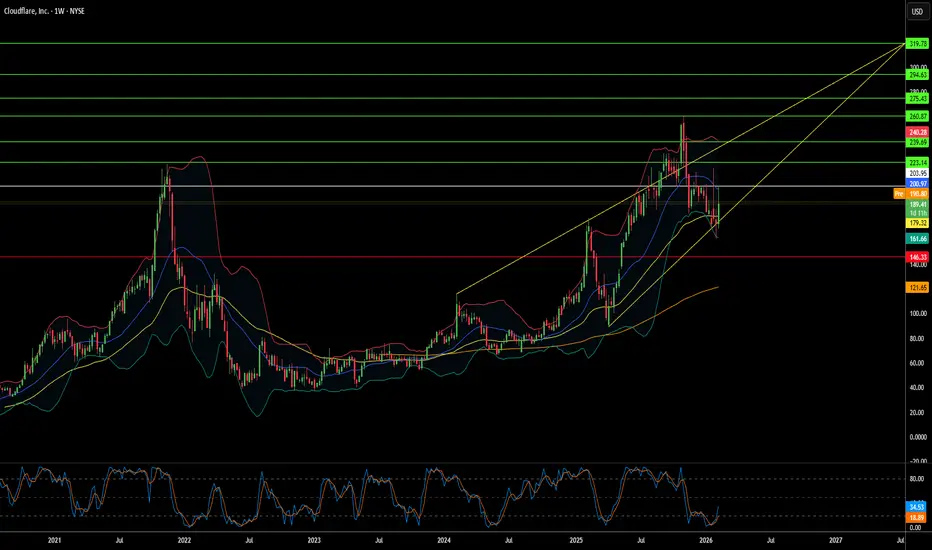
Cloudflare (NET): Momentum Aligns Ahead of Key Resistance BreakCurrent Price: 173.21 (Analysis was generated on Monday Morning)
Direction: LONG
Confidence level: 68%(Professional trader insights and X sentiment both lean bullish with momentum holding, but volume and macro risks keep confidence below high conviction.)
Targets
Target 1: 178.50
Target 2: 183.00
Stop Levels
Stop 1: 168.00
Stop 2: 165.00
Key Insights:
Here’s what’s driving this setup. Multiple professional traders are watching Cloudflare’s strong up‑trend structure, with higher highs and higher lows holding since January. Momentum indicators like RSI and MACD remain supportive, and traders keep pointing to the stock’s ability to hold above short‑ and medium‑term moving averages as a sign buyers are still in control.
What’s interesting is that while macro chatter around rates and labor data is cautious, traders are still willing to lean into Cloudflare because of its positioning in security and AI infrastructure. On X, the majority of trading‑focused posts over the last day lean bullish, with traders calling out breakout potential if price holds above the low $170s.
Recent Performance:
You can see this play out in the price action. Cloudflare has pushed higher over the last week, riding strong volume and shaking off minor pullbacks quickly. The stock is trading well above recent consolidation zones, which tells me dip buyers are active and defending levels aggressively.
Expert Analysis:
Several professional traders I tracked emphasized that Cloudflare tends to move fast once momentum builds, especially ahead of earnings‑related catalysts. From a technical angle, traders are focused on the $178–$180 zone as the first real test. A clean push through there opens the door to the low $180s within days, not weeks.
At the same time, risk management matters here. Traders consistently mentioned the mid‑$160s as a line in the sand. A break below that area would signal momentum failure, which is why I’m keeping stops tight for a short‑term trade.
News Impact:
The news flow supports this view. Ongoing discussion around AI‑optimized infrastructure, upcoming earnings, and potential analyst commentary keeps Cloudflare in focus. Even without a fresh headline today, the expectation of near‑term catalysts is enough to keep speculative interest elevated.
Trading Recommendation:
Putting it all together, I’m staying LONG on Cloudflare for this week. I like entries on shallow pullbacks above $170, targeting $178.50 first and $183 if momentum accelerates. I’d cut the trade if price loses $168, with a hard stop at $165 to protect capital. Position sizing should stay reasonable given the stock’s volatility, but the risk‑reward here still looks attractive.
INIT-USD testing key support as traders position for a rebound:Current Price: 0.0708 (Analysis was generated on Monday Morning)
Direction: LONG
Confidence level: 58%(Professional trader commentary leans slightly bullish near a well-defined support zone, RSI is oversold, and downside levels are clearly defined, but overall data volume is limited which keeps confidence moderate.)
Targets
Target 1: 0.082
Target 2: 0.095
Stop Levels
Stop 1: 0.060
Stop 2: 0.055
Key Insights:
Here’s what’s driving this setup. Several professional traders are focused on the $0.058–$0.060 zone, calling it a strong demand area after the recent sharp pullback. Price is hovering just above that zone, and when I look at similar small-cap structures, this kind of compression near support often precedes a bounce. What caught my attention is that multiple traders mentioned upside levels clustered around $0.075 and then $0.09, which gives us clean, actionable targets.
At the same time, momentum indicators shared by traders show conflicting short-term signals, but the RSI being deeply oversold keeps coming up in discussions. That tilts the risk-reward slightly upward. With price already well off the recent highs, downside feels more defined than upside, which is why I’m leaning long rather than fading this move.
Recent Performance:
This all played out in the price action over the last 24 hours. INIT-USD sold off hard, dropping roughly 14% and tagging lows near $0.057 before stabilizing. Volume stayed elevated relative to its market cap, which tells me traders didn’t walk away during the selloff. Instead, they kept trading it, and that often matters more than the direction of the last candle.
Expert Analysis:
Traders are taking notice of how INIT is behaving below its short-term moving averages. Several traders pointed out that while the medium-term trend still needs work, the gap between price and the 20-day average is narrowing. A few traders explicitly said they’re watching for a push back above $0.075 as confirmation that buyers are back in control. Until then, the play is about buying close to support with tight risk.
News Impact:
On the news side, the recent volatility following exchange-driven hype cycles is still fresh in traders’ minds. That’s adding caution, but it’s also why expectations are more grounded this week. There’s chatter about potential exchange promotions and network-related updates, and while nothing is confirmed, even small positive headlines could spark momentum in a thin market like this.
Trading Recommendation:
Putting it all together, here’s my take. I’m going LONG INIT-USD near current levels, using $0.060 as the first line of defense and $0.055 as the hard stop if things unravel. On the upside, I’m targeting $0.082 first, then $0.095 if momentum builds. This isn’t a high-conviction slam dunk, so position size matters. Keep it modest, respect the stops, and let the trade work if support holds.
Zcash Near Key Support as Traders Position for Upside Break:Current Price: 240.55 (Analysis was generated on Monday Morning)
Direction: LONG
Confidence level: 62%(Several professional traders focus on a bounce from the $228–$235 support zone with repeated upside references to $250–$260, and short-term sentiment aligns with that view, though volume of signals is moderate.)
Targets
Target 1: 250.00
Target 2: 260.00
Stop Levels
Stop 1: 235.00
Stop 2: 228.00
Key Insights:
Here’s what’s driving this setup. ZEC has been under pressure in a broader down‑move, but traders are increasingly focused on the fact that price is holding above a prior swing low. Multiple traders highlighted that this looks like a short‑term base rather than a fresh breakdown. When price keeps revisiting support without collapsing, it often sets up a bounce.
What’s interesting is the upside focus. Across trader commentary, $250 comes up again and again as the first level that matters. A push into that zone this week wouldn’t be surprising if buyers stay active. Beyond that, $260 is the level many traders say would confirm momentum shifting back in favor of the bulls, even if only for a short‑term trade.
Recent Performance:
Over the last few sessions, Zcash has been moving between roughly $233 and $247, with the current price sitting near the middle of that range. Despite intraday sell pressure, the market hasn’t been able to force a decisive move below the low‑$230s. That behavior tells me buyers are still stepping in on dips, which fits the long‑side thesis for this week.
Expert Analysis:
Several professional traders I’m tracking noted that ZEC is testing support rather than slamming into resistance. That distinction matters. Traders generally look to go long near support with tight risk, and that’s exactly how many are framing this setup. A few also mentioned that volume remains healthy, even if some spikes have come on selling, which suggests there’s still enough liquidity for a tradable bounce.
From a chart perspective, price is sitting just below short‑term moving averages, but not far enough to suggest panic selling. Traders tend to see this as a spot where a push back toward the $250 handle is realistic within days, not weeks.
News Impact:
The recent addition of a ZEC/USD trading pair on a major exchange has improved liquidity and visibility. While regulatory headlines around privacy coins remain a background risk, traders don’t see an immediate catalyst this week that would force a sharp sell‑off. For short‑term positioning, the news flow slightly favors stability to upside rather than sudden downside.
Trading Recommendation:
Here’s my take. I’m going LONG on Zcash this week while price holds above $235, looking for a move toward $250 first and potentially $260 if momentum builds. I’d keep risk tight with stops below $228, because a clean break of that level would invalidate the bounce idea. This isn’t a high‑conviction, all‑in trade, but it’s a reasonable support‑based long with defined risk and clear upside levels traders are already watching.
ZRO: Institutional Capital Enters at Structural BaseGM gentlement,
LayerZero just secured backing from Citadel Securities and Ark Invest while partnering with Google Cloud and DTCC.
This goes beyond retail speculation.
It’s institutional plumbing.
On the chart:
• ZRO has completed a post-launch distribution phase
• Weekly volatility has compressed
• Volume is expanding into news flow
• Structure suggests early stage accumulation after a Time@Mode weekly pattern emerged.
If ZRO reclaims and holds above the October 2025 high, this could transition from mean reversion to trend regime.
Invalidation: Weekly close below base lows.
Best of luck!
Cheers,
Ivan Labrie.
$TXT , SetupENTRY : CMP
TP1 : 108.61
TP2 : 140.37
TP3 : 336.64
TP4 : LET IT ROLLLLLL
SL : If you wish
My SL is never a SELL, just an alarm to stop adding money and wait for better dca
Follow, Boost, Thank You !!
⚠️ Financial Disclaimer:
This post is not financial advice. I am not your financial advisor, your life coach, or your legally responsible adult.
Always do your own research and never trade based solely on internet comedy.
WILL SUNCOR ENERGY CONT ITS MARK UP?This is a typical reaccmulation pattern of scehmatic #2 in wyckoff methode
i am interested with the Bar @ 4february26, high effort with low result
-i consider this as possiblity of absoprtion
With Springboard (red color) spotted,
Trigger bar today dictate for position intiation
PNE AG: A juicy entry point or a trap for long-term investors?XETR:PNE3 is sitting on a 'make-or-break' intersection of multi-year levels—here’s why the next move could either ignite a 60% rally or trigger a free fall
Technicals:
- price is testing the intersection of the lower boundary of the 2023 downtrend and that global support zone from 2021
- if market sentiment turns negative and price breaks support, a free fall toward 7.90 seems likely — that’s basically the last barrier holding the price up
- if the positive scenario plays out, look for an Expanding Triangle pattern to trigger a test of the mid-range of the descending channel
- the main target is the imbalance zone from Sep-Oct 2025 — expect heavy profit-taking from mid-term traders in that area
- long scenario invalidated if 2 bars close below 7.90
Fundamentals:
- GETTEX:PNE3 shares dropped 8% last month after the 2025 fiscal year earnings downgrade, triggered by short-term traders closing their positions
- having sold their Panama windfarm portfolio in January 2026, the company signals a strategic shift toward Germany, France, and Poland. This move is backed by new capacity permits recently secured in Germany in December
- in the short term these can drive short-term traders or weak hands out, but the mid-to-long-term recovery story now looks even more intact
- the company is definitely not a giant and still has high debt ratio, and this is a key risk which might negatively impact the share price in case the EU decides to increase % rates
- whereas European renewables sector faces headwinds and receives less support than it should, in my opinion, the limited fossil fuels might make green energy a solid long-term bet
Conclusion:
- the 8.50–9.10 zone plays a key role in determining the medium-term price action
- if this level holds, the price could head toward 12.20, with a long-term target of 15.00
- if the support zone fails, it opens the door for a retest of 7.90
- 8.80 serves as an attractive entry price for long-term investors, but short-term traders are advised to wait for a clear outcome: a strong bullish candle, consolidation at the support zone, or a decisive breakdown
# - - - - -
⚠️ Long-Term Signal - Buy ⬆️
✅ Entry Point - 8.80
🛑 SL - 7.78
🤑 TP - 12.14
⚙️ Risk/Reward - 1 : 3.2👌
# - - - - -
Good Luck!
# - - - - -
DISCLAIMER: Not financial advice. Everyone must make trading decisions at their own risk, guided only by their own criteria and strategy for opening or not opening a trade
Ss//@version=5
indicator("FarNazz Smart Money Ichimoku PRO", overlay=true)
// ===== Inputs =====
volMult = input.float(2.0, "Volume Multiplier")
pullbackN = input.int(4, "Pullback Candles")
showCloud = input.bool(true, "Show Ichimoku Cloud")
// ===== Ichimoku =====
tenkan = (ta.highest(high,9) + ta.lowest(low,9)) / 2
kijun = (ta.highest(high,26) + ta.lowest(low,26)) / 2
senkouA = (tenkan + kijun)/2
senkouB = (ta.highest(high,52) + ta.lowest(low,52)) / 2
plot(tenkan, color=color.orange, title="Tenkan")
plot(kijun, color=color.blue, title="Kijun")
plot(showCloud ? senkouA : na, offset=26, color=color.new(color.green,70))
plot(showCloud ? senkouB : na, offset=26, color=color.new(color.red,70))
// ===== Volume Smart Money =====
volAvg = ta.sma(volume,20)
bigVol = volume > volMult * volAvg
// ===== Pullback (چند کندل منفی قبلی) =====
redCount = 0
for i = 1 to pullbackN
redCount += close < open ? 1 : 0
pullback = redCount >= pullbackN-1
// ===== Trend Condition =====
bullTrend = close > tenkan and tenkan > kijun
// ===== Final Signal =====
buySignal = bullTrend and bigVol and pullback
// ===== Plot =====
plotshape(buySignal, style=shape.triangleup,
location=location.belowbar,
color=color.lime, size=size.small,
text="BUY")
bgcolor(buySignal ? color.new(color.green,85) : na)
// ===== Alerts =====
alertcondition(buySignal, title="BUY Alert",
message="Smart Money + Ichimoku Entry")