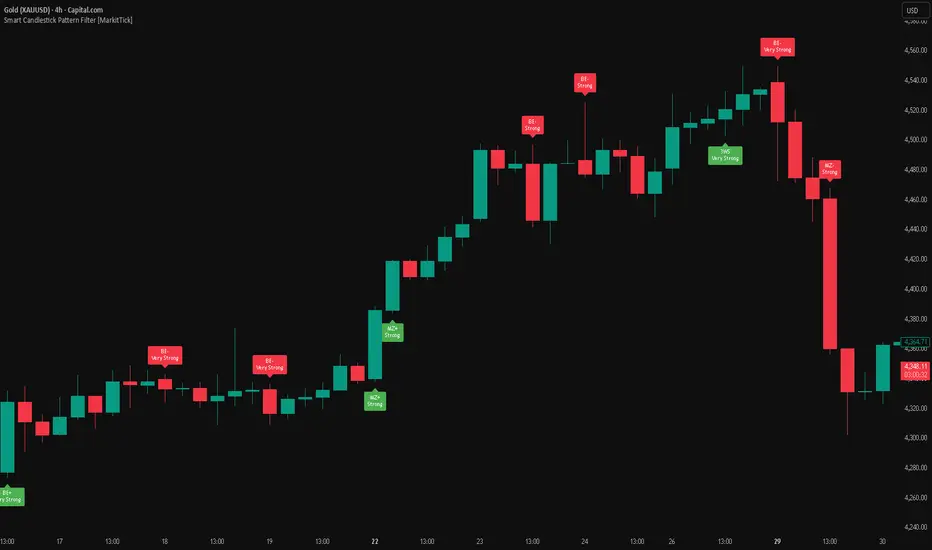
Quantitative Analysis of Algorithmic Candlestick Pattern● Quantitative Analysis of Algorithmic Candlestick Pattern Recognition: Code Logic, Statistical Reliability, and Market Psychology
● Introduction: The Intersection of Algorithmic Logic and Behavioral Finance
The digitization of financial markets has catalyzed a paradigm shift in technical analysis, moving from subjective visual interpretation to rigorous, rule-based algorithmic detection. Candlestick charting, a methodology with roots in 18th-century Japanese rice trading, serves as the foundational language for reading price action. However, in the context of modern high-frequency and systematic trading, the "art" of reading candles must be translated into the "science" of boolean logic, threshold ratios, and trend filters.
This report provides an exhaustive analysis of the 40+ candlestick patterns identified within the proprietary "Smart Candlestick Pattern Filter" indicator. By dissecting the source code, we isolate the specific mathematical conditions—such as the DOJI_RATIO of 0.05 or the SHADOW_MULT of 2.0—that determine pattern validity. Furthermore, we juxtapose these rigid algorithmic definitions against the theoretical underpinnings of market psychology and the statistical reliability data compiled by researchers such as Thomas Bulkowski.
The patterns are categorized by their signal strength (1 through 5), a hierarchical system inherent to the algorithm that attempts to filter market noise from actionable signal. This classification provides a structured framework for understanding how single-bar indecision evolves into complex, multi-bar reversal or continuation structures. The analysis reveals critical insights into the discrepancies between traditional textbook definitions and their code-based implementations, particularly regarding trend context and gap requirements, offering a nuanced perspective for professional traders deploying automated recognition systems.
• Methodological Framework of the Indicator
The analyzed script operates on a sophisticated logic engine that calculates candle metrics relative to trend context. Before individual patterns are detected, the system establishes a baseline for trend direction using a Simple Moving Average (SMA), defined by the input trendPeriod (default 20). This allows the algorithm to filter patterns contextually—for instance, a "Hanging Man" is only valid if detected within a mathematically defined uptrend ( trendUpCond ), while an "Inverted Hammer" requires a downtrend ( trendDownCond ).
This pre-processing step is critical. Traditional visual analysis often fails because traders identify reversal patterns in sideways markets. By enforcing boolean constraints such as close > trendSMA the algorithm attempts to solve the problem of false positives inherent in manual charting. Furthermore, the script utilizes dynamic variables for body size body_size = math.abs(c - o) and shadows ( upper_shadow , lower_shadow ), standardizing pattern recognition across varying asset classes and volatility regimes.
● Strength 1: The Architecture of Indecision and Volatility Compression
The first tier of patterns identified by the algorithm represents market indecision. While assigned the lowest strength rating, these patterns are statistically significant as precursors to volatility expansion. They signify a state of equilibrium where supply meets demand, often marking the calm before a breakout.
• The Doji: The Keystone of Equilibrium
The Doji is the most fundamental single-candle pattern, representing a total stalemate between bulls and bears.
Algorithmic Definition: The code defines a Doji not by a perfect equality of open and close, but by a specific ratio. The isDoji boolean variable returns true if the body_ratio (body size divided by high-low range) is less than or equal to DOJI_RATIO , which is set to 0.05. This quantitative threshold allows for "near-doji" candles to be recognized, accommodating the noise of modern electronic markets where exact price matches are rare due to micro-volatility.
Market Psychology: The formation of a Doji indicates that the conviction driving the prior trend has evaporated. If appearing in an uptrend, it suggests that buyers are no longer willing to bid prices higher, and sellers have found a price level they deem fair. It is a sign of hesitation. The market opens, explores a range, and closes virtually unchanged, signaling that the net result of the trading session was zero directional progress. This "tug-of-war" psychology is crucial; it does not guarantee a reversal but screams that the current trend is vulnerable.
• The Dragonfly Doji: Bullish Rejection
Algorithmic Definition: The Dragonfly Doji is a specialized Doji detected when the open and close occur at the session's high. The script's logic ( isDragonflyDoji ) is rigorous:
It must first satisfy the isDoji condition.
The upper shadow must be negligible, defined as
(h - c) <= ohlc_range * EDGE_RATIO
and
(h - o) <= ohlc_range * EDGE_RATIO
(where EDGE_RATIO is 0.1).
The total range must be substantial, specifically greater than three times the body size ohlc_range > body_size * 3
Psychology and Reliability: Visually appearing as a "T," the Dragonfly indicates that sellers dominated the early session, driving prices to a low. However, by the close, buyers resurged to push the price back to the opening high. This rejection of the lower prices is significantly bullish, especially at support levels. Bulkowski's research suggests that the Dragonfly Doji performs best as a reversal signal in bear markets, acting as a setup for a bullish breakout. The long lower shadow represents a "check" of liquidity at lower levels, which was found lacking, forcing price back up.
• The Gravestone Doji: Bearish Exhaustion
Algorithmic Definition: The inverse of the Dragonfly, the Gravestone Doji forms when the open and close are at the session low. The code checks isGravestoneDoji by ensuring the lower shadow is within the EDGE_RATIO (bottom 10% of the range) and the total range is significant.
Psychology and Reliability: Resembling an inverted "T," this pattern signifies a failed rally. Bulls attempted to drive the price up but were met with overwhelming supply, forcing the price back to the open by the close. It serves as a visual testament to the graves of the bulls who died defending the highs. In an uptrend, this is a distinct warning of overhead resistance and buyer exhaustion.
• The Long-Legged Doji: High Volatility Indecision
Algorithmic Definition: The isLongLeggedDoji pattern is identified when a Doji has massive shadows in both directions. The code requires both the upper and lower shadows to be greater than the body size multiplied by SHADOW_MULT (2.0).
Psychology: Unlike the standard Doji, which might indicate a quiet market, the Long-Legged Doji (or "Rickshaw Man") indicates violent indecision. The market traded significantly higher and significantly lower, yet closed unchanged. This reflects a market searching for value and finding none at the extremes. It is often a precursor to a major volatility breakout as the compression of the close belies the intraday chaos.
• Spinning Tops: The Pause
Spinning tops are defined by small bodies that are slightly larger than a Doji but still indicative of indecision.
Bullish Spinning Top ( isSpinTopBull ): A green candle where the body_ratio is less than SPIN_TOP_RATIO (0.4), and shadows are present.
Bearish Spinning Top ( isSpinTopBear ): A red candle with the same ratio constraints.
Algorithmic Note: The code ensures the shadows are prominent by checking (h - c) > body_size (upper shadow > body) and (o - l) > body_size (lower shadow > body)
Psychology: Spinning tops represent a "loss of steam." In a strong trend, the appearance of a spinning top suggests that the dominant group (bulls or bears) is losing control, and the opposing force is gaining ground. While not immediate reversal signals, they are critical components of larger patterns like Morning or Evening Stars. Bulkowski notes that spinning tops have a reversal success rate of approximately 48% when viewed in isolation, reinforcing the algorithm's decision to categorize them as low-strength indecision markers rather than actionable signals.
● Strength 2: Weak Reversal and Continuation Signals
Strength 2 patterns introduce directional bias but lack the conviction of multi-candle confirmations. They are often "setup" candles that require a subsequent trigger.
• The Hammer and Hanging Man: Context is King
These patterns share an identical shape—small bodies near the top of the range with long lower shadows—but their implications are diametrically opposed based on the prior trend.
The Hanging Man ( isHangingMan )
Algorithmic Validation: The code enforces strict geometry:
Shadows: lower_shadow >= body_size * SHADOW_MULT (2.0) and upper_shadow <= ohlc_range * EDGE_RATIO
Context: It must occur in an uptrend ( trendUpCond is true).
Position: The high must be greater than the previous high h > h1
Psychology: The Hanging Man appears at the peak of an uptrend. The long lower shadow indicates that for a portion of the session, sellers were able to drive the price significantly lower. Although buyers recovered the price by the close, the sell-off is a warning that bullish control is becoming fragile. The "hanging" nature suggests bulls are left dangling with positions at highs. Reliability statistics suggest a 59% accuracy for bullish continuation in some datasets, which is counter-intuitive and highlights why this is a Strength 2 pattern requiring confirmation (a lower close the next day).
The Inverted Hammer ( isInvHammer )
Algorithmic Validation: The mirror of the Hanging Man, validated by a long upper shadow (>= 2x body) and minimal lower shadow. Must occur in a downtrend ( trendDownCond ).
Psychology: Appearing at a bottom, the Inverted Hammer suggests that buyers attempted a rally (long upper shadow) but failed to hold it. However, the mere presence of buying pressure in a downtrend signals that sellers are losing their grip. It is a "testing of the waters" by bulls. Bulkowski estimates a 60% success rate for reversals when confirmed.
• Belt Hold Lines: The Yorikiri
Bullish Belt Hold ( isBullishBelt ): A candle that opens at its low (no lower shadow) and closes near its high, occurring in a downtrend. Code checks: math.abs(l - o) <= TOLERANCE * c
Bearish Belt Hold ( isBearishBelt ): A candle that opens at its high (no upper shadow) and closes near its low in an uptrend.
Psychology: Derived from the sumo term "Yorikiri" (pushing out), the Belt Hold signifies unidirectional dominance from the opening bell. A Bullish Belt Hold indicates that sellers were exhausted at the open, and buyers immediately took control, never allowing the price to dip. This abrupt shift in sentiment acts as a localized support level. Statistical analysis suggests a 71% success rate for bullish reversals, though the pattern is prone to failure in highly volatile markets without volume confirmation.
• The Neckline Continuation Series: On-Neck, In-Neck, and Thrusting
This trio of bearish continuation patterns is frequently confused. They all feature a bearish candle followed by a smaller bullish candle, distinguished solely by the depth of the bullish candle's close into the previous bearish body.
On-Neck ( isOnNeck ): The most bearish of the three. The second candle opens lower and rallies, but closes at or near the previous candle's low math.abs(c - l1) <= TOLERANCE * c It fails to enter the previous body. The buyers' attempt to rally is pathetic; they cannot even push the price back into the previous day's trading range.
In-Neck ( isInNeck ): The second candle closes slightly higher than the On-Neck, penetrating the previous body but staying within the bottom 10% of the range c <= c1 - (c1 - o1) * 0.1 Similar to On-Neck, but with slightly more buying pressure.
Thrusting ( isThrusting ): The bullish candle thrusts deeper into the bearish body but fails to close above the midpoint c < c1_midpoint . This is the strongest of the weak patterns but still a continuation signal. The failure to cross the equilibrium point (midpoint) of the previous sell-off implies that the bears still control the dominant trend.
● Strength 3: Moderate Reversal and Confirmation Patterns
Strength 3 patterns involve interaction between two or more candles, creating a "setup" and "trigger" dynamic that enhances reliability.
• The Harami: The Insider
Algorithmic Validation:
Bearish Harami ( isBearHarami ): Preceded by a bullish candle ( isBullish_1 ), the current bearish candle's body is completely engulfed by the previous body .
o <= c1 and o1 <= c
.
Bullish Harami ( isBullHarami ): A bearish candle followed by a smaller bullish candle inside its body.
The code enforces that body_size < body_size_1 .
Psychology: "Harami" means "pregnant" in Japanese. The large first candle is the mother, the small second candle is the baby. This pattern represents a sudden contraction in volatility. After a strong trend, the market stalls. In a downtrend (Bullish Harami), the small second candle indicates that selling pressure has dried up. While not a forceful reversal like an Engulfing pattern, it signals that the trend has hit a wall. Bulkowski rates the Bullish Harami with a 54% reversal success rate, suggesting it is better used as a "take profit" signal than an entry signal.
• Penetration Patterns: Piercing Line and Dark Cloud Cover
These patterns are stronger than Haramis because they involve a test and rejection of price extremes.
Piercing Line ( isPiercing ):
Gap: The second (bullish) candle must open below the previous low ( o < l1 ).
Penetration: It must rally to close above the midpoint of the previous bearish body c > c1 + body_size_1 * 0.5
Psychology: This is a panic-induced reversal. The gap down at the open signals capitulation by bulls. However, "smart money" steps in to buy the deep discount, driving prices up aggressively. The close above the midpoint is crucial—it signifies that the buyers have erased more than 50% of the previous day's losses.
Dark Cloud Cover ( isDarkCloud ):
Gap: Opens above the previous high/close.
Penetration: Closes below the midpoint of the previous bullish candle c < c1_midpoint
Psychology: A gap-up opening (greed) is met with heavy institutional selling. The failure to hold the highs and the subsequent collapse below the midpoint signals a "cloud" forming over the uptrend.
• Tweezer Tops and Bottoms
Algorithmic Validation: The code identifies Tweezers by matching extremes on adjacent candles.
Tweezer Bottom ( isTweezerBottom ): math.abs(l - l1) <= TOLERANCE * c
Tweezer Top ( isTweezerTop ): math.abs(h - h1) <= TOLERANCE * c
Psychology: Tweezers represent a "double tap" rejection of a price level. The market tested a specific low (or high) twice and failed to break it both times. This reinforcement of support/resistance suggests that the barrier is solid. In technical terms, it is a micro double-bottom or double-top forming on a lower timeframe.
• Matching Low and Matching High
Algorithmic Validation:
Matching Low ( isMatchingLow ): Two bearish candles in a downtrend with identical closing prices math.abs(c - c1) <= TOLERANCE * c
Matching High ( isMatchingHigh ): Two bullish candles in an uptrend with identical closes.
Psychology: The Matching Low is a unique and subtle bullish reversal signal. The market sells off on day one. On day two, it opens higher, attempts to rally, fails, and sells off again, but—crucially—closes at the exact same level as day one. The failure to make a new closing low despite the selling pressure indicates that support is forming. It differs from the "On-Neck" pattern because the second candle here is bearish, yet the implication is bullish reversal due to the support validation at the close. Bulkowski notes a 61% accuracy for this pattern.
• Separating Lines and Counterattack Lines
Separating Lines ( isSeparatingLinesBull/Bear ): A continuation pattern where two candles of opposite colors share the same opening price math.abs(o - o1) <= TOLERANCE_2 In an uptrend, a red candle forms. The next day, price opens at the same level as the red candle's open (erasing the red candle's impact immediately) and rallies. The prices "separate" in opposite directions from a common origin. It signals that the correction was a one-day fluke and the trend is resuming.
Counterattack Lines ( isCounterattackBull/Bear ): A reversal pattern where two candles of opposite colors share the same closing price math.abs(c - c1) <= TOLERANCE_2 . Also known as "Meeting Lines." The market gaps in the direction of the trend but reverses to close unchanged from the prior day. The gap has been neutralized, indicating momentum exhaustion.
● Strength 4: Strong Reversal and Momentum Patterns
Patterns at Strength 4 typically involve confirmation candles or massive momentum shifts, significantly increasing their statistical reliability.
• Engulfing Patterns: The Outside Bar
Algorithmic Validation:
Basic Logic: The current body completely overlaps the previous body c >= o1 and c1 <= o for bullish).
Smart Filter: The algorithm includes a loop for i = 1 to maxCheck to calculate bullEngulfCount . If the engulfing candle is large enough to engulf the range of multiple previous candles, its strength is upgraded to 5. This dynamic sizing is a significant improvement over standard definitions.
Psychology: An Engulfing pattern represents a total eclipse of the previous market sentiment. A Bullish Engulfing acts as a key reversal signal with a 63% success rate.
• Morning and Evening Stars: The Three-Act Play
Algorithmic Validation:
Morning Star: Long Bearish Candle -> Gap Down Small Candle -> Bullish Candle closing above midpoint of Candle 1.
Evening Star: Long Bullish Candle -> Gap Up Small Candle -> Bearish Candle closing below midpoint of Candle 1.
Psychology: These patterns visually depict a transfer of power over three periods: Dominance (Long Body), Equilibrium (Star/Doji), and Reversal (Third Candle). The Evening Star has a documented 72% accuracy rate, making it one of the most reliable top reversal patterns.
• Three Outside/Inside Up/Down: Confirmed Patterns
Algorithmic Validation:
Three Inside Up: A Bullish Harami followed by a third candle that closes higher than the Harami's top.
Three Outside Up: A Bullish Engulfing followed by a third candle that closes higher than the Engulfing candle's close.
Psychology: These are "confirmed" versions of the 2-candle patterns. The third candle provides the proof that the reversal signaled by the Harami or Engulfing was valid. The Three Outside Up is generally more reliable (approx. 70-75% success) than the Three Inside Up because the base pattern (Engulfing) is stronger than the Harami.
• Abandoned Baby: The Rare Island
Algorithmic Validation: A variation of the Morning/Evening Star where the middle "star" is a Doji that is completely separated by gaps from both the preceding and succeeding candles. The code checks h1 < low (gap down) and h1 < l (gap up) relative to the Doji.
Psychology: This is a rare and powerful "Island Reversal." The Doji is left "abandoned" in isolation. It represents a total dislocation of price. The gaps indicate extreme emotional shifts—panic selling to create the island, followed by panic buying to leave it. With a 70% accuracy rate, it is a high-conviction signal.
• Marubozu: Momentum Unleashed
Defined by a body_ratio >= MARUBOZU_RATIO (0.9) A candle with virtually no shadows. A Bullish Marubozu opens at the low and closes at the high. Buyers controlled every tick of the session. There was no hesitation at the open and no profit-taking at the close. It signals maximum conviction and often initiates or confirms a breakout.
● Strength 5: Very Strong Patterns and Anomalies
These patterns represent the highest tier of algorithmic confidence. They are rare, structurally complex, or represent violent market shocks.
• Three White Soldiers and Three Black Crows
Algorithmic Validation:
Three White Soldiers: Three consecutive bullish candles. The code requires each to open within the previous body o > o1, o < c1 and close higher (c > c1) This "stairstep" logic ensures a steady trend rather than a gap-driven spike.
Three Black Crows: Three consecutive bearish candles with the same overlapping logic.
Psychology: This pattern represents a sustained, methodical shift in capital flow. Three Black Crows indicates a collapse in buyer confidence; each day opens slightly higher (attempting to stabilize) but is crushed to a new low by the close. Reliability is exceptionally high, around 78-83% for reversals.
• The Kicker Pattern: The Shock Event
Algorithmic Validation: The Kicker is unique because it ignores the prior trend context in many interpretations, focusing on the immediate shock.
Bullish Kicker: A bearish candle followed by a bullish candle that opens at or above the previous open o >= o1
Bearish Kicker: A bullish candle followed by a bearish candle that opens at or below the previous open.
Psychology: The Kicker represents a violent repricing, usually driven by overnight news. The market gaps up above the previous day's open (erasing the entire previous bearish session instantly) and rallies. Short sellers are trapped with massive immediate losses, forcing a short squeeze. It is considered one of the most powerful reversal signals (Strength 5).
• The Three Line Strike: Continuation or Reversal?
Algorithmic Validation:
Bearish Three Line Strike: Three bearish candles (trend) followed by a massive bullish candle that engulfs all three previous candles c > o3
Bullish Three Line Strike: Three bullish candles followed by a massive bearish candle engulfing them.
Analysis of Conflict: Here lies a critical divergence between traditional theory and modern statistical analysis. The code logic labels this as a "Continuation" pattern (Strength 5). Traditional theory suggests the "strike" is merely deep profit-taking. However, Thomas Bulkowski's extensive backtesting reveals that the Bearish Three Line Strike actually functions as a Bullish Reversal 84% of the time.
Trader Implication: While the code flags this as isThreeLineStrikeBear , traders should treat the pattern (big green candle after three reds) as a high-probability Buy Signal (Reversal).
• Rising and Falling Three Methods
Algorithmic Validation: A 5-candle continuation pattern.
Rising: Long Bullish Candle -> Three small bearish candles holding within the first body -> Long Bullish Candle closing above the first. The code rigorously checks that the inner candles h3, l3, etc. do not breach the extremes of the first candle.
Psychology: This is a "Bull/Bear Flag" on a candlestick chart. The market explodes up (Candle 1), then consolidates on profit-taking. The fact that bears cannot push the price below the low of Candle 1 despite three days of trying proves selling pressure is weak. Candle 5 confirms the resumption. It is a highly reliable trend continuation signal (74-79% accuracy).
• Tasuki Gaps and Gap Three Methods
Upside Tasuki Gap: Bullish Candle -> Gap Up Bullish Candle -> Bearish Candle that opens inside the second body and closes inside the gap but does not close the gap completely c > h2
Psychology: The pattern tests the validity of a gap. In an uptrend, the market gaps up (strength). Profit-taking creates a red candle (Candle 3). Crucially, this red candle fails to "fill the gap." If the gap remains open, it is confirmed as support.
• Breakaway Patterns
Algorithmic Validation: A rare 5-candle reversal pattern. Example: Bearish Breakaway: Uptrend -> Long Bullish Candle -> Gap Up -> Three small candles continuing up but losing momentum -> Bearish candle closing inside the gap between Candle 1 and 2.
Psychology: This pattern captures the "exhaustion" phase of a trend. The gap accelerates the trend into an overbought state (climax). The subsequent small candles show that while price is drifting higher, momentum is dying (divergence). The final candle confirms the reversal by closing the initial gap.
● Comparative Analysis: Reliability and Performance
Using data from Thomas Bulkowski's Encyclopedia of Candlestick Charts, we can rank the reliability of the patterns detected by the algorithm. This helps traders prioritize which "Strength 5" signals are truly superior.
Three Line Strike (Bearish) - Bullish Reversal
Strength: 5 (Labeled Continuation) | Success Rate: 84%
Note: Top performer. Code labels as continuation; stats say reversal.
Three Black Crows - Bearish Reversal
Strength: 5 | Success Rate: 78%
Note: Highly reliable, especially in high volatility.
Evening Star - Bearish Reversal
Strength: 4 | Success Rate: 72%
Note: The most reliable 3-candle top reversal.
Abandoned Baby - Bullish Reversal
Strength: 4 | Success Rate: 70%
Note: Rare but exceptionally accurate due to gap structure.
Two Black Gapping - Bearish Continuation
Strength: 5 (Tasuki Variant) | Success Rate: 68%
Note: Strong continuation signal.
Inverted Hammer - Bullish Reversal
Strength: 2 | Success Rate: 65%
Note: Surprisingly high reliability for a single candle (needs confirmation).
Bearish Engulfing - Bearish Reversal
Strength: 2-5 | Success Rate: 79%
Note: Performs better than Bullish Engulfing (63%).
Rising Three Methods - Bullish Continuation
Strength: 5 | Success Rate: 74%
Note: Reliable flag pattern analog.
● Conclusion
The "Smart Candlestick Pattern Filter" script provides a robust, mathematically rigorous framework for identifying market sentiment. By establishing strict ratios for Dojis (0.05), enforcing trend context ( trendPeriod=20 ), and distinguishing between nuanced patterns like On-Neck vs. In-Neck, it filters out the noise that plagues manual analysis.
For the professional trader, the value lies not just in detection, but in understanding the specific logic constraints:
Context is Enforced: The code prevents "Hanging Man" signals in downtrends, a common amateur mistake.
Size Matters: The dynamic scaling of Engulfing patterns ( bullEngulfCount ) allows the system to weigh the magnitude of a reversal.
The Continuation Trap: Traders must be vigilant with the Three Line Strike. While the code identifies it as a continuation, empirical data suggests it is often a terminal blow-off move leading to a sharp reversal.
Ultimately, this algorithmic tool serves as a high-fidelity scanner. It effectively automates the recognition of complex structures like the Rising Three Methods and Kicker, which are statistically proven to offer an edge, allowing the trader to focus on secondary confirmations such as volume and market structure.
Candlestickpatternformation
How to use advanced candlestick anatomy in trading: CADJPYEvery candlestick on the chart is made up of different or multiple candles on the lower timeframe. For example, a weekly candle is made up of seven daily candles. While a 4 hours candle is made up of four 1 hour candles. Understanding how these candles contribute to the formation of a single or more candlesticks will go a long way in improving our performance.
Candlestick anatomy has to do with the formation of candlestick on the chart and the implication of such candlestick. Conventionally, common candlesticks are engulfing candlestick, doji, evening star, hammer, pin bar and the rest. Some signify continuation while others are meant for reversal. The formation of these candlesticks at key levels provide an helpful insights into understanding the next market move. Hence, they can serve as confluence and confirmation for our trading decision.
Taking this further a bit, by examining these candlesticks, one can get to understand better a precise point for entry and exit. This may be new to a retail trader who trades just the candlestick while it will provide more insights for anyone looking for ways to optimize his performance.
As a case study, I had a sell setup on CADJPY and it gave a bearish engulfing candlestick on 1 hour timeframe as a confirmation for selling. Instead of entering the trade after the bearish candle closed, I changed to 5 minutes timeframe to examine the anatomy of the candlestick. Then, I discovered that there was sweep and change of character. Based on the price narrative on 5 minutes timeframe, then trading decision was made using the 5 minutes timeframe, targeting 3 RR. If 1 hour timeframe had been used for taking the trade, one is likely to have lost the profit by now.
Candlestick anatomy will help you to optimize your performance and returns.
I hope you've learnt something helpful from this post.
Thanks.
Fatai Kareem, Kof T Fx.
📊10 Candlestick Patterns You need To Know🔷 Bullish engulfing:
A candlestick pattern where a smaller bearish candle is followed by a larger bullish candle, indicating a potential reversal of a downtrend.
🔷 Bearish engulfing:
The opposite of a bullish engulfing pattern, where a smaller bullish candle is followed by a larger bearish candle, suggesting a potential reversal of an uptrend.
🔷Tweezer tops:
Two consecutive candlesticks with equal or near-equal high prices, indicating possible resistance and a potential reversal from an uptrend.
🔷Tweezer bottoms:
Similar to tweezer tops, but indicates support and a potential reversal from a downtrend.
🔷Bullish harami:
A bullish harami is a candlestick chart indicator used for spotting reversals in a bear trend. It is generally indicated by a small increase in price (signified by a white candle) that can be contained within the given equity's downward price movement (signified by black candles) from the past couple of days.
🔷Morning star:
A three-candle pattern consisting of a bearish candle, a small indecisive candle, and a bullish candle, indicating a potential reversal from a downtrend.
🔷Evening star:
The opposite of a morning star pattern, consisting of a bullish candle, a small indecisive candle, and a bearish candle, suggesting a potential reversal from an uptrend.
🔷Three white soldiers:
Three consecutive long bullish candles, typically seen as a strong bullish reversal pattern.
🔷Three black crows:
Three consecutive long bearish candles, often considered a bearish reversal pattern.
🔷Three inside up :
A bullish reversal pattern composed of a large down candle, a smaller up candle contained within the prior candle, and then another up candle that closes above the close of the second candle.
👤 @AlgoBuddy
📅 Daily Ideas about market update, psychology & indicators
❤️ If you appreciate our work, please like, comment and follow ❤️
🔋Candlestick Power📍Candlestick patterns are powerful tools used in technical analysis to analyze and predict price movements in financial markets, particularly in trading. They provide valuable insights into market sentiment and help traders make informed decisions. The open, close, and various components of a candlestick, such as the body and shadows, are crucial in determining whether it is bullish or bearish.
🔷A candlestick consists of a body and two shadows, also known as wicks or tails. The body represents the price range between the open and close of a trading period, while the shadows represent the high and low points reached during that period.
🔷A bullish candlestick occurs when the closing price is higher than the opening price, indicating buying pressure and market optimism. The body is typically filled or colored, indicating a bullish trend. The longer the body, the stronger the bullish sentiment. Shadows may exist above or below the body, and they represent the price range outside of the open and close. Long shadows indicate higher volatility during the trading period.
🔷A bearish candlestick forms when the closing price is lower than the opening price, reflecting selling pressure and market pessimism. The body is often empty or colored differently to indicate a bearish trend. Again, the length of the body provides information about the strength of the bearish sentiment. Shadows can be found above or below the body, representing the price range outside the open and close. Similar to bullish candles, long shadows suggest increased volatility.
Traders use different candlestick patterns and combinations to identify potential trend reversals, continuation patterns, or price consolidations. For example, a doji candlestick, where the open and close are very close or equal, signals indecision in the market and may precede a reversal. Engulfing patterns occur when one candle fully engulfs the body of the preceding candle, indicating a potential trend reversal. However, it is important to note that candlestick patterns should be used in conjunction with other technical indicators and fundamental analysis to confirm the validity of a potential trade signal.
👤 @AlgoBuddy
📅 Daily Ideas about market update, psychology & indicators
❤️ If you appreciate our work, please like, comment and follow ❤️
💥 Bullish VS Bearish Candlesticks📍Bullish and bearish candlestick patterns are technical analysis tools used by traders to identify potential market trends and reversals. Bullish patterns indicate a potential rise in the price of an asset, while bearish patterns indicate a potential decline in price.
🔷 Bullish candlestick patterns include the dragonfly doji, hammer, tweezer bottom, morning star engulfing and three white soldiers. These patterns suggest that buying pressure is increasing and that there may be a potential for a trend reversal.
🔷 Bearish candlestick patterns include the gravestone doji, inverted hammer, tweezer top three black crows and more. These patterns suggest that selling pressure is increasing and that there may be a potential for a trend reversal.
🔷When using candlestick patterns for trading, it's important to look for confluence with other signals, such as trend lines, support and resistance levels, and other technical indicators. Combining multiple signals can provide a stronger indication of potential market movements and help traders make more informed trading decisions.
🔷It's also important to note that candlestick patterns should not be relied on as the sole indicator for trading decisions, as they are not always accurate and can produce false signals. Traders should always use a combination of technical analysis tools and fundamental analysis when making trading decisions. This is why its important to create and monitor your own strategy and backtest what works and what doesn't.
👤 @AlgoBuddy
📅 Daily Ideas about market update, psychology & indicators
❤️ If you appreciate our work, please like, comment and follow ❤️
All Patterns Finish, Part 7 GuideGuide Candles Patterns
Candlestick patterns are usually quite good when trying to finish an analysis as it can help you confirm a trend.
Basic Candles - Three Line Patterns
1- Advance Block
Description:
The Advance Block is classified as a three-line bearish reversal pattern. The first line is a white candle that appears as a long line in an uptrend. It can be any of the following basic candles: White Candle, Long White Candle, Opening White Marubozu, Closing White Marubozu or White Marubozu.
The second line can be made up of any white candle, appearing as a long or short line. It opens within the body of the first candle and closes above it.
The last, third line, is also any white candle that appears as a long or short line. It opens inside the body of the second line and closes above it.
Each subsequent candle body within the Advance Block pattern is shorter than the previous one.
The shadows in the second and third lines should be longer than those in the first line. The pattern indicates that the bulls are weakening. However, three white bodies form a support zone and, to consider the pattern, it is necessary to confirm it. Therefore, after the appearance of the pattern, the market should close below the first line. If this is not the case, the occurrence of the pattern should be treated as false.
The Advance Block is a very rare pattern.
Building:
First candle
• Or a candle in an uptrend
• Or white body
Second candle
• Or white body
• Or the opening price is within the previous body
• Or the closing price is above the previous closing price
Third candle
• Or white body
• Or the opening price is within the previous body
• Or the closing price is above the previous closing price
Example:
MRK ,14 Dec, 2010. Chart 1d.
2- Three Outside Up
Description:
The Three Outside Up pattern is a three-line pattern that is an extension of the two-line Bullish Engulfing pattern. Morris introduced the pattern and was intended to improve the performance of the two-line pattern. The third candle is bound to behave as a confirmation of the bullish engulfing. As with the Bullish Engulfing, the first black candle is engulfed by the second with a white body.
The first line can appear as a short or long line. It can be any basic black body sail. Doji candles are allowed, except for the four price Doji.
The second line should appear as a long line and the candle should be white. It can be one of the following candles: White Candle, Long White Candle, White Marubozu, Opening White Marubozu and Closing White Marubozu. Spinning tops and doji candles are not allowed.
The last line of candles can be any basic candle, which has a white body and closes above the closing price of the second candle.
In the case of this pattern, the length of the shadows does not matter.
Although the idea behind the Three Outside Up is to confirm the Bullish Engulfing, in our opinion the extended pattern should be confirmed anyway. Confirmation can be in the form of a breakout of the nearest resistance zone or a trend line.
Building:
First candle
• Or a candle in a downtrend
• O black body
Second candle
• Or white body
• Or the body of the candle wraps around the body of the previous candle (black)
Third candle
• Or closing price above the previous closing price
• Or white body
Example:
WMT ,22 Aug, 2012. Chart 1d.
3- Three Stars in the South
Description:
The Three Stars in the South are classified as a three-line bullish reversal pattern.
All of its candles are shortening and having black bodies, indicating that bearish momentum is weakening.
The pattern name can be somewhat misleading, as we are not dealing with star-like short candles here. There are also no price differences between the candle lines.
The first line of the pattern appears as a long line that has a long lower shadow that must be longer than the body. This means that the first line can be made up of the Hammer or Takuri Line pattern.
The second candle opens below the previous opening price and closes below the previous closing price. The low price should be higher than the previous low price.
The third line is a marubozu sail that has a black body. The candle fits within the midline. It appears as a short line. This last condition has the greatest impact at very low frequencies, meaning the pattern rarely appears on candlestick charts.
Building:
First candle
• Or a candle in a downtrend
• O black body
• Or long lower shadow
Second candle
• O black body
• Or the opening below the previous opening
• Either the close below or at the previous close
• Or the low above the previous low
Third candle
• Or a marubozu candle with a black body
• Or appears as a short line
• Or a candle is inside the previous candle
Example:
WMB,15 Sep, 1986. Chart 1d.
4- Evening Doji Star
Description:
The Evening Doji Star is a bearish reversal pattern, very similar to the Evening Star. The only difference is that the Evening Doji Star must have a doji candle (except for the four price Doji) on the second line. The doji candle (second line) must not be preceded or followed by a price difference.
If a lower shadow of a doji candle were placed above the first and second shadow lines, we would be dealing with the Bearish Abandoned Baby pattern.
It happens that the first two candles are forming the Bearish Doji Star pattern.
The pattern, like any other candlestick pattern, should be confirmed in the next few candles exiting the support zone or a trend line. If the occurrence is confirmed, then your third line can act as an area of resistance. However, it also happens that the pattern is simply a short pause before further price increases.
Patterns rarely occur on charts.
Building:
First candle
• or a candle in an uptrend
• or white body
Second candle
• Or a doji candle
• Or a doji body on the body of the previous candle
• Or the low price below the high price of the previous candle
Third candle
• O black body
• O body of the candle below the body of the previous candle
• Or the closing price below the midpoint of the body of the first candle
Example:
PG,12 Dec, 2012. Chart 1d.
5- Bearish Abandoned Baby
Description:
The Bearish Abandoned Baby is a three-line bearish reversal candlestick pattern.
Its construction is very similar to that of the Evening Doji Star. The only difference is that in the case of Bearish Abandoned Baby, the doji candle opens on the shadows of the candle lines on either side, which is not the case with the Evening Doji Star.
The doji candle can be of any type except the four price Doji. In other words, it can be any of the following types of doji: Doji, Long Legged Doji, Dragonfly Doji, Tombstone Doji.
The pattern needs to be confirmed, either by breaking the trend line or the nearest support zone.
The Bearish Abandoned Baby pattern appears very rarely in charts, so its practical application is quite low.
Building:
Building:
First candle
• Or a candle in an uptrend
• Or white body
Second candle
• Or a doji candle
• Or the low price above the previous high price
Third candle
• O black body
• Or the high price below the previous low price
Example:
I have no example for this pattern, sorry.
6- Bearish Side-by-Side White Lines
Description:
The side-by-side bearish white line pattern is a three-line pattern that predicts a continuation of the downtrend.
The first line appears as a long line in a downtrend. The second and third lines can be any white candle that appears as a long or short line, but the body cannot be greater than the body of the first line.
The pattern is characterized by a price gap that appears between the first line and two subsequent lines, whose high prices are below the low price of the first line. The last two candles should be a similar size. Also, your opening and closing prices should be similar.
The first two lines of the pattern form the Descending Window pattern. Bulkowski and Morris in their books present examples where price differences are only between bodies. In other words, the upper shadows of the second and third lines can reach above the low price of the first line. However, in our approach we decided to be more strict. The price gap should appear between candles, including shadows, because Shimizu emphasizes that the candles in this pattern must be quite short.
The pattern has a very low frequency.
Building:
First candle
• Or a candle in a downtrend
• O black body
Second candle
• Or white body
• Or the high price below the previous low price
Third candle
• Or white body
• Or the high price below the low price of the first line
• Or the size of the candle is similar to the size of the previous candle
Example:
We can find this chart in JDSU Stock, As of January 14, 2008, tradingview sadly does not have this stock.
7-Evening Star
Description:
The Evening Star is a three-line bearish reversal pattern that appears in an uptrend.
The first line is any white candle that appears as a long line in an uptrend: Long White Candle, White Candle, White Marubozu, Opening White Marubozu, Closing White Marubozu.
The second line can be any black or white candle that appears as a short line, except doji candles. The body of the candle must be placed above the previous body, that is, the opening and closing price must be higher than that of the previous candle.
The third line is a black candle that appears as a long line, that is: Long Black Candle, Black Candle, Black Marubozu, Opening Black Marubozu, Closing Black Marubozu. The opening price should be below the body of the previous candle. The candle should close at least halfway across the body of the first line.
The length of the shadows or the lack of it does not matter for any pattern line.
The second line of the evening star can form the shooting star pattern of a candle. The first two lines can form the two-candle shooting star.
The Evening Star should be confirmed in the following candles, breaking the trend line or the closest support zone, which can be formed by the first line of the pattern. If the pattern is confirmed, your third line may turn into a resistance zone. When the pattern is not confirmed, it may simply be a short pause before further market growth.
Building:
First candle
• Or a candle in an uptrend
• Or white body
Second candle
• Or white or black body
• Or the body of the candle is above the previous body
Third candle
• O black body
• Or the body of the candle is below the previous body
• Or the candle closes at least half the body of the first line
Example:
BAC,14 Apr, 2010. Chart 1d.
8- Three White Soldiers
Description:
The pattern of the Three White Soldiers has had several names historically. The Japanese called it the Three Red Soldiers, because what in the western world is known as a white candle, they actually used the color red. During World War II, some called the pattern the Three Soldiers on the March. Finally, now the pattern is widely known as the Three White Soldiers.
The pattern is classified as a bullish reversal and appears within a downtrend. The three lines can be formed by any candle that has a white body, appearing as long lines. This means that the following candles may appear: Long White Candle, White Candle, White Marubozu, Opening White Marubozu and Closing White Marubozu. Doji candles and spinning tops are not allowed.
The first line forms in a downtrend. The next lines, which is the second and third, open above the opening price of the previous candle and close above the closing price of the previous candle.
In the past, some authors required that the opening price of the second and third lines be at least half the height of the body of the previous candle. Others demanded that the closing prices be near the high of the candle, that is, that the candles have very short shadows. However, candlestick patterns and technical analysis in general are evolving, and the Three White Soldiers can be used as an example of such an evolution.
In fact, three long white candles in a row with a higher subsequent close price indicate that the bulls are in control of the market.
The pattern must be confirmed, but it does not have to occur on the next nearest candle because it becomes a significant upward movement and some market participant may be willing to take the profit. Such behavior may lead to a temporary price drop, but the candles that form the pattern create an area of support that should rescue the market. Then the bulls can regain control.
If the pattern is followed by a candle that closes below the opening price of the first line, it should be seen as a false signal.
Building:
First candle
• Or a candle in a downtrend
• Or white body
Second candle
• Or white body
• Or the opening price within the previous body
• Or the closing price above the previous closing price
Third candle
• Or white body
• Or the opening price within the previous body
• Or the closing price above the previous closing price
Example:
HPE ,27 Apr, 2005. Chart 1d.
9- Morning Star
Description:
The Morning Star is a three-line bullish reversal pattern that appears in a downtrend.
The first line is any black candle that appears as a long line in a downtrend: Long Black Candle, Black Candle, Black Marubozu, Opening Black Marubozu, Closing Black Marubozu.
The second line can be any black or white candle that appears as a short line, except doji candles. The body of the candle must be placed below the previous body, that is, the opening and closing price must be lower than those of the previous candle. In other words, there must be a space between the first and the second body.
The third line is a white candle that appears as a long line, that is: Long White Candle, White Candle, White Marubozu, White Marubozu that opens, White Marubozu that closes. The opening price should be above the body of the previous candle. The candle should close to at least half the body of the first line. Some fonts do not require a space between the second and third body.
The length of the shadows or the lack of it does not matter for any pattern line.
It happens that the first two lines can form the inverted hammer candlestick pattern.
The morning star should be confirmed in the following candles, breaking the trend line or the closest resistance zone, which can be formed by the first line of the pattern. If the pattern is confirmed, your third line can become a support zone. When the pattern is not confirmed, it may simply be a short pause before the market continues to decline.
Building:
First candle
• Or a candle in a downtrend
• Or white body
Second candle
• Or white body
• Or the opening price within the previous body
• Or the closing price above the previous closing price
Third candle
• Or white body
• Or the opening price within the previous body
• Or the closing price above the previous closing price
Example:
KO ,23 May, 2007. Chart 1d.
10- Three Inside Down
Description:
Gregory Morris introduces the Three Inside Down three-line pattern as an extension of the Bearish Harami pattern.
The first line of it is any candle that has a white body, appearing as a long line, i.e. White Candle, Long White Candle, White Marubozu, Opening White Marubozu, or Closing White Marubozu. The second line is any black candle except doji candles. Also, the body of the second line must be swallowed by the body of the first line.
The opening price of the second line can be equal to the closing price of the first candle. The closing price of the second line can be equal to the opening price of the first candle. However, these two situations cannot occur at the same time.
The third candle in the pattern can be made up of any candle that has a black body, except doji candles, which close below the closing price of the second candle.
Shadows don't matter in the case of this pattern.
The first line of the pattern can act as a support area.
The Three Inside Down pattern should be confirmed. Confirmation can be in the form of breaking out of the nearest support zone or a trend line.
Building:
First candle
• Or a candle in an uptrend
• Or white body
Second candle
• O black body
• Or the body of the candle is enveloped by the body of the previous candle
Third candle
• Or the closing price is below the previous closing price
Example:
CVX,01 May, 2012. Chart 1d.
11- Bullish Tri-Star
Description:
The Bullish Tri-Star pattern is a three-line bullish reversal pattern in which all three lines are doji candles (any doji candle except the four-price Doji).
The middle doji (second line) is below the others. Shadows don't matter.
The pattern must be confirmed at the next candles, which is the closest resistance zone or a trend line must be broken. The context of the market, in which the pattern appears, is crucial.
Nison first introduced the Bullish Tri-Star pattern. It appears very rarely on candlestick charts and is therefore not very useful on a daily basis.
Building:
First candle
• Or a doji candle in a downtrend
Second candle
• Or a doji candle
• Or a body under the previous body
Third candle
• Or a doji candle
• Or a body above the previous body
Example:
BAX,04 Mar, 2009. Chart 1d.
After:
12- Upside Gap Three Methods
Description:
The Upside Gap Three Methods is a bullish continuation pattern of three lines that belongs to the family of tasuki patterns. It is a variant of the Upside Tasuki Gap pattern, but the price gap between the two white candles is closed.
Although the price gap between the two white candles is closed, the pattern is classified as bullish continuation. The pattern must be confirmed, that is, the price must move above the closing price of the second line. In other words, the third line that is a black candle must be negated.
Last two lines can form the Bearish Tasuki Line pattern, which is a bearish reversal pattern. If such a situation occurs, then the market context should play the most important factor.
Building:
First candle
• Or a candle in an uptrend
• Or white body
Second candle
• Or white body
• Or the minimum above the previous maximum (gap)
Third candle
• O black body
• Or the opening price within the previous body
• Or the closing price within the body of the first line (closing the gap)
Example:
AXP,13 Apr, 2009. Chart 1d.
After:
13- Bullish Side-by-Side White Lines
Description:
The side-by-side bullish white line pattern is a three-line pattern that predicts a continuation of the uptrend.
The first line appears as a long line in an uptrend. The second and third lines can be any white candle that appears as a long or short line, but the body cannot be longer than the body of the first line.
The pattern is characterized by a price gap that appears between the first line and two subsequent lines, whose low prices are above the high price of the first line. The last two candles should be a similar size. Also, your opening and closing prices should be similar.
The first two lines of the pattern form the Ascending Window pattern. Bulkowski and Morris in their books present examples where price differences are only between bodies. In other words, the lower shadows of the second and third lines can fall below the high price of the first line. However, in our approach we decided to be more strict. The price gap should appear between candles, including shadows, because Shimizu emphasizes that the candles in this pattern must be quite short.
Building:
First candle
• Or a candle in an uptrend
• Or white body
Second candle
• Or white body
• Or the low price above the previous high price
Third candle
• Or white body
• Or the low price above the high price of the first line
• Or the size of the candle is similar to the size of the previous candle
Example:
I have no example for this pattern.
14- Three Inside Up
Description:
The Three Inside Up pattern was introduced by Gregory Morris as an extension of the Bullish Harami, confirming that pattern.
Your first line is any candle that has a black body, appearing as a long line, that is, a black candle, a long black candle, a black marubozu, a black marubozu that opens, or a black marubozu that closes. The second line is any white candle, except doji candles. Also, the body of the second line must be swallowed by the body of the first line. In other words, the first and second lines of the pattern form the Bullish Harami pattern.
The opening price of the second line can be equal to the closing price of the first candle. The closing price of the second line can be equal to the opening price of the first candle. However, these two situations cannot occur at the same time.
The third candle in the pattern can be made up of any candle that has a white body, except doji candles, closing above the closing price of the second candle. This candle is intended to act as a confirmation of the Bullish Harami pattern.
Shadows don't matter in the case of this pattern.
The first line of the pattern can serve as a support area.
The Three Inside Up pattern should be confirmed, although it is an extension of the confirmed Bullish Harami pattern. Confirmation can be in the form of breaking out of the nearest support zone or a trend line.
Building:
First candle
• Or a candle in a downtrend
• O black body
Second candle
• Or white body
• Or the body of the candle is enveloped by the body of the previous candle
Third candle
• Or the closing price is above the previous closing price
Example:
JPM,25 Sep, 2012. Chart 1d.
15- Three Inside Up
Description:
The Three Inside Up pattern was introduced by Gregory Morris as an extension of the Bullish Harami, confirming that pattern.
Your first line is any candle that has a black body, appearing as a long line, that is, a black candle, a long black candle, a black marubozu, a black marubozu that opens, or a black marubozu that closes. The second line is any white candle, except doji candles. Also, the body of the second line must be swallowed by the body of the first line. In other words, the first and second lines of the pattern form the Bullish Harami pattern.
The opening price of the second line can be equal to the closing price of the first candle. The closing price of the second line can be equal to the opening price of the first candle. However, these two situations cannot occur at the same time.
The third candle in the pattern can be made up of any candle that has a white body, except doji candles, closing above the closing price of the second candle. This candle is intended to act as a confirmation of the Bullish Harami pattern.
Shadows don't matter in the case of this pattern.
The first line of the pattern can serve as a support area.
The Three Inside Up pattern should be confirmed, although it is an extension of the confirmed Bullish Harami pattern. Confirmation can be in the form of breaking out of the nearest support zone or a trend line.
Building:
First candle
• Or a candle in a downtrend
• O black body
Second candle
• Or white body
• Or the body of the candle is enveloped by the body of the previous candle
Third candle
• Or the closing price is above the previous closing price
Example:
JPM,25 Sep, 2012. Chart 1d.
16- Deliberation
Description:
Deliberation is a three-line bearish reversal candlestick pattern. It is made up of three white chandeliers. The first and second lines of the pattern have long bodies. The third candle has a shorter body than two previous candles. Each subsequent candle opens above the previous opening price. The same applies to closing prices. The third candle appears as a short line and can be one of the following: Short white candle or White spinning top. The opening price of the last candle is slightly lower or higher than the previous closing price.
Shimizu provides a somewhat different characteristic of the deliberation pattern. The first candle is short, the second is long, indicating a significant upward movement (a price gap is visible on the diagram of his book). The third candle is short, indicating that the bulls are tired of trying to raise the price.
Because all the candles in the pattern have white bodies, the pattern acts as a support zone. The pattern is confirmed if the bears manage to move the price below the opening price of the first candle.
Building:
First candle
• Or a candle in an uptrend
• Or white body
Second candle
• Or white body
• Or the opening price is higher than the previous opening price
• Or the closing price is above the previous closing price
Third candle
• Or white body
• Or the opening price is slightly lower or higher than the previous closing price
• Or the closing price is above the previous closing price
Example:
MCD ,16 Feb, 2007. Chart 1d.
17- Upside Tasuki Gap
Description:
The Upside Tasuki Gap is a three-line bullish continuation pattern that belongs to the family of tasuki patterns.
Your first line appears as a long line in an uptrend, with a white body.
The second line can appear as any white candle, either as a long or a short line. There is a price gap between the first two lines.
The third line can be any black candle (except doji candles) that opens between the previous open and close prices. It closes below the previous opening price, however it does not close the price gap between the first and second lines.
The Upside Tasuki Gap should be confirmed, that is, the candles that follow its appearance should close above the closing price of the second line.
The second and third lines of the pattern can form the bearish Tasuki Line which acts as a bearish reversal pattern. Therefore, considering the market context is very important.
Building:
First candle
• Or a candle in an uptrend
• Or white body
Second candle
• Or white body
• Or the minimum above the previous maximum (gap)
Third candle
• O black body
• Or the opening price within the previous body
• Or the closing price above the close of the first line
Example:
MCD ,20 Oct, 2014. Chart 1d.
18- Collapsing Doji Star
Description:
The collapsed Doji star pattern is a bearish three-line reversal pattern, which appears very rarely. Therefore, the pattern is not very useful.
The first line is a white candle that appears in an uptrend. The next line is a doji candle (except the four price Doji) that opens below the previous candle, including shadows. The last, third line, is a black candle that also opens below previous candles, including shadows.
The pattern should be confirmed on the following candles.
Building:
First candle
• Or a candle in an uptrend
• Or white body
Second candle
• Or a doji candle
• Or the high price below the previous low price
Third candle
• O black body
• Or the high price below the previous low price
Example:
IVZ,16 Nov, 2006. Chart 1d.
19- Three Black Crows
Description:
The Black Three Crows is a three-line bearish reversal candlestick pattern.
The first line appears in an uptrend, and two other lines open below the opening price of the previous candle but above the closing price of the previous candle. The opening price of the second or third candle is allowed to be equal to the opening price of the previous candle.
Historically, the pattern had more conditions, for example, that the next candle should open at least half of the previous candle. Another requirement in the past was that the sails had to have very short bottom shadows. Today, most traders reject such restrictions. Three black candles that appear as long lines, each closing at a new low, indicate market sentiment well.
The Three Black Crows often form a hardiness zone. However, it happens that three black candles are not breaking the nearest support zone and the price is moving sideways.
Often the pattern is preceded by reversal patterns, for example, Bullish Engulfing, Evening Star, Northern Doji, and others.
The location of the pattern on the table can be essential. If the first line breaks a trend line, price drops can be deep. Especially when there are no significant support areas nearby.
The Three Black Crows pattern is canceled when it is followed by candles whose closing price is above the opening price of the first line.
Building:
First candle
• Or a candle in an uptrend
• O black body
Second candle
• O black body
• Or the opening price within the previous body
• Or the closing price below the previous closing price
Third candle
• O black body
• Or the opening price within the previous body
• Or the closing price below the previous closing price
Example:
VZ,14 Dec, 2009. Chart 1d.
After:
20- Three Black Cross
Description:
Greg Morris proposed the three-line Three Outside Down pattern as an extension of the two-line Bearish Engulfing pattern. The first and second lines of it form the bearish engulfing pattern.
The first line can appear as a short or long line. It can be any basic candle that has a white body. Doji candles are allowed, except for the four price Doji.
The second line should appear as a long line and the candle should be black. It can be one of the following candles: Black Candle, Long Black Candle, Black Marubozu, Opening Black Marubozu and Closing Black Marubozu. Spinning tops and doji candles are not allowed.
The last line of candles can be any basic candle, which has a black body and closes below the closing price of the second candle.
The length of the shadows does not matter for any line.
The Three Outside Down pattern appears in a downtrend that predicts its reversal. Although the third line is a kind of confirmation of the bearish engulfing, it is worth waiting for the confirmation in the later candles. In other words, it is recommended to see if the price breaks out of the nearest resistance zone or a trend line. Depending on the market, if trading volume information is available, it should normally be significantly higher on the third line of the pattern.
Building:
First candle
• Or a candle in an uptrend
• Or white body
Second candle
• O black body
• Or the body of the candle wraps around the body of the previous candle (white)
Third candle
• Or closing price below the previous closing price
• O black body
Example:
INTC,02 May, 2012. Chart 1d.
After:
20- Three Black Cross
Description:
Greg Morris proposed the three-line Three Outside Down pattern as an extension of the two-line Bearish Engulfing pattern. The first and second lines of it form the bearish engulfing pattern.
The first line can appear as a short or long line. It can be any basic candle that has a white body. Doji candles are allowed, except for the four price Doji.
The second line should appear as a long line and the candle should be black. It can be one of the following candles: Black Candle, Long Black Candle, Black Marubozu, Opening Black Marubozu and Closing Black Marubozu. Spinning tops and doji candles are not allowed.
The last line of candles can be any basic candle, which has a black body and closes below the closing price of the second candle.
The length of the shadows does not matter for any line.
The Three Outside Down pattern appears in a downtrend that predicts its reversal. Although the third line is a kind of confirmation of the bearish engulfing, it is worth waiting for the confirmation in the later candles. In other words, it is recommended to see if the price breaks out of the nearest resistance zone or a trend line. Depending on the market, if trading volume information is available, it should normally be significantly higher on the third line of the pattern.
Building:
First candle
• Or a candle in an uptrend
• Or white body
Second candle
• O black body
• Or the body of the candle wraps around the body of the previous candle (white)
Third candle
• Or closing price below the previous closing price
• O black body
Example:
INTC,02 May, 2012. Chart 1d.
After:
Basic Candles - Four Line Patterns/b]
1- Bearish Three-Line Strike
Description:
The three-line bearish exercise is a bearish continuation candlestick pattern.
First three candles have black bodies. They can be made up of any black candle except doji and form lower closes. All of them are located within a downtrend.
The fourth candle has a white body and appears as a long line. It can be one of the following candles: White Candle, Long White Candle, White Marubozu, Opening White Marubozu, Closing White Marubozu. The candle opens below the previous close and closes above the open of the first line. In other words, the body of the fourth candle envelops all the previous candles. The length of the shadows does not matter.
Similar to the bullish counterpart, the three-line bearish strike is a controversial pattern. Its last two lines form the bullish engulfing pattern, which by definition reverses the downtrend. This is in opposition to what the three-line bearish exercise predicts, which is the continuation of the downtrend. Therefore, as usual, every pattern occurrence must be confirmed.
Bulkowski writes that the three-line bearish strike behaves like a bullish reversal, rather than a bearish continuation. Within its classification of candlestick patterns, the pattern is number one. We are against creating such classifications for a few reasons. First, the pattern appears very rarely on the charts, which does not allow for reasonable statistics to be calculated. Second, by testing many patterns, we clearly see that a given pattern can be very profitable on asset A, while it is a business disaster on asset B. Therefore, each pattern must be thoroughly tested under its specific conditions.
Building:
First candle
• Or a candle in a downtrend
• O black body
Second candle
• O black body
• Or the opening price is within the previous body
• Or the closing price is below the previous closing price
Third candle
• O black body
• Or the opening price is within the previous body
• Or the closing price is below the previous closing price
Fourth candle
• Or white body
• The body of the candle wraps all the previous black bodies.
Example:
BF.B,29 Aug, 2013. Chart 1d.
2- Bearish Three-Line Strike
Description:
Hiding Baby Swallow is a four line candlestick pattern, appearing so rarely (or not appearing) that traders can ignore it.
Two Black Marubozu candles appearing one after the other is a very rare situation on candlestick charts, limiting the appearance of this pattern. The additional requirement, which is the appearance of the High Wave candle, makes the pattern hardly appear on the charts.
There is a space between the first and second lines. The second and third lines can form the Inverted Hammer pattern, which has the same forecast as the Hidden Swallow, which is a bullish reversal.
Building:
First candle
Or a Black Marubozu candle in a downtrend
Second candle
• Or a black Marubozu candle
• Or the candle opens inside the body of the previous candle
• Or candle closes below the previous closing price
Third candle
• Or a basic High Wave sail with no bottom shadow
• Or the candle opens below the previous close price
• Or the upper shadow enters the body of the previous candle
Fourth candle
• O black body
• Or the body of the candle wraps around the body of the previous candle, including the shadows
Example:
EXPD ,10 Aug, 1990. Chart 1d.
Basic Candles - Five Line Patterns/b]
1- Bearish Breakaway
Description:
The bearish breakout is a five-line bearish reversal pattern introduced by Greg Morris as the counterpart of the bullish breakout.
Similar to the bullish variant, a price gap forms between the first and second lines.
The last fifth line represents a trend break formed by a long black candle. The opening price is lower than the previous closing price, but the candle closes above the closing price of the first line and the gap is not covered. The pattern requires confirmation and one of the following candles should close the price gap.
The bearish breakout appears very rarely on the charts. In 20 years on the S & P500, we found only 23 occurrences.
Building:
First candle
• Or a tall white candle
Second candle
• Or a white candle
• Or the candle opens above the previous closing price (price difference up, shadows may overlap)
Third candle
• Or a white or black candle
• Or candle opens above the previous opening price
Fourth candle
• Or a white candle
• Or candle closes above the previous closing price
Fifth candle
• Or a tall black candle
• Or the candle opens below the previous close price
• Or the candle closes below the opening price of the second line and above the closing price of the first line
• Or the price gap formed between the first and second lines is not closed
Example:
DIS,02 Apr, 1992. Chart 1d.
2- Ladder Bottom
Building:
• The candlestick pattern at the bottom of the ladder is a bullish 5-bar reversal pattern.
• It is formed by following these characteristics:
• The first three long black chandeliers, which resemble the formation of three black ravens, with successive lower openings and closings
• The fourth is also a black candlestick but with a short body and an upper wick.
• The fifth white candle that opens on the body of the fourth candle
Example:
CMA,30 Jul, 2012. Chart 1d.
3- Rising Three Methods & Falling
Building:
• The Rising Three Methods or Falling is a bullish 5-candle continuation candlestick pattern.
• It has a large green candle, 3 small red ones and a large green one that closes over the others. Or Contrary
• The three descending methods are the opposite of the three ascending methods and is a bearish continuation candlestick pattern.
Falling Three Methods
The three descending methods are the opposite of the three ascending methods and can be seen in a downtrend. The first bar in this pattern is dark bearish with a large real body. The next candles are expected to be smaller, bullish, light-colored ascending candles. These bars should not go beyond the maximum or minimum of the first bar. The last candle to complete the pattern must be lower than the close of the previous candle and must close below the close of the first candle.
That chart pattern experiences a price decline, recovers during the corrective phase, and then the decline resumes. The chandelier behaves in theory as it does in real life. It is a bearish continuation 71 percent of the time and a reversal the rest of the time. Unfortunately, with only 64 samples from 4.7 million candle lines studied, quality performance statistics are as rare as the candle itself.
Example:
KSU ,24 Dec, 2001. Chart 1d.
Rising Three Methods
Using three methods is a bullish continuation pattern that forms in an uptrend and the conclusion of which sees a resumption of that trend. This is the opposite of the three-drop method.
The three-method bottom-up pattern is formed when the price of a security meets these characteristics:
The first bar in the pattern is a bullish candle with a large real body within an obvious uptrend.
The next few candles, usually three consecutive small-bodied bearish candles trading above the low and below the high of the first candle.
The final bar is another bullish candle that has a large real body that breaks above the high and closes above the high and close of the first candle, suggesting that the bulls have once again controlled the direction of the value.
The bulls are in full control before pausing a bit to see if there is enough conviction in the trend. The series of small candles that fall between the first and the fifth candle in the ascending three-method pattern is considered a period of consolidation before the uptrend resumes. The decisive bullish candle is proof that the sellers did not have enough conviction to reverse the previous uptrend and that the buyers have regained control of the market. Active traders can apply the pattern as an indication to include in their long positions.
Example:
OMGBTC ,14 Sep, 00:00, 2008. Chart 6h.
4- Bullish Breakaway
Building:
• The breakaway candlestick pattern is a reversible five-bar candlestick pattern.
• It is a counterpart to Bearish breakaway
• The first candle must be long.
• The next three candles must be spinning tops.
• The second candle must also create a space between the first and itself.
• The fifth candle must be a long candle that closes within the body space of the first two candles.
Example:
DISCK ,06 May, 2015. Chart 1d.
5- Ladder Top
Building:
• The Ladder Top candlestick pattern is a 5-bar bearish reversal pattern that appears at the end of an uptrend.
• You can identify it with the following characteristics:
• The first three candles are always white with long real bodies that open and close above the open and close levels of the previous candle.
• The fourth candle should have a short white body with a long lower wick.
• The fifth candle should be a long black candle that opens below the true body of the fourth candle.
• Its opposite is Ladder Bottom.
How to identify the candlestick pattern at the top of the ladder?
The appearance of the candlestick pattern at the top of the ladder is a very rare phenomenon that occurs very rarely. As we already know that it is a bearish reversal pattern, therefore the predominant trend must be an uptrend or an uptrend. There are a few other suggestions that can be used to identify the pattern at the top of the ladder.
The first three candles are always white with long real bodies that open and close above the open and close levels of the previous candle.
The fourth candle should have a short white body with a long lower wick.
The fifth candle should be a long black candle that opens below the true body of the fourth candle.
Example:
DISCK ,05 Dec, 2016. Chart 1d.
6- Mat Hold Bullish & Bearish
Building:
The bullish Mat Hold Japanese candle formation is a highly reliable trend continuation pattern, which occurs in uptrend or downtrend markets and indicates that there is a high probability that the market will continue with the general trend of its trend. real.
Example:
With this we have finished all the relevant patterns in candles, congratulations you have finished everything. You can go easy, there are others but they are not relevant and they are created by other authors. These are the main ones. They work mostly in Forex and in cryptocurrencies from time to time they are useful, this topic is wide, but I like to teach a completely complete guide. This has just started, the next topic will be Heikin Ashi where it will not be as long as this, but I will try to explain ways to use it. Then we will continue with Line, BaseLine, etc.
Thank you very much for supporting.
Patterns Candlestick, Guide Part 4.Guide Candles Patterns
Candlestick patterns are usually quite good when trying to finish an analysis as it can help you confirm a trend.
Basic Candles
11- Long White Candle
Description:
When analyzing the situation on the chart, it is always more important to observe what is happening at that moment. Therefore, in order to determine whether the candle appeared as a long or a short line, the last appointments are crucial.
If market volatility is low for a long time, even a small breakout may be enough to form a long white candle. However, in the same chart below, when market volatility is much higher, a candle has to be appropriately larger to recognize it as a valid long white candle.
Many analysts make a mistake when determining whether the candle is a long or a short line, position on historical charts. They forget that by the time a candle is forming, it is not clear what the market will look like in the future. In other words, if we have a candle on the chart today that meets the requirement of a valid long line, it does not mean that the same requirement will be met in the future. What appears to be extremely long today may not be at a later time, when market volatility will grow rapidly.
Some authors (eg Bulkowski) classify Long White Candle as a continuation (bullish) pattern. Let us think for a moment whether this should be regarded as a correct interpretation. First, the candle should appear only in an uptrend; otherwise, we could not call this pattern a bullish continuation. But this is not true, as we can find this candle in an uptrend or a downtrend. Second, Long White Candle is not a pattern in itself, it is a basic candle and can be part of both bullish and bearish patterns. Some people choose to think of this candle as bullish, but in fact it may appear as part of, for example, bearish engulfing patterns or dark clouds. Third, if this candle is formed with a low trading volume, it is recommended to be very suspicious as far as its bullish meaning is respected.
According to Nison, the appearance of a long white candle body (that is, no shadows) after a series of dips, may indicate a change in the current trend. Especially if the closing price is higher than the close of several previous candles. Nison also adds that when the long white candle appears during an uptrend and breaks some major recent resistance level, there is a good indication of the continuation of the trend. The higher the volume when the Long White Candle is forming, the louder the signal will be.
Long white candles, accompanied by a large volume of trades, should also be considered as a support zone. The support level appears within the average and low price of that candle. Others are treating the entire Long White Candle as a support zone.
Building:
• White paste
• Upper and lower shade required
• None of the shadows can be bigger than the body
• The body of the candle is three times higher than the average body of the last 5 or 10 candles.
• Appears as a long row
Example:
NASDAQ,05 Mar, 2021. Long White Candle. Chart 1d.
12- White Marubozu
Description:
Marubozu in Japanese means "bald head" or "shaved head". This is because said candle does not have at least one shadow, which implies that the opening or closing price will be equal to one of the maximum prices of the candle. A Marubozu, which does not have both shadows, indicates that the market opened and closed at the extreme levels of that candle.
The white Marubozu that appears as a long line, like the Long White Candle, has substantial meaning. It indicates the strength of the market, especially if it is forming with high trading volumes. Depending on how it appears on the chart, it can be thought of as a continuation or reversal candle.
White Marubozu that appears in an uptrend may suggest its continuation, especially if it appears after a price gap (Shimizu). As with many other basic candles, White Marubozu can appear within patterns, both bullish and bearish.
In a downtrend, White Marubozu can be part of a bullish reversal pattern, for example in Bullish Engulfing. While occurring during an uptrend, it can form a bearish reversal pattern, for example, the Bearish Tasuki Line.
Building:
• White body
• Lack of shadows
• Appears as a short or long line
Example:
ALCOA INC,31 Jan, 2011. White Marubozu. Chart 1d.
13- Closing White Marubozu
Description:
Closing White Marubozu is a candle belonging to the marubozu group. Depending on its appearance on the chart and how the lower shadow looks, you can predict the continuation of a trend or indicate its reversal. The sail is notable for the absence of the upper shadow, but it must have a body that covers at least 51 percent of the overall height of the sail.
If a closing white Marubozu candle appears in an uptrend, it is a much stronger trend continuation signal than the opening white Marubozu candle. This is because the high price and the closing price are the same (no upper shadow), which means that the market has remained strong until the end of the session (if we consider the daily charts).
Building:
• White paste
• No upper shadow
• Lower shadow smaller than the body
• Appears as a short or long line
Example:
ALCOA INC,15 Jan, 2012. Closing White Marubozu. Chart 1d.
15- Long-Legged Doji
Description:
The literature contains many descriptions of doji candles that provide examples of schematic thinking. It is widely accepted that doji candles are neutral. However, it is an extremely important type of candle that must be interpreted differently for different types of situations.
An example is a basic long-legged Doji candle. The appearance of this type of doji on a chart can be a sign of a reversal, especially if it occurs after a long white candle. Seiki Shimizu writes that traders often take positions in the direction designated by the candle opening after the long-legged Doji (i.e. if the open is lower, take a short position and vice versa). This is very aggressive behavior; It is important to recognize that when the market returns to trend after the doji, it is seen as a sign of defeating momentary weakness.
It is worth remembering how the creation of this candle arises. The opening and closing prices are the same, but during the day (if we use daily candles) we are dealing with extremely rapid growth and decline. Such situations indicate considerable concern among traders. In many cases, these rapid movements take place in a few minutes. It can represent a momentary euphoria causing sharp rises and then a sudden market leak or vice versa. Therefore, the next candle is of great importance for the interpretation of subsequent events.
Building:
• A doji candle
• The opening and closing prices are the same or similar
• The upper and lower shadows are very long
• The body is located in the middle of the candle or almost in the middle range
• Appears as a long line
Example:
Intel INC,18 April, 2002. Long-Legged Doji. Chart 1d.
15- White Spinning Top
Description:
The tops are candles with very small bodies. They are different in nature compared to long candles, which show the strength of the trend. In this case we are facing indecision. The importance of a spinning top depends largely on the current situation on the chart. If one or more spinning tops occur in a stable market, it doesn't mean anything in terms of predicting how prices will evolve. However, when the market is growing rapidly and there is this type of candle - long shadow (s) and a small body - this means that, despite the large fluctuations during the session, the market does not have the strength to continue the current trend. Confirmation of this weakness can be the appearance of black candles after the top.
When the top appears following a clear trend (downtrend or uptrend) its importance is greater, if at the same time we notice a rapid increase in volume - this situation should be considered as a potential sign of the trend change.
In the case of a spinning top, the color of the body, in principle, does not matter, so the interpretation of Black Spinning Top and White Spinning Top is identical.
Building:
• White paste
• At least one shade is required
• At least one shadow must be longer than the body
• Appears as a long and a short line
• If it appears as a long line, none of the shadows can exceed three times the body (otherwise we would have the basic High Wave candle)
Example:
PFE INC,06 April, 2010. White Spinning Top. Chart 1d.
16- Dragonfly Doji
Description:
Dragonfly Doji is a basic candle shaped like a Hanging Man pattern (in an uptrend) or Takuri Line (in a downtrend). Due to the identical opening and closing prices, it is classified as a doji candle. The Japanese name means not only "dragonfly" but also bamboo helicopter or bamboo dragonfly (jap. Taketombo), which is a toy helicopter rotor that flies upward when its shaft rotates rapidly. Shimizu points out that the market after the appearance of the Dragonfly Doji can behave as unpredictably as the toy: both go up and down.
Morris, on the other hand, draws attention to the fact that such a candle can announce a reversal after a long downtrend, especially when the lower shadow is very long, then we have the pattern called the Takuri Line. A little difference between opening and closing is accepted.
Building:
• The opening, closing and maximum prices are the same or very similar
• Long lower shadow
• Appears as a long line
Or
Example:
Intel,14 Sep, 2006. Dragonfly Doji. Chart 1d.
17- Opening Black Marubozu
Description:
The Opening Black Marubozu candle has no upper shadow and its high price is equal to the opening price.
According to Shimizu, Opening Black Marubozu is a bearish candle, either reversal or continuation. In a clear downtrend, the appearance of such a candle preceded by a price gap can predict the acceleration of declines. Another important factor is the length of the lower shadow (note that the shadow cannot be longer than the body of the candle). The shorter the shadow, the more negative the candle's meaning.
The Black Marubozu opening can also occur within bullish patterns, both continuation and reversal.
This candle is very similar to the Bearish Belt Hold pattern, but at the Black Marubozu open the lower shadow can be longer.
Building:
• Black body
• No upper shadow
• Lower shadow smaller than the body
• Appears as a long or short line
Example:
Intel,07 Aug, 2007. Opening Black Marubozu. Chart 1d.
18- Doji
Description:
This candle doesn't really have any trend meaning for the most part. It is usually only a continuation of the current one.
Building:
• A doji candle
• Appears as a long or short line
Example:
Intel,18 Aug, 2006. Doji. Chart 1d.
19- Four-Price Doji
Description:
The Four Price Doji is a basic candle that has all four of the same prices (i.e. Open, Close, Low and High). Usually this means that we are dealing with a very small number of transactions, and in many cases a single transaction. Therefore, its importance is very limited. Note that we can assume, as for all other types of doji candles, that a very small body is acceptable. In the case of the four price Doji, this means that the open, close, high and low prices are not necessarily all the same, but are very similar.
The Four Price Doji often appears in pre-market and after-hours trading. Also, when the candles are low frequency (for example 1 minute candles), the chances of such candles being seen are higher. When such candles occur on a daily chart, it means that the trading volume is likely to be extremely low.
Building:
• A doji candle
• All prices are the same
• Lack of shadows
• Appears as a short line
Example:
NRG Energy INC,31 Mar, 2009. Four Doji. Chart 1d.
20- Opening White Marubozu
Description:
Opening white Marubozu is similar to a long white candle and should be treated similarly, that is, depending on the context, as a reversal or continuation candle. Distinguished by the absence of the lower shadow, the body must be at least 51 percent of the overall height of the sail. The length of the upper shadow and the context in which the candle is forming on the chart (see the bullish belt hold pattern) may be relevant to your interpretation.
The appearance of this basic candle in an uptrend can suggest a continuation of the uptrend, but it can also be part of the bearish reversal pattern (for example, Dark Cloud Cover). In the downtrend, the opening white Marubozu may be part of the bullish reversal pattern.
The White Marubozu basic opening candle is considered a bullish belt hold pattern, but then a downtrend is required before it occurs, and the upper shadow should not be too long.
Building:
• White body
• No lower shadow
• Upper shadow smaller than the body
• Appears as a long or short line
Example:
NRG Energy INC,30 Jul, 2009. Opening White Marubozu. Chart 1d.
Just relax. If you do not master everything it is normal, to be realistic I have not learned all this in its entirety, but with a script and simply knowing how to interpret them you can use them whenever you want. You don't need to know them by heart.
With this we finish the Basic Candles. We will continue with One Line Patterns tomorrow.
Holding 1hr trend line This pair has been in an uptrend both on 4hr and 1 hr time frame. So I decided to go long if the 1 hr trend line holds, and also look out for a bullish candle stick pattern for my entry trigger. I already marked out 2 tps. Red line is the first tp while purple area is the second. So let's see how it goes..... What do you think 🤔?
EURUSD LONG IDEA 1.09705 +0.6%EURUSD PLAYED OUT AS THOUGHT OUT BOUNCING AT 50% FIB LEVEL RETESTING THE PREVIOUSE SUPPORT LEVEL, NOW MOMENTUM TO THE UPSIDE IS BEGINNING TO RISE AND MAY GO IN THE FAVOR OF THE PREVIOSE IDEA ON THE EURO...
EURUSD SHORT
TP 1 - LEVEL 1.30441
TP 2 - LEVEL 1.10944
STOP LOSS - OPEN OF THE CURRENT CANDLE / RISK MANAGEMENT
PERIOD - SWING