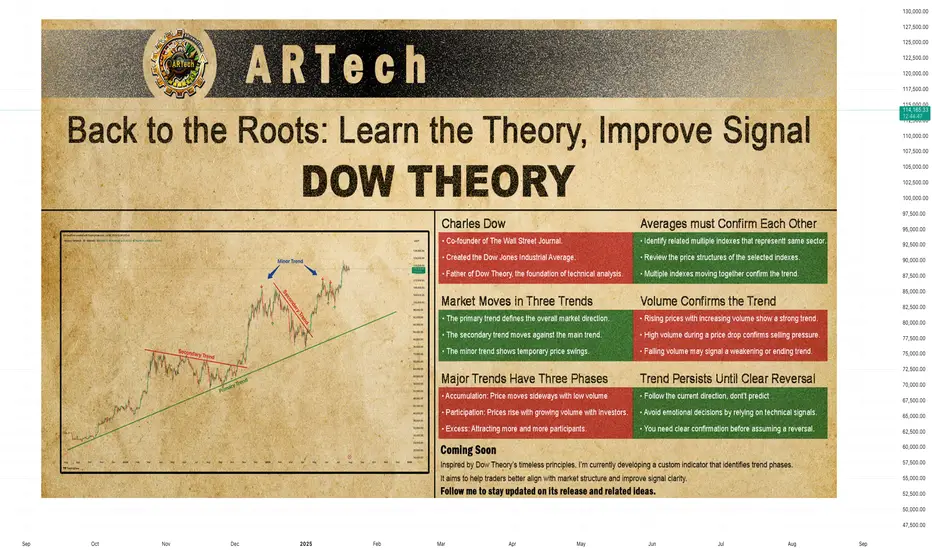
DOW THEORYBack to the Roots: Learn the Theory, Improve Signal
Charles Dow
Before we explore Dow Theory, let’s take a moment to understand who Charles Dow was — and why his ideas still matter today.
Charles Dow wasn’t a financial expert. He was a journalist with a sharp eye for market behavior. In the late 1800s, he began to write about how prices move, how trends form, and what they might mean. His goal was simple: to bring structure and logic to the chaotic world of stock prices.
More importantly, he believed that markets move in trends , and that these trends reflect the collective psychology of all investors. This basic idea became the starting point of technical analysis .
Dow created one of the first stock indexes, which helped investors see the bigger picture instead of focusing only on individual stocks. He also promoted transparency in financial data — long before it was required by law.
In 1889, Dow co-founded The Wall Street Journal, a newspaper that became the voice of financial markets. Through its pages, he published his observations on price behavior, setting the foundation for what would later be known as Dow Theory .
Dow Theory
At the heart of Dow Theory lies a simple but powerful idea:
The market discounts everything.
This means that all known information — earnings reports, interest rates, economic events, political changes, and even future expectations — is already reflected in the price. Price is not random. It is the result of collective investor behavior based on all available knowledge.
Charles Dow didn’t write this exact sentence, but his work clearly reflected this belief. He trusted that by analyzing price movements alone, one could understand the overall direction of the market — because price already includes all the important signals.
Dow and later analysts outlined a set of guiding principles. These are now known as the Six Core Principles of Dow Theory , and they continue to serve as a foundation for modern technical analysis.
The market discounts everything
The market moves in three trends
Major trends have three phases
Averages must confirm each other
Volume confirms the trend
A trend stays in place until it clearly reverses
🔸🔸🔸 The Market Moves in Three Trends 🔸🔸🔸
According to Dow Theory, market movements are not random. Prices move in three different dimensions and time frames: the primary trend , the secondary trend , and the minor (short-term) trend. These three types of movement often occur at the same time. It is very important for an investor to distinguish between them.
The primary trend shows the general direction of the market and can last for months or even years. It’s the major upward or downward movement.
The secondary trend refers to corrections or pullbacks that move in the opposite direction of the primary trend.
The minor trend typically consists of daily or weekly fluctuations and is often considered market “noise.” These short-term movements can occur in the same or opposite direction of the primary trend and may last from a few hours to two or three weeks.
Dow Theory emphasizes that understanding this three-layered structure can protect investors from many mistakes. The theory not only classifies trends but also offers valuable lessons about investor behavior.
It especially highlights the importance of three key principles:
Don’t go against the main trend
Short-term moves can easily confuse traders. Trading against the primary trend often leads to losses. That is why it is crucial to identify the main trend and follow it.
Diversify your exposure
In Dow’s time, technology wasn’t as advanced as it is today, but he still followed multiple indexes (like industrials and transport) to reduce risk. The same principle applies today: investors shouldn’t rely on a single asset — diversification remains a critical part of managing risk.
Define your holding period before entering a trade
Each type of trend comes with a different time expectation. The holding period you choose will play a key role in shaping your trading strategy and aligning it with your financial goals. Instead of debating how long each type of trend should last, it’s more important to define your intended holding period before entering a position.
Your answer to the question “Which holding period suits me?” reflects not only your trading style and lifestyle, but also determines which chart timeframes and indicator timeframes you should use.
🔸🔸🔸 Major Trends Have Three Phases 🔸🔸🔸
According to Dow Theory, major (primary) trends consist of three phases. This structure reflects how investor psychology changes over time and how those emotions are reflected in price action. Regardless of whether the trend is bullish or bearish, each major trend includes these three stages:
Accumulation Phase
The first stage of a bull market often looks like a small bounce during a bear trend. Most people still feel negative about the market. They are afraid to buy again after losing money. Trading volume is low, and prices move in a narrow range. The market stops making new lows, but investors are still unsure. Many have left the market or are very careful now. The price action becomes slow and sideways. It feels boring. But during this quiet time, smart investors slowly start buying. This is how a new trend begins — silently and with doubt.
However, there is no clear signal that a bull market has started. Buying now carries two big risks. First, the market may still go lower. Second, even if a bull trend is coming, no one knows when it will start. How long can you wait while the market does nothing? Holding positions in a flat market has costs — financial, emotional, and missed opportunities elsewhere. That’s why this phase is difficult for most traders to handle.
Public Participation Phase
The market begins to recover, and the broader investor base starts to notice positive changes. News improves, technical indicators give bullish signals. Prices rise, and trading volume increases. This is usually the strongest part of the trend. At this stage, more disciplined and research-driven investors — who follow the market closely — start buying in. They see confirmation in both price action and economic data. Their confidence supports the trend, and momentum grows. The market attracts more attention. Confidence replaces fear. Many investors who stayed out during the earlier phase now feel safer to enter.
Joining the market during this phase is important. The trend is already underway, but there’s still room to grow. Risk is lower than in the early phase, and potential rewards are still high. For many investors, this is the best time to take a position.
Excess Phase
The market enters a phase of excessive optimism. Prices have been rising for a long time, attracting more and more participants. However, during this stage, institutional investors and professional traders who entered earlier begin to gradually take profits.
Although prices remain high, momentum weakens, and the rate of increase slows down. Looking at the volume profile, prices may reach new highs but often without volume support. Technical indicators frequently show bearish divergences. These conditions generate early technical signals that the primary trend may be coming to an end.
🔸🔸🔸 Averages must Confirm Each Other 🔸🔸🔸
According to Dow Theory, a market trend is considered valid only when different indexes move in the same direction. The term “average” here refers to an index or the general direction of a price series. This principle is used to assess whether a price movement is supported by broad market participation.
A single index reaching a new high or low is not enough. For a real and sustainable trend to be confirmed, related indexes are expected to show similar movement and generate signals in the same direction. If this confirmation is missing, the current move may be considered weak or temporary.
How to Analyze It:
Identify related indexes
Choose multiple indexes that represent the same market, sector, or economic domain.
Compare trend direction
Review the price structures of the selected indexes. Are they all showing similar patterns? Did the new highs or lows form around the same time?
Look for confirmation
If multiple indexes form new structures in the same direction (e.g., all make new highs in an uptrend), this increases the validity of the trend.If only one index is moving while others are not participating, confirmation is lacking.
Be cautious without confirmation
When confirmation is missing, trading strategies should be more conservative, or additional signals should be awaited before taking action.
🔸🔸🔸 Volume Confirms the Trend 🔸🔸🔸
According to Dow Theory, the validity of a market trend depends not only on price movement but also on trading volume. For a trend to be considered strong and sustainable, price action should be supported by volume.
Why Is Volume Important?
In a rising market, increasing volume is expected. This indicates growing investor interest and broader participation in the trend.
In a falling market, if the decline happens with high volume, it suggests serious selling pressure and strengthens the trend.
Declining volume may signal a loss of momentum and suggest that the current trend is weakening or nearing its end.
How to Analyze It:
Observe the relationship between price and volume:
Price rising + volume increasing → Strong trend
Price rising + volume decreasing → Lack of confirmation; caution is advised
Check volume during breakouts:
If resistance or highs are broken with strong volume → Reliable signal
If breakouts happen on low volume → May indicate a false move (fakeout)
🔸🔸🔸 A Trend Persists Until a Clear Reversal Occurs 🔸🔸🔸
This core principle of Dow Theory is at the heart of all trend-following strategies.
It states that once a price begins moving in a certain direction, the trend is assumed to continue — until there is clear and technically confirmed evidence that it has ended.
Why Is This Principle Important?
Follow, don’t predict
Instead of guessing what the market will do next, traders stay with the current direction.
Reduces emotional decisions
Trades are based on technical signals, not assumptions like “the price is too high, it must fall.”
A weak trend is not the same as a reversal
Not every pullback means the trend is over. You need clear confirmation before assuming a reversal — such as a breakdown, volume shift, momentum loss, or structural change.
How to Apply It
First, identify the trend direction clearly, and trade in that direction.
Pullbacks are seen as normal movements within the trend — not as reversals.
Even when signs of a reversal appear, wait for confirmation before acting.
Confirmation signals may include:
Failure to form new highs or lows
A break of previous support or resistance
Sudden drop in volume or volume rising in the opposite direction
Weakness or divergence in momentum indicators
Strategic Benefit
This principle is especially useful in trend-following strategies. It helps avoid premature exits and allows traders to stay in profitable trends longer. By focusing on technical confirmation instead of speculation or panic, it encourages disciplined and systematic decision-making.
Charlesdow
DreamAnalysis | Technical Analysis Dow Theory EP03📚 Welcome to the Educational Content Section of Our Channel: Technical Analysis Training
👋 Recap of the Previous Session: In the previous session, we covered the middle two principles of Dow Theory. Make sure to review and study them, and if you have any questions, feel free to reach out to us in the comments.
📖 Today’s Focus: Let’s dive into Principles 5 & 6 of Dow Theory and explore their significance in market analysis.
🎨 What is Technical Analysis? Technical analysis is more of an art than a science. Just like art, there is no definitive right or wrong. Instead, we create rules based on experience to navigate the lawless market. Patterns in life can reflect in the markets, but we must always approach it with an artistic perspective.
📑 Principles of Dow Theory:
1 - The Averages Discount Everything (Not applicable to crypto)
2 - The Market Has Three Trends
3 - Trends Have Three Phases
4 - Trends Continue Until a Reversal is Confirmed
5 - The Averages Must Confirm Each Other
6 - Volume Confirms the Trend
📊 Principle 5: Volume Confirms the Trend
Typically, when the price moves in the direction of the main trend, the trading volume increases. The same applies to bearish trends, where declining prices are supported by increasing sell volume. Low volume suggests weakening momentum. For example, in a bull market, buying volume should rise with the price, and during corrections, volume should remain steady.
📉 However, if volume increases during a correction, it may signal that more investors are turning bearish on the asset. Therefore, volume acts as a crucial indicator of the strength or weakness of a trend.
📉 Principle 6: Trends Continue Until a Reversal is Confirmed
🔄 Dow Theory emphasizes that trends continue until a clear reversal signal is observed. This means that despite short-term fluctuations or corrections, the primary market trend remains intact until there is unmistakable evidence of a change in direction.
🚩 It’s important to distinguish between temporary corrections and true trend reversals. Misinterpreting short-term declines in a bull market or temporary rallies in a bear market can lead to confusion and poor decision-making.
🎯 Conclusion: This concludes our breakdown of the 6 principles of Dow Theory. In the next session, we will review and summarize the entire Dow Theory to solidify your understanding.
📝 Important Note: These principles were developed over 100 years ago, and with today’s diverse markets, there are many different perspectives on their application.
⚠️ Please remember that these lessons represent our personal view of the market and are not financial advice. Always do your own research before making investment decisions.
DreamAnalysis | Technical Analysis Dow Theory EP01📚 Welcome to the Educational Content Section of Our Channel: Technical Analysis Training
We aim to produce educational content in playlist format that will teach you technical analysis from A to Z. We will cover topics such as risk and capital management, Dow Theory, support and resistance, trends, market cycles, and more. These lessons are based on our experiences and the book The Handbook of Technical Analysis, as well as our learning and insights from the Trade City Pro channel.
🎨 What is Technical Analysis?
Let’s talk a bit about technical analysis and patterns in life. Technical analysis is not a science; rather, it is an art. Therefore, there is no right or wrong in art. Instead, we apply rules we have created through experience in this lawless market.
📊 Introduction to Dow Theory :
Today, for the first part of our lessons, we will begin with Dow Theory, which was developed by American journalist Charles Dow. Many traders still use this method for analysis and trading.
📑 Principles of Dow Theory :
1 - The Averages Discount Everything (Not applicable to crypto)
2 - The Market Has Three Trends
3 - Trends Have Three Phases
4 - Trend Continues Until a Reversal is Confirmed
5 - The Averages Must Confirm Each Other
6 - Volume Confirms the Trend
💵 Principle 1: Price is All You Need
Dow's theory operates based on the "Efficient Market Hypothesis," which assumes that the price of assets reflects all available information. In other words, this approach contrasts with behavioral economics. Factors like earning potential, competitive advantage, management competence—all are accounted for in the price, even if individuals do not know all the details. In more precise readings of this theory, even future events might be reflected in the current market price.
📊 Principle 2: The Market Has Three Types of Trends
According to Dow Theory, price movements in the market are trend-based, and these trends can be divided into three types:
1 - Primary Trend: This is the main movement of the market, dictating the long-term direction, and can last for years.
2 - Secondary Trends: These are corrective movements that run opposite to the primary trend. For instance, if the primary trend is bullish, the corrective trend will be bearish. These trends can last from weeks to months.
3- Minor Trends: These are the daily price fluctuations in the asset. Although minor trends can last for weeks, their direction will always align with the primary trend, even if they contradict the secondary trend.
💡 Final Thoughts for Today :
This is the end of this part, and I must say we have a long journey ahead. We will continually strive to produce better content every day, steering clear of sensationalized content that promises unrealistic profits, and instead, focusing on the proper learning path of technical analysis.
⚠️ Please remember that these lessons represent our personal view of the market and should not be considered financial advice for investment.
SPY: Don’t “Guess” the Top.We can learn a very interesting lesson by looking at the SPY chart. Anyone who tries to guess the next top or bottom is a gambler, not a trader, and as someone who has gambled a lot in the past, this rally brings back some memories.
It's very easy for someone to see such an explosive movement and think: "It's already gone up a lot, it's going to have to come down soon". It's very easy to look for clues in other indicators, for example, and get excited when you see the RSI exploding close to 70. Looking for clues that reinforce a pre-existing belief is common among individuals corrupted by the "confirmation bias", which is something else, and would be content for a future article.
Still talking about the RSI, it's important to mention that the RSI was already at 70 when the price was at $450. Since then it has risen by more than $20 (approximately 5%), and there is no sign of a top yet. Far from being a criticism of such an efficient indicator, this is just evidence that the use of indicators should be aligned with what we see on the chart.
Top or bottom signals are confirmed when we see a clear breakout from a notorious reversal pattern. As we can see from the SPY chart below, just one or two bearish patterns, even when appears close to clear resistance, is not enough. There needs to be confirmation of a good breakout.
Perhaps this is one of the reasons why so many are rushing to sell a possible top, even without confirmation. By waiting for confirmation, you sacrifice part of your profits, and amateurs hate that. To feel like a pro, you have to feel the satisfaction of buying the bottom and selling the top, all the time. Which is ironic, because that's not the focus of a professional. A real trader seeks long-term consistency.
Speaking for myself, as far as I can see it's a strong rally in the SPY, and the next resistance is the all-time high at $479.98. So far, there is no clear reversal pattern for me, although I personally would like to see a correction to a support point.
What if the SPY made a bearish candlestick pattern today? Just as we see on November 9, 15 and 29, and on December 6, a top signal is plausible, but we need to wait for confirmation via a breakout. Otherwise, it would just be another bear trap.
Another thing I like to do is wait for a clear bearish reversal structure to appear on shorter time frames, such as the hourly chart. Uptrends are characterized by rising tops and bottoms, and the reverse applies to downtrends. When a stock is in a clear uptrend, but the hourly chart suddenly makes a lower top and bottom, it's a warning sign. If such a reversal occurs near a resistance area, all the better, as was the case with NVDA at the end of last month.
One of the most overlooked principles of Dow Theory is the number 6: "Trends Persist Until a Clear Reversal Occurs". When Charles Dow, founder of the Dow Jones index and the Wall Street Journal, began working on the principles more than a century ago, he never imagined that in the 21st century there would still be traders who anticipate and don't wait for confirmation (again, I was among these gamblers in the past).
Therefore, trading reversals is interesting and can be very profitable, but you need to base your decisions on technical reasons. I shared how I like to trade reversals, but there are more strategies that you can use. Feel free to share yours. That's the difference between a gambler and a trader. Moreover, remember to follow me for more content like this, and support this idea if you liked it!
All the best,
Nathan.
#CADCHF buying opportunityAs depicted in the chart, the price successfully broke above a range-bound area yesterday. This pattern, known as the "line formation" in Charles Dow's trading strategy, represents the only tradable Daily time frame pattern based on Dow's principles. We are currently waiting for the price to retest the previously broken resistance, with the expectation that it will now act as support.
To maintain our position and adjust our stop loss in line with this bullish trendline, it is essential for the price to remain above our short-term trend.
In order to manage our Risk-to-Reward ratio effectively, we have decided not to initiate a position until the price reaches our designated support level. At that point, we will be on the lookout for bullish price confirmations.
by the way If you've found this analysis helpful, please take a moment to like, comment, or share your thoughts with me.
💡🎓 Dow Theory & Bitcoin 🎓💡To share awareness for the beauty and history of our art of Technical Analysis of financial markets, in this educational post, I look at the six fundamental principles of Dow Theory, applied to Bitcoin and its current macro/local trends.
Dow Theory Principles;
1. Markets Discount Everything
2. The Market has 3 Trends
3. Major Trends have 3 Phases
4. Markets must Confirm Each Other
5. Volume must confirm the Trend
6. A trend is assumed to be in effect until is shows clear signals it has reversed
[Below is a summary of who Charles H. Dow was and his impact, by John J. Murphy;
“ Charles Dow and his partner Edward Jones founded Dow Jones & Company in 1882.
Most technicians and students of the markets concur that much of what we call technical analysis today has its origins in theories first proposed by Dow around the turn of the century.
Dow published his ideas in a series of editorials he wrote for the Wall Street Journal.
Most technicians today recognize and assimilate Dow's basic ideas, whether or not they recognize the source.
Dow Theory still forms the cornerstone of the study of technical analysis, even in the face of today's sophisticated computer technology, and the proliferation of newer and supposedly better technical indicators.
On July 3, 1884, Dow published the first stock market average composed of the closing prices of eleven stocks: nine railroad companies and two manufacturing firms.
Dow felt that these eleven stocks provided a good indication of the economic health of the country.
In 1897, Dow determined that two separate indices would better represent that health, and created a 12 stock industrial index and a 20 stock rail index.
By 1928 the industrial index had grown to include 30 stocks, the number at which stands today.
The editors of The Wall Street Journal have updated the list numerous times in the ensuing years, adding a utility index in 1929.
In 1984, the year that marked the one hundredth anniversary of Dow's first publication, the Market Technicians Association presented a Gorham-silver bowl to Dow Jones & Co.
According to the MTA, the award recognized "the lasting contrbution that Charles Dow made to the field of investment analysis.
His index, the forerunner of what today is regarded as the leading barometer of stock market activity, remains a vital tool for market technicians 80 years after his death.
Unfortunately for us, Dow never wrote a book on his theory.
Instead, he set down his ideas of stock market behavior in a series of editorials that The Wall Street Journal published around the turn of the century.
In 1903, the year after Dow's death, S.A Nelson compiled these essays into a book entitled The ABC of Stock Speculation.
In that work, Nelson first coined the term "Dow's Theory."
Richard Russell, who wrote the introduction to a 1978 reprint, compared Dow's contribution to stock market theory with Freud's contribution to psychiatry.
In 1922, William Peter Hamilton (Dow's associate and successor at the Journal) categorized and published Dow's tenets in a book entitled The Stock Market Barometer.
Robert Rhea developed the theory even furtherIn the Dow Theory (New York: Barron's), published in 1932.
Dow applied his theoretical work to the stock market averages that he created; namely the Industrials and the Rails.
However, most of his analytical ideas apply equally well to all market averages. “
John J. Murphy, Technical Analysis for the Financial Markets, 1999, Page 23-24
What are your thoughts?
yemala