EURUSD: Liquidity Grab @ 1.15000EURUSD has experienced a liquidity grab as price closed below the previous low and is heading towards 1.15. CRT suggest price could go lower and wick below the previous candle or even drop further.
Alongside 1.15, there is an imbalance, which price could tap into and possibly fill, both EURUSD and GBPUSD has some divergence so it will be interesting to see how it plays out
Euro-dollar
EURUSD in channel resistance rangeHello friends
The EURUSD currency pair has reached the ceiling in the channel resistance range and you can take a sell position at this price.
The stop loss if the price stabilizes above the trend line in the 4h time frame is in the price range of 1.16900
The take profit is in the channel bottom range in the price range of 1.14800
Dear traders, please do not forget about capital management, risk management and adherence to the stop loss.
When the price reaches the target, the update for this currency pair will be posted again, so follow me to be informed about low-risk and successful trading ranges and be the first to know
I hope you are profitable.
Fundamental Market Analysis for October 7, 2025 EURUSDThe euro (EUR) is weakening against the US dollar (USD) after France's new Prime Minister Sébastien Lecornu and his government resigned on Monday, just hours after the cabinet was announced.
Sébastien Lecornu resigned just a few weeks after his appointment, making his government the shortest-lived in modern French history. This raises concerns about a new political crisis in France and puts some pressure on the euro.
The ongoing US government shutdown may raise concerns about its impact on the country's economy, which could lead to a decline in the dollar and become a favorable factor for the main currency pair.
The Federal Reserve (Fed) is expected to cut rates by 25 basis points (bps) at its October meeting amid signs of a weakening labor market.
Trade recommendation: SELL 1.1665, SL 1.1745, TP 1.1480
Fundamental Market Analysis for September 19, 2025 EURUSDThe US Department of Labor (DOL) reported on Thursday that the number of Americans filing new claims for unemployment benefits fell to 231,000 for the week ending September 13. The latest data was lower than the initial estimate of 240,000 and lower than the previous week's figure of 264,000 (revised from 263,000). Meanwhile, the number of people continuing to claim unemployment benefits fell by 7,000 to 1.920 million for the week ending September 6.
The US dollar remains strong after the Federal Reserve (Fed) announced an expected rate cut on Wednesday but did not indicate that it would rush to lower borrowing costs in the coming months.
The decline in the EUR/USD pair may be limited as the euro (EUR) could be supported by growing expectations that the European Central Bank (ECB) will end its cycle of rate cuts after the release of the latest inflation data.
ECB Vice President Luis de Guindos said the central bank should take a “very cautious” approach given the high uncertainty. Guindos added that the current rate is adequate given inflation trends and monetary policy transmission.
Trade recommendation: SELL 1.1735, SL 1.1765, TP 1.1685
Fundamental Market Analysis for September 16, 2025 EURUSDThe euro is gaining support against other currencies thanks to comments from the European Central Bank (ECB). European Central Bank (ECB) board member Isabel Schnabel said on Tuesday that interest rates in the eurozone are at a good level, adding that risks of inflation remain prevalent. Schnabel said growth is likely to exceed potential as domestic demand offsets the decline in exports.
ECB board member Peter Kazimir said on Monday that policy should not be adjusted due to “minor deviations” from the inflation target, while warning of the risks of rising inflation. Kazimir added that interest rates had been brought to a neutral level.
The EUR/USD rose as the US dollar (USD) weakened on growing expectations that the Federal Reserve (Fed) would cut rates by 25 basis points at its September meeting on Wednesday. Markets also see the likelihood of a more significant 50 basis point cut as low, while anticipating continued policy easing through 2026 to counter the risk of recession.
Trade recommendation: BUY 1.1805, SL 1.1770, TP 1.1860
Fundamental Market Analysis for August 29, 2025 EURUSDEUR/USD is losing ground after three days of decline, trading around 1.1660 during Asian hours on Friday.
The EUR/USD pair is depreciating amid a recovery in the US dollar (USD) due to US economic growth in the second quarter. Annual gross domestic product (GDP) in the US grew by 3.3% in the second quarter, exceeding initial estimates of 3.1% and the previous 3.0%.
However, the US dollar may face difficulties amid renewed dovish sentiment regarding the prospects for Federal Reserve (Fed). According to Reuters, Fed member Christopher Waller said on Thursday that he would support lowering interest rates at the September meeting and further cuts over the next three to six months to prevent a collapse in the labor market.
Concerns about the Fed's independence have intensified following recent statements by US Vice President Jay D. Vance. He noted: "I don't think we should allow bureaucrats to make decisions about monetary policy and interest rates without taking into account the opinions of people who were elected to serve the American people... The US president is much better equipped to make such decisions."
Trade recommendation: BUY 1.1690, SL 1.1610, TP 1.1790
Fundamental Market Analysis for August 26, 2025 EURUSDEUR/USD is holding onto its gains after rising more than three-quarters of a percent in the previous session, trading around 1.1630 during Asian hours on Tuesday.
President Trump posted a letter on social media Tuesday morning announcing that he was removing Fed Governor Cook from the Fed's board of directors. However, Cook said she would not resign because there was no reason for her dismissal. “I will continue to fulfill my duties,” she added.
President Trump also warned that he could impose a 200% tariff on Chinese goods if China refuses to supply magnets to the US. In addition, Trump threatened “additional tariffs” and restrictions on the export of advanced technologies and semiconductors in response to digital services taxes that have hit US technology companies.
The EUR/USD pair is strengthening as the euro (EUR) receives support after the European Central Bank (ECB) signaled a pause in monetary policy easing amid a strengthening labor market in the eurozone. Meanwhile, details of the agreement between the EU and the US indicate that a 15% tariff will be imposed on most European goods, while cars, pharmaceuticals, and semiconductors may be exempt from tougher US duties.
Trade recommendation: BUY 1.1655, SL 1.1585, TP 1.1765
EURUSD (Daily)EUR/USD Daily Chart shows a clear bullish trend, with demand consistently supporting higher prices. The most probable scenario is a breakout above 1.2000, targeting 1.2202. This aligns perfectly with your DXY analysis, where further USD weakness supports Euro strength.
🔎 Chart Context
• Pair: EUR/USD
• Broker: FXCM
• Timeframe: 1D (Daily)
• Date: 19 August 2025
This chart shows the Euro’s performance against the US Dollar. Since EUR/USD is strongly inversely correlated with the DXY, this analysis complements the DXY bearish outlook.
📊 Key Observations
1. Macro Trend
• EUR/USD bottomed near 1.0200 earlier in 2025.
• Since then, price has established a strong bullish uptrend, breaking through multiple resistance levels.
• Current structure shows higher highs and higher lows, confirming a bullish market bias.
2. Support & Demand Zones
• Key demand zone around 1.1100 – 1.1200, previously a resistance-turned-support.
• A well-defined S/D (supply → demand flip) is visible, showing institutional accumulation.
• Price respected this area on multiple retests, suggesting strong bullish interest.
3. Resistance Zones
• 1.2000: Psychological resistance and liquidity pool.
• 1.2202: Next major projected upside target, marked on the chart.
• Price is consolidating below 1.2000, building energy for a potential breakout.
4. Liquidity Behavior
• Market has absorbed sellers around 1.1600–1.1700, pushing into higher levels.
• Liquidity likely rests above 1.2000, where stop orders are clustered.
• If price clears this, a sweep toward 1.2202 becomes very probable.
5. Projected Path
• Chart projection suggests a bullish continuation:
• Short-term pullback → retest of demand zone (around 1.1600–1.1700).
• Then breakout above 1.2000.
• Final move toward 1.2202 liquidity zone.
📈 Bullish Case (Higher Probability)
• Structure strongly favors bulls.
• Scenario:
• If EUR/USD sustains above 1.1600 demand, breakout above 1.2000 is expected.
• Target 1: 1.2000 (psychological & liquidity).
• Target 2: 1.2202 (projected liquidity sweep).
• This aligns with DXY bearish outlook (as seen in your previous chart).
📉 Bearish Case (Low Probability, Countertrend)
• Only valid if price breaks back below 1.1100 demand zone.
• Downside targets:
• 1.0800 (structural support).
• 1.0500 (deep retracement).
• This would require a sudden USD strength revival, which contradicts current DXY projection.
⚡ Trading Plan
• Long Setup (Preferred):
• Entry: Pullbacks into 1.1600–1.1700 demand zone.
• TP1: 1.2000
• TP2: 1.2202
• Stop-loss: Below 1.1100
• Short Setup (Risky, Countertrend):
• Entry: At 1.2000 liquidity zone if price rejects strongly.
• TP: 1.1600
• Stop: Above 1.2202
EURUSD: Important Breakout 🇪🇺🇺🇸
EURUSD keeps rising for the last 2 weeks.
Yesterday, the market went up again and violated
a significant falling trend line
It is another strong bullish signal.
I think that the pair will most likely continue rising
and reach 1.1755 soon.
❤️Please, support my work with like, thank you!❤️
I am part of Trade Nation's Influencer program and receive a monthly fee for using their TradingView charts in my analysis.
Fundamental Market Analysis for August 8, 2025 EURUSDThe EUR/USD exchange rate remains stable after rising during the previous three sessions, trading at around 1.1660 during Asian trading hours on Friday. The pair may regain its positions as the US dollar (USD) may struggle as markets assess the probability of a 25 basis point (bp) rate cut at the September meeting at nearly 93%, compared to 48% a week ago.
Expectations for a Fed rate cut in September have intensified as the number of new applications for unemployment benefits in the US increased after the US nonfarm payrolls (NFP) report for July pointed to a cooling labor market.
Data on initial jobless claims in the US showed that the number of US citizens filing new claims for unemployment benefits rose to 226,000 for the week ending August 2. This figure exceeded the market consensus forecast of 221,000 and was higher than the previous week's figure of 218,000.
The probability that the central bank will leave rates unchanged is approximately 87%. Markets estimate the probability of another ECB rate cut before March 2026 at only 60%.
Trade recommendation: BUY 1.1660, SL 1.1625, TP 1.1710
EURUSD Current Market Situation Technical Analysis Current Market Situation
The chart displays a Double Top pattern, a strong bearish reversal signal that often indicates the start of a downward move.
The price has already broken the neckline, and it is now approaching a retest of both the neckline and the broken trendline, which serves as a critical resistance area for potential bearish continuation.
Key Zones
Neckline Retest Zone: Around 1.1600, acting as immediate resistance.
Trendline Retest Zone: Between 1.1670 – 1.1700, serving as an additional resistance level to confirm the bearish bias.
Potential Scenarios
✅ Bearish Scenario (Preferred):
If price respects the retest zones and fails to break higher, we may see a decline toward:
Target 1: 1.1500
Target 2: 1.1400
Target 3: 1.1300
⚠ Bullish Scenario (Alternative):
A clear breakout and daily close above 1.1700 would invalidate the bearish outlook and could lead to a bullish reversal.
Conclusion
The market structure currently favors the bears.
Rejection from the neckline or trendline retest zones will provide a strong confirmation for sell positions.
⚠️ Trade at your own risk – We are not responsible for any losses.
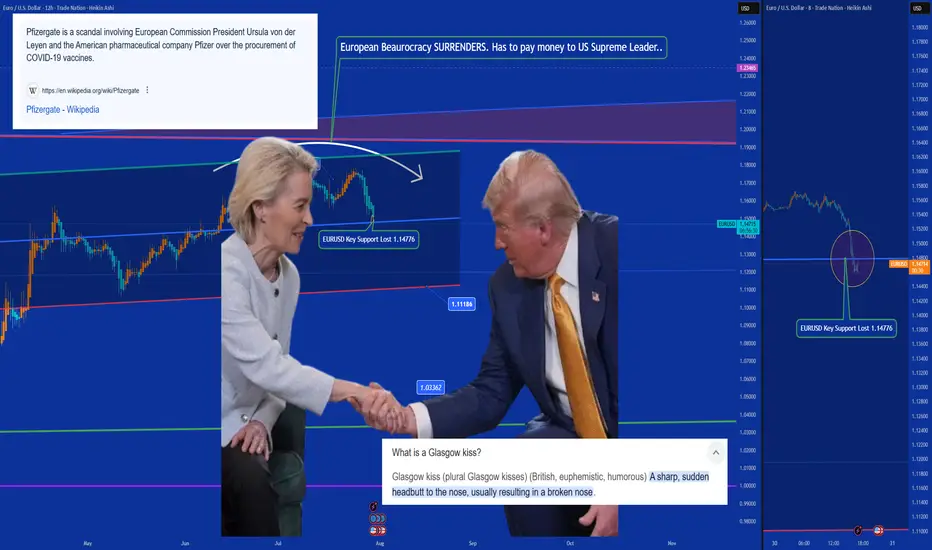
Ursulization = Bureaucracy > Democracy (a.k.a. The Glasgow Kiss)🤝💥 Ursulization – Bureaucracy Replaces Democracy (a.k.a. The Glasgow Kiss) 🇺🇸🇪🇺
📍Background:
The media spun it as a "15% tariff agreement"…
But in reality, this wasn’t diplomacy — it was a disguised capitulation.
And the stage? None other than Scotland, ancestral ground of Donald J. Trump.
So when Ursula von der Leyen came seeking a gentle diplomatic handshake…
What she received instead was the infamous Glasgow Kiss — sudden, sharp, and unmissable.
💥 What’s a Glasgow Kiss?
A British slang term for a violent headbutt to the face —
No grace. No warning. Just raw force.
💬 The Real Story:
Ursula von der Leyen — unelected, unaccountable —
signed off on $1.4 trillion in U.S.-bound capital flows:
💸 $750B to buy American energy
🛠 $600B in U.S. infrastructure, defense & industry
All to sidestep 50% tariffs the Trump team had ready to roll.
But here's the kicker:
She wasn’t acting on behalf of European citizens.
She was speaking for the bureaucracy, not the people.
🔥 Welcome to Ursulization:
Where democracy is sidelined by unelected power.
Where negotiations happen in silence.
Where scandals like PfizerGate get buried while the euro breaks down.
📉 EUR/USD just lost key support at 1.14776 —
The chart shows t he cost of surrender.
💉 PfizerGate Reminder:
Ursula already faced heat for secretive vaccine contracts with Pfizer.
Now, she’s handing over Europe’s industrial backbone —
To Trump. In Scotland. With no public mandate.
📌 Conclusion:
Trump didn’t compromise — he collided.
Europe didn’t resist — it surrendered.
This wasn’t diplomacy.
It was a Glasgow Kiss — a collision between legitimacy and bureaucratic power.
👑 One elected by the people (Trump). One not elected at all (Woke agenda style Ursula).
💰 One walks away with trillions (Trump). The other, with silence (Ursula 'Von der Pfizinen never electenen'').
One Love,
The FXPROFESSOR 💙
ps. Till we can bring Democracy and Europe back.
Disclosure: I am happy to be part of the Trade Nation's Influencer program and receive a monthly fee for using their TradingView charts in my analysis. Awesome broker, where the trader really comes first! 🌟🤝📈
The euro extends sharp losses following the US-EU tariff deal
The euro weakened sharply against the dollar amid views that the US-EU tariff deal favors the US. European leaders voiced mixed reactions. Germany’s Chancellor Merz welcomed the agreement as a safeguard against economic damage, while Hungary’s PM Orbán criticized it as a one-sided win for the US. Meanwhile, the IMF raised its eurozone growth forecast from 0.8% to 1.0% in its July outlook, citing the lower-than-expected tariff levels as supportive of the region’s economy.
EURUSD broke below the ascending trendline and briefly tested the support at 1.1520. EMA21 has death-crossed EMA78, indicating the potential extension of bearish momentum.
If EURUSD fails to hold above the support at 1.1520, the price could decline further toward 1.1450. Conversely, if EURUSD breaches above the resistance at 1.1590, the price may gain upward momentum toward 1.1640.
Opportunities Arise from Dollar WeaknessSince the dollar peaked in 2022, it has declined by 24%.
Such a decline may not seem significant for a stock, it’s a different story when it comes to currencies, especially a reserve currency for USD. US purchasing power has dropped by a quarter, meaning they will now have to pay 24% more for imports from EU.
However, the decline in the USD also presents opportunities in other markets.
Mirco EUR/USD Futures
Ticker: M6E
Minimum fluctuation:
0.0001 per euro = $1.25
Disclaimer:
• What presented here is not a recommendation, please consult your licensed broker.
• Our mission is to create lateral thinking skills for every investor and trader, knowing when to take a calculated risk with market uncertainty and a bolder risk when opportunity arises.
CME Real-time Market Data help identify trading set-ups in real-time and express my market views. If you have futures in your trading portfolio, you can check out on CME Group data plans available that suit your trading needs www.tradingview.com
EUR/USD: Euro Pops Above $1.16 in Four-Year High. What’s Next?The dollar wobbles, Trump talks tariffs, and the euro’s got its dancing shoes on.
The Euro Wakes Up, Stretching Its Legs at $1.16
Look who just rolled out of bed and decided to make a scene.
For the first time in four years, the euro has finally leapt out of its slumber and sprinted to $1.16 — all at the expense of the US dollar, which continues to shed value.
The FX:EURUSD isn’t just crawling higher. It’s flexing, fueled by dollar fatigue, political drama, and some very European stubbornness.
So what’s behind the move? Why is the euro soaring while the European Central Bank is actually cutting rates? And what’s the dollar doing? Let's unpack it all — one central bank, one tweet, and one inflation print at a time.
Trump’s Tariff Ping-Pong: Back On, Back Off
Let’s start with the one thing that never quite leaves the headlines: Trump’s trade policy.
Just when traders were catching their breath after some tariff reprieve on China, the market got pulled back into the mess. “WE ARE GETTING A TOTAL OF 55% TARIFFS, CHINA IS GETTING 10%. RELATIONSHIP IS EXCELLENT,” Trump posted on Truth Social late on Wednesday, reigniting fears that the trade war is getting heated up again. Especially after a US squad of negotiators touched down in London and walked away with some promising news .
Markets don’t love confusion. Investors especially don’t love a US trade policy that changes faster than the Nasdaq NASDAQ:IXIC during CPI week. This kind of noise erodes confidence in US economic leadership and — more importantly — in the dollar.
The world’s most important currency is starting to feel… less important, less relevant, and less reliable. And while it’s not collapsing, it’s definitely catching fewer friends at the FX party.
On the other side of the pond, the euro isn’t rising because Europe is crushing it (even though it’s doing pretty well against rival currencies, just check the forex heatmap ) — it’s rising because the dollar is slipping off its pedestal. So yes, the euro’s up. But this isn’t a standing ovation for Europe — it’s more of a polite shrug away from America.
US Inflation Creeps Higher — And That Means a Cut?
US inflation picked up to 2.4% in May but still left the door open for a cut by the Federal Reserve.
So what does the market do? It prices in a cut.
Lower rates mean lower yields on Treasuries, which means less incentive for global investors to hold dollars. And when the yield game turns dull, guess what gets more attention? Gold OANDA:XAUUSD — because if your asset doesn’t yield anything, at least let it be shiny.
ECB Cuts Again, and the Euro Still Rises?
Now here’s the riddle. The ECB last week cut its benchmark rate to 2% , hitting a two-year low. By all textbook logic, a rate cut should weaken the local currency.
Here’s why it’s rising instead:
Markets are forward-looking . The rate cut was expected and already priced in. What matters now is whether more cuts are coming (spoiler: not too many). Traders are betting the ECB is nearing the end of its easing cycle — and may turn neutral soon.
The Fed looks more dovish . Rate differentials still matter. Even if the ECB is cutting, the Fed is expected to cut more over the next 12 months. That narrows the gap between euro and dollar yields, making the euro more attractive in relative terms.
Eurozone data isn’t great — but it’s not falling apart either. While growth in the eurozone isn’t setting any records, it’s been just OK to support the currency. Inflation is cooling in line with ECB targets, unemployment remains low, and key sectors like manufacturing are showing signs of life.
Put it all together and you get a euro that’s rising despite rate cuts — a phenomenon that would make FX professors tear their hair out, but makes perfect sense when you zoom out.
Technicals: This Isn’t a Flash in the Pan
From a chartist’s perspective, the FX:EURUSD breakout above $1.16 was a big deal. That level had acted as resistance since November 2021. Now cleared, a flurry of algo buys and retail FOMO might fuel the next leg in either direction.
From the bulls’ perspective, momentum is picking up, and the euro looks poised to test $1.17–$1.18 if the dollar stays fragile (that said, keep your eye on any hot news coming out of the economic calendar ). RSI is not yet flashing overbought, and MACD is still screaming “more grounds to cover.”
Question is: How long can the euro dance before the music changes? And we’re asking you — share your thoughts on the euro-dollar pair and let’s see who gets it right!
Digital Euro: Separating Fact from Conspiracy TheoriesIn today’s fast-paced digital landscape, misinformation can spread rapidly and mislead even those well-intentioned readers. With the Digital Euro project circulating online, numerous pieces of fake news have surfaced—not just criticism or differing opinions, but outright falsehoods that may convince citizens, especially those less familiar with financial innovations, that the project is something it is not. In this article, we delve into the most common misconceptions and explain with clarity and factual context why these claims do not correspond with reality.
1. Myth: "The Digital Euro Will Replace Cash"
❌ False. Despite alarming headlines, cash will not vanish. The Digital Euro is poised to become an additional payment option alongside physical money. The Eurosystem is committed to ensuring that banknotes and coins remain accessible. In fact, plans are already underway to introduce new series of euro banknotes, reaffirming the continued value of cash in our daily transactions.
2. Myth: "The ECB Will Be Able to Control and Block Your Payments"
❌ False. Privacy is a cornerstone of the Digital Euro. Similar to the way cash transactions operate, offline payments would be possible without any tracking by the Eurosystem. This means that your personal transactions remain private and free from arbitrary interference. The design of the digital euro ensures that your financial autonomy is preserved.
3. Myth: "There Will Be Arbitrary Limits on How Much Digital Euro Can Be Held"
❌ False. Any limits imposed on holding digital euros would not be arbitrary measures of control but rather tools to safeguard financial stability. Such thresholds are considered from the perspective of systemic security—not the curtailment of individual freedom. The focus is on ensuring that the financial ecosystem remains resilient rather than monitoring or constraining individual spending.
4. Myth: "The Digital Euro Is a Way to Introduce Negative Interest Rates on Deposits"
❌ False. The digital euro is designed to mirror cash in its fundamental properties—namely, being interest-free. It is not a mechanism for financial authorities to impose negative interest rates on personal funds. The purpose is to complement traditional cash by offering a modern payment solution without altering the neutrality of money.
5. Myth: "It Will Be Mandatory to Use the Digital Euro"
❌ False. Use of the digital euro is entirely optional, serving as one out of many available payment instruments. Just as consumers choose between cash, credit cards, or other digital means, the digital euro is simply an additional tool. No regulation compels you to adopt this innovation if you prefer your existing methods.
6. Myth: "Banks Will Lose All Their Role"
❌ False. The introduction of the digital euro will not render banks obsolete. Banks will continue to provide essential financial services, acting as intermediaries and offering the digital euro alongside other products. The evolution of the payment system enhances consumer choice without dismantling the traditional banking framework.
7. Myth: "The Digital Euro Will Be Programmable, So They Will Tell You How to Spend Your Money"
❌ False. The concept of programmability—that is, dictating how funds are spent—has been explicitly ruled out by the ECB. Both proposals from the European Commission and the legislative frameworks confirm that the digital euro will not be programmable. The goal is to maintain financial freedom and user discretion, similar to how cash operates.
8. Myth: "It's a Project to Eliminate Cryptocurrencies"
❌ False. Rather than extinguishing cryptoassets, the Digital Euro is designed to coexist alongside them. While cryptocurrencies are often speculative and volatile, the digital euro aims to offer a more stable and secure means of payment. The two are intended to serve different purposes: cryptoassets are generally considered investment or speculative instruments, whereas the Digital Euro would fulfill everyday transactional needs.
9. Myth: "There Will Be No More Privacy in Payments"
❌ False. Privacy in the digital age remains a top priority. Offline transactions with the Digital Euro will mirror the privacy features of cash, shielding your personal data. For online transactions, robust privacy regimes are in place. Importantly, the issuer—the Eurosystem—will not have the ability to directly connect transactions to specific individuals, ensuring that your financial privacy is maintained.
Conclusion
The Digital Euro is not the harbinger of a new era of financial surveillance or control. Instead, it represents an additional, modern means of payment designed to coexist with traditional cash and current banking services . By dispelling these myths, we hope to foster a clearer understanding of the Digital Euro project and promote informed discussions based on official facts.
Embracing accurate information is crucial to navigating the ever-changing world of digital finance, ensuring that choices are made based on facts rather than fictions.
FX_IDC:EURUSD TVC:DXY TVC:EXY INDEX:BTCUSD CRYPTO:BTCUSD TVC:SPX EUREX:FESX1! EURONEXT:N100 AMEX:FXE TVC:GOLD FX_IDC:XAUUSD
SHORT ON EUR/USDEUR/USD has finally given a change of character to the downside and is currently pulling back into a supply area.
The dollar is gaining strength due to Tariffs and looks like it will rise.
I will be selling EUR/USD with a sell limit order looking to catch over 200-300 pips over the next few days.
ICT Concepts for FX and GOLD traders: 2025 edition🔍 ICT (Inner Circle Trader) is a trading methodology developed by Michael J. Huddleston. It focuses on market structure, smart money concepts (SMC), and how institutions manipulate liquidity to trap retail traders.
📚 It's not about indicators or over-complication — it's about reading the price action like a pro, understanding where liquidity is, and trading with the banks, not against them.
📐 1. Market Structure
Understand Highs & Lows: Identify break of structure (BOS) and change of character (CHOCH)
Follow the macro to micro flow: D1 > H4 > M15 for precision entries
🧱 2. Order Blocks (OBs)
An order block is the last bullish or bearish candle before a major price move.
Banks and institutions place large orders here.
Smart traders look for price to return to these areas (mitigation), then enter with tight stop losses.
👉 Think of OBs as institutional footprints on the chart.
💧 3. Liquidity Zones
Equal highs/lows, trendline touches, support/resistance — these are liquidity traps.
ICT teaches that price often hunts liquidity before reversing. That’s why many retail traders get stopped out.
Learn to trade into liquidity, not off it.
🔄 4. Fair Value Gaps (FVGs)
Also called imbalances — when price moves too fast and leaves gaps.
Price often retraces to "fill the gap" — a key entry point for ICT traders.
🥇 ICT for Gold & Forex in 2025
💰 Why It Works for XAUUSD & Majors:
Gold is a highly manipulated asset, perfect for ICT-style trading.
It responds beautifully to liquidity grabs, order blocks, and Asian–London–New York session transitions.
Forex majors (EUR/USD, GBP/USD, etc.) are also ideal since they’re heavily influenced by institutional flow and news-driven liquidity hunts.
🕐 Timing Is Everything
Trade Killzones:
📍 London Killzone: 2AM–5AM EST
📍 New York Killzone: 7AM–10AM EST
These are high-volume sessions where institutions make their moves.
📈 Typical ICT Setup
▪️Spot liquidity zone above or below recent price
▪️Wait for liquidity sweep (stop hunt)
▪️Identify nearby order block or FVG
▪️Enter on a pullback into OB/FVG
▪️Set tight SL just past the recent swing
Target internal range, opposing OB, or next liquidity level
👨💻 Why FX/GOLD Traders Love ICT
✅ It’s clean, no indicators, and highly logical
✅ Great for part-time trading — 1 or 2 trades a day
✅ Feels like "leveling up" your understanding of the market
✅ Perfect for backtesting and journaling on platforms like TradingView or SmartCharts
✅ Easy to integrate into algo-based systems or EAs for semi-automation
If you’re tired of indicators and guessing, and want to trade like the institutions, ICT is a game changer. In 2025, more prop firms and traders are applying ICT concepts to dominate markets like gold, forex, and even crypto.
🧭 Master the method. Understand the logic. Ride with the smart money.
🔥 Welcome to the next level of trading.
Eur/Usd Mar/24 Weekly analyzeHello eveyone.
Price reject at W200 ma for 2 weeks and Closed below W 200 MA also this w open below W pivot so i'm gonna sell for this week
..............................
( This is an idea and entry-tp-sl placed for my own trade , you can change entry-tp-sl depends on your risk management )
Eurozone Spending Plans Boost EuroThe euro surged past $1.09, its highest in four months, gaining 5% since early March. This rally was driven by Eurozone plans to expand deficit spending, stimulating growth prospects. Germany pushed for a €500 billion infrastructure fund, while France and Italy supported joint EU funding for economic and military initiatives.
The ECB signaled a shift toward a less restrictive policy after last week’s rate cut, suggesting the easing cycle may be nearing its end. Meanwhile, US economic concerns pressured the dollar, further lifting the euro.
Key resistance is at 1.0950, followed by 1.1000 and 1.1050. Support stands at 1.0800, with further levels at 1.0730 and 1.0650.
EurUsd ShortEUR/USD Short Idea
The EUR/USD pair is approaching the 1.09700--1.09940--1.10204 resistance level, which aligns with a significant supply zone and a potential area for bearish reversal.
Key Analysis:
Resistance Zone:
The 1.09700--1.09940--1.10204 levels marks a critical resistance where selling pressure has previously emerged.
Technical Indicators:
RSI is approaching overbought conditions, indicating limited upside potential.
Bearish divergence may form if momentum weakens near this level.
Fundamental Context:
A stronger USD due to hawkish Fed sentiment or economic data could pressure EUR/USD downward.
Eurozone economic uncertainties may add to bearish bias.
Entry: Short positions around 1.09700--1.09940--1.10204
This setup offers a favorable risk-reward opportunity in a high-probability reversal zone.