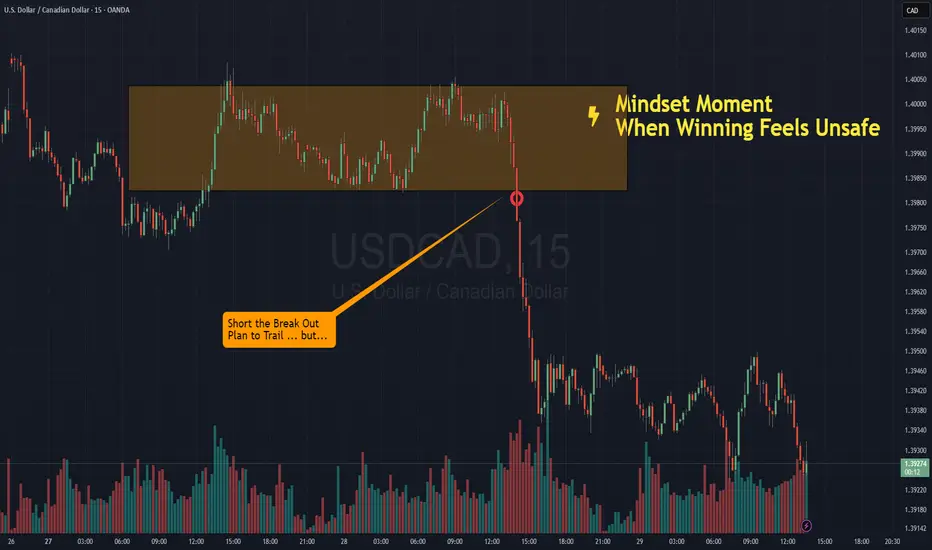
When Winning Feels UnsafeNOTE – This is a post on mindset and emotion. It is not a trade idea or strategy designed to make you money. My intention is to help you preserve your capital, focus, and composure so you can trade your own system with calm and confidence.
You’re in profit.
The trade’s working.
Your system’s doing exactly what it should.
But instead of ease, something tightens.
A flicker of doubt.
You can hear that inner voice: “Don’t mess this up. You wouldn’t want to give this back now would you? How much is enough anyway?”
You scan the chart again.
Check your unrealized PnL.
Move the stop closer.
Start managing… what doesn’t need managing.
Here’s what’s really happening:
Your subconscious is remembering what happened the last time you saw success…
The time you relaxed and it reversed.
The time you felt proud and someone cut you down.
The time you won and it didn’t last.
So even when the market moves in your favour, part of you braces.
Waiting for the other shoe to drop.
So that voice saying, don’t mess this up - is actually a memory trying to protect you.
And in so doing, never really lets you feel safe
The point here is that your work as a trader is to be in the here and now. Not in the past.
Be cognisant to the cues of your memory and body that don’t work in your favour.
So when you notice tension rising,
Take one slow breath. Feel your feet on the floor. And repeat. ‘Right here, right now’.
And then …
Follow your trade plan.
Stay true to your trading plan.
Manage your risk
And let the market do what it does.
Exit
Exit Psychology 4/5: The Profit Target - Certainty vs. PotentialNOTE – This is a post on Mindset and emotion. It is NOT a Trade idea or strategy designed to make you money. If anything, I’m taking the time here to post as an effort to help you preserve your capital, energy and will so that you are able to execute your own trading system as best you can from a place of calm, patience and confidence.
This 5-part series on the Psychology of Exits is inspired by TradingView’s recent post “The Stop-Loss Dilemma.” Link to the original post at the end of this article.
A familiar scenario:
Price is moving your way. You’re edging closer to your profit target. An internal debate begins:
“Should I book it now? What if it turns?” . Your pulse quickens. Thoughts circle:
“What if it turns now?”
“Should I take it here? It’s good enough…”
“But what if I exit and it keeps running?”
One voice says “bank it before it disappears.” Another whispers “hold, the real move is still ahead.”
You exit early, relief for a moment - until you watch the chart run far beyond where you got out. Next time, you hold on longer… only to see your winner evaporate.
Most traders know this dance. It’s not about charts. It’s about the pull between certainty and potential.
How behaviour shows up with profit targets:
The way we take profits tells us more about our beliefs than about the market itself. :
Cutting trades too early: The belief that profit can vanish at any moment, so you must grab it while it’s there.
Holding too long: Rooted in the hope that “one big trade will make the month.” or erase prior losses.
Moving targets mid-trade: Reflects the belief that adjusting = control, even if it means inconsistency.
Ignoring targets entirely: Suggests discomfort with closure - “If I don’t exit, I haven’t missed out yet.”
The psychology underneath:
What looks like “profit management” is often emotional management in disguise:
Loss aversion in reverse: Protecting unrealised gains feels safer than risking them for more.
Regret aversion: The fear of “what if”- too soon or too late - shapes every decision.
Scarcity belief: “Opportunities are rare - I must squeeze every drop.”
Over-attachment: Treating one trade as if it carries all the weight, rather than one of many in a series.
Identity layer: For some, banking profit = validation; missing the bigger move = failure.
At the heart of it is this tension: Do you seek the certainty of closing now, or the potential of holding on? And which one do you believe defines your worth as a trader?
Why traders use profit targets:
Pre-defined targets do have value.
They provides clarity, structure and reduce decision fatigue.
Locks in gains and avoids paralysis at turning points.
They allow for consistent risk-reward planning.
But the challenge is sticking to those targets without rewriting them mid-trade based on emotion. That’s where the psychology is tested.
Practical tips … the How:
The aim is to separate strategy-based exits from emotion-based exits, namely to exit in line with your plan, while conserving psychological capital for the next trade: A few ways traders manage this:
Define profit targets in advance - structure, measured move, or R-multiple and write them down before entry so you are not improvising mid-trade.
Consider scaling out: partial profits banked, partial profits to satisfy the need for certainty, while leaving a portion to capture potential.
Journal post-trade: Did you exit where planned, or did emotion intervene? Track the pattern across multiple trades.
Build awareness: notice the urge to “grab it” or “stretch it.” Pause and label the feeling (fear/greed/doubt) before acting on it. Naming the emotion can reduce its grip on you.
Reframe:
A profit target isn’t a ceiling. It’s a decision point. The skill isn’t in guessing the high it’s in exiting consistently in line with your plan, while protecting your psychological capital for the next trade.
Closing thought:
Every profit exit is a mirror. It reflects not only what the market offered, but also how you relate to certainty, potential, and trust in your own process.
A link to Exit Psychology 3/5 : The Trailing Stop – Patience vs. Protection
A link to the original article as promised:
This is Part 4 of the Psychology of Exits series .
👉 Follow and stay tuned for Part 5: Tight vs. Loose - Personality, Context, and the Real Trap.
Risk Management: The Key to Trading SuccessCut the Cord: A Trader's Survival Guide
How to Cut Losses Wisely: A Trader's Guide
Mastering the Exit: A Trader's Handbook
As a trader, it's inevitable to encounter losing trades. However, the key to success lies in how you manage these losses. By implementing effective strategies, you can minimize their impact and stay on track towards your financial goals.
1. Manage Your Risk:
Never risk more than you can afford to lose. Diversify your portfolio, spread your investments across different assets, and avoid over-leveraging. By managing your risk, you can protect your capital and prevent a single losing trade from causing significant damage.
2. Set Stop-Loss Orders:
Your stop-loss order acts as a safety net, protecting your capital from excessive losses. Determine a specific price point at which you'll exit a trade if it moves against you. This helps prevent emotional trading decisions and ensures you stay disciplined.
3. Consider Trailing Stop-Loss Orders:
A trailing stop-loss is a dynamic order that adjusts automatically as the price moves in your favor. It allows you to lock in profits while still protecting against potential losses. This can be a valuable tool for managing your positions effectively.
4. Stick to Your Trading Plan:
A well-defined trading plan is your roadmap to success. It outlines your strategies, risk management rules, and exit points. Adhering to your plan, even during challenging times, helps avoid impulsive decisions that can lead to further losses.
5. Stay Informed:
Keep up-to-date with market news, economic indicators, and industry trends. Understanding the factors driving price movements can help you anticipate potential risks and make informed decisions.
6. Cut Your Losses Quickly:
Don't hold onto losing trades in the hope that they will recover. Cut your losses promptly to minimize the damage and preserve your capital for future opportunities.
7. Learn from Your Mistakes:
Every losing trade is an opportunity to learn and improve. Analyze your trades, identify the reasons for the losses, and adjust your strategies accordingly. By learning from your mistakes, you can become a more successful trader.
8. Take Breaks:
Emotional fatigue can lead to poor decision-making. When you're feeling overwhelmed or stressed, take a break from trading to allow yourself time to recharge and regain perspective.
9. Seek Guidance:
If you're struggling to manage losses or unsure about your trading strategies, consider seeking advice from a mentor or professional trader. They can provide valuable insights and help you develop effective risk management techniques.
10. Maintain a Positive Mindset:
Trading can be emotionally challenging, but it's important to maintain a positive mindset. Focus on your long-term goals, learn from your setbacks, and believe in your ability to succeed.
Remember, losing trades are a natural part of trading. By adopting these strategies, you can effectively manage your losses, protect your capital, and increase your chances of long-term success.
I am not Sebi registered analyst.
My studies are for educational purpose only.
Please Consult your financial advisor before trading or investing.
I am not responsible for any kinds of your profits and your losses.
Most investors treat trading as a hobby because they have a full-time job doing something else.
However, If you treat trading like a business, it will pay you like a business.
If you treat like a hobby, hobbies don't pay, they cost you...!
Hope this post is helpful to community
Thanks
RK💕
Disclaimer and Risk Warning.
The analysis and discussion provided on in.tradingview.com is intended for educational purposes only and should not be relied upon for trading decisions. RK_Charts is not an investment adviser and the information provided here should not be taken as professional investment advice. Before buying or selling any investments, securities, or precious metals, it is recommended that you conduct your own due diligence. RK_Charts does not share in your profits and will not take responsibility for any losses you may incur. So Please Consult your financial advisor before trading or investing.
Know When To Close Your Trades!It's important to know when to hold a trade and when to close it.
Knowing can be difficult, however ask yourself - would I open a position at the current price?
For example, if you have bought a trendline and the trendline breaks should you close the trade? We say yes.
The exception to this is backtesting. If you backtest manual exits of a trade you can find the optimal exit strategy for your trade plan.
The logic of "sell half keep half" (Forex)Both holding & not holding don't make sense.
Definitions:
- Holding = try to hit "homeruns" every time
- Not holding = snatching profits at target (not before, that's just being a huge noob)
Assume winners 5 times bigger than losers on average: 5R.
And the winrate is of 20%. So that's a PF of 1.25, all good.
To keep it simple there is no trailing until target.
Risking 0.5% per trade you'll never be down more than 10%.
Once at target if you move the stop to 1R (-4),
12% of the time the price will go to 45R.
So risk 4 to make 40, or 1 to make 10.
With a winrate of 12%. PF = 1.36.
But if you do hold and trail well...
12% of 20% is 2.4% of total.
80% will be losers (-1R),
17.6% will be +1R,
and only 2.4% will be (huge) winners.
In other words:
Risking 0.5% per trade, by the time you get that big winner (+22.5%)
you will be down 15, 25, maybe 50% on a bad luck streak, or more.
22.5% is just enough to get to breakeven after an 18% drawdown.
Compared to just lose 4 times (down to 98%) then win once 2.5% (up to 100.45%)
Even after a 10% drawdown (an unlucky >20 losses in a row) get a few 5R's and you quickly get back to zero.
Holding just makes little sense, and there is no margin for error.
But at the same time it's stupid to ignore these big wins.
So here is the solution:
Sell half, keep half. (Or any other fraction).
Selling half at target allows to smooth the returns.
If they are too volatile it just won't work out.
And keeping half first with a wide stop then maybe not as much, allows to catch the "big ones".
This makes most sense even if "on paper" some will say "oh well you should go for the big ones if the odds are in your favor" lol sorry but it's a bit more complicated than this.
More generally with Forex I think that any risk to reward under 1 to 2 is bad as is anything above 1 to 10.
Can aim for the moon, but not all the time. The "sell half keep half" concept is the best compromise.
Adding to winner at some point is too dangerous, it doesn't work, it's just greed.
Adding to winners is another subject entirely and anyway there is nothing as a "just do this".
It all must be researched and well thought.
With this sell half concept you're securing 2.5 + 1.25 = 3.75 / 5R so that's 75% of the profit.
Then risking 25% of profit to catch some of these massive winners is I think the smart move here.
Profit is secured, to push this a bit further you might have thought of this already:
secure enough profit to breakeven (on 20% winrate secure 4/5 R) and "go double or nothing" on the extra (1R).
So it's as if in a way these big winners are "free".
Risking 1R with 50% retracement means you're leaving 2R in or 2/5 = 40%. Pretty good.
And then the account I showed turns to this:
Isn't this the best? Sure you'll "only" be in the huge wins with maybe 1/3 of the normal size but it's how it is.
This is not gambling. Really, there is no other choice in my opinion.
Sort of go nowhere for a while, then boom get a big winner, account jumps up, then go nowhere for a while, etc.
The risk all "double or nothing" is actually stupid even if "on paper" you are risking less than you stand to make.
And constantly closing at target is just bad and leaving some profit on the table.
This does not apply to stocks (sometimes it does, probably).
To be honest with stocks you're better off holding everything and getting these zigzags and all so you always have (balanced out) losses ready to be declared, and the huge winners never ever getting closed.
How Do You Know When To Exit A Trade? Hey Traders 👋
Today I wanted to share with you a quick lesson that has helped me with knowing exactly when to enter and exit trades....
First:
Add the 4 and 10 period moving averages to your chart
Second:
When the trend begins let your profits ride until either
A) A Candle closed above or below the 10 moving average (you could close early, but its the most profitable exit)
B) The 4 and the 10 MA cross back over eachother at candle close (less profitable, but more concrete)
I hope this helps with increasing profit instead of hoping and guessing! Take a look for yourself and see if this is something that you want to implement on your charts and strategies!
How to use the Oscar OscillatorOSCAR Oscillator by GenZai
Green line is the Oscar Rough
Red line is the Oscar
By default based on the 8 last candles and smoothed using RMA
Purple line is the Slow Oscar
By default based on the 16 last candles and smoothed using WMA
HOW TO USE
Exit signaling
This indicator can be used as an exit indicator when line cross each other.
Entry signaling
When the green line crosses up, it indicates a long entry
When the red line crosses up, it indicates a short entry
Overbought/Oversold
When the indicator crosses the dashed grey lines it indicates Overbought Oversold
Slow Oscar Add-on
This is an Add-on to the orignal Oscar indicator
Can be hidden if you want the original experience of the Oscar indicator.
Can be used as a confirmation indicator by looking at the direction of the slope to verify is your are trending long or trending short.
Can be used as a baseline to confirm signals given by Oscar
Can be used to tweak your signals and test different settings.
Stock or Forex?
The program was originally written for stocks, but works equally well with the Forex market.
How this indicator is calculated ?
This is the formula we use to calculate the Oscar:
let A = the highest high of the last eight days (including today)
let B = the lowest low of the past eight days (including today)
let C = today's closing price
let X = yesterday's oscillator figure (Oscar)
Today's "rough" oscillator equals (C-B) divided by (A-B) times 100.
Next we "smooth" our rough number (let's call it Y) like this:
Final oscillator number = ((X divided by 3) times 2), plus (Y divided by 3).
SETTINGS:
You can choose between different smoothing options:
RMA: Moving average used in RSI. It is the Adjusted exponential moving averages (also known as Wilder's exponential moving average)
SMA : Simple moving average
EMA : Exponential moving average
WMA : Weighted moving average
The Script can be found here:
Trading Entry and Exit ChecklistsSELF DEVELOPMENT/METHODOLOGY/PSYCHOLOGY
Trading Entry and Exit checklists
Over the past 18 years of trading, it has been a crucial step in my development to constantly critique myself and my trading strategy. I constantly monitor my performance on a daily, weekly,monthly,quartley and yearly timeframe. Listed below is a small simple example of some of the checklists that i have used in the past prior to entering and exiting a trade.
Entry Rules
1. Is the stop loss placed past the strongest support or resistance line?
2. Am i following my trading rules?
3. The risk/reward is acceptable
4. Have i double checked my entry/stop loss and target position?
5. No news announcements that will affect my trade?
6. Bid/ask spread - Is it in normal range for this pair, this session, this time?
7. AM i risking more then my agreed 1%?
8. Correlation - AM i trading against myself with already open trading trades?
Exit Rules
1. Has the market behaved as predicted? If so stay on track
2. Has the trade reached the support or resistance line?
3. Has the stop been placed too far away? or to close?
4. Am i exiting to early?
5. If unsure of trade exit immediately?
6. If i was impatient and entered trade exit immediately?
7. Is there an upcoming news event that will affect my trade?
8. Is the trade changing directions?
9. Don't take profits to early!! Are you exiting before your target line?
How has yours differed? is it similar?
A Strategy for Market Entry and Exit - Part 3SUGARUSD:OANDA Weekly Chart
A-E are similar to A-C above.
F. This is another example of a DI becoming dominant in a pullback but for only a brief period of time. Notice how (A) gave a signal but that an exit was quickly signaled. After the pullback (B), then (C) gave a new entry signal to long side for many weeks before TRIX signaled a potential cover of the short.
G. Is another example of the action similar to (F).
NOTE: These types of actions work best when the ADX is above 20 or when it is trending up.
SUGARUSD:OANDA Daily Chart
More examples of the same concepts. However, this one provides good insight into a strong trend and how the TRIX, in conjunction with the DMI, will keep you in a market longer. And, when an exit is signaled, how to re-enter if the DMI indicates the trend is still intact.
A Strategy for Market Entry and Exit - Part 2Part 1 can be found here:
Key Tenants
DMI is used as a triggering mechanism to establish support->resistance or resistance->support lines
TRIX used to identify targets to exit and re-enter and on-going trend (if the DMI indicates a down trend, the a negative cross of TRIX over HMA would indicate a level to short
Divergence can happen in both DMI and TRIX to indicate a weakening trend. With the TRIX, it can be a negative divergence where price makes new lows but TRIX makes higher lows or positive divergence where price is making a new low but TRIX is making lower lows in a blow-off fashion.
Stoch indicates overbought/sold conditions with potential leading trigger on trade. Can leverage mid-point levels as trade continuation
SUGARUSD:OANDA as an example reference 4hr chart above
A. This is the period where the -DI crossed up over the +DI signaling that the trend was turning down. For Wilder, the low on this day would be the extreme point and you would enter a short position once price moved below it. A stop would be placed at the high of the same day as the cross. I’m looking at this more from the point of using the closing price instead of the high or low. If the next day closed below this price, then I would enter a short position at that close. At this point, you can use whatever trailing stop strategy you currently used to exit should price move contrary to your position
B. This is the day that the +DI crossed up over the -DI signaling a possible buy. However, price did not close above this line before the ADX (green line on the DMI) dropped below both DI’s and eventually 20. Once this happens, a trend following indicator should not be used and signals that happen now I don’t act on. What has been suggested is that during this time, look for patterns in price and watch for price to breakout of this pattern.
C. -DI again crosses up over +DI and with price closing below this line, a signal to enter short again is given
1. This is the first signal after (A) that indicates a correction may be happening. Once the TRIX crosses up over the HMA, that period’s close is used as the line to determine if the trade will be closed. If price closes above this line, then exit the trade. This is the case and the short position would have been exited
2. Because the trend is still down as indicated by the -DI being dominant, when the TRIX crosses down over the HMA, the close for that period is used to enter another short position.
3. Again, a signal is given to cover the short but in this case, price did not close over this close so the trade would not have been exited even though many periods went by
4. This time, the signal was hit to cover the short and again, due to the trend being down (-DI dominant), the signal was again triggered to re-enter a short position
5. Exit signal given and short was covered
6. This time, the sell signal to re-enter was not hit and price eventually entered a period of consolidation signaled by the ADX dropping below both DI’s and 20
7. NOTE: This is a important part of DMI/ADX that I use and will keep you out of a lot of churn in markets: When ADX drops below both DI’s and/or below 20, don’t use a trend following indicator to take trades. An option is to look for a price pattern (a channel, flag, a triangle, maybe a trend line) for price to consolidate into and then break out of. This consolidation should last for at least 5-7 periods or longer. Use the TRIX to potentially give a signal as to the direction of the breakout. In this case, the breakout was to the down side.
Between (B) and (C), you see a pattern that happens in the DMI where there is a pullback. In these cases, one of the DI’s can become dominant for a briefly.