Nifty 50 | Intraday Price–Time Structure Study(12 July 2023 | WD Gann Methodology)
This idea is a historical, educational study demonstrating how price structure and time alignment, as described in classical WD Gann methodology, can be analysed on an intraday chart.
This post is not a trade call, prediction, or recommendation.
📌 Market Context
On 12 July 2023, Nifty was trading within a short-term consolidation phase after a prior decline.
According to WD Gann principles:
Markets often react near structural price levels
These levels gain importance when price and time balance
Risk is always defined before observing market response
📈 What the Chart Illustrates
The chart highlights:
A reference price zone derived from prior structure
A downside risk boundary used for invalidation
Subsequent price response after interaction with the level
This example is shared to explain how price structure can be studied objectively, without emotional bias.
🧠 Key Learning Points
Gann analysis begins with price structure
Risk must be pre-defined, not adjusted later
Time confirms whether price is accepted or rejected
Studying completed sessions improves execution discipline
The focus here is on process, structure, and risk awareness, not outcome.
⚠ Disclaimer
This idea is shared strictly for educational and analytical purposes only.
It does not constitute financial advice, live trade calls, or investment recommendations.
Ganntheory
Nifty 50 | Price–Time Square Structure(22 Nov 2023 | Educational Gann Study)
This idea presents a historical, educational study of how Price–Time Square geometry, as described in classical WD Gann methodology, appeared on the Nifty 50 intraday structure.
The intent of this post is market structure analysis, not prediction or trading advice.
📌 Structural Context
On 22 November 2023, Nifty was trading within a defined intraday range after a prior swing.
According to Gann principles:
Markets often respond to square relationships between price and time
When price units align proportionally with time units, measurable reaction zones may appear
These zones act as reference levels, not guarantees
📈 What the Chart Illustrates
The chart highlights:
A reference base level used for structure measurement
Two price–time proportional zones derived from square calculations
Price movement interacting with these zones during the same session
This example helps demonstrate how price symmetry and time balance can be studied objectively.
🧠 Key Takeaways
Gann analysis focuses on structure, not certainty
Price–Time Squares help define potential reaction areas
Risk control and confirmation remain essential
Studying completed sessions improves future market awareness
The emphasis is on process and discipline, not outcome.
⚠ Disclaimer
This idea is shared strictly for educational and analytical purposes.
It does not constitute financial advice, live calls, or recommendations.
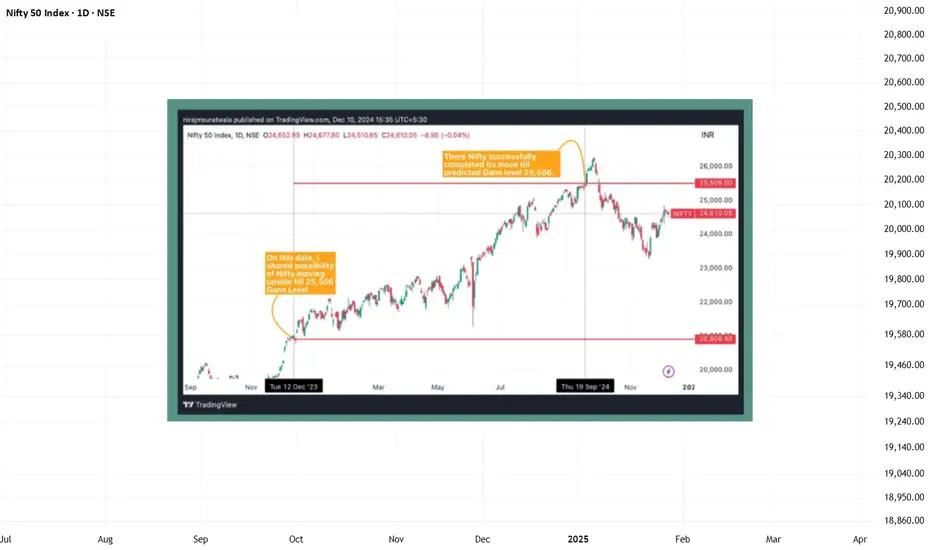
Nifty 50 | Gann Price–Time StructureDecember 2023 – September 2024 (Educational Case Study)
This idea is a historical and educational study of how Gann price–time geometry aligned with Nifty 50’s movement over a multi-month period.
It is shared only to explain structure and methodology, not as a forward-looking forecast or trading advice.
📌 Historical Context
In December 2023, Nifty was trading near a major price–time pivot zone formed after a prolonged consolidation phase.
Using classical WD Gann principles — including:
Price symmetry
Harmonic level progression
Time–price balance
a key higher resistance zone was identified on the chart as an important reference level.
📈 What the Chart Demonstrates
From an observational standpoint:
Price respected the lower structural base
A sustained bullish phase unfolded over the following months
The market eventually tested a major horizontal Gann level
After reaching that zone, price behavior shifted into consolidation and correction, which is typical near higher-degree levels
The chart highlights how markets respond to geometry and time alignment, rather than reacting randomly.
🧠 Key Educational Insight
This case study reinforces several important Gann concepts:
Gann levels act as zones of interaction, not guarantees
Reaching a major level does not automatically imply reversal
Confirmation always comes after price behavior is observed
Responsibility in analysis means waiting for structure, not assuming outcomes
Understanding this distinction helps traders move away from emotional reactions and focus on process-driven analysis.
Disclaimer
This idea is shared strictly for educational purposes only.
It is not a prediction, recommendation, or financial advice.
Nifty 50 | Gann Levels & Market GeometryAugust–November 2024 (Educational Case Study)
This idea is a post-event educational case study explaining how Gann price levels aligned with Nifty 50’s structure during Aug–Nov 2024.
The objective is to study how price reacted around predefined geometric levels, not to make forward predictions.
📌 Context (Historical Observation)
In early August 2024, Nifty was trading near the 24,200 region after a corrective phase.
Using Gann-based price geometry, two important price zones were identified on the chart:
A higher structural support zone
A lower fallback support zone
These zones were derived from price symmetry and Gann level spacing, which are commonly studied in classical Gann analysis.
📈 What the Chart Shows
From a purely observational perspective:
Price halted its decline near the upper support zone
From that area, the market transitioned into an upward phase
The advance later tested a major horizontal resistance zone
Subsequent corrections respected the same geometric framework
A lower Gann level was later adjusted slightly based on updated market structure and time progression — a normal process in Gann studies when price evolves.
🧠 Educational Takeaway
This case highlights how:
Markets often respond to predefined price geometry
Gann levels act as reference zones, not guarantees
Structure becomes clearer after the fact, helping traders improve future analysis
Geometry-based mapping can reduce emotional decision-making
Important Note:
This idea is shared strictly for educational and analytical purposes only.
It does not represent a live trading call or financial advice.
ICICI Bank | Gann Square of 9 Intraday Case Study | 06 Apr 2023This chart presents a classical WD Gann Square of 9 intraday setup, where price completed its normal capacity early in time, leading to a high-probability reversal.
On 06 April 2023, ICICI Bank started gaining upside momentum from the third 15-minute candle.
The intraday low at ₹875 was selected as the 0-degree (0°) reference point, following standard Gann methodology.
Using the Gann Square of 9, the stock’s normal intraday upside level was projected at:
45° → ₹890
Price reached the 45-degree level around 11:15 AM, which is significantly earlier than the ideal Gann time window near 2:30 PM.
As per Gann’s time–price relationship, early completion of a degree level often indicates temporary exhaustion.
The stock reacted precisely from this zone and reversed lower, offering clear intraday downside movement.
This case highlights how price geometry combined with time analysis helps traders identify logical reaction zones, rather than depending on indicators or assumptions.
📌 Key Gann Levels
0° → 875
45° → 890
🔍 Learning Points
Square of 9 defines price capacity
Time determines when that capacity becomes effective
Early completion = higher probability of reaction
Structure > indicators
Disclaimer:
This idea is shared for educational and analytical purposes only. It is not a trading or investment recommendation.
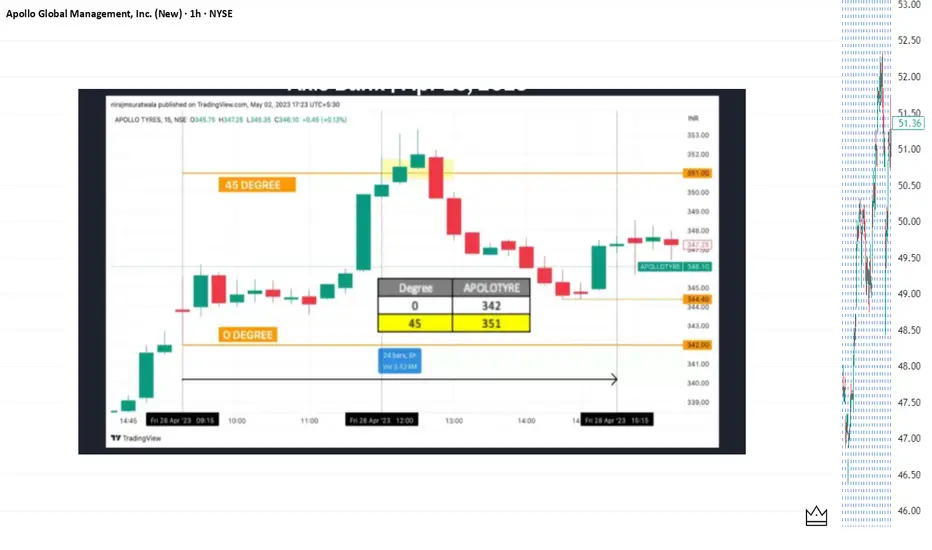
Apollo Tyres | Gann Square of 9 Intraday Case Study | 28 Apr 202This chart demonstrates a classic Gann Square of 9 intraday application, where price reached its normal capacity early in time, leading to a logical reversal.
On 28 April 2023, Apollo Tyres opened with strong upward momentum.
The low of the first 15-minute candle (₹342) was selected as the 0-degree (0°) reference point, following standard WD Gann methodology.
Using the Gann Square of 9, the stock’s normal intraday upside capacity was projected at:
45° → ₹351
Price reached the 45-degree level around 12:00 PM, which is well before the ideal Gann timing window near 2:30 PM.
According to Gann’s time–price relationship, early completion of a degree level increases the probability of exhaustion.
The market reacted immediately from this zone and moved lower, offering clear and logical intraday selling opportunities.
This example highlights how price geometry combined with time analysis helps traders identify high-probability reaction zones, rather than relying on guesswork.
📌 Key Gann Levels
0° → 342
45° → 351
🔍 Key Takeaways
Square of 9 defines price capacity
Time defines when that capacity matters
Early degree completion often signals exhaustion
Geometry + time = structured intraday decisions
Disclaimer:
This idea is shared strictly for educational and analytical purposes. It does not constitute investment or trading advice.
Axis Bank | Gann Square of 9 Failure Case Study | 10 Jul 2023This chart highlights an important learning example of the Gann Square of 9 — where price alignment occurred, but time confirmation failed.
On 10 July 2023, Axis Bank started a downside move.
The day’s high at 986 was selected as the 0-degree (0°) reference point, following standard Gann price–angle methodology.
Using the Square of 9, the following intraday levels were projected:
45° → 970
90° → 955
The stock reached the 45-degree level (970) around 1:00 PM, which is earlier than the ideal Gann timing window (around 2:30 PM).
While a short-term reaction is often expected near the 45° level, price failed to hold and continued lower, eventually trading near 965, moving toward the next degree zone.
This case reinforces a critical Gann principle:
Price alone is not sufficient — time confirmation is equally important.
Studying such failure structures improves discipline, expectation management, and probabilistic thinking in intraday trading.
🔍 Key Learning Points
Square of 9 defines price structure
Time determines probability
Early achievement of a degree level does not guarantee reversal
Failure cases are essential for refining execution rules
📌 Key Gann Levels
0° → 986
45° → 970
90° → 955
Disclaimer:
This idea is shared strictly for educational and analytical purposes. It does not constitute trading or investment advice.
Axis Bank | Gann Square of 9 Intraday Case Study | 28 Jun 2023This chart demonstrates a pure intraday application of Gann Square of 9 using price–degree structure.
On 28 June 2023, Axis Bank showed upward continuation after the second 15-minute candle.
The lowest price of that structure (967) was taken as the 0-degree (0°) reference point, in line with classical Gann methodology.
Using Square of 9 calculations, the 45-degree level was projected at:
45° → 983
This level represents the normal intraday upside capacity of price.
By 2:15 PM, Axis Bank reached the 45-degree level, slightly ahead of the ideal 2:30 PM timing window.
As per Gann rules, early completion of price capacity often leads to reaction or reversal.
Price reacted precisely from the 983 zone, confirming the price–degree balance and providing a clear intraday reaction area.
🔍 Key Observations
Square of 9 defines measured price capacity
Time plays a confirming role, not a prediction
Early arrival at capacity increases reaction probability
Focus remains on structure, not signals
📌 Key Gann Levels
0° → 967
45° → 983
Disclaimer:
This analysis is shared for educational purposes only and does not constitute trading or investment advice.
Axis Bank | Gann Square of 9 Intraday Case Study | 20 Oct 2023This idea highlights an intraday price-reaction study in Axis Bank using the Gann Square of 9 and classical price–angle logic.
On 20 October 2023, Axis Bank started the session with downward momentum.
The first 15-minute structure defined the reference point, where 993 was used as the 0-degree (0°) base.
Using Square of 9 calculations, the 45-degree level was projected at:
45° → 977
This level represented the stock’s normal intraday downside capacity.
Price reached 977.75 around 12:45 PM, reacting precisely within a 1-point tolerance, which aligns with standard Gann accuracy ranges.
From this zone, Axis Bank showed a clear intraday bounce, moving back toward 985+ levels, validating the projected price-angle support.
🔍 Key Observations
Square of 9 helps define logical intraday capacity
Angle levels act as reaction zones, not predictions
Price respected the calculated level within normal variance
Focus is on structure and price behavior, not signals
📌 Key Gann Levels
0° → 993
45° → 977
Disclaimer:
This chart is shared strictly for educational and analytical purposes. It does not constitute trading or investment advice.
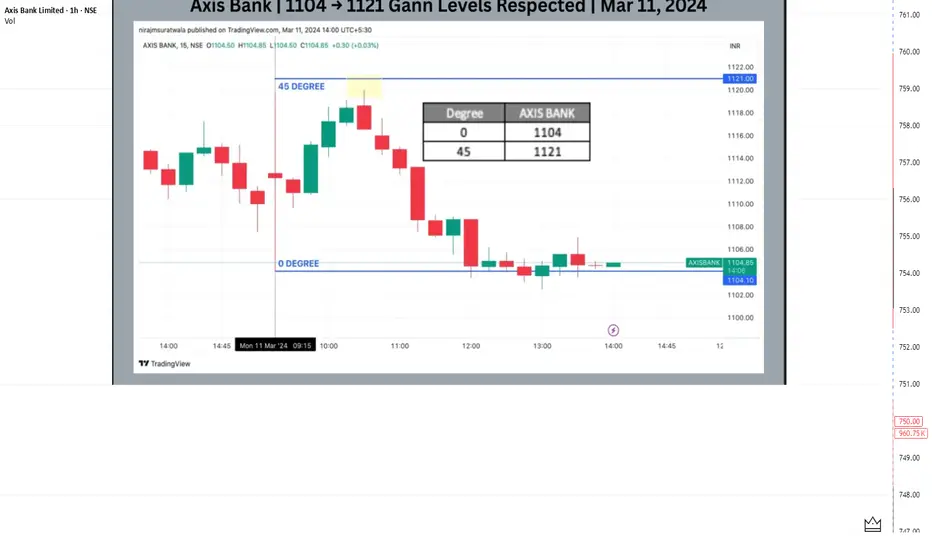
Axis Bank | Gann Square of 9 Intraday Case Study | 11 Mar 2024This chart presents an intraday price-reaction study in Axis Bank using the Gann Square of 9.
After the first 15-minute candle showed upward momentum, the low of that candle (1104) was used as the 0-degree reference, following classical WD Gann price-angle principles.
Using Square of 9 calculations, the 45-degree level was projected at:
45° → 1121
Price moved into the 45-degree zone before the later part of the session, indicating completion of its normal intraday upside capacity.
As per Gann methodology, when price reaches a calculated angle earlier than expected, the market often responds with a temporary price reaction.
Axis Bank reacted from the 1120–1121 zone, respecting the projected level within a normal intraday margin.
🔍 Key Observations
First 15-minute structure defines the degree base
Square of 9 provides objective intraday price levels
Early arrival at angle levels highlights price exhaustion
Focus is on reaction zones, not trade recommendations
📌 Key Gann Levels
0° → 1104
45° → 1121
Disclaimer:
This idea is shared for educational and analytical purposes only and does not constitute trading or investment advice.
Axis Bank | Gann Square of 9 Intraday Case Study (12 March 2024)This idea presents an intraday price reaction study in Axis Bank using the Gann Square of 9, with focus on price–time balance.
On 12 March 2024, Axis Bank showed early strength from the first 15-minute candle.
The low of the first 15-minute candle near 1100 was considered the 0-degree reference, following classical WD Gann methodology.
Using Square of 9 calculations, the following level was derived:
45° level → 1117
Price reached the 45-degree level very early in the session (around 9:30 AM), much earlier than the commonly observed time balance later in the trading day.
According to Gann principles, early completion of price expansion often reflects temporary imbalance, after which the market may attempt to rebalance.
Following this early test of the 45° level, Axis Bank showed intraday weakness and downside continuation.
🔍 Key Observations
Early intraday structure defines the degree base
Square of 9 helps project natural price expansion levels
Early arrival at angle levels can indicate price exhaustion
Focus is on reaction zones, not prediction
Key Gann Levels Observed
0° → 1100
45° → 1117
Disclaimer:
This idea is shared strictly for educational and analytical purposes only.
It does not constitute trading or investment advice.
Axis Bank | Gann Square of 9 Intraday Case Study (15 March 2024)(Educational Purpose only)
This idea explains an intraday price reaction in Axis Bank using the Gann Square of 9 method, focusing on price–time balance.
On 15 March 2024, Axis Bank showed initial weakness from the first 15-minute candle.
The high of the first 15-minute candle near 1050 was considered as the 0-degree reference, following classical WD Gann methodology.
Using Square of 9 calculations, the following key level was derived:
45° level → 1034
Price declined rapidly and reached the 45-degree level very early in the session (around 9:45 AM), much before the commonly observed time balance later in the day.
Such early completion of price expansion often reflects price exhaustion.
After testing the 45° level, Axis Bank showed rejection and reversal, offering clean intraday recovery points from that zone.
🔍 Key Observations
Define the 0-degree base from early intraday structure
Use 45° as a normal price expansion reference
Early arrival at angle levels can indicate imbalance
Gann geometry helps identify logical reaction areas, not predictions
This case study demonstrates how price and time symmetry can be observed using structured chart analysis.
Disclaimer:
This idea is shared strictly for educational and analytical purposes only.
It does not constitute investment or trading advice.
AXIS BANK | Price–Time Square & Law of VibrationAXIS BANK | Price–Time Square & Law of Vibration – Educational Case Study (Nov 2021)
Disclaimer:
This analysis is for educational purposes only.
I am not a SEBI-registered advisor.
This is not financial advice.
This idea shares an educational case study on Axis Bank (NSE) to demonstrate how WD Gann’s Price–Time Square and Law of Vibration have historically interacted with price behavior.
📌 Study Background
In November 2021, Axis Bank was observed near a price–time square zone around 669–681
The square had completed earlier, indicating a potential timing window
The focus of this study is observation of price behavior, not prediction
📊 Observed Historical Behavior
Price revisited the vibration zone during the time window
The market showed temporary pressure reduction near the zone
On a closing basis, structure remained stable for that session
Subsequent movement respected the broader time–price relationship
🧠 Educational Insight
Price–time squares highlight areas of possible pause, reaction, or continuation
These zones do not guarantee reversals
Market response depends on time alignment, structure, and follow-through
Gann analysis is best used to study behavior, not issue trade instructions
This post is intended purely to help traders understand how price and time have aligned historically under WD Gann principles.
CNX AUTO | WD Gann Law of VibrationCNX AUTO | WD Gann Law of Vibration – Educational Case Study (Sept 2021)
Disclaimer:
This analysis is for educational purposes only.
I am not a SEBI-registered advisor.
This is not financial advice.
This idea presents an educational case study on CNX AUTO (Nifty Auto) using WD Gann’s Law of Vibration, focusing on how markets have historically behaved after interacting with specific vibration zones.
📌 Study Context
During September 2021, CNX AUTO was observed near a Gann vibration base zone around 9785
This zone was studied as a potential energy / pressure area, not as a trade signal
The objective was to observe price behavior after vibration alignment
📊 Observed Market Behavior
Price showed stability and reduced downside pressure near the vibration base
Sustained trade above the zone was followed by gradual strength development
Over time, the index expanded upward, reflecting range expansion after vibration alignment
🧠 Educational Insight
Gann vibration levels do not guarantee reversals
Some levels act as structural bases where energy builds over time
Expansion often follows time + price alignment, not indicators or news
Understanding why price reacts is more important than predicting how far
This study is shared to help traders understand how vibration-based zones have behaved historically in index movement and how patience and structure matter when applying WD Gann concepts.
CNX AUTO | Gann Vibration Reaction Study(WD Gann Law of Vibration | Aug 2021)
This idea shares a historical educational study of CNX AUTO using WD Gann’s Law of Vibration, focusing on how markets react to vibration-aligned pressure zones during strong trends.
⚠️ This is not a trading recommendation and is posted strictly for learning purposes.
📌 Study Context
During August 2021, CNX AUTO was trading in a well-established bearish structure.
Instead of looking for a reversal, the study focused on identifying where price could temporarily react or pause based on vibration alignment.
A key Gann vibration level was marked as a pressure zone, not as a trend-change signal.
📊 What the Chart Illustrates
Ongoing bearish price structure
A predefined Gann vibration level
Price interaction near the vibration zone
Temporary slowdown in downside momentum
This highlights how not all Gann levels signal reversals—some act as reaction or hesitation zones.
🧠 Educational Takeaways
Gann vibration levels can create pause, reaction, or time correction
Reaction zones differ from reversal zones
Trend context is essential when interpreting Gann levels
Professional analysis distinguishes impact from trend change
⚠️ Disclaimer
This post is for educational purposes only and does not constitute investment advice.
NIFTY 50 | Price–Time Exhaustion Zone Study(September 2022 | WD Gann Framework)
This idea presents a historical market structure study based on WD Gann’s price–time principles, focusing on how downside pressure often pauses near exhaustion zones.
⚠️ This post is not a trading signal and is shared strictly for educational purposes.
📌 Context of the Study
By late September 2022, NIFTY was still under downside pressure.
However, price–time symmetry and vibration balance suggested that the decline was approaching a temporary pause zone, rather than an immediate trend reversal.
The key observations were:
Downside momentum was losing balance
A pause or consolidation phase was statistically more likely
Blind buying without confirmation carried higher risk
Sustainable moves require price confirmation after pressure release
📊 What the Chart Illustrates
A well-defined downside pressure zone
Price reaction near a time-aligned level
Market stabilization following pressure exhaustion
How markets often pause before clarity emerges, not at emotional extremes
🧠 Educational Takeaways
Markets respond to pressure zones created by price and time
Not every pause is a reversal — structure comes first
WD Gann analysis emphasizes patience and confirmation
Studying completed structures improves future decision-making
⚠️ Disclaimer
This analysis is shared for educational and research purposes only and does not constitute financial advice.
NIFTY 50 | Vibration-Based Reversal Zone Study(September 2022 | WD Gann Framework)
This idea shares a historical market structure study based on WD Gann’s Law of Vibration, focusing on how specific price zones become sensitive when vibration balance shifts.
⚠️ This is not a trade recommendation or signal.
The post is shared strictly for educational purposes.
📌 Study Background
In mid-September 2022, NIFTY reached a price region where vibration alignment and structural symmetry became more relevant than short-term momentum.
Rather than reacting to price movement, this study observes:
Pre-defined vibration-sensitive zones
Market behavior near structural extremes
How reversals often occur when vibration conditions change
📊 What the Chart Demonstrates
A clearly defined resistance zone
A time-aligned price reaction
Expansion in volatility following vibration shift
How markets often move after internal balance changes, not news events
🧠 Educational Takeaways
Vibration governs when reversals become possible
Price reacts only after internal conditions shift
WD Gann analysis focuses on structure and balance
Studying completed cycles helps understand future behavior
⚠️ Disclaimer
This analysis is shared for educational and research purposes only and should not be considered financial advice.
NIFTY 50 | Natural Time Cycle Observation(Jan–Mar 2023 | WD Gann Framework)
This post presents a historical market study focusing on time-cycle behavior in NIFTY, using concepts derived from WD Gann’s Natural Time Cycle and Vibration framework.
⚠️ This is not a trading signal or forecast.
Shared strictly for educational and analytical purposes.
📌 Study Context
During mid-January 2023, NIFTY entered a period where time symmetry and vibration balance became more relevant than short-term price movement.
Instead of forecasting direction, this study focuses on:
Time windows
Structural reference levels
Volatility expansion zones
📊 What the Chart Illustrates
A clearly defined reference low
A broader time window extending into late March
How markets often resolve trends near time-cycle completion
Price reaction occurring after time alignment, not before
🧠 Key Educational Observations
Time plays a leading role; price responds later
Natural cycles often define when movement expands, not how
Gann analysis emphasizes market structure, not prediction
Studying completed cycles improves contextual market understanding
⚠️ Disclaimer
This content is for educational purposes only and does not constitute financial advice or a trading recommendation.
NIFTY 50 | Time-Based Market Structure Study(Oct–Dec 2022 | WD Gann Framework)
This idea shares a historical, educational study of how time-based market structure can be analyzed using principles derived from WD Gann methodology.
⚠️ This is not a forecast or trade call.
It is a post-event structural study for learning purposes only.
📌 Study Context
During October 2022, NIFTY was in a corrective phase with strong bearish sentiment.
Instead of focusing on momentum or news, this study highlights how time exhaustion and structural balance can be observed on the chart.
📊 What the Chart Demonstrates
A time zone where selling pressure began to lose effectiveness
Price behavior shifting from impulse decline to consolidation
How markets often pause or reverse when time symmetry completes
A subsequent time window where expansion stalled again
This study focuses on how time influences structure, not on predicting future market movement.
🧠 Key Learning Points
Markets often change behavior after time completion, not price extremes
Time-based analysis helps identify risk zones, not certainty
WD Gann methods emphasize structure and balance, not directional bias
Studying past cycles improves contextual understanding
⚠️ Disclaimer
This content is shared strictly for educational and research purposes.
It does not constitute investment advice, recommendations, or forecasts.
NIFTY 50 | Price–Time Square Structure Study(May 2023 | WD Gann Framework)
This idea shares a historical chart study explaining how Price–Time Square alignment can be observed in NIFTY using classical WD Gann methodology.
⚠️ This is a chart study for educational purposes only, not a forecast or trading recommendation.
📌 Concept Overview
WD Gann’s Price–Time Square concept focuses on:
Balance between price movement and time progression
Structural symmetry rather than indicators
Understanding when markets remain within a valid structural window
During May 2023, NIFTY was in an ongoing trend phase where price acceptance within a defined structure could be observed.
📊 What This Chart Demonstrates
A key structural price zone derived from price–time alignment
The importance of closing-basis support validation
How price behaved inside the projected structure during the period
The chart is shared only to demonstrate how structure is studied, not to suggest future direction.
🧠 Learning Insights
Price–Time Square works on mathematical balance, not prediction
Time windows help define structural validity
Trend continuation often depends on support acceptance, not momentum
Historical chart studies improve contextual market reading
⚠️ Disclaimer
This idea is intended purely for education and research.
It does not constitute financial advice or market forecasting.
Axis Bank | Gann Square of 9 Intraday Case Study | 11 Mar 2024This chart presents an intraday price-reaction study in Axis Bank using the Gann Square of 9.
After the first 15-minute candle showed upward momentum, the low of that candle (1104) was used as the 0-degree reference, following classical WD Gann price-angle principles.
Using Square of 9 calculations, the 45-degree level was projected at:
45° → 1121
Price moved into the 45-degree zone before the later part of the session, indicating completion of its normal intraday upside capacity.
As per Gann methodology, when price reaches a calculated angle earlier than expected, the market often responds with a temporary price reaction.
Axis Bank reacted from the 1120–1121 zone, respecting the projected level within a normal intraday margin.
🔍 Key Observations
First 15-minute structure defines the degree base
Square of 9 provides objective intraday price levels
Early arrival at angle levels highlights price exhaustion
Focus is on reaction zones, not trade recommendations
📌 Key Gann Levels
0° → 1104
45° → 1121
Disclaimer:
This idea is shared for educational and analytical purposes only and does not constitute trading or investment advice.
Axis Bank | Gann Square of 9 Intraday Case Study (12 Nov 2024)This idea shares an intraday case study illustrating how price reacted to a Gann Square of 9 angle level.
On 12 November 2024, Axis Bank showed early strength from the first 15-minute candle.
The initial intraday low around 1166 was considered the 0-degree reference, following WD Gann’s price–angle methodology.
Using Square of 9 calculations, the following key level was identified:
45° level → 1183
Price reached the 45-degree level very early in the session (around 9:30 AM), much before the ideal time window typically observed for balanced moves.
This early completion of price capacity indicated a potential price–time imbalance.
After touching the 45° level, Axis Bank showed clear rejection and downside follow-through, resulting in a clean intraday decline from that zone.
🔍 Key Takeaways from This Study
Identify a clear 0-degree base from intraday structure
Calculate the 45° angle as normal price expansion
Early arrival at an angle can signal exhaustion
Price–time imbalance helps locate high-probability reversal areas
This case demonstrates how structured geometric analysis can be used to study intraday market behaviour logically instead of guessing.
Disclaimer:
This idea is shared for educational and chart-study purposes only.
It does not constitute trading advice or recommendations.
Axis Bank | Gann Square of 9 Intraday Case Study (07 Feb 2025)This idea documents a recent intraday example of applying WD Gann’s Square of 9 to estimate downside capacity and potential reaction zones using price–angle relationships.
On 07 February 2025, Axis Bank showed weakness from the very first intraday candle, indicating a potential one-directional move during the session.
In such situations, Gann methodology allows traders to evaluate how far price may travel based on its normal and exceptional intraday capacity.
Using the session’s reference price as the 0-degree base, the following projections were calculated:
• 45° level → normal intraday capacity
• 90° level → exceptional intraday capacity
As price declined, it reached the 45-degree projection around 10:30 AM, well before the late-session time window. Near this level, price showed stability and a visible pause, followed by a tradable intraday bounce.
🔍 Key Observations from This Case
• Early directional bias helps define intraday expectations
• Square of 9 allows pre-calculation of downside capacity
• Reaching 45° before the late session often signals normal exhaustion
• Reactions at geometric levels can provide structured study points
This case highlights how price geometry and time alignment can be used to study intraday behaviour in a disciplined and rule-based manner.
Disclaimer:
This content is shared strictly for educational and analytical purposes only.
It does not constitute trading advice or recommendations.