Gold ATH Is Not Random – It’s a War to Defend the USDBombs and bullets are just smoke screens.
The real war is about who still controls the world’s money.
And that’s why Trump appears at the right time.
This is not a shooting war.
It’s a war to protect the US dollar.
If you look at US actions separately, everything feels messy:
Pressure on Iran
Sanctions and control over Venezuela
Tough stance with Russia, yet still talking
For new traders → it looks chaotic.
But once you put everything on one chessboard, there’s only one objective:
👉 Make sure the world still needs USD.
Not oil.
Not Iran.
Not Venezuela.
👉 Settlement currency.
Why is USD so important?
The US today:
Doesn’t compete on cheap labor
Doesn’t mass-produce low-cost goods
Doesn’t live off exports
👉 The US lives on money and the financial system.
If USD loses its central role:
Printing money becomes hard
National debt becomes a real burden
Military power loses its “credit-backed” strength
👉 Lose USD = lose superpower status.
Where does the real problem start?
Some countries sell oil to China without using USD, instead using:
Chinese yuan
Bilateral swaps
Systems outside US control
👉 For the US, this is a direct attack on the foundation of its power,
without firing a single bullet.
So what is Trump doing?
Not fighting to seize oil.
Not fighting to take land.
👉 Trump is making non-USD oil trading risky.
Very pragmatic moves:
Creating controlled instability
Disrupting “off-system” oil flows
Forcing countries back to USD because… it’s safer
A simple example for traders
Imagine a market where only one currency is accepted.
You want to buy anything?
You must use that currency.
One day, some stalls say:
“We’ll accept another currency. It’s cheaper.”
The market owner doesn’t shut them down.
He just:
Makes selling harder
Increases delivery risks
Tightens inspections
👉 Eventually, those stalls go back to the old currency to avoid headaches.
That’s exactly how USD and oil work.
Putting it all together – the trader’s view
Iran – Venezuela – Middle East
These are not random events.
👉 This is a war to maintain the monetary order.
Trump:
Isn’t fighting for oil
Isn’t fighting for morality
👉 He’s fighting for the settlement currency.
Anyone who makes the world less dependent on USD
automatically becomes a target.
CONCLUSION – trader style, slightly sarcastic 😄
Gold ATH is not the market being crazy.
👉 It’s the result of a war to protect the global “toll currency.”
If you understand this:
Charts feel less “stupid”
You stop wanting to short every high candle
Your account suffers less heart attacks
But wait 😄
The real question is:
If the big players are fighting a monetary chess game,
where should retail traders stand to avoid getting wiped out?
In the next part, I’ll talk about:
Why SELLING gold at ATH is extremely hard to survive
When chasing BUYs is stupid – and when it’s actually right
How traders can protect their rice bowl when the chart runs like it’s being chased
👉 If this hits home, drop a 🚀
Enough 🚀 and I’ll continue – no secrets 😏
Geopolitics_analysis
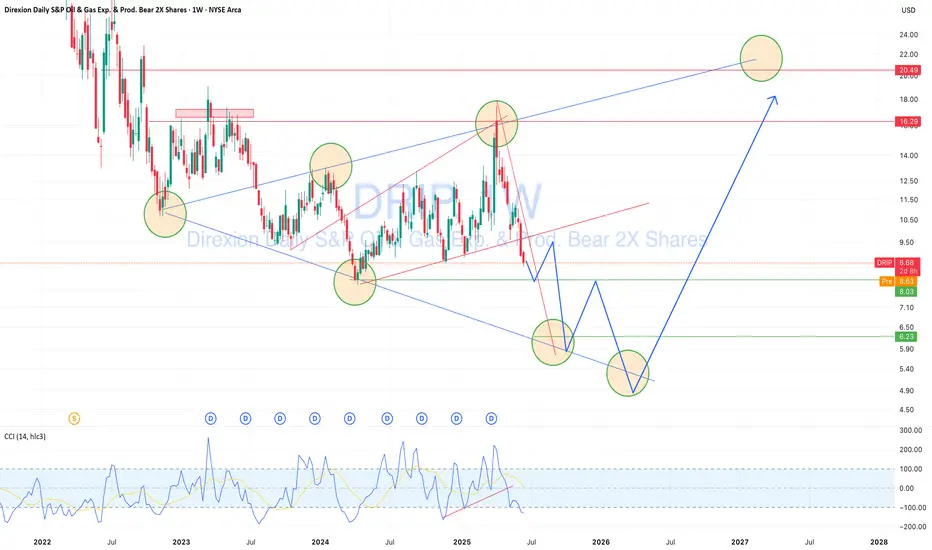
DRIP — Geopolitical Oil Risk Creates a Buying OpportunityDRIP (inverse 2x ETF on US oil & gas exploration/production) is approaching a key technical support zone.
While oil may continue rising short term due to geopolitical tensions — especially US-Iran risks and Middle East instability — this short-term pressure could push DRIP lower toward the $5.00–6.00 area. That zone aligns with strong historical reversal points and trend support. From there, a rebound toward $12.00–20.00 is technically and fundamentally possible, offering 30–50%+ profit potential. I’m planning staged entries in the marked range, managing risk with awareness of commodity market volatility and global uncertainty.
Will America's Tech Sovereignty Rise or Fall on a Silicon Chip?In the high-stakes chess game of global technological supremacy, Intel emerges as America's potential knight—a critical piece poised to reshape the semiconductor landscape. The battleground is not just silicon and circuits, but national security, economic resilience, and the future of technological innovation. As geopolitical tensions simmer and supply chain vulnerabilities become increasingly apparent, Intel stands at the crossroads of a transformative strategy that could determine whether the United States maintains its technological edge or surrenders ground to international competitors.
The CHIPS and Science Act represents more than a financial investment; it is a bold declaration of technological independence. With billions of dollars earmarked to support domestic semiconductor production, the United States is making an unprecedented bet on Intel's ability to leapfrog current manufacturing limitations. The company's ambitious 18A process, slated for 2025, symbolizes more than a technological milestone—it represents a potential renaissance of American technological leadership, challenging the current dominance of Asian semiconductor manufacturers and positioning the United States as a critical player in the global tech ecosystem.
Behind this narrative lies a profound challenge: can Intel transform from a traditional chip manufacturer into a strategic national asset? The potential partnership discussions with tech giants like Apple and Nvidia, and the looming geopolitical risks of over-reliance on foreign chip production, underscore a moment of critical transformation. Intel is no longer just a technology company—it has become a potential linchpin in America's strategy to maintain technological sovereignty, with the power to redefine global semiconductor production and secure the nation's strategic technological infrastructure.
Geopolitical Analysis : Wild Palladium Rally [Ukraine Crisis]
A. Element
1. Palladium is a chemical element with the symbol Pd and atomic number 46.
2. It is a rare and lustrous silvery-white metal.
3. It is discovered in 1803 by the English chemist William Hyde Wollaston.
B. Platinum group metals (PGMs)
1. Palladium, platinum, rhodium, ruthenium, iridium, and osmium form platinum group metals (PGMs).
2. They have similar chemical properties.
3. But, palladium has the lowest melting point and is the least dense of them.
C. Application of palladium
1. Catalytic converters (convert as much as 90% of the harmful gases in automobile exhaust into harmless substances)
2. A key component of fuel cells in which hydrogen and oxygen react to produce electricity, heat, and water.
3. Dentistry
4. Medicine
5. Hydrogen purification
6. Chemical applications
7. Groundwater treatment
8. Jewelry
9. Electronics
D. Occurrence
1. Russia
- Norilsk Nickel: 39% of the world's production
2. South Africa
3. Canada
4. U.S
E. Palladium producers
1. Norilsk Nickel (MCX: GMKN, LSE: MNOD), palladium powder, and ingots
2. North American Palladium (NYSE: PAL), Canada's largest producer of palladium operating the Lac des Iles palladium mine near Thunder Bay, Ontario.
3. Stillwater Mining (NYSE: SWC), a major North American palladium miner in Montana.