DAX Rebound Signals Potential Upside After Key Support HoldGerman DAX was very non-directional, basically since June of 2025 and what I see is some very nasty moves on both sides of the market, but what got our attention recently is that the price has stopped at key support levels around 23k to 23300 area, from where we can see a very interesting and strong rebound. What is most important is that this rebound is coming after only three waves down from all-time highs, so it can be part of a WXY complex correction here in a fourth wave on a daily chart. Of course there can be some other labelings as well, but with any approach you will probably come out with the same idea that this whole price action in this five to six month range is corrective, and whenever we see a correction we know that sooner or later it should be fully retraced, meaning the price could already be headed back toward the highs from current levels.
Bounce looks impulsive, and it may have formed a bullish setup formation with waves 1 and 2, so we think that more gains are coming within wave 3, especially if breaks back above 24500 bullish confirmation level.
Germany
Is Europe's Industrial Crown Jewel Being Quietly Dismantled?Volkswagen Group, once the symbol of German engineering dominance and post-war European recovery, is experiencing what can only be described as a structural dismantling rather than a cyclical downturn. The company faces a perfect storm of challenges: geopolitical vulnerability exposed by the Nexperia semiconductor crisis, where China demonstrated escalation of dominance over critical supply chains, catastrophic labor cost disadvantages ($3,307 per vehicle in Germany versus $597 in China), and a complete failure of its CARIAD software division that consumed €12 billion with little to show for it. The result is unprecedented: 35,000 German job cuts by 2030, the first factory closures in 87 years, and Golf production moving to Mexico.
The technological surrender is perhaps most revealing. VW is investing $5.8 billion in American startup Rivian and $700 million in Chinese EV maker XPeng—not as strategic partnerships, but as desperate attempts to acquire the software and platform capabilities it failed to develop internally. The company that once provided technology to Chinese joint ventures now buys entire vehicle platforms from a Chinese startup founded in 2014. Meanwhile, its profit engine has collapsed: Porsche's operating profit plummeted 99% to just €40 million in Q3 2024, while VW's China market share eroded from 17% to under 13%, with only 4% share in the critical EV segment.
This isn't just corporate restructuring—it's a fundamental transfer of power. VW's "In China, For China" strategy, which moves 3,000 engineers to Hefei and creates a separate technological ecosystem under Chinese jurisdiction, effectively places the company's intellectual property and future development under the control of a systemic rival. The patent analysis confirms the shift: while BYD has built a moat of 51,000 patents focused on battery and EV technology, much of VW's portfolio protects legacy internal combustion engines—stranded assets in an electric future. What we're witnessing is not Germany adapting to competition, but Europe losing control of its most important manufacturing sector, with the engineering and innovation increasingly done by Chinese hands, on Chinese soil, under Chinese rules.
Is Germany's Economic Success Just an Illusion?Germany's benchmark DAX 40 index surged 30% over the past year, creating an impression of robust economic health. However, this performance masks a troubling reality: the index represents globally diversified multinationals whose revenues originate largely outside Germany's struggling domestic market. Behind the DAX's resilience lies fundamental decay. GDP fell 0.3% in Q2 2025, industrial output reached its lowest level since May 2020, and manufacturing declined 4.8% year-over-year. The energy-intensive sector suffered even steeper contraction at 7.5%, revealing that high input costs have become a structural, long-term threat rather than a temporary challenge.
The automotive sector exemplifies Germany's deeper crisis. Once-dominant manufacturers are losing ground in the electric vehicle transition, with their European market share in China plummeting from 24% in 2020 to just 15% in 2024. Despite leading global R&D spending at €58.4 billion in 2023, German automakers remain trapped at Level 2+ autonomy while competitors pursue full self-driving solutions. This technological lag stems from stringent regulations, complex approval processes, and critical dependencies on Chinese rare earth materials, which could trigger €45-75 billion in losses and jeopardize 1.2 million jobs.
Germany's structural rigidities compound these challenges. Federal fragmentation across 16 states paralyzes digitalization efforts, with the country ranking below the EU average in digital infrastructure despite ambitious sovereignty initiatives. The nation serves as Europe's fiscal anchor, contributing €18 billion net to the EU budget in 2024, yet this burden constrains domestic investment capacity. Meanwhile, demographic pressures persist, though immigration has stabilized the workforce; highly skilled migrants disproportionately consider leaving, threatening to transform a demographic solution into brain drain. Without radical reform to streamline bureaucracy, pivot R&D toward disruptive technologies, and retain top talent, the disconnect between the DAX and Germany's foundational economy will only widen.
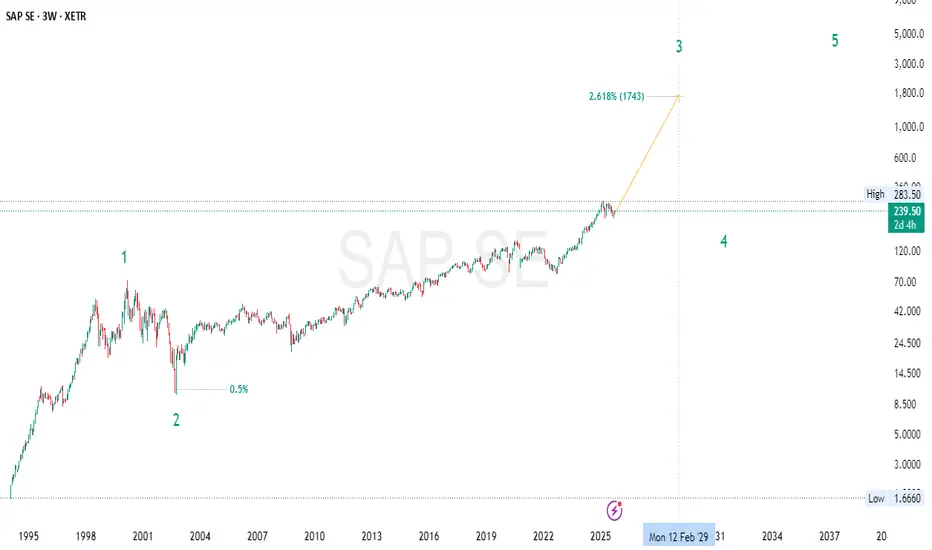
SAP SE – Wave 3 Macro Rally in Progress🚀 SAP SE – Wave 3 Macro Rally in Progress | Fibonacci Targets & Institutional Accumulation in Play 💼
📅 Timeframe : 3W (Macro Outlook)
📍 Current Price: 238.85
🎯 Wave 3 Target: ~1743 (2.618 Fibonacci Extension)
📊 Wave Structure & Elliott Theory
SAP SE appears to be mid-way through a major Elliott Wave cycle , where:
Wave 1 formed during the late 90s tech boom 📈
Wave 2 brought a deep correction post-2000 crash, respecting the 0.5 Fibonacci retracement
Wave 3 now underway, projected toward the 2.618 extension at ~1743 , suggesting a strong impulsive leg fueled by fundamentals and institutional accumulation
Wave 4 and 5 to come, but we are early in the Wave 3 journey – historically the most powerful wave in terms of price growth and investor sentiment ⚡
🧠 Smart Money Concepts (SMC)
✅ Reaccumulation Range: After an extended period of sideways price action (2001–2019), the chart shows clear signs of Smart Money accumulation – long-term positioning by institutions.
📈 Break of Structure (BOS): Clean break above prior macro highs indicates the end of reaccumulation and the start of a markup phase . This aligns with the SMC concept of entering trades after BOS and mitigation of supply zones.
📦 Liquidity Grab: Previous dips served to collect liquidity before major impulsive moves – a classic institutional playbook.
📐 Fibonacci Confluence
🔹 0.5 Retracement from Wave 1 → Wave 2 provided a textbook correction
🔹 2.618 Extension from Wave 1–2 projects a long-term Wave 3 target of ~1743 , giving this move macro-level significance
🔹 No visible divergence yet – momentum is supporting continuation 🌀
🔎 Price Action
Higher Highs & Higher Lows structure confirmed on multi-year view 📶
Strong bullish candles breaking historical resistances
No major supply zones overhead on the macro chart until much higher levels – suggests room for exponential upside
Pullbacks remain shallow, indicating strong buy-side pressure
🧾 Fundamental Outlook
SAP SE is Europe’s largest software company and a global ERP leader. It’s undergoing a digital transformation into cloud-based SaaS, improving recurring revenue and margins. 💻☁️
Strong balance sheet
Growing enterprise customer base
Cloud revenue growing YoY
Excellent positioning in AI and digital infrastructure themes going forward 🔮
Fundamentals support a multi-year bullish cycle , aligning perfectly with the current Wave 3 structure.
📌 Conclusion:
SAP is entering a potentially parabolic phase as part of a long-term Wave 3 impulse, supported by:
📈 Elliott Wave alignment
🔁 Institutional reaccumulation (SMC)
🔍 Strong technical structure & price action
📐 Fibonacci confluence
💼 Solid fundamental trajectory
As long as price holds above previous structure highs and no macroeconomic shock disrupts the tech cycle, SAP could be heading for an exponential breakout over the coming years.
⚠️ Disclaimer: This is not financial advice. For educational purposes only. Always manage risk and use proper position sizing. 🛡️
#SAP #SAPSE #ElliottWave #WaveAnalysis #Fibonacci #SmartMoney #PriceAction #LongTermInvestment #SwingTrading #TechnicalAnalysis #BullishSetup #MacroView #FibonacciExtensions #StockMarket #TradingStrategy #InstitutionalTrading #Breakout #Reaccumulation #ChartPattern #Fundamentals
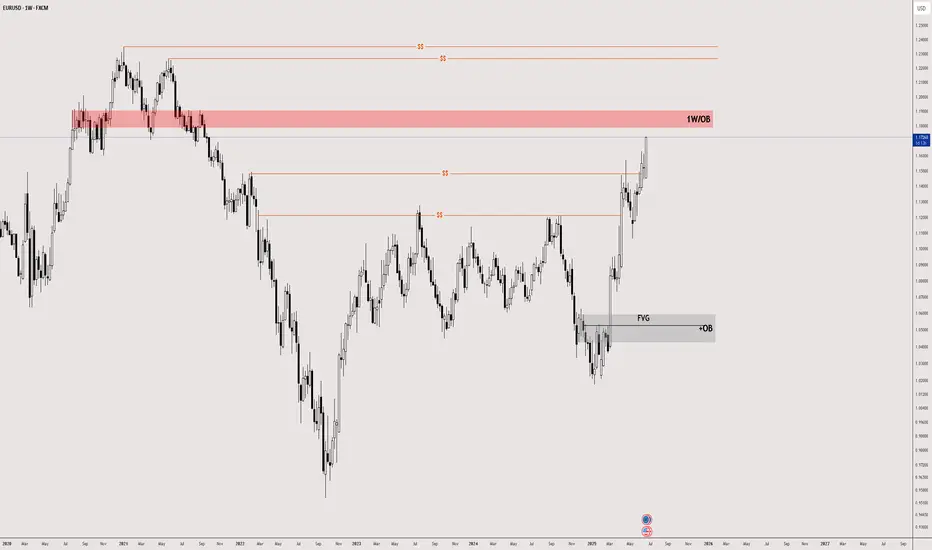
EUR/USD Biases (Long, Short, and Today’s View)EUR/USD Trading Biases: Navigating Bullish Momentum and Key Resistance Zones
This will be a concise market analysis essay (around 600–700 words) suitable for a financial audience, such as forex traders or analysts. Let me begin:
EUR/USD Trading Biases: Navigating Bullish Momentum and Key Resistance Zones
The EUR/USD pair, one of the most actively traded currency pairs in the forex market, has exhibited strong bullish momentum in recent sessions. As of June 26, 2025, the euro’s ascent against the dollar has brought it to a critical juncture, testing significant technical and psychological resistance levels. Traders are now weighing the potential for continued upside against growing signals of exhaustion and looming fundamental catalysts.
Bullish Outlook: A Technically Supported Advance
From a technical perspective, the bullish case for EUR/USD remains compelling. The pair is entrenched in a sustained uptrend, marked by successive breakouts above prior resistance levels and validated by daily and weekly closes above 1.1600. The current price action is converging on a crucial supply zone located between 1.1700 and 1.1900—an area historically known for triggering reversals but also pivotal in confirming trend continuation if broken convincingly.
Technical indicators further bolster the bullish narrative. The Relative Strength Index (RSI), while approaching overbought territory, is still supportive of higher prices. The Moving Average Convergence Divergence (MACD) displays a widening bullish histogram, and the Average Directional Index (ADX) confirms trend strength. Near-term resistance lies between 1.1680 and 1.1730, with potential for an extension to 1.1800 should the pair breach this upper band.
On the fundamental front, improved German Ifo business sentiment data has injected optimism into the eurozone outlook. Additionally, easing geopolitical tensions and a broader risk-on sentiment in global markets have undercut the dollar's safe-haven appeal. Speculation over potential Federal Reserve rate cuts further dampens dollar strength, creating tailwinds for EUR/USD.
Bearish Considerations: Resistance and Reversal Risks
Despite the encouraging trend, caution is warranted. The area between 1.1700 and 1.1900 represents a major weekly order block (OB) resistance—territory where several past rallies have lost steam. Oscillators such as the Commodity Channel Index (CCI) and RSI are showing signs of overextension, and the market is now vigilant for reversal patterns or signs of exhaustion.
Fundamentally, while the recent Ifo data is encouraging, it remains below the key threshold of 100, reflecting lingering skepticism about the eurozone's full recovery. Moreover, upcoming U.S. economic releases, particularly GDP figures and jobless claims, could act as potential catalysts for a dollar rebound. Hawkish commentary from Federal Reserve officials could also tilt sentiment, especially if it dampens expectations of rate cuts.
If EUR/USD fails to hold above the 1.1700–1.1730 resistance zone, a corrective move toward 1.1530–1.1500 becomes plausible. Deeper pullbacks could extend toward 1.1470 and 1.1390, especially if risk sentiment reverses or economic data surprises in favor of the dollar.
Today’s View: Bullish with a Note of Caution
For today, June 26, the prevailing bias remains bullish, yet increasingly cautious. The pair is testing the lower end of the 1.1700 OB zone. A decisive break and hold above this level would likely unleash further upside toward 1.1730 and 1.1800. However, overbought conditions and proximity to a known resistance zone suggest that traders should remain alert to potential rejection.
Intraday strategies favor buying on dips above 1.1600–1.1635, with stops placed just below 1.1600 and targets set at 1.1700–1.1730. Conversely, short positions should only be considered if there is a clear rejection from the 1.1700–1.1730 area, with downside targets at 1.1530–1.1500 and stops above 1.1800.
Conclusion
The EUR/USD is currently at a pivotal inflection point. While the bullish trend is intact and supported by both technical and fundamental factors, the proximity to a major resistance zone introduces a layer of complexity. Traders must remain agile—ready to ride a breakout higher if confirmed, but equally prepared to pivot if the pair falters and signals a reversal. In markets like these, timing and confirmation are everything.
"Downside DAX" is what we will call it in July?Looking at the technical picture purely, we can see that weakness is starting to kick in. Will July be a negative month for DAX? Let's have a look.
XETR:DAX
Let us know what you think in the comments below.
Thank you.
77.3% of retail investor accounts lose money when trading CFDs with this provider. You should consider whether you understand how CFDs work and whether you can afford to take the high risk of losing your money. Past performance is not necessarily indicative of future results. The value of investments may fall as well as rise and the investor may not get back the amount initially invested. This content is not intended for nor applicable to residents of the UK. Cryptocurrency CFDs and spread bets are restricted in the UK for all retail clients.
Is DAX ready for a slight correction lower?We are watching the German XETR:DAX as it is currently struggling to go for a new all-time high. Can this be the moment for a deeper correction lower?
Let's dig in...
MARKETSCOM:GERMANY40
Let us know what you think in the comments below.
Thank you.
77.3% of retail investor accounts lose money when trading CFDs with this provider. You should consider whether you understand how CFDs work and whether you can afford to take the high risk of losing your money. Past performance is not necessarily indicative of future results. The value of investments may fall as well as rise and the investor may not get back the amount initially invested. This content is not intended for nor applicable to residents of the UK. Cryptocurrency CFDs and spread bets are restricted in the UK for all retail clients.
SAP: Macro PotentialPolitical uncertainty and questionable economic policies from the U.S. administration are eroding investor confidence globally, prompting a search for more reliable investment opportunities outside the U.S.
Currently, the performance of European stock markets is outpacing that of the U.S. markets. For example, the ETF tracking major German stocks (ETF DAX) has been trading at historical highs for the second consecutive week, while
U.S. markets have merely recovered from their initial tariff-related declines.
One of the most promising medium-term investment ideas in the European equity market right now, in my opinion, is SAP ( XETR:SAP )
• Quarterly revenue and profit growth dynamics and forecasts
• Relative price strength
• Signs of accumulation by major funds
The macro trend structure of SAP also shows interesting potential
Weekly chart:
Monthly chart:
Thank you for your attention and I wish you successful trading decisions!
#dax Forex Signal German index #dax says I am rising in the medium term in technical indicators. 30% increase is normal. It is necessary to take a position for a decrease when the blue line at the top, which is our technical resistance, turns.
If you want to be in action at the right place and at the right time, you can follow me.
I can draw it for you. Please write me privately.
NOTE: IT DOES NOT CONTAIN INVESTMENT ADVICE. EVERYONE IS FREE TO BUY AND SELL THE SHARES THEY WANT FROM THEIR PERSONAL ACCOUNT WITH THEIR OWN FREE WILL. NO ONE CAN GUIDE ANYONE OR PROVIDE SHARES THAT WILL PROVIDE 100% GUARANTEED PROFIT.
I can draw it for you. Please write me privately.
German $DAX ($EWG) Topping Out?Originally posted on 3/12, but blocked b/c I referenced my X account. Looks like a bearish move could be materializing alongside broader risk asset weakness:
Is the XETR:DAX topping out? Monthly RSI @ 80+ w/ weekly nosing over and daily bearish divergences observable. Index high from 3/6 coincided with the 261.8% Fibonacci extension of the 11/2021-10/2022 uptrend correction.
Confirmation short setup could materialize $FDAX closes below pivot low of the 1D uptrend (22226), bounces off of short-term demand (ex: 22142-21691, and trades into supply ≥ 22226. This scenario is speculative - the market needs to show its hand.
Presently, DAX is up > 1.5% alongside US stocks, which dipped into intermediate-term demand and benefited from softer-than-expected CPI prints. However, DAX (and domestic) bulls haven't proven anything yet. Unless buyers manage to push the DAX higher - initially above 22900 and secondarily through 23000-23200 - on accelerating momentum, risk remains to the downside (IMO). German stocks have been global relative strength leaders as of late, so if they do correct, other equity indexes may retreat in tandem.
Long-term charts for US indices ( SP:SPX , NASDAQ:NDX , TVC:RUT ) look more bearish vs. bullish (I still have some shorts on), though a near-term recovery is plausible. If domestic equities do trade lower, selling could materialize in Asian and European markets. Use LTF charts to monitor price action/manage risk and splice into shorts if German stocks AMEX:EWG start to crack.
My $0.02. Feedback welcome.
Jon
Booze Wars... How DAX could react?Now it's time for US and EU to have their public tariff battle. Given that wine, champagne and beer are a huge part of EU export into the US, there might be some pain felt among the MARKETSCOM:DE30 bulls. Let's dig in.
XETR:DAX
Let us know what you think in the comments below.
Thank you.
74.2% of retail investor accounts lose money when trading CFDs with this provider. You should consider whether you understand how CFDs work and whether you can afford to take the high risk of losing your money. Past performance is not necessarily indicative of future results. The value of investments may fall as well as rise and the investor may not get back the amount initially invested. This content is not intended for nor applicable to residents of the UK. Cryptocurrency CFDs and spread bets are restricted in the UK for all retail clients.
Will DAX go for another all-time high?It seems that geopolitics are the key driving force of the MARKETSCOM:DE30 bulls. The current news on a possible end of the war in Ukraine is helping boost trader morale. Let's dig in!
XETR:DAX
What are your thoughts on this?
74.2% of retail investor accounts lose money when trading CFDs with this provider. You should consider whether you understand how CFDs work and whether you can afford to take the high risk of losing your money. Past performance is not necessarily indicative of future results. The value of investments may fall as well as rise and the investor may not get back the amount initially invested. This content is not intended for nor applicable to residents of the UK. Cryptocurrency CFDs and spread bets are restricted in the UK for all retail clients.
EURUSD’s zone of interest after German election Polls have now closed in Germany’s parliamentary elections.
Exit polls indicate Friedrich Merz’s center-right Christian Democratic Union (CDU) has secured a clear victory, positioning him as Germany’s next chancellor.
The far-right AfD is projected to achieve its best result yet, currently in second place with 20.2%, nearly doubling its 2021 support. However, the Bundestag’s composition remains uncertain, and Merz has ruled out cooperation with the AfD.
Prolonged coalition talks could lead to a government divided on economic recovery and international policy, which could be bearish for the euro. With this in mind, the 61.8% to 50.0% Fibonacci zone could be an area of interest (to begin with at least), which coincides with flattening longer moving averages.
EUROPEAN DEFENCE STOCKS SURGE AMID NATO SPENDING DEBATEEUROPEAN DEFENCE STOCKS SURGE AMID NATO SPENDING DEBATE
(1/8)
Big News: European defence shares soared on Monday 📈🔥, with growing expectations of increased military spending. This rally follows renewed U.S. pressure (re-elected President Trump) calling for NATO allies to ramp up defence budgets to 5% of GDP—far above the usual 2%. Let’s break it all down! 🚀
(2/8) – STOCKS IN FOCUS
• Rheinmetall (Germany): +9% (Frankfurt) 💥
• BAE Systems (UK): +5% (London) 🇬🇧
• Thales (France): +4% (Paris) 🇫🇷
• Dassault Aviation: +4% 🛩️
• Kongsberg Gruppen (Norway): +3% 🔧
• Rolls-Royce: +2% 🚀
Stoxx Europe Aerospace and Defence Index hit a 30-year high 🎉
(3/8) – WHY THE SURGE?
• EU leaders consider relaxing fiscal rules for bigger defence budgets 💶
• President Trump demands NATO allies go for 5% of GDP 🏛️
• NATO Secretary General Mark Rutte suggests a new target >3% GDP, warning about Russia’s rapid military buildup 🏴☠️
(4/8) – GEOPOLITICAL CONTEXT
• Russia’s war in Ukraine (nearing 4th year) pushes EU to reassess capabilities ⚔️
• IISS report: Russia’s defence spending surpasses Europe’s combined 💥
• U.S. threatens troop reductions unless Europe meets higher spending goals 🗽
(5/8) – POLICY SHIFT IN BRUSSELS
• EU might tweak Stability and Growth Pact—exempt certain defence costs from debt caps 🏛️
• “Dual-use” infrastructure (e.g., shelters) reclassified as defence, bypassing strict borrowing limits ⚙️
• Emergency meeting in Paris: Macron + von der Leyen open to flexing EU budget rules for a military surge 🇪🇺
(6/8) – INVESTOR OPTIMISM VS. CHALLENGES
• Many EU nations already beyond debt thresholds—3% or 5% GDP on defence = tough choices 📉
• S&P Global warns big defence boosts could threaten credit ratings 📢
• Germany’s €100B special fund ends 2028; France’s deficit hits 6.6% of GDP by 2025—both face fiscal strain 😬
(7/8) – OPPORTUNITIES FOR EUROPE’S DEFENCE INDUSTRY
• Bigger budgets = a wave of investment in European-made weapons 💸
• EU’s €1.5B Defence Industry Programme aims to strengthen the bloc’s military capacity 🇪🇺
• Analysts predict a robust outlook for companies like Rheinmetall, BAE, Thales, etc. 🤝
(8/8) – FINAL TAKEAWAY
Investors are betting on a more militarized Europe 🌍, poised to spend big under NATO pressure and looming threats. Balancing fiscal rules with security needs is a tall order, but for defence stocks, it’s their moment to shine. Stay tuned: the NATO summit in June could solidify spending targets—and shape Europe’s defence future! 💪
DAX traders are not bothered about steel and aluminum tariffs It seems that MARKETSCOM:DE30 traders today don't care much about the announcement of US tariffs on steel and aluminum. In fact, the German index continues to show resilience and keeps forming new highs. But how can this last for?
XETR:DAX
74.2% of retail investor accounts lose money when trading CFDs with this provider. You should consider whether you understand how CFDs work and whether you can afford to take the high risk of losing your money. Past performance is not necessarily indicative of future results. The value of investments may fall as well as rise and the investor may not get back the amount initially invested. This content is not intended for nor applicable to residents of the UK. Cryptocurrency CFDs and spread bets are restricted in the UK for all retail clients.
The Coming EU Recession into 2028, Mercedes BENZ $MBG Triple TopThe principal pillar of the European economy is Germany, recognized as its wealthiest nation.
A parallel can be drawn to the adage regarding America: when it experiences a minor setback, the global economy often faces significant repercussions.
It is often asserted that the essence of "Deutschland" is deeply rooted in its automotive industry, leading to its moniker as "Autoland." German automobiles have consistently been esteemed as the finest globally.
In fact, the most thriving economic engine in Europe has been heavily dependent on the automotive sector, and the initiatives aimed at addressing climate change have been likened to the act of vanquishing a vampire—driving a stake through its heart.
Volkswagen, the biggest car maker in Europe, is warning that it might have to cut thousands of jobs and close some factories in Germany. This is happening because they are having tough talks with unions about rising costs.
The push for climate-friendly cars has really affected how many people want to buy new vehicles, and they are also facing strong competition in the electric car market. The news about job cuts and possible factory shutdowns is causing a big stir around the world.
Other car companies like Mercedes Benz, BMW, and Ford are also making cuts and letting employees go. Volkswagen is planning to lay off tens of thousands of workers and is even thinking about closing some factories, which is a big deal. Bosch, the largest auto parts supplier in the world and a major employer in Germany, is also cutting hours and pay for around 10,000 workers. Even Meyer Werft, a shipbuilding company that has been around since the 1800s, recently needed a huge bailout of $423 million to stay out of bankruptcy.
The economic strategies implemented by Brussels have significantly weakened the overall economy of the European Union. Germany has remained committed to the traditional Mercantile economic model, maintaining elevated tax rates to curb inflation while producing goods for export to generate profits.
In 2023, the automotive sector is projected to represent as much as 17% of Germany's exports. This sector has created over 750,000 jobs. However, German manufacturing has struggled to achieve a full recovery since the COVID-19 pandemic in 2020, currently reaching only about 90% of its pre-pandemic output.
Germany is destined for upside to 20,893 according to thisWe have seen a textbook Falling Wedge form on the Daily with the Dax.
It seems like there has been a consolidation (range bounded) move before the next direction.
So looking at the indicators and sentiment of the markets, in the medium term it looks like DAX is destined for upside.
Along with the main markets like S&P500 and Crypto.
We just need the price to break above 20MA and we could see the next target at 20,893
WHat do you think?
Daily analyzes of EURUSD - Dollar regains lost positionsAmong the important fundamentals from Monday is Factory Orders for the month of August in Germany from 8am GMT. It is very likely that we will see another contraction that will negatively affect the Euro. In general, the industry in Germany has started to shrink and there are no chances for growth.
The other important news is related to retail sales in the Eurozone at 11am GMT. Although we expect levels around zero or very little growth in retail sales.
Among the world events that affect the currency markets are the escalation of the conflict in the Middle East, where mainly the Euro may suffer due to disrupted supplies of both goods and fuels.
Overall, the Dollar will be in a stronger position this week and we at World-Signals.com expect the Dollar to strengthen against the Euro.
In the last week, the Dollar has taken about 200 pips on the Euro. In retrospect, the Dollar had 3 losing weeks, and only in the last one did it regain some of the lost positions.
Use the 1.1010 levels to open short positions with a 6-8 business day closing target.