IREN - Pressure Building Near Call ResistanceIREN is quietly building pressure.
For five consecutive sessions, price has been compressing in a tight range, holding above HVL , which already tells us the gamma environment remains supportive . ๐ข
๐ถ Key Structure ๐ถ
Price holding above HVL ๐ข
Tight daily range โ volatility compression ๐ต
Major call resistance at 60 ๐ข
This setup matters because of who is positioned where .
In names like IREN, the flow is typically:
Retail long calls
Dealers short calls, hedging by buying the underlying
That dynamic means any sustained move toward โ or through โ the 60 call resistance can trigger a gamma-driven acceleration , as dealers are forced to add delta on strength rather than fade it.
๐ถ Options Sentiment ๐ถ
Call pricing skew ~82% ๐ข
Calls are significantly richer than puts
Options market sentiment is clearly bullish but it doesn't meean it will go up immediately.
๐ถ Bottom Line ๐ถ
IREN is coiling above HVL with heavy call skew. If price engages the 60 level with momentum, the structure is set up for a call gamma squeeze , not a slow grind.
This is a classic โpressure first, expansion laterโ setup โ worth keeping on the radar.
Gexwalls
MU GEX - Potential Call Gamma Squeeze๐ถ MU โ Call Resistance at 400 Becomes the Decision Point ๐ถ
MU continued higher last week and tagged the 400 level , which now stands out as the largest call resistance on the board.
That level matters.
๐ถ Structural Context ๐ถ
Price has reached a key call wall at 400 ๐ข
Momentum remains strong ๐ข
Gamma dynamics are increasingly important here ๐ต
In MU, the flow looks very similar to other momentum-driven tech names:
Retail positioned long calls
Dealers short calls , hedging via underlying buying
That creates a reflexive loop :
๐ strength forces dealers to buy more stock
๐ which can amplify upside if resistance breaks cleanly ๐ข
๐ถ Additional Context ๐ถ
Call pricing skew has expanded further ๐ข
Calls are getting richer โ sentiment remains bullish
Elevated skew also means expectations are crowded ๐ต
๐ถ What to Watch ๐ถ ๐ก
The 400 level is the inflection point .
Acceptance above 400 โ opens the door for a call gamma squeeze ๐ข
Rejection at 400 โ likely leads to consolidation or pullback ๐ด
As always, the tell is momentum + follow-through , not the level itself. MU is strong โ but this is where structure decides whether the move accelerates or pauses.
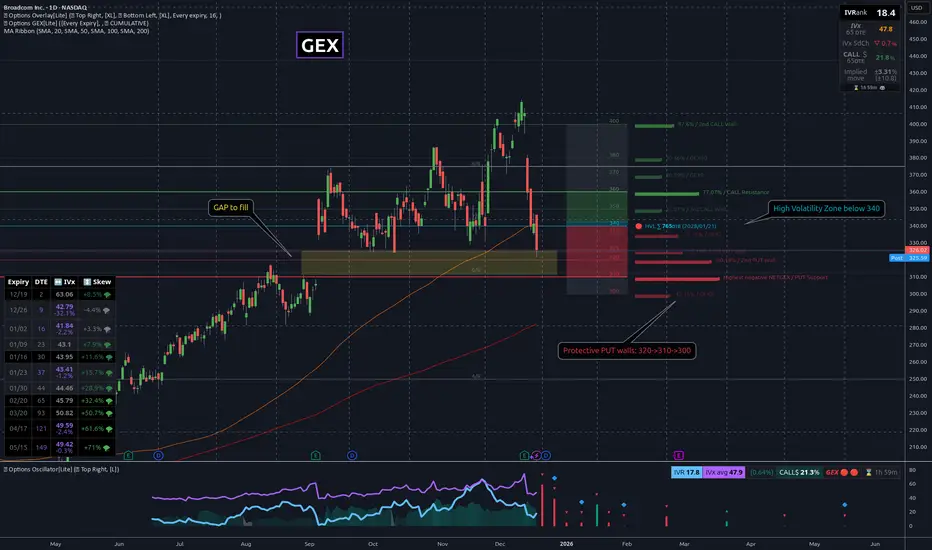
AVGO โ Breakdown Below HVL๐ถ AVGO โ Breakdown Below HVL, Negative GEX Targets Gap Fill ๐ถ
AVGO has cleanly broken below the High Volatility Level (HVL) , which was previously holding around 330 . This breakdown marks a clear regime shift , pushing the market into a ๐ด negative GEX environment where downside sensitivity and volatility expansion tend to dominate.
With HVL lost , price action becomes more reactive, and moves are less likely to be absorbed smoothly.
๐ถ Structural Context ๐ถ
From a structural perspective, AVGO is now moving into a gap-fill phase . The gap below price is in the process of being filled and is likely to act as a short-term downside magnet .
๐ถ Current Options Structure ๐ถ
297.5 โ primary put support ๐ด
310 โ overhead resistance zone, aligned with the 100-day moving average ๐ต
As long as price remains below HVL and under the 100 SMA , rallies are more likely to be sold rather than sustained .
๐ถ Volatility Dynamics ๐ถ
GEX profile is negative , favoring directional expansion rather than compression ๐ด
Implied volatility has been rising steadily over the past 5 sessions , confirming growing demand for downside protection and positioning into volatility
In a negative GEX regime , downside moves tend to accelerate once support levels are tested , rather than grind slowly.
๐ถ Key Levels to Watch ๐ถ
330 (HVL) โ invalidation / regime flip level ๐ต
311 (100 SMA) โ overhead resistance ๐ต
297.5 โ put support / downside reference ๐ด
As long as AVGO remains below HVL with a negative GEX profile , the path of least resistance remains lower , with volatility expected to stay elevated until the gap is fully resolved or structure changes.
SPX โ GEX 6800 Put Support Holds๐ถ SPX โ 6800 Put Support Holds, Pricing Skew Mean-Reversion ๐ถ
On the daily chart, SPX found clean support at the 6800 put level , tied to the Jan 23 expiration . That level absorbed yesterdayโs downside pressure, and price has been rotating higher since the bounce. ๐ข
๐ถ Options Structure ๐ถ
From an options structure perspective, the range is now clearly defined:
6800 acts as the primary put support ๐ด
6915 marks the next call resistance on the weekly expiration ๐ข
One of the most important signals comes from the Options Oscillator . Yesterday, put pricing skew reached a historically extreme level , indicating significant put overpricing relative to calls. Since then, weโve seen a sharp mean-reversion in skew, suggesting that downside hedging pressure is easing.
That said, caution is still warranted . SPX remains below the High Volatility Level (HVL) , a regime where price action tends to be faster and more reactive, with elevated volatility. ๐ต
If 6800 continues to hold , the next key test is the HVL zone around 6895 . A reclaim above HVL would shift the regime toward more controlled price behavior and opens the path toward 6915 call resistance as the next upside reference. ๐ข
๐ถ Key Levels to Watch ๐ถ
6800 โ put support / downside anchor ๐ด
6895 (HVL) โ regime pivot ๐ต
6915 โ next call resistance (weekly) ๐ข
As long as price holds above 6800 , the structure favors continued upside rotation , but sustained strength likely requires a reclaim above HVL . Failure to hold 6800 would quickly reintroduce downside volatility .
SPX โ GEX Back to Positive๐ถ SPX โ HVL Reclaim & GEX Shift ๐ถ
SPX briefly traded below the High Volatility Level (HVL) yesterday, entering a ๐ด negative GEX regime , which increased downside sensitivity and intraday volatility. However, that breakdown failed to follow through.
Price has since reclaimed the HVL , and based on the 01/16 GEX profile , SPX is now back in ๐ข positive GEX territory , signaling a structural shift away from downside acceleration and back toward dealer-supported price behavior.
On the daily chart, this reclaim occurred directly off the rising trendline , which has defined the broader uptrend. The successful defense of this trend support suggests that the move below HVL was a temporary liquidity sweep rather than a regime change.
With HVL reclaimed and GEX flipping positive again, ๐ข upside flows regain control , and price becomes more responsive to call-side positioning rather than put hedging pressure.
๐ถ Options Structure โ Upside Reference ๐ถ
From an options structure perspective, the next major upside reference is the 7000 level , which represents:
a key call resistance zone
the dominant upside magnet in the current positive GEX environment
a natural extension target following the trendline bounce
๐ถ Key Structure to Monitor ๐ถ
HVL โ reclaimed, now acting as regime pivot ๐ข
Rising trendline โ trend integrity confirmed ๐ข
Positive GEX (01/16) โ supportive dealer positioning ๐ข
7000 โ primary upside target / call resistance ๐ข
As long as SPX holds above HVL and the rising trendline , downside volatility should remain contained, and ๐ข rotation toward 7000 remains the higher-probability path. Failure to hold HVL would be the clearest signal that ๐ด negative GEX dynamics are reasserting.
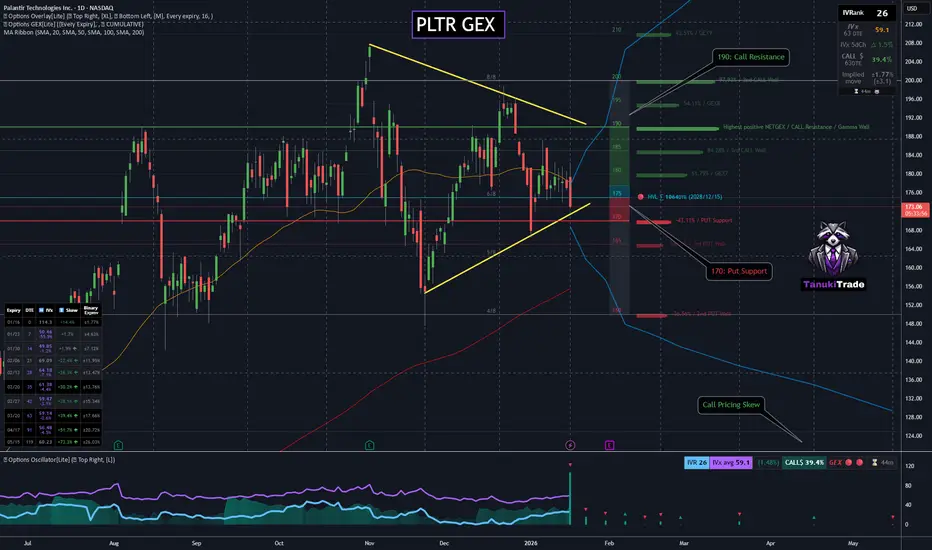
PLTR - GEX Compression Signals BreakoutPLTR has entered a tight volatility compression phase , both on price and in the GEX profile , which is now clearly squeezed between well-defined option levels. ๐ต
๐ถ Current Structure ๐ถ
Call resistance sits at 190
Put support is defined at 170
Price has been trading in a narrow range for over a week , confirming balance rather than trend ๐ต
This type of GEX compression + price compression rarely persists for long, especially in a high-beta tech name like PLTR. Historically, these regimes resolve via sharp directional expansion , not slow grind.
From a regime perspective, PLTR is currently trading below the HVL , which keeps downside sensitivity elevated. A clean break below 170 would likely trigger ๐ด negative gamma dynamics , opening the door for accelerated downside.
๐ถ Options Sentiment ๐ถ
Call pricing skew is elevated near 40% , signaling stronger call demand despite range-bound price ๐ข
Implied volatility has been rising steadily over the past 5 sessions , confirming positioning ahead of a catalyst
Earnings are scheduled for 02/02 , adding fuel to an already compressed structure
๐ถ Key Structure to Watch ๐ถ
170 โ put support / downside trigger ๐ด
190 โ call resistance / upside breakout level ๐ข
HVL โ regime pivot ๐ต
Compressed GEX profile โ volatility expansion risk ๐ต
With price, GEX, and volatility all compressing simultaneously, PLTR is setting up for a near-term breakout , with earnings acting as a potential catalyst. Direction will be determined by which side of the GEX range resolves first.
NVDA โ Consolidation Breakout Toward 200 Core Resistance?๐ถ Downside structure
Looking at NVDA on the daily chart, one level clearly stands out on the downside:
170 PUT support , where price has bounced multiple times in the past. This level has been well defended by put positioning, creating a solid structural floor. ๐ด
๐ถ Consolidation behavior
Over the past weeks, price spent a considerable amount of time sitting on the 50-day moving average , repeatedly testing it from below but failing to break through decisively. That dynamic now appears to be changing. NVDA is starting to push higher, suggesting a potential breakout from this consolidation range. ๐ข
๐ถ Upside reference level
If this breakout holds, the next key level to watch is 200 Call Resistance . This is currently the largest Call Resistance on the board, and it also aligns with an 8/8 MM level , adding technical confluence to the zone. ๐ข
๐ถ Options sentiment context
Whatโs important here is sentiment:
๐ต Call Pricing Skew is currently minimal, meaning the options market is not aggressively positioned for upside yet. This keeps the move cleaner and reduces the risk of an overcrowded bullish trade. In other words, this is not a euphoric call-heavy environment, which often allows price to travel further if momentum builds.
๐ถ Scenario
๐ข If NVDA successfully breaks out of this consolidation and holds above the 50-day MA , a move toward the 200 Call Resistance becomes a very realistic upside target.
๐ถ Key levels
๐ด PUT Support: 170
๐ต Trigger: Sustained breakout above the 50-day MA
๐ข Upside Target: 200 Call Resistance (8/8 MM)
Not financial advice โ just a clean structure driven by price, positioning, and option market context.
Positive GEX Profile Points Toward 700 Gap FillMETA โ Holding Above HVL, 50 DMA Reclaim in Progress, Upside Call Resistance at 700
META is currently trading below the 200-day moving average , but recent price action suggests a potential structural improvement rather than continued weakness.
From an options perspective, the broader structure remains Positive GEX , indicating that dealer positioning is still supportive on pullbacks. At the same time, IV remains low , which typically favors range expansion and directional follow-through once key technical levels are reclaimed.
On the daily chart, price is now starting to reclaim the 50-day moving average , a level that previously acted as dynamic resistance. Importantly, META is also holding above the High Volatility Level (HVL) , which keeps the short-term regime constructive rather than defensive.
Volatility conditions remain favorable:
Call Pricing Skew is elevated (~31.6%), showing persistent call demand
IV remains controlled, allowing price to move without immediate volatility compression pressure
Looking forward, the most important upside call resistance is the 700 level, which represents:
Highest core call resistance on the Feb 20 (Optimal Monthly) expiration
A major gap fill from the prior breakdown
A clear technical resistance zone visible on the daily chart
This confluence makes 700 a logical upside target if price can hold above HVL and fully reclaim the 50 DMA.
Key structure to watch:
200 DMA โ higher timeframe resistance overhead
50 DMA โ short-term trend reclaim in progress
HVL โ holding above keeps structure constructive
700 โ primary upside target (gap fill + core call resistance)
As long as price holds above HVL with supportive GEX structure, rotational upside toward 700 remains the higher-probability path .
PLTR GEX - Bull Flag Breakout SetupPLTR Technical & Options Setup Overview
PLTR is setting up a clean bull flag breakout on the daily chart, following a strong impulsive leg higher.
The consolidation has been holding above the 50-day moving average , which has acted as dynamic support throughout the flag structure. Two sessions ago price briefly dipped below the 50 SMA, but that weakness was immediately bought, signaling strong dip demand and structural acceptance above this level.
From an options perspective, the setup remains supportive. On the Feb 20 (Optimal Monthly) expiration, PLTR shows a Positive GEX Profile .
Volatility and skew conditions further strengthen the bullish case:
Core Call Pricing Skew is elevated (~36%), indicating persistent call demand
Implied volatility remains relatively low, leaving room for price expansion without volatility headwinds
Looking ahead, the next major reference is the 200 level , which represents the primary Core Resistance for the Optimal Monthly cycle. Given the compression within the bull flag and supportive options structure, 200 becomes a natural upside objective if the breakout confirms.
Structure to watch:
50 SMA โ key trend support
Bull flag high โ breakout trigger
Positive GEX โ supportive dealer flow
200 โ next major upside target (Core Resistance)
As long as price holds above the 50 DMA and volatility stays contained, risk remains skewed to the upside, with a measured breakout toward 200 favored.
Protective Put Support Zone & Gap FillAVGO โ Breakdown Below HVL, Gap Fill Toward 320, Protective Put Support Zone
AVGO is trading in a high-volatility, momentum-driven downside phase , following a clean breakdown below the HVL. The move marks a clear regime shift, as price exited a tight transition zone and accelerated lower with conviction.
The downside was well signaled by sustained put-side pressure over multiple sessions, with price repeatedly rejecting from the 50 EMA . Once HVL failed, downside momentum expanded rapidly, consistent with a retail-driven move rather than a controlled dealer-defended range.
From an options structure perspective, protective put positioning now defines the next meaningful downside reference. Current positioning shows the next major protective put support clustered around 320 , which also aligns with a clean gap-fill level on the chart.
This makes 320 a dual-confluence area:
technical gap fill
protective put floor where dealer hedging dynamics may begin to dampen downside momentum
Until that zone is reached, price is effectively moving through thin structure, where volatility expansion and sharp intraday swings should be expected.
Key levels & structure:
Below HVL โ bearish regime confirmed
50 EMA โ repeated rejection, trend continuation signal
320 โ primary downside target & potential stabilization zone (gap fill + protective puts)
Any stabilization or bounce attempts are more likely to occur only after interaction with the 320 area, not before.
MSFT Potential Upside Squeeze SetupMSFT is currently forming a constructive structure with clearly defined levels.
On the downside, the 475 put support has been defended three separate times, signaling strong positioning interest and consistent absorption of selling pressure. Price continues to hold above the HVL , with an extremely narrow transition zone and a broadening upward-tilted positive GEX profile โ all reinforcing structural stability.
If price breaks upward from the first call wall at 480 , this typically favors continuation rather than any sustained move lower.
Upside levels :
The next major call resistance sits at 500 โ which also aligns with the 8/8 level on the MM grid system . This creates a very strong confluence, making 500 a significant resistance zone.
If price cleanly accepts and pushes through 500, dealer hedging flows can accelerate, potentially triggering an upside squeeze โ with an initial upside extension capped near 520 .
If momentum continues to build above 500, the next substantial call resistance sits at 520 , currently the second-largest call wall on the chain.
As long as price remains above HVL and the 475 support zone holds, the risk-reward skew favors continuation to the upside, with 480 as the trigger level and 500 as the speculative call-positioning target .
However โ critical risk scenario:
If 475 breaks and we do not see a fast rebound from the 470/460 negative squeeze zone , this could initiate a sharp downward move and a trend shift. Currently, the largest protective put concentration sits at 475 โ and the put side only begins to melt if price can reclaim 480 .
At least based on the aggregated options chain, MSFT is now under immense compression with clear trigger points .
MSFT tightening under GEX squeeze pressure
$IWM โ The Rate-Cut Leverage PlayLast week delivered one of those classic market paradoxes where everything that should be bearish suddenly became bullish:
layoffs โ bullish
weak labor data โ bullish
flat inflation โ bullish
Why?
Because the market has now fully locked its focus on one thing only:
a Federal Reserve rate cut.
Volatility was sharp, price action even sharper, and the headlines kept flipping faster than most traders could adjust.
Letโs break down what actually happened โ and what matters for the week ahead.
IWM GEX for 01/16/2025 expiration using TanukiTrade Options Overlay GRID System and the GEX Profile indicator
If the Fed cuts, small caps win the most โ and last week proved it again.
IWM broke above the 250 call gamma level
Short-term gamma squeeze potential
Closed at new all-time highs
This is where rate-cut optimism expresses itself with maximum torque.
If the Fed turns dove on Wednesday โ IWM can easily extend.