Institutions & Participants in Financial Markets1. Introduction
Financial markets are the backbone of global economies. They provide a platform where individuals, corporations, and governments can raise capital, invest savings, and manage risks. Behind every transaction in the stock market, currency exchange, bond market, or commodity trading, there are participants who make the system function. Some are individuals trading with their own savings, while others are large institutions managing billions of dollars. Together, they form a complex network of buyers, sellers, intermediaries, and regulators who ensure liquidity, stability, and transparency in markets.
Understanding Institutions and Participants is essential because they influence how prices are discovered, how risks are shared, and how capital flows across economies. Without them, financial markets would not function efficiently.
2. Definition of Institutions & Participants
Institutions in financial markets refer to organized bodies that create, regulate, or facilitate market activities. Examples include central banks (RBI, FED), regulators (SEBI, SEC), stock exchanges (NSE, NYSE), clearing houses, and depositories. Their primary role is to ensure smooth functioning, enforce rules, and reduce risks of defaults or fraud.
Participants are entities or individuals that actively take part in financial transactions. This includes retail traders, institutional investors, corporations, governments, and intermediaries like brokers and dealers. They provide liquidity, demand, and supply for financial assets.
Together, institutions and participants form the ecosystem of financial markets, where institutions provide the structure and participants provide the activity.
3. Types of Market Participants
(a) Retail Investors
Retail investors are individual participants who invest their personal savings in stocks, mutual funds, bonds, or derivatives. They usually trade in smaller quantities compared to institutions. Retail participation has grown tremendously with the rise of mobile trading apps, discount brokers, and financial literacy campaigns.
Strengths: Flexibility, diversity of strategies, emotional conviction.
Weaknesses: Limited capital, lack of information compared to institutions, prone to herd behavior.
Example: In India, after 2020, retail investors surged on platforms like Zerodha, Upstox, and Groww, contributing significantly to stock market liquidity.
(b) Institutional Investors
These are large organizations that pool funds from clients or members and invest systematically. They include:
Mutual Funds – Manage pooled capital for retail investors.
Pension Funds – Invest long-term for retirement benefits.
Insurance Companies – Invest premiums in safe and growth-oriented assets.
Hedge Funds & Private Equity – Use complex strategies to maximize returns.
Institutions play a dominant role because of their large capital base and access to advanced research. Their actions often influence market trends and sentiments.
(c) Brokers & Sub-Brokers
Brokers act as intermediaries between investors and the stock exchange. They provide platforms, research, and execution services. Sub-brokers or franchisees work under main brokers to service clients in smaller regions.
In India, SEBI regulates brokers, requiring them to register and follow compliance rules. Discount brokers like Zerodha revolutionized the industry by reducing costs and increasing retail participation.
(d) Market Makers & Dealers
Market makers are institutions or individuals who continuously provide buy and sell quotes for securities, ensuring liquidity in the market. Dealers trade on their own account, taking positions in securities to profit from price movements.
Example: In the Forex market, banks act as market makers by offering two-way quotes (bid and ask prices).
(e) Corporates
Companies participate in markets to raise funds by issuing shares, bonds, or commercial papers. They also engage in hedging using derivatives to manage currency or interest rate risks.
For example, Reliance Industries regularly taps debt markets, while Infosys issues shares under ESOPs.
(f) Governments & Central Banks
Governments raise capital through bonds (sovereign debt) to finance infrastructure, welfare, and development. Central banks regulate money supply, set interest rates, and intervene in foreign exchange markets.
The Federal Reserve (US) sets monetary policy that affects global markets.
The Reserve Bank of India (RBI) manages inflation, rupee stability, and liquidity.
(g) Regulators & Exchanges
Regulators (e.g., SEBI in India, SEC in the USA) create and enforce laws to protect investors and maintain fair markets.
Exchanges (e.g., NSE, NYSE) provide the physical or electronic infrastructure where buyers and sellers meet. They ensure price transparency, equal access, and fair competition.
(h) Foreign Institutional Investors (FIIs) & Foreign Portfolio Investors (FPIs)
Global investors participate in emerging markets like India to seek growth opportunities. They bring in large capital inflows, which can boost stock indices but also increase volatility if they withdraw funds quickly.
Example: In 2020–2021, FPIs invested heavily in Indian equities, leading to record highs in Nifty and Sensex.
4. Institutions in Global & Indian Context
Stock Exchanges
Global: NYSE, NASDAQ, London Stock Exchange.
India: NSE and BSE dominate trading volumes.
Clearing Corporations & Depositories
They reduce settlement risks by ensuring that buyers get their securities and sellers receive payments.
India: NSDL, CDSL.
Global: DTCC (USA), Euroclear (Europe).
Regulators
India: SEBI, RBI, IRDAI.
Global: SEC (USA), FCA (UK), ESMA (Europe).
International Institutions
IMF & World Bank – provide financial stability and funding to nations.
Bank for International Settlements (BIS) – sets banking regulations.
5. How Participants Interact in Markets
Financial markets are divided into:
Primary Market: Where new securities are issued (IPOs, bonds). Corporates and governments raise funds here.
Secondary Market: Where existing securities are traded. Retail and institutional investors interact here.
Price Discovery happens when buyers and sellers agree on prices based on demand and supply. Institutions often lead price discovery, while retail investors follow.
Technology’s Role: Algorithmic trading, high-frequency trading, and fintech platforms have transformed participation. Machines now execute trades in microseconds, increasing liquidity but also creating flash-crash risks.
6. Case Studies & Examples
2008 Financial Crisis: Triggered by reckless lending by banks, misuse of mortgage-backed securities, and regulatory gaps. It showed the danger of unregulated institutions.
Indian Markets Post-2020: Surge in retail investors and rise of discount brokers democratized investing. FIIs also played a strong role in pushing indices to record highs.
7. Challenges & Risks
Conflicts of Interest – Brokers may mis-sell products, institutions may prioritize profits over clients.
Market Manipulation – Pump-and-dump schemes, insider trading, and algorithmic manipulation distort fairness.
Globalization Risks – Capital flight during crises (e.g., FIIs pulling funds).
Regulatory Gaps – Some instruments (like crypto) still lack clear regulations.
8. Future of Institutions & Participants
AI & Algorithmic Trading will dominate markets, with human traders playing a smaller role.
Fintech & Digital Platforms will bring more retail investors into the system.
Global Institutional Flows will decide the fate of emerging markets like India.
Sustainable Finance – ESG-focused investing and green bonds will rise.
9. Conclusion
Institutions and participants together form the lifeline of financial markets. Institutions provide the rules, infrastructure, and trust needed for smooth functioning, while participants provide liquidity, capital, and demand. Their interaction shapes prices, drives innovation, and supports economic growth.
From a small retail trader buying a single stock to a central bank moving billions in currency reserves, each participant plays a vital role in maintaining balance. The future will bring more technology-driven participation, deeper global integration, and stronger institutional oversight.
In essence, the strength of a financial market depends on the quality of its institutions and the diversity of its participants.
Learning
Short Selling & Market Volatility WorldwideIntroduction
Financial markets thrive on a balance between optimism and skepticism. While investors who buy assets express confidence in growth, those who sell short represent a contrasting, yet equally vital, belief system. Short selling refers to the practice of selling borrowed securities with the expectation that their price will fall, enabling the seller to buy them back later at a lower price for a profit. Though often controversial, short selling is deeply embedded in the functioning of global financial markets.
On the other hand, market volatility refers to the speed and magnitude of changes in asset prices, reflecting uncertainty, investor sentiment, and macroeconomic conditions. Both concepts are closely interlinked: short selling can amplify volatility, while volatile conditions often fuel short-selling opportunities.
Globally, regulators, institutional investors, and policymakers debate whether short selling destabilizes markets or provides healthy skepticism that enhances efficiency. This discussion has become more critical after episodes like the 2008 Global Financial Crisis, the 2020 COVID-19 crash, and retail-driven short squeezes like GameStop in 2021.
This paper explores the mechanisms, history, controversies, regulatory frameworks, and global impacts of short selling, along with its deep connection to market volatility.
1. Understanding Short Selling
1.1 The Mechanics of Short Selling
The process of short selling involves several steps:
Borrowing the asset: A short seller borrows shares (or other securities) from a broker.
Selling in the open market: The borrowed securities are sold at the prevailing market price.
Repurchasing (covering the short): Later, the seller buys back the same quantity of shares, ideally at a lower price.
Returning the shares: The borrowed securities are returned to the lender, and the difference between the selling and repurchasing price becomes the short seller’s profit (or loss).
For example, if a trader sells borrowed shares of Company X at ₹1,000 each and repurchases them later at ₹800, the profit per share is ₹200 (excluding fees and borrowing costs).
1.2 Types of Short Selling
Naked Short Selling: Selling shares that have not been borrowed beforehand (often restricted).
Covered Short Selling: Selling shares that have already been borrowed (legal and widely practiced).
Synthetic Shorts: Using derivatives like options and futures to replicate short exposure.
1.3 Motivations Behind Short Selling
Profit-seeking: Traders speculate on price declines.
Hedging: Institutions use short positions to protect long portfolios.
Arbitrage: Exploiting mispricings in related securities.
Market correction: Identifying overvalued companies or fraudulent firms.
2. Market Volatility: A Global Phenomenon
2.1 Defining Volatility
Volatility measures the variability of asset returns, often expressed through standard deviation or implied volatility indices (e.g., VIX in the US, India VIX).
Historical Volatility: Based on past price movements.
Implied Volatility: Derived from option prices, reflecting market expectations.
2.2 Drivers of Volatility
Macroeconomic factors: Inflation, interest rates, GDP growth.
Political & geopolitical events: Elections, wars, trade tensions.
Corporate events: Earnings surprises, fraud revelations, mergers.
Market psychology: Fear and greed cycles.
Liquidity shocks: Sudden shortages or surges in capital flows.
2.3 Measuring Volatility Across the World
US: CBOE Volatility Index (VIX), often called the “fear gauge.”
India: NSE’s India VIX.
Europe: VSTOXX index.
Japan: Nikkei Volatility Index.
Volatility has universal dimensions but varies in intensity across emerging vs. developed markets.
3. The Interplay Between Short Selling & Volatility
3.1 Short Selling as a Source of Volatility
Downward pressure: Aggressive shorting can accelerate sell-offs.
Panic amplification: Retail investors may overreact to visible short interest.
Short squeezes: When heavily shorted stocks rise sharply, short sellers rush to cover, creating upward volatility.
3.2 Short Selling as a Dampener of Volatility
Price discovery: Shorts expose overvaluation and fraud, preventing bubbles.
Liquidity enhancement: Short sellers add trading volume, reducing bid-ask spreads.
Market efficiency: They ensure both positive and negative information is reflected in prices.
Thus, short selling has a dual effect: it can either stabilize by correcting mispricings or destabilize by triggering rapid sell-offs.
4. Historical Case Studies
4.1 The Great Depression (1929)
Short sellers were widely blamed for accelerating the market crash, leading to restrictions and the introduction of the Uptick Rule in the US (1938).
4.2 The Global Financial Crisis (2008)
Amid Lehman Brothers’ collapse, regulators worldwide banned or restricted short selling to prevent systemic risk. Critics argue these bans reduced liquidity and delayed price corrections.
4.3 European Debt Crisis (2010–2012)
Countries like Spain, Italy, and Greece banned short selling during sovereign debt fears. However, studies later showed such bans were ineffective in calming markets.
4.4 COVID-19 Market Crash (2020)
Volatility surged globally. Several European countries, India, and others imposed temporary short-selling restrictions, though the US refrained. Markets eventually recovered, highlighting that volatility stemmed more from uncertainty than short sellers.
4.5 GameStop Short Squeeze (2021)
A unique retail-driven rebellion where Reddit’s WallStreetBets community targeted heavily shorted stocks like GameStop and AMC. The short squeeze led to extreme volatility, losses for hedge funds, and debates about transparency in short selling.
5. Global Regulatory Perspectives
5.1 United States
Regulated by the SEC.
Uptick Rule (1938–2007): Allowed short selling only at higher prices than previous trades.
Alternative Uptick Rule (2010): Restricts shorting when a stock falls 10%+ in a day.
Transparency: Short interest data is disclosed biweekly.
5.2 Europe
European Securities and Markets Authority (ESMA) coordinates rules.
Transparency requirements: Large short positions must be disclosed publicly.
Temporary bans are common during crises.
5.3 Asia
Japan: Longstanding short-sale disclosure rules.
India: Short selling allowed with restrictions; naked shorting is prohibited. Stock lending & borrowing (SLB) mechanism facilitates covered shorts.
China: Very restrictive, viewing short selling as destabilizing.
5.4 Emerging Markets
Regulations often stricter due to concerns about volatility and investor confidence. Many nations restrict short selling during market stress.
6. The Ethical & Controversial Side
6.1 Criticisms of Short Selling
Seen as betting against success of companies.
Can exacerbate panic during downturns.
Potential for abusive practices, such as spreading false rumors (short-and-distort).
6.2 Defense of Short Selling
Vital for price discovery.
Helps identify fraudulent companies (e.g., Enron, Wirecard, Luckin Coffee).
Encourages transparency and corporate accountability.
6.3 Public Perception
Retail investors often view short sellers negatively, especially when firms collapse. Yet institutional investors appreciate their role in balancing optimism with caution.
7. Short Selling, Technology, and the Future
7.1 Algorithmic & High-Frequency Shorting
Algorithms execute rapid-fire shorts based on news, price movements, or arbitrage.
Concerns exist about flash crashes and heightened volatility.
7.2 Role of Social Media
Platforms like Reddit, Twitter (X), and Discord amplify sentiment.
Retail coordination can now challenge institutional short sellers.
7.3 Crypto Markets
Short selling extends to Bitcoin and altcoins via futures and perpetual swaps.
Volatility in crypto is often more extreme than in traditional markets.
7.4 ESG & Ethical Investing
Debates arise whether short selling aligns with sustainable finance principles. Some argue it deters harmful companies; others view it as destructive speculation.
8. Short Selling in Different Market Structures
8.1 Developed Markets (US, UK, EU, Japan)
Deep liquidity supports active short selling.
Transparency rules balance risks.
8.2 Emerging Markets (India, Brazil, South Africa)
Lower liquidity makes volatility concerns greater.
Short selling often tightly regulated.
8.3 Frontier Markets
Limited short-selling infrastructure due to lack of stock-lending systems.
Volatility often driven by macro shocks, not short activity.
9. Empirical Research on Short Selling & Volatility
Studies suggest short selling increases intraday volatility but contributes to long-term price efficiency.
Short-sale bans during crises reduce liquidity and increase spreads, worsening volatility rather than containing it.
Transparency of short positions has a calming effect, as investors better understand bearish sentiment.
10. Policy Recommendations
Maintain transparency: Public disclosure of short positions helps reduce rumor-driven panic.
Avoid blanket bans: Evidence shows bans worsen liquidity and delay corrections.
Encourage stock-lending markets: Well-functioning lending systems reduce settlement risk.
Balance retail vs. institutional interests: Retail investors need education to understand short selling rather than fear it.
Global harmonization: Given interconnected markets, international coordination is vital during crises.
Conclusion
Short selling and market volatility are inseparable components of the financial ecosystem. While short selling often attracts controversy, it remains a critical tool for liquidity, hedging, and price discovery. Global evidence shows that volatility is not inherently caused by short sellers but by broader uncertainty and structural imbalances.
Regulators face the delicate task of balancing market stability with efficiency. A world without short selling would risk bubbles, fraud, and illiquidity. Conversely, unchecked shorting could fuel panic. The challenge is to create transparent, fair, and robust systems where skepticism and optimism coexist.
As financial markets evolve—with technology, retail participation, and new asset classes like crypto—the role of short selling in shaping volatility will continue to grow. Rather than vilifying it, policymakers and investors must acknowledge its dual nature: both a source of turbulence and a guardian of truth in markets worldwide.
Currency Derivatives in International MarketsIntroduction
Global trade, cross-border investments, and multinational business operations depend heavily on currencies. Whenever goods, services, or capital cross borders, transactions often involve exchanging one currency for another. Because exchange rates constantly fluctuate, this creates both risks and opportunities for businesses, investors, and traders.
To manage these risks or speculate on currency movements, international financial markets provide a sophisticated set of instruments known as currency derivatives.
Currency derivatives are financial contracts whose value is derived from the exchange rate of two currencies. For example, a contract tied to USD/INR, EUR/USD, or JPY/CNY is a currency derivative. These instruments enable market participants to hedge against foreign exchange (forex) volatility, arbitrage between markets, or speculate on price trends.
This article will provide a comprehensive exploration of currency derivatives in international markets, covering their types, mechanisms, uses, risks, regulatory aspects, and global market trends.
1. The Need for Currency Derivatives
1.1 Exchange Rate Volatility
Currencies fluctuate due to factors like interest rate changes, inflation, trade balances, geopolitical events, and capital flows. For instance, when the US Federal Reserve raises interest rates, the US dollar typically strengthens, impacting emerging market currencies.
A European exporter selling machinery to India and receiving payment in Indian Rupees (INR) faces the risk that the INR might depreciate against the Euro before payment, reducing profit margins. Currency derivatives help hedge such risks.
1.2 Globalization and Trade
With the rise of global supply chains, companies constantly deal with multiple currencies. Currency risk can materially impact revenues and costs. Derivatives are necessary tools for financial planning, pricing, and budgeting.
1.3 Capital Flows and Investments
Portfolio investors and institutional funds investing abroad face currency exposure. For instance, a US-based investor holding Japanese equities will see returns influenced not only by the performance of Japanese stocks but also by the movement of USD/JPY.
1.4 Speculation and Arbitrage
Not all currency derivative participants are hedgers. Many are speculators (betting on movements for profit) or arbitrageurs (exploiting price inefficiencies across markets). This mix ensures liquidity and efficient pricing in derivative markets.
2. Types of Currency Derivatives
Currency derivatives exist in both over-the-counter (OTC) and exchange-traded markets. The most common types are:
2.1 Currency Forwards
A forward contract is a private agreement between two parties to exchange a fixed amount of one currency for another at a predetermined exchange rate on a future date.
OTC product: Customized in terms of amount, maturity, and settlement.
Commonly used by corporations for hedging.
Example: An Indian company expects to pay $1 million to a US supplier in 3 months. It enters a forward contract to lock the USD/INR rate at 84.50, ensuring certainty regardless of market fluctuations.
2.2 Currency Futures
Futures are standardized contracts traded on organized exchanges, obligating the buyer and seller to exchange currencies at a specific price and date.
Exchange-traded: Offers liquidity, transparency, and margin requirements.
Example: An investor on the CME (Chicago Mercantile Exchange) may buy a Euro futures contract against the USD, betting on Euro appreciation.
2.3 Currency Options
Options give the right (but not the obligation) to buy (call) or sell (put) a currency at a specified strike price before or at maturity.
Useful for hedgers who want downside protection but retain upside potential.
Example: A US importer buying goods from Japan may purchase a call option on USD/JPY to guard against Yen appreciation.
2.4 Currency Swaps
A currency swap involves exchanging principal and interest payments in one currency for those in another, often for long durations.
Used by corporations and governments to secure cheaper debt or match cash flows.
Example: A European company needing USD may swap its Euro-based loan obligations with a US company holding dollar liabilities.
2.5 Exotic Currency Derivatives
Beyond plain vanilla products, international markets also use structured derivatives:
Barrier options (knock-in, knock-out)
Basket options (linked to multiple currencies)
Quanto derivatives (currency-linked but settled in another currency)
These instruments cater to advanced hedging and speculative needs.
3. Mechanism of Currency Derivatives Trading
3.1 Pricing and Valuation
Forward Rate = Spot Rate × (1 + Interest Rate of Domestic Currency) / (1 + Interest Rate of Foreign Currency)
Futures prices are influenced by forward rates, interest rate parity, and market demand-supply.
Options pricing uses models like Black-Scholes or Garman-Kohlhagen (an extension for forex options).
3.2 Clearing and Settlement
Exchange-traded derivatives use central counterparties (CCPs) to guarantee settlement.
OTC derivatives often settle bilaterally, though post-2008 reforms require central clearing for many contracts.
3.3 Participants
Hedgers: Exporters, importers, MNCs, institutional investors.
Speculators: Traders betting on short-term price swings.
Arbitrageurs: Exploit mispricing between spot, forward, and derivative markets.
4. Role of Currency Derivatives in Risk Management
4.1 Corporate Hedging
Companies hedge to reduce earnings volatility. For example, Apple Inc. uses currency forwards and options to manage exposure to sales in Europe and Asia.
4.2 Portfolio Diversification
Fund managers hedge international portfolios to ensure returns are not eroded by currency losses.
4.3 Central Bank Intervention
Some central banks use derivatives indirectly to manage currency volatility without outright market intervention.
5. Risks in Currency Derivatives
While derivatives mitigate risk, they carry their own risks:
Market Risk – Adverse movements in exchange rates.
Credit Risk – Counterparty default in OTC forwards/swaps.
Liquidity Risk – Difficulty in exiting contracts, especially in exotic currencies.
Operational Risk – Errors in execution, valuation, or reporting.
Systemic Risk – Excessive derivative speculation (as seen in 2008 crisis) can amplify global financial instability.
6. Regulatory Framework in International Markets
US: Commodity Futures Trading Commission (CFTC) regulates currency futures/options.
Europe: European Securities and Markets Authority (ESMA) oversees derivatives under EMIR (European Market Infrastructure Regulation).
Asia: Singapore (SGX), Hong Kong (HKEX), India (SEBI) have their own frameworks.
Global: Bank for International Settlements (BIS) coordinates reporting and risk control.
Post-2008, G20 reforms emphasized:
Mandatory central clearing of standardized OTC contracts.
Reporting of derivatives trades to trade repositories.
Higher capital requirements for banks dealing in derivatives.
7. Major International Markets for Currency Derivatives
7.1 Chicago Mercantile Exchange (CME)
World’s largest market for currency futures and options (USD, Euro, Yen, GBP, CAD, etc.).
7.2 London
Global hub for OTC forex and currency swaps due to deep liquidity and time-zone advantages.
7.3 Asia-Pacific
Singapore Exchange (SGX): Growing hub for Asian currency derivatives.
India’s NSE/BSE: Offers USD/INR, EUR/INR, GBP/INR contracts.
China: Restricted but gradually opening with RMB futures and offshore CNH markets.
7.4 Emerging Markets
Increasing participation as trade volumes grow (e.g., Brazil, South Africa).
8. Case Studies
Case Study 1: Indian IT Companies
Infosys and TCS earn over 70% of revenue in USD/EUR but report in INR. To stabilize earnings, they actively use currency forwards and options.
Case Study 2: European Sovereign Debt
During the Eurozone crisis (2010–2012), several governments used swaps to manage currency-linked borrowings, highlighting both utility and hidden risks of derivatives.
Case Study 3: Hedge Fund Speculation
George Soros’ famous bet against the British Pound in 1992 (Black Wednesday) used massive currency derivative positions, forcing the UK out of the ERM (Exchange Rate Mechanism).
9. Current and Future Trends in Currency Derivatives
Rising Use in Emerging Markets: As Asia, Africa, and Latin America expand global trade.
Digital Platforms: Algorithmic and high-frequency trading dominate currency futures/options.
Clearing Reforms: Push for greater transparency in OTC markets.
Crypto and Digital Currencies: Bitcoin futures/options and central bank digital currencies (CBDCs) are reshaping forex risk management.
Geopolitical Tensions: Currency derivatives are increasingly used to hedge risks from wars, sanctions, and supply-chain disruptions.
ESG-linked derivatives: Growing alignment with sustainable finance trends.
10. Advantages and Criticisms
Advantages:
Hedging reduces business uncertainty.
Enhances global trade and investment flows.
Provides liquidity and efficient price discovery.
Criticisms:
Over-speculation can destabilize economies.
Complex derivatives can hide risks (as seen in 2008 crisis).
Dependence on clearing houses may concentrate systemic risks.
Conclusion
Currency derivatives are the backbone of modern international financial markets, enabling businesses, investors, and governments to manage risks associated with exchange rate fluctuations. They enhance global trade, promote investment flows, and ensure efficient allocation of capital.
However, they are double-edged swords. When used responsibly, they stabilize earnings, reduce volatility, and promote growth. But when misused, they can fuel financial crises.
As globalization deepens and financial technology advances, currency derivatives will only grow in importance. Regulators, corporations, and investors must balance innovation, risk management, and systemic stability to ensure that these instruments continue to support — rather than destabilize — the global economy.
Healthcare & Pharma StocksIntroduction
Healthcare and pharmaceutical (pharma) stocks represent one of the most vital and resilient segments of global equity markets. Unlike cyclical sectors such as automobiles or real estate, healthcare is a necessity-driven industry—people require medical care, medicines, and treatments regardless of economic ups and downs. This inherent demand creates a unique investment landscape where growth, stability, and innovation intersect.
Pharma and healthcare stocks include a wide variety of companies—ranging from multinational giants like Pfizer, Johnson & Johnson, and Novartis to Indian leaders such as Sun Pharma, Dr. Reddy’s Laboratories, and Cipla. The sector also encompasses hospitals, diagnostic chains, biotech innovators, medical device manufacturers, and health-tech startups.
This write-up provides a deep 360-degree analysis of healthcare & pharma stocks, covering their structure, business drivers, global trends, risks, opportunities, and investment strategies.
1. Structure of Healthcare & Pharma Sector
The healthcare & pharma ecosystem can be broadly divided into:
A. Pharmaceuticals
Generic drugs: Off-patent medicines manufactured at lower costs. (e.g., Sun Pharma, Teva)
Branded drugs: Patented products with high margins. (e.g., Pfizer, Novartis)
Active Pharmaceutical Ingredients (APIs): Raw drug materials, where India and China dominate.
Contract Research & Manufacturing Services (CRAMS): Outsourcing R&D and manufacturing.
B. Biotechnology
Companies focused on genetic engineering, cell therapies, and monoclonal antibodies.
High-risk but high-reward investments (e.g., Moderna, Biocon).
C. Hospitals & Healthcare Services
Hospital chains (Apollo, Fortis, Max Healthcare).
Diagnostics (Dr. Lal PathLabs, Metropolis, Thyrocare).
Health insurance companies.
D. Medical Devices & Technology
Imaging equipment, surgical tools, wearables (Medtronic, Siemens Healthineers).
Digital health platforms and telemedicine providers.
E. Global vs. Domestic Markets
Global players dominate innovation-driven drug discovery.
Indian players dominate generics, APIs, and affordable healthcare solutions.
2. Key Growth Drivers
A. Rising Global Healthcare Spending
Worldwide healthcare spending is projected to cross $10 trillion by 2030.
Ageing populations in developed nations and increasing middle-class healthcare demand in emerging economies fuel growth.
B. Lifestyle Diseases
Diabetes, hypertension, cardiovascular disorders, and obesity are increasing.
Continuous demand for chronic therapy drugs.
C. Patents & Innovation
Innovative drugs with patent protection ensure high profit margins.
Pipeline of oncology, rare disease, and immunology drugs is expanding.
D. COVID-19 Acceleration
Pandemic showcased the sector’s importance.
Vaccine manufacturers, diagnostics, and hospital chains saw exponential growth.
E. Government Policies & Healthcare Access
India’s Ayushman Bharat scheme, US Medicare expansion, and Europe’s universal healthcare systems are pushing accessibility.
F. Digital Transformation
Telemedicine, AI-based diagnostics, robotic surgeries, and wearable devices.
Creates new sub-segments for investors.
3. Risks & Challenges
A. Regulatory Risks
FDA (US), EMA (Europe), and CDSCO (India) have stringent regulations.
Compliance failures lead to import bans, plant shutdowns, and fines.
B. Patent Expirations
Blockbuster drugs lose exclusivity after 10–15 years.
Leads to generic competition and margin erosion.
C. Pricing Pressure
Governments cap drug prices to maintain affordability.
Generic drug prices are constantly under pressure.
D. R&D Uncertainty
Only 1 in 10,000 drug molecules successfully reaches the market.
High R&D costs with uncertain returns.
E. Geopolitical & Supply Chain Issues
China controls key raw materials (APIs).
Any disruption impacts global supply.
4. Global Leaders in Healthcare & Pharma
A. Pharma Giants
Pfizer (US): COVID-19 vaccine, oncology, cardiovascular drugs.
Johnson & Johnson (US): Diversified pharma, medical devices, consumer healthcare.
Novartis (Switzerland): Oncology, gene therapy.
Roche (Switzerland): Diagnostics and cancer treatments.
AstraZeneca (UK): Cardiovascular and respiratory therapies.
B. Biotechnology Leaders
Moderna & BioNTech: mRNA vaccine technology.
Gilead Sciences: HIV and hepatitis treatments.
Amgen: Biologic drugs.
C. Indian Leaders
Sun Pharma: Largest Indian pharma company, strong in generics.
Dr. Reddy’s: APIs, generics, biosimilars.
Cipla: Strong in respiratory segment.
Biocon: Pioneer in biosimilars.
Apollo Hospitals: Leading hospital chain.
Metropolis & Dr. Lal PathLabs: Diagnostics leaders.
5. Market Trends
A. Consolidation & M&A
Big pharma acquiring biotech startups.
Indian firms expanding globally via acquisitions.
B. Biosimilars & Biologics
Biologics (complex drugs made from living organisms) are the future.
Biosimilars (generic versions of biologics) gaining ground after patent expiry.
C. Personalized Medicine
Genetic testing enables customized treatments.
Oncology leading the way.
D. Artificial Intelligence in Drug Discovery
AI reduces time and costs in clinical trials.
Companies like Exscientia and BenevolentAI working with pharma giants.
E. Medical Tourism
India, Thailand, and Singapore attract patients globally due to cost advantage.
Growth in hospital and diagnostic sector.
6. Investment Perspective
A. Defensive Nature
Healthcare is non-cyclical—stable demand even in recessions.
Acts as a hedge in uncertain markets.
B. Growth Potential
Emerging markets like India offer double-digit growth.
Biotech and innovation-driven companies can deliver multibagger returns.
C. Dividends & Stability
Big pharma firms are cash-rich and provide regular dividends.
Stable revenue models for hospitals and insurers.
D. Valuation Metrics
Investors should analyze:
R&D pipeline: Future drug launches.
Regulatory compliance: FDA approvals, audits.
Debt levels & cash flow: Capital-intensive sector.
Market presence: US, Europe, and India exposure.
7. Indian Market Outlook
Pharma exports: India supplies 20% of global generics by volume.
Domestic healthcare: Rising insurance penetration and government spending.
Diagnostics: High growth with preventive healthcare awareness.
Hospital chains: Consolidation and increasing private equity investments.
API manufacturing push: Government incentives to reduce dependency on China.
8. Future Opportunities
Gene Therapy & CRISPR: Revolutionary treatments for genetic disorders.
mRNA Technology: Beyond vaccines, applicable in cancer therapies.
Wearable Health Tech: Smartwatches, glucose monitors, cardiac sensors.
Telemedicine: Remote healthcare becoming mainstream.
AI in Healthcare: Faster drug discovery, predictive healthcare analytics.
9. Risks for Investors
Litigation Risks: Patent disputes, product liability lawsuits.
Currency Fluctuations: Export-driven Indian pharma firms face forex risk.
Competition: Generic wars in the US and EU.
Policy Shifts: Government price controls can reduce profitability.
10. Investment Strategies
A. Long-Term Play
Biotech & R&D-driven pharma are long-term investments (10–15 years).
Examples: Biocon, Moderna, Roche.
B. Defensive Allocation
Hospitals, insurance, and generic pharma are safer bets for portfolio stability.
C. Thematic Investing
Focus on oncology, biosimilars, digital health, or telemedicine themes.
D. Diversification
Spread across global pharma (Pfizer, J&J), Indian generics (Sun, Cipla), and hospitals (Apollo, Fortis).
Conclusion
Healthcare & pharma stocks represent a unique mix of stability, growth, and innovation. The sector is driven by non-cyclical demand, global healthcare spending, lifestyle diseases, and constant innovation in biotechnology. At the same time, it faces challenges like regulatory hurdles, pricing pressures, and patent expirations.
For investors, healthcare and pharma provide defensive positioning in uncertain times and long-term multibagger opportunities in high-growth biotech and digital health. In India, the sector is set to grow rapidly with rising domestic demand, government support, and increasing global market share.
In essence, investing in healthcare & pharma stocks is not just about chasing profits—it is about betting on the future of human health and well-being.
Commodity Market TrendsIntroduction
The commodity market is one of the oldest forms of trade in human history. From ancient barter systems to modern-day electronic exchanges, commodities such as gold, silver, oil, grains, and livestock have always played a central role in global trade. Unlike stocks and bonds, which represent ownership of a company or debt obligations, commodities are tangible goods that people consume, use in manufacturing, or trade for value preservation.
Commodity market trends reflect how prices move over time, influenced by demand, supply, economic growth, geopolitics, climate, and investor behavior. Understanding these trends is vital for traders, investors, businesses, and policymakers because commodities impact everything—from inflation to national security.
In this essay, we’ll explore commodity market trends in detail, covering:
Types of commodities
Factors influencing commodity prices
Historical evolution of commodity trends
Current global trends
Sector-wise commodity insights
Role of technology and trading platforms
India’s role in global commodity markets
Risks and challenges
Future outlook
1. Types of Commodities
Commodities are broadly classified into two categories:
A. Hard Commodities
These are natural resources that must be mined or extracted.
Energy: Crude oil, natural gas, coal, uranium
Metals: Gold, silver, platinum, copper, aluminum
B. Soft Commodities
These are agricultural products or livestock.
Grains: Wheat, rice, corn, barley, soybeans
Cash crops: Cotton, coffee, sugar, cocoa, rubber
Livestock: Cattle, hogs, poultry
Each commodity has unique demand-supply cycles, trading methods, and price drivers, which create distinctive trends.
2. Factors Influencing Commodity Market Trends
Commodity trends are shaped by multiple interrelated factors.
A. Supply and Demand
A poor monsoon can reduce India’s wheat and rice production, pushing prices higher.
Rising industrial demand in China increases the global price of copper and steel.
B. Economic Growth
Strong GDP growth increases energy demand (oil, coal, gas).
Slowdowns reduce consumption and depress prices.
C. Geopolitical Events
Wars in oil-producing regions like the Middle East push crude prices up.
Trade sanctions disrupt supply chains, creating shortages.
D. Inflation and Currency Value
Commodities, especially gold and silver, are seen as a hedge against inflation.
A weaker US dollar generally boosts commodity prices since most are dollar-denominated.
E. Technological Advancements
Shale oil extraction revolutionized US energy supply.
Precision farming and GM crops increase agricultural yields.
F. Speculation and Investment Flows
Commodities are part of hedge funds’ and ETFs’ portfolios.
Heavy speculation can exaggerate short-term price swings.
3. Historical Evolution of Commodity Trends
Commodity markets have evolved through distinct eras:
A. Ancient and Medieval Period
Gold and silver were primary stores of value.
Spices, silk, and cotton drove global trade routes like the Silk Road.
B. Industrial Revolution (18th–19th Century)
Coal became central to powering factories and railways.
Agricultural markets expanded with colonial trade networks.
C. 20th Century
Oil replaced coal as the dominant energy source.
The Bretton Woods system (post-WWII) tied currencies to gold, which influenced commodity flows.
D. 21st Century
Commodities became financialized—futures, options, ETFs.
Climate change, ESG investing, and green energy are reshaping commodity dynamics.
4. Current Global Commodity Market Trends
A. Energy Commodities
Crude Oil – Prices remain volatile due to OPEC policies, US shale production, and geopolitics (Russia-Ukraine conflict, Middle East tensions).
Natural Gas – LNG demand is rising in Asia, especially India and China, while Europe shifts away from Russian supply.
Coal – Despite clean energy policies, coal demand remains strong in emerging markets like India due to electricity needs.
B. Metals
Gold – Functions as a safe-haven asset during inflation, recession fears, or geopolitical tension.
Silver – Dual role as industrial metal and safe haven. Solar panel demand is pushing industrial consumption.
Copper – Known as "Dr. Copper" because it reflects economic health. Demand is surging from EVs, batteries, and infrastructure.
Aluminum & Nickel – Essential in renewable energy technologies and lightweight transport manufacturing.
C. Agricultural Commodities
Grains – Climate change, supply chain disruptions, and fertilizer shortages drive volatility.
Coffee & Cocoa – Affected by weather shocks (El Niño) and global consumer demand.
Sugar & Cotton – Linked to biofuel trends, textile demand, and monsoon performance in India.
5. Sector-Wise Commodity Insights
A. Energy Sector
Oil demand is plateauing in developed countries but surging in Asia.
Renewable-linked commodities like lithium, cobalt, and rare earths are gaining importance.
B. Precious Metals
Gold remains the world’s ultimate crisis hedge.
Silver and platinum are benefiting from the green energy transition.
C. Base Metals
Copper and aluminum are crucial for infrastructure and EV adoption.
Supply disruptions in Africa and South America impact availability.
D. Agriculture
Population growth increases long-term demand for food commodities.
Climate change increases unpredictability—extreme droughts, floods, and pests.
6. Technology and Commodity Trading
Electronic Trading Platforms (MCX, CME, ICE) have made commodity markets global and fast-paced.
AI and Data Analytics help forecast weather impacts, demand patterns, and price trends.
Blockchain improves traceability in agricultural and mining commodities.
Algo-Trading has increased speculative flows and high-frequency trading.
7. India’s Role in Commodity Markets
India is both a major producer and consumer of commodities:
Gold & Silver: India is the second-largest consumer of gold, driven by cultural and investment demand.
Crude Oil: India imports over 85% of its crude needs, making it vulnerable to global price shocks.
Agriculture: Leading producer of rice, wheat, sugarcane, and cotton.
Coal: India is the second-largest coal producer but still imports due to quality mismatches.
Exchanges: MCX (Multi Commodity Exchange) and NCDEX (National Commodity & Derivatives Exchange) are the leading Indian platforms.
Government policies—like MSP (Minimum Support Price), import-export bans, and subsidies—also strongly influence domestic commodity trends.
8. Risks and Challenges in Commodity Markets
Price Volatility – Rapid swings can hurt producers, consumers, and investors.
Geopolitical Tensions – Wars, sanctions, and trade wars disrupt supply chains.
Climate Change – Unpredictable weather patterns affect agriculture and energy demand.
Technological Risks – Cyberattacks on trading platforms and supply chain disruptions.
Regulatory Risks – Changes in taxation, subsidies, and environmental laws affect trade.
9. Future Outlook for Commodity Market Trends
A. Energy Transition
The world is shifting towards renewables, EVs, and green hydrogen.
Demand for lithium, cobalt, nickel, and copper will surge.
B. Digital Commodities
Data, carbon credits, and even water rights may emerge as tradable commodities.
C. Inflation Hedge Investments
Investors will continue to use gold and silver as hedges against economic uncertainty.
D. Agriculture & Food Security
With rising global population (expected 10 billion by 2050), agriculture commodities will remain critical.
Precision farming, vertical farming, and biotech seeds will shape future supply.
E. India’s Growing Role
As one of the fastest-growing economies, India’s demand for energy, metals, and food will strongly influence global trends.
10. Conclusion
The commodity market is the backbone of the global economy, deeply tied to human survival, industrial growth, and financial systems. Its trends are not just numbers on a chart—they reflect global consumption patterns, political events, and technological changes.
In today’s interconnected world, understanding commodity market trends is essential for:
Traders who seek profit from price movements.
Businesses that need raw materials for production.
Governments that must ensure stability and security.
Investors looking for safe havens and diversification.
From gold and oil to wheat and copper, commodities are the foundation of every nation’s economic journey. As we move into a future shaped by green energy, climate change, and digitalization, the role of commodities will only grow stronger.
👉 In summary, the next era of commodity market trends will be defined by energy transition, technological disruption, and geopolitical rebalancing, making it one of the most exciting and unpredictable spaces in global trade.
Cryptocurrency & Digital Assets1. Introduction
In the past decade, finance has seen a revolution that goes beyond banks, stock markets, and traditional currencies. This revolution is called cryptocurrency and digital assets. What started as a niche experiment with Bitcoin in 2009 has now become a global phenomenon worth trillions of dollars. Cryptocurrencies, non-fungible tokens (NFTs), central bank digital currencies (CBDCs), and blockchain-based assets are redefining money, ownership, and trust in the digital era.
To understand this world, we need to cover not only the technical foundation but also the real-world applications, benefits, challenges, and risks. Let’s explore.
2. What Are Digital Assets?
At the core, a digital asset is anything of value stored electronically. This can include documents, music, art, or data. But in financial terms, digital assets refer to assets that exist purely in digital form and can be owned, transferred, or traded.
Examples:
Cryptocurrencies (Bitcoin, Ethereum)
Stablecoins (USDT, USDC)
Security tokens (digital representation of real-world securities)
NFTs (unique digital collectibles/art)
Central Bank Digital Currencies (CBDCs)
Digital assets are usually recorded and verified using blockchain technology, which ensures transparency, immutability, and decentralization.
3. What is Cryptocurrency?
A cryptocurrency is a type of digital asset designed to work as a medium of exchange, store of value, or unit of account. It is secured by cryptography, making it difficult to counterfeit or double-spend.
Key Features:
Decentralization – Not controlled by a single authority like banks or governments.
Blockchain-based – Transactions are recorded on a distributed ledger.
Cryptographic Security – Ensures authenticity and prevents fraud.
Peer-to-Peer Transactions – People can send money directly without intermediaries.
Global & Borderless – Works across countries with internet access.
4. The Origin of Cryptocurrencies
The story begins in 2008 when an anonymous person or group known as Satoshi Nakamoto released a whitepaper:
“Bitcoin: A Peer-to-Peer Electronic Cash System.”
The idea was to create money outside of government control, relying on cryptography and decentralized networks.
In 2009, Bitcoin was launched. It introduced blockchain technology as a transparent ledger, enabling trust without banks.
From there:
2015: Ethereum introduced smart contracts.
2017–2018: ICO (Initial Coin Offering) boom.
2020–2021: Rise of DeFi (Decentralized Finance) and NFTs.
2022–2023: Market corrections, regulations, and institutional adoption.
2024 onward: Growth of CBDCs, tokenization, and AI integration.
5. How Cryptocurrencies Work
To understand cryptocurrencies, let’s break down the components:
a) Blockchain Technology
A blockchain is a decentralized digital ledger that records all transactions.
Each block contains transaction data, a timestamp, and a cryptographic hash.
Once added, blocks cannot be altered (immutability).
b) Mining & Consensus Mechanisms
Proof of Work (PoW): Used by Bitcoin. Miners solve puzzles to validate transactions.
Proof of Stake (PoS): Used by Ethereum 2.0. Validators stake coins to secure the network.
Other mechanisms: Delegated Proof of Stake, Proof of Authority, etc.
c) Wallets & Keys
To own cryptocurrency, you need a digital wallet.
Wallets use private keys (your password to access funds) and public keys (your address to receive funds).
d) Transactions
When you send Bitcoin, your transaction is broadcasted to the network.
Miners/validators verify and record it on the blockchain.
Once confirmed, it becomes permanent.
6. Types of Cryptocurrencies
Bitcoin (BTC):
First cryptocurrency, digital gold.
Mainly used as a store of value.
Ethereum (ETH):
Introduced smart contracts and decentralized applications (dApps).
Backbone of DeFi and NFTs.
Stablecoins (USDT, USDC, DAI):
Pegged to stable assets like the US dollar.
Reduce volatility, widely used in trading.
Altcoins (Litecoin, Ripple, Cardano, Solana, etc.):
Offer various improvements or innovations over Bitcoin/Ethereum.
Utility Tokens:
Used within specific platforms (e.g., Binance Coin, Chainlink).
Security Tokens:
Represent ownership in real assets (stocks, real estate).
Non-Fungible Tokens (NFTs):
Unique digital items (art, music, in-game assets).
7. Non-Fungible Tokens (NFTs)
NFTs became mainstream in 2021 when digital art sold for millions.
Unlike cryptocurrencies (fungible, interchangeable), NFTs are unique and indivisible.
Examples:
Digital artwork (Beeple’s $69 million sale)
Collectibles (NBA Top Shot)
In-game items (Axie Infinity)
Music rights & virtual real estate
NFTs represent a revolution in digital ownership.
8. Decentralized Finance (DeFi)
DeFi is a financial ecosystem built on blockchain, without intermediaries like banks.
Key elements:
Lending & Borrowing Platforms (Aave, Compound)
Decentralized Exchanges (DEXs) (Uniswap, PancakeSwap)
Yield Farming & Liquidity Mining
Synthetic Assets & Derivatives
Benefits:
Open to anyone with internet.
Transparent and programmable.
Higher returns compared to traditional banking.
9. Central Bank Digital Currencies (CBDCs)
Governments are developing their own digital money, called CBDCs.
Unlike cryptocurrencies, CBDCs are centralized and backed by national banks.
Examples:
China’s Digital Yuan (e-CNY)
India’s Digital Rupee (pilot launched by RBI)
European Union exploring Digital Euro
CBDCs aim to combine the efficiency of digital assets with the trust of government money.
10. Advantages of Cryptocurrencies & Digital Assets
Decentralization – Reduced dependency on banks/governments.
Fast & Cheap Transactions – Cross-border payments in seconds.
Financial Inclusion – Access for unbanked populations.
Transparency – Blockchain records are public and verifiable.
Ownership Control – You truly own your assets (self-custody).
Innovation & Programmability – Smart contracts enable new business models.
Global Access – Works anywhere with internet.
Potential for High Returns – Many investors see massive growth.
Conclusion
Cryptocurrencies and digital assets are more than just speculative investments—they represent a new paradigm for money, ownership, and trust in the digital age. While risks exist, the opportunities for innovation, financial inclusion, and global economic transformation are immense.
From Bitcoin’s vision of decentralized money to NFTs redefining art and CBDCs reshaping government-issued currency, the world of digital assets is evolving rapidly. We are witnessing a once-in-a-generation shift that could impact how humans trade, invest, and interact for decades to come.
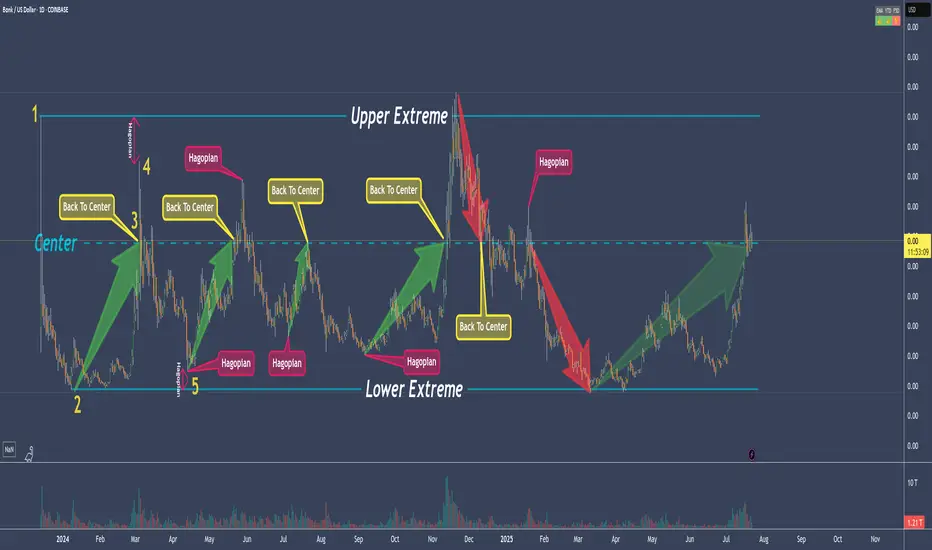
80% Of Time - A Trading Edge You Don't Want To MissDo you want to know why trading with median lines, also known as pitchforks, can be so successful? It’s simple:
Prices swing from one extreme back to the middle.
From the middle, they often swing to the other extreme.
What do we see on the chart?
- The upper extreme
- The center
- The lower extreme
So far, so good.
Now let’s follow the price and learn a few important rules that belong to the rulebook of median lines/pitchforks, and with which you can make great trades.
Point 1
The price starts and is sold off down to…
Point 2
...and from there starts to rise again, up to…
Point 3
...which is the center. And here we have a rule that is very important and one that you need to be aware of in trading to be successful:
THE PRICE RETURNS TO THE CENTER IN ABOUT 80% OF ALL CASES
If we know this, then we can stay in a trade with confidence.
Point 4
The price climbed even higher but missed the upper extreme.
This is the “Hagopian Rule” (named after the man who discovered it).
And the rule goes: If the price does not reach the next line (upper extreme, lower extreme, or center), then the price will continue moving in the opposite direction from where it originally came.
Phew...that’s a mouthful ;-)
But yes, we actually see that the price does exactly this.
From point 4, where the price missed the upper extreme, the price not only goes back to the center but continues and almost reaches the lower extreme!
Now if that isn’t cool, I don’t know what is!
And what do we have at point 5?
A "HAGOPIAN"!
What did we just learn?
The price should go higher than the center line.
Does it do that?
Oh yes!
But wait!
Not only does the Hagopian Rule apply. Remember?
"The price returns to the center line in about 80% of the cases."
HA!
Interesting or interesting?
So, that’s it.
That’s enough for now.
Now follow the price yourself and always consider which rule applies and whether it’s being followed.
How exactly do you trade all this, and what are the setups?
...one step at a time.
Don’t miss the next lesson and follow me here on TradingView.
Wishing you lots of success and fun!
Mastering the MACD - How to use it in trading?The MACD, or Moving Average Convergence Divergence, is one of the most widely used technical indicators in trading. It was developed by Gerald Appel in the late 1970s and is designed to reveal changes in the strength, direction, momentum, and duration of a trend in a stock's price. At its core, the MACD is a momentum oscillator, though it is commonly plotted as a line chart rather than the traditional bounded oscillators like the RSI. Despite being unbounded, traders use the MACD primarily to identify potential buy and sell signals.
What will be discussed?
- How does the MACD work?
- How to use the MACD in trading?
- Divergences
- Conclusion
How does the MACD work?
The MACD is calculated by subtracting the 26-period Exponential Moving Average (EMA) from the 12-period EMA. The result of this calculation is the MACD line. A nine-period EMA of the MACD line, known as the signal line, is then plotted on top of the MACD line. The third component is the MACD histogram, which represents the difference between the MACD line and the signal line. The histogram gives traders a visual cue about momentum: when the histogram bars are growing in height, momentum is increasing in the direction of the MACD line; when they shrink, momentum is slowing down.
How to use the MACD in trading?
Understanding how to use the MACD in trading requires some interpretation of the relationships between these components. One of the primary signals traders look for is a crossover between the MACD line and the signal line. When the MACD line crosses above the signal line, it is considered a bullish signal, suggesting that it might be a good time to buy. Conversely, when the MACD line crosses below the signal line, it indicates a bearish signal and potentially a good time to sell. These crossovers tend to be more significant when they occur below or above the zero line, which is where the MACD and signal line are equal. A crossover below the zero line followed by a move above it could signal the beginning of an uptrend, while a crossover above the zero line followed by a move below it might signal a downtrend.
Divergences
Another important application of the MACD is identifying divergence between the MACD and the price action of the asset. Divergence occurs when the price is moving in one direction and the MACD is moving in the opposite. For instance, if the price makes a new high but the MACD forms a lower high, it can be a warning sign that the upward momentum is weakening and that a reversal could be on the horizon. Similarly, if the price hits a new low but the MACD makes a higher low, it might suggest a potential bullish reversal.
Conclusion
In summary, the MACD is a versatile and powerful indicator that helps traders analyze the momentum and direction of a market trend. Its ability to provide both trend-following and momentum signals makes it a valuable tool in a trader’s toolkit. While it is not a standalone solution, when used properly and in conjunction with other strategies, the MACD can greatly enhance the accuracy and confidence of trading decisions.
Thanks for your support.
- Make sure to follow me so you don't miss out on the next analysis!
- Drop a like and leave a comment!
Can AI Forge America's Next Shield?Palantir Technologies finds itself strategically positioned at the forefront of a potentially transformative U.S. defense initiative, the "Golden Dome" missile defense system. As a crucial partner in a consortium reportedly led by SpaceX and including Anduril Industries, Palantir is a leading contender for significant involvement in this multi-billion-dollar project. Golden Dome aims to establish a next-generation, networked shield against advanced missile threats, emphasizing rapid development and integration of space-based sensors and diverse defensive capabilities, moving beyond traditional procurement timelines.
Within this ambitious framework, Palantir's role leverages its core expertise in AI and large-scale data analytics. The company is anticipated to provide the essential software platform required to process and interpret data from potentially hundreds or thousands of tracking satellites, creating real-time situational awareness and enabling coordinated responses across the complex defense network. This involvement could also benefit from innovative procurement approaches, such as SpaceX's proposed subscription model, potentially securing stable, long-term revenue streams for Palantir.
Recent successes underscore Palantir's readiness for such a demanding role. The rapid adoption of its Maven Smart System by NATO validates its AI capabilities in high-stakes military environments, while its partnership with Vatn Systems demonstrates the utility of its platform in scaling and modernizing defense manufacturing. Securing a key position in the Golden Dome would represent a major strategic victory, solidifying Palantir's ascent as a disruptive force in the defense technology sector and signaling significant growth potential as it helps shape the future of national security.
Gold Target $4054 Year 2025-2026 With Reasons & 4$rules.1st Tp completed at 3341
2nd Tp 3437
3rd Tp 3622
4th Tp 3747
Final target is $ 4054 for Year 2025 to 2027
Below the Base line mentioned in chart will be the Seller profit zone which is marked as 1st Support, 2nd Support, 3rd Support & 4th Major Support.
Current Major reasons mentioned in the chart and future will be running of food, drinking water crisis and health issues will remain on high alerts (after covid 19 and pollution issues) and Insurance companies profits will be on Top of every Monthly trading results.
Can Efficiency Topple AI's Titans?Google has strategically entered the next phase of the AI hardware competition with Ironwood, its seventh-generation Tensor Processing Unit (TPU). Moving beyond general-purpose AI acceleration, Google specifically engineered Ironwood for inference – the critical task of running trained AI models at scale. This deliberate focus signals a Major bet on the "age of inference," where the cost and efficiency of deploying AI, rather than just training it, become dominant factors for enterprise adoption and profitability, positioning Google directly against incumbents NVIDIA and Intel.
Ironwood delivers substantial advancements in both raw computing power and, critically, energy efficiency. Its most potent competitive feature may be its enhanced performance-per-watt, boasting impressive teraflops and significantly increased memory bandwidth compared to its predecessor. Google claims nearly double the efficiency of its previous generation, addressing the crucial operational challenges of power consumption and cost in large-scale AI deployments. This efficiency drive, coupled with Google's decade-long vertical integration in designing its TPUs, creates a tightly optimized hardware-software stack potentially offering significant advantages in total cost of ownership.
By concentrating on inference efficiency and leveraging its integrated ecosystem, encompassing networking, storage, and software like the Pathways runtime, Google aims to carve out a significant share of the AI accelerator market. Ironwood is presented not merely as a chip, but as the engine for Google's advanced models like Gemini and the foundation for a future of complex, multi-agent AI systems. This comprehensive strategy directly challenges the established dominance of NVIDIA and the growing AI aspirations of Intel, suggesting the battle for AI infrastructure leadership is intensifying around the economics of deployment.
GOLD LIVE TRADE AND EDUCATIONAL BREAKDOWN LONGGold clings to gains above $3,110, closes in on all-time high
Gold builds on Wednesday's impressive gains and trades above $3,110 on Thursday. The broad-based selling pressure surrounding the US Dollar and retreating US bond yields on growing fears of a deepening trade war between China and the US fuel XAU/USD's rally.
USDJPY SHORT LIVE TRADE AND EDUCATIONAL BREAKDOWNUSD/JPY tumbles below 147.00, awaits US CPI for fresh impetus
USD/JPY has come under intense selling presure and drops below 147.00 in the Asian session on Thursday. The US-China trade war escalation and the divergent BoJ-Fed policy expectations underpin the Japanese Yen and weigh heavily on the pair amid a renewed US Dollar downtick. US CPI awaited.
EURUSD LIVE TRADE EDUCATIONAL BREAK DOWNEUR/USD holds gains below 1.1000 ahead of US CPI release
EUR/USD is tirmimng gains while below 1.1000 in the European session on Thursday. The Euro gains on the German coalition deal and Trump's 90-day pause on reciprocal tariffs. Meanwhile, the US Dollar finds demand on profit-booknig ahead of the US CPI data release.
XAU QUICK SHORT TRADE LIVE TRADE AND EDUCATIONAL BREAKDOWN Gold price (XAU/USD) touches a fresh weekly top, around the $3,132-3,133 area heading into the European session as concerns about escalating US-China trade tensions continue to drive safe-haven flows. Moreover, fears that tariffs would hinder economic growth and boost inflation turn out to be another factor that benefits the precious metal's status as a hedge against rising prices. Apart from this, bets for multiple interest rate cuts by the Federal Reserve (Fed) push the non-yielding higher for the second successive day.
XAU LONG LIVE TRADE AND EDUCATIONAL BREAKDOWN Gold extends rally to $3,050 area as safe-haven flows dominate markets
Gold preserves its bullish momentum and trades near $3,050 in the second half of the day. Further escalation in the trade conflict between the US and China force markets to remain risk-averse midweek, allowing the precious metal to capitalize on safe-haven flows.
AUDUSD SELL 106 PIPS LIVE EXCAUTION AND EDUCATIONAL BREAKDOWN AUD/USD has ereased earlier gains to edge lower below 0.6300 in the Asian session on Monday. Trump's tariff concerns outweigh mixed Chinese NBS March PMI data, Australia's hot private inflation data and broad US Dollar weakness, exerting downward pressure on the pair as risk-aversion intensifies.
CADCHF SHORT LIVE TRADE AND BREAKDOWN EXPLANATION 9K PROFITThe CHF/CAD pair tells the trader how many Canadian Dollar (the quote currency) are needed to purchase one Franc Swiss (the base currency). These two economies are quite intensely linked because Canada is an important producer of gold while Switzerland is a great importer of that same commodity - a quart part of the overall commodities imported by Switzerland is gold and there is a solid tradition of gold refineries/gold mining companies in the country. Switzerland can be considered as a stable and safe country. The same accounts for its currency, the Swiss Franc (CHF). The currency is often referred to as the “safe-haven” currency, as it is a backup for investors during times of geopolitical tensions or uncertainty: it is expected to increase its value against other currencies in times of volatility.
Toast me or Roast me - I'm still learning & practicing charting
I was looking at descending scallops and some of their features via thepatternsite.com
What is valid or invalid about this charting here??
I have the high peak marked from the ATH that topped the uptrend on AMEX:SPY and the most recent upward breakout prior to trending back down on the 1HR as of yesterday. I know I will only be able to confirm in hindsight but is there good reason here for me to say we have the makings of a long-er term descending scallop in play here?
Thanks to all. I enjoy reading your opinions and discussions on the daily.
Machine Learning Algorithms for Forex Market AnalysisMachine Learning Algorithms for Forex Market Analysis
Machine learning is transforming the currency trading landscape, offering innovative ways to analyse market trends. This article delves into how machine learning algorithms are reshaping forex trading. Understanding these technologies' benefits and challenges provides traders with insights to navigate the currency markets potentially more effectively, harnessing the power of data-driven decision-making.
The Basics of Machine Learning in Forex Trading
Machine learning for forex trading marks a significant shift from traditional analysis methods. At its core, machine learning involves algorithms that learn from and provide signals based on data. Unlike standard trading algorithms, which operate on predefined rules, these algorithms adapt and improve over time with exposure to more data.
Machine learning forex prediction algorithms analyse historical and real-time market data, identifying patterns that are often imperceptible to the human eye. They can process a multitude of technical and fundamental factors simultaneously, offering a more dynamic approach to analysing market trends.
This capability can allow traders to make more informed decisions about when to buy or sell currency pairs. The increasing availability of market data and advanced computing power has made machine learning an invaluable tool in a trader's arsenal.
Types of Machine Learning Algorithms in Forex Trading
In the realm of forex trading, various machine-learning algorithms are utilised to decipher complex market patterns and determine future currency movements. These algorithms leverage forex datasets for machine learning, which encompass historical price data, economic indicators, and global financial news, to train models for accurate analysis.
- Support Vector Machines (SVMs): SVMs are particularly adept at classification tasks. In forex, they analyse datasets to categorise market trends as bullish or bearish, helping traders in decision-making.
- Neural Networks: These mimic human brain functioning and are powerful in recognising subtle patterns in market datasets. They are often embedded in forex forecasting software to determine future price movements based on historical trends and fundamental data.
- Linear Regression: This straightforward approach models the relationship between dependent and independent variables in forex data. It's commonly used for its simplicity and effectiveness in identifying trends.
- Random Forest: This ensemble learning method combines multiple decision trees to potentially improve analysis accuracy and reduce overfitting, making it a reliable choice in the forex market analysis.
- Recurrent Neural Networks (RNNs): Suited for sequential data, RNNs can be effective in analysing time-series market data, capturing dynamic changes over time.
- Long Short-Term Memory (LSTM) Networks: A specialised form of RNNs, LSTMs are designed to remember long-term dependencies, making them effective tools for analysing extensive historical forex datasets.
Benefits of Machine Learning in Forex Trading
Machine learning offers significant advantages for forex analysis. Its integration into forex prediction software may enhance trading strategies in several key ways:
- Real-Time Data Analysis: Algorithms excel in analysing vast amounts of real-time data, which is crucial for accurate forex daily analysis and prediction.
- Automated Trading: These algorithms automate the buying and selling process, which may increase efficiency and reaction speed to market changes.
- Enhanced Market Understanding: It helps in dissecting historical market data, providing a deeper understanding for informed decision-making.
- Accuracy in Analysis: Software powered by machine learning offers superior analysis abilities, leading to potentially more precise and timely trades.
- Risk Reduction: By minimising human error and maintaining consistency, machine learning may reduce trading risks, contributing to a safer trading environment.
Challenges and Limitations
Machine learning in currency trading, while transformative, comes with its own set of challenges and limitations:
- Data Quality and Availability: Accurate machine learning analysis depends on large volumes of high-quality data. Forex markets can produce noisy or incomplete data, which can compromise the reliability of the analysis and signals.
- Complexity and Overfitting: Developing effective algorithms for forex trading is complex. There's a risk of overfitting, where models perform well on training data but poorly in real-world scenarios.
- Interpretability Issues: Machine learning models, especially deep learning algorithms, can be "black boxes," making it difficult to understand how decisions are made. This lack of transparency can be a hurdle in regulatory compliance and trust-building.
- Regulatory Challenges: Currency markets are heavily regulated, and incorporating machine learning must align with these regulatory requirements, which can vary significantly across regions.
- Cost and Resource Intensive: Implementing machine learning requires significant computational resources and expertise, which can be costly and resource-intensive, especially for smaller trading firms or individual traders.
The Bottom Line
Machine learning represents a paradigm shift in forex trading – it may offer enhanced analysis accuracy and decision-making capabilities. While challenges like data quality, complexity, and regulatory compliance persist, the benefits of advanced algorithms in understanding and navigating market dynamics are undeniable. For those looking to trade forex, opening an FXOpen account could be a step towards a wide range of markets, lightning execution and tight spreads.
This article represents the opinion of the Companies operating under the FXOpen brand only. It is not to be construed as an offer, solicitation, or recommendation with respect to products and services provided by the Companies operating under the FXOpen brand, nor is it to be considered financial advice.