 Short
ShortLyft
Short
$UBER in downside price discovery Despite positive earnings reports, Uber is dumping. Lyft also has positive earnings and is at the brink of support. hmmm..

$LYFT inches to price discovery to the downside Probably gonna follow $UBER. A bounce here would be a good sign though. Lyft has been beating earnings expectations.


Lyft amazing buying opportunityThere is a lot going on in this chart but there are a couple things i would like to put an emphasis on for Lyft. First, notice that we are in a massive falling wedge structure, generally indicating a breakout upwards. Second, notice the red line i have drawn at the bottom of this descending wedge. This red line could be considered a major support level, as it acted as both support and resistance back in May. Third, notice the MASSIVE bullish divergence on the 4hr RSI. Finally, notice that the fib retracement .786 level matches up in confluence with the red line major support I have drawn. All in all, I think it is safe to say we will be seeing a larger reversal for Lyft in the coming weeks. Don't miss out on this amazing opportunity.
If you enjoyed this analysis, and/or like cookies, give me a thumbs up and follow for more content (:
Long
Lyft potential long from supply areaTarget 1: 58s
Target 2: 61s
Stoploss: 46s
Reward/Risk: 1.3-1.93
I might be looking to dollar cost average around the stop loss level. When the market is so weak like it is supply and demand levels tend to react aggressively.
Long Short
Short
Will Lyft Repeat What Snap Did Already?Hello dear stock traders & friends, hope you're doing well guys! ;)
In this comparison, I wanna show you the similarities between Lyft & Snap: In trading we often have 'non-linear' trendlines & corrections , which I'm personally counting in my analyses when looking at stocks or commodities or crypto.
In this case case we have nice rounded bullish upmove, which always gets into a descending ending move, before we see a break out of this shape.
=> Snap went from $11.50 to almost $18,50 breaking from this pattern.
Of course it will strongly depend on company performance over the coming months, but Lyft could similarly see a bounce going on from the current $60-59 zone, and even another dip to $57, before we see a breakout coming. We could go towards $78-80 psychological in this case.
If you had some value from my analysis, give it a thumbs-up & comment it, because the mechanism shows my analysis to other people then. Make also sure to follow me so you get notified on my analyses! I wish you a good trading! :)
Edgy is providing online education only. We are not a financial advisor, nor do we hold any formal qualifications in this area. You're trading at your own risk. No matter what you do, please set your stop loss. Please be aware, that you can lose all your money on the online exchanges.
Long
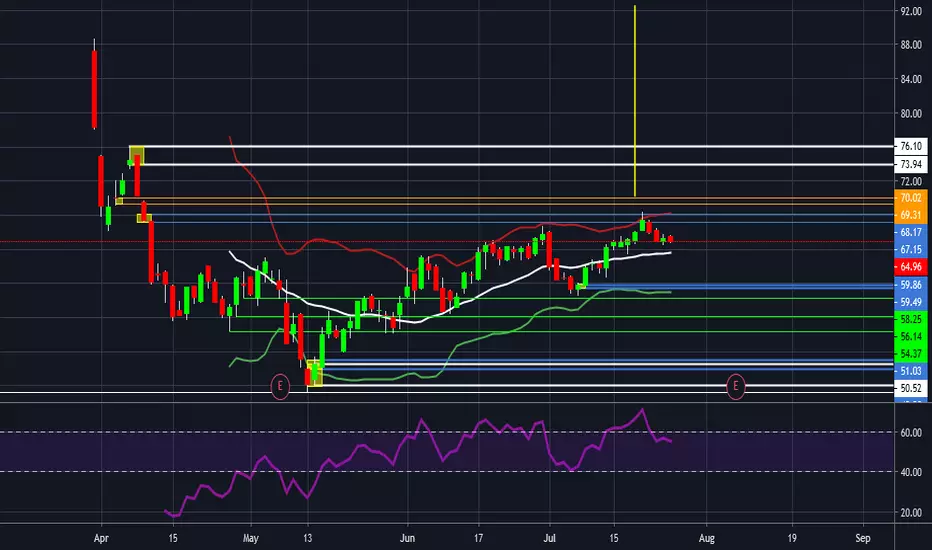
Lfyt Mark UpI do not trade Lyft, yet. I would like to share what I would do IF I were to trade this stock. I believe the overall is bullish even though we might see price head to the downside before we get some real bullish momentum into the market. That vertical represents the length of the move I'm projecting. I would long it from the $76.10 to $92 only if there's a break followed by a retest of the $76.10 price point.
*DISCLAIMER* THESE ARE JUST MY HUMBLE OPINIONS, NOT TRADING ADVICE.
LYFT Inc. Rising Channel, Respecting .382 & .5 Fib RetracmentsPlease see Callouts on chart
Please Like, Comment, and Follow for more analysis!
Goodluck!
Long
LYFT Gaining Momentum After Completing RetracementHere we can look to long LYFT to the most recent highs after price reversed from a fibonacci confluence zone.
Long
No fear, it's just a money trade with $LYFTI'm sure the price is going to hit the resistance $72 area, it's ~ 10% of profit if you buy today. Or if you have your enter target like I have ~ $62 we will do more than 15% profit.
Time Frame : 1D
Resistance ~ $72
Support:
~ Uptrend line
~ Support EMA lines
Enter: $63-61
Stop Loss ~ $58.5
TP 1 ~ $73
TP 2 ~ Maybe it will be pumped like TLRY or TSLA. So you can take a little risk to hold 3% in $LYFT
I have the REDDIT and TWITTER with the same name, if you wanna ask me or community, feel free to do that. Hit like, comment and follow for more profitable ideas.
Long
Transportation Clones / LevelsIn name and concept; clones
some people refer to fib levels colloquially as clones as well!
enjoy
manage your own risk
much love
gl hf
xoxo
snoop

Uber ready for a Lyft tomorrow?Not financial advice. I’m not a financial advisor. I’m learning to trade. Learn to trade!
Still on course for a possible breakout of a possible ASC TRI
Long
LYFT INC - Sometimes the crazy ones get lucky. Will it do 123% ?Risk Reward : 11.62
Stop loss : 54.68 ( -10% stop loss very very high risk )
Target : 136.47
Take profits at red boxes.
Long term EOY
Long
Lyft breaking important resistance (intraday)If LYFT can stay today above the $63. I would expect it to go higher.
If the candlestick today has a wick on its top (breaking through this $63). I see potentially heavy winds for the stock.

LYFT Inverse H&S bullish breakoutPattern: Bullish breakout of inverse Head and Shoulders
Edge: No outside edge since this stock just IPO'd a few weeks ago. We are just trading the pattern.
Risk Management: Bought at $62.92. Stop below $58.52 (below the 20 day moving average). PT1 is $73, PT2 is $78 (gap fill), then open target for the remainder of the shares.
Long
LYFT Mark UpHere's a mark up for Lyft. These would be the areas of interest that I would track. I'm always neutral, but I would be looking for a short opportunity.

LYFT Inverse H&S $75 6/21 PTThe Right shoulder is formed now on this pattern and it has room to run especially if the market runs as well.
Long
UBER Breakout Imminent UBER is about to make a large movement.
I don’t usually operate on 1h candles, but with Uber we don’t have much history to look at. In the three weeks since its IPO, Uber has been surprisingly boring to watch. This is mostly due to the unfortunate timing of its launch. In the week of Uber’s IPO the market experienced its highest volatility since the Christmas massacre. We have yet to decide whether 2019’s party is over, but Uber will likely trade as an amplified version of market’s decision.
Uber has been forming a small flag since its debut, unsure of which direction it should breakout. Options expiring in two weeks currently hold a 5% premium in both directions, anticipating the coming move, but split on the direction it will take. Since before its launch I have felt that, should the market have another significant leg to its bull run, UBER could potentially be a significant bubble of 2019 in similar fashion to the cannabis industry in 2018 and cryptocurrency in 2017. Whenever enough attention is focused on the future, anticipation surpasses reality without fail. With markets this creates bubbles as the integral variable of time falls from calculations.
While there is a large upside to UBER at the moment, it will be entirely subject to prevailing market sentiment, which is currently a jittery mix of trepidation and ambition. It wants to go all in on one more hand, but it also knows that it’s drunk and should head on home to recover.
Relevant indicators:
1. As mentioned, we have a flag forming. Volume has been drying up as market players place their bets over the last few weeks, and when the dice roll soon, the price will either break above 45 or below 35, the current high and low created by the first two trading days.
2. Bloomberg recently reported that 70% of available shares for shorting are lent out. This high amount indicates a strong belief in the downside, but it also shows a saturation of the position that hasn’t yet managed to materialize, indicating that it may not be strong enough to dissuade investors who want in on UBER.
2. Uber is not a profitable company, which means any investments made currently will require a large amount of time to bring a return from the company itself. The only way to profit off of a company like this is if someone else is more excited about the investment than you. Netflix (NFLX) is an example of this. These companies are expanding rapidly, and all returns are reinvested immediately in a battle to grab future market share. Due to time being such an unknown variable for the return, there is a natural inclination to the downside caused by reality that can only be countered by an increasing amount of hype regarding the potential returns of the future. This factor is largely dependent on overall market sentiment, but high-profile companies like Uber are the ones that best achieve this.
1. Lyft had its IPO shortly before Uber, and with the stock’s premier going a way similar to Facebook’s initial launch, this seems a simple instinctive guess to the direction due to LYFT being the closest comparison on the surface. But Uber is not Lyft, and its image and scope can be argued to place it in a different class than Lyft, rendering the comparison flawed. If investments in the future of self-driving cars are going to operate similarly to that of media and entertainment like Netflix, then Uber is the obvious choice for an investment in this future.
Note: Bottom trend line may be entirely accurate due to such limited information. While This movement is expected imminently, there is no accurate way to determine the exact timing for this.

The $LYFT Lift... FinallyI’m just firing a few off here.. I love LYFT, DOCU, and STNE (Warren Buffett’s crypto baby)
Long
Picking a Buy Point for Uber (UBER)The IPO for Uber (UBER) has fallen out the bed. The company priced its IPO at $45, opened at $42, and closed at $41.57. UBER’s one-day total loss in value from the IPO price was apparently the largest in history. For a moment, UBER looked like it could stabilize around its poor first day. Unfortunately, the next trading day a major market sell-off helped take UBER down another 11.0% to close at $37.00.
{Uber (UBER) is two days old and has managed to sink 17.8% from its IPO price. This 15-minute chart shows the current persistence of selling.}
I believe retail investors have typically been left out of the big IPO cash machine of 2019 (like most successful IPOs). Yet, with 207M shares put out to market (180M from the company and 27M from selling stockholders), I strongly suspect too many retail investors got caught up in the UBER slide.
First of all, valuation is a tenuous metric for UBER. TechCrunch provided great coverage of the UBER S1 filing which threw into question the $90-$100B valuation at the time, down from a peak of around $120B. UBER is now valued at a $62B market cap. Here are some choice quotes which undermined any justification for premium pricing for UBER:
“…Those figures say show Uber’s growth slowing as it scaled. Still, at Uber’s revenue scale, growing 42 percent is impressive. However, the pace of deceleration from 2017’s over 100 percent figure could provide pause to some investors looking at Uber’s results from a growth perspective. And, when examined quarterly, the company’s revenue deceleration is even starker…a closer look at those quarterly results indicates that the company is growing at a rate much slower than that yearly total.”
“The company’s operating losses decreased year over year from $4.1 billion to $3.1 billion. Improving net loss is a positive for Uber, but $3.1 billion is still a huge figure, particularly within the context of slowing growth.”
In other words, UBER is NOT the kind of stock investors should rush to grant a premium. Still, UBER is now priced at 5.5x sales, just above the 5.1x for Grub Hub (GRUB) which competes directly with Uber Eats and also strongly relies upon a flexible labor force of non-professional drivers.
{Grubhub (GRUB) is well off its all-time highs but has not (yet?) reversed the big breakout from July, 2017.}
Based on this admittedly simplistic valuation exercise, I am going to hazard a guess that buying Uber around current levels is a good long-term bet assuming it proves to be a viable business. My preferred spot to buy UBER is around 5x sales or $33-$34 to account for more of the risk in the business and the stock.
Technicals should help refine the entry point. For technicals, I lean on my framework of stepping aside while sellers are getting busy and jumping in when buyers show strong interest: “Anatomy of A Bottom: Do Not Argue With Sellers – Celebrate With Buyers.” In Uber’s case, buyers prove nothing until they are able to at least breach Monday’s gap down. In the absolute best case scenario, I would buy at $39.50 and stop out below $36. I will be much more interested in applying the technical framework if (once?) UBER breaks $36.
I will likely be slow to speculate on UBER because I got caught up using options to generate a lower entry price on Lyft (LYFT). At $48.15/share Lyft is well below the $55 strike price of the last put I sold (October expiration). Lyft is currently valued at 5.4x sales, but I used GRUB for UBER’s valuation yardstick because of its extended trading history.
{Lyft (LYFT) closed at a fresh all-time low after freshly breaking down last week.}
Options are not yet available for UBER. When they are trading, I will reach for selling puts before next picking a spot to buy shares.
Be careful out there!
Full disclosure: short LYFT puts and long calls
Long
UBER and LYFT comparisonI am going to assume that UBER is going to exhibit similar behavior as LYFT after it's failed IPO.
Therefore I am looking for UBER to make a second deeper dip near the end of this month which will probably take it down to 30.
Here I would be willing to take up a first position.
Short Short
Short