The Support Zone That Refused To Be IgnoredSome chart zones whisper. This one practically waved its arms.
Price slid right into a hefty support area on the higher timeframe… and suddenly started behaving like it had forgotten how to move lower. Classic clue.
Zoom in, and the daily chart shows price squeezing itself into a falling wedge — the market’s equivalent of someone pacing in a hallway, unsure whether to sit down or sprint. Sellers kept trying to push prices lower, but each attempt had less conviction than the last.
When you stack those two pieces together — a big support zone from the monthly chart and a daily pattern running out of room — things start to get interesting. Not predictive, just… interesting.
A breakout above the wedge (around 0.0065030) would basically say, “Alright, I’m done compressing.”
A stop tucked below the lower support range (roughly 0.0063330) keeps the scenario clean.
And a structural projection toward 0.0067695 gives the idea a tidy endpoint if momentum decides to stretch its legs.
Of course, leverage cuts both ways, and traders working with the standard or micro contracts often choose size based on how much room they want between entry and invalidation. When traders choose between the standard and micro versions of this market, it usually comes down to scale. The bigger contract represents 12,500,000 units of the underlying with a $6.25 tick, while the micro mirrors the behavior at 1,250,000 units with a $1.25 tick. Estimated margins also differ — roughly $2,800 for the larger contract and about $280 for the micro. Same chart logic, just two very different footprints on the account.
The real takeaway? When a major zone teams up with a compression pattern, it’s usually worth paying attention. Maybe it leads to a beautiful breakout. Maybe it fizzles. But structurally, this is one of those “save the screenshot” moments.
And whatever the outcome, risk management keeps the whole thing sensible — size smartly, define failure points, and let the chart prove itself instead of assuming it will.
Want More Depth?
If you’d like to go deeper into the building blocks of trading, check out our From Mystery to Mastery trilogy, three cornerstone articles that complement this one:
🔗 From Mystery to Mastery: Trading Essentials
🔗 From Mystery to Mastery: Futures Explained
🔗 From Mystery to Mastery: Options Explained
When charting futures, the data provided could be delayed. Traders working with the ticker symbols discussed in this idea may prefer to use CME Group real-time data plan on TradingView: www.tradingview.com - This consideration is particularly important for shorter-term traders, whereas it may be less critical for those focused on longer-term trading strategies.
General Disclaimer:
The trade ideas presented herein are solely for illustrative purposes forming a part of a case study intended to demonstrate key principles in risk management within the context of the specific market scenarios discussed. These ideas are not to be interpreted as investment recommendations or financial advice. They do not endorse or promote any specific trading strategies, financial products, or services. The information provided is based on data believed to be reliable; however, its accuracy or completeness cannot be guaranteed. Trading in financial markets involves risks, including the potential loss of principal. Each individual should conduct their own research and consult with professional financial advisors before making any investment decisions. The author or publisher of this content bears no responsibility for any actions taken based on the information provided or for any resultant financial or other losses.
Pricecompression
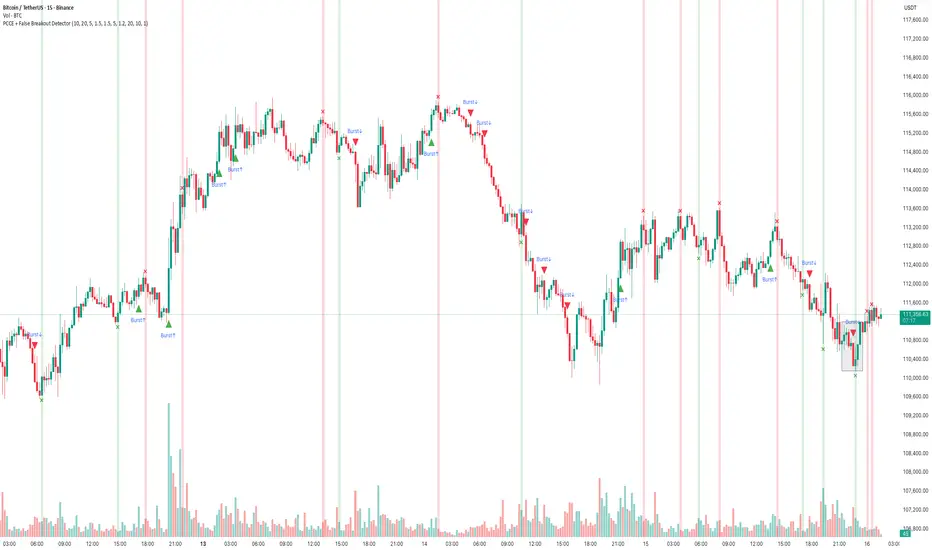
How to PCCE+FBD – Decoding Expansion/Exhaustion & Reversal zones🧭 PCCE + False Breakout Detector – Decoding Expansion, Exhaustion & Reversal Zones
How It Worked on the Chart
In this BTC/USDT 15-minute chart, the indicator detected several Price Coil Compression & Expansion (PCCE ) phases and confirmed false breakouts with visual clarity:
• Green vertical zones represent bullish expansion bursts — price coils tightly, then breaks upward with volume confirmation.
→ These often appear after sideways congestion, signaling early trend ignition.
• Red vertical zones mark b earish expansion bursts — price expands downward after compression, usually following distribution-like setups.
→ Notice how each burst frequently aligns with a decisive trend move.
• The “Burst↑ / Burst↓” labels highlight valid expansions confirmed by momentum and volume thrust conditions, showing continuation opportunities.
However, the true power lies in the False Breakout Detection System — the small “X”-shaped bullish (green) or bearish (red) crosses that appear at potential exhaustion points.
🔍 Interpreting the False Breakout Marks
The bullish “X” and bearish “X” crosses represent trap zones or deceptive breakouts that failed to sustain momentum beyond the coil’s boundary.
• Bearish X (Red) : Price attempted to break higher but was rejected, often marking a short-term top.
→ Can be used as a signal to exit long trades or prepare for short entries once confirmation candle closes below.
• Bullish X (Green) : Price dipped below the compression base but quickly re-entered, showing rejection of lower prices.
→ Indicates a failed breakdown, usable as an early long setup or exit from short positions.
🎯 How Traders Can Use It
1. For Entry Confirmation:
• Wait for a Burst↑ or Burst↓ label after a compression phase.
• Enter in the direction of the expansion, confirming with volume or candle momentum.
2. For Exit or Reversal Spotting:
• Use the False Breakout crosses as smart exit markers.
→ If you are long and a red “X” appears near the top, consider partial profit or tighten stops.
→ If short and a green “X” appears near the bottom, expect possible short covering.
3. For Reversal Trading:
• Combine “Burst” direction with the opposite false breakout mark.
Example: After a Burst↓ (bearish move), if a bullish X appears, it suggests exhaustion — a reversal or pullback may begin
💡 Practical Takeaway
The PCCE + False Breakout Detector effectively blends volatility compression theory with trap pattern logic, letting traders:
• Spot pre-move compression zones ,
• Identify false breakouts and momentum traps , and
• Time exits or reversals with visual precision.
This makes it a dual-purpose tool — both a trend-continuation detector and a reversal warning system — ideal for intraday and swing traders across all markets.
Dollar-Yen Compression Coil: A Breakout is Brewing🧠 Why This Matters Right Now
USD/JPY has been tightly range-bound for the past 7 sessions, hugging the underside of 154.50, a historically significant resistance level. With U.S. inflation coming in hotter than expected and the Bank of Japan stepping back from policy tightening, this tug-of-war has compressed price action into a tight coil. A volatility eruption is right around the corner.
🔍 Breakdown of the Strategy
This is a volatility compression breakout setup based on the logic that low volatility precedes expansion. The ingredients:
Bollinger Bands (20, 2) for detecting squeeze zones
ADX (14) under 15 to confirm low trend strength
Price range compressing within 0.5%
Entry Logic:
📈 Long: Close above upper Bollinger Band + ADX > 20
📉 Short: Close below lower Bollinger Band + ADX > 20
Stops & Targets:
Stop Loss: Just inside the opposite Bollinger Band
Take Profit: 2× ATR(14)
🚀 Why This Works in Today’s Market
The policy divergence between the U.S. and Japan is creating a classic fundamental standoff, but the price can't stay neutral for long. Volatility is compressed to its limits. When the breakout comes, it's likely to run fast and clean in the direction of the imbalance.
🤖 Automate It with PineScriptAI
With PineScriptAI, you can instantly:
Detect when Bollinger Band width narrows
Monitor ADX thresholds
Set up conditional breakout logic with smart alerts and backtests
Create a dual-trigger script that catches either direction — no need to guess the breakout side.
⚡ From Trend to Code — Instantly
This isn’t just a chart pattern — it’s a recurring market phenomenon. With PineScriptAI, you can adapt this same logic to GBP/JPY, EUR/JPY, or even gold compressions with zero manual tweaking.
🧭 Final Insight FX:USDJPY
When price coils, energy builds. Don’t just watch it break — code it, trade it, and scale it across markets with PineScriptAI.
Bitcoin price compressionHi Guys.
Im in 1H timeframe and i think BTC price compressed between two line i drawn on my chart.
Also we can see a weak Divergence between RSI and Price action too.
This will lead the price to the lower line and despite there is a strong support line there , in 24000
the price will bouce back and go approch upper line.
So we can take 2 trades here:
1- Now with SL upper than latest minor peak
2- after reaching lower line and the bounce verified.
The price action around 24000 was very strong because you see two long shadowed candle in this area historically.
After this price compression ends , we shuold analysis again to see what will happen.
But in some extent , I think we break this Triangle upward and go toward 26000 target.
Hope you enjoy , thats just my idea NOT a trading Advice.
Trade on your own strategy but take ideas from others.
THANK YOU ALL
BTC might see 50k levels in near futureI know it's been pretty dull for BTC lately but I see possibility of 50k levels to come soon, confirmation of strong bull trend will be when bottom indicator moves above 0 or yellow line.
One reason for above observation is that lately price action has been compressed and I feel its an indication of big player interest area, do not be surprised if current levels are avg price for the most big players when the price ends up really going to 50k
I can't speak on time required for this but I estimate at least 4-5 months.