TetherTether price for today is $0.993657. It has a current circulating supply of 2.06 Billion coins and a total volume exchanged of $97,581,934
Resistance Level (R3): 1.021
Resistance Level (R2): 1.013
Resistance Level (R1): 1.003
Pivot Point: 0.995
Support Level (S1): 0.985
Support Level (S2): 0.977
Support Level (S3): 0.967
Search in ideas for "tether"
Tether Rakes in $4.9B Q2 Profit, Cementing Its Reign as Crypto’sTether Q2 Net Profit Hits $4.9 Billion, Pushing Total Earnings to $5.7 Billion: What It Means for the Crypto Industry
Tether Holdings Ltd., the issuer of the world’s largest stablecoin USDT, has once again made headlines with its Q2 2025 earnings report, revealing a staggering net profit of $4.96 billion. This brings the company’s total profits for the first half of the year to $5.7 billion—a record-breaking milestone for both the company and the broader stablecoin ecosystem.
This article explores the implications of Tether’s Q2 performance, the sources of its revenue, its impact on the crypto markets, and the growing significance of stablecoins in the evolving financial landscape.
________________________________________
A Record-Setting Quarter for Tether
Tether’s Q2 2025 results have astonished even seasoned analysts. The company’s reported $4.96 billion in net profit in a single quarter represents one of the most profitable periods in the history of any fintech or crypto-native company. What’s even more remarkable is that this profit was not driven by speculative trading or token sales, but by conservative, yield-generating strategies rooted in traditional finance.
The company’s Q1 earnings were already impressive at $0.76 billion, but Q2’s results eclipse those numbers entirely. Tether’s cumulative profit year-to-date now stands at $5.72 billion, putting it on track to potentially exceed $10 billion in earnings for the full year if current trends continue.
________________________________________
What’s Driving Tether’s Massive Profit?
Tether’s incredible profitability is primarily fueled by one key factor: the interest earned on its reserves. As the issuer of USDT, Tether is responsible for maintaining a 1:1 backing of every token in circulation. These reserves are primarily held in short-term U.S. Treasury Bills (T-Bills), reverse repos, and cash equivalents.
Here’s a breakdown of the main profit drivers:
1. High Interest Rates on U.S. Treasuries
With the U.S. Federal Reserve maintaining elevated interest rates to combat inflation, short-term T-Bills have become highly lucrative. Tether holds tens of billions of dollars in these instruments, generating billions in annual interest income.
For example, the yield on a 3-month Treasury bill in Q2 2025 averaged around 5.2%, and Tether’s reserve base has hovered near $90 billion to $100 billion. Even a conservative allocation can earn several billion dollars in annual yield.
2. Reverse Repurchase Agreements (Reverse Repos)
Tether has also expanded its use of reverse repos, which allow it to lend cash to counterparties in exchange for securities, earning a premium on the transaction. This has contributed significantly to its earnings, especially in a high-yield environment.
3. Gold Holdings and Bitcoin Exposure
Tether has acknowledged that a small portion of its reserves includes gold and Bitcoin holdings. These assets appreciated in Q2, contributing to the overall profit. While not the primary revenue source, their performance added notable value during the quarter.
4. Equity Investments
The company has begun investing in infrastructure and technology firms related to blockchain and AI. While these investments are not liquid, mark-to-market gains may have also contributed to the net profit figure.
________________________________________
A Closer Look at Tether’s Reserve Report
Tether’s Q2 attestation report, published alongside its earnings update, provides transparency into how its assets are allocated. Here are some highlights:
• Over 85% of reserves are held in U.S. Treasury instruments
• $5.4 billion in excess reserves—a buffer above the value of circulating USDT
• $3.3 billion in gold and Bitcoin holdings
• Minimal exposure to unsecured commercial paper or riskier debt instruments
Tether has continuously emphasized its commitment to transparency and risk management. Unlike in its early years, when it faced criticism over opaque reserve practices, the company now releases quarterly attestations audited by third-party firms such as BDO Italia.
________________________________________
USDT’s Growing Dominance
Tether’s profits are closely tied to the growth of its flagship product: USDT, the world’s largest stablecoin by market cap. As of August 2025, USDT has a circulating supply exceeding $110 billion, giving it a dominant share of the stablecoin market.
This growth can be attributed to several factors:
1. Increased Adoption in Emerging Markets
USDT is widely used in countries with unstable fiat currencies, such as Argentina, Nigeria, and Turkey. For many users, USDT represents a dollar-denominated safe haven in environments plagued by inflation and capital controls.
2. DeFi and Cross-border Payments
USDT continues to be a core asset in decentralized finance (DeFi) protocols, serving as a stable medium of exchange and collateral. It's also a preferred tool for cross-border remittances, given its speed and low transaction costs compared to traditional banking systems.
3. Institutional Integration
Major crypto exchanges, custodians, and payment processors have incorporated USDT into their platforms, driving further liquidity and utility. In many cases, USDT is preferred over fiat due to its 24/7 availability and blockchain-native nature.
________________________________________
What Does This Mean for the Crypto Industry?
Tether’s Q2 performance is more than just a corporate milestone—it’s a bellwether moment for the crypto industry. It signifies the maturation and institutionalization of digital assets and stablecoins. Here’s what it means for the broader ecosystem:
1. Stablecoins as Profitable Financial Products
Tether’s profitability proves that stablecoins are no longer just “crypto plumbing.” They are now financial products generating billions in yield, much like money market funds. This is reshaping how investors and regulators think about stablecoins—not as speculative tools, but as interest-bearing assets backed by real-world securities.
2. Regulatory Scrutiny Will Intensify
With Tether generating profits that rival traditional banks, expect regulators to increase oversight. Stablecoins have long been in the crosshairs of the U.S. Treasury, SEC, and global central banks, and Tether’s dominant market share will likely place it under further examination.
However, Tether’s transparency efforts, including quarterly attestations and reserve disclosures, may help it navigate these regulatory waters more effectively than in the past.
3. Competition Will Escalate
Tether’s extraordinary profits will likely attract new entrants and existing competitors to the stablecoin arena. Circle’s USDC, PayPal’s PYUSD, and even central bank digital currencies (CBDCs) are all vying for market share.
Tether’s early-mover advantage, global reach, and deep liquidity make it hard to displace, but increased competition could pressure margins in the long term.
4. Decentralized Alternatives Will Seek Market Share
Decentralized stablecoins like DAI, FRAX, and USDD aim to offer alternatives to centralized issuers like Tether. While they remain relatively small, the ethos of decentralization might gain appeal, especially in regulatory-heavy environments.
Still, decentralized stablecoins have struggled to maintain pegs during market stress, giving Tether an edge in terms of trust and resilience.
________________________________________
The Road Ahead for Tether
As Tether moves into the second half of 2025, several strategic themes will define its trajectory:
Continued Profitability
If interest rates remain elevated and USDT circulation continues to grow, Tether’s annual profit could reach or exceed $10 billion—putting it in league with the most profitable fintech firms globally. This surplus could be reinvested in:
• Infrastructure expansion
• Strategic acquisitions
• Reserve diversification
• R&D for stablecoin innovation
Expansion into Emerging Markets
Tether has hinted at expanding its presence in Latin America, Africa, and Southeast Asia, where demand for dollar-denominated assets is high and banking infrastructure is limited. Expect to see more localized partnerships and on-ramp/off-ramp solutions.
Embracing Blockchain Innovation
Tether is already deployed on multiple blockchains—Ethereum, Tron, Solana, and more. The company is likely to support new Layer 1s and Layer 2s to enhance speed, reduce costs, and maintain competitiveness in the DeFi space.
There are also rumors that Tether may be exploring tokenized asset offerings and programmable money features, allowing USDT to integrate more deeply with smart contracts and enterprise use cases.
________________________________________
Criticisms and Controversies: Still Lingering?
Despite its success, Tether continues to face criticism from parts of the crypto community and regulatory world. Concerns include:
• Lack of full audits (attestations are not the same as full financial audits)
• Opaque ownership structure
• Past legal issues, including settlements with the New York Attorney General and the U.S. CFTC
However, it’s worth noting that Tether has addressed many of these concerns over the past two years. Its transparency has improved, and its operations have become more conservative and professional.
Still, its scale and impact on the crypto market mean that any misstep could have systemic consequences. Investors and regulators alike will continue to scrutinize its activities.
________________________________________
Final Thoughts: Tether’s Moment of Ascendance
Tether’s Q2 2025 net profit of $4.96 billion doesn’t just reflect a successful quarter—it marks a paradigm shift in crypto finance. What began as a controversial stablecoin project has evolved into a global financial powerhouse, rivaling traditional banks and asset managers in profitability.
More than just a win for Tether, this moment signals the growing legitimacy of stablecoins in the global financial system. It shows that crypto-native firms can not only survive but thrive in traditional financial environments, leveraging yield, transparency, and blockchain infrastructure to create sustainable business models.
As the world watches, Tether’s next chapters will likely be shaped by innovation, regulation, and global expansion. But for now, with $5.7 billion in profits in just six months, one thing is clear:
Tether is no longer just a stablecoin issuer—it’s one of the most powerful financial entities
in the digital age.
________________________________________
Disclaimer: This article is for informational purposes only. It does not constitute financial advice. Always conduct your own research before making investment decisions.
TETHER is becoming increasingly more unstable.Tether is the biggest Ponzi scheme in the history of crypto and is becoming increasingly more unstable every day. USDT is subject to many factors, such as the rising and falling value of the dollar and the constant increase of Tether into Infinium to manipulate the price of other cryptocurrencies that are solely reliant upon USDT for purchase.
I do believe that we will see a day in the very near future when Tether (USDT) will collapse and lose the vast majority of its value overnight, much like the TerraUSD/LUNA collapse, except it will be orders of magnitude more extreme as Tether has a market cap that TerraUSD could only dream of, even in its heyday.
If you hold large amounts of TETHER on any blockchain, you're taking massive, unseen risk.
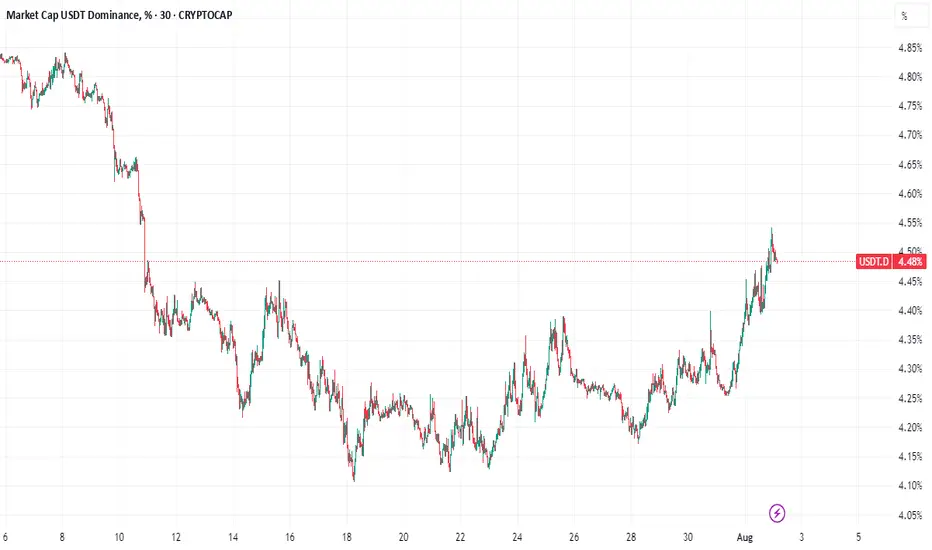
Tether discount creating artificial premium between USDT & USDTether's current trading value against USD has created a huge spread between USDT and USD traded pairs. A possible reason is tether's long-standing lack of transparency or the perceived safer stable coin competitors. @AureliusBTC on Twitter noticed the gap on multiple spot exchanges using USDT vs. BitMEX long before I did, and linked this article about possible risk that USDT has on the cryptospace:
medium.com
Here's a CCN article about regulated stablecoins vs. tether:
www.ccn.com
Trusting financial giants with your money is the antithesis of bitcoin but it looks like a necessity to bring new investors to lose their money to trading bots and FUD.
TrueUSD vs. USDT
TrueUSD vs. USDT in bitcoin pairing
Tether (USDT) is becoming unstable and will likely crash to..Tether is eventually going to crack and will become depeg from the USD. When this happens - much like TerraUSD, it will lose massive amounts of marketcap and come tumbling down to pennies on the dollar. This will likely coincide with the failure/collapse of Binance.
Don't hold your buying power in USDT, USDC or any other stable coin or you could lose it in a flash!
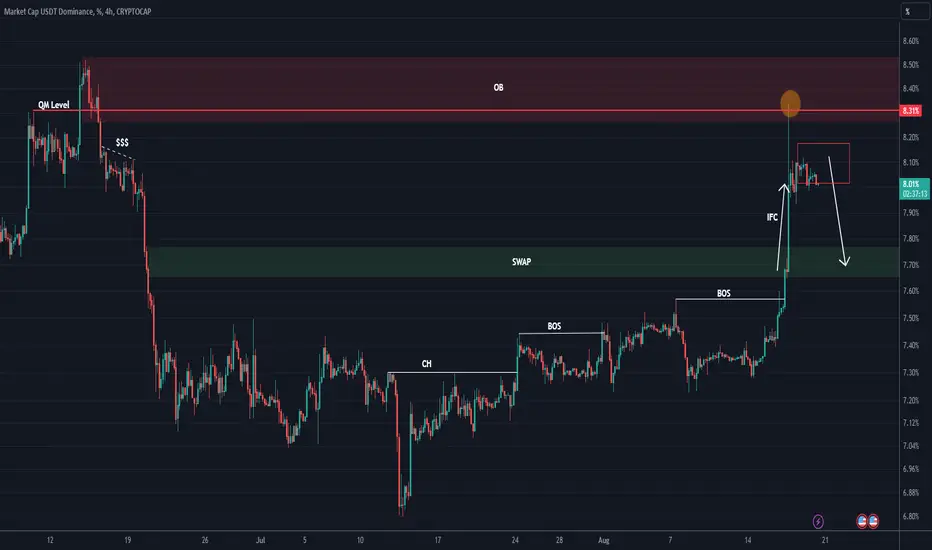
Tether's Dominance Aanalysis (4H)Tether's Dominance, after creating a bullish CH and the BOS it had, climbed and ran into a fresh Order Block and has now reacted to it.
Inside this OB, we also have a QM Level that has increased the power of this supply area.
Also, a liquidity pool that I have shown in $$$ has been collected
According to the movement of Sharp (ifc) and the lack of trading liquidity, it is expected that the price will move towards the swap support area after settling down a bit.
As you know Tether Dominance moves inverse of BTCUSDT. This means that Bitcoin and some altcoins may go a little higher.
Tether Dominance Ultra BearishOne of our readers pointed out the USDT.D (Tether Dominance) chart... It is ultra bearish.
Let's get started.
We have these strongly bearish candles (1):
While prices are now moving below EMA10 (2), we also have a double top (3) and a lower high (4):
The MACD is about to print a bearish cross (5) while the RSI is about to move to weak from strong (6).
These are many bearish signals...
Bitcoin is moving higher (7).
USDT.D and BTCUSD have an inverse correlation.
Taking this into consideration, we can expect Bitcoin to grow some more.
Namaste.
Tether Dominating the StablecoinsTether's stablecoin USDT was introduced to improve the liquidity of the early Bitcoin market.
The project has faced various legal controversies revolving around the legitimacy of its 1:1 USD backing.
Despite these obstacles, the stablecoin has dominated one of the fastest growing sector's in crypto.
Tether is by far the most popular and most liquid stablecoin and will see volatile moves for day trading.
BREAKOUT INDICATOR SHOWING A LONG REVERSAL FOR DAY TRADING.
Tether Dominance Still MixedTether Dominance (USDT.D) hit an All-Time High this very month, just as Bitcoin (BTCUSD) went through the worst drop in several years.
This chart is not weak but a high has been hit.
Each time the upper trendline is hit, we tend to have a correction.
This is a mixed situation... But the volume is lower now compared to June 2021.
So USDT.D is likely to correct...
Still, this is a difficult chart.
Namaste.
Tether The Trumpet- On this Chart i use zero indicator and just the trend.
- Some basic supports and resistances.
- What we can see and deduct ?
- Tether jumped from 0.01% to 1% dominance from 2015 to 2018.
- from 2019 to 2023 USDT.Dom growed from 1% to 10%.
- now the trend is still evolving in a steady broadening trumpet formation.
- Do you really believe Tether would reach 35% Dominance in Crypto Markets ?
- it would mean that 35% of peoples would prefer to stay in Stables Fiat and win nothing.
- Just using logic and combine FA + TA :
- This uper trend will be broken down soon or later.
- i just do believe that Tether have to crash at one point ( no matter the reason ).
--------------------------------------------------------------------------------------------------------
- So now a quick comprehensive explanation about Tether.Dom and how it works :
1 - When BTC down = Peoples swap their BTC to USDT (panic)
- USDT.Dom up !
- Tether stop the printing Machine and wait.
2. - When BTC up = Peoples swap their USDT to buy BTC (fomo)
- USDT.Dom Down !
- Tether have to restart the printing machine and issue more USDT to cover BTC demands.
- Yes it's simple as that..
- Tether is not really different than the FED.
- they just print more USDT from thin air when peoples want buy more BTC.
--------------------------------------------------------------------------------------------------------
- Remember that without BTC, Tether would worth 0$ and disappear.
--------------------------------------------------------------------------------------------------------
St4y Safe
Happy Tr4Ding !
TETHER THE BEST INDICATOR TO FIND THE NEXT BOTTOMSince a few weeks tether is surprisingly acting like as an altcoin.
The last time that tether acted as a stablecoin was during .. the tether sell off of 15 october. A lot of tether were rapidly sold to buy bitcoins. The price of tether felt and bitcoin was squeezed up.
Since there everything changed and tether was no more my good old tether. Just to remember binance undervalued this situation and in the last time had to rush to offer an alternative to the tether trade.
Now lets look how tether/USD and btc/usd acted since the the sell off of mid november.
1) the bitcoin first sell off was preceeded by a marked decrease of the price of tether. The bitcoin sell off was followed surprisingly by a further and sharp decrease of the price of tether.
---- predictive value of thether, with price convergence ----
2) as bitcoin consolidated the tether price increased, as a RSI that warm up after a sell off.
----- a sort of "hidden bearish divergence" -----
3) sell off with convergence between tether and bitcoin price
4) as the price of bitcoin began to slow down, the price of the tether began to increase.
---- bullish divergence ----
5) The increase in price of tether was convergent with the price of bitcoin.
---- positive convergence ----
If we follow this logic of our new super indicator the next step would be a bearish divergence between the price of bitcoin and the price of tether.
Now lets look at tether now.
Tether is consolidating on top of the parity and in an ascending wedge projecting to the beginn of the second week of January in a clearly overvalued " overbought" zone.
Enjoy your bullish trades!
BIO
#usdt #tether dominance is going crazy (Mid/Long Term Strategy)#tetherdollar dominance in market is slightly following uptrend channel since end of 2021. Weeks ago started form a bullish flag. I highlighted the target on the chart. When it reaches the the target (in mid / long term in 2024 I think) the altcoins will already had a long blood bath.
NOT FINANCIAL ADVICE. DYor.
Tether Concerns And Why They Matter BACKGROUND
Tether launched in 2014, and quickly became the world's largest stablecoin, with a current market value of almost $70 billion.
In order to assure buyers that Tether is Legitimate, Tether claimed it had cash reserves equal in value to the stablecoins it issued. That means that 1 Tether Has 1 U.S Dollar backing it. The US government found that wasn’t at all true. During a period from 2016 to 2018, the CFTC found that Tether held 27.6% of the value of issued stablecoins in fiat currency reserves. The Commission filed and settled charges with Tether that the company made “untrue or misleading statements and omissions of material fact.”
The company insisted it always had enough money in reserve, saying in response to the CFTC fine that “There is no finding that tether tokens were not fully backed at all times—simply that the reserves were not all in cash and all in a bank account titled in Tether’s name, at all times.” Tether has also invested some of its reserves in Chinese commercial paper. A document detailing the reserves of Tether Holdings Ltd reveals that Tether has given billions of dollars in short-term loans to large Chinese companies.
Tether has also been offering billions of dollars in crypto-backed loans. Some of these loans have Bitcoin as collateral. However, Tether’s lawyers claim that these secured loans are low risk since the borrowers have put up bitcoin that’s way more worth than their borrowings. Just recently, Alex Mashinsky, CEO of Celsius Network, was the latest person to claim that Tether’s stablecoin tokens aren’t fully backed by dollar reserves. “ If you give them enough collateral, liquid collateral, bitcoin, ethereum and so on . . . they will mint tether against it,” Mashinsky told the Financial Times. He explained that new USDT is issued directly for the loan, and then destroyed after so it doesn’t permanently increase the amount of Tether in circulation. Should this occur as Mashinsky describes, it would be in contradiction of Tether’s own terms of service: “Tether will not issue Tether Tokens for consideration consisting of the Digital Tokens (for example, bitcoin); only money will be accepted upon issuance.” Short-seller Hindenburg just set a $1,000,000 ‘bounty’ for details on Tether’s reserves.
SO WHY DOES THIS MATTER?
In May, Tether published details of its reserves in a pie chart. The breakdown showed it had 75.9% in "cash and cash equivalents." However, looking at that in more detail, only a small proportion of the 75.9% is held in cash:
* 65.4% is in commercial paper. That equates to almost half of Tether's total reserves.
* 3.9% is in cash. That equates to 2.9% of its total reserves.
Commercial paper is a type of short-term loan that's usually made to corporations. The trouble is that Tether hasn't released information about what types of loans it has made. We don't know who the borrowers are or what types of debt it is. Most importantly, we don't know how easy it would be for Tether to access that money. Bitcoin as well as Altcoins are often paired in USDT. Meaning it isn’t real U.S dollars that are being used to purchase cryptos but instead Tether Dollars. Sure you may have used your hard earned dollars to attain Tether dollars but that money goes to Tether, you in return receive tether dollars that are then used to buy crypto.
USDT volume often ranges from 50% to 80%, which is higher than any other crypto on the market. Exchange data clearly shows USDT is mainly fueling Bitcoin’s price valuation, which is deeply concerning. Bitcoin mainly rises during times when Tether is seen injecting hundreds of millions into Bitcoin. And during the periods they stopped, we saw major market corrections. When Tether released their questionable pie chart showing the breakdown of their reserves, Bitcoin dropped by another 53% and lost over $520 billion in market cap. Which was also during a period in which tether stopped printing.
SO WHY DOES THIS REALLY MATTER?
It’s evident that Tether is the glue holding up the crypto markets. With its potential insolvency, we could see a crypto-liquidity crisis which will create extreme levels of panic and fear amongst investors. Since Tether only has 2.9% of its supply backed by actual cash that means that if enough investors decided to convert from Tether back into U.S dollars simultaneously, Tether simply wouldn’t have enough cash to go around. Meaning the value of Tether could actually go far below 1 USD.
Nobody can be sure of what will happen in the future but this is just something to be aware of. I love crypto and believe in the technology. I am just not sold on the legitimacy of the current evaluations of top projects. Should Tether go down it would not mean the end of crypto. It would just be a catastrophic event and would go down as the largest case of fraud in history.
Thank you for reading. I will attach all sources below.
www.coindesk.com
www.fool.com
cryptowhale.medium.com
www.ft.com
blockworks.co
qz.com
www.coinspeaker.com
Tether Printing and Bitcoin PriceOn Friday May 18 2018, Tether printed another 250 million tokens, bringing the total supply to about 2.5 billion USDT. The last print was for 300 million tokens on March 20 2018. And the previous before that was for 100 million USDT on January 23 2018.
It is no secret how Tether and Bitfinex are intertwined, as a simple search will reveal those involved with them. It is also no secret that there is a lot of distrust in whether USDT is in fact backed by United States Dollars on a 1:1 ratio, the market currently values it as such.
Another concern about USDT is the ability to influence the overall crypto market one way or another. 300 million or even 100 million dollars worth of orders strategically placed on a single exchange, like Bitfinex, can literally move the market. You can read more about this at procinctu.info
As for the chart, I just wanted to show the price of Bitcoin in correlation with the printing of Tethers. I used Kraken instead of Bitfinex on purpose, to make the data independent. The thicker lines show larger prints, the thinner lines show smaller prints. Also, this is on a daily chart, so it does not include volume spikes and movement on a smaller time frame, which probably would be more beneficial. But this is just to show in general the Bitcoin price and Tether printing alongside each other.
You can track the Tether printing for yourself at omniexplorer.info
Travis
JMJ - UIOGD
Tether (USDT): Oversold and finding supportAnalyzing the Tether Price from Kracken, where according to cryptocompare , 90% of the volume derives from. The stable coin everyone's talking about that dropped 15% against USD. Will it tether back to $1?
Tether is finding support at the early 2018 levels of $0.94. It is currently 4.6% away from it's $1 value.
Daily TD Sequential is on a 9, hinting a reversal is due, with RSI deeply ovesold at 18-month record low of 7.5.
2% stop loss is set below the daily low of $0.9428. If it falls below it's daily low, it's in big trouble.
Tether Premium: Binance USDT price / Coinbase USD fiatThis chart measures Bitcoin Tether price @ Binance / Bitcoin USD fiat price @ Coinbase. If # is above 1.00 means investors value Tethers more than USD fiat. On the other hand #s below 1.00 means Tethers are trading at a discount to USD fiat. 0.98 = 2% discount. Only listed market for Tether/USD fiat is Kraken exchange but there's no real volume going on there, hence this Binance USDT indicator is the best proxy.
Tether - A word of caution over Tether stablecoin safetyIn our previous posts, we warned about de-pegging of the Tether stablecoin from the U.S. dollar. The precedent was set when Luna stablecoin fell 99%, spilling to other tokens and temporarily breaking the peg between the USDT and USD. With the recent crash in the cryptocurrency market, we remain very pessimistic about its outlook.
Illustration 1.01
The picture above shows the precedent that took place on 12th May 2022. The Tether token can be seen losing almost 6% of its value against the U.S. dollar.
Already back in July 2021, Jannet Yellen, the U.S. treasury secretary, summoned Jerome Powell and the head of the Securities and Exchange Commission to discuss Tether and the danger it poses. Then in October 2021, the Commodity Futures Trading Commission (CFTC) filed and settled legal cases against iFinex Inc. , BFXNA Inc. , and BFXWW Inc.
The actual text (only excerpts) from the CFTC website
1st excerpt
“The Tether order finds that since its launch in 2014, Tether has represented that the tether token is a stablecoin with its value pegged to fiat currency and 100% backed by corresponding fiat assets, including U.S. dollars and euros. However, the Tether order finds that from at least June 1, 2016 to February 25, 2019, Tether misrepresented to customers and the market that Tether maintained sufficient U.S. dollar reserves to back every USDT in circulation with the “equivalent amount of corresponding fiat currency” held by Tether and “safely deposited” in Tether’s bank accounts. “
2nd excerpt
In fact Tether reserves were not “fully-backed” the majority of the time. The order further finds that Tether failed to disclose that it included unsecured receivables and non-fiat assets in its reserves, and that Tether falsely represented that it would undergo routine, professional audits to demonstrate that it maintained “100% reserves at all times” even though Tether reserves were not audited.
3rd excerpt
“Tether held sufficient fiat reserves in its accounts to back USDT tether tokens in circulation for only 27.6% of the days in a 26-month sample time period from 2016 through 2018. “
We raise a word of caution as to the question of stablecoin safety - in this particular case of Tether .
Illustration 1.02
The picture shows another anomaly in the price of Tether, but this one started to occur yesterday.
Please feel free to express your ideas and thoughts in the comment section.
DISCLAIMER: This analysis is not intended to encourage any buying or selling of any particular securities. Furthermore, it should not be a basis for taking any trade action by an individual investor. Therefore, your own due diligence is highly advised before entering a trade.