Hedge Fund Secrets: Unveiling the Hidden World of High-FinanceIntroduction
Hedge funds represent one of the most mysterious and influential corners of global finance. Often surrounded by secrecy and elite status, they attract both admiration and controversy. While mutual funds are accessible to the average investor, hedge funds are designed for the wealthy—institutions, corporations, and high-net-worth individuals—who seek aggressive growth and diversification. The “secrets” of hedge funds lie not only in their strategies but also in their flexibility, risk-taking ability, and sophisticated financial engineering.
This essay explores the structure, functioning, strategies, and inner workings of hedge funds—uncovering the tactics and philosophies that make them powerful engines in the financial markets.
1. What Is a Hedge Fund?
A hedge fund is a private investment partnership that pools money from investors and employs a range of strategies to earn high returns, often regardless of market direction. Unlike mutual funds, hedge funds are lightly regulated and have more freedom in how they invest. They can use leverage (borrowed money), short selling, derivatives, and alternative assets such as real estate, commodities, cryptocurrencies, or private equity.
The term “hedge” comes from the original goal—to “hedge” against market risk by taking offsetting positions. However, modern hedge funds have evolved into aggressive return-seeking vehicles, willing to take large, calculated risks for potentially outsized profits.
2. The Secret Structure: Limited Partnership Model
Most hedge funds operate under a limited partnership (LP) structure:
The general partner (GP) manages the fund, makes investment decisions, and assumes full liability.
The limited partners (LPs) are the investors who provide the capital but have limited liability.
This structure allows hedge fund managers to maintain flexibility and control while protecting investors from excessive risk exposure. The GP typically earns a management fee (2%) of total assets and a performance fee (20%) of profits—known as the “2 and 20 rule.” This incentivizes managers to maximize returns.
This performance-based compensation is one of the fund’s “secrets to motivation.” It aligns the manager’s goals with the investors’—both profit when performance is strong. However, it also encourages risk-taking, as the rewards can be massive.
3. The Secret Ingredient: Flexibility and Freedom
Unlike mutual funds or pension funds, hedge funds have minimal investment restrictions. This flexibility is their biggest advantage. Hedge funds can:
Short sell stocks (bet on price decline)
Use leverage to amplify returns
Trade derivatives like options, futures, and swaps
Invest globally across asset classes
Move in and out of positions rapidly
This freedom allows hedge funds to profit in bull or bear markets. For instance, during the 2008 financial crisis, some hedge funds—like John Paulson’s—made billions by betting against the U.S. housing market using credit default swaps.
4. Hedge Fund Strategies: The Real Secrets
Hedge funds are not a single strategy—they are a collection of sophisticated investment techniques. Some of the most powerful and “secretive” strategies include:
A. Long/Short Equity
The classic hedge fund strategy. Managers buy undervalued stocks (long) and short overvalued ones (short). The goal is to profit from relative performance rather than overall market direction.
Example: If a manager expects Apple to outperform Samsung, they go long Apple and short Samsung, profiting from the spread regardless of whether the tech sector rises or falls.
B. Global Macro
This strategy exploits global economic trends—interest rates, currencies, commodities, and geopolitical events. Legendary investor George Soros famously used this approach when he “broke the Bank of England” in 1992, betting against the British pound and earning over $1 billion.
C. Event-Driven
Event-driven funds profit from corporate events such as mergers, bankruptcies, or restructurings. Merger arbitrage is common: buying shares of a company being acquired and shorting the acquirer to profit from the deal’s price spread.
D. Quantitative (Quant) Strategies
Quant funds use advanced algorithms, machine learning, and statistical models to find patterns in massive data sets. These funds rely on technology and mathematics rather than human judgment.
Firms like Renaissance Technologies (founded by Jim Simons) have built mathematical models that consistently outperform markets—a true “black box” secret of modern finance.
E. Distressed Securities
These funds buy the debt of companies in financial trouble, betting that they will recover or that assets can be sold for more than their current market value. This strategy requires deep expertise in corporate law, restructuring, and valuation.
F. Multi-Strategy
Large funds diversify across multiple strategies to balance risk and return. These “all-weather” funds can adapt quickly to changing market conditions.
5. Leverage: The Power and the Danger
One of the most closely guarded secrets of hedge funds is how they use leverage to amplify returns. By borrowing money, a hedge fund can increase its exposure to profitable trades. For instance, a 10% return on a $1 billion position becomes 20% if the fund borrows another $1 billion.
However, leverage also magnifies losses. Many hedge fund collapses—like Long-Term Capital Management (LTCM) in 1998—occurred because excessive leverage turned small losses into disasters. The secret lies in risk management discipline: knowing when to cut losses and when to increase exposure.
6. Risk Management: The Hidden Backbone
While hedge funds are often portrayed as reckless gamblers, successful ones are masters of risk management. They use advanced models to monitor:
Value at Risk (VaR): the maximum expected loss over a given period.
Beta: sensitivity to market movements.
Drawdown limits: maximum allowed decline before positions are cut.
Some hedge funds employ dedicated risk teams independent of portfolio managers. The secret here is not just in taking risks—but in knowing which risks are worth taking.
7. Information Edge: The Secret Weapon
Information is the lifeblood of hedge funds. Successful managers invest heavily in data analytics, market intelligence, and proprietary research. The best funds have access to alternative data—credit card transactions, satellite imagery, social media trends, and supply chain data—that help them detect market trends before others.
In essence, hedge funds compete on information asymmetry. The faster and more accurately they interpret data, the greater their advantage.
However, this “edge” must stay within legal limits. In the past, some hedge funds were caught in insider trading scandals, revealing the fine line between legitimate research and illegal access to non-public information.
8. The Psychology of Hedge Fund Managers
Another hidden secret lies in the psychological resilience of hedge fund managers. The job involves high pressure, rapid decision-making, and emotional control. Successful managers often possess:
Contrarian thinking: Going against market consensus.
Risk tolerance: Comfort with uncertainty and volatility.
Discipline: Following the model or thesis even under stress.
Adaptability: Changing strategies when markets shift.
In many ways, hedge fund management is as much an art as a science—combining intellect, intuition, and emotional stability.
9. Technology: The New Frontier
Modern hedge funds are deeply intertwined with technology and artificial intelligence. High-frequency trading (HFT), machine learning algorithms, and predictive analytics now dominate the industry. Algorithms can execute trades in microseconds, identifying inefficiencies humans cannot detect.
The secret advantage of top-tier funds like Two Sigma or Citadel lies in their data infrastructure—massive computing power, real-time analytics, and AI-driven prediction models. These technological tools enable them to extract tiny profits millions of times per day.
10. Secrecy and Regulation
Hedge funds are notoriously secretive about their strategies. Their competitive advantage depends on keeping algorithms, models, and data confidential. Unlike mutual funds, they are not required to disclose holdings publicly. Investors receive quarterly or annual reports, but details remain hidden to protect intellectual property.
However, after major scandals and financial crises, regulators have increased oversight. The U.S. Securities and Exchange Commission (SEC) now requires large hedge funds to register and disclose basic information about risk and leverage. Yet, compared to other financial institutions, they still enjoy considerable privacy.
11. Hedge Funds and Market Influence
Though they represent a small portion of total global assets, hedge funds have an outsized impact on financial markets due to their leverage and trading volume. They can:
Move markets through large positions.
Provide liquidity during volatile times.
Expose overvalued or fraudulent companies (through short selling).
Hedge institutional portfolios against systemic risks.
However, their power can also destabilize markets if excessive leverage or herd behavior occurs—as seen during the 2008 crisis or the GameStop short squeeze of 2021.
12. The Dark Side: Failures and Risks
Not all hedge funds are successful. Many close within a few years due to poor performance, high fees, or changing market conditions. Common causes of failure include:
Over-leverage: excessive borrowing leading to collapse.
Overconfidence: ignoring market signals.
Lack of liquidity: inability to exit positions in time.
Misaligned incentives: managers chasing bonuses over long-term success.
The hedge fund secret to survival is adaptability—those that continuously evolve with technology, regulation, and global trends endure.
13. The Future of Hedge Funds
The hedge fund industry is changing rapidly. Artificial intelligence, blockchain, and decentralized finance (DeFi) are reshaping investment strategies. Investors are demanding lower fees and greater transparency, pushing funds to prove their value.
Sustainability is also becoming important. New hedge funds now explore ESG (Environmental, Social, Governance) strategies, blending profitability with ethical investing.
The next generation of hedge funds will likely combine AI-driven insights, quantitative analytics, and global macro intelligence—a fusion of technology and human expertise.
Conclusion
Hedge funds remain one of the most fascinating institutions in modern finance. Their “secrets” are not mystical tricks but a blend of flexibility, innovation, information, and discipline. They thrive on uncovering inefficiencies in the global financial system, exploiting them with speed, intelligence, and precision.
At their best, hedge funds bring liquidity, innovation, and market efficiency. At their worst, they amplify volatility and risk. The truth lies in their dual nature—both as engines of progress and mirrors of financial ambition.
In the end, the ultimate hedge fund secret is mastery over uncertainty—turning chaos into opportunity through knowledge, technology, and courage.
Secretsignals
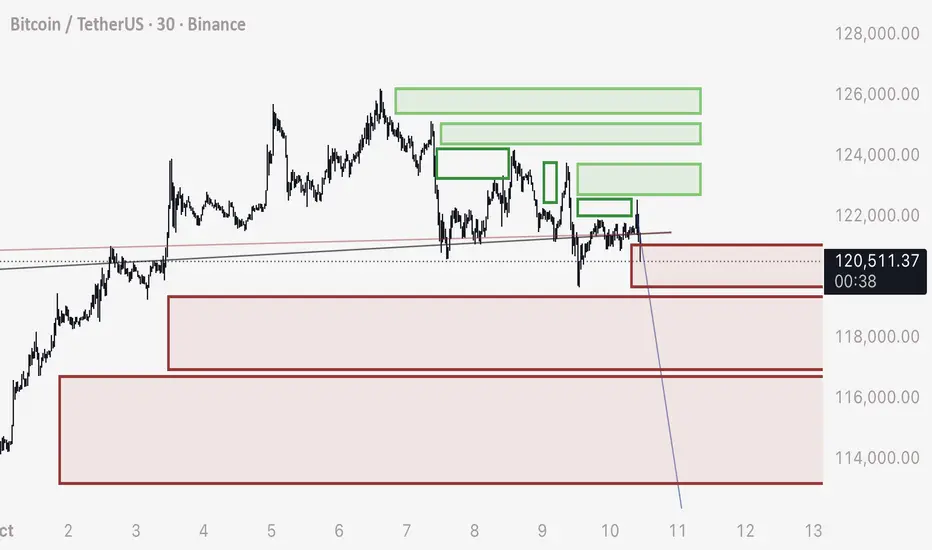
BTC - Use Order Blocks to Predict if Price with move UP OR DOWNI will give a practical demonstration here on how to draw your own order blocks and heat maps to predict if price will move up or down from this 121,400 current level.
First understand that stop loss order blocks are opposite to what we have learned as traders.
We are told that buy orders are below price (limit buys) and sell orders are above us (limit sells).
The truth of Bitcoin however is the exact opposite is true. The stop loss orders carry much more power than limit orders, as they are filled for the “whole leveraged position size”, not for only the margin used.
While limit buys will automatically fill if price is below that price, or limit sells will automatically fill if price is above that price - this is not true for stop loss orders or liquidation orders.
Stop Losses and Liquidations only FILL if price CROSSES the level.
This means we can use order blocks from open candle sets, extended out past price currently, to understand where these gaps of orders are located.
Green boxes for BUYS above price.
Red boxes for SELLS below price.
When price enters into these boxes zones, these orders will start filling - acting as a type of propellant that’s implanted in the chart from traders previous choices. This creates “wicks” and fast movements.
WILL PRICE GO UP OR DOWN FROM 21,400?
In this example from 121,400 I drew both long stops and sell stops.
The emptied green boxes have already been reclaimed. The filled in green boxes are left unreclaimed and contain these orders.
For price to go up, it would have to move past the previous wick, and enter into these zones - which have a significant gap in between them.
For price to DROP, we can look at the boxes of long stops or sell orders.
Note that these order blocks are neatly placed one after the next, with no significant gaps between them.
Therefor, there is much better odds of price dropping from 121,400 - entering into these sell order blocks, and naturally dropping as those orders are filled one into the other.
It would be a good day trade strategy to SHORT the 121,400 level, and expect the price to move down through these blocks.
It would be a bad day trade strategy to LONG the 121,400, as the orders are very few compared to the downside, therefor, lower odds.
This is really the only strategy you need to scalp trades on Bitcoin and predict where price is going.
If you find these helpful, please let me know below.
Yours truly,
- DD
Trading Secrets of the Global Market1. The Power of Liquidity: The Secret Pulse of Global Markets
Liquidity is the heartbeat of global trading. It determines how easily assets can be bought or sold without affecting prices dramatically. But here’s the secret — liquidity is often manufactured and manipulated by major institutions to create traps for smaller traders.
Large institutional players — like central banks, sovereign funds, and hedge funds — know that market liquidity hides in plain sight. They place massive orders in specific price zones to lure retail traders into believing that demand or supply is surging. Once small traders jump in, these giants reverse their positions, triggering stop losses and creating price whipsaws.
In forex and commodity markets, liquidity pockets are created intentionally to hunt for stop orders. The secret for smart traders? Follow liquidity, not emotions. Watch where volumes cluster, study order books, and track institutional footprints — not just price movements.
2. Volume Profile Analysis: Reading the Market’s Hidden Story
Volume Profile is one of the most underrated tools used by professional traders. It reveals where the most trading activity occurs — the zones where institutional traders are accumulating or distributing assets quietly.
Here’s the trick: price shows you what happened; volume shows you why it happened.
For instance, when price spikes on low volume, it’s often a false breakout. But when price consolidates on high volume, it signals smart money building positions.
Global trading desks use this insight to detect accumulation zones, identify breakout points, and plan trades with precision.
The secret? Retail traders often chase the breakout. Professionals wait for the retest of high-volume nodes — entering the market when the crowd has already been trapped.
3. The Currency Web: How Forex Controls Everything
The foreign exchange market (Forex) is the largest and most liquid market on the planet, with over $7.5 trillion traded daily. What few realize is that forex dictates the rhythm of global finance — from stock valuations to commodity prices and even real estate trends.
Major currencies like the USD, EUR, JPY, and GBP are influenced by interest rate differentials, trade balances, and geopolitical shifts. But beneath these fundamentals lies a secret: currency correlations.
For example:
When USD strengthens, commodities like gold and oil often decline.
When JPY rises, equity markets tend to fall due to its “safe haven” status.
Emerging market currencies often move opposite to U.S. Treasury yields.
Top traders exploit these interconnections — using one market’s movement to predict another’s. It’s a sophisticated form of global arbitrage, where understanding cross-asset relationships can generate enormous profits.
4. The Shadow of Algorithms: Trading in the Age of AI
In the 21st century, the real battle in trading is fought by machines. Over 70% of trades in developed markets are now executed by algorithms — automated systems that analyze data, detect inefficiencies, and act in microseconds.
The secret advantage of AI-driven trading lies in its ability to read market sentiment, news, and liquidity simultaneously — far faster than any human. But the flip side? These algorithms often trigger flash crashes or liquidity vacuums, catching human traders off guard.
Institutional players use high-frequency trading (HFT) to manipulate spreads, trigger retail orders, and profit from market micro-movements invisible to the naked eye.
For the smart trader, the lesson is simple: don’t fight the machines — learn from them. Use algorithm-friendly tools like volume heatmaps, tick charts, and market depth indicators to spot where these automated systems are most active.
5. Global Macro Secrets: The Big Money Mindset
While retail traders obsess over short-term charts, the world’s top hedge funds — like Bridgewater Associates or Renaissance Technologies — think macroeconomically.
They study:
Interest rate policies by central banks.
Commodity cycles tied to inflation.
Debt-to-GDP ratios of major economies.
Trade wars and sanctions impacting global supply chains.
The secret? Macro traders understand that markets don’t move in isolation. Every central bank announcement, oil price fluctuation, or political conflict creates ripple effects across all asset classes.
For instance:
Rising U.S. interest rates strengthen the dollar but hurt emerging market equities.
A spike in oil prices benefits energy exporters like Saudi Arabia but hurts importers like India or Japan.
Inflation data can move gold, bonds, and currency pairs simultaneously.
To trade globally, you must connect the dots across economies — not just across charts.
6. The Emotional Game: Psychology Behind Market Moves
Here’s one of the most guarded truths of trading — markets move on emotion, not logic.
Fear, greed, hope, and panic drive more trades than any technical pattern. The world’s top traders exploit this by understanding crowd psychology. When the masses panic, they buy; when the masses get euphoric, they sell.
Global trading floors call this the contrarian principle — “Be fearful when others are greedy and greedy when others are fearful.”
This secret plays out in every crisis: the 2008 crash, the COVID-19 dip, or the 2023 inflation scare. Those who maintained emotional discipline and followed data instead of sentiment often walked away with life-changing profits.
7. Central Banks: The Hidden Market Makers
No entity influences global markets more than central banks. Institutions like the U.S. Federal Reserve, the European Central Bank (ECB), and the Bank of Japan control liquidity flows, interest rates, and currency valuations.
The secret to understanding global trends is to track central bank actions — not their words.
When the Fed cuts rates, it fuels equity rallies worldwide. When it tightens liquidity, global capital retreats into safer assets like bonds or gold.
Professional traders follow these clues using the bond yield curve, repo market trends, and Federal Reserve balance sheet data.
In short: central bank policies shape the trading environment. The secret isn’t reacting to announcements — it’s anticipating them through macro signals.
8. Dark Pools: Where the Real Deals Happen
While most retail traders operate on public exchanges, big institutions trade in dark pools — private markets where large transactions occur anonymously to avoid price shocks.
These dark pools allow hedge funds to buy or sell billions worth of shares without alerting the public. It’s where real price discovery happens, long before retail traders see the effects on charts.
The secret? Volume anomalies on public exchanges often reflect dark pool activity. When prices move strongly without clear news or retail volume, it’s usually institutional repositioning behind the scenes.
9. Global Intermarket Relationships: The Secret of Smart Correlations
Global markets are deeply interconnected. A secret weapon for top traders is intermarket analysis — understanding how different asset classes influence each other.
Here’s how professionals decode these links:
Bonds vs. Equities: Rising bond yields usually mean falling stock prices.
Commodities vs. Currencies: Gold and oil tend to move opposite to the U.S. dollar.
Equities vs. VIX Index: When the volatility index (VIX) rises, stocks often drop.
By reading these relationships, global traders anticipate shifts before they appear on individual charts.
It’s not about predicting one market — it’s about seeing the ecosystem of money flow between them.
10. Risk Management: The Ultimate Secret of Longevity
Every successful trader — from George Soros to Ray Dalio — agrees on one truth: risk management is the foundation of all trading success.
You can have the best analysis, perfect timing, and deep market insight, but without proper risk control, one wrong move can wipe you out.
Global trading pros follow strict rules:
Never risk more than 1-2% of total capital per trade.
Use stop-loss orders religiously.
Diversify across asset classes and regions.
Measure correlation exposure — don’t be overexposed to one trend.
The secret to surviving in global markets isn’t making the biggest profits — it’s avoiding catastrophic losses.
11. Geopolitical Trading: When Politics Becomes Profit
War, elections, sanctions, and trade deals — these political moves shape global capital flows.
Savvy traders watch geopolitical triggers like hawks.
Examples:
Russia-Ukraine conflict: Sent energy prices soaring.
U.S.-China trade tensions: Moved technology and semiconductor stocks.
Middle East instability: Affects crude oil, defense stocks, and gold.
The secret is not reacting emotionally to political news — but identifying who benefits and who loses economically from these events.
12. The Long Game: How Patience Creates Power
The biggest myth in global trading is that success comes from fast trades. In reality, the most profitable traders think in years, not minutes.
They build strategies based on cycles — economic, credit, and liquidity cycles that repeat every few years. Understanding these patterns allows traders to buy undervalued assets early and sell near euphoric peaks.
Global wealth is built through strategic accumulation, not impulsive speculation.
Conclusion: Cracking the Code of the Global Market
The global market is a living organism — complex, unpredictable, and endlessly fascinating.
The secrets of successful trading aren’t mystical formulas or insider tips — they are disciplined habits, macro understanding, and emotional control.
To thrive, you must:
Follow liquidity and volume, not just price.
Think globally, not locally.
Manage risk like a professional.
Learn how economies, currencies, and emotions intertwine.
In a world where data moves faster than thought and algorithms trade faster than humans blink, the real edge lies in wisdom — understanding the forces beneath the surface.
Master these secrets, and you won’t just trade in the global market — you’ll understand its rhythm, predict its mood, and profit from its every pulse.
XRPUSDTIt was making a clear Lower Lows however recently it has taken a retracement from a significant trend line and Fib level.
For new entries it is vital that you follow safer trade plans. I have shared both long and short trade plans. Please follow the plan with pure discipline and enjoy profits from both sides :)
Bitcoin bubble?!?! I don't think so! Bitcoin's bubble has even begun to inflate yet. We are going well over 100k before the end of this market cycle. Yes, yes we will hit bumps in the road and have dips from time to time, but we have a long road ahead of us. We have a buy signal initiated on the daily chart after breaking out of the wedge. I honestly couldn't think of a better time to buy if you missed out on the start of the bull run.
You can catch the falling knifeBots aren't the only ones who can buy in at the absolute bottom of a trend. If you look hard enough, you can find them too and set buy orders accordingly or mark those prices as possible future bottoms. Here is an example of that happening, it'll probably change the way you look at every trend and help you find key hidden levels in the future.
XRP Shitluminati CicleIn this idea you can clearly see a breakout at 322, (I mean march 22),
If you are informed about freemasonry and secret societies, you know XRP is controlled as all this garbage but is centralized, aside it, you must know this controll is carried out throug occult language which based on numbers, infamous numbers.
322 Skull and Bones is a secret society.
In this idea you can clearly see a breakout at 1217, (I mean December 17)
December 17 is no more than the begining of Saturnalia, The ancient Roman festival of Saturn in December. If you are informed about the pagan roman festivals you'll clearly see a relationship with some movements in cryptocurrencies and off course secret societies.
As we live in a system you must understand systems are designed over numbers, their functioning is based on numbers, now go and try yourself to figure it out.
I hope you get funny with this puzzle. Will xrp be 3x,6x or 9x? and when?
GBPUSD Some actual tradesHi everyone,
Getting tired of only seeing analysis being posted up.
So, I am posting the visual definition of my actual trades this week.
Hoping you will all give friendly feedback and thoughts as truly I am wanting to generate solid profitable returns.
Based ont he calendar, trend analysis plus some instinct I am Shorting GBPUSD today and my lines mark it all nicely for you to see.
Red= Stop
Orange = Entry
Green = Profit take
SPX500 Major unwind - Pro analysisHandling a very tricky case. An account handed over that was on the verge of losing just about 500k GBP.
The unwind is tricky and stressful, very much dependent on the price touching up to 2120 and beyond.
Here is the chart with a clear head and shoulder pattern supported by waves Fib and MACD