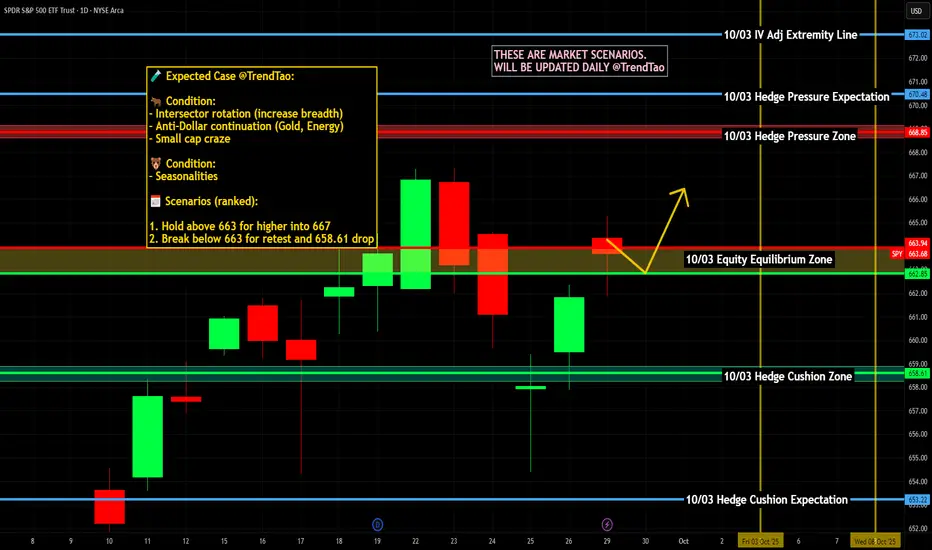
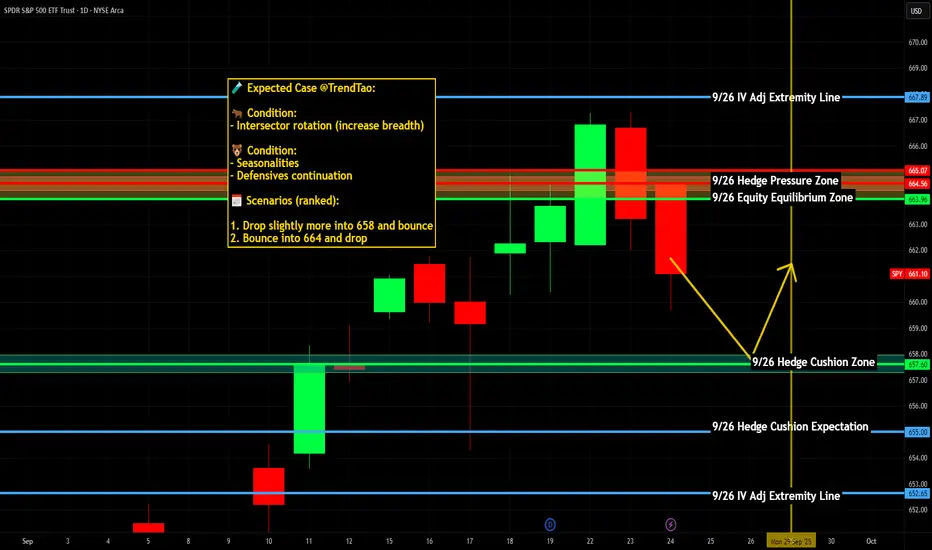
$SPY / $SPX Scenarios — Tuesday, Sept 30, 2025🔮 AMEX:SPY / SP:SPX Scenarios — Tuesday, Sept 30, 2025 🔮
🌍 Market-Moving Headlines
📉 Q3 closeout: Last trading day of September = quarter-end rebalancing flows in equities and bonds.
💵 Fed watch: Multiple Fed speakers across the day keep policy tone in focus.
💻 Mega-cap drift: NASDAQ:AAPL , NASDAQ:MSFT , NASDAQ:NVDA leadership remains sensitive to yields + growth data.
📊 Key Data & Events (ET)
⏰ 🚩 9:00 AM — S&P Case-Shiller Home Price Index (Jul, 20-city)
⏰ 🚩 10:00 AM — JOLTS Job Openings (Aug)
⏰ 🚩 10:00 AM — Consumer Confidence (Sep, Conf. Board)
⏰ 9:45 AM — Chicago PMI (Sep)
🗣️ Fed Speakers:
• 6:00 AM — Philip Jefferson (Fed Vice Chair)
• 9:00 AM — Susan Collins (Boston Fed)
• 1:30 PM — Austan Goolsbee (Chicago Fed)
• 3:30 PM — Austan Goolsbee (Chicago Fed, TV appearance)
⚠️ Disclaimer: Educational/informational only — not financial advice.
📌 #trading #stockmarket #SPY #SPX #Fed #Powell #JOLTS #ConsumerConfidence #CaseShiller #PMI #Dollar #bonds #megacaps
SPDR S&P 500 ETF (SPY)
SPX - That's all folks?The world has gone nuts, but markets didn't even blink.
Now the SPX has reached it's U-MLH, which means, it's at a real extreme.
This is a level where price starts to stall, then turn.
Often we see "a last attempt" to break through, and it really could happen. But then, gravity again takes it's toll and the rocket starts to turn south.
Here are the scenarios I see:
1. Immediate turn at the U-MLH. Target is the Centerline.
2. A break of the U-MLH, then back into the fork and a fall down to the Centerline.
3. Break the U-MLH, continuation to the WL1.
The most unlikely would be 3.
In my view, Party People should have left allready, but they refused to.
And that's why this time headaches will be the least problem they face.
Wating for a short signal, to load up heavy.
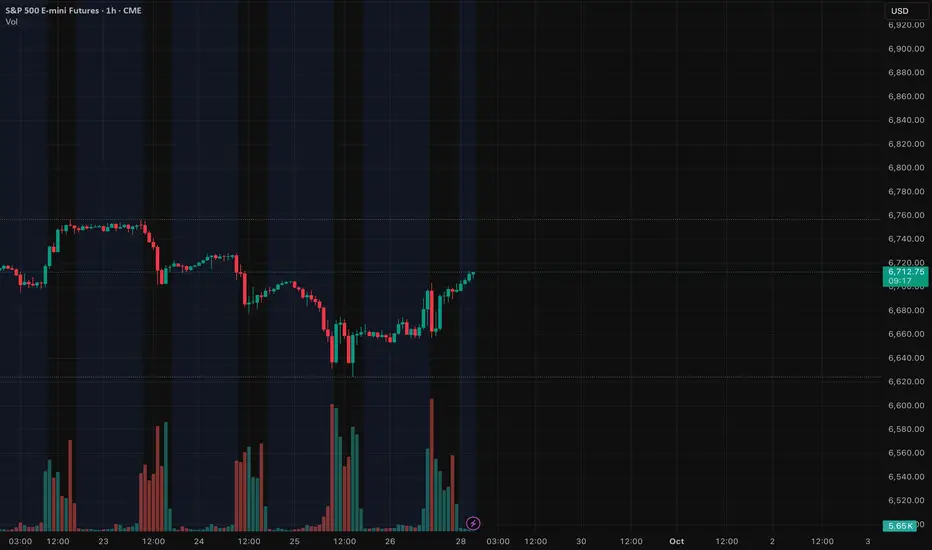
ES Futures (SPX, SPY) Weekly Analyses, Levels: Sep 29 - Oct 3 Weekly Outlook
The trend remains bullish on both the weekly and daily charts, with price action re-accumulating beneath a well-defined supply zone around 6750–6760. Friday’s rebound from the low 6600s has established a higher-low structure on the 4-hour and 1-hour timeframes, closing above the mid-range of 6612–6630, which shifts near-term momentum back in favor of the buyers.
As we enter a catalyst-heavy week, the path of least resistance suggests a measured push through last week’s “weak high” zone (6750–6760). A decisive move above this supply shelf could target the psychological 6800 mark first, with potential for further upside towards 6865–6885, assuming momentum and market breadth are supportive.
Conversely, if we fail to establish acceptance above 6755, the market could revert to a 6700–6760 range, with downside risks extending to 6620 in response to any hot economic data or risk-off sentiment in the headlines.
Key catalysts this week (ET)
Mon–Thu: Fed speakers scattered; watch for rate-path color and balance-sheet remarks.
Tue 10:00: JOLTS (Aug).
Wed 8:15: ADP employment (Sep). Wed 10:00: ISM Manufacturing (Sep).
Fri 8:30: Non-Farm Payrolls & Unemployment (Sep). Fri 10:00: ISM Services (Sep).
Note: Any fiscal headlines or shutdown noise can skew liquidity and tape reactions around these prints.
Tomorrow — NY AM plan (Level-KZ Protocol 15/5/1)
ES Long (A++) — 6750–6760 Acceptance Continuation
Bias: Bullish if we get acceptance above the 6750–6760 shelf.
Trigger: 15m full-body close above 6755. Then 5m pullback holds ≥6750 and re-closes up; enter on the first 1m HL.
Entry: 6752–6756 pullback fill (avoid chasing a wick).
Stop: Hard SL below the 15m break-candle low −0.50. Viability gate: TP1 ≥ 2.0R.
Targets: TP1 6798–6805; TP2 6865–6885; TP3 6900–6915.
Management: No partials before TP1. At TP1 close 70%, move runner to BE. Trail only after TP2 or if a 5m lower-high forms against you. Time-stop 45–60m if neither TP1 nor SL hits. Max 2 attempts at this level for the session.
Invalidation: 15m body back inside ≤6748 or a failed 5m re-close (acceptance lost).
ES Short (A+) — 6750–6760 Rejection Fade
Bias: Mean-revert to base if the shelf is swept and rejected.
Trigger: Sweep 6750–6760 and 15m closes back below 6748. Then 5m re-close down with a LH; enter on the first 1m LH.
Entry: 6744–6748.
Stop: Above the rejection wick +0.50 or ≥6762, whichever is tighter.
Targets: TP1 6705; TP2 6680; TP3 6620.
Management: Take 70% at TP1, runner to BE; consider covering more ahead of 6680 into data windows. Time-stop 45–60m. Max 2 attempts.
Invalidation: 15m acceptance back above 6755 or a 5m close making new session highs.
Price Projection for the Week
Base Scenario: If we see early-week acceptance above 6755, look for targets at 6800, paving the way for a gradual move towards 6865–6885 by Friday. A soft-landing scenario, characterized by cooler labor growth and steady ISM data, could push prices even to the 6900–6915 range.
Alternative Scenario: Should we experience a rejection in the 6750–6760 range, expect the ES to remain range-bound between 6700–6760. Hot labor market data or strong ISM figures could drive the price back to 6620, where it’s crucial for buyers to defend this level to maintain the uptrend.
Execution Notes:
- Focus on trade opportunities only within key kill-zones: primary session is NY AM from 09:30–11:00; optional trading during Asia/London sessions should be done at reduced sizes.
- Adhere to daily barriers: halt trading at -2R or after achieving +3R net.
- On first touch, prioritize R0/S1 as significant; consider de-risking during second or third interactions.
SPY trend Broken? Use this Long / Short StrategyLast week was a choppy sell off in the markets.
We did see the bulls defend price later into the week by bouncing the main indices very nicely.
We discuss the simple support / resistance where you should be watching.
Using the daily 7MA as resistance can be shorted however if we recapture and close above, then the markets remain a long to new highs.
The trend of higher lows is still in tact signaling bullish strength... can we search for a new higher high?
Hope The Apple Doesn't Rot The Fall of The Big Apple
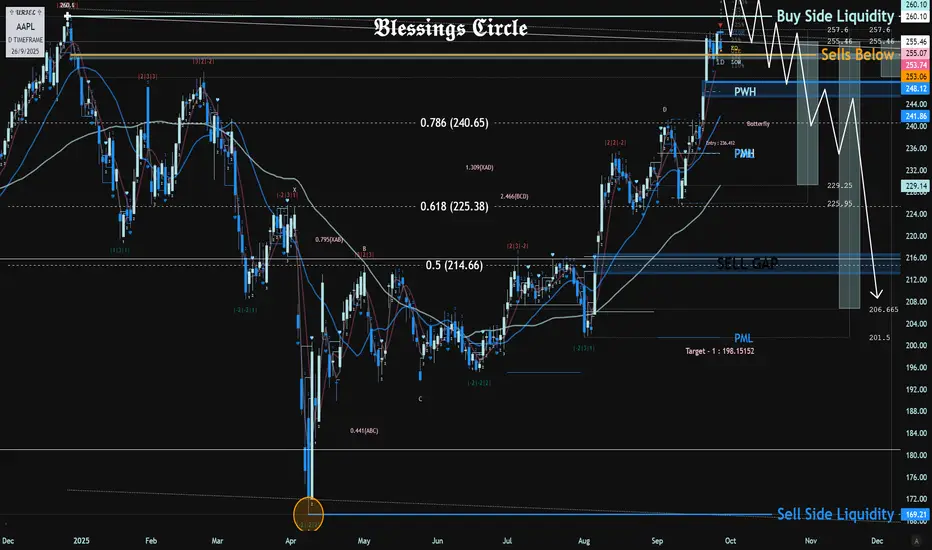
Watching For AAPL to Potentially Trade into 260.10 This Week.
If 260.10 Does Trade I Will Be Looking To Short & Actively Scale into Sells Up Until 265.
If AAPL Were To Squeeze Above 265, The Sells Thesis Would Be Null.
First Sells Target Would Be Into The Sell Gap @ 248-245.
Second Sells Target Would Be The Second Sell Gap @ 216-212.
Third Sells Target Would Be The April Wick Low @ 169.21.
We Can Fall Potentially Fall As Low As 100 or Maybe Even Lower, but Majority If Not 100% of My Sells Positions Will Be Scaled Out Into The Above Sells Targets.
Good Luck To All Traders Going Into The Month Of October & Start of Q4.
With NFP on Friday to Finish off The Week Make Sure To DE Risk If Long.
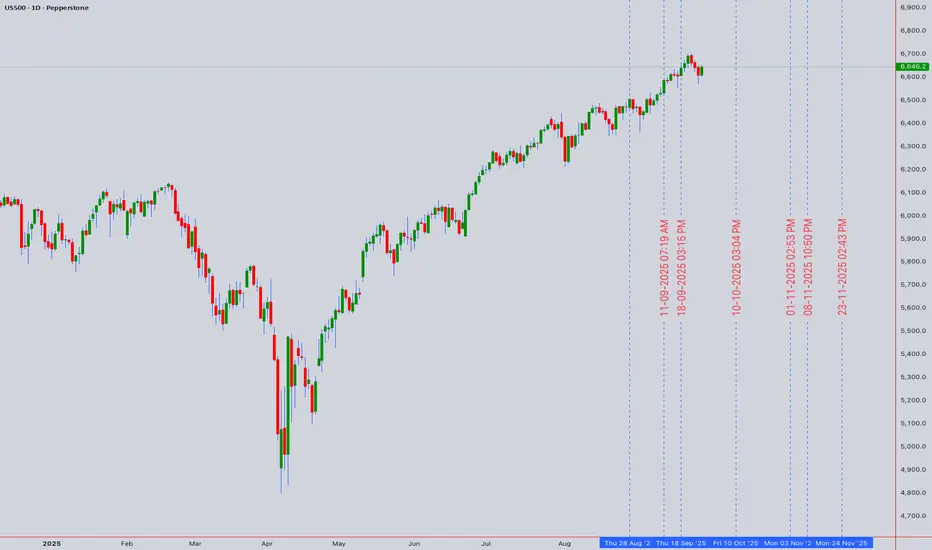
US500: 7K ASSAULT BEGINS! Mega Bull Flag Breakout 🚀 US500: 7K ASSAULT BEGINS! Mega Bull Flag Breakout 📊
Current Price: 6,646.2 | Date: Sept 27, 2025 ⏰
📈 INTRADAY TRADING SETUPS (Next 5 Days)
🎯 BULLISH SCENARIO
Entry Zone: 6,630 - 6,650 📍
Stop Loss: 6,590 🛑
Target 1: 6,720 🎯
Target 2: 6,780 🚀
🎯 BEARISH SCENARIO
Entry Zone: 6,670 - 6,690 📍
Stop Loss: 6,720 🛑
Target 1: 6,580 🎯
Target 2: 6,520 📉
🔍 TECHNICAL ANALYSIS BREAKDOWN
📊 KEY INDICATORS STATUS:
RSI (14): 61.2 ⚡ *Bullish Momentum Building*
Bollinger Bands: Coiling for Expansion 🔥
VWAP: 6,635 - Acting as Launch Pad 💪
EMA 50: 6,610 ✅ *Golden Cross Confirmed*
Volume: Institutional Accumulation 📊
🌊 WAVE ANALYSIS:
Elliott Wave: Wave 4 Triangle Complete 🌊
Target: Wave 5 Extension to 7,000+ 🎯
🔄 HARMONIC PATTERNS:
Bullish Butterfly at 6,600 Support ✨
ABCD Pattern targeting 6,780 🔄
⚖️ SWING TRADING OUTLOOK (1-4 Weeks)
🚀 BULLISH TARGETS:
Psychological: 7,000 🏆
Monthly Target: 6,850 🌙
Gann Resistance: 6,900 ⭐
📉 BEARISH INVALIDATION:
Weekly Support: 6,550 ⚠️
Critical Level: 6,480 🚨
🎭 MARKET STRUCTURE:
Trend: Ascending Triangle 💪
Momentum: Coiling Energy 🔥
Wyckoff Phase: Spring Loading 📈
Ichimoku: Bullish Cloud Break 🟢
🏆 MEGA PATTERN ALERT:
Bull Flag Pole: 6,400 → 6,700 📏
Flag Consolidation: 6,600-6,680 🚩
Breakout Target: 6,980 (300pt move!) 💥
⚡ RISK MANAGEMENT:
Max Risk per Trade: 1.5% 🛡️
R:R Ratio: Minimum 1:2.5 ⚖️
Breakout Confirmation: 6,690 close 📏
🌍 MARKET CATALYSTS:
Q3 Earnings Beating Expectations 📈
Fed Dovish Stance Supporting Risk-On 🏛️
Economic Resilience Narrative Strong 💼
🔥 KEY LEVELS TO WATCH:
Breakout Zone: 6,680-6,700 💥
Support Cluster: 6,620 | 6,580 | 6,550 🛡️
Resistance: 6,720 | 6,780 | 6,850 🚧
🎯 FINAL VERDICT:
S&P500 primed for EXPLOSIVE 7K RALLY! 🚀
Bull flag completion = 300+ point surge! 💯
Multiple timeframes align perfectly! 📈
Trade Management: Scale into dips above 6,620 💎
Breakout Alert: Watch 6,690 decisive close! 🔔
---
*⚠️ Disclaimer: High-risk trading. Use strict risk management. Educational analysis only.*
For individuals seeking to enhance their trading abilities based on the analyses provided, I recommend exploring the mentoring program offered by Shunya Trade. (Website: shunya dot trade)
I would appreciate your feedback on this analysis, as it will serve as a valuable resource for future endeavors.
Sincerely,
Shunya.Trade
Website: shunya dot trade
🔔 Follow for 7K Journey Updates | 💬 What's Your 7K Timeline?
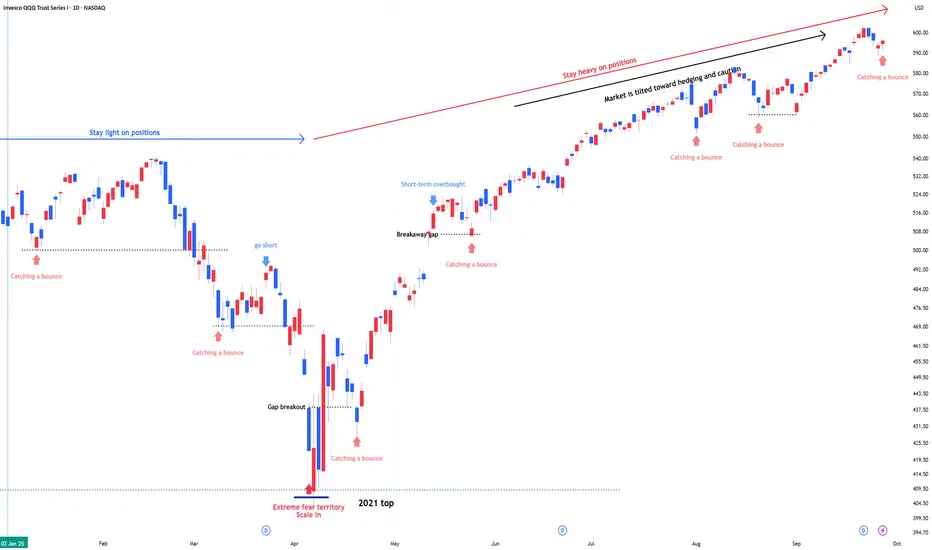
QQQ : Stay heavy on positionsQQQ : Stay heavy on positions (QLD, TQQQ)
Entering a risk-on, high-volatility zone.
A signal for catching a bounce has emerged.
In stay light on positions zones, I hold QQQ and reduce exposure.
In stay heavy on positions zones, I increase allocation using a mix of QLD and TQQQ.
** This analysis is based solely on the quantification of crowd psychology.
It does not incorporate price action, trading volume, or macroeconomic indicators.
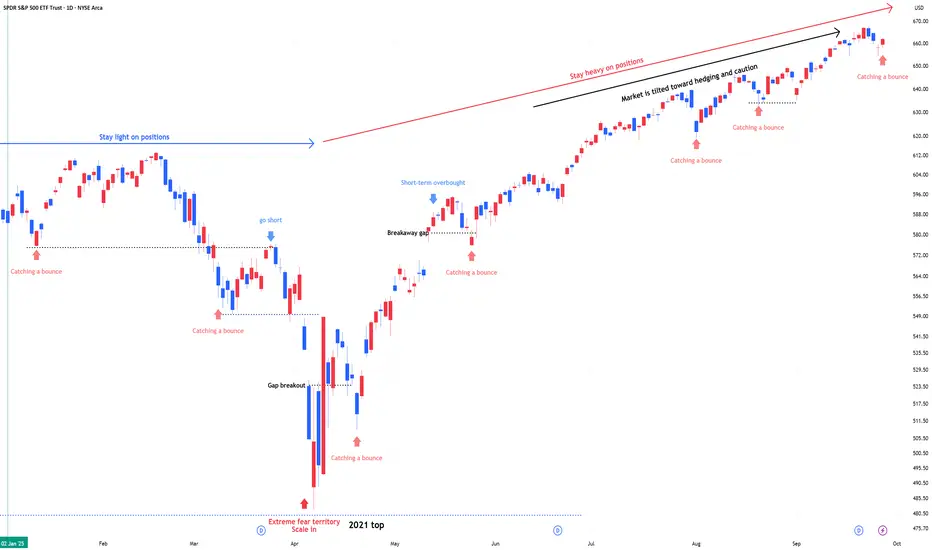
SPY : Stay heavy on positionsSPY : Stay heavy on positions (2x leverage)
Entering a risk-on, high-volatility zone.
A signal for catching a bounce has emerged.
In stay light on positions zones, I hold SPY(+QQQ) and reduce exposure.
In stay heavy on positions zones, I increase allocation using a mix of SSO(+QLD) and TQQQ.
** This analysis is based solely on the quantification of crowd psychology.
It does not incorporate price action, trading volume, or macroeconomic indicators.
ES Futures (SPX) - Analyses, Key-Zones, Setups - Thu, Sep 26News & catalysts (ET)
8:30 — PCE & Core PCE (Aug) , the Fed’s preferred inflation gauges. Market focus is on Core PCE ~2.9% YoY and ~0.2% MoM consensus.
10:00 — University of Michigan Consumer Sentiment (final Sep) . Scheduled time confirmed by
Fed speakers: Vice Chair for Supervision Bowman in a 10:00 discussion;
Fed Board’s Beth Anne Wilson remarks at 8:45 at a New York Fed conference.
Earnings/overnight tone: Costco (COST) reported FY Q4 results Thu after close; headlines can sway retail/consumer sentiment pre-open. Nike (NKE) is due Tue 9/30 after close (next week).
Bias:
Base case: Two-way trade into 8:30, directional break afterward.
If Core PCE ≤ 0.2% MoM or ≤ 2.8% YoY: risk-on; favor upside continuation through near-term supply toward 6700+.
If Core PCE ≥ 0.3% MoM or ≥ 3.0% YoY: risk-off; favor sell-the-rips into 6630 → 6605 ladder.
Secondary input 10:00: Michigan Sentiment can add a second impulse; weak sentiment keeps rallies fragile.
PA roadmap
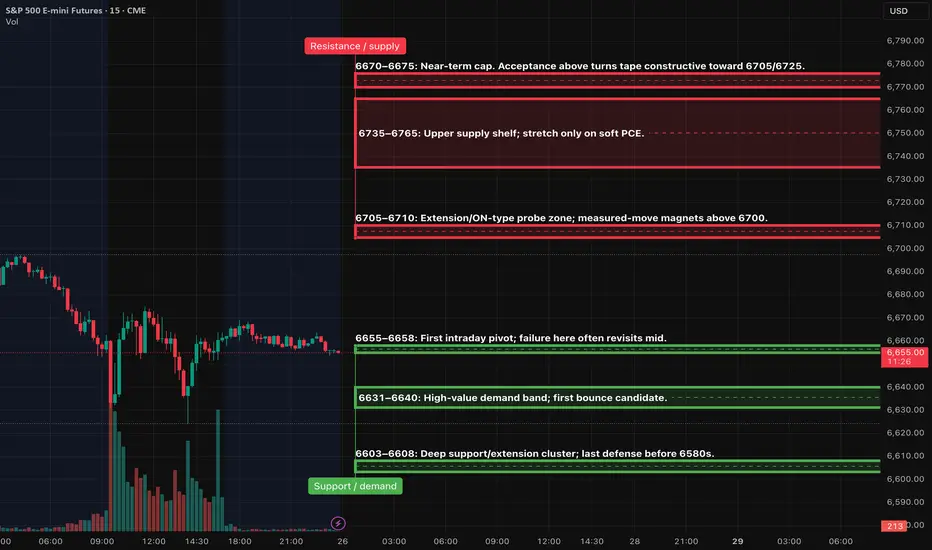
Overnight: Expect balance inside 6655–6675 until 8:30. Liquidity likely pools above 6675 and below 6650 for the data sweep.
NY AM (09:30–11:00): Trade the post-8:30 acceptance: continuation if 15m structure accepts beyond a zone; fade if we get swift rejection back inside.
NY PM (13:30–16:00): Look for consolidation breaks toward untested AM extremes; avoid initiating inside mid-range chop.
Setups (Level-KZ Protocol 15/5/1)
A++ Acceptance Long (major)
Trigger: 15m full-body close above 6670–6675, followed by 5m pullback that re-closes above.
Entry: 1m HL after the 5m re-close.
SL: Below the 15m trigger wick −0.25–0.50 pts.
TPs: TP1 6705, TP2 6725, TP3 6760–6765.
Management: No partials before TP1; at TP1 close 70%, set 30% runner to BE; runner aims TP2→TP3. Time-stop 45–60m if neither TP1 nor SL hits.
Invalidation: 15m body back inside 6670 (acceptance lost).
A++ Acceptance Short (major)
Trigger: 15m full-body close below 6655, then 5m pullback that fails and re-closes below.
Entry: 1m LH after the 5m re-close.
SL: Above the 15m trigger wick +0.25–0.50 pts.
TPs: TP1 6631–6635, TP2 6605–6608, TP3 6580–6585.
Management: Same as above.
Invalidation: 15m body back above 6658.
SPY SEP 25,2025 READ NOTESSpy can still hit $676 but as a trader my job is to understand the risk then put Stop loss & then trade.
So, I am long with stocks only:
SL @$653 with a target of $676.
The level is pretty average & most of the traders who learnt price action from me won't even call this a level. If you don't understand a level, then don't trade it(simple).
I initiated the long trade when I posted the chart in the morning.
If it hits my SL then il accept and move on. I am waiting for this week to close &will publish the video analysis tomorrow after market close.
NOTE: DO NOT TRADE OPTIONS
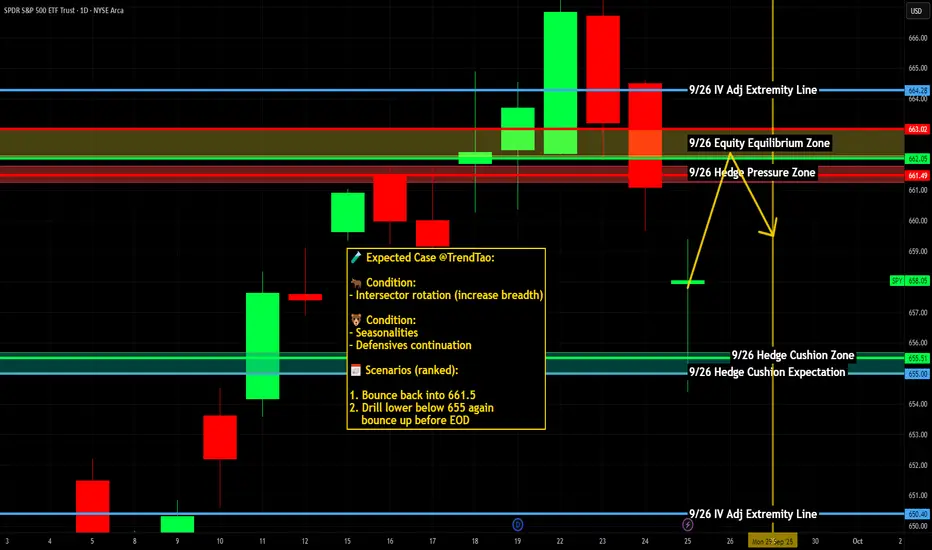
$SPY / $SPX Scenarios — Friday, Sept 26, 2025🔮 AMEX:SPY / SP:SPX Scenarios — Friday, Sept 26, 2025 🔮
🌍 Market-Moving Headlines
📉 Month-end flows: Positioning shuffle as traders square books into Q3-end.
💵 Fed lens: Multiple Fed appearances keep policy tone in focus post-SEP.
💻 Tech + growth watch: AMEX:XLK flows remain sensitive to yields + inflation gauges.
🛢️ Commodities check: Oil and dollar volatility continue to set cross-asset tone.
📊 Key Data & Events (ET)
⏰ 🚩 8:30 AM — Personal Income & Spending (Aug)
⏰ 🚩 8:30 AM — PCE Price Index (Aug) + Core PCE (YoY & MoM)
⏰ 10:00 AM — Consumer Sentiment (Final, Sep)
🗣️ Fed Speakers:
• 7:30 AM — Tom Barkin (Richmond Fed, TV appearance)
• 9:00 AM — Tom Barkin (speech)
• 1:00 PM — Michelle Bowman (Fed Vice Chair for Supervision)
⚠️ Disclaimer: Educational/informational only — not financial advice.
📌 #trading #stockmarket #SPY #SPX #PCE #inflation #Fed #Powell #joblessclaims #consumer #Dollar #bonds #megacaps
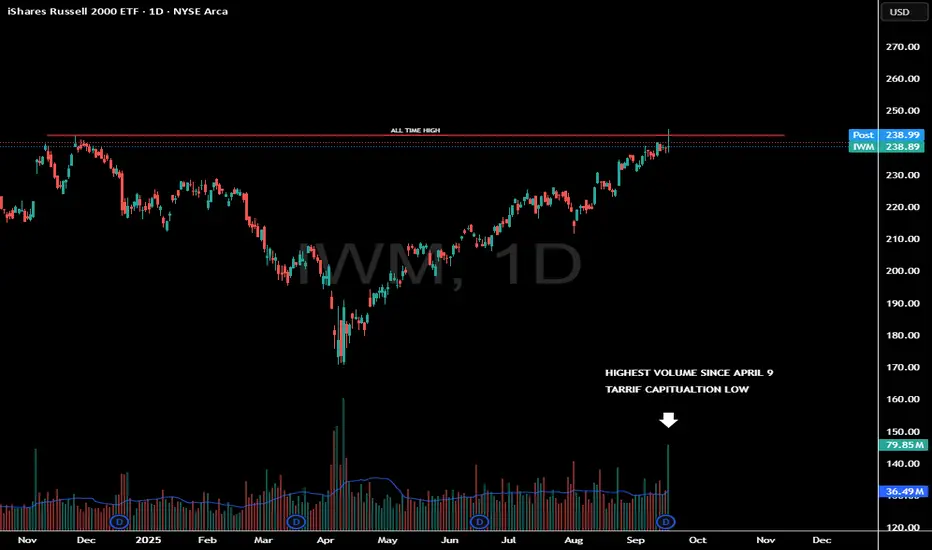
Highest Volume Candle Since Tarriff LowIWM saw a nasty reversal off the all time highs today.
A potential weekly topping tail is building.
What important about this reaction is the amount of volume that was traded.
This was the highest candle since April 9th.
High Volume reversals need to be monitored closely as it does show large money distributed into this strength.
A high volume candle marked the tariff bottom.
Will a high volume candle signal a near term top?
Blood in the streets...Is a Bear Market Starting? We discuss the technical obseravtion in the SPX / SPY.
Why was IWM so weak today?
What is happening with inflation & why are yields rallying?
Are tensions with Russia escalating?
Today we closed IWM 241 puts for 150% gain.
We took profits on many other short ideas & entered several new trades today.
Caution needs to be warranted since the Dollar and oil are rallying.
TSLA LONG SWING READ NOTES 25 SEP 2025I have bought some Tesla stocks now around $424 for swings. I know market is all time high & Tsla can do $450 here. I am just taking market over all support which is again very poor.
This is an average trade
If you are not confident dont trade.
I have gone long with stocks only
ES-mini Futures - (SPX) Analyses for Sep 25Market drivers for Thu, Sep 25 (ET)
• 8:30 — GDP 2Q (Third estimate) + Corporate Profits (annual update). Official BEA release.
• 8:30 — Durable Goods (Advance, Aug). Census M3 advance report (release time 8:30 a.m. ET).
• 8:30 — Initial Jobless Claims (weekly). DoL weekly claims (standard Thu 8:30 a.m. ET cadence).
• 10:00 — Existing-Home Sales (Aug). National Association of Realtors, scheduled for Thu 10:00 a.m. ET.
• Fed speakers — Vice Chair Bowman: 9:00 a.m. (Economic Outlook) and 1:00 p.m. (Approach to Monetary Policy).
• Treasury — Multiple bill auctions scheduled for Sep 25 (4-, 6-, 13-, 26-, 52-week). Watch rate/curve reaction around midday.
• (Context) Atlanta Fed GDPNow next update Fri, Sep 26 (used by markets for GDP tracking).
Risk windows to respect: 8:30 (data cluster) and 10:00 (housing). Avoid fresh entries ~5m before/after these prints; expect liquidity gaps.
Overall bias & PA projection (overnight → tomorrow)
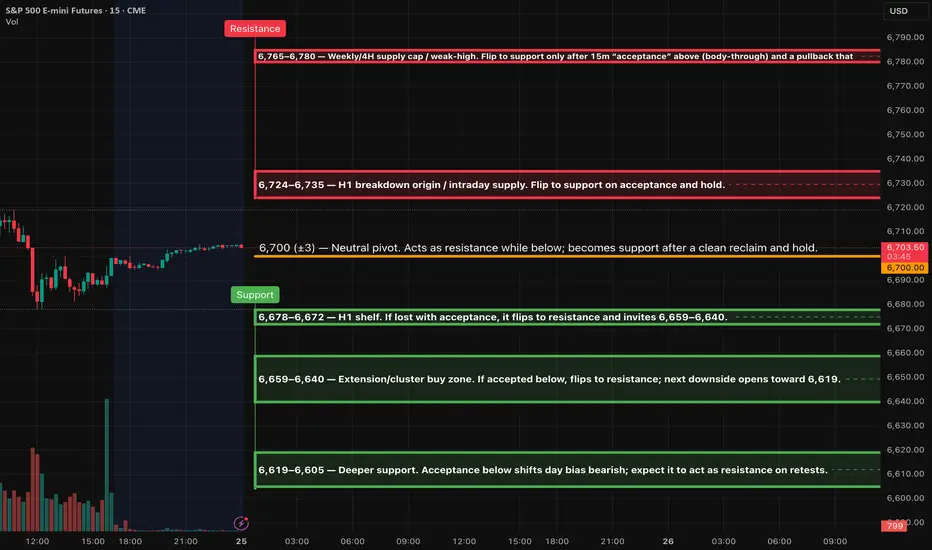
Structure: Uptrend on higher timeframes, but near a weekly/4H supply cap ~6,76x–6,78x with a fresh H1 pullback printed.
Bias into NY: Balanced-to-slightly-bullish if 6,67x holds. Below that, rotation toward the extension cluster 6,66x–6,64x likely before buyers try again.
Overnight projection: Asia/London likely to range 6,68x–6,70x. A London stop-run under 6,678 that quickly reclaims sets the stage for NY bounce. Acceptance below 6,672 opens 6,659 → 6,640 → 6,619.
NY session — A++ setups (Level-KZ Protocol 15/5/1)
Management rules (as usual): TP1 = next opposing MAJOR level; close 70% at TP1, leave 30% runner → TP2/TP3; hard SL = 15m trigger wick ±0.25–0.50pt; time-stop 45–60m; max 2 attempts per level.
ES SHORT (A++) — Rejection Fade at 6,735–6,750
Trigger: 15m rejection close back inside the zone → 5m re-close down with LH → 1m pullback fail to enter.
Entry: 6,740 ±2 (within zone after the 1m pullback).
SL: Above the 15m signal wick / hard cap 6,768.
• TP1: 6,700 pivot.
• TP2: 6,678–6,672 shelf.
• TP3: 6,659–6,640 ext cluster.
Invalidation / maintenance: Two whipsaws or a 15m body-through ≥1.0pt above 6,768 → demote/stand down; acceptance >6,768 flips bias to longs toward 6,78x.
ES LONG (A++) — Acceptance-Continuation from 6,658–6,642
Context: High-prob “flush & reclaim” at the extension cluster before/after 8:30 data.
Trigger: 15m full-body close back above 6,652, 5m HL + re-close up, 1m HL entry.
Entry: 6,650 ±3 after reclaim.
SL: Below the 15m signal wick / hard cap 6,637.
• TP1: 6,700 pivot.
• TP2: 6,724–6,735 supply.
• TP3: 6,760–6,770 (weekly cap).
Notes: If the 8:30 print gaps price through TP1 immediately, manage fills but still honor runner plan; no trailing before TP2 per protocol.
==========
London session game plan (02:00–05:00 ET)
Base case: Range 6,678–6,700 with liquidity sweeps. Reclaim of 6,700 during London often fades back into the range; prefer patience for NY AM.
Alternative: London sell program to 6,66x–6,64x → if quick reclaim above 6,652, that’s the Tier-2 bounce that feeds the NY long setup.
Bear path: Acceptance <6,640 in London → prepare for a trend-day lower toward 6,619 unless NY reverses on data.
$SPY / $SPX Scenarios — Thursday, Sept 25, 2025🔮 AMEX:SPY / SP:SPX Scenarios — Thursday, Sept 25, 2025 🔮
🌍 Market-Moving Headlines
📉 Data-heavy morning: Multiple macro releases hit at 8:30 AM, setting tone across bonds, USD, and equities.
💬 Fed chorus: Packed lineup of Fed speakers keeps policy narrative in focus.
💻 Tech + rates tension: AMEX:XLK flows remain sensitive to bond yield direction post-FOMC.
🛢️ Energy lens: Oil volatility continues to act as an inflation wildcard.
📊 Key Data & Events (ET)
⏰ 🚩 8:30 AM — Initial Jobless Claims (weekly)
⏰ 🚩 8:30 AM — GDP (Q2, third estimate)
⏰ 🚩 8:30 AM — Durable Goods Orders (Aug)
⏰ 10:00 AM — Existing Home Sales (Aug)
🗣️ Fed Speakers:
• 8:20 AM — Austan Goolsbee (Chicago Fed)
• 9:00 AM — John Williams (NY Fed) & Jeff Schmid (Kansas City Fed)
• 10:00 AM — Michelle Bowman (Fed Vice Chair for Supervision)
• 1:00 PM — Michael Barr (Fed Gov.)
• 1:40 PM — Lorie Logan (Dallas Fed)
• 3:30 PM — Mary Daly (San Francisco Fed)
⚠️ Disclaimer: Educational/informational only — not financial advice.
📌 #trading #stockmarket #SPY #SPX #GDP #joblessclaims #durablegoods #housing #Fed #Powell #Dollar #bonds #megacaps
SPY S&P 500 etf Oversold on the RSI ! 2025 Price Target ! The SPDR S&P 500 ETF Trust (SPY) is flashing a major buy signal, with its Relative Strength Index (RSI) currently sitting at 28.33 — firmly in oversold territory. Historically, every time SPY has entered oversold levels on the RSI, institutional buyers have stepped in aggressively, driving sharp rebounds in the following weeks and months.
The last time SPY dipped below the 30 RSI threshold was during market pullbacks in 2022 and 2023 — both of which were followed by significant rallies as institutions capitalized on discounted valuations. The current setup is no different. With earnings growth stabilizing, inflation cooling, and the Federal Reserve signaling a potential shift toward rate cuts in the second half of the year, the backdrop for a recovery is aligning perfectly.
Technically, SPY is also approaching key support levels that have held strong in past market corrections. The combination of an oversold RSI and strong institutional appetite at these levels creates a compelling case for a bounce.
My price target for SPY by year-end is $640, representing over 15% upside from current levels. With sentiment stretched to the downside and technical indicators flashing green, SPY looks primed for a sharp and sustained rebound. Now could be the perfect time to position for the next leg higher.
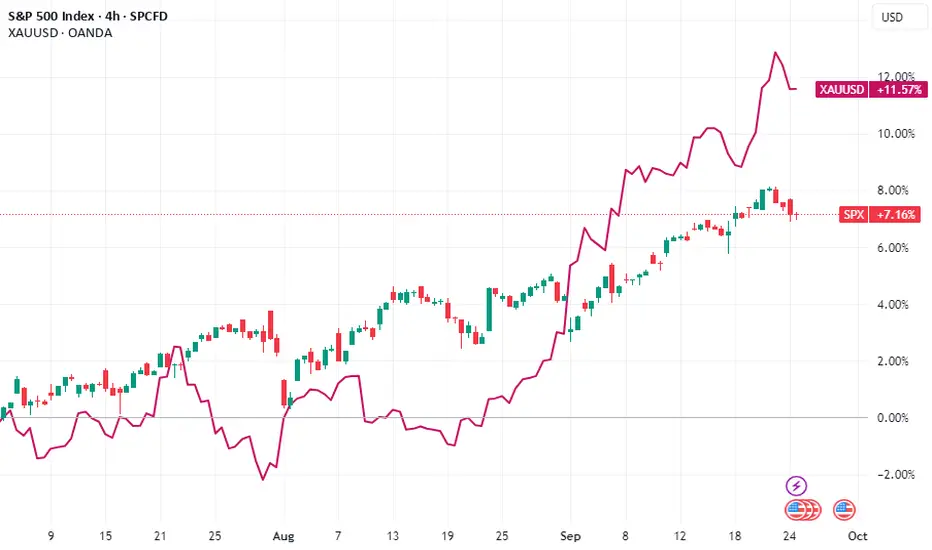
Gold’s Decade Shines Less Brightly for Stocks: The New Rational
Gold’s Decade Shines Less Brightly for Stocks: The New Rationale for the King Metal
For over a decade, the narrative surrounding gold was one of stark contrast to the equity markets. As stock indices, powered by tech innovation and ultra-low interest rates, embarked on a historic bull run, gold was often relegated to the sidelines—a relic for the fearful, an underperforming asset in a world chasing yield. The 2010s were, without question, the decade of the stock market. Gold’s shine, by comparison, seemed dull.
But a perceptible shift is underway. The latest rally in gold, which has seen it scale unprecedented nominal heights, is not the frantic, fear-driven surge of past crises. Instead, it appears to be driven by a more sober, strategic, and perhaps more durable force: the rational calculations of central banks and a fundamental rewiring of the global financial architecture. This new rationale suggests that gold’s resurgence may not spell immediate doom for stocks, as traditional wisdom would hold, but rather reflects a new, more complex macroeconomic reality where the two can coexist, albeit with gold casting a long, less brilliant shadow over the equity landscape.
The Ghost of Gold Rallies Past: A Tale of Fear and Froth
To understand the significance of the current rally, one must first revisit the drivers of previous gold booms. Historically, gold’s major upward moves were tightly correlated with periods of acute stress and negative real interest rates.
The post-2008 financial crisis surge, which took gold from around $800 an ounce in 2008 to over $1,900 in 2011, was a classic "fear trade." The world was confronting a systemic banking collapse, unprecedented monetary experimentation in the form of Quantitative Easing (QE), and rampant fears of runaway inflation and currency debasement. Gold was the safe haven, the hedge against a collapsing system. Similarly, the spike in mid-2020, at the onset of the COVID-19 pandemic, was a panic-driven flight to safety as global economies screeched to a halt.
These rallies shared common characteristics: they were often sharp, volatile, and ultimately prone to significant retracements. When the immediate crisis abated—when inflation failed to materialize post-2008, or when fiscal and monetary stimulus ignited a V-shaped stock market recovery in 2020—the rationale for holding a non-yielding asset weakened. Money flowed back into risk assets like stocks. Gold’s role was binary: it was the asset for when things were falling apart. In a functioning, risk-on market, it had little place.
This created the perception of an inverse relationship. A strong gold price was a signal of market distress, and thus, bad for stocks. But this decade is different.
The New Architects: Central Banks and Strategic Repatriation
The most profound change in the gold market has been the transformation of its largest and most influential buyers: central banks. For years, the narrative was that developed Western central banks, holders of the world’s primary reserve currencies, were gradually diversifying away from gold. The modern financial system, built on the U.S. dollar, Treasury bonds, and other interest-bearing instruments, was deemed superior.
That assumption has been decisively overturned. Since around 2010, but accelerating dramatically in recent years, central banks—particularly those in emerging economies—have become net purchasers of gold on a massive and sustained scale. The World Gold Council reports that central banks have been adding to their reserves for over a decade, with annual purchases hitting multi-decade records.
This buying is not driven by panic. It is a calculated, long-term strategic move rooted in three key rationales:
1. De-dollarization and Geopolitical Hedging: The weaponization of the U.S. dollar through sanctions, particularly against Russia following its invasion of Ukraine, served as a wake-up call for nations not squarely in the U.S. geopolitical orbit. Holding vast reserves in U.S. Treasury bonds suddenly carried a new risk: they could be frozen or seized. Gold, by contrast, is a sovereign asset. It can be held within a nation’s own vaults, is nobody’s liability, and is beyond the reach of any other country’s financial system. For China, Russia, India, Turkey, and many nations in the Global South, accumulating gold is a strategic imperative to reduce dependency on the dollar and insulate their economies from geopolitical friction.
2. Diversification Against Fiscal Profligacy: Even for allies of the U.S., the sheer scale of U.S. government debt is a growing concern. With debt-to-GDP ratios at record levels in many developed nations and little political will to address them, the long-term value of fiat currencies is being questioned. Central banks are increasingly viewing gold as a perennial hedge against the fiscal and monetary policies of their allies—a form of insurance against the potential devaluation of the very government bonds that form the backbone of their reserves.
3. A Return to a Multi-Polar Financial World: The post-Bretton Woods era has been dominated by the U.S. dollar. There are increasing signs that the world is shifting towards a multi-polar system, with the euro, Chinese yuan, and possibly other currencies playing larger roles. In such a transitional period, gold’s historical role as a neutral, trusted store of value becomes immensely attractive. It is the one asset that is not tied to the economic fortunes or policies of a single nation.
This central bank demand provides a powerful, structural floor under the gold price. It is consistent, price-insensitive buying (they are not chasing momentum but executing a strategy) that is largely divorced from the short-term sentiment swings of the stock market. This is the "more rational calculation" that makes the current rally fundamentally different and potentially longer-lasting.
The Interest Rate Conundrum: Gold’s Old Nemesis Loses Its Bite
For years, the primary argument against gold was simple: it offers no yield. In a world of rising interest rates, where investors can earn a attractive, risk-free return on cash or government bonds, the opportunity cost of holding gold becomes prohibitive. The theory held that the Federal Reserve’s aggressive hiking cycle from 2022 onward would crush the gold price.
It didn’t. Gold not only weathered the storm but continued its ascent. This paradox reveals another layer of the new rationale.
While nominal rates rose, real interest rates (nominal rates minus inflation) have been more ambiguous. Periods of high inflation meant that even with higher rates, the real return on cash and bonds was often negative or minimal. In such an environment, gold, as a traditional inflation hedge, retains its appeal.
More importantly, the market’s focus has shifted from the level of rates to their trajectory. There is a growing belief that the era of structurally higher interest rates is unsustainable, given the colossal levels of global debt. Servicing this debt becomes exponentially more difficult as rates rise. Therefore, many market participants are betting that the current rate cycle represents a peak, and that central banks will be forced to cut rates sooner rather than later, regardless of the inflation fight. Gold performs well in a environment of falling rates, and this anticipation is being priced in now.
Furthermore, high rates have begun to expose fragilities in the system, from regional banking crises in the U.S. to debt distress in emerging markets. In this sense, high rates haven't killed gold’s appeal; they have reinforced its role as a hedge against the consequences of high rates—namely, financial instability.
A Less Bright Shine for Stocks: Coexistence in a New Reality
So, what does this new, rationally-driven gold bull market mean for stocks? The relationship is no longer a simple inverse correlation. It is more nuanced, suggesting a future of coexistence rather than direct competition, but one where gold’s strength signals underlying headwinds that will dim the stellar returns equities enjoyed in the previous decade.
1. The End of the "Free Money" Era: The 2010s were built on a foundation of zero interest rates and quantitative easing. This environment was nirvana for growth stocks, particularly in the tech sector, as future earnings were discounted at very low rates, justifying sky-high valuations. The new macroeconomic order—one of higher structural inflation, larger government debt, and geopolitical fragmentation—is inherently less favorable to such valuation models. Gold’s strength is a symptom of this new order. It doesn’t mean stocks will collapse, but it does suggest that the era of effortless, broad-based double-digit annual returns is likely over. Returns will be harder won, more selective, and more volatile.
2. A Hedge Within a Portfolio, Not a Replacement: Investors are now likely to view gold not as a binary alternative to stocks, but as a critical component of a diversified portfolio. In a world of heightened geopolitical risk and uncertain monetary policy, holding a portion in gold provides stability. This means fund flows are not a simple zero-sum game between the SPDR Gold Trust (GLD) and the SPDR S&P 500 ETF (SPY). Institutions and individuals may increase allocations to both, using gold to mitigate the specific risks that now loom over the equity landscape.
3. Sectoral Winners and Losers: A strong gold price is a direct positive for gold mining stocks, a sector that has been largely neglected for years. This could lead to a resurgence in this niche part of the market. Conversely, the factors driving gold—higher inflation and rates—are headwinds for long-duration assets like high-flying tech stocks. The outperformance may shift towards value-oriented sectors, commodities, and industries with strong pricing power and tangible assets. The stock market’s shine may dim overall, but it will create bright spots in new areas.
4. The Signal of Sustained Uncertainty: Ultimately, a gold market driven by central bank de-dollarization and fiscal concerns is a barometer of persistent, low-grade global uncertainty. This is not the acute panic of 2008, but a chronic condition of fragmentation and distrust. Such an environment is not conducive to the explosive, confidence-driven growth that stock markets thrive on. It favors caution, resilience, and tangible value over speculative growth. Gold’s steady ascent is the clearest signal of this psychological shift.
Conclusion: A Duller but More Enduring Glow
The gold rally of the 2020s is not a siren call of an imminent market crash. It is the quiet, determined accumulation of a strategic asset by the world’s most powerful financial institutions. It is a vote of no confidence in the unfettered dominance of the current financial order and a bet on a more fragmented, uncertain future.
For stock market investors, this does not necessarily portend a bear market. Instead, it heralds a more challenging environment where the tailwinds of globalization and cheap money have reversed. The dazzling shine of the stock market’s previous decade is likely to be replaced by a duller, more realistic glow. Returns will be more modest, risks more pronounced, and the need for prudent diversification more critical than ever.
In this new era, gold and stocks will learn to coexist. The king of metals is no longer just a refuge for the fearful; it has become a strategic holding for the rational. Its decade may not shine with the same speculative brilliance as the stock market’s last bull run, but its light may well prove to be more enduring, illuminating a path through a landscape of greater complexity and risk. The lesson for investors is clear: the old rules are changing, and in this new game, gold holds a very strong hand.
Macro & Technical Signals: IWM, Uranium, Dollar, Oil, ALAB, LULUIn todays video we discuss the breakdown in small caps and high beta stocks.
A macro shift could be unfolding today as we saw the dollar & oil rally all day.
Uranium & gold saw some distribution.
Financials reversed off the highs.
High Beta stocks that have rallied are softening up.
SPX has triggered a near term bearish pattern while losing the 7 day MA.
ES (E-mini S&P 500) — Plan for Wed Sep 24Fundamentals (tomorrow, ET)
04:00 Germany IFO Business Climate (often moves European risk tone during London).
10:00 U.S. New Home Sales (Aug) — official Census schedule lists New Residential Sales at 10:00 a.m..
10:30 EIA Weekly Petroleum Status Report (standard time each Wed).
13:00 U.S. 5-Year Note auction (can nudge yields/indices).
Context: Yesterday’s U.S. flash PMIs showed slower but still-expanding activity (Composite 53.6 vs 54.6 Aug).
Bias(HTF→LTF)
HTF: Uptrend but near prior highs; Tuesday printed a lower-timeframe selloff into ~6,701–6,705 (confluence with D1 1.272 ≈ 6,705).
Base case into London: Two-way trade inside 6,701–6,744–6,756 triad while Europe digests IFO.
Two paths for NY:
Acceptance ↑ above 6,756.5 → squeeze the weak-highs toward 6,765–6,770, then 6,798–6,800 (D1 1.618).
Acceptance ↓ below 6,701–6,705 → trend rotation toward 6,690s → 6,680s (next liquidity shelves).
London session game plan
If Europe pushes up early: Watch 6,744. Failure there → rotate back to 6,711–6,718; clean reclaim → sets NY for a 6,756 test.
If Europe bleeds down: Look for sweep & hold behavior at 6,701–6,705; loss of that area on 15m body-through tends to trend extend into the 6,69x/6,68x shelves before NY AM.
NY AM (09:30–11:00 ET) and NY PM (13:30–16:00 ET) → full size, run the exact confirmations and targets I gave.
A++ Acceptance LONG — above 6,756.5
Confirmations (15/5/1):
• 15m full-body close above 6,756.5 (acceptance).
• 5m pullback holds ≥ 6,754–6,756 and re-closes up.
• 1m HL entry on first clean re-trigger.
Entry: 6,756–6,758 on the retest (or continuation >6,760 after 5m re-close).
Hard SL: below the 15m trigger wick or < 6,744 by 0.25–0.50 pt (whichever is lower).
Targets: TP1 6,765–6,770, TP2 6,798–6,800, TP3 6,901.
Management: No partials before TP1; at TP1 close 70%, set 30% runner to BE; no trail before TP2. Time-stop 45–60m if neither TP1 nor SL hits. Max 2 attempts at this level.
Invalidation: 15m close back inside < 6,756 after entry that fails the 5m hold → cancel and reassess.
=============
A++ Acceptance SHORT — below 6,701–6,705
Confirmations (15/5/1):
• 15m full-body close below 6,701 (body-through the band).
• 5m LH + re-close down on the retest of 6,701–6,705.
• 1m LH entry on first pullback failure.
Entry: 6,699–6,703 on the retest.
Hard SL: above the 15m trigger wick or > 6,705 by 0.25–0.50 pt (whichever is higher).
Targets: TP1 6,690–6,692, TP2 6,680–6,685, TP3 trail if trend accelerates.
Management: Same rules as Setup #1 (TP1 70% + runner to BE; 45–60m time-stop; max 2 attempts).
Invalidation: Reclaim on 15m back above 6,705 that holds → cancel the short.
⸻
Risk & timing notes
• 10:00 New Home Sales and 10:30 EIA can cause abrupt spikes; favor entries after the first post-data 5m bar closes unless already in with cushion.
• 13:00 5-Year auction can alter yield curve into the NY PM window; manage runners.