EUR/AUD ~ Weekly 50 EMAEUR/AUD ~ Weekly 50 EMA Rejection for 3R Upside Potential
EUR/AUD is retesting the weekly 50 EMA after a controlled multi-week pullback. This level has acted as a major dynamic support in past uptrend phases. Price is showing early signs of demand returning, creating a potential swing opportunity aiming toward the prior structure highs. With clear invalidation below the EMA zone, the setup offers a clean 3R path if momentum follows through.
📊 Technical Setup Overview
Current Status: Retesting weekly 50 EMA support
Momentum: Stabilizing after multi-week correction
Target: Return to previous swing highs
Trade Type: Higher timeframe swing setup
📈 Why This Level Matters
Weekly 50 EMA Dynamic Support
The weekly 50 EMA often defines the midpoint of strong trends. EUR/AUD has respected this moving average several times throughout the year, creating reliable inflection points during corrections.
This pullback has tapped the EMA with precision, showing early demand wicks and slowing downside tempo.
Structure Alignment
The current test aligns with a previous consolidation shelf, increasing the importance of this zone.
Large timeframe participants typically step in at these overlapping structure areas.
Trend Integrity
Despite the pullback, the higher timeframe structure remains intact. The series of higher lows is not broken and the long term bullish rhythm remains valid while price holds above this support region.
🎯 Trade Structure
Entry Consideration: Weekly 50 EMA touch zone
Stop Loss: Below the recent weekly wick low
Primary Target: Prior swing high zone
Reward Potential: Approximately 3R depending on exact stop placement
Timeframe: Multi-week hold
📰 Context Behind the Pullback
Recent weakness was driven by euro softness and short term risk flows rather than structural trend change.
These types of corrective moves often fade once higher timeframe participants re-enter at key EMAs.
As volatility cools, weekly structure becomes the dominant driver again and price tends to mean-revert toward trend direction.
📊 Weekly Chart Analysis
Structure
✓ Uptrend intact
✓ Pullback respecting major dynamic support
✓ Higher low structure still active
Momentum
✓ Selling pressure slowing
✓ No breakdown continuation
✓ Volume contraction signaling exhaustion
Key Levels
Support: Weekly 50 EMA
Target Zone: Prior swing highs
Invalidation: Break and weekly close below last wick low
🧠 Why Traders Miss These Setups
Fear of Weekly Pullbacks
Many traders interpret deep pullbacks as trend failure. Weekly EMAs often attract liquidity and are engineered for shakeouts before continuation.
Waiting for Confirmation
By waiting for a break above the weekly candle high, traders risk giving away 70 to 120 pips and compress the reward to 1R or 1.5R.
Overlooking Higher Timeframes
Intraday charts may look messy or bearish. Weekly structure tells the real story and often leads the next macro move.
📅 Expected Duration and Catalysts
Estimated Duration: 2 to 4 weeks
Potential Catalysts:
✓ Euro strength rotation
✓ Weakness in AUD from risk shifts
✓ Improvement in eurozone data
✓ Mean reversion back into trend
⚠️ Risk Factors
A clean break and weekly close beneath the 50 EMA signals trend exhaustion and invalidates the setup.
Fundamental shocks affecting eurozone or Australian macro conditions could also disrupt technical structure.
🏆 The Professional Approach
Professionals focus on:
✓ Structure over emotion
✓ Entering at dynamic support with defined risk
✓ Playing the asymmetric payoff at 3R
✓ Scaling partial profits as price approaches targets
The setup focuses on buying strength at a long term trend support rather than chasing breakouts.
📌 Key Takeaways
✓ Weekly 50 EMA touch creates high probability inflection
✓ Trend structure remains intact
✓ Upside toward previous swing highs offers clean 3R
✓ Risk defined with tight invalidation
✓ Weekly timeframe swing with strong confluence
Swingtrade
USD/CAD - Daily Oversold Bounce Setup Into 1.40000 TargetUSD/CAD Post-News Recovery Play: 0.786 Fib Hold + DeM Oversold Signal 1.40000
The US Dollar/Canadian Dollar has pulled back to a critical support zone following recent news volatility, setting up a potential swing trade opportunity targeting the psychological 1.40000 level. Technical confluence at the 0.786 Fibonacci retracement combined with deeply oversold momentum indicators suggests this pullback may be nearing exhaustion.
📊 Technical Setup Overview:
Current Status: Holding 0.786 Fibonacci retracement
Daily Momentum: DeMarker (DeM) indicator showing extreme oversold conditions
Target: 1.40000 psychological resistance
Trade Type: Swing position - multi-day hold
📈 Why This Level Matters:
0.786 Fibonacci Retracement:
The 0.786 level represents one of the deepest retracement zones in trending markets before a reversal becomes a trend change. USD/CAD has tested and held this mathematical support level, indicating strong buying interest at current prices.
This Fibonacci level was calculated from the recent swing low to swing high and marks the zone where institutional accumulation typically occurs during healthy trend corrections.
DeMarker Oversold on Daily Chart:
The DeMarker oscillator on the daily timeframe has reached extreme oversold territory - a condition that historically precedes mean reversion moves. When DeM reaches these levels, it indicates selling pressure has reached exhaustion and momentum is primed for reversal.
Unlike intraday noise, daily DeM oversold readings carry significant weight as they represent sustained directional pressure across multiple trading sessions that is now reaching a turning point.
1.40000 Psychological Target:
Round numbers act as magnetic price levels in forex markets due to:
Order clustering from institutional and retail traders
Option strike concentrations
Psychological significance creating self-fulfilling behavior
Previous support/resistance memory at these levels
The 1.40000 level represents approximately 150-200 pips of upside potential from current support, offering favorable risk/reward for a swing position.
🎯 Trade Structure:
Entry Consideration: Current 0.786 Fibonacci support zone
Stop Loss: Below recent swing low (structure invalidation)
First Target: 1.3900 (psychological level, profit-taking zone)
Primary Target: 1.40000 (round number resistance)
Timeframe: Multi-day swing trade (3-7 days estimated)
Risk Management:
Position sizing should account for potential 50-80 pip stop loss distance. The 1.40000 target offers approximately 2:1 to 3:1 reward-to-risk ratio depending on exact entry and stop placement.
📰 Post-News Context:
Recent news events created volatility that pushed USD/CAD into this technical support zone. Post-news environments often see:
Reduced volatility as immediate reactions are priced in
Technical levels regaining importance as primary drivers
Mean reversion opportunities as emotional extremes normalize
The combination of news-driven overselling into strong technical support creates a setup where fundamental pressure has eased while technical structure remains intact.
📊 Daily Chart Analysis:
Structure:
Higher timeframe uptrend remains intact
Current pullback represents correction within larger bullish context
0.786 Fibonacci acting as demand zone
Momentum:
DeM indicator deeply oversold (condition that preceded previous bounces)
Divergence may be forming (price making lower lows while momentum stabilizes)
Volume showing signs of exhaustion rather than acceleration
Key Levels:
Support: 0.786 Fibonacci zone (current)
Resistance 1: 1.3900 (first profit-taking area)
Resistance 2: 1.40000 (primary target)
🧠 Why Traders Miss These Setups:
Emotional Comfort vs. Technical Opportunity:
After a sustained decline, USD/CAD "feels" weak and most traders assume further downside. But the best risk/reward exists precisely when sentiment is most negative and price has reached structural support.
Waiting for Confirmation:
Many will wait for USD/CAD to break above 1.3850 to "confirm" the reversal. By then, risk has expanded 50-80 pips and reward has compressed by the same amount. Entries at technical support with defined risk offer superior asymmetry.
Ignoring Daily Timeframe Signals:
Intraday traders focused on 1-hour or 4-hour charts may miss the significance of daily DeM oversold conditions. These higher timeframe signals carry more weight and have longer-lasting effects on directional bias.
News-Driven Fear:
Recent news created the selloff, making traders cautious about catching a "falling knife." However, technical analysis helps identify where the knife lands - the 0.786 Fibonacci support.
📅 Timeframe and Catalysts:
Expected Duration:
This swing trade setup could take 3-7 trading days to reach the 1.40000 target, depending on:
Broader USD strength/weakness
Oil price movements (CAD correlation)
Risk sentiment shifts
Upcoming economic data releases
Potential Catalysts:
US economic data supporting dollar strength
Weakness in crude oil (negative for CAD)
Risk-off flows benefiting USD as safe haven
Technical buying at support creating momentum
⚠️ Risk Factors:
What Could Invalidate This Setup:
Support Breakdown:
If USD/CAD closes decisively below the 0.786 Fibonacci support on the daily chart, the thesis is compromised. This would indicate the correction is deeper than typical and may target the next Fibonacci level.
Fundamental Shifts:
Unexpected dovish Fed policy signals
Surge in crude oil prices (bullish for CAD)
Risk-on environment reducing USD safe-haven demand
Canadian economic data significantly exceeding expectations
Technical Failure:
Daily DeM can remain oversold longer than expected during strong trending moves. If the broader trend has changed from bullish to bearish, mean reversion may not occur at typical technical levels.
Geopolitical Events:
Unforeseen news events could override technical structure and create renewed selling pressure regardless of oversold conditions.
🏆 The Professional Approach:
They Buy Structure, Not Sentiment:
The 0.786 Fibonacci + daily DeM oversold combination provides objective structure. Professional traders recognize this confluence as an area where probability favors reversal, regardless of how the chart "feels."
They Size for Volatility:
USD/CAD is a major pair but still experiences 50-100 pip daily ranges. Position sizing accounts for this inherent volatility while keeping total portfolio risk at 1-2% per trade.
They Accept Being Early:
The perfect bottom is unknowable. Entries at structural support with defined stops accept that price may test the level multiple times before resolving higher. This is why stop placement below structure (not arbitrary) is critical.
They Scale Out at Targets:
Rather than holding for the full 1.40000 target:
Reduce 1/3 at 1.3850 (books profit, reduces emotional pressure)
Reduce 1/3 at 1.3900 (locks gains, allows breathing room)
Final 1/3 at 1.40000 or trailing stop (maximizes upside)
This approach removes emotion from exit decisions and ensures partial profits are captured even if the full target isn't reached.
📌 Key Takeaways:
✅ Technical confluence present: 0.786 Fibonacci support + daily DeM oversold creates high-probability setup
✅ Clear target structure: 1.40000 offers 150-200 pip upside with defined reward-to-risk asymmetry
✅ Post-news environment: Emotional selling into technical support often marks turning points
✅ Risk is defined: Stop below 0.786 support provides clear invalidation point
✅ Daily timeframe signal: Higher timeframe oversold conditions carry more weight than intraday fluctuations
⚠️ Important Disclaimers:
This analysis is for educational purposes and reflects a technical view based on Fibonacci retracement levels, momentum indicators, and structural support. It is not financial advice or a recommendation to buy or sell USD/CAD or any currency pair.
Forex trading involves substantial risk of loss. The 0.786 Fibonacci support could fail, and daily DeM can remain oversold during strong trending moves. Past instances of reversals from these conditions do not guarantee similar outcomes.
Market conditions can change rapidly due to economic data, central bank policy, geopolitical events, and liquidity conditions. What appears as technical support may not hold during fundamental regime changes.
Position sizing must account for volatility and potential for stop loss to be hit. Never risk more than you can afford to lose on any single trade.
Always conduct independent analysis, consider your risk tolerance, and consult with a financial professional if needed. All forex trading involves significant risk.
✨ Your Perspective:
Are you watching USD/CAD at these levels? How do you trade Fibonacci + momentum confluence setups? Share your approach in the comments.
📜 Trade the structure. Manage the risk. Stay disciplined.
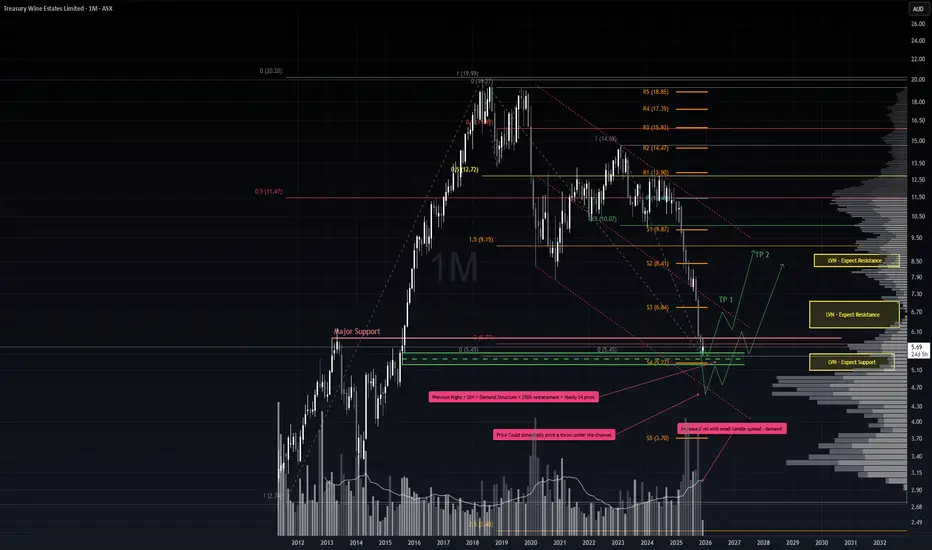
Relief Rally Incoming?It’s been a punishing stretch for TWE holders, but price action has now pulled back into a critical zone where a relief rally could emerge. The broader trend remains bearish, so any positioning here must respect that context.
Key Support Factors
1. 200% retracement from the 2018 double top.
2. Low Volume Node (LVN) zone, indicating limited price acceptance and potential for sharp moves.
3. Demand structure anchored by the August 2015 candle.
4. Historical tops acting as structural support.
5. November monthly candle showed notable demand — high volume on a narrow spread.
6. 11 consecutive weeks down in a single swing, aligning with Gann’s 7–10 bar exhaustion principle.
7. Proximity to the yearly S4 pivot, reinforcing the demand zone.
Trade Scenario 1 – Aggressive Entry
Setup: Despite no confirmed trend reversal, risk-tolerant traders could begin scaling in here, supported by the confluence of demand factors.
Stop Loss: 5.22 — just beneath the demand structure and S4 pivot.
Take Profit: Initial target at the midline (EQ) of the downward channel. If price breaks cleanly above, extend targets toward the upper bounds of the channel.
Trade Scenario 2 – Throw-Under Reversal
Setup: If the S4 pivot and demand structure fail, watch for a throw-under pattern whereby price dips below support but quickly reclaims the range.
Confirmation: A bullish hammer or doji on surging volume, ideally accompanied by negative sentiment, would strengthen the reversal case.
Take Profit: Similar roadmap to Scenario 1 — first target at the channel EQ, then potentially the upper boundary if momentum builds.
Summary
This is a high-risk, counter-trend play. The confluence of structural supports, exhaustion signals, and pivot proximity offers a tactical window for relief. However, discipline around stops and scaling is essential, as the long-term bear market backdrop remains intact.
* Note, price pathing is not time based, just the overall price movement
Gold (XAUUSD) – Don’t Get Trapped: Sell High, Buy LowGold (XAUUSD) – Structural Outlook
Price action continues to develop within a corrective framework, forming a potential A–B–C structure following the recent impulsive advance. The market is approaching a key resistance zone aligned with the 0.786 retracement , where liquidity above the internal swing high may be targeted before a broader downside continuation toward the $3,880–$3,790 demand region. A confirmed sweep and rejection from the upper boundary would strengthen the case for the final leg of the correction, completing wave (C) before a higher-time-frame bullish continuation resumes.
⚠️ Disclaimer
This analysis is provided for educational purposes only and does not constitute financial advice. Trading financial markets involves risk, and you are solely responsible for your own investment decisions. Always conduct your own research and use proper risk management.
If you found this analysis valuable, leave a like, drop your thoughts in the comments, and follow for more structured market insights.
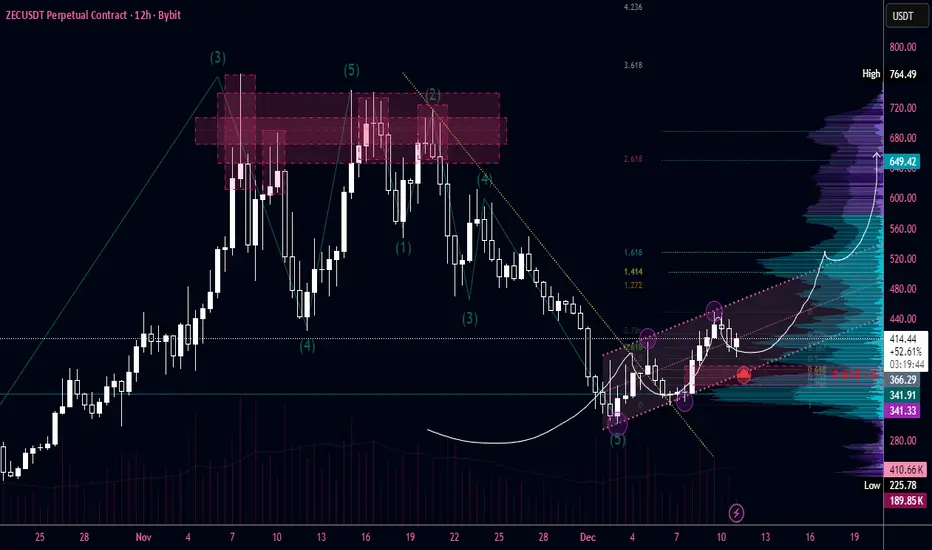
Zcash(ZEC/USDT) | Don’t Get Caught in the Whales’ Trap🧠 ZEC/USDT – Smart Money Trap Before the Drop?
Zcash just swept liquidity below a key short-term low 👀 — now reacting from a demand zone, but volume confirms weak bullish intent.
Expect a liquidity grab + distribution phase before price dives toward the $300–$350 range, aligning with higher-timeframe imbalance fills and unmitigated demand below.
Smart Money might be engineering one last bull trap before the real markdown begins.
📉 Watch for rejection from the $620–$650 supply zone to confirm the move!
#ZECUSDT #Zcash #CryptoAnalysis #PriceAction #SmartMoneyConcepts #LiquidityGrab #BearishSetup #CryptoTraders #TradingView #Fibonacci #SwingTrade #MarketStructureBreak #Wyckoff #SMC
💬 What’s your bias — bull trap or reversal? Drop your thoughts below 👇
Title: FARTCOIN | Breakout Retest and Long-Term Structure PlayAfter a long period of compression, FARTCOIN (FART/USDT) is showing early signs of a potential trend reversal on the 1D chart.
Price has respected a descending resistance line for months while simultaneously forming higher lows on the ascending yellow trendline — signaling that bullish pressure may be building.
Currently, price is testing the intersection point between descending resistance and ascending support, forming what could be a symmetrical triangle breakout setup.
If we can hold above the breakout area and reclaim the mid-structure level (~0.40–0.42), the next technical objectives would be:
TP1: 0.56 – Retest of prior structural resistance
TP2: 0.73 – Measured move from the breakout pattern
TP3: 1.00+ – Potential full cycle expansion target
⚠️ Invalidation:
A daily candle close below 0.30 would suggest a failed breakout and continuation of the prior downtrend.
Educational Breakdown:
This setup is designed to teach how trendline confluence + structural compression can reveal early trend reversal zones.
Notice how the breakout leg aligns with a swing projection pattern, confirming momentum shift probability.
Bias:
Directional Bias: Bullish
Setup Type: Breakout + Retest (Mid-term swing)
Timeframe: 1D
Difficult and imperfect swing trade setup on BTCUSD dailyCOINBASE:BTCUSD has broken below its rising channel and is now exhibiting a downward trajectory. This shift creates a potential swing-trading opportunity arising from two distinct scenarios:
A reversal of the current downward trend, leading to a renewed bullish movement, or
A temporary pullback within the continuation of a broader bearish trend.
On the weekly timeframe, the first major traditional moving average above the current price is the 50-week moving average, positioned at approximately 100,000 USD. The daily chart reflects a similar structure: the nearest significant moving average above is again the 50-day moving average, also situated near 100,000 USD. This alignment establishes a notable—albeit high-risk—swing-trade setup. Should the price initiate even a micro bullish trend within a larger bearish context, the most probable target for such a move would be a reversion toward the 50 DMA at around 100,000 USD.
Supporting this thesis, several momentum indicators—specifically the RSI, Rate of Change (ROC), and MACD—are beginning to turn upward from recent troughs. This emerging positive momentum suggests that underlying buying strength may be forming, which would be consistent with the early stages of a bullish swing within a broader bearish structure.
A potential entry trigger on the daily chart would occur once price breaks above and remains above the 10 DMA for a sustained period (e.g., a 1- to 3-day confirmation filter, depending on risk tolerance). Historically, such moves have provided reliable signals on at least four consecutive prior occasions as depicted in the chart.
However, caution is warranted: daily closes above the 10 DMA are common, and many such moves fail to persist. This is why a multi-day filter is proposed—to increase the probability that the breakout represents a genuine shift rather than short-lived noise.
Proposed Trade Parameters
Entry: Break and sustained hold above the 10 DMA (estimated near 90,000 USD).
Take Profit (TP): Reversion to the 50 DMA (approximately 100,000 USD).
Stop Loss (SL): A daily close back below the 10 DMA (likely around 95,000 USD).
Risk–Reward Ratio: ~1:2.
Important Caveats: This setup is inherently imperfect, as both the entry and stop-loss levels are determined by moving averages and the trade itself yields a relatively modest risk–reward profile. Moreover, the rationale for a bullish retracement is based solely on technical patterns—specifically, the observation that counter-trend rallies frequently occur even within pronounced bearish phases. There is, at this point, no anticipated fundamental catalyst or macro-level justification supporting an imminent bullish move; the thesis is grounded entirely in probabilistic technical behaviour.
USDCAD Alert! — Smart Money + Elliott Wave + Price Action + Fib🚨 USDCAD Wave C Correction Alert!
According to Wave Theory Confluence , we’re likely approaching the end of Wave B (Y) around the 1.4150–1.4300 zone — aligning with the 0.5–0.618 Fibonacci retracement levels. 📉
Price is showing exhaustion near this area with signs of liquidity grab (BSL hit) and smart money distribution , suggesting potential bearish reversal setups ahead. 🔍
Expecting Wave C to unfold next, targeting deeper downside correction before the next impulsive leg resumes.
📊 Key Confluences:
Elliott Wave B completion zone
Smart Money liquidity sweep
Bearish structure shift forming
Fibonacci rejection area
Fundamentals still favor short-term CAD strength
💡 Trade Idea: Watch for confirmation of bearish momentum and structure break before entering shorts toward 1.33–1.32 region.
Stay sharp — Wave C could be fast and decisive! ⚡
What’s your take, traders? 🤔
Do you think Wave C is about to drop hard or will bulls surprise us again? 🐻📉🐂
Drop your analysis 👇 — let’s see who nails the next big move! 🚀
#USDCAD #ForexAnalysis #ElliottWave #SmartMoneyConcepts #PriceAction #WaveTheory #ForexTrading #SwingTrade #Fibonacci #FXForecast #TechnicalAnalysis #TradeSetup #MarketStructure #USD #CAD #ForexCommunity
USDJPY | Institutional Sells from HTF Supply Zone (Instant ExecuUSDJPY has tapped into a higher-timeframe supply zone that aligns with the weekly sweep and 4H CHoCH, confirming potential downside momentum.
After the recent BOS, price retraced back into the previous structural supply, forming an S&S pattern (sweep and shift) within the same zone.
The setup aligns with bearish intent from institutional order flow, suggesting smart-money distribution before the next leg down.
🔹 Execution: Instant market sell from 154.15–154.20
🔹 Stop-Loss: Above 154.55 (protected high)
🔹 Target: 152.80 (Realistic TP area)
🔹 Bias: Bearish continuation into lower liquidity zones
Technical Confluence:
• W1 sweep confirms distribution phase
• 4H CHoCH + BOS = structural shift bearish
• S&S rejection inside refined M30 supply
• Liquidity resting below recent lows (152.80)
This setup respects SMC principles — liquidity sweep → structural shift → premium entry — under institutional context.
💬 Monitor for a clean M15–M5 confirmation candle close to maintain precision entry and manage partials along the way.
SANGAM (INDIA) LTD – Volume Breakout with Bullish MomentumCMP: ₹466.6
🟢 Buy Zone: ₹460–465 (on minor pullback or consolidation)
🎯 Targets:
Target 1: ₹481
Target 2: ₹490
Target 3: ₹497
🔻 Stop Loss: ₹447 (below recent swing low)
⏳ Duration: 5–10 trading days (short-term swing setup)
SANGAM (India) Ltd has shown a strong bullish breakout above the resistance zone with a surge in volume (see chart). The RSI reversal from mid-levels confirms renewed momentum. Sustaining above ₹457 could push price towards ₹490–₹497 levels in the coming sessions. A healthy retest near ₹460–₹465 offers a low-risk entry opportunity.
Risk–Reward: 1:2.5 (Favorable for short-term swing traders)
⚠️ Disclaimer:
This analysis is for educational purposes only and not financial advice. Always do your own research before investing or trading.
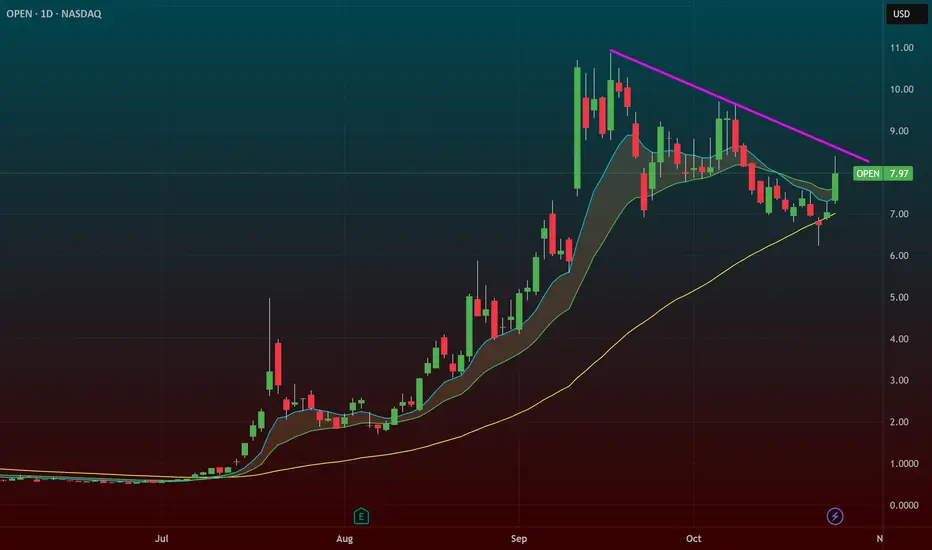
$OPEN – 50 SMA Retest with Trendline Breakout TriggerOpendoor Technologies ( NASDAQ:OPEN ) is setting up for a trendline breakout right as it tests the 50 SMA — a perfect technical spot for dip buyers to step in after a massive run.
🔹 The Setup:
After a strong multi-month rally, NASDAQ:OPEN finally pulled back into the 50 SMA, the first real test of trend support in this cycle.
Price is coiling just under a descending trendline, with an $8.50 trigger marking the breakout zone.
The consolidation is clean, volume is light, and momentum could reload quickly if the market stays hot.
🔹 Market Context:
The broader market is at all-time highs, and NASDAQ:OPEN has been one of the biggest winners in that run.
This pullback looks natural and healthy, not distributional.
Often, the first touch of the 50 SMA after a big run is where institutional buyers step back in.
🔹 My Trade Plan:
1️⃣ Entry: Watching for a breakout through $8.50 with volume confirmation.
2️⃣ Add: On strength above that level or retest of the breakout zone.
3️⃣ Stop: Below the 50 SMA — tight, well-defined risk.
Why I Like This Setup:
Trendline break + 50 SMA retest = classic continuation setup.
Big winner resting while the market is strong = ideal timing for a reload.
Risk is clean, structure is tight, and breakout potential is strong.
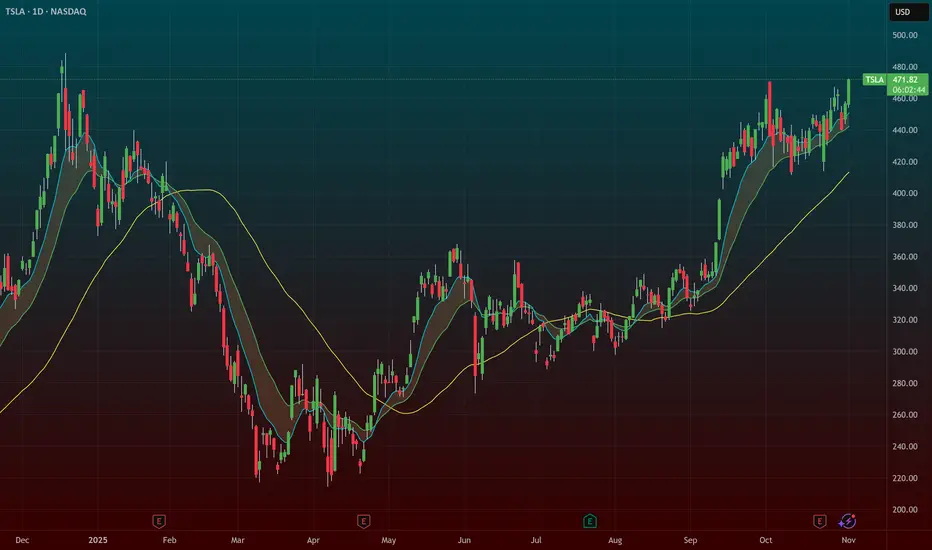
$TSLA – Breakout Setup Targeting ATHs → $500 ZoneTesla ( NASDAQ:TSLA ) looks ready for liftoff. After months of absorbing negative headlines and post-earnings volatility, it’s finally setting up for a major breakout that could take it back to all-time highs — and possibly the $500 level.
🔹 The Setup:
NASDAQ:TSLA has shaken off every piece of bad news — earnings, delivery headlines, margin fears — all absorbed without breaking trend.
The stock is now coiling under major resistance, and the tape is showing accumulation.
The narrative has flipped from “EV slowdown” to autonomous driving and robotics, giving the stock new life.
🔹 Why This Setup Has Juice:
It’s the last major leader yet to make a big move — the rotation setup is real.
Market sentiment is improving, and NASDAQ:TSLA is showing relative strength.
Volume expansion here could mark the start of the next major leg higher.
🔹 My Trade Plan:
1️⃣ Position: Added $500 calls (2 weeks out) at the open this morning.
2️⃣ Stop: If the stock goes under $450, I’m out — keeping risk tight.
3️⃣ Targets: First stop at ATHs, then a potential run toward $500 if momentum holds.
Why I Love This Chart:
The structure is perfect — long base, trendline reclaim, sector rotation lining up.
NASDAQ:TSLA has flipped from “bad news reaction” to “no sell reaction,” a clear sentiment shift.
Risk/reward is ideal here with a tight stop and clear upside roadmap.
Gold (XAUUSD) Pullback Analysis: Testing OB Before TargetsA potential trading setup based on concepts from Smart Money Concepts (SMC) or similar institutional methodologies.
Asset and Timeframe: XAU/USD (Gold Spot / US Dollar) on a 1-Hour (1H) timeframe.
Current Price: The price is hovering around $3,983.55.
Market Structure:
There's a recent Break of Structure (BOS), suggesting an upward bias or a shift in momentum to the bullish side.
The price is currently pulling back into a key zone.
Key Zones/Concepts:
OB (Order Block): The shaded gray area is identified as an Order Block. This is a zone where significant institutional buying/selling previously occurred, and the price is expected to react to it.
$$$ (Liquidity/Equal Lows): The three dollar signs indicate an area of liquidity or equal lows below the current price action. These are often targeted for a stop-hunt or liquidity grab before a significant move.
1H / BPR (Balance Price Range): The lower green box is labeled as a 1H / BPR. A Balance Price Range is a more refined area of support/demand, suggesting an even stronger reaction zone if the initial OB fails.
Projected Trade Scenarios: The dotted lines outline two primary possibilities:
Bullish Scenario (Solid Line): A bounce from the OB (Order Block) to hit Target 1 ($4,030.00).
Bearish/Liquidity Grab Scenario (Dotted Line): A drop below the OB to sweep the $$$ (Liquidity), potentially testing the 1H / BPR before a sharp reversal back up to Target 1 or even Target 2 ($4,050.00).
Strategy Inc (MSTR) – High-Beta Bitcoin Proxy at Key SupportStrategy Inc NASDAQ:MSTR has delivered another strong quarterly report, underscoring its continued commitment to aggressive Bitcoin accumulation. With over 158,000 BTC on the books, MSTR has firmly positioned itself as a leveraged proxy for Bitcoin, offering equity traders indirect crypto exposure. This bold balance sheet strategy has also pushed MSTR into alignment with S&P 500 inclusion criteria — a potential catalyst if index inclusion materializes.
Technically, the stock is now retesting a key support zone between $228 and $233. This level has historically held well and may offer a high-conviction entry for those anticipating a BTC rebound. Should Bitcoin aim for new highs, MSTR could respond with outsized upside, though traders must account for the volatility and downside risks that come with crypto-correlated equities.
🎯 Trade Setup:
Entry Zone: $228 – $233
Take Profit Targets: $360 and $535
Stop Loss: $198
This setup offers a high-risk, high-reward opportunity. As always, manage position size carefully and watch BTC price action for confirmation.
XAU/USD Daily Structure – Bullish Reversal Targeting BPR ZoneA potential bullish reversal after a recent pullback, aiming for a retest of higher price levels.
Prior Price Action: The price experienced a strong uptrend (sequence of large green candles) leading up to the mid-October high, followed by a sharp pullback (red candles) which broke below a previous low, labeled as BOS (Break of Structure). This BOS confirms a short-term bearish shift or the start of a deep correction within the larger uptrend.
Current Price Level: The price is currently near $4,008.10, having shown recent bullish momentum (the last green candle) off a recent swing low.
Key Levels and Concepts:
D/FVG (Daily Fair Value Gap): There are two Fair Value Gaps marked on the chart.
The lower D/FVG (around $4,000 - $4,060) acted as an initial target or point of interest during the decline. The price has started to move up from this area.
The upper D/FVG (around $4,170 - $4,220) represents a future potential target.
BPR (Balanced Price Range): This blue area (around $4,160 - $4,180) is an area where a previous down move's FVG overlaps with a subsequent up move's FVG (or vice versa), suggesting a zone where the market might find temporary balance or resistance/support.
Projected Path: The black arrow illustrates a bullish projection. The price is expected to continue its upward move, potentially targeting the lower D/FVG for a re-entry/retest before making its way towards the BPR and the upper D/FVG as the final target of this short-term analysis.
HYPEUSDT – Watching a Key Support Zone for Long SetupHYPEUSDT is currently pulling back and heading toward a major support area at $42–$43. This zone has historically provided strong buying interest and could act as a platform for a reversal. We’re closely watching this level for a potential long swing trade opportunity.
🛠 Trade Setup
Entry Zone: $42 – $43 (Support Area)
Take Profit Levels:
• TP1: $53
• TP2: $59
Stop Loss: $38 (Just below structure)
IONQ — Re-Accumulation Structure📈 IONQ — Re-Accumulation Structure Setting Up for Phase B Expansion
After completing a clear Phase A stopping action marked by the Selling Climax (SC) and Automatic Rally (AR), price action has confirmed a re-accumulation structure rather than a full distribution. The recent retest of the AR level occurred on notably reduced volume and lower implied volatility, suggesting that supply has been exhausted and that composite operators are absorbing shares rather than distributing them.
The Volume Profile (VRVP) shows a strong high-volume node between $56–$62, where demand has consistently stepped in. Below that zone, liquidity thins rapidly—indicating that this area represents a value base rather than a weak support. Meanwhile, successive tests of this range have produced higher lows on contracting downside volume, a hallmark of accumulation nearing its Phase B transition.
As the structure matures, a move to re-test the upper resistance near $83 would represent the Up-Thrust (UT) typical of Phase B, serving as a preliminary sign of strength before the eventual breakout (Phase C–D). With improving relative strength and declining volatility, the stock is poised for a measured $20 swing, aligning with a broader markup continuation once absorption completes.
In short: Low-volume retests + balanced profile + diminishing supply = classic Wyckoff re-accumulation dynamics.
UPS Breakout & Retest – Long Spot OpportunityNYSE:UPS has broken above the key $90 resistance level, indicating a potential shift in trend. This level may now act as support, offering a textbook retest setup. We’re watching closely for a pullback to confirm $88.00–$90.00 as a buy zone for a possible long entry.
🎯 Entry Zone: $88.00–$90.00
📈 Targets:
• TP1: $103.00–$111.00
• TP2: $122.00–$138.00
🔻 Stop Loss: Below $85.00
If price holds the $90 zone with bullish confirmation (volume, wick rejections, etc.), this could be a strong continuation setup. As always, risk management is key – keep an eye on broader market sentiment and earnings-related moves.