At Trendline Resistance — Pullback Before the Next Leg?BITSTAMP:BTCUSD is pressing into the descending trendline resistance after a strong impulsive rally. Momentum remains constructive, but price is now at a reaction area, where profit-taking and pullbacks are likely. The broader structure still favors continuation as long as higher lows are maintained.
The EMA cluster is rising and aligning with a strong demand zone, supporting a dip-buying framework rather than immediate reversal.
Resistance: 93,200 – 93,800 (trendline)
Support: 89,200 – 89,800 (strong demand)
EMA support: ~90,600
➡️ Primary: rejection at trendline → pullback into 89.2k–89.8k → higher low → continuation higher.
⚠️ Risk: clean breakout and acceptance above trendline opens extension toward new highs without a deep pullback.
Technical
Gold Nears $4,440 — Is This a Real Breakout or ........
OANDA:XAUUSD has extended its rebound aggressively, pushing into the $4,430–$4,440 area after a sharp recovery from the prior sell-off. The speed of the bounce is notable, but price is now approaching a technically sensitive zone where upside momentum historically begins to stall. At this stage, the market is no longer trading in “easy trend” conditions; instead, it is transitioning into a decision area where positioning matters more than direction.
Key Resistance and Price Reaction
The $4,400–$4,440 region is acting as a clear resistance band. This level previously served as a breakdown point and is now being retested from below — a classic role-reversal zone. The most recent candles show reduced follow-through and early signs of hesitation, suggesting that buy-side momentum is slowing as price runs into resting supply. Without a clean impulsive break and acceptance above this level, upside continuation remains questionable.
Gap Structure and Mean-Reversion Risk
Below current price lies a clearly defined inefficiency (GAP) zone, created by the impulsive upside move. Markets rarely leave such gaps unresolved, especially when they form after emotional rebounds. From a structural perspective, this gap represents unfinished business — an area where price may return to rebalance liquidity before choosing a sustained directional move. The highlighted “fill gap” area aligns well with prior consolidation, increasing its technical relevance.
Support Zone and Downside Scenarios
The broader support zone around $4,300 remains the key downside magnet. If price fails to hold above $4,400 and begins to roll over, a controlled pullback toward the gap is the first logical scenario. A deeper retracement into the $4,300 support zone would still be considered corrective rather than trend-breaking, as long as buyers defend that area with structure and volume.
Trend Structure Assessment
Despite the short-term pullback risk, the higher-timeframe structure remains constructive. Higher lows are still intact, and price continues to trade above major dynamic supports. However, from a professional trading perspective, this is no longer a location to chase longs. Risk-to-reward now favors patience — either waiting for confirmation above resistance or looking for reactions at lower, more favorable levels.
Technical Conclusion
Gold is currently at a crossroads. A clean breakout and acceptance above $4,440 would invalidate the gap-reversion thesis and open the door for continuation higher. Conversely, failure at this level increases the probability of a corrective move toward the gap and potentially the $4,300 support zone. Until one of these scenarios confirms, gold remains in a high-risk, low-conviction zone where discipline matters more than bias.
Climbing the Channel — ATH Is the MagnetOANDA:XAUUSD continues to trade inside a well-defined ascending channel, with price respecting both channel support and structure of higher highs – higher lows. Pullbacks remain shallow and are consistently absorbed, signaling sustained bullish control rather than exhaustion.
Momentum remains constructive as price holds mid-channel, keeping the focus on continuation toward the previous all-time high (OLD ATH) rather than a structural reversal.
Key Levels
Resistance: 4,525 → 4,550 (OLD ATH)
Support: 4,460 – 4,470 (channel support)
Structure invalidation: below 4,440
➡️ Primary: hold above 4,460 → grind higher → test 4,525, then OLD ATH.
⚠️ Risk: loss of channel support → deeper pullback toward 4,440 before trend reassessment.
Bitcoin Is Not Overextended — This Is a Structured Trend Hello everyone,
On the H1 timeframe, Bitcoin remains in a clean, well-respected bullish trend, and the current price action continues to validate trend continuation rather than exhaustion.
Market Structure Breakdown
The chart shows a clear ascending structure, defined by:
Higher highs and higher lows
Price consistently respecting the ascending trendline
Each pullback forming a rounded corrective base, followed by impulsive expansion
Every highlighted orange circle marks a successful reaction at trend resistance, which was later converted into support. This is a textbook example of break → accept → continue, not rejection.
Key Technical Observations
The impulsive leg from ~91,000 to above 92,800 was followed by tight consolidation, not aggressive selling.
Current candles are holding above the prior breakout level (~92,300), confirming acceptance, not a fake move.
Pullbacks remain shallow and overlapping, indicating buyers are in control and sellers lack follow-through.
Scenario Logic
The projected path is structurally sound:
Hold above 92,300 → continuation remains valid
Minor consolidation / flagging → fuel for expansion
Upside continuation toward 93,900, then 94,400+
Importantly, there is no distribution signature:
No sharp rejection from highs
No aggressive bearish displacement
No loss of trendline structure
Invalidation Conditions
This bullish continuation thesis only weakens if:
Price loses 92,300 with acceptance
Followed by a breakdown below 91,800, which would indicate a deeper corrective phase
Until then, any pullback is structural, not directional.
Conclusion
Bitcoin is not “too high” — it is doing exactly what a strong trend should do:
Break levels
Pause briefly
Continue higher
As long as price remains above the reclaimed supports and respects the rising structure, the path of least resistance remains upward.
Trade safe and stay disciplined.
Market Analysis & Reaffirmation of Trading PlanMarket Analysis & Reaffirmation of Trading Plan
- Today's market is moving exactly as planned yesterday. After a consolidation phase and absorption of liquidity around the 4.38x – 4.40x range, the price has clearly broken out, confirming the return of large capital flows. The market structure on the H4 timeframe has shifted to a higher high – higher low, indicating that the uptrend has been established and is being maintained.
- The price holding above the breakout zone not only reinforces the trend but also proves that following the structure was the correct choice. The current corrections are merely technical, serving to create more liquidity for the market to continue expanding its range.
Message to the community:
- The market is not random. When you correctly read the structure, identify the correct price zone, and patiently wait for confirmation, the advantage will automatically be on your side.
- A correct plan doesn't need fanfare The results are the clearest evidence of a leader's position.
TODAY'S LIMITED STRATEGY JAN 6
Intraday trading: Increase
📌 SET UP 1. Timming Sell Zone
XAUUSD SELL ZONE: 4517 - 4520
💰 Take Profit(TP): 4514 - 4509
❎ Stoploss(SL): 4524
Note capital management to ensure account safety
📌 SET UP 2. Timming Buy Zone
XAUUSD BUY ZONE: 4394 - 4397
💰 Take Profit(TP): 4400 - 4405
❎ Stoploss(SL): 4390
Note capital management to ensure account safety
Geopolitical Risk & GoldGeopolitical Risk & Gold
Geopolitical risk has risen sharply following the U.S. capture of Venezuela’s President Nicolás Maduro, increasing political uncertainty across Latin America and driving a broader risk-off tone in markets. Given Venezuela’s strategic role in energy and its ties to non-Western powers, the event may trigger secondary volatility across financial assets.
In this environment, gold continues to benefit as a primary safe haven. Historical precedents (e.g., Ukraine 2022, Crimea 2014) show that geopolitical escalation typically supports gold demand. This dynamic is reinforced by muted market confidence, with the Fear & Greed Index near 48 (neutral)—limiting appetite for risk assets and supporting short-term flows into gold.
Gold Technical Outlook (XAU/USD)
Trend: Dominant bullish structure intact since late August 2025; no meaningful corrective selling to threaten the trend.
Momentum:
RSI holding above 50 → bullish momentum remains dominant.
MACD bullish crossover with histogram above zero → short-term momentum has turned positive.
$4,546 – Major resistance (ATH). A sustained break could accelerate upside.
$4,300 – Neutrality/near-term reference zone.
$4,200 – Critical support (near 50-SMA). A break would risk the bullish structure into early 2026.
Bottom line: Elevated geopolitical tension and neutral confidence conditions support continued demand for gold, with the prevailing bias remaining bullish while key supports hold.
H4 US Dollar Index (DXY) – Technical AnalysisThe US Dollar Index (DXY) is trading near 98.70 on the 4H chart, and it’s looking like it’s going to continue its recovery within that rising channel from the low at 97.75. Price has managed to take back the 50% Fib level at 98.24 and is now testing the resistance at 98.74 – which just so happens to be where a prior support level used to be.
The 200-EMA at 99.00 is a big deal as far as upside goes, while the supports sit at 98.12 and 97.9. RSI is sitting at 58, which is a pretty good sign. The trade idea is to pick up a few dollars on the dip near 98.30 and aim for 99.20, but set a stop loss below 97.95.
the Fed faces another slew of challenges in the year aheadThe Federal Reserve heads into 2026 facing a slew of political and policy challenges, headlined by a new chair and an economy fed by both tailwinds and headwinds that will make policymakers’ choices all the more important.
Coming off three consecutive interest rate cuts, the central bank is expected to follow a more tepid path for the year ahead in which additional cuts could be hard to come by considering expectations for solid growth and ongoing inflation pressures.
One thing does seem certain: After a year of extraordinary upheaval surrounding the Fed, 2026 looks to offer more of the same.
“I do think there’ll be a big spotlight. There’ll be lots of intrigue,” said Kathy Bostjancic, chief economist at Nationwide. “There’s still a lot of uncertainty that keeps the Fed in the spotlight, and probably in the hot seat too.”
The previous year saw the Fed come under that spotlight in ways that it never had before.
As he started his second term at the White House, President Donald Trump repeatedly threatened to fire Fed Chair Jerome Powell for not being quicker to push for interest rate cuts. Around mid-year, the Fed came under fire again, this time for cost overruns at a renovation project it had undertaken at its Washington headquarters.
In between, Trump tried to remove Governor Lisa Cook over allegations — as yet unproven and not even brought as formal charges — that she committed mortgage fraud. That all came against a backdrop of who would succeed Powell as chair when his term expires in May, with as many as 11 candidates considered during an interview process led by Treasury Secretary Scott Bessent.
If all that sounds exhausting, consider that 2026 begins with a Supreme Court hearing scheduled for Jan. 21 to decide whether Trump has the authority to remove Cook. A week later, the Federal Open Market Committee holds its interest rate vote. At some point during the month, Trump is expected to unveil his choice for Fed chair. And Powell, cagey on the issue so far, also will have to disclose whether he plans on serving out his term on the Board of Governors that runs until January 2028.
There also have been multiple dissents at recent rate votes, and new regional presidents set to come on board at the FOMC have a hawkish bent, meaning they’re likely to resist additional cuts.
“It’s still a tough spot for the Fed,” Bostjancic said.
Focus on policy
Still, when it comes to policy, most on Wall Street expect the Fed to put the noise in the background and continue down the road of lowering its benchmark interest rate just a bit more until it gets closer to a neutral level around 3%. Neutral is considered a spot that neither boosts nor holds back economic activity, and the funds rate is just half a percentage point above where most on the FOMC see the rate landing over the long term.
“Chair Powell helped orchestrate three 25-basis-point rate cuts in a row. It’s not as if he was standing in the way of the FOMC cutting rates,” Bostjancic said. As far as further cuts go, “For us, it’s the economic data.”
Bostjancic sees the data pointing to two cuts this year, one around mid-year and another toward the end. The Fed’s “dot plot” grid of expectations indicates just one cut, while outliers such as Moody’s Analytics chief economist Mark Zandi and Citigroup seeing labor market weakness pointing to three.
Powell and his colleagues have stood by the notion that they won’t be bullied into cuts and indeed will be guided by data.
Torsten Slok, chief economist at Apollo Global Management, thinks the economy will be too strong for the Fed to cut much more, seeing just one reduction ahead.
“The issue is that the winds are really changing for the U.S. economy,” Slok said during a CNBC interview Friday.
Whereas 2025 saw headwinds of tariffs, inflation and a general air of uncertainty, fiscal stimulus and a stabilizing labor market will be pushing on growth, he said.
“It is, in my view, looking like more that the tailwinds are beginning to accumulate and making it more difficult for the Fed to cut rates this year,” Slok added.
The role of AI
One wildcard will be the role that artificial intelligence plays on economic growth.
Seen as both a productivity enhancer and a potential impediment to hiring, assessing the impact AI is having on the economy will be paramount for the Fed, said Joseph Brusuelas, chief economist at RSM.
“The Fed this year has got a real challenge in terms of communicating their strategy,” Brusuelas said. “We have this massive investment flowing into very sophisticated technologies, and the Federal Reserve is going to need to communicate their basic view on what this means.”
After sputtering at the beginning of 2026, the economy grew rapidly in the middle two quarters and is on pace to accelerate at a 3% pace in the fourth quarter, according to preliminary data from the Atlanta Fed.
In addition to helping push along the broader economy, AI-related stocks were a key highlight of another stellar year on Wall Street that saw major averages post double-digit increases.
Calibrating monetary policy in that kind of environment will be tough, Brusuelas said.
“They’re going to need to provide strategic direction for the central bank at a time when the economy is clearly pivoting towards the integration of this sophisticated technology in the production of goods and provision of services,” he said. “This is a really big potential pivot around policy that needs to happen.”
Ethereum Is Pressing the Ceiling — Breakout or Final Rejection Hello everyone,
On the H1 timeframe, the key focus right now is not chasing upside, but evaluating how Ethereum is behaving at a critical resistance cluster after a well-structured recovery. Price has already done the hard work on the downside; the market is now at a decision point.
After the sharp sell-off into the 2,900–2,920 support zone, ETH formed a clean base and transitioned into a step-by-step recovery, printing higher lows and reclaiming multiple intraday levels. The advance has been orderly and controlled, not impulsive — a sign that buyers are rebuilding positions rather than FOMO buying.
Structurally, price has now pushed into the 3,020–3,035 resistance zone, which has historically capped upside. The current candles are reacting directly at this level, confirming it as active supply, not a level the market can ignore. This is exactly where we expect hesitation, consolidation, or a rejection attempt.
From a price action perspective, two valid scenarios are visible directly on the chart:
- Primary scenario: a shallow pullback toward the 3,000–3,010 area to retest demand, followed by another push higher. Acceptance above 3,035–3,050 would confirm a breakout and open the door toward 3,070–3,100.
- Alternative scenario: failure to hold above reclaimed levels, leading to a deeper pullback toward 2,970–2,990, where buyers would need to step in again to keep the bullish structure intact.
Importantly, there is no distribution pattern yet. Pullbacks remain corrective, candles overlap constructively, and price continues to hold above prior breakout levels. That keeps the bias constructive, but not confirmed.
In short, Ethereum is not late, and it is not guaranteed. It is compressing at resistance, and the next few H1 closes will determine whether this move resolves into acceptance and expansion, or a final rejection and reset.
Wishing you all effective and disciplined trading.
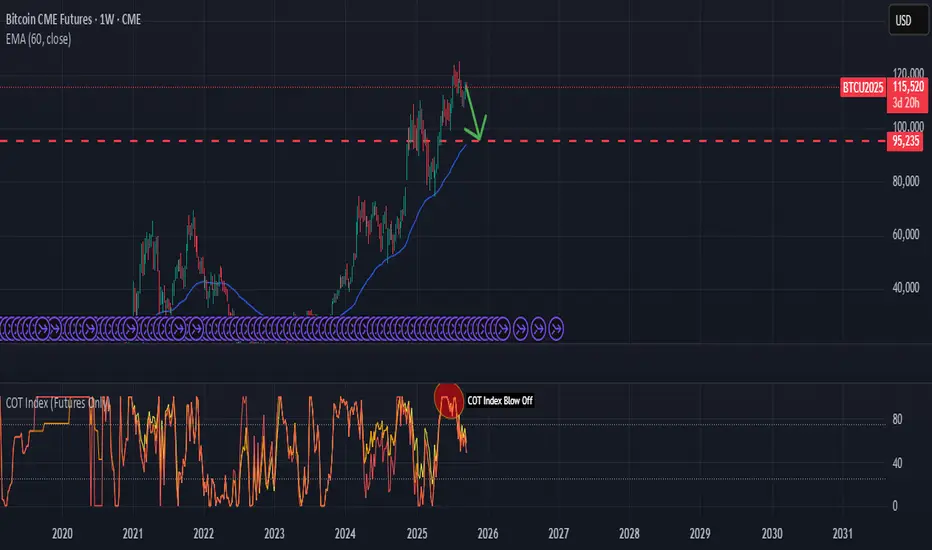
Bitcoin Blow-Off TopBitcoin is showing signs of exhaustion after a strong rally into the $120k region. On the weekly timeframe, several signals point toward a potential corrective leg lower:
📊 Key Technicals
Major Supply Zone: $115k–$120k area has acted as resistance, with sellers defending this level.
Trend Structure: Price has broken momentum after the blow-off move and is now trading below recent highs.
EMA Support: Price is extended above the EMA 60 (94k), leaving room for mean reversion.
COT Data: Commercials are heavily net short with a COT Index blow-off signal, indicating distribution from strong hands to weak hands.
🎯 Trade Thesis
The risk-reward favors the short side from current levels.
Initial downside target sits at the $95k region (prior resistance turned support + EMA alignment).
A break of that level could open the door toward the $80k handle in the medium term.
📌 Plan
Entry: 114k–116k
Stop: Above 120k
Targets:
TP1: 95k
TP2: 80k
💡 This setup combines market structure, supply zone rejection, and institutional positioning via COT. The technical picture suggests Bitcoin is vulnerable to a deeper pullback before any further sustainable rally.
Ethereum Is Not Ready to Rally — This Is a DistributionHello everyone,
On the H1 timeframe, the key focus right now is not upside continuation, but the fact that Ethereum is stalling below a well-defined resistance zone after a completed impulsive move. The current price action suggests distribution and rebalancing, rather than the start of a new bullish leg.
After the strong impulsive rally that pushed ETH sharply above 3,000, price was rejected from the upper resistance near 3,030, triggering a fast corrective sell-off. That initial drop was aggressive and directional, signaling that buyers who entered late were forced to exit. Since then, ETH has recovered partially but has failed to regain acceptance inside the resistance zone around 2,980–3,000.
From a structural perspective, the market is now printing lower highs beneath resistance, with price compressing in the middle of the range. This behavior indicates that upside momentum has weakened and that buyers are no longer in control. The consolidation here is not constructive it is occurring below resistance, which favors another leg lower rather than a breakout.
Technically, the current structure aligns with a bearish corrective sequence. The sideways-to-lower drift suggests that ETH is building a base for continuation down toward the 2,900–2,880 support zone, which has acted as a demand area previously. The projected path on the chart reflects this logic clearly: a shallow bounce, followed by renewed selling pressure into support.
Resistance zone: 2,980–3,000 — repeated rejection, sellers active.
Major resistance: ~3,030 — prior impulse high and supply.
Support zone: 2,880–2,900 — next area where buyers may step in.
Only a clean breakout and sustained acceptance above the 3,000–3,030 resistance would invalidate this pullback scenario and reopen bullish continuation. Until that happens, ETH remains in a post-impulse correction phase, where downside tests are more likely than upside expansion.
Wishing you all effective and disciplined trading.
Decision Point — Bounce or Breakdown?EURUSD is trading at a key decision area after a sustained decline from the upper range. Price is now approaching the mid-range support, with momentum slowing, suggesting the market is preparing for either a reaction bounce or continuation lower.
The broader structure remains range-bound, with price capped below the 1.1800–1.1810 resistance zone and buyers historically stepping in near the lower boundary.
Resistance: 1.1800 – 1.1810
Support: 1.1700 – 1.1710
Decision zone: 1.1730 – 1.1740
➡️ Primary: hold above 1.1700 → corrective bounce → rotation back toward 1.1760–1.1780.
⚠️ Risk: clean break below 1.1700 → continuation toward the lower support zone before stabilization.
EUR/USD Is Not Trending — This Is a Controlled Liquidity RangeMarket Analysis (EUR/USD – H1)
EUR/USD is currently trading inside a well-defined sideways range, with price repeatedly rotating between support around 1.1760–1.1770 and resistance near 1.1804, while the upper extension at 1.1819 remains untouched. The structure is clear: lower highs capped by resistance and consistent demand absorption at support, signaling balance rather than directional conviction.
From a technical perspective , the repeated rejections at 1.1804 confirm the presence of resting sell liquidity, while buyers continue to defend the support zone aggressively, preventing a breakdown. Volume remains relatively stable without expansion, reinforcing that this is range rotation driven by liquidity sweeps, not trend continuation.
Macro-wise, EUR/USD remains sensitive to USD yield stability and expectations around Fed policy normalization. With no fresh catalyst shifting rate differentials, price action reflects indecision and positioning cleanup, not a new macro leg. Until either USD strength accelerates or Euro demand improves via data surprise, this range is likely to persist.
Key takeaway:
As long as price holds above 1.1760, downside remains limited. However, a clean breakout above 1.1804–1.1819 with volume is required to unlock bullish continuation. Until then, EUR/USD remains a mean-reversion environment, favoring patience over prediction.
EURUSD Is Coiling — One Clean Break Will Decide the Next MoveEURUSD (1H)
1) Market Structure
Price is in a sideways accumulation range after a prior bullish leg.
Repeated higher reactions from the same base indicate buyers are absorbing supply near support.
Upper wicks near 1.1800+ show sell pressure overhead → market needs a clean break to expand.
2) Key Levels
Support Zone: 1.1760 – 1.1770
Structural base of the range. Holding this zone keeps bullish scenarios valid.
Target 1 / Resistance: 1.18040
First breakout trigger. Needs a clear H1 close above to confirm strength.
Target 2 / Resistance: 1.18197
Range ceiling. Acceptance above this level confirms a true breakout.
3) Trading Scenarios
Scenario A (Preferred): Buy from Support
Condition: Price sweeps 1.1760–1.1770 and reclaims 1.1775–1.1780 with rejection.
Targets:
TP1: 1.18040
TP2: 1.18197
Scenario B (Breakout Buy):
Condition: H1 close above 1.18040, followed by a shallow pullback holding above 1.1800.
Target: 1.18197, then reassess for extension.
Invalidation:
A clean H1 close below the support zone invalidates bullish structure and opens downside risk.
4) Macro Drivers to Watch
USD strength: Rising US yields, hawkish Fed tone, strong US data → EURUSD capped or pushed lower.
EUR strength: ECB staying restrictive, improving Eurozone data, risk-on sentiment → supports breakout.
High-impact catalysts: CPI, PCE, NFP, PMI, FOMC/ECB speeches, and moves in DXY & US10Y.
Breakout Ahead or Another Trap Inside the $85K–$90K Range?Bitcoin is currently trading inside a well-defined consolidation range between $85,000 and $90,000, and the latest price action confirms that this zone remains highly respected by both buyers and sellers. On the 1H timeframe, price was aggressively pushed into the upper boundary near $89,500–$90,000, but the immediate rejection shows that sell-side liquidity and profit-taking are still concentrated at this resistance zone. This behavior is typical of a mature range market, where impulsive moves toward the extremes are often faded unless strong follow-through volume appears.
From a technical structure perspective, Bitcoin has failed to establish a clean series of higher highs above resistance. Instead, the market continues to print range highs with weak continuation, while the EMA 34 and EMA 89 remain relatively flat, reinforcing the sideways environment. The lack of trend expansion indicates that momentum is being absorbed rather than extended. As long as price remains below the $90,000 supply zone, upside attempts should be treated as range tests, not trend breakouts.
On the downside, the $86,000–$85,500 support zone remains the key level to monitor. This area has repeatedly attracted buyers and represents the lower liquidity pool of the range. The projected move on the chart suggests that, after rejection from resistance, price may rotate lower toward this support zone to rebalance liquidity. A reaction from this area would likely result in another mean-reversion move back toward mid-range or resistance, keeping the market rotational rather than directional.
From a macro standpoint, Bitcoin is currently lacking a strong catalyst to break out decisively. U.S. macro data remains mixed, with Federal Reserve rate-cut expectations still uncertain, keeping risk assets in a cautious state. Liquidity conditions are stable but not expanding aggressively, which aligns with Bitcoin’s current consolidation rather than trend acceleration. Without a clear shift in monetary policy expectations or ETF inflow momentum, the market is more likely to continue respecting this range.
In conclusion, Bitcoin remains neutral and range-bound, not bearish but also not yet bullish. Traders should remain disciplined, focusing on selling near resistance and buying near support until a confirmed breakout occurs. A daily close above $90,000 with strong volume would invalidate the range and open the door toward higher targets. Until then, patience is key, the market is building structure, not direction.
ETH/USD – H1 Technical Analysis DetailETH/USD – H1 Technical Analysis
Ethereum has just delivered a strong impulsive breakout from the consolidation structure around 2,950–2,980, pushing price decisively above the prior balance area and reclaiming the psychological $3,000 level. This move is technically significant because it comes after an extended period of compression, where liquidity was building on both sides of the range.
From a structure perspective, ETH has flipped the former resistance zone around 2,980–3,000 into a new support zone. The impulsive bullish candle was accompanied by a clear volume expansion, confirming that this was not a false breakout but rather active participation from buyers. As long as price holds above this reclaimed support, the bullish structure remains intact.
The next key levels are clearly defined:
Immediate support: 2,980–3,000
Resistance 1: ~3,033
Major resistance: ~3,073
A healthy pullback into the 3,000 zone would be structurally bullish, allowing the market to build a higher low before attempting continuation toward 3,030 → 3,070. A clean break and acceptance above 3,073 would open the door for a broader upside expansion on higher timeframes.
On the macro backdrop, ETH is benefiting from a stable risk-on environment, with crypto sentiment supported by expectations of easier monetary conditions in 2026, declining US real yields, and continued institutional positioning in large-cap digital assets. As long as Bitcoin holds its higher range and the USD remains capped, Ethereum retains upside potential.
Conclusion:
This is no longer a range trade. ETH has shifted into a bullish continuation phase, with pullbacks likely to be corrective rather than trend-reversing. The market now favors buying dips above $3,000, not chasing breakouts blindly, while respecting that failure back below 2,980 would invalidate the bullish scenario.
This Resistance Test Will Decide the Next 10% MoveETH/USD – 1H Market Analysis
Ethereum is currently locked in a clear range structure, trading between a major support zone around 2,880–2,920 and a well-defined resistance zone near 3,060–3,120. Price has already tested both extremes multiple times, confirming that this is not a trending environment yet, but a controlled consolidation where liquidity is being built.
From a structural perspective, ETH is forming repeated higher lows inside the range, while sellers continue to defend the resistance zone aggressively. This behavior reflects compression, not weakness. The market is balancing orders, shaking out impatience, and preparing for expansion rather than reversing impulsively.
Forward Scenarios to Watch:
Primary scenario (Higher probability): Another pullback toward the mid-range or support zone, followed by a rotation higher and a renewed test of resistance.
Bullish continuation: A clean hourly close above 3,120 with acceptance opens upside toward 3,200–3,280.
Bearish invalidation: A decisive breakdown below 2,880 would shift the structure bearish and target the lower demand zone.
Bottom line:
Ethereum is not breaking out yet it’s compressing. This is the phase where smart money positions quietly, while reactive traders get chopped. The breakout will come, but only after liquidity has been fully harvested. Patience remains the edge.
“Gold Is Not Overextended — This Is Controlled Accumulation CURRENT MARKET ANALYSIS & TODAY’S TREND
Gold (XAUUSD) – H1
Market Context
Gold continues to maintain a dominant bullish trend on the H1 timeframe. Following the Wyckoff accumulation process (Phase B), price has shown clear absorption behavior, breaking above the previous equilibrium area. This confirms that smart money remains in control of the trend.
Structure & Technical Perspective
Price is developing a continuation impulsive structure, where corrective legs (2) and (4) remain purely technical and do not damage the bullish framework.
The market stays above key moving averages, validating sustained upside momentum.
The 4.46x – 4.47x zone is acting as a dynamic support area. As long as price holds above this region, bullish strength remains intact and continuation pressure builds.
Today’s Scenario
Primary bias: BUY with the trend.
Focus on pullback entries, not chasing highs.
If momentum persists, the market is positioned to extend toward the 4.57x zone and beyond.
Only a clear breakdown below the lower support zone would require reassessing the bullish outlook.
Market Conclusion
Main Trend: UP
Market State: Re-accumulation within a strong bullish cycle
Strategy: Follow the trend, execute patiently, manage risk strictly
Gold is not distributing — it is absorbing supply and preparing for the next leg higher.
TODAY’S LIMITED STRATEGY — DEC 24
Intraday Bias: Re-accumulation
📌 SETUP 1: Timing Sell Zone (Counter-trend scalp)
SELL ZONE: 4576 – 4579
TP: 4573 – 4568
SL: 4583
Short-term reaction trade only. Strict risk control required.
📌 SETUP 2: Timing Buy Zone (Trend-following)
BUY ZONE: 4430 – 4433
TP: 4436 – 4441
SL: 4426
Preferred setup — aligns with the dominant bullish structure.
Final Note:
Stay disciplined. Trade in alignment with structure, respect risk management, and let the market confirm continuation rather than forcing entries.
USD/JPY(20251224)Today's AnalysisMarket News:
The US economy expanded at a rate of 4.3% in the third quarter, the fastest growth in two years, but the US consumer confidence index declined for the fifth consecutive month.
ADP Weekly Employment Report: In the four weeks ending December 6, 2025, private sector employers added an average of 11,500 jobs per week.
Trump: Those who disagree with him will never become Fed Chair. Next Fed candidate Hassett: Predicts monthly job growth may return to 100,000+, and the Fed is far behind the times on interest rate cuts.
Technical Analysis:
Today's Buy/Sell Threshold:
156.30
Support and Resistance Levels:
157.71
157.18
156.84
155.76
155.42
154.90
Trading Strategy:
If it breaks above 156.30, consider buying, with a first target price of 156.84.
If it breaks below 155.76, consider selling, with a first target price of 155.42.
USD/JPY(20251218)Today's AnalysisMarket News:
Ben Waller, one of the final candidates for the next Federal Reserve Chair and current Governor, said on Wednesday that the current job market is "very weak" and job growth is "not optimistic," therefore the Fed still has room to cut interest rates. He supports further rate cuts to restore the central bank's interest rate setting to a neutral level, while stating that policymakers do not need to rush into doing so.
Speaking at the Yale University CEO Summit, Waller noted that the Fed's current interest rate is 50 to 100 basis points higher than the neutral rate, but he emphasized that "aggressive action is not needed" and that rate cuts can continue "at a moderate pace."
Waller stated that "the job market indicates the Fed should continue cutting rates," while also assuring that "we are not seeing a cliff-like drop in the job market."
Technical Analysis:
Today's Buy/Sell Threshold:
155.30
Support and Resistance:
156.52
156.06
155.77
154.83
154.54
154.08
Trading Strategy:
If the price breaks above 155.77, consider buying, with a first target price of 156.06.
If the price breaks below 155.30, consider selling, with a first target price of 154.83.
BTCUSD: Bearish Trend Confirmed with Downside TargetsAs per the updated analysis, BTCUSD has reversed its previous bullish momentum and is now poised for a downtrend toward lower targets. The chart shows a well-defined resistance zone at 91,563, where price has started to recoil and move lower.
🔹 Market State: Bearish Reversal Confirmed
BTCUSD has now entered a consolidation phase below the resistance zone, with price rejecting the higher levels around 91,563.
The market is setting up for a downside continuation with clear price action signals. The move lower has already begun, and targets are positioned around 89,200 (Target 1), 88,000 (Target 2), and 86,386 (Target 3).
🔹 Macro Factors Driving the Decline:
1. Risk-Off Sentiment Prevails
Yesterday's decline can be attributed to the broad market risk-off sentiment. Concerns about global economic uncertainty, geopolitical tensions, and weaker-than-expected economic data are pressuring risk assets like Bitcoin.
2. Strong USD and Profit-Taking
The US dollar’s strength has been a key factor in BTC's retreat. As the dollar rises, investors typically retreat to more secure assets, causing Bitcoin and other risk assets to experience declines.
Profit-taking after Bitcoin's recent surge also contributed to the market's downward movement.
3. Fed Rate Expectations
Fed's hawkish stance (with interest rates possibly staying higher for longer) is placing further pressure on risk assets, making them less attractive to investors. This also increases the capital inflow into USD and dampens demand for Bitcoin.
4. Macro Data Weakness
Poor economic indicators such as reduced job growth or disappointing inflation figures could contribute to the broader market decline. The weak economic data creates more uncertainty, prompting liquidation of higher-risk assets.
🔹 Price Expectations and Targets:
Resistance Zone: 91,563 (Key Rejection Point)
Target 1: 89,200
Target 2: 88,000
Target 3: 86,386
As long as price remains below 91,563, the bearish continuation setup is intact, and the market is expected to decline towards Target 1, then Target 2 and Target 3.
Gold Holds Steady as Traders Position Ahead of Key Fed Outlook🔹 MARKET BRIEFING – XAU/USD (4H)
Market State:
– Price is holding above short-term support and consolidating sideways, with momentum still leaning toward the buyers.
Key Levels:
– Support: 4164
– Resistance: 4264
– Breakout Zone: 4300–4340
Next Move:
– Bullish momentum remains in control; a breakout above 4300 would open the path toward 4340 and 4380.