GBPJPY Gearing Up for a New Bullish Wave?If we were to describe GBPJPY at this moment, it would be the picture of a market gathering momentum to climb higher . After a mild pullback, the macro backdrop still leans toward further upside: the JPY continues to weaken as risk-aversion eases, while the GBP remains supported by a stable economy and higher interest rates . This combination forms a solid foundation for the current recovery phase.
Looking at the 4H chart, the uptrend is clearly intact with an ascending trendline that has been respected consistently since early November. Each touch of this trendline has triggered strong buying pressure — a clear sign that bulls are still in control . Most recently, price has bounced again from the 205.6 support confluence , aligning perfectly with the trendline and the nearest support zone.
With the current structure, the primary scenario remains bullish. Price is likely to consolidate slightly above the trendline before moving toward the 207.3 resistance — the next key target of the trend. If buying pressure stays firm, GBPJPY could even extend higher toward 207.8–208.0.
Only a break below 205.5 and a candle close under the trendline would threaten the bullish outlook. But for now, market flow continues to favor the buy side, and every pullback still presents an opportunity to observe the potential continuation of the uptrend .
Technical Analysis
Fed Turns Dovish – Is the Euro Taking the Throne?In the current environment, the market is expecting the Fed to become increasingly dovish , while the ISM Manufacturing PMI—though forecasted to rise slightly—remains below the 50 mark . This indicates that the U.S. manufacturing sector is still not strong enough to support the USD. As a result, the dollar struggles to generate sustainable bullish momentum, unintentionally giving stronger support to the euro . From a sentiment perspective, as long as the data isn’t overly positive for the USD, capital flow will continue to favor EURUSD.
Looking at the H4 chart, the bullish structure is clear: price keeps forming higher lows , respecting the ascending trendline, and trading above the Ichimoku cloud — all signs that the primary trend remains bullish. The 1.1560 zone, aligned with both the trendline and the top of the cloud, acts as critical support , while 1.1650 stands out as the natural upside target for the current bullish wave.
My preferred scenario: EURUSD may make a small pullback toward 1.1560–1.1580 to retest support before bouncing higher toward 1.1650. As long as price stays above the trendline and doesn’t break below 1.1560, I continue to view this market as leaning strongly toward buying rather than selling.
In summary, with news flow putting pressure on the USD and technical structure supporting the bulls, the short-term trend for EURUSD remains decisively bullish .
GBPUSD Set to Break Higher: Buyers Take Back Control!If I had to pick one currency pair that is “warming up” in the most positive way, GBPUSD would easily be the standout . The news is lining up behind the British pound, and the technicals are opening the door for another bullish leg — everything is aligning perfectly for buyers.
From a news perspective, the market reacted positively to the UK’s Autumn Budget , with the OBR noting that the new fiscal plan helps reduce financial-risk pressure . This strengthens confidence in GBP. Meanwhile, the USD continues to weaken as expectations grow that the Fed may cut rates — a factor that makes it difficult for the dollar to stage a strong recovery. When one currency weakens due to fundamentals, the opposing currency — in this case the pound — naturally gains room to rise.
On the H4 chart, the bullish structure is very clean : price is moving inside an ascending channel, printing higher lows, and consolidating above the Ichimoku cloud — a highly important bullish signal. The 1.3170 zone is a confluence of horizontal support and the cloud’s lower boundary, making it an ideal area for a mild pullback before a continuation move. Above, the 1.3260 region stands as the nearest swing high and the most natural target for the next bullish wave.
My preferred scenario: GBPUSD may dip slightly toward 1.3170 to retest support, then gradually bounce and move upward toward 1.3260 following the channel structure. As long as price holds above 1.3170 and does not close an H4 candle below the cloud, I will continue to prioritize BUY setups , rather than attempt counter-trend sells.
DOGE — WEEK 49 TREND REPORTBINANCE:DOGEUSDT — WEEK 49 TREND REPORT
Ticker: BINANCE:DOGEUSDT — 12/03/2025 @ 0.15$
Timeframe: WEEKLY
This is a reactive structural classification of CRYPTOCAP:DOGE based on the weekly chart as of this timestamp. Price conditions are evaluated as they stand — nothing here is predictive or forward-assumptive.
⸻
1) Current Trend Condition
• Trend Duration: +7 weeks (Bearish)
• Trend Reversal Level (Bullish): .018$
• Trend Reversal Level (Bullish Confirmation): 0.20$
• Structural Support: 0.28$
⸻
2) Structure Health
• Retracement Phase:
Breakdown (establishing price beneath 38.2%)
• Position Status:
Unstable (price below both structural layers)
⸻
3) Temperature :
Cooling Phase
⸻
4) Momentum :
Bearish
⸻
Author’s Note
This analysis is fully reactive, not predictive. Market conditions, trend structure, and behavior are classified as they appear in real time. The objective is to identify where directional shifts first occurred, where structural integrity remains intact, and where it would begin to weaken if key levels were breached.
Predictive analysis projects outcomes that do not exist yet. Without price confirmation, prediction is built on baseless assumptions. This framework avoids that entirely by responding only to verified structural changes and live conditions.
The levels shown simply identify where the current trend structure first shifted and where it would begin to lose integrity if breached. Recognizing these boundaries allows for clearer interpretation of market behavior without relying on forward guarantees, speculative projections, or unsupported assumptions.
⸻
Methodology Overview
This classification framework evaluates directional conditions using internal trend-interpretation logic that references price behavior relative to its structural layers. These relationships are used to identify when price movement aligns with the framework’s criteria for directional phases, transition points, or regime shifts. Visual elements or structural labels reflect these internal interpretations, rather than explicit trading signals or preset indicator crossovers. This framework is observational only and does not imply future outcomes.
Bank Of America Is Eyeing All-Time Highs From 2006Bank of America is one of the largest banks in the world, serving millions of consumers, businesses, and institutions. It has a broad mix of operations — consumer banking, wealth management, corporate banking, and global markets — which helps keep its earnings stable. The bank has been heavily investing in digital services and technology, aiming to improve efficiency and customer experience. Its size and global reach make it a key player in the U.S. and global financial system.
Bank of America is in an uptrend with a very strong rebound since April 2025, and the price is now approaching the 2006 highs. That area around 55 is extremely important because the current structure looks like an ending diagonal in wave five, meaning we could be in the late stages of a higher-degree bullish cycle. The push up this year also comes out of a very big triangle on the monthly chart, so despite the positive momentum, we should be aware that resistance is getting closer and bullish momentum may slow down. We also see RSI divergence on the daily chart, which is very common when diagonals mature. So while the trend is still up for now, it makes sense to be careful around 55, as a potential reversal in 2026 would not be a surprise.
Highlights:
Trend: Bullish but late-stage (ending diagonal risk)
Resistance: 55-56 area (2006 high)
Invalidation of a bull trend: broken trendline support
Note: Watch RSI divergence and respect the 55/56 zone as potential exhaustion of wave five
MarketBreakdown | USDJPY, EURCAD, Dollar Index, US30
Here are the updates & outlook for multiple instruments in my watch list.
1️⃣ #USDJPY daily time frame 🇺🇸🇯🇵
Correctional movement continues.
The price now formed a falling parallel channel - a bullish flag.
A bullish breakout of its resistance and a daily candle close above
will confirm a completion of a correction and a resumption
of a long-term uptrend.
2️⃣ #EURCAD daily time frame 🇪🇺🇨🇦
The market is in a deep consolidation.
The price is stuck within a wide horizontal range on a daily
for more than a month.
We can expect a bullish continuation to a resistance of the range.
A bearish movement will most likely follow from that.
3️⃣ Dollar Index #DXY daily time frame $
The market reached a significant daily horizontal support cluster.
Due to its historic importance, there is a high probability
to see a pullback from that.
4️⃣ DOW Jones Index US30 daily time frame
The market continues coiling alongside a recently broken
trend line that turned into a strong vertical resistance now.
There is a high probability that we will see a stronger retracement
from that and a bearish movement.
Do you agree with my market breakdown?
❤️Please, support my work with like, thank you!❤️
I am part of Trade Nation's Influencer program and receive a monthly fee for using their TradingView charts in my analysis.
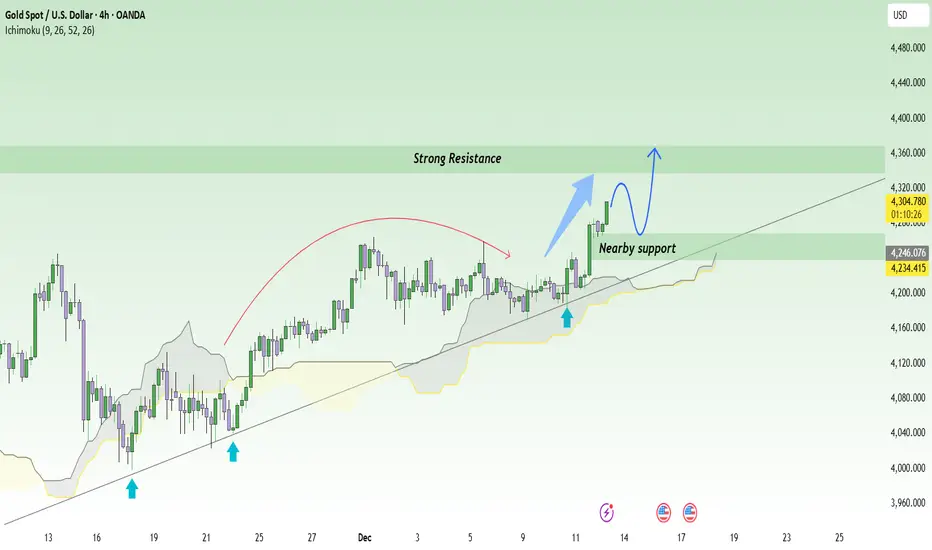
GOLD (XAUUSD): Updated Support & Resistance Analysis
Here is my latest support and resistance analysis Gold.
Vertical Structures:
Vertical Support 1: Rising trend line
Horizontal Structures
Support 1: 4164 - 4172 area
Support 2: 4080 - 4132 area
Support 3: 3996 - 4045 area
Support 4: 3869 - 3930 area
Resistance 1: 4230 - 4264 area
Resistance 2: 4359 - 4382 area
Consider these structures for pullback/breakout trading.
❤️Please, support my work with like, thank you!❤️
I am part of Trade Nation's Influencer program and receive a monthly fee for using their TradingView charts in my analysis.
TradeCityPro | COMPUSDT Ready for a Long Setup!👋 Welcome to TradeCityPro!
Let’s dive into the analysis of COMP, one of the active DeFi tokens that has recently been seeing a noticeable increase in its 24-hour trading volume — making it worth paying attention to.
🌐 Bitcoin Overview
Before we begin, let me remind you once again that at your request, we’ve moved the Bitcoin analysis section to a dedicated daily report — allowing us to analyze Bitcoin’s trend, dominance, and overall market sentiment in greater depth each day.
On the daily timeframe, after the sharp decline that broke $39.58, the price dropped toward the major support at $28.52.
Price was supported from that level, and despite several attempts to break below it, the zone held strong — leading to a bounce and eventually a breakout of the daily trendline.
Currently, price is sitting just below the trendline trigger.
Since this trendline break is part of a reversal structure, we still need confirmation.
A break above $39.58 would provide a clear long trigger and open the way for bullish continuation.
However, if you have entered a position anywhere within this range, it’s best to place your stop-loss below the $28.52 support zone, and manage your risk accordingly.
📝 Final Thoughts
Stay calm, trade wisely, and let's capture the market's best opportunities!
This analysis reflects our opinions and is not financial advice.
Share your thoughts in the comments, and don’t forget to share this analysis with your friends! ❤️
Is the Aussie Awakening a Mirage?The Australian Dollar is staging a formidable recovery, driven by a stark divergence in central bank leadership and shifting geopolitical tides. As the pair approaches the critical 0.6600 resistance, we analyze the multi-domain factors fueling this ascent.
Geopolitics & Geostrategy: The Stability Premium
Global capital is currently re-evaluating the "safety" premium. The US grapples with political gridlock and government shutdown threats. Meanwhile, Australia presents a geostrategic anchor in the Asia-Pacific. The AUD is benefiting from a "stability premium" as investors rotate out of the uncertainty plaguing the US Dollar. Furthermore, renewed hopes for European peace deals have buoyed global risk sentiment. This shift disproportionately benefits high-beta currencies like the AUD over the safe-haven USD.
Management & Leadership: Bullock vs. Powell
The divergence in governance between the Reserve Bank of Australia (RBA) and the Federal Reserve drives this trend. RBA Governor Michele Bullock displays assertive leadership, maintaining a hawkish stance to combat sticky inflation. In contrast, the Federal Reserve appears reactive, with markets pricing in a high chance of a December rate cut. This leadership contrast—steadfastness versus capitulation is steering capital flows toward the AUD.
Industry Trends & Innovation: The Infrastructure Boom
A hidden driver of the AUD’s resilience is a surge in high-tech infrastructure. Q3 GDP data revealed that while household consumption slowed, private investment surged 2.9%. This growth relies heavily on machinery, equipment, and renewable energy projects. This is not just a mining story anymore; it is an infrastructure evolution. Tangible capital expenditure in technology sectors provides a structural floor for the currency that speculative flows cannot match.
Macroeconomics: The Two-Speed Economy
Australia currently exhibits a classic "two-speed" economy. The consumer sector softens under the weight of cost-of-living pressures, yet the business sector aggressively expands capacity. The 0.4% GDP growth missed forecasts, yet the currency rallied. The reason is simple: sticky inflation forces the RBA to keep rates higher for longer. In a world where the US cuts rates, Australia’s high-yield status acts as a powerful magnet.
Business Models: Intellectual Property of Policy
Metaphorically, the RBA holds the "patent" on credible inflation targeting in 2025. Other central banks pivot prematurely, but the RBA’s refusal to cut rates preserves the integrity of their monetary policy. This adherence to mandate over market pressure creates a predictable business environment for foreign investors. It distinguishes the AUD as a currency of yield and integrity in a volatile G10 landscape.
Technical Analysis: The Battle Lines
The AUD/USD has executed a V-shaped recovery, bouncing from key support. The pair is now confronting the 2022 trendline at 0.6592/98.
* Bullish Case: A weekly close above 0.6598 invalidates the bearish trend. This opens the door to 0.6651 * and 0.6723 .
* Bearish Case: Failure here triggers a potential "Head and Shoulders" pattern. This targets a retest of 0.6453 .
* Algorithmic Insight: High-frequency traders likely target this specific trendline collision. Expect volatility as human conviction battles automated resistance.
Final Verdict: The fundamental backdrop favors the bulls due to the RBA/Fed policy divergence. However, the technical barrier at 0.6600 is formidable. Traders must watch for a confirmed breakout before chasing this rally further.
Solana Breakout to 153/156/ and 159 Jump on this MOVE !! Breakout on COINBASE:SOLUSD gets real only if we clear 144.67 with conviction. Above that, the levels to watch are 153, 156, and 159 for potential take profits.
Trade Smarter, Live Better/ Mindbloome Exchange.
If your trading feels stuck or you’re wrestling with a position right now, shoot me a message. Tell me what you’re doing, what’s not working, and I’ll send you a free, specific tweak you can test this week. No fluff, just something you can implement and see if it moves the needle.
Bad US Data — Will EURUSD Seize the Chance to Surge?Hello everyone, today let’s take a look at the current movement of the EURUSD pair.
Following recent news, we can see that the ADP and ISM US reports are expected to come in worse than before , putting pressure on the USD while the euro takes advantage of the momentum. When fundamentals lean toward selling the USD, every pullback on EURUSD naturally becomes an opportunity for buyers to step in.
Looking at the chart, EURUSD is moving beautifully inside an uptrend channel , forming higher highs and higher lows . Price is respecting the lower boundary of the channel and bouncing strongly, showing that the bullish structure is still intact . The Ichimoku cloud lies below price , and price has broken above the cloud and held — a classic sign of a strong bullish market.
The area around 1.1610 is a key support zone : aligned with the channel bottom, the Ichimoku cloud, and an area where price has reacted multiple times. As long as this level holds, any dip is simply a setup for the next leg up. The ideal scenario: price may fluctuate slightly around 1.1610–1.1630, then push upward to retest the resistance zone at 1.1680 — the natural target of the current uptrend channel.
In summary, with bearish expectations for the USD and a technical structure that strongly supports the bulls, my priority remains buying on pullbacks , waiting for price to revisit 1.1610–1.1630 and aiming toward 1.1680, rather than fighting the bullish flow currently driving EURUSD upward.
$SPY & $SPX Scenarios — Wednesday, Dec 3, 2025 🔮 AMEX:SPY & SP:SPX Scenarios — Wednesday, Dec 3, 2025 🔮
🌍 Market-Moving Headlines
💼 Labor + services-heavy morning: ADP, import prices, services PMIs, and ISM all land before 10 AM — a full macro pulse on jobs, inflation pressure, and service-sector strength.
🧾 Shutdown-delayed September reports continue: Import Prices, Industrial Production, and Capacity Utilization still come from the backlog but remain relevant for inflation and growth trend review.
📈 ISM Services is the star: With manufacturing soft, services remain the market’s key gauge of economic momentum into year end.
📊 Key Data and Events (ET)
⏰ 8 15 AM
• ADP Employment (Nov): 40,000 vs 42,000
⏰ 8 30 AM
• Import Price Index (Sept, delayed): 0.1 percent vs 0.3
• Import Prices ex Fuel (Sept, delayed): 0.4 percent
⏰ 9 15 AM
• Industrial Production (Sept, delayed): 0.1 percent
• Capacity Utilization (Sept): 77.3 percent
⏰ 9 45 AM
• S and P Final United States Services PMI (Nov): 55.0
⏰ 10 00 AM
• ISM Services (Nov): 52.5 percent
⚠️ Disclaimer: Educational and informational only — not financial advice.
📌 #SPY #SPX #trading #macro #ADP #services #ISM #inflation #imports #markets #investing
ZECUSDT – Potential Long Setup at Key Fibonacci LevelZECUSDT – Potential Long Setup at Key Fibonacci Level
After a strong rally, ZECUSDT has entered a corrective phase, dropping from the 750 zone down to 307.8 – which aligns precisely with the 0.618 Fibonacci retracement level. Historically, this area has acted as a significant resistance twice, and once broken, it led to a notable bullish continuation.
Currently, price action is testing this level again, and given its historical importance, I see potential for a long setup if bullish confirmation appears.
📌 My Targets (TP):
- TP1: 470
- TP2: 658
- TP3: 743
🛡️ Stop Loss: 299
🕒 Timeframe: Daily
📈 Perspective: Long-term
⚠️ Disclaimer: This is not financial advice or a buy/sell signal. Just sharing my personal view based on technical analysis.
META — WEEK 49 TREND REPORTNASDAQ:META — WEEK 49 TREND REPORT
Ticker: NASDAQ:META — 12/02/2025 @ 647.10$
Timeframe: WEEKLY
This is a reactive structural classification of NASDAQ:META based on the weekly chart as of this timestamp. Price conditions are evaluated as they stand — nothing here is predictive or forward-assumptive.
⸻
1) Current Trend Condition
• Trend Duration: +9 weeks (Bearish)
• Trend Reversal Level (Bullish): 670.20$
• Trend Reversal Level (Bullish Confirmation): 688.75$
• Pullback Support: 645.90$
• Correction Support: 525.73$
⸻
2) Structure Health
• Retracement Phase:
Correction (approaching 61.8%)
• Position Status:
Unstable (price below both structural layers)
⸻
3) Temperature :
Cooling Phase
⸻
4) Momentum :
Bearish
⸻
5) Market Sentiment
Bearish
⸻
Author’s Note
This analysis is fully reactive, not predictive. Market conditions, trend structure, and behavior are classified as they appear in real time. The objective is to identify where directional shifts first occurred, where structural integrity remains intact, and where it would begin to weaken if key levels were breached.
Predictive analysis projects outcomes that do not exist yet. Without price confirmation, prediction is built on baseless assumptions. This framework avoids that entirely by responding only to verified structural changes and live conditions.
The levels shown simply identify where the current trend structure first shifted and where it would begin to lose integrity if breached. Recognizing these boundaries allows for clearer interpretation of market behavior without relying on forward guarantees, speculative projections, or unsupported assumptions.
⸻
Methodology Overview
This classification framework evaluates directional conditions using internal trend-interpretation logic that references price behavior relative to its structural layers. These relationships are used to identify when price movement aligns with the framework’s criteria for directional phases, transition points, or regime shifts. Visual elements or structural labels reflect these internal interpretations, rather than explicit trading signals or preset indicator crossovers. This framework is observational only and does not imply future outcomes.
AAPL — WEEK 49 TREND REPORTNASDAQ:AAPL — WEEK 49 TREND REPORT
Ticker: NASDAQ:AAPL — 12/02/2025 @ 286.19$
Timeframe: WEEKLY
This is a reactive structural classification of NASDAQ:AAPL based on the weekly chart as of this timestamp. Price conditions are evaluated as they stand — nothing here is predictive or forward-assumptive.
⸻
1) Current Trend Condition
• Trend Duration: +22 weeks (Bullish)
• Trend Reversal Level (Bearish): 265.7$
• Trend Reversal Level (Bearish Confirmation): 241.24$
• Pullback Support: 237.27$
⸻
2) Structure Health
• Retracement Phase:
Uptrend (operating above 78.6%)
• Position Status:
Healthy (price above both structural layers)
⸻
3) Temperature
Warming Phase
⸻
4) Momentum
Bullish
⸻
5) Market Sentiment
Bullish
⸻
Author’s Note
This analysis is fully reactive, not predictive. Market conditions, trend structure, and behavior are classified as they appear in real time. The objective is to identify where directional shifts first occurred, where structural integrity remains intact, and where it would begin to weaken if key levels were breached.
Predictive analysis projects outcomes that do not exist yet. Without price confirmation, prediction is built on baseless assumptions. This framework avoids that entirely by responding only to verified structural changes and live conditions.
The levels shown simply identify where the current trend structure first shifted and where it would begin to lose integrity if breached. Recognizing these boundaries allows for clearer interpretation of market behavior without relying on forward guarantees, speculative projections, or unsupported assumptions.
⸻
Methodology Overview
This classification framework evaluates directional conditions using internal trend-interpretation logic that references price behavior relative to its structural layers. These relationships are used to identify when price movement aligns with the framework’s criteria for directional phases, transition points, or regime shifts. Visual elements or structural labels reflect these internal interpretations, rather than explicit trading signals or preset indicator crossovers. This framework is observational only and does not imply future outcomes.
SOL — WEEK 49 TREND REPORTSOLUSD — WEEK 49 TREND REPORT
Ticker: COINBASE:SOLUSD — 12/02/2025 @ 139.43$
Timeframe: WEEKLY
This is a reactive structural classification of SOL based on the weekly chart as of this timestamp. Price conditions are evaluated as they stand — nothing here is predictive or forward-assumptive.
⸻
1) Current Trend Condition
• Trend Duration: +8 weeks (Bearish)
• Trend Reversal Level (Bullish): 179.71$
• Trend Reversal Level (Bullish Confirmation): 187.51$
⸻
3) Temperature :
Cooling Phase
⸻
4) Momentum :
Bearish
⸻
Author’s Note
This analysis is fully reactive, not predictive. Market conditions, trend structure, and behavior are classified as they appear in real time. The objective is to identify where directional shifts first occurred, where structural integrity remains intact, and where it would begin to weaken if key levels were breached.
Predictive analysis projects outcomes that do not exist yet. Without price confirmation, prediction is built on baseless assumptions. This framework avoids that entirely by responding only to verified structural changes and live conditions.
The levels shown simply identify where the current trend structure first shifted and where it would begin to lose integrity if breached. Recognizing these boundaries allows for clearer interpretation of market behavior without relying on forward guarantees, speculative projections, or unsupported assumptions.
⸻
Methodology Overview
This classification framework evaluates directional conditions using internal trend-interpretation logic that references price behavior relative to its structural layers. These relationships are used to identify when price movement aligns with the framework’s criteria for directional phases, transition points, or regime shifts. Visual elements or structural labels reflect these internal interpretations, rather than explicit trading signals or preset indicator crossovers. This framework is observational only and does not imply future outcomes.
XRP — WEEK 49 TREND REPORTCRYPTOCAP:XRP — WEEK 49 TREND REPORT
Ticker: BITSTAMP:XRPUSD — 12/02/2025 @ 2.15$
Timeframe: WEEKLY
This is a reactive structural classification of XRP based on the weekly chart as of this timestamp. Price conditions are evaluated as they stand — nothing here is predictive or forward-assumptive.
⸻
1) Current Trend Condition
• Trend Duration: +14 weeks (Bearish)
• Trend Reversal Level (Bullish): 2.31$
• Trend Reversal Level (Bullish Confirmation): 2.62$
• Pullback Support: 2.90$
• Structural Support: 1.47$
⸻
2) Structure Health
• Retracement Phase:
Testing Structure (approaching 38.2%)
• Position Status:
Unstable (price below both structural layers)
⸻
3) Temperature
Cooling Phase
⸻
4) Momentum
Bearish
⸻
Author’s Note
This analysis is fully reactive, not predictive. Market conditions, trend structure, and behavior are classified as they appear in real time. The objective is to identify where directional shifts first occurred, where structural integrity remains intact, and where it would begin to weaken if key levels were breached.
Predictive analysis projects outcomes that do not exist yet. Without price confirmation, prediction is built on baseless assumptions. This framework avoids that entirely by responding only to verified structural changes and live conditions.
The levels shown simply identify where the current trend structure first shifted and where it would begin to lose integrity if breached. Recognizing these boundaries allows for clearer interpretation of market behavior without relying on forward guarantees, speculative projections, or unsupported assumptions.
⸻
Methodology Overview
This classification framework evaluates directional conditions using internal trend-interpretation logic that references price behavior relative to its structural layers. These relationships are used to identify when price movement aligns with the framework’s criteria for directional phases, transition points, or regime shifts. Visual elements or structural labels reflect these internal interpretations, rather than explicit trading signals or preset indicator crossovers. This framework is observational only and does not imply future outcomes.
ATUSDT.P: short setup from daily support at 0.1910BINANCE:ATUSDT.P the asset experienced a sharp drop on the 25th and 26th. The attempt to recover on the 27th failed, confirming seller dominance. For three consecutive days, the price has been gradually compressing towards the local low, signaling buyer weakness.
I expect a gradual approach to the level, a test, the formation of an entry setup (base), and a subsequent breakdown.
Key factors for this scenario:
Global & local trend alignment
Price void / low liquidity zone beyond level
Liquidity grab (false move against the trend)
Volatility contraction on approach
Immediate retest
Prolonged consolidation
Consolidation with price compression (squeeze)
Closing near the level
Was this analysis helpful? Leave your thoughts in the comments and follow to see more.
AMZN long-term TAAmazon is consolidating, the indicators do not support recent short-term runs which resulted in pullbacks but the trend is neither bearish, more neutral-bullish and also it supports SMA50 along the way, yes there were news about new AI chip from Amazon to rival Nvidia and so on and it has a chance to rally yet following the AI hype trend ride, but the volumes didn't react that much either, we just have to give it a little bit more time to finish the consolidation and project the approximate outcome.
SLV long-term TASilver is going parabolic as well as gold, sure there are many who wonder when is the correction, and yet it's bullish on weekly time frame yes, but there's a negative divergence in the process on daily that started after the recent distribution, which means mid-term will correct eventually and you can't ignore the gap between the price and SMA50 on weekly which is getting huge, so you have to be prepared for the correction in the near future. In general, even after the correction it has plenty of cash flow on weekly trend yet and it will take time to absorb and distribute all the supply and likely the uptrend will continue through 2026.
$ADBE — WEEK 49 TREND REPORT NASDAQ:ADBE — WEEK 49 TREND REPORT
Ticker: NASDAQ:ADBE — 12/02/2025 @ 323$
Timeframe: WEEKLY
This is a reactive structural classification of NASDAQ:ADBE based on the weekly chart as of this timestamp. Price conditions are evaluated as they stand — nothing here is predictive or forward-assumptive.
⸻
1) Current Trend Condition
• Trend Duration: +6 weeks (bearish)
• Trend Reversal Level (Bullish): 337.64$
• Trend Reversal Level (Bullish Confirmation): 365.70$
• Structural Support (38.2%): 424.90$
⸻
2) Structure Health
• Retracement Phase:
Breakdown (establishing price beneath 38.2%)
• Position Status:
Unstable (price below both structural layers)
⸻
3) Temperature
• Cooling Phase
⸻
4) Momentum
• Bearish
⸻
5) Market Sentiment
• Bearish
⸻
Author’s Note
This analysis is fully reactive, not predictive. Market conditions, trend structure, and behavior are classified as they appear in real time. The objective is to identify where directional shifts first occurred, where structural integrity remains intact, and where it would begin to weaken if key levels were breached.
Predictive analysis projects outcomes that do not exist yet. Without price confirmation, prediction is built on baseless assumptions. This framework avoids that entirely by responding only to verified structural changes and live conditions.
The levels shown simply identify where the current trend structure first shifted and where it would begin to lose integrity if breached. Recognizing these boundaries allows for clearer interpretation of market behavior without relying on forward guarantees, speculative projections, or unsupported assumptions.
⸻
Methodology Overview
This classification framework evaluates directional conditions using internal trend-interpretation logic that references price behavior relative to its structural layers. These relationships are used to identify when price movement aligns with the framework’s criteria for directional phases, transition points, or regime shifts. Visual elements or structural labels reflect these internal interpretations, rather than explicit trading signals or preset indicator crossovers. This framework is observational only and does not imply future outcomes.