Gold Breaks the Triangle - Liquidity Targets Now in Sight📌 MACRO ANALYSIS REPORT — GOLD BREAKS THE TRIANGLE, BULLISH MOMENTUM ACCELERATES
1. Global Macro Environment
- Gold is navigating a highly supportive macro landscape as global financial conditions continue shifting toward lower yields, softer inflation, and rising risk-hedging flows. The U.S. economy has shown signs of gradual cooling most recently reflected in moderating labor data and softer inflation prints reducing pressure on the Federal Reserve to maintain restrictive policy. These developments keep real yields capped, which historically strengthens gold’s demand profile.
- In addition, rising geopolitical uncertainty and fragile sovereign debt dynamics in multiple regions (Europe, Middle East, parts of Asia) are reinforcing the global bid for safe-haven assets. Central banks especially in emerging markets have continued accumulating physical gold as part of long-term reserve diversification strategies. These macro forces combine to create a structural floor beneath gold prices.
2. U.S. Dollar & Treasury Dynamics
- The dollar has struggled to maintain upside momentum as markets increasingly price in the likelihood of policy normalization in 2025. Although the USD remains broadly resilient, the loss of bullish follow-through has weakened its pressure on commodities, especially gold.
- U.S. Treasury yields also remain near key cycle lows after a sharper than expected deceleration in inflation indicators. Lower yields reduce the opportunity cost of holding non yielding assets like gold, generating a more favorable environment for sustained upside movement. Combined with slowing global growth expectations, gold benefits from these yield/dollar dynamics aligning simultaneously.
3. Liquidity Conditions & Risk Sentiment
- Global liquidity conditions have improved subtly as several major central banks shift from tightening to neutral stances. China continues to inject targeted liquidity to stabilize domestic financial markets and support manufacturing. The Bank of Japan maintains accommodative conditions, while the ECB signals caution amid slowing Eurozone demand.
- Improved liquidity typically increases investors’ willingness to allocate capital toward alternative stores of value and inflation hedges—gold remains a primary beneficiary. Risk sentiment across global equities is stable but not euphoric, leaving investors open to diversifying into metals as a defensive balance.
4. Gold’s Structural Demand
Beyond short-term macro drivers, the long-term structural demand for gold continues to intensify.
- Central bank purchases remain near multi-year highs.
- Retail demand is being reinforced by inflation concerns, currency instability in several emerging markets, and elevated geopolitical risk.
- Institutional allocation into commodity baskets is increasing after years of underweight positioning.
This sustained structural demand provides a strong macro foundation supporting gold’s technical breakout.
5. Technical Confirmation Backed by Macro
- The chart shows a clear symmetrical triangle consolidation, a pattern typically appearing during periods of macro uncertainty. The strong breakout confirms that institutional flows are aligned with the broader macro narrative of falling yields and rising demand for safe haven exposure.
The current ascending leg reflects:
- Strong trend continuation
- Aggressive dip buying
- Absence of major supply zones until 4365–4370 liquidity
This aligns perfectly with the global macro backdrop favoring further upside movement.
6. Forward-Looking Macro Risks
While the outlook is constructive, a few key risks warrant monitoring:
- A surprise rebound in U.S. inflation could revive dollar strength
- Any aggressive Fed communication could temporarily suppress gold’s momentum
- Rapid easing in geopolitical tensions could reduce haven flows
However, none of these risks have materialized convincingly, allowing gold to maintain its bullish structure.
📈 Final Outlook
Gold’s breakout is supported not only by technical strength but also by a robust macro foundation: softening yields, a stalling dollar, central bank buying, improving liquidity, and persistent geopolitical risk.
As long as price maintains its higher-low structure and remains above channel support, the path toward the next major liquidity cluster at 4365–4370 remains firmly intact.
Traders
ETH Just Flushed — Now the Market Is Being ResetMARKET BRIEFING – ETH/USD (1H)
Market State:
– Ethereum just completed a sharp impulsive sell-off, breaking previous structure and entering a range-building phase.
– The drop was aggressive, but follow-through selling has stalled price is now compressing inside a sideways box, signaling digestion, not trend continuation.
Key Levels:
– Demand / Base Zone: 2,900 – 2,920
– Range High: ~2,970 – 2,980
– Reclaim Level: ~3,040 – 3,050
– Major Resistance: ~3,100 – 3,120
Price Action Read:
– The sell-off swept liquidity below prior lows, then immediately slowed — a sell-side exhaustion move.
– Current candles show failed downside expansion and repeated rejections from the range low, typical of sideways accumulation after impulse.
Next Move:
– Expect continued sideways rotation between 2,900 – 2,980 while the market rebalances.
– A clean reclaim and acceptance above 3,040 opens room for a recovery push toward 3,100+.
– A decisive break below 2,900 would invalidate the base and reopen downside risk.
Bottom Line:
ETH is not trending it’s resetting after the flush.
Until price escapes the range with acceptance, patience and range logic dominate.
What do you think about ETH at this level?
Gold Is Compressing for a Break, Macro Forces Are Lining UpMARKET BRIEFING – XAU/USD (4H)
Market State:
– Gold is consolidating bullishly below the previous ATH at 4,380, maintaining higher lows. This price behavior aligns with a market that is absorbing supply, not distributing.
MACRO CONTEXT – WHY THE UPSIDE CASE IS STRONG
1. Fed Policy: Tightening Is No Longer the Driver
– The Fed has shifted from aggressive tightening to a data-dependent, hold-biased stance.
– Rate expectations are capped → real yields struggle to push higher, removing downside pressure on gold.
– Markets are already pricing future easing cycles, which structurally favors precious metals.
2. USD Weakness Is Structural, Not Temporary
– The U.S. Dollar has failed to extend upside despite elevated rates a classic late-cycle signal.
– Any USD bounce remains corrective while macro flows rotate toward hard assets and inflation hedges.
3. Global Risk & Geopolitics Remain Unresolved
– Ongoing geopolitical instability and fiscal uncertainty continue to support safe-haven demand.
– Central banks remain net buyers of gold, reinforcing long-term accumulation beneath price.
4. Liquidity Environment Favors Asset Inflation
– Global liquidity conditions are stabilizing after prolonged tightening.
– Gold historically performs best during liquidity inflection phases, especially when rates peak.
TECHNICALS + MACRO ALIGNMENT
Key Levels:
– Resistance / Decision Zone: 4,360 – 4,380
– Support Holding Structure: 4,300 – 4,320
– Structural Base: ~4,250
– Macro Expansion Target: 4,450 → 4,500
Price Action:
– Bullish consolidation under ATH = smart money absorption.
– Macro backdrop removes the conditions required for a sustained breakdown.
– Technical compression + macro tailwinds = high-probability expansion setup.
Next Move (High-Confidence Scenario):
– Acceptance above 4,380 triggers range expansion toward 4,450–4,500.
– As long as price holds above 4,300, pullbacks are continuation opportunities, not reversal signals.
Gold is not just technically strong — macro conditions are validating the breakout thesis.
This is not speculation; it is structure + policy + liquidity moving in the same direction.
Bitcoin Repeats a Familiar Pattern - NEXTZone Is Already Defined🔹 MARKET BRIEFING – BTC/USD (1H)
Market State:
– Bitcoin is once again trading inside a repeating range structure, similar to the previous consolidation phases marked (1 → 3).
– Price has just rebounded from the lower demand area and is now holding above short-term support, while still trading below the key moving averages, keeping the broader structure neutral-to-corrective.
Key Technical Levels:
– Demand / Base Zone: 87,800 – 88,600
– Mid-Range Reaction Level: 90,000 – 90,300
– Major Resistance / Supply Zone: 93,000 – 93,500
– The projected move toward zone (4) aligns with prior range highs and unfilled liquidity.
🌍 Macro Context – Why This Remains a Range, Not a Breakout
– Federal Reserve: Policy expectations remain stable with no immediate liquidity expansion signal. This limits impulsive upside in risk assets.
– Liquidity Conditions: The recent downside move cleared leveraged longs, enabling a technical rebound, but macro liquidity is not supportive of trend continuation yet.
– Risk Sentiment: Broader markets continue to show consolidation behavior, reinforcing mean-reversion rather than directional conviction.
Next Move:
– A controlled push toward 90,000–90,300 is likely as part of a corrective recovery.
– Extension toward the 93,000–93,500 resistance zone is possible, but this area is expected to act as a decision point, not an automatic breakout.
– Only acceptance above 93,500 would invalidate the range-based thesis and shift the bias toward trend continuation.
Bottom Line:
– Bitcoin is following a structured, repeating range pattern, not randomness.
– Until macro conditions shift, rallies should be viewed as range extensions into resistance, not confirmed trend reversals.
Bitcoin Is Trapped — But Not WeakMarket State:
– Bitcoin is trading inside a defined sideways structure, bounded by a strong support zone near 87,500–88,000 and a heavy resistance band around 90,500–91,000.
– The sharp sell-off into support was immediately absorbed, followed by a rebound — confirming buyers are defending the range, not abandoning it.
Key Levels:
– Strong Support: 87,500 – 88,000
– Range Mid / Balance: ~89,000
– Strong Resistance: 90,500 – 91,000
– Breakout Trigger: Acceptance above 91,000
Price Action Read:
– Repeated rejections at resistance and higher lows from support signal range compression.
– This is not trend continuation yet — it is market indecision resolved through time, not price.
NEXT MOVE SCENARIOS
➡️ Primary Scenario – Range Continuation
– Price oscillates between support and resistance.
– Buy reactions near 87,500–88,000, fade moves into 90,500–91,000.
➡️ Breakout Scenario (Macro-Driven)
– A decisive break and acceptance above 91,000 requires:
• Dovish Fed repricing
• USD weakness
• Broader risk-on rotation
– Only then does upside expansion become sustainable.
❌ Invalidation:
– A clean breakdown below 87,500 would shift bias to deeper corrective price discovery.
Gold Is Quiet — Because It’s About to ExplodeGOLD (XAUUSD) — 4H MARKET ANALYSIS
ATH Preparation | Accumulation → Breakout Model
1. Market Structure Overview
Gold remains in a strong bullish macro structure on the 4H timeframe. The market has repeatedly shown a clear behavioral pattern:
Impulse → Accumulation → Expansion.
At the current stage, price is consolidating just below the All-Time High (ATH), which is a classic sign of strength, not weakness. There is no aggressive rejection instead, price is being absorbed.
This confirms the market is preparing for a continuation breakout, not a reversal.
2. Accumulation & Liquidity Behavior
Multiple Accumulation Zones are visible throughout the trend:
- Each accumulation previously led to a strong impulsive leg higher.
- The current accumulation zone is forming directly below ATH, which is the most bullish location possible.
- Liquidity has already been collected on minor pullbacks, leaving little resistance overhead once ATH is breached.
This behavior signals institutional positioning, not retail speculation.
3. Key Levels to Watch
- Major Resistance:
ATH zone (~4,380 – 4,400)
- Key Support (Structure Hold):
Upper accumulation range (~4,280 – 4,300)
As long as price holds above the accumulation base, the bullish structure remains fully intact.
4. Forward Scenarios
Primary Scenario – Breakout Continuation (High Probability):
- Price holds above the accumulation zone
- Breaks and accepts above ATH
- Enters price discovery, targeting a new ATH expansion leg
Projected path:
➡ Break ATH → shallow pullback → continuation
➡ Momentum builds toward new historical highs
Alternative Scenario – Extended Accumulation (Low Risk):
- Price continues ranging just below ATH
- Further compression before the breakout
This only adds fuel to the next impulsive move.
No structural evidence currently supports a bearish reversal.
5. Market Psychology & Conclusion
- The market is not rejecting ATH — it is absorbing orders beneath it.
- Volatility compression near highs is a bullish continuation signal.
- Gold is behaving exactly as it has before every major upside expansion in this trend.
Conclusion:
Gold is not topping it is loading liquidity.
Once ATH breaks with acceptance, new all-time highs become the base case, not the exception.
The biggest moves come after patience — not prediction. Stay aligned with structure, and let the breakout pay you.
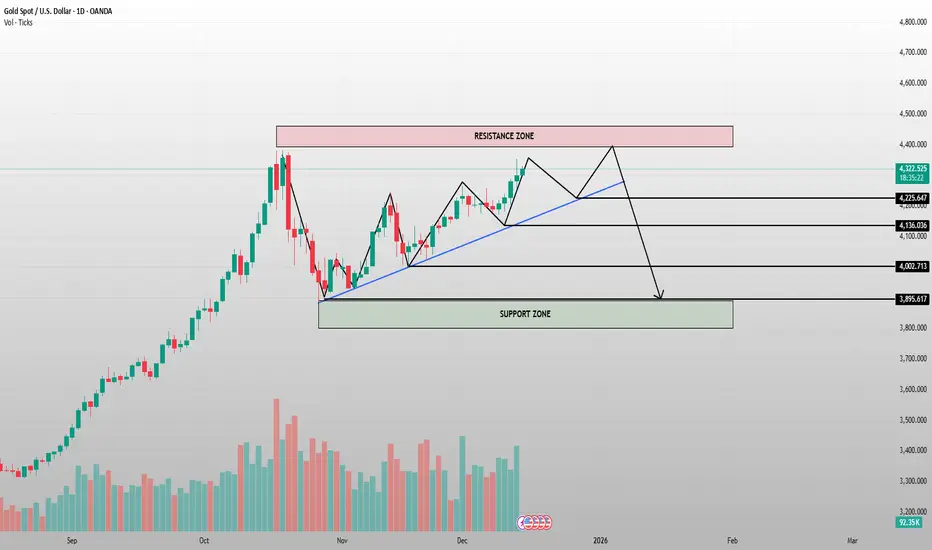
Gold at a Critical Crossroad — One Last Push Before the Trap?MARKET BRIEFING – GOLD (XAU/USD) | 1D
Market Structure:
Gold remains in a rising structure, respecting the ascending trendline. However, price is now approaching a major resistance zone, where selling pressure has previously stepped in aggressively.
Key Levels to Watch:
– Resistance Zone: 4,380 – 4,420
– Intermediate Support: 4,225 / 4,136
– Major Support Zone: 3,900 – 3,950
Price Action Read:
– As long as price holds above the rising trendline, bulls still have control.
– A final push into resistance is possible, but momentum is weakening near the highs.
– Failure to break and hold above resistance could trigger a sharp pullback toward the 4,000 handle and deeper into the support zone.
Bias:
➡️ Short-term: Cautious bullish into resistance
➡️ Medium-term: Watch for rejection → corrective move likely
Trader Focus:
This is decision time — either a clean breakout with acceptance above resistance, or a liquidity sweep followed by a downside rotation. Patience > prediction
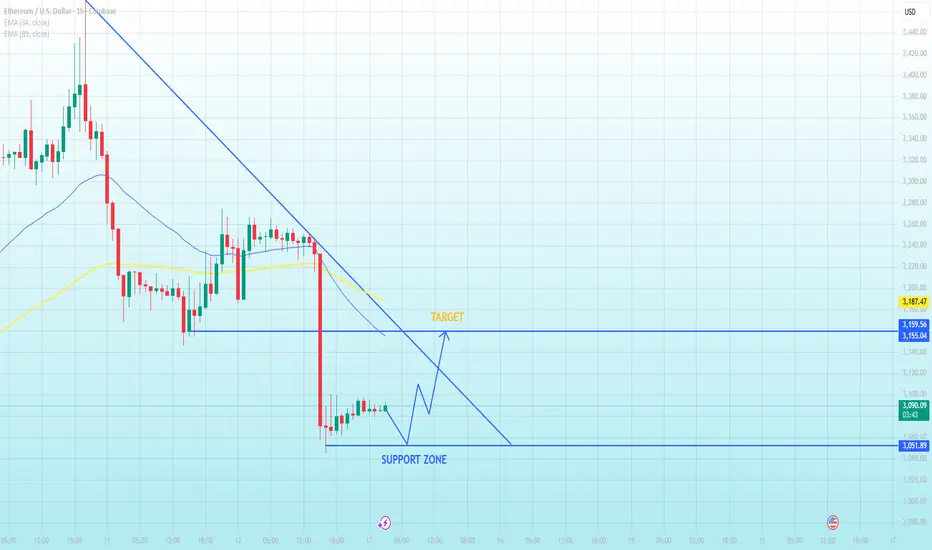
Is Ethereum Ready to Bounce Back or Will It Fall Deeper?Ethereum (ETH/USD) – 1-Hour Chart
Current Market Structure:
- Ethereum has recently seen a sharp drop, followed by a consolidation phase.
- Price is now positioned near a key support zone, as indicated by the horizontal blue line.
- The trendline above suggests a descending resistance that could play a significant role in price action going forward.
Key Levels:
- Support Zone: $3,051.89 - The price is currently near this level, and it will be critical in determining whether Ethereum will reverse or continue lower.
- Target Zone: $3,159.56 - If Ethereum successfully bounces from the support zone, the next target is near this level, marked by the blue arrow.
- Resistance Trendline: The price is approaching a downward sloping resistance. A break above this trendline would signify a potential bullish breakout.
Probable Scenarios:
- Bounce from Support Zone: The current level looks like a potential buy zone, with a bounce toward $3,159.56 as the first target.
- Continued Rejection at Resistance: If price fails to break the resistance trendline, expect further downside action toward lower support zones.
- Breakdown of Support: If price breaks below the support zone, a move lower toward the next support level is likely, potentially extending the decline.
Market Impact:
- Short-Term Volatility: There is likely to be volatility due to the support and resistance interaction, so keeping an eye on price action near these levels is crucial.
- Upcoming Events: Be aware of external factors like economic announcements that could disrupt price movement.
Trading Strategy:
Buy at Support: Look for a confirmation of the bounce from the support zone, aiming for the target near $3,159.56.
Sell at Resistance: If price fails to break above the resistance trendline, consider shorting with a target near the next support zone.
For now, patience is recommended until the price shows clear behavior near these key levels.
ETH/USD Just Found Key Support - Is the Next Breakout Coming?🔹 MARKET BRIEFING – ETH/USD (1H)
Market State:
– Ethereum is holding strong above the key support level around 3,050, showing bullish momentum after bouncing from this level. A retest of the support zone seems to have set up the potential for another leg higher.
Key Levels:
– Support Zone: 3,050
– Target 1: 3,100
– Target 2: 3,150
– Resistance Zone: 3,200
Next Move:
– With price respecting support at 3,050, ETH/USD is poised for another rally toward 3,100 and 3,150, aiming for a test of the 3,200 resistance.
GOLD CYCLE ANALYSIS - WAVE 5 PATTERN EMERGING1️⃣ MACRO CONTEXT — GLOBAL CONDITIONS ARE RELOADING GOLD’S NEXT MEGA WAVE
Gold is entering a multi-year super-cycle powered by a rare combination of global instability and monetary shifts:
- Ongoing geopolitical conflicts (Ukraine, Middle East) continue to elevate safe-haven demand.
- U.S. economic momentum is slowing → rising recession probability.
- The market is pricing in aggressive Fed rate cuts in the coming year → real yields cooling, a direct catalyst for gold upside.
- Central banks (China, India, Turkey) are buying gold at the fastest pace in 50 years, diversifying away from the USD.
These macro foundations perfectly align with the repetitive growth cycle pattern displayed in chart.
2️⃣ STRUCTURAL ANALYSIS — GOLD IS REPEATING ITS 5-WAVE GROWTH CYCLE
On the 1D chart, gold is moving exactly within a classic 5-wave impulsive cycle:
Wave 1: A long accumulation zone → first breakout.
Wave 2: Shallow correction, maintaining higher lows.
Wave 3:The strongest expansion phase — identical to the 2024–2025 rally.
Wave 4: A consolidation wedge + sideway pullback inside the green zone you marked.
Wave 5 (Forming Now): The next explosive leg upward, projected by the white path on your chart.
Price is currently sitting inside Accumulation Zone 4, building energy before launching the final impulsive wave.
3️⃣TRADE SCENARIO — BASED ON STRUCTURE + MACRO ALIGNMENT
🔵 Primary Scenario: Bullish Super-Cycle Continues
If price holds the ascending yellow trendline and the Zone 4 support:
- Gold completes its corrective zigzag → then accelerates into Wave 5, aiming for new all-time highs.
Macro factors reinforce this bullish scenario:
- Fed rate cuts expected → lower real yields.
- USD entering a weakening cycle.
- Geopolitical tensions remain elevated.
- Central banks increasing gold reserves aggressively.
→ This is the dominant, high-probability scenario.
🔴 Secondary Scenario: Macro Repricing Pullback
Only triggered if:
- The Fed unexpectedly turns hawkish again (low probability),
- Geopolitical tensions ease significantly (low probability).
In that case, gold may retest lower zones:
3125 → 2523, exactly as marked on your chart.
4️⃣ RISK MANAGEMENT — WHEN THE MODEL FAILS
The super-cycle view becomes invalid if:
- Daily close breaks below the green Wave 4 accumulation zone.
- U.S. bond yields spike sharply higher again.
- DXY rallies above 115.
These conditions contradict the current global macro trajectory, so the probability remains low.
5️⃣ GOLD’S 5-WAVE PATTERN IS NOT RANDOM
Each accumulation zone (1–2–3–4) shares identical behavior:
- 6–12 weeks of tight consolidation
- Breakout triggered by macro news
- Each impulsive wave larger than the previous one
This is the footprint of a long-term impulsive super-cycle, currently unfolding from 2023–2026.
Given the macro backdrop and repeated structural pattern, Wave 5 is positioned to become the strongest and most extended wave of this entire cycle.
I
Gold Is Preparing for a Deep Liquidity SweepMost traders chase the final push of wave (B) and get trapped right before the market reverses. When you understand wave structure + liquidity zones, you stop trading emotions and start trading precision.
📌 1. Market Structure
Gold has just completed a 5-wave impulsive structure (1 → 5) into the resistance zone.
Immediately after wave (5), price shifted into a corrective phase, forming leg (A) downward.
This is classic Elliott behavior: Impulsive (5 waves) → Corrective (ABC).
Current structure is entering wave (B) retracement before dropping into wave (C).
📌 2. Key Zones
Resistance Zone:
Price reacted strongly at the previous swing-high cluster where wave (5) completed — confirming heavy sell orders.
Support Zone:
The zone around wave (2) & (4) provided multiple rejections, but a break below (A) suggests this support is weakening.
Liquidity Zone (Target): 4128 – 4136
This is the major liquidity pocket where the market likely aims for a sweep during wave (C).
📌 3. Price Action
- Wave (A) formed with clear momentum down.
- Current upward leg into (B) shows weaker volume, typical of a corrective pullback.
- The projected path shows price retesting resistance before a deeper drop.
- Structure is no longer bullish — it’s transitioning into a corrective sequence.
- The dashed path is perfectly aligned with typical ABC behavior.
📌 4. Technical Confirmation
- Wave Theory: 5-wave impulse completed → ABC retracement is expected.
- Liquidity Map: Price has unfinished business at the 4128–4136 zone.
- Support Break: Wave (A) broke below the previous minor support, shifting short-term bias bearish.
- Resistance Rejection: Wave (B) is likely to fail at the previous top structure.
Everything aligns with a bearish continuation into wave (C).
📌 5. Trading Plan
🎯 SELL Setup (High probability)
Entry: 4,230 – 4,255 (top of wave B retracement)
Stop-Loss: 4,290 (above previous swing & invalidation of B)
Take Profit 1: 4,165
Take Profit 2: 4,140
Final Target: Liquidity 4128 – 4136 (wave C completion)
Why this setup is strong:
You are shorting into the end of wave B, which typically traps breakout buyers before wave C dumps sharply.
EURUSD: This Move Wasn’t Accidental…EURUSD MARKET ANALYSIS – 1H
1. Current Price Structure
- EURUSD has completed a full parabolic rounded bottom formation, pushing price back into the upper boundary of the ascending channel.
- After touching the resistance zone (1.16800), price sharply rejected and transitioned into a descending channel, signaling a shift from bullish continuation to correction.
- The recent rally lost momentum, and price is now moving inside a bearish correction channel, confirming that buyers are weakening.
- The circled area shows a failed breakout attempt, followed by strong re-entry inside the bearish channel → classic distribution signal.
2. Liquidity Zones
Resistance Liquidity (1.16800):
Price tapped this level multiple times and got rejected aggressively → liquidity above remains intact, suggesting the market is not ready for a breakout.
Support Liquidity (1.15900):
The support zone below holds significant liquidity — multiple previous wicks show repeated absorption by buyers.
Current structure indicates
Smart money is distributing near resistance and collecting liquidity for a deeper move toward support.
3. Today’s Market Scenario
🔻 Main Scenario – Bearish Correction Toward Support
The price is expected to continue moving inside the descending channel:
Multiple lower highs forming at the top of the channel.
Price likely oscillates sideways with bearish bias, forming repeated LH–LL structures.
Final target of this correction: 1.15900 (support zone).
This aligns perfectly with the red path drawn on your chart:
- Zig-zag correction
- Progressive decline
- Reaching support zone for liquidity sweep.
Unless the resistance zone is broken convincingly, bearish continuation remains the highest-probability scenario.
4. Market Psychology
The chart reflects a classic sentiment shift:
- Before reaching resistance, traders were optimistic due to the strong bullish rally (rounded bottom).
But the sharp rejection at resistance created psychological distribution, where:
-Early buyers take profits
-Late buyers get trapped
- Smart money sells into retail optimism
The descending channel represents controlled selling pressure, not panic — this is strategic distribution.
Price will typically move slowly downward, trapping breakout traders until deeper liquidity at support is reached.
This is textbook smart-money behavior:
Euphoria → Distribution → Controlled Decline → Liquidity Sweep.
5. Intraday Strategy
🔻 Short Bias (High Probability)
Trade with the correction channel.
Entry: Short at the upper boundary of the descending channel (1.16500 – 1.16600).
SL: Above mini-swing high or above channel top (≈ 1.16750).
TP1: 1.16250
TP2: 1.16050
TP3: 1.15900 (major support zone)
🔹 Conservative Strategy
Wait for price to retest 1.16500 and show rejection before shorting.
🔸 Long Setup (Low Probability)
Only consider long if:
Price breaks the descending channel
AND Retests above 1.16650 with strong bullish confirmation.
Target if breakout occurs: 1.16800 – 1.17000.
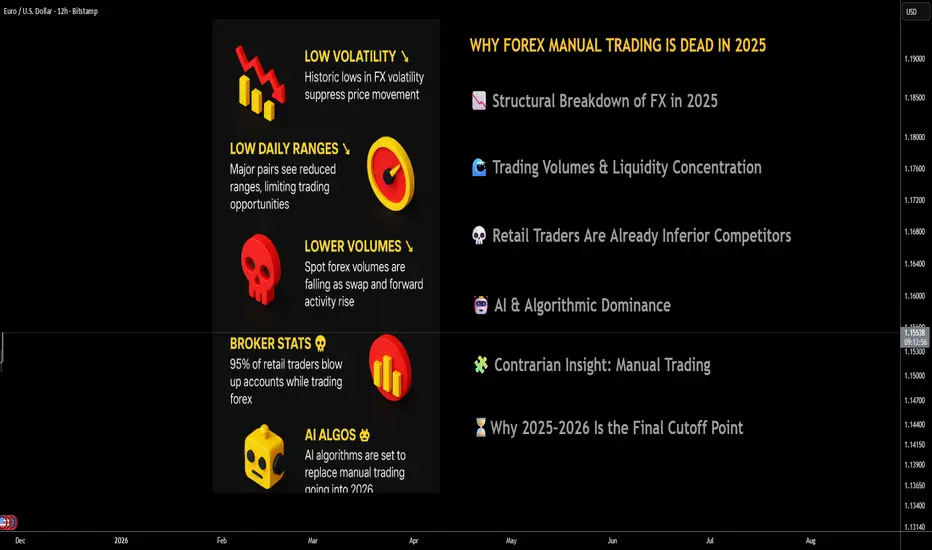
Why Manual Forex Trading Is Officially Dead 📘 Why Manual Forex Trading Is Officially Dead — And AI Will Bury It in 2026
________________________________________
1. 🚨 Executive Summary
Manual FX trading is not merely declining—it is entering its terminal phase. As of 2025, the confluence of record-low volatility, crushed daily ranges, shrinking spot volumes, and hyper-efficient AI execution frameworks has dismantled the edge discretionary traders once possessed.
Regulators report that 74–89% of retail CFD/FX traders lose money, with internal broker statistics showing even higher failure rates—often pushing the informal industry estimate of 90–95% account blow-up rates. The structural market environment now exacerbates those figures: less movement, tighter spreads, and faster AI-driven price formation leave no oxygen for manual decision-making.
The verdict is clear: manual FX trading is no longer a competitive activity—it's an anachronism.
________________________________________
2. 📉 Structural Breakdown of FX in 2025: A Market That No Longer Moves
The fundamental requirement for profitable manual FX trading—price movement—has been suppressed. According to multiple 2023–2024 analyses (Reuters, BIS), FX markets entered a multi-year period of historically subdued volatility, with the CVIX (Currency Volatility Index) sitting near multi-cycle lows.
Major pairs like EUR/USD and USD/JPY are posting 1/3 to 1/2 of their historical daily ranges, compressing intraday opportunity. What used to be 80–120 pip swings are now 30–50 pip oscillations dominated by micro-structure noise rather than directional moves.
In this environment, manual traders have insufficient statistical runway to generate returns, while AI systems can still monetize tiny dislocations at millisecond speed.
________________________________________
3. 🌊 Trading Volumes & Liquidity Concentration: The Game Has Moved On
The 2022 BIS Triennial Survey already documented a shift: spot FX volumes stagnated while swap and forward activity increased, driven by hedging and treasury optimization rather than speculative flows.
By 2025, institutional venues show continued softness in spot volumes, and even the leading eFX platforms reported lower activity during prolonged volatility droughts. This matters because:
• Lower volume = fewer sustained directional trends
• More volume concentrated among algos = fewer exploitable inefficiencies
• Liquidity providers internalize flow before it ever becomes visible to retail charts
Manual trading can’t survive structural liquidity centralization reinforced by machine execution.
________________________________________
4. 💀 Retail Traders Are Already Inferior Competitors and the Data Shows It
Manual traders are not just competing against the market—they are competing against:
• Prime brokers running internal AI risk engines
• HFT firms reading order books at microsecond resolution
• Banks using reinforcement-learning execution algos
ESMA’s regulatory disclosures show 74–89% of retail FX/CFD accounts lose money, but internal broker studies often cite 90–95% destruction rates, especially when volatility is muted.
The brutal truth: manual traders blow up because the game is no longer designed for human reaction speed or intuition.
________________________________________
5. 🤖 AI & Algorithmic Dominance: The 2026 Regime Shift
By 2026, FX will be AI-first, not human-first. Institutional adoption of AI execution is growing double digits annually (per GMI, GrandView), and retail brokers are already rolling out AI-assisted trade generation, AI signal clusters, and AI risk models.
AI advantages include:
• Predictive ability using LSTM/transformers trained on terabytes of tick data
• Zero-latency execution across fragmented liquidity pools
• Ability to profit in low-volatility regimes via microstructure edge
• Adaptive models that rewrite themselves every 24 hours
• No fatigue, no bias, no emotional degradation
In contrast, manual traders operate on slow cognition, subjective pattern recognition, and outdated chart heuristics. This is not a fair fight. Manual trading is no longer a skill—it's an obsolete hobby.
________________________________________
6. 🧩 Contrarian Insight: Manual Trading Isn't Just Dying—It’s Being Engineered Out
Here are non-obvious, high-conviction insights that institutional investors should consider:
(1) Market makers WANT low volatility
Low volatility increases internalization efficiency and reduces hedging costs. Human traders thrive on chaos; AI thrives on order. Who does the system favor?
(2) AI reduces liquidity available to humans
Liquidity is increasingly “dark” inside internal matching engines, meaning price discovery happens before retail traders ever see the candle.
(3) Manual trading can’t survive the “fractionalization” of edge
AI doesn’t need large moves—it monetizes micro-micro-inefficiencies in ways humans never could.
(4) Spread compression kills human R:R ratios
With 0.1–0.3 pip spreads on majors, AI can scalp micro-spreads—humans cannot.
(5) Behavioral inefficiencies have been minimized
Classic manual strategies—breakouts, fib levels, candlestick patterns—worked because humans created predictable behavioral cycles.
Now? AI models detect and arbitrage those behaviors instantly.
The most contrarian conclusion?
Manual trading didn’t die naturally—the market evolved to eliminate it.
________________________________________
7. ⏳Why 2025–2026 Is the Final Cutoff Point
Three forces collide in this window:
1. Volatility compression (structure-driven, not temporary)
2. AI adoption exceeding human adaptability
3. Retail traders facing the worst statistical environment in 15 years
This is the first time in FX history where:
• Human intuition has zero measurable edge
• AI dominance is irreversible
• Market conditions structurally reject manual trading
The past cycles always argued “vol will return.”
In 2025–2026, that is no longer a credible investment thesis.
________________________________________
8. 📈 Implications for Investors & Brokers
Investors should allocate to:
• AI-driven FX funds
• ML-enhanced macro strategies
• Data infrastructure feeding predictive FX models
Brokers should:
• Pivot to AI-based trading tools
• Monetize analytics subscriptions
• Shift away from promoting discretionary trading education
The firms that expect a retail manual trading revival will be structurally misaligned with market evolution.
________________________________________
________________________________________
🔥 Final Conclusion: Manual Traders Will Be Left Behind in 2026
The logic is now overwhelming:
low volatility + low ranges + reduced volumes + AI dominance = endgame for manual FX trading.
Human discretionary trading cannot survive in a marketplace designed for—and increasingly ruled by—data-driven, sub-millisecond, self-learning AI engines.
Manual traders in 2026 will not fight the bots.
They will simply be trading inside a system architected by the bots, reacting slowly to patterns that no longer exist.
The era is over.
The market has moved on.
GBPUSD Retracement Idea for a new Lower HighHi Traders!
Since my last idea GU reached my short target around 1.30000. I'm now looking for price to retrace to a previous bearish BOS area around 1.32500-1.33000. If price can create a new lower high in that area we could possibly see more bearish movement. In addition, if DXY can hold around 99.000-99.500, and continue reversing to the upside I'd have a new swing target for GU at the next Daily OB around 1.29000-1.28500.
1st alert set just below 1.32500 in case price doesn't make it to my target.
*DISCLAIMER: I am not a financial advisor. The ideas and trades I take on my page are for educational and entertainment purposes only. I'm just showing you guys how I trade. Remember, trading of any kind involves risk. Your investments are solely your responsibility and not mine.*
BTC DAILY KEY LEVEL APPROACHING BTC has been on a down trend for a while now and is currently approaching a daily demand zone which is the zone that caused the break of structure of the previous high on the daily time frame. So let wait for price to Tap into the zone and see if buyers will eventually kick in or probably break below it to continue the downtrend. Let wait for clear confirmation.
BTCUSD: Waiting for breakout confirmation near the range highBTCUSD – Analysis for October 24, 2025
Yesterday, we had two trading setups for BITSTAMP:BTCUSD .
The IRB setup played out as planned when the price rebounded from the EMA, formed a consolidation zone within the range, and then broke out strongly, pushing up toward the upper boundary of the range.
This move shows that bullish momentum is still present, although the resistance near the range high remains a key area where short-term profit-taking may occur.
Today’s Trading Plan
Wait for the price to compress and form a tight consolidation zone near the upper boundary of the range.
Confirmation condition: No candle closes below the EMA, which would confirm that buying pressure remains in control.
Once a RB or ARB setup appears, that will be our signal to enter long positions.
Bullish Scenario (primary bias):
Entry: On confirmed RB/ARB setup near the upper edge of the range
Stop Loss: Below the nearest EMA
Take Profit: Targeting extended resistance levels above the range
Alternative Scenario:
If the price closes below the EMA and breaks the compression structure, we’ll stay out of the market and wait for a new setup once the structure stabilizes.
Summary
BTC continues to show strength, but the upper range boundary remains a key test.
Today’s plan: Wait – Confirm – Execute. Avoid FOMO until a clear confirmation appears.
Daniel Miller @ ZuperView
BTCUSD: Sideways - Watch for setup near range boundariesBITSTAMP:BTCUSD Analysis – October 22, 2025
BITSTAMP:BTCUSD is currently trading within a sideways range between 107,726 and 111,377 USD. After a breakout attempt, the price formed a buildup zone near the lower boundary of the range and surged upwards. However, it then created a false breakout at the upper boundary before pulling back to retest the previous buildup area.
This false breakout was caused by weakening buying momentum after breaking above the range, partly because the buildup zone was too far from the upper boundary, limiting the follow-through. According to yesterday’s plan, we are waiting for a buildup close to the upper boundary and EMA compression to confirm a valid breakout.
Trading plan for today:
Look to sell when price forms a buildup near the lower boundary of the range with EMA compressing close. Enter the trade upon the appearance of rejection signals such as RB or ARB.
The buy setup has not yet formed clearly but may be considered if an IRB appears within the larger BTC range.
In summary, BTC is still in an accumulation phase. Prioritize waiting for confirmed signals before entering trades to minimize risk.
Daniel Miller @ ZuperView
BTCUSD: Waiting for EMA pullback and bullish setupBITSTAMP:BTCUSD Analysis – October 20, 2025
Overview:
After a strong drop to the 103,600 area, BITSTAMP:BTCUSD is showing a solid recovery momentum. Price has broken out of the previous accumulation range and made a pullback, but the early buying opportunity has already passed.
Trading Plan for Today:
Currently, price is approaching a previous key resistance level—a critical zone to watch for reaction.
The main strategy is to wait for a pullback toward the EMA zone and look for a confirmed buy setup based on one of the following patterns:
DD (Double Doji) – indicating a potential pause and reversal.
SB (Second Break) – confirming continuation of the bullish trend.
Alternative Scenario:
If BTC continues to rally strongly without a pullback and breaks above the key level.
It’s better to stay on the sidelines rather than chase the move.
Avoid FOMO when the market doesn’t offer a clear setup — patience usually brings higher-probability entries.
Daniel Miller @ ZuperView
BTCUSD: Short opportunities on technical retrace BITSTAMP:BTCUSD Analysis – October 17, 2025
Yesterday’s short setup (BB) was triggered and hit target as planned.
The main trend remains bearish, confirming that sellers are still in control.
For today, the focus remains on looking for short opportunities following the current downtrend.
Expecting a technical pullback toward the 40%–60% retracement zone of the previous bearish leg.
As price approaches this area and retests the EMA, wait for a clear confirmation signal before entering.
If price fails to follow the setup, stay patient and wait for more confirmation to ensure a safe and disciplined trade.
Main Plan: Keep a bearish bias — look for shorts near the 40–60% retracement zone once confirmation appears.
Daniel Miller @ ZuperView
BTCUSD: Sideways in a block, looking for setup🧭 BITSTAMP:BTCUSD analysis – October 16, 2025
Currently, BITSTAMP:BTCUSD remains in a broader downtrend, so for today’s session, our main focus will be on looking for short (sell) opportunities, rather than counter-trend buys.
I’m using the 30-minute timeframe (M30) for today’s setup.
At the moment, BTC price action is quite complex — moving sideways within a block structure and has recently retested the resistance area around 110,904.
The plan for today is to wait for solid accumulation and a clear BreakBlock (BB) setup to confirm continuation to the downside.
Once a valid setup forms, we can look for short entries following the main trend, with strict risk management and flexible profit targets depending on market volatility.
Alternative Scenario:
If price breaks above the current range, we’ll stay patient and wait for clearer signals before entering any trades.
This approach helps us avoid FOMO and stay disciplined, ensuring all trades align with our predefined plan and market structure.
Daniel Miller @ ZuperView
Traders, Investors, and PolicymakersTheir Role in Global Trading.
Introduction
Global trading forms the backbone of the world economy. It connects nations through the exchange of goods, services, capital, and ideas, driving economic growth and innovation. Behind the seamless flow of trade, three critical groups shape its structure and direction — traders, investors, and policymakers. Each group plays a distinct but interconnected role in ensuring that global markets function efficiently, fairly, and sustainably.
Traders facilitate transactions and price discovery; investors allocate capital and influence long-term market trends; policymakers design the legal and institutional framework that governs trade and investment. Together, they create a dynamic balance between market forces and regulations, driving global economic progress.
1. The Role of Traders in Global Trading
1.1 Market Intermediaries and Price Discovery
Traders are the front-line participants in global markets. Their primary function is to buy and sell goods, commodities, currencies, and financial instruments across borders. Through their actions, traders facilitate price discovery — the process by which the value of an asset is determined based on supply and demand.
In global markets, traders operate in multiple forms:
Commodity traders, dealing in oil, metals, agricultural products, etc.
Currency traders (forex traders), influencing exchange rates and liquidity.
Equity and derivatives traders, focusing on stocks, bonds, and financial contracts.
By responding quickly to changing market conditions — such as geopolitical tensions, inflation data, or production shifts — traders ensure that prices reflect real-time global realities. This continuous activity keeps markets liquid and efficient.
1.2 Risk Management and Hedging
Global trade is inherently risky. Prices of commodities and currencies fluctuate constantly due to factors like weather, politics, and global demand. Traders play a critical role in risk management by using derivatives instruments such as futures, options, and swaps.
For example:
An oil producer may hedge future prices by selling crude oil futures contracts.
An importer may buy currency futures to protect against exchange rate volatility.
Such hedging activities stabilize revenues and costs, making international trade more predictable. Traders thus act not merely as profit seekers but also as risk absorbers, helping firms and economies manage uncertainty.
1.3 Liquidity Creation and Market Efficiency
One of the most important functions traders perform is liquidity creation. By continuously buying and selling, they ensure that there is always a counterparty for market participants wanting to enter or exit a trade. Liquidity enhances market efficiency, reducing transaction costs and narrowing bid-ask spreads.
In global markets, high-frequency trading firms, market makers, and institutional traders provide the bulk of this liquidity. Their algorithms process information in microseconds, reacting to changes across global exchanges — from New York to London to Tokyo — creating an interconnected trading ecosystem.
1.4 Speculation and Price Stabilization
While speculation is often criticized, it plays a vital role in price stability. Speculators take positions based on their forecasts of market movements, which often correct price distortions caused by temporary imbalances in supply and demand.
For instance, if a drought threatens wheat production, speculators may buy wheat futures, pushing prices up early. This incentivizes farmers to produce more and consumers to conserve, helping balance the market over time. Thus, traders indirectly contribute to long-term equilibrium through their speculative actions.
2. The Role of Investors in Global Trading
2.1 Capital Allocation and Global Growth
Investors — including individuals, institutions, and sovereign wealth funds — play a foundational role by providing the capital that fuels global trade and development. Their investment decisions determine which countries, industries, and companies receive funding to expand production, improve infrastructure, and innovate.
Foreign Direct Investment (FDI), portfolio investment, and venture capital flows are all forms of global investment that bridge financial gaps between nations. For developing economies, such inflows bring not just capital but also technology, expertise, and access to international markets.
For example, investors in emerging markets like India or Vietnam help create factories, logistics hubs, and export-oriented industries that become integral parts of the global supply chain.
2.2 Long-Term Stability and Confidence
While traders focus on short-term movements, investors typically adopt a long-term outlook. Their steady commitment provides stability and confidence to global markets. Institutional investors like pension funds, mutual funds, and insurance companies deploy capital over years or decades, allowing businesses to plan for sustainable growth.
Moreover, investors’ willingness to hold assets across economic cycles smooths out market volatility and helps economies recover from downturns. For instance, during global recessions, sovereign and institutional investors often continue to fund key projects, preventing total collapse in economic activity.
2.3 Portfolio Diversification and Global Integration
Global investors diversify across countries and asset classes to spread risk and enhance returns. This diversification links markets together — a movement in one region can now affect investment sentiment worldwide.
For example:
A slowdown in China can influence global commodity prices and stock markets.
A rise in U.S. interest rates can trigger capital outflows from emerging markets.
Thus, global investors not only connect financial systems but also transmit economic signals, influencing policymaking and business strategies worldwide.
2.4 Corporate Governance and Ethical Standards
Investors today increasingly focus on Environmental, Social, and Governance (ESG) principles. By choosing where to allocate capital, they exert influence over corporate behavior, encouraging transparency, sustainability, and ethical conduct.
Large institutional investors such as BlackRock or Norway’s sovereign wealth fund use their ownership stakes to push companies toward sustainable practices. In this way, investors act as guardians of global corporate responsibility, ensuring that profits are balanced with long-term social and environmental well-being.
3. The Role of Policymakers in Global Trading
3.1 Creating a Legal and Regulatory Framework
Policymakers — including governments, central banks, and international organizations — set the rules of the global trading system. Their policies determine tariffs, taxes, capital controls, interest rates, and trade agreements.
Without effective policymaking, global markets could descend into chaos. Laws governing intellectual property, labor rights, dispute resolution, and customs procedures ensure fairness and predictability. Institutions such as the World Trade Organization (WTO), International Monetary Fund (IMF), and World Bank coordinate policies among nations to maintain a level playing field.
3.2 Trade Agreements and Economic Diplomacy
One of the key policymaking roles is negotiating trade agreements that define how countries exchange goods and services. Bilateral and multilateral pacts such as the European Union (EU), North American Free Trade Agreement (NAFTA), or Regional Comprehensive Economic Partnership (RCEP) facilitate cross-border commerce.
Through diplomacy, policymakers open new markets, remove barriers, and harmonize standards. These agreements also provide dispute-resolution mechanisms that reduce uncertainty for traders and investors, making global trade smoother and more predictable.
3.3 Monetary and Fiscal Policies
Global trading is deeply influenced by monetary and fiscal policies. Central banks manage interest rates, currency supply, and inflation — all of which affect exchange rates and investment flows. For example:
When the U.S. Federal Reserve raises interest rates, the U.S. dollar strengthens, making imports cheaper and exports less competitive.
Fiscal policies like tax incentives or export subsidies can promote certain industries, shaping trade patterns.
Policymakers must balance domestic goals (such as employment and inflation control) with global competitiveness, ensuring their economies remain resilient in a fluctuating global environment.
3.4 Crisis Management and Market Stabilization
During periods of global crisis — such as financial collapses, pandemics, or wars — policymakers play a stabilizing role. They coordinate interventions like stimulus packages, bailouts, and monetary easing to restore confidence and liquidity in markets.
For instance, during the 2008 global financial crisis, coordinated actions by central banks and governments prevented a deeper economic collapse. Similarly, during the COVID-19 pandemic, massive fiscal and monetary responses helped maintain global trade flows and investment levels despite severe disruptions.
4. Interconnection Between Traders, Investors, and Policymakers
4.1 A Symbiotic Relationship
While their roles differ, traders, investors, and policymakers form a mutually dependent ecosystem.
Traders provide liquidity and efficiency that attract investors.
Investors supply the capital that drives global growth and trade volume.
Policymakers set the structure within which both can operate securely.
For example, a trader may profit from short-term movements created by new policy announcements, while investors adjust long-term strategies based on those same signals. Policymakers, in turn, analyze market reactions to gauge the effectiveness of their decisions.
4.2 Feedback Loops and Global Impact
The actions of one group often influence the others in a feedback loop:
If policymakers tighten monetary policy, investors may withdraw funds, leading traders to adjust their positions.
If traders detect currency instability, policymakers may intervene to stabilize exchange rates.
Investor confidence, reflected in capital inflows or outflows, often guides future policy decisions.
This constant interplay ensures that global trade remains dynamic and adaptive, capable of responding to new challenges and opportunities.
5. Challenges and Future Outlook
5.1 Technological Disruption
The rise of AI-driven trading, blockchain, and digital currencies is reshaping the roles of traders and investors. Algorithms now execute billions of trades daily, while decentralized finance (DeFi) is bypassing traditional intermediaries. Policymakers are challenged to keep pace with this rapid innovation while ensuring transparency and stability.
5.2 Geopolitical Tensions and Protectionism
Trade wars, sanctions, and regional conflicts can disrupt global supply chains. Policymakers must balance national interests with global cooperation. Traders and investors, in turn, must adapt to shifting regulations, tariffs, and political risks — making flexibility and diversification more critical than ever.
5.3 Sustainable and Inclusive Growth
The global trading system is under pressure to become more sustainable and inclusive. Investors are pushing for green finance; policymakers are designing carbon-neutral trade policies; and traders are exploring ethical sourcing. The collaboration between these three groups will determine whether global trade can evolve into a system that benefits both people and the planet.
Conclusion
The story of global trading is not just about goods, currencies, or capital — it’s about the interaction of human decisions across borders and markets. Traders bring liquidity and efficiency; investors provide capital and confidence; and policymakers ensure order and fairness.
Together, they form the three pillars of the global economic structure. Their coordinated actions determine how wealth is created, distributed, and sustained across nations. In an era of technological transformation and geopolitical complexity, their collaboration will be essential for building a resilient, equitable, and sustainable global trading system.