Release the Pressure: Why Relaxed Traders Win MoreOne of the most overlooked psychological factors in trading is pressure — the silent force that makes you enter trades too early, exit too late, and misread what’s actually happening on the chart.
The truth is simple:
When you relax, you trade better.
The Illusion of “Always Doing Something”
Many traders feel that if they’re not in a trade, they’re missing out.
The market becomes a constant test of patience — and silence between trades feels unbearable.
That’s when poor decisions appear: forced entries, revenge trades, and overtrading to “feel productive.”
But the market doesn’t reward effort; it rewards timing.
Trading well often looks like doing nothing most of the time.
You wait, you observe, and you strike when the setup aligns.
This is where the relaxed mindset beats the pressured mindset every single time.
Example: Gold (XAUUSD) Between 3960 and 4030
Let’s take gold as an example.
As explained in my recent analysis, we have two clear levels to watch — 3960 and 4030.
Price is currently trading in between.
Even though it may look like it’s pressing upward and could form an ascending triangle, clarity only comes with a real breakout, not with anticipation.
A pressured trader will often feel the urge to predict — to “get in early” before confirmation.
But the calm trader simply waits.
They know that between levels, price action is noise, not opportunity.
And when clarity comes — either through a clean breakout or a rejection — the decision is obvious and stress-free.
This is what “releasing the pressure” looks like in practice:
You don’t force a trade. You let the market reveal the next step.
Why Pressure Kills Performance
Pressure doesn’t just come from the charts — it comes from expectations.
The trader who needs to make x$ per day will subconsciously search for confirmation that a trade exists.
Charts suddenly look clearer than they actually are.
Bias replaces logic.
And objectivity, which is the foundation of good trading, fades away.
In reality, the more you need to make money from trading, the harder it becomes to do so.
That’s not because the market is cruel — it’s because the human brain under stress stops processing probabilities correctly.
The Paradox of Ease
Every trader eventually experiences this paradox:
The less you try to “make something happen,” the more naturally good trades appear.
This isn’t mystical — it’s psychological.
When the mind is calm, your ability to notice quality setups improves dramatically.
You stop trying to control the market and start aligning with it.
It’s the difference between chasing a wave and surfing one.
Creating Space to Breathe
The professional approach to trading is not about constant activity — it’s about creating the conditions where clarity thrives.
That means reducing pressure in three ways:
1. Detach from daily profit goals.
The market doesn’t care about your personal targets. Focus on setups, not outcomes.
2. Allow financial breathing room.
When your rent, bills, and daily life depend on your next trade, emotional clarity disappears.
Build a secondary income or savings buffer — not for luxury, but for mental freedom.
3 . Redefine success.
A good trading day is not one with profit — it’s one with discipline.
When you measure success by process, not by dollars, you take power back from the market.
Final Thought
Most traders lose not because they lack skill, but because they trade under pressure.
The weight of expectation distorts perception, and the market punishes impatience.
Release the pressure — mentally, financially, and emotionally.
When you do, trading starts to flow the way it was meant to:
Quietly, naturally, profitably.
Tradersedge
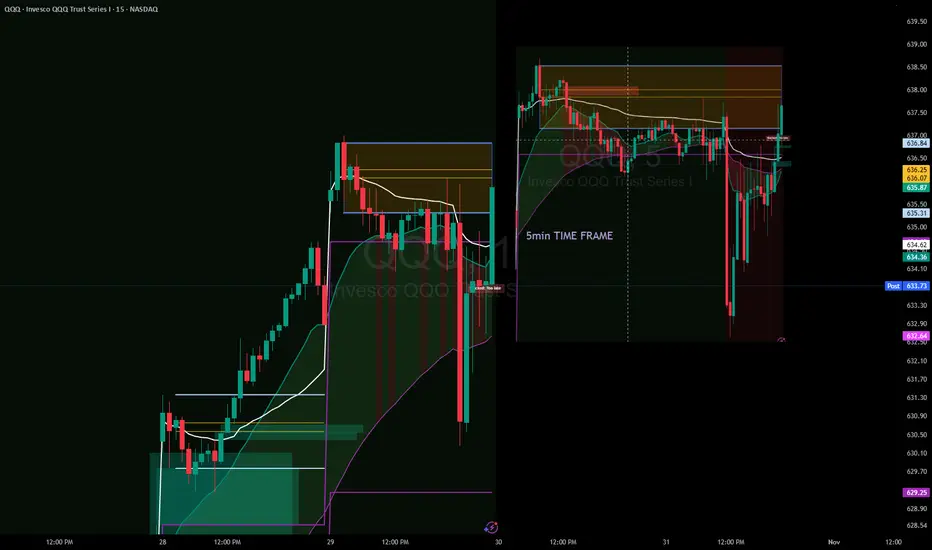
Daily Recap – The Patience Play (QQQ ORB Setup)Fellow traders,
Today was one of those sessions that remind us: sometimes the best trade is no trade at all.
The morning ORB (9:30 – 9:45 NY) gave us a wide initial range with very little conviction in either direction. We saw price flirt with both edges, but no candle could close decisively outside the box. Each push quickly reversed, leaving nothing but wicks and false momentum.
Volume stayed neutral and the EMAs never truly separated — a classic sign of indecision. Even the higher-timeframe (30-min) trend stayed flat, confirming there was no clean alignment to give us the confidence we needed.
Mid-session, price finally poked above the ORB high — but it immediately failed and rolled right back into the range. Later in the day, the real move came to the downside… well past the optimal ORB window. By then, discipline meant staying out.
👉 No setup, no entry — and that’s perfectly fine.
The goal isn’t to trade every day; it’s to trade only when probability lines up.
Tomorrow, we reset with the same rules:
Wait for a clean break and retest outside the ORB.
Confirm volume and trend.
Let the market come to us.
Stay patient, stay disciplined, and remember — consistency is built on the days you don’t force it.
— Trades with B
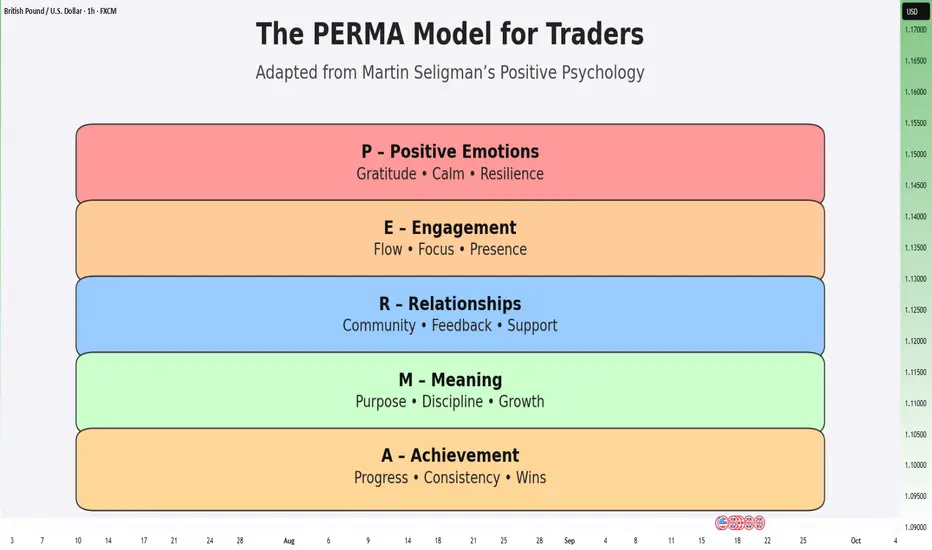
The PERMA Model: A Psychology Framework Every Trader Should UseIntroduction – Why Mindset Beats Strategy
You can have the best system in the world, but if your mind collapses under stress, you won’t follow it. That’s why traders need more than technical skills — they need a psychological framework.
One of the most powerful comes from Martin Seligman, founder of modern positive psychology. He introduced the PERMA model, designed to explain how humans thrive under pressure. And if there’s one place where pressure is constant, it’s trading.
________________________________________
P – Positive Emotions
Trading success starts with balance, not adrenaline. Cultivating gratitude and calm optimism helps you:
• Reduce impulsivity
• Build resilience after losses
• Make clearer decisions
👉 Daily practice: Write down 3 things you did well after each trading session.
________________________________________
E – Engagement
The best trades happen when you’re fully absorbed — no distractions, no second-guessing.
• Deep focus without burnout
• Quick but thoughtful decisions
• A fulfilling process regardless of outcome
👉 Tip: Limit screen time, trade with a plan, cut the noise.
________________________________________
R – Relationships
Trading feels solitary, but support is fuel. Surround yourself with people who grow, not just chase hype.
• Less isolation
• More constructive feedback
• Higher motivation
👉 Find: A community that values discipline over jackpots.
________________________________________
M – Meaning
Without a “why,” trading turns into random gambling. Purpose keeps you steady.
• Helps endure drawdowns
• Keeps you aligned with your rules
• Prevents burnout
👉 Ask yourself: “Why do I really trade? Freedom? Growth? Mastery?”
________________________________________
A – Achievement
Progress > perfection. It’s not about one jackpot, but consistent wins.
• A week of discipline = success
• Following your plan = victory
• Avoiding overtrading = growth
👉 Celebrate: The process, not just the P&L.
________________________________________
Conclusion – PERMA Could Be Your Hidden Edge
Seligman built PERMA as a blueprint for a fulfilling life. For traders, it’s more than theory — it’s a mental operating system.
If you want consistency, don’t just master charts. Master your mindset.
👉 Challenge: Pick one PERMA element and apply it this week. Journal the impact, and watch how your trading psychology changes. 🚀
EN - GOLD1. due to the current economic situation the demand for Gold went down.
2. On the daily if we get a morning star , we can go long to the retracements, else I would look for short signals at the marked pricelevels
leave a comment
:)