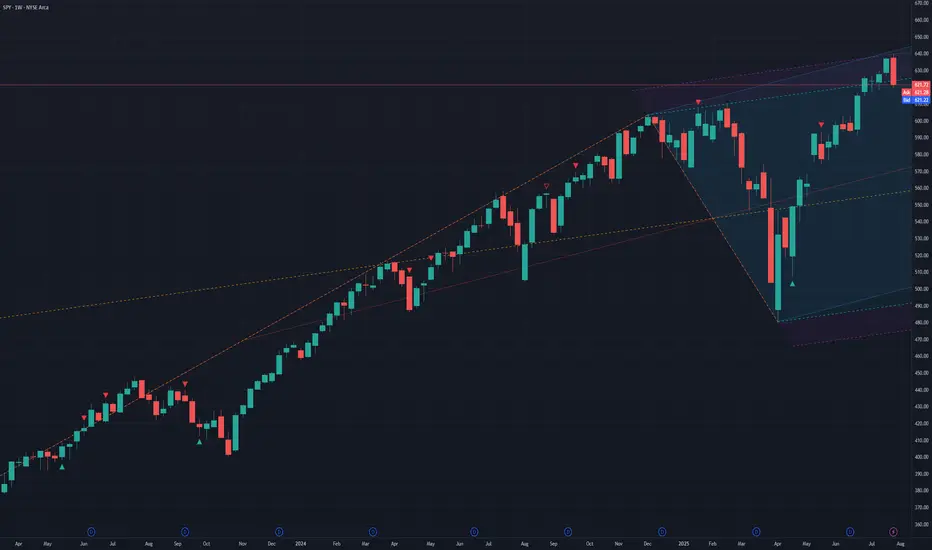
SPY Weekly Outlook – Week 5 of 2026 (Feb 02–06)SPY Weekly Outlook – Week 5 of 2026 (Feb 02–06)
Weekly Recap
Last week, SPY respected our bullish framework perfectly, resulting in a clean and profitable execution. The market opened with a gap up and reached Bullish Target 1, where we took partial profits and reduced exposure.
We then carried the remaining position toward the 700 level with a break even stop. However, price failed to expand further, closed back inside the range, and started to retrace after the mid week. As a result, the remaining position was stopped out around breakeven.
(For reference, I’m sharing last week’s SPY Weekly Outlook on the side.)
At this stage, I see growing indecision in the market, and below I outline my strategy to navigate this environment.
Scenarios – Prediction
Scenario: Range Play
At the moment, I do not see a clear directional bias. Price is trading between well defined key levels and I expect reactions from these zones.
My base case is a range bound market, where price gets rejected from the Range High and Range Low areas and rotates back inside the range.
Deviations into these levels followed by acceptance back inside the range would keep price compressed within its internal structure. A strong break and acceptance beyond the range boundaries would signal the market’s true directional bias.
Key Levels to Watch / Trade
Range High: 697.75
Range Low: 676.5 – 669.5
Mid Range / Internal Liquidity: 687.25 – 684.25
Game Plan
If price sweeps liquidity at one of these key levels and then closes back inside the range, I will look to trade in the opposite direction of the liquidity grab.
The core idea is to fade moves where traders get trapped thinking the level has broken, only for price to reverse back into the range.
Example:
If the 676.5 level gets tapped and price closes back above it with either two 1H candles or one 4H candle, I will treat that as a deviation and look for call side setups.
If price instead breaks a key level with strong acceptance and holds above or below it, that would signal continuation beyond the range.
Example:
A strong close below 684.25 would shift my focus toward the Range Low at 676.5, where I would look to trade the downside using puts.
Position Management Notes
Positions should only be taken after confirmation, either through a clean break or a clear deviation at key levels. If price closes back against the direction of the expected move, the setup is invalidated and the position should be stopped.
For example, if 684.25 breaks strongly and I enter short, but price then reclaims 684.25 with two consecutive 1H closes above it, that would invalidate the short setup and signal the need to exit.
I share deeper US Market breakdowns and weekly scenario updates on Substack. Link is in my profile.
This analysis is for educational purposes only and reflects my personal opinion. It is not financial advice.
Usmarket
SPY Weekly Outlook – Week 4 of 2026 (Jan 26–30)SPY Weekly Outlook – Week 4 of 2026 (Jan 26–30)
Technical Look
SPY moved exactly as expected on the bearish side, reaching its downside targets with the Tuesday open last week and finding a bounce from those levels.
In the Mid Week Update shared afterward, I highlighted that price had transitioned into a bullish structure and that higher targets were now in focus. I’m also linking last week’s outlook on the side for reference.
Scenarios – Prediction
At this point, I am tracking two possible scenarios for SPY.
Scenario 1: Bullish Scenario (Likely)
With the bullish structure formed during the week, I expect price to continue higher and potentially target all time highs. Bullish sentiment remains strong enough to support this move.
That said, risks remain. Escalation around Iran or a potential 100% tariff on Canada could shift market structure back to bearish, so staying cautious is important.
This bullish scenario can play out in two ways:
1-A direct gap up open followed by continuation toward bullish targets
2-A pullback toward the 687 area, a brief deviation, then a bounce with a strong close above that level, leading to higher targets
Bullish scenario targets:
691 – 696 – 700
Scenario 2: Bearish Scenario
Geopolitical tension around Iran or a potential tariff shock could still trigger a bearish shift, keeping this scenario in play.
A strong break and close below 687 would activate the bearish scenario for me. On any retest, price should fail to reclaim and close back above 687. If that happens, I would look to actively trade this scenario using puts.
Potential bearish targets:
676.5 and 669.5
Position Management Notes
I manage risk by scaling out of positions at key reaction levels and adjusting exposure as structure confirms. Partial profit taking at major levels is a core part of my approach.
I share deeper SPY-QQQ breakdowns and weekly scenario updates on Substack. Link is in my profile.
This analysis is for educational purposes only and reflects my personal opinion. It is not financial advice.
SPY Mid Week Update (Jan 22–23)SPY Mid Week Update
Technical Look:
Price opened the week with a strong breakdown, exactly as outlined in my Sunday Weekly Outlook. After the initial move we saw a retest followed by continuation into the bearish target (please refer to the linked idea).
Then before the market close, Trump’s tariff cancellation comments shifted sentiment and the structure flipped back to a bullish setup.
Bullish Scenario (Active):
With Wednesday’s close, SPY has fully transitioned back into a bullish structure.
A decisive move above 686 would likely trigger a strong upside expansion.
My upside targets are:
696.25 – 700
A strong break below 679.5 would invalidate the bullish scenario.
Bearish Scenario (Unlikely):
If price breaks decisively below 679.5, I would consider the bullish scenario canceled and activate the bearish scenario.
In that case, I would expect price to continue lower and put positions could be considered on a retest near the 679 area.
This scenario would likely require a major narrative shift, such as Trump reintroducing EU tariffs. Without such a catalyst, the bullish scenario remains in play.
The primary bearish target in this scenario would be 671.25.
I share deeper US Market breakdowns and weekly scenario updates on Substack. Link is in my profile.
This analysis is for educational purposes only and reflects my personal opinion. It is not financial advice.
QQQ Mid Week Update (22-23 JAN)QQQ Mid Week Update
Technical Look:
Price opened with a strong breakdown, exactly as I expected in my Weekly Outlook from Sunday. After the initial move, we got a retest, and price continued lower into the bearish target. (Checked the linked idea.)
Then before the market close, Trump’s tariff cancellation comments shifted sentiment, and the structure flipped back to a bullish setup.
With Wednesday’s close, QQQ has fully transitioned into a bullish structure. Price action confirms that the bullish scenario is currently active and in control.
As long as there is no major sentiment shift (such as a cancellation of the Greenland deal), I expect the market to maintain its bullish structure.
Given the current momentum, price may reach upper targets relatively quickly.
Bullish Scenario (Active):
As long as the bullish structure remains intact, I expect price to continue higher.
Upside targets:
Target 1: 630
Target 2: 637
If price breaks the 610 level aggressively due to a sentiment shift, this bullish idea would be considered invalidated.
Bearish Scenario (Unlikely):
A bearish scenario would come into play only if Trump reintroduces EU tariff rhetoric and signals that the Greenland deal has been canceled.
In that case, a decisive break below 610 would open the door for put positions, and a downside continuation could follow.
The first downside target in this scenario would be 600.
I share deeper US Market breakdowns and weekly scenario updates on Substack. Link is in my profile.
This analysis is for educational purposes only and reflects my personal opinion. It is not financial advice.
QQQ Weekly Outlook – Week 3 of 2026 (Jan 19–23)QQQ Weekly Outlook – Week 3 of 2026 (Jan 19–23)
Technical Look:
Last Monday, price pushed into 629.25, which I marked as Bullish Target 1 in last week’s outlook, but failed to secure a close above that level. As mentioned in my Sunday outlook, with CPI scheduled for Tuesday, I did not expect sustained upside continuation beyond those levels before the data release.
QQQ tapped 629.25, failed to hold above it, and began its retracement exactly as anticipated.
Since QQQ was the stronger index relative to SPY, it found support earlier and did not need to reach its full downside target at 610.25. SPY had already reached its key support zone, which allowed QQQ to stabilize sooner.
(Please refer to the linked idea for visual confirmation.)
Scenarios – Prediction:
At this stage, I am tracking two potential scenarios.
Scenario 1: Bearish Scenario (Higher Probability)
This is currently the more likely scenario due to the macro environment, particularly Trump–EU tensions and potential EU tariffs related to Greenland.
I believe price may open the week with a sharp downside move.
My bearish targets are:
614.5 – 610.25 – 599.5
If price breaks 614.5 decisively and closes a 4H candle below it, I would expect a move toward 610.25.
Likewise, if 610.25 is broken aggressively and holds below, price could extend toward 599.5.
Each of these bearish targets also represents a potential bounce or reversal zone, so I prefer taking partial profits (around 1/3) at each level.
If price breaks 614.5 decisively, I would look to engage on the short side using put options.
Scenario 2: Bullish Scenario
This scenario becomes valid only if Trump–EU tensions ease before the market opens (with Monday being a holiday and trading resuming on Tuesday).
The 626 level acts as a call wall in options positioning for QQQ. If price breaks above 626 aggressively, I would look to buy calls on a retracement, targeting 629.5 and 636.5.
Position Management Notes:
I rely on confirmation-based entries around key levels. Once in a position, I manage risk by taking partial profits at reaction zones and adjusting exposure as price structure develops.
I share deeper US Market breakdowns and weekly scenario updates on Substack. Link is in my profile.
This analysis is for educational purposes only and reflects my personal opinion. It is not financial advice.
SPY Mid-Week Update (Jan 15–16)SPY Mid-Week Update (Jan 15–16)
Technical Look:
As mentioned in my Sunday SPY Weekly Prediction, price followed the downside move exactly as expected. The market reached 687.50, which I labeled as Bearish Target 1, and once again behaved in line with the outlined plan.
After price printed a daily close back above 687.50, a reversal confirmation was triggered from that level.
Prediction – Outlook:
In my view, once SPY secured a daily close above 687.5, the upside move started to develop. Based on this confirmation, I entered my call contracts approximately one hour before the market close.
I am currently expecting the following upside targets, in sequence:
691.75 – 694 – 695.25
The 688–689 zone now acts as a key support area, where price may find support if a pullback occurs. That said, it is also possible for the market to open strong and continue directly toward the bullish targets without a meaningful retracement.
Bearish Scenario:
If price breaks strongly and closes above the 686 level, I will exit my call positions and look to buy puts from that level. In this scenario, my downside target would be 680.
Options flow shows a concentration of a put wall around the 680 level. Price may first run toward 691.75 and then reverse back to the downside, shifting into a bearish move.
Position Management Notes:
Once price reaches the first target, I plan to close 1/2 of my position and move the stop loss on the remaining size to breakeven. This is how I personally manage my positions.
I share deeper US Market breakdowns and weekly scenario updates on Substack. Link is in my profile.
This analysis is for educational purposes only and reflects my personal opinion. It is not financial advice.
SPY Weekly Outlook – Week 2 of 2026 (12-16 JAN 25)SPY Weekly Outlook – Week 2 of 2026
Technical Look:
Price followed the bullish scenario from last week’s SPY outlook, and the expectation played out as planned. I’ve shared the linked idea below so you can clearly review the expectation versus the actual price action.
SPY is currently trading around the area where it has just printed new highs, and attempting to predict price flow ahead of CPI carries elevated risk.
Scenarios – Prediction:
Pre-CPI / Range Expectation:
With CPI data scheduled for Tuesday, market direction is likely to become clearer after the release. For Monday, my base expectation is a range bound session.
If SPY attempts an upside move ahead of CPI, the level I am watching for a potential early expansion is 700. However, I would expect a retracement after a move into the 700 area, rather than immediate continuation. For this reason, 700 remains my primary bullish target ahead of CPI.
Bearish Scenario (CPI-driven):
If CPI data comes in bearish for risk assets, I will be watching the following support zones for a potential reversal or bounce:
687.5 – 679.75 – 669.50
I expect price to react at these levels. For a bullish reversal confirmation, price must tap one of these zones and then close a daily candle above it. This daily close would be my confirmation trigger.
Bullish Scenario (CPI-driven):
If CPI data comes in bullish, I expect price to target the 700 level first.
If 700 is broken decisively, with a daily close above the level, I would expect price to continue higher toward upper levels. Call positions can be considered only after this confirmation.
Position Management Notes:
During high impact macro weeks, I focus strictly on confirmation based entries. Once in a position, I manage risk by scaling at key reaction zones and adjusting exposure based on daily market structure.
I share deeper US Market breakdowns and weekly scenario updates on Substack. Link is in my profile.
This analysis is for educational purposes only and reflects my personal opinion. It is not financial advice.
QQQ Weekly Outlook – Week 2 of 2026 (12-16 JAN 25)QQQ Weekly Outlook – Week 2 of 2026
Technical Look:
Price followed last week’s bullish scenario from my previous weekly outlook, and the expectation played out as planned. I’ve shared the linked idea below, where you can clearly review the expectation versus the actual price action.
QQQ is currently trading near a resistance zone and finished Friday’s session in a position that allows for a potential bullish continuation.
Scenarios – Prediction:
Bullish Scenario:
If price continues higher, my bullish targets are:
629.25 – 636.5
However, since the market is likely waiting for the CPI data release on Tuesday, one or both of these targets could be reached through an early expansion on Monday, but I do not expect sustained upside continuation beyond those levels until CPI is released.
Because price is near resistance and close to all time highs, I do not expect Monday to be very active. In my view, a cleaner market structure is more likely to form after Tuesday’s CPI data.
If CPI comes in supportive and price breaks and closes strongly above 636.5, we could see a bullish expansion that continues throughout the rest of the week.
Bearish Scenario:
If CPI data comes in bearish (higher than expected inflation), I expect a short term bearish move.
In that scenario, the key support zones where price may find a bounce or reversal are:
610.25 – 599.50
Trades should only be taken with confirmation at these levels. If price taps one of these zones and closes a daily candle above it, I would look to engage in bullish call options.
Position Management Notes:
I prefer confirmation-based entries around key levels. Once in a position, I manage risk by taking partial profits at reaction zones and adjusting exposure as price structure develops.
I share deeper US Market breakdowns and weekly scenario updates on Substack. Link is in my profile.
This analysis is for educational purposes only and reflects my personal opinion. It is not financial advice.
QQQ Weekly Outlook – Week 1 of 2026QQQ Weekly Outlook – Week 1 of 2026
Technical Look:
Price moved exactly as planned in my December 21 Weekly QQQ outlook (you can check the linked idea). The market bottomed on December 17, as anticipated in my December 14 Weekly QQQ prediction, and then started to move higher. Price reached both of my targets and began retracing from those levels. (Please refer to the linked post for details)
Currently, QQQ is retracing from the highs and appears to be seeking additional liquidity and energy before any continuation higher. This consolidation phase may take longer than initially expected.
Scenarios – Prediction:
Scenario 1: Bullish Scenario
I am looking for price to break and close above the 614.5 level on the 4H timeframe.
A confirmed 4H close above 614.5 would indicate that the bullish scenario is in play, and I would consider engaging on the long side.
Potential upside targets for this scenario:
621.75 – 629.5
Scenario 2: Bearish Scenario
If price fails to break above 614.5, I would consider that QQQ is shifting into a bearish flow and seeking lower prices. In that case, I would look to engage on the short side.
Downside targets for this scenario:
610 – 606.25 – 600 – 588.5
The 588.5 level represents the most extended bearish scenario. If price breaks 600 aggressively , I would then expect a move toward 588.5.
Position Management Notes:
Each target level may trigger significant pullbacks or reversals. Personally, I take partial profits at these levels and keep the remaining position open toward the next targets, while trailing the stop loss to breakeven. This is how I manage my positions.
I share deeper US Market breakdowns and weekly scenario updates on Substack. Link is in my profile.
This analysis is for educational purposes only and reflects my personal opinion. It is not financial advice.
SPY Weekly Outlook – Week 1 of 2026SPY Weekly Outlook – Week 1 of 2026
Technical Look:
Price moved exactly as planned in my December 21 Weekly SPY outlook (you can check the linked idea). The market bottomed on December 17, which was also anticipated in my December 14 Weekly SPY prediction. After that, price pushed into all time highs and got rejected from those levels.
Currently, SPY is retracing from the highs and appears to be seeking additional liquidity and energy before any continuation higher. This consolidation phase may take longer than initially expected.
Scenarios – Prediction:
I am tracking two main scenarios for SPY during January 5–9.
Scenario 1: Bullish Scenario
The 684 level is marked as an options put wall. I will be closely watching for a 4H close above this level.
A confirmed 4H close above 684 would indicate that the bullish scenario is in play, and I would look to engage on the long side.
Potential upside targets for this scenario:
686.75 – 689 – 691.75
Scenario 2: Bearish Scenario
If price fails to break above 684 and starts declining, I would consider that SPY is seeking lower prices.
Downside targets in this scenario:
678.75 – 673 – 669.25
If price breaks 678.75 aggressively , I would then consider lower targets to be in play. Otherwise, the 678.75 level could act as a strong bounce zone for a potential upside reaction.
Position Management Notes:
Each target level may cause significant pullbacks or reversals. Personally, I take partial profits at these levels and keep the remaining position open toward the next targets, while trailing the stop loss to breakeven. This is how I manage my positions.
I share deeper US Market breakdowns and weekly scenario updates on Substack. Link is in my profile.
Disclaimer: This analysis is for educational purposes only and reflects my personal opinion. It is not financial advice.
QQQ (NQ-US100) Weekly Prediction – Outlook (21 DEC)QQQ (NQ-US100) Weekly Prediction – Outlook (21 DEC)
📊 Market Sentiment
Market sentiment turned fully bullish after the CPI data came in significantly lower than expected on Thursday. While the consensus expectation was 3.1%, the actual CPI print came at 2.7%, representing a meaningful downside surprise.
This data does not directly determine the outcome of the January FED meeting, as another CPI report will be released on January 13, 2026, which will be far more critical for the FED’s decision making process. However, the current soft inflation trend increased the probability of another lower CPI reading in January, which positively impacted risk sentiment across markets.
📈 Technical Analysis
Last week’s QQQ analysis played out perfectly. I hope you were able to capitalize on it. Price reversed precisely from the levels we anticipated following the CPI release. I am linking last week’s QQQ weekly analysis below for reference.
After the CPI data, price transitioned back into a clean bullish structure on both the daily and weekly timeframes. On Friday, QQQ rallied impulsively and closed the week with strong bullish momentum.
Overall, I think the market structure supports bullish continuation.
📌 Game Plan
I think QQQ may directly test 618.5 (Target 1) early in the week, followed by a move toward 625.75. These are the two bullish targets I expect to be reached within this week.
Price may also move toward these targets without any meaningful retracement. I plan to close one third of my call options at 618.5 and the remaining portion at 625.75 from the positions I am holding since Thursday.
If price pulls back to 611.75 or 607 before reaching 625.75 and prints strong 1H or 4H bullish candle closes, I will look to add new call option positions targeting 625.75.
In the event of a developing bearish structure, I will provide updates. However, at this stage, I do not see any clear bearish signals.
💬 For deeper sentiment and strategy insights, subscribe to my Substack free access available.
This analysis is for educational purposes only and does not constitute financial advice. Always conduct your own research before trading or investing.
BLMZ - bottom building or just warming up before a move?BLMZ continues to hold the key 0.14 support zone, where the market has built a tight accumulation base after completing the previous descending channel. Volatility compression, multiple retests of the horizontal level, and persistent lower wicks indicate active absorption by buyers. A rebound from 0.14 opens the way toward the first structural target at 0.50 - the liquidity zone of the previous range and a confirmed breakout above it unlocks the next target around 0.65, aligned with the upper imbalance area of the prior structure.
Company: BLMZ (Harrison Global Holdings) is a holding entity focused on distressed and developing assets, investing in undervalued businesses and restructuring opportunities.
Fundamentally , as of November 15, the company remains in a restructuring stage with low revenue, minimal liabilities, and attempts to stabilize operating expenses. As a typical microcap, the stock combines weak financials with high sensitivity to news, low float, and thin volumes. The balance sheet structure - low debt, ongoing corporate reboot, and occasional institutional interest - creates potential for sharp upside moves if a positive catalyst emerges.
As long as price stays above 0.14, the accumulation structure remains valid. A move above 0.18 pulls the range toward 0.30, and a full breakout of the upper boundary sets targets at 0.50 and 0.65. Losing 0.14 returns the stock to an extended sideways phase, though the current formation increasingly resembles pre-impulse positioning.
The chart may be whispering for now, but whispers often turn into sudden moves in the microcap world.
NAS100 8H - real correction or just another dramatic rehearsal?NAS100 held the 24850–25000 demand zone with precision, forming a classic false break followed by a sharp recovery back into the rising channel. Volume expansion on the reversal, strong lower wicks, and sustained support at the dynamic trendline all signal that the medium-term bullish structure remains intact. The path toward 26300 inside the channel stays open, and a breakout above this level unlocks the next target at 27300 - the upper boundary of the current impulse.
The NAS100 index represents the core of the US tech sector, reflecting demand for IT, cloud infrastructure, AI technologies, communication platforms, and high-growth digital companies.
Fundamentally , the backdrop on November 15 strengthens the bullish case: the market continues to price in a softer Fed stance, bond yields are easing, major tech companies are raising guidance, and demand for AI-driven solutions remains stable. With inflation trending into a manageable range and expectations for improved credit conditions rising, liquidity is rotating into high-beta assets, providing structural support and limiting corrective depth. Strong margins, solid earnings and resilient tech demand continue to anchor the broader uptrend.
As long as price holds above 24850–25000, the bullish scenario remains active. A confirmed breakout above 26300 opens the way toward 27300. Any controlled pullback into 24850–25000 remains a buy zone within the prevailing trend.
NASDAQ likes to overact, but more often than not it’s simply warming up before the next performance.
NVDA (NVIDIA) – Buy PlanNVDA (NVIDIA) – Buy Plan
📊 Market Sentiment
On October 29, the FED lowered rates by 25bps as expected. However, Powell’s remarks introduced uncertainty around further cuts in December, emphasizing that future policy will depend on incoming data.
One FED member dissented, preferring no cut this cycle — a notable shift from September’s unanimous decision.
Additionally, ADP Non-Farm Employment Change came at 42K versus 32K expected. It’s slightly higher, but since other macro data are missing due to the U.S. government shutdown, the overall sentiment remains mixed.
For now, macro sentiment leans bearish, as rate cuts may be delayed into 2026.
However, with NVDA earnings approaching, we could see a short-term bullish sentiment building around the stock.
📈 Technical Analysis
NVDA is currently trading around the 0.5 equilibrium zone, which aligns with the HTF bullish trendline.
This area could provide temporary support and a potential bounce setup.
However, it’s crucial to watch the SPY structure as it may influence NVDA’s short-term movement.
📌 Game Plan / Expectations
I’ll be watching the $185–$180 range as a key HTF support zone.
This area also aligns with a possible trendline deviation, where price could manipulate below the trendline to trap sellers before reclaiming it.
I plan to buy call options within this range, targeting a continuation of the bullish leg post-earnings.
💬 If this breakdown aligns with your outlook, like and comment below.
For deeper sentiment and strategy insights, subscribe to my Substack — free access available.
⚠️ Disclaimer
This analysis is for educational purposes only and does not constitute financial advice. Always conduct your own research before trading or investing.
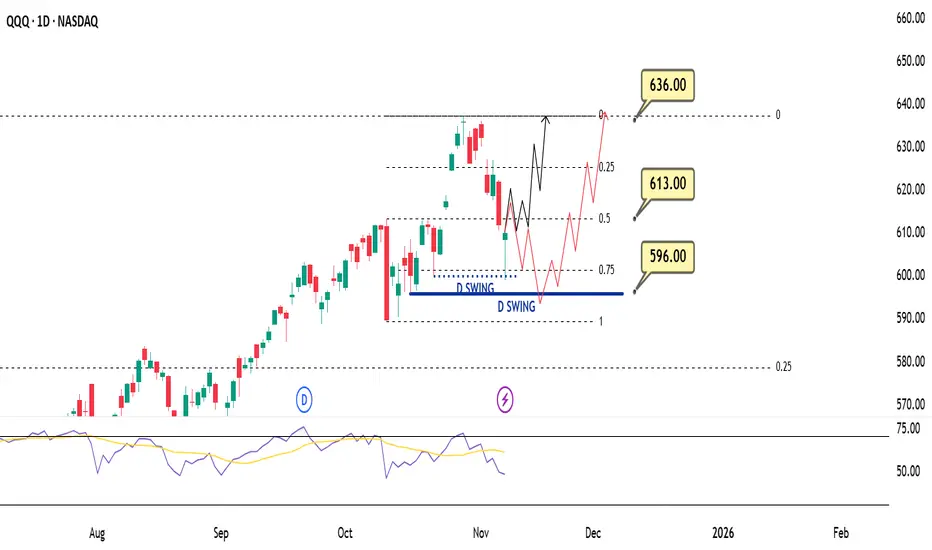
Weekly QQQ (US100) Outlook - Prediction (09 NOV)Weekly QQQ Outlook - Prediction (09 NOV)
📊 Market Sentiment
Market sentiment remains slightly bearish as expectations for a December rate cut may be postponed into 2026. We have seen some sell-offs, likely due to hedging or profit-taking activity. However, the market experienced a healthy bounce last Friday, as anticipated in my previous Daily SPY Outlook on November 7.
Today, Trump announced that American citizens, excluding high-income individuals, will receive a $2,000 payment. This news could inject additional liquidity into risk assets, similar to what occurred during his first term. In my opinion, this development may create a short-term bullish narrative for the markets.
📈 Technical Analysis
Price retraced throughout the week and reached the 600 level. The 601 zone represents the most discounted range (based on my quarterly range theory, 0.75 fib level), which I consider an optimal buy area. This level also aligns with daily swing liquidity, and the recent reaction suggests a potential move toward new all-time highs.
📌 Game Plan
I’m considering two possible scenarios for this week:
Scenario 1 (Black Line):
In my opinion, the price now has enough momentum to extend higher and create new all-time highs. Therefore, I’ll be watching for a daily close above the 613 level. If confirmed, I plan to buy QQQ calls targeting new highs.
Scenario 2 (Red Line):
If the price fails to close above 613, it may indicate that more accumulation is needed before another upward move. In that case, I’ll look to short (buy puts) toward the 596 level and observe whether we can bounce from there. Should that happen, I’ll then switch to calls and target higher prices.
💬For detailed insights and broader market context, please check my Substack link in profile.
⚠️ For educational purposes only. This is not financial advice.
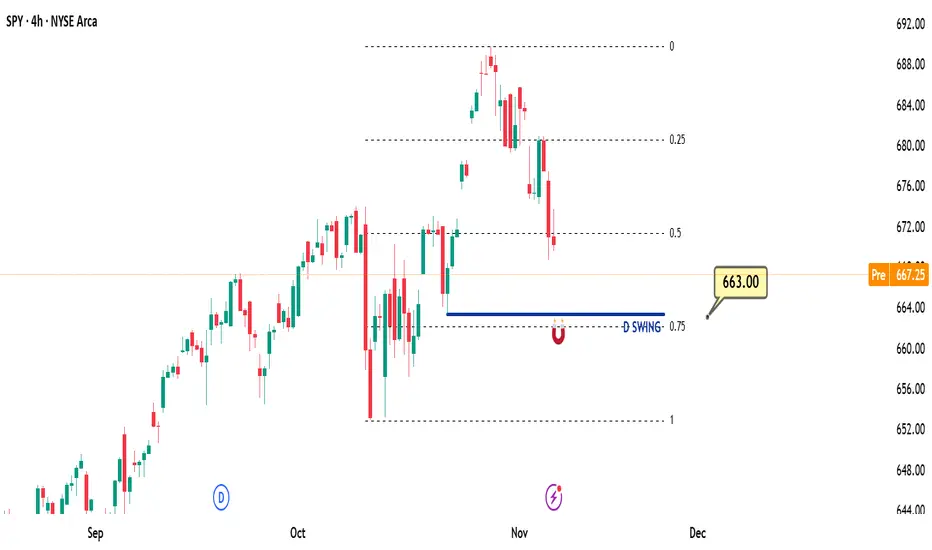
Daily SPY Outlook - Prediction (07 NOV)Daily SPY Outlook - Prediction (07 NOV)
📊 Market Sentiment
Market sentiment is slightly bearish as expectations for a December rate cut may be delayed into 2026. We have seen some sell-offs, likely due to hedging or profit-taking activity.
📈 Technical Analysis
Price is currently pulling back from the all-time high and moving within the equilibrium zone near the 670 level, which acts as short-term support. This is where I think accumulation may occur.
📌 Game Plan
In my opinion, price could reach the 663 level before showing a potential rebound. Therefore, I plan to stay short-biased toward 663, as puts might perform well today — unless I see a strong 4H candle close after the market open.
💬For detailed insights and broader market context, please check my Substack link in profile.
⚠️ Disclaimer: For educational purposes only. This is not financial advice.
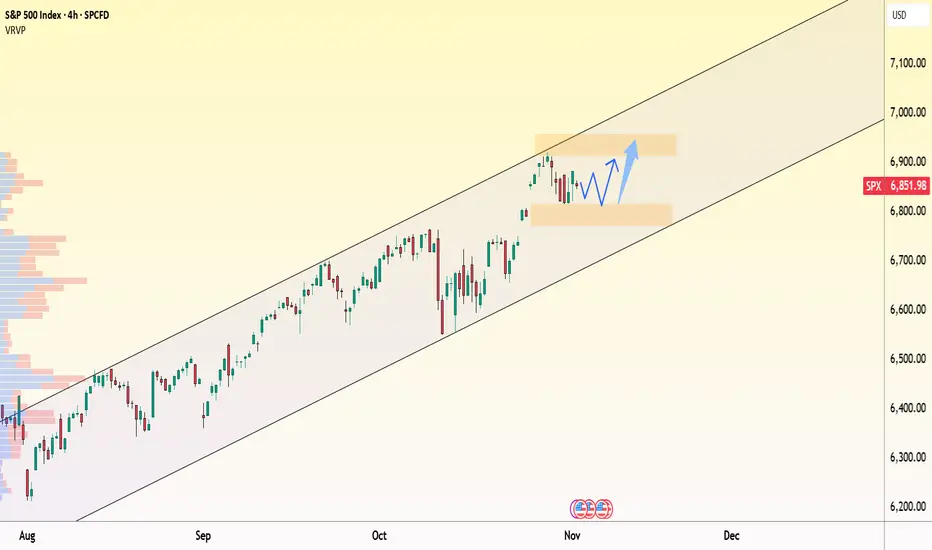
SPX:uptrend remains intact – consolidating for the next breakoutOn the 4-hour chart, the S&P 500 (SPX) continues to move firmly within its ascending channel , with the current range around 6,850–6,900 representing a healthy pause after a strong rally. The nearest support sits at 6,800, where buyers previously stepped in, while short-term resistance remains near 6,900.
From a news perspective, the rally is still being driven by tech and AI sectors , especially after the Amazon–OpenAI partnership deal , which reignited positive sentiment across the market. However, investors remain cautious ahead of upcoming U.S. ADP employment and ISM PMI data , which could influence the Fed’s next rate-cut decision.
Overall, the technical structure still supports an upward bias: SPX is consolidating between 6,800–6,900 before potentially breaking toward the 7,000-point zone , aligning with the upper boundary of the trend channel.
As long as the 6,800 support holds, the market retains room for another bullish leg in the sessions ahead, backed by renewed capital inflows into leading sectors.
Nasdaq-100 (NDX) Weekly Chart 2025 Chart Context
This weekly timeframe analysis of the Nasdaq-100 Index (NDX) forms a key pillar in our 2025 macro analysis series. Following the breakout structure seen in TOTAL, TOTAL2, BTC.D, and US10Y, this chart utilizes 2 Fibonacci tools (1 trend-based extensions and 1 retracement) to project potential corrective and expansion scenarios.
Fibonacci Tools Used:
Fibonacci Retracement : Applies to the recent smaller swing to determine micro retracement zones and cluster supports.
0=20674 and 100=10504
Trend-Based Fibonacci Extension: Drawn using a three-leg structure (point A= 3993 to B=16724 to C10504) to forecast upside targets beyond ATH.
All take-profit (TP) levels: TP1 (~23,400), TP2 (~26,700), and TP3 (~30,344.49)—are located at confluence zones where Fibonacci levels from different tools align, reinforcing their validity and strength.
There is a 4TP above all the Visible TPs
Key price references:
0% retracement: ~20,674.71
Next Resistance ~23,400 (confluence of extensions and psychological resistance)
Projected TPs:
1TP=~23,400,
2TP=~26,700,
3TP=~30,344.49,
4TP=44000
Support/Resistance:
Red zone: ~16,700–18,300 (historical S/R and correction target and Fib Confluences)
Resistance zone: ~23,000–23,400 ,
22000(ATH area)
Key Technical Observations:
Fibonacci Retracement from ~20674 to ~15732 marks the initial corrective range.
Trend-Based Extensions forecast:
TP1 (~23,400): First breakout resistance
TP2 (~26,700): Medium-term expansion zone
TP3 (~30,344): Long-term target if macro tailwinds persist
Scenario Pathways:
Bullish Continuation: Breaks above ATH to reach TP2/TP3
Healthy Correction: Pullback to ~20,600 or deeper ~18,300 before resumption
Deep Correction: Revisits ~16,700 zone if macro environment deteriorates
Fundamental Context:
Tech Stocks & Economic Sentiment: NDX is often the first to move during liquidity expansions. Its performance signals risk-on behavior across global equity markets.
Rate Cuts in 2025: With anticipated Fed rate cuts, tech stocks are primed for inflows. Forward earnings valuations rise, justifying extended upside in high-beta tech.
AI Boom & Earnings Growth: Nasdaq is heavily weighted toward AI, cloud, and semiconductors—sectors expected to lead earnings surprises.
NDX Influence on Gold and Crypto
When NDX rallies:
Crypto: Risk appetite improves. Capital rotation flows into altcoins and layer-1 assets.
Bitcoin: Often sees parallel inflows, especially during strong tech rallies (e.g., 2020).
TOTAL & TOTAL3: Begin breakout patterns if NDX continues to surge.
Gold: May stall or correct as investors favor risk assets. However, gold still holds due to macro hedging and real yield pressures.
When NDX corrects:
Crypto: Volatility spikes. Altcoins bleed faster.
Bitcoin: Short-term dip but may decouple if viewed as digital gold.
Gold: Benefits from flight-to-safety behavior.
US10Y: Often reacts inversely to NDX moves—used for confirmation.
Search Highlights (2024–2025):
Institutions view NDX correction as signal to rotate into commodities (incl. gold).
Cross-market correlations show NDX peaks often precede crypto mini-rallies.
De-risking from NDX often triggers gold strength, especially in geopolitical or inflationary backdrops.
Bias & Strategy Implication
Primary Bias: Bullish
Expecting upside continuation to 26,700–30,000 zone
Multiple correction opportunities are present even during rally
Strategic Actions:
Monitor for correction to yellow/red zones for accumulation
Use NDX behavior as leading macro signal for crypto rotations
Watch resistance at 23,400 closely; breakout confirms trend extension
Time Horizon
Short-Term (1–2 months): Watch for breakout or correction to ~20,600–18,300
Mid-Term (3–6 months): Probable test of ~26,700
Long-Term (6–12 months): Potential expansion to ~30,344.49
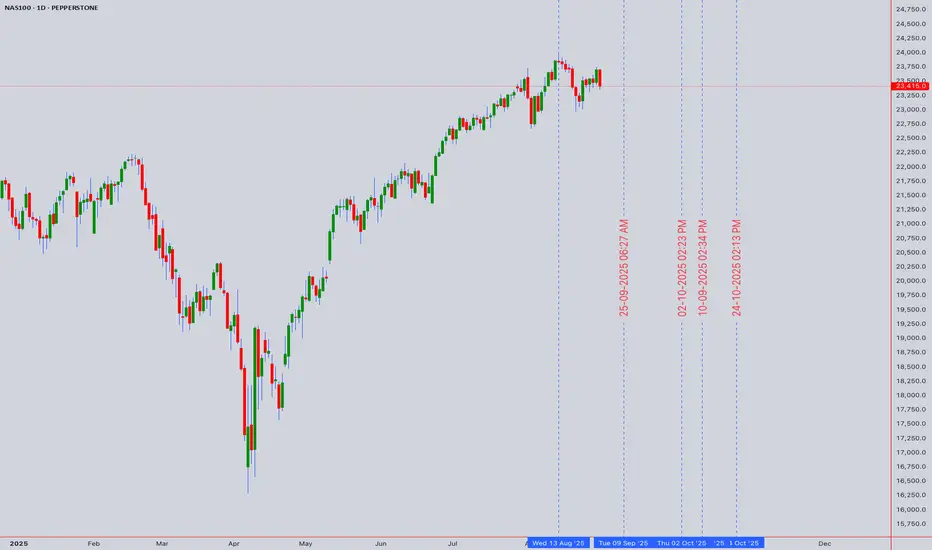
NAS100 Technical Analysis Report - NASDAQ & US Market# NAS100 Technical Analysis: NASDAQ Comprehensive Multi-Timeframe Trading Strategy
Executive Summary
Current Price: 23,415.0 (August 30, 2025, 12:54 AM UTC+4)
Market Sentiment: Cautiously Bullish with Rate Cut Optimism
Primary Trend: Uptrend with consolidation characteristics
Key Catalyst: Fed Chair Powell's Jackson Hole speech signaling potential September rate cut
The NASDAQ-100 continues to demonstrate resilience following Fed Chair Jerome Powell's dovish signals at Jackson Hole, with markets pricing in high probability of September rate cuts. The index benefits from renewed optimism in technology sectors and artificial intelligence themes, though elevated valuations warrant selective positioning.
Market Context & Fundamental Backdrop
Federal Reserve Policy Outlook
Following Powell's Jackson Hole speech, markets have significantly increased bets on a September rate cut. The Fed Chair indicated that "conditions may warrant" interest rate cuts, with the balance of risks to employment and inflation shifting. Current federal funds rate remains at 4.25%-4.50%, but CME FedWatch Tool shows high probability of cuts beginning in September 2025.
Economic Environment
The US economy has shown resilience despite policy uncertainties, with the dual mandate of the Fed becoming more balanced. Labor market data shows some "unusual" behavior that could become concerning, supporting the case for monetary policy adjustment.
Technology Sector Dynamics
The artificial intelligence boom remains robust, providing fundamental support for NASDAQ constituents. However, chipmaker volatility has created intermittent pressure on the index, requiring careful sector rotation analysis.
Market Performance Context
Recent trading sessions have shown volatility, with the NASDAQ experiencing both significant gains and pullbacks. The index closed at 21,449.29 in late August trading sessions, demonstrating the current consolidation phase around elevated levels.
Technical Analysis Framework
Japanese Candlestick Analysis
Weekly Pattern: Long-legged doji formation indicating indecision at current levels
Daily Pattern: Inside bar sequences suggesting consolidation before next major move
Intraday Patterns: Morning star and evening star formations frequent in 4H timeframe
Volume Analysis: Average volume during recent consolidation phase
Elliott Wave Analysis
Primary Wave Structure:
Major Degree: Wave 5 of secular bull market potentially in final stages
Intermediate Degree: Subwave 5 of major Wave 5 showing extension characteristics
Minor Degree: Currently in subwave 4 correction within intermediate Wave 5
Wave Count Analysis:
Impulse Wave: Completed from 2020 lows to recent highs
Corrective Phase: Current consolidation representing Wave 4 of larger structure
Target Projection: Wave 5 completion targeting 25,000-26,000 zone
Critical Levels: Wave 4 support at 22,800-23,200 maintains bullish count
Harmonic Pattern Recognition
Active Harmonic Structures:
Bullish Cypher Pattern: Potential completion at 22,900-23,100 zone
ABCD Extension: Current formation targeting 24,200-24,500
Potential Bearish Gartley: Formation risk above 24,800 indicating reversal
Fibonacci Confluence Analysis:
- 61.8% retracement of major swing: 23,150
- 50% retracement level: 23,400 (current area of interest)
- 38.2% retracement: 23,650
- 1.618 extension target: 24,300-24,500
Wyckoff Method Analysis
Phase Assessment: Accumulation Phase D - Testing resistance
Market Structure:
- Sign of Strength (SOS) evident on rate cut optimism
- Last Point of Support (LPS) established around 23,000
- Backup to Edge of Creek (BUE) tests showing institutional accumulation
- Spring action potentially completed in August lows
Composite Operator Activity: Evidence of large player accumulation during recent weakness
W.D. Gann Technical Analysis
# Square of 9 Application
Current Position: 23,415.0 = 152.98° on the Gann wheel
Critical Resistance Levels:
- 23,409 (153°) - immediate geometric resistance
- 23,716 (154°) - intermediate resistance zone
- 24,025 (155°) - major resistance confluence
Key Support Levels:
- 23,104 (152°) - immediate geometric support
- 22,801 (151°) - strong support zone
- 22,500 (150°) - major psychological and geometric support
# Time Theory Application
Critical Time Cycles:
- September 3-6: 90-degree time angle from recent high
- September 21: Autumn equinox - natural market turning point
- October 12-15: 144-degree time cycle completion
- November 2-8: 180-degree cycle from major low
# Price and Time Squaring Analysis
Square Root of Price: √23,415.0 = 152.98
Next Significant Square Levels:
- 154² = 23,716 (key resistance zone)
- 155² = 24,025 (intermediate target)
- 156² = 24,336 (extended resistance)
- 160² = 25,600 (long-term target)
Support Square Levels:
- 152² = 23,104 (immediate support)
- 151² = 22,801 (strong support)
- 150² = 22,500 (major support)
# Gann Angle Analysis
Primary Angles from Major Low:
- 1x1 Angle: Providing dynamic support around 23,200
- 2x1 Angle: Resistance trend line near 23,800
- 1x2 Angle: Long-term support at 22,600
Ichimoku Kinko Hyo Analysis
Cloud Configuration:
Tenkan-sen (9): 23,425 - Price slightly below, neutral bias
Kijun-sen (26): 23,380 - Price above, mild bullish confirmation
Senkou Span A: 23,402 (cloud top)
Senkou Span B: 23,150 (cloud bottom)
Chikou Span: Above price action 26 periods ago (bullish)
Assessment: Price trading at cloud top resistance with mixed signals requiring breakout confirmation for directional clarity.
Multi-Timeframe Technical Indicator Analysis
5-Minute Chart (Scalping Focus)
RSI(14): 51.3 - Neutral territory with slight bullish bias
VWAP: 23,408 - Price oscillating around VWAP equilibrium
Bollinger Bands: Middle band at 23,410, bands contracting (low volatility environment)
Stochastic: 48.2 in neutral zone
Volume: Below average, typical for consolidation phase
Key Scalping Levels:
Micro Resistance: 23,435, 23,460, 23,485
Micro Support: 23,390, 23,365, 23,340
15-Minute Chart (Scalping Focus)
MACD: Histogram near zero line, momentum neutral
Williams %R: -52% indicating no extreme conditions
Moving Averages: EMA(20) converging with SMA(20) around 23,400
Volume Profile: High volume node at 23,380-23,430
Scalping Strategy Levels:
Long Bias Zone: 23,385-23,405
Short Bias Zone: 23,445-23,465
Breakout Alerts: Above 23,480 (bullish) / Below 23,360 (bearish)
1-Hour Chart (Day Trading)
RSI(14): 54.7 - Slight bullish momentum without overbought conditions
VWAP: 23,395 providing dynamic support
ADX(14): 28.3 indicating moderate trend strength
Parabolic SAR: Below price at 23,350 (bullish signal)
Day Trading Framework:
Primary Resistance: 23,500-23,550
Secondary Resistance: 23,650-23,700
Primary Support: 23,250-23,300
Secondary Support: 23,100-23,150
4-Hour Chart (Swing Trading)
RSI(14): 58.9 in bullish territory but not overbought
MACD: Positive momentum with slight bullish divergence forming
Bollinger Bands: Price near upper band, expansion needed for continuation
Ichimoku: Price at cloud resistance requiring break for bullish confirmation
Swing Trading Levels:
Key Resistance Zone: 23,700-23,800
Breakout Target: 24,000-24,200 on sustained break
Support Structure: 23,200-23,300
Stop Loss Consideration: Below 23,100 invalidates bullish structure
Daily Chart (Position Trading)
RSI(14): 61.4 showing healthy bullish momentum
MACD: Positive with momentum building
Volume: Consolidation pattern with average participation
Moving Averages: All major MAs (20, 50, 100, 200) aligned bullishly
Position Trading Analysis:
Triangle Pattern: Ascending triangle formation approaching apex
Breakout Targets: 24,500-25,000 on upside resolution
Support Defense: 23,000-23,200 critical for trend continuation
Time Factor: Resolution expected within 2-3 weeks
Weekly Chart (Long-term Analysis)
RSI(14): 65.8 approaching overbought but sustainable
MACD: Strong positive momentum with room for extension
Long-term Trend: Powerful uptrend since 2020 lows intact
Major Resistance: 25,000-25,500 psychological zone
Monthly Chart (Strategic View)
RSI(14): 71.2 significantly overbought (caution warranted)
Long-term Structure: Multi-year cup and handle completion
Secular Target: 28,000-30,000 based on pattern measurement
Major Support: 20,000-21,000 long-term trend support
Comprehensive Support and Resistance Analysis
Primary Support Structure
1. 23,380-23,420: Kijun-sen and VWAP confluence (immediate)
2. 23,300-23,350: Previous consolidation zone with volume
3. 23,200-23,250: Triangle support and trend line confluence
4. 23,100-23,150: Cloud bottom and Fibonacci support
5. 23,000-23,050: Major psychological level and institutional interest
6. 22,800-22,900: Elliott Wave 4 support and harmonic completion
7. 22,500-22,600: Extended support and Gann square level
Primary Resistance Structure
1. 23,450-23,480: Immediate intraday resistance
2. 23,550-23,600: Short-term resistance and previous reaction high
3. 23,700-23,750: Triangle resistance and Gann confluence
4. 23,900-24,000: Intermediate resistance and psychological level
5. 24,200-24,300: Major resistance zone and measured targets
6. 24,500-24,700: Extended targets and harmonic projections
7. 25,000-25,200: Major psychological resistance and long-term targets
Weekly Trading Strategy (September 2-6, 2025)
Monday, September 2, 2025 (Labor Day - US Markets Closed)
Market Environment: Limited trading due to US holiday
Strategy Focus: Pre-positioning for Tuesday's resumed activity
International Markets: Monitor for any overnight developments
Pre-Market Analysis:
Gap Scenarios: Assess any gap formation from Friday's close
Global Sentiment: Monitor Asian and European markets for cues
News Flow: Fed speakers or economic data releases
Tuesday, September 3, 2025
Market Environment: Resumption of full trading after holiday
Primary Strategy: Range trading with breakout preparation
Volatility Expectation: Above average due to holiday catch-up
Intraday Trading Strategy:
Opening Range: 23,350-23,480 expected
Long Setup: 23,380-23,400
- Stop Loss: 23,350
- Target 1: 23,450 (1:2 R/R)
- Target 2: 23,500 (1:3.5 R/R)
Short Setup: 23,460-23,480
- Stop Loss: 23,510
- Target 1: 23,400 (1:1.2 R/R)
- Target 2: 23,350 (1:2.2 R/R)
Key Levels to Watch:
Breakout Above: 23,500 targets 23,600-23,650
Breakdown Below: 23,320 targets 23,250-23,200
Wednesday, September 4, 2025
Market Environment: Mid-week momentum potential
Primary Strategy: Trend following with momentum confirmation
Focus: Economic data and Fed speakers impact
Trading Approach:
Bullish Scenario: Break above 23,500 with volume
- Entry: 23,510-23,530
- Stop: 23,450
- Targets: 23,600, 23,700, 23,800
Bearish Scenario: Break below 23,300 with momentum
- Entry: 23,290-23,270
- Stop: 23,330
- Targets: 23,200, 23,100, 23,000
Risk Management: Reduce position sizes by 30% if range-bound continues
Thursday, September 5, 2025
Market Environment: Potential high-volatility day
Primary Strategy: Breakout trading with volume confirmation
Critical Factor: Triangle pattern resolution expected
Triangle Breakout Strategy:
Upside Breakout: Above 23,650
- Volume Requirement: 150% of 20-day average
- Initial Target: 23,800-23,850
- Extended Target: 24,000-24,200
- Stop Loss: 23,550
Downside Breakdown: Below 23,200
- Volume Requirement: 130% of 20-day average
- Initial Target: 23,000-22,950
- Extended Target: 22,800-22,700
- Stop Loss: 23,280
Position Management:
- Scale into positions on confirmed breakouts
- Trail stops aggressively after first target achieved
- Monitor sector rotation for continuation signals
Friday, September 6, 2025
Market Environment: Week-end positioning and profit-taking
Primary Strategy: Consolidation trading and weekly close analysis
Focus: Jobs data potential and weekly settlement
End-of-Week Strategy:
Weekly Close Bullish: Above 23,500 sets up next week advance
Weekly Close Neutral: 23,300-23,500 maintains current pattern
Weekly Close Bearish: Below 23,300 suggests pattern failure
Day Trading Approach:
Morning Session: Follow Thursday's breakout direction
Midday: Range trading within established boundaries
Final Hour: Position adjustments for weekend risk
Non-Farm Payrolls Impact:
Strong Data: Could delay Fed cuts, potential market negative
Weak Data: Supports Fed cut narrative, likely market positive
In-Line Data: Maintains current rate cut expectations
Advanced Risk Management Framework
Position Sizing Matrix
Risk Allocation by Timeframe:
5M Scalping: 0.25-0.5% of capital per trade
15M Scalping: 0.5-0.75% of capital per trade
1H Day Trading: 1-1.5% of capital per trade
4H Swing Trading: 1.5-2.5% of capital per trade
Daily Position Trading: 2.5-3.5% of capital per trade
Dynamic Stop Loss Framework
Volatility-Adjusted Stops:
Low Volatility (<1% ATR): Stops at 0.75% of entry
Medium Volatility (1-2% ATR): Stops at 1.25% of entry
High Volatility (>2% ATR): Stops at 2% of entry
Timeframe-Specific Stops:
5-Minute Charts: 40-60 points maximum
15-Minute Charts: 80-120 points maximum
1-Hour Charts: 150-250 points maximum
4-Hour Charts: 300-450 points maximum
Daily Charts: 600-900 points maximum
Profit-Taking Methodology
Systematic Profit Realization:
First Target (40%): 1:1.5 Risk/Reward ratio
Second Target (35%): 1:2.5 Risk/Reward ratio
Third Target (25%): 1:4+ Risk/Reward ratio
Trailing Implementation: After second target achievement
Maximum Exposure Limits
Daily Risk Limits:
Total Portfolio: Maximum 5% risk across all positions
Single Strategy: Maximum 3% risk concentration
Sector Concentration: Maximum 40% in tech-related trades
Emergency Stop: -2% daily account drawdown triggers cessation
Geopolitical and Economic Risk Assessment
Federal Reserve Policy Impact
September FOMC Meeting: High probability of 25bp rate cut based on recent communications
Policy Path: Markets pricing 2-3 cuts through end of 2025
Communication Risk: Any hawkish surprises could trigger sharp correction
Independence Concerns: Political pressure on Fed policy creates uncertainty
Economic Data Dependencies
Labor Market: "Unusual" behavior noted by Powell requires monitoring
Inflation Trends: Sticky services inflation remains concern
GDP Growth: Resilience continues but tariff impacts uncertain
Consumer Spending: Holiday season performance critical for Q4
Geopolitical Considerations
Trade Policy: Tariff implementation timeline and magnitude
China Relations: Technology sector exposure to policy changes
Energy Security: Minimal direct impact on NASDAQ constituents
Dollar Dynamics: Strength/weakness affecting multinational earnings
Technology Sector Risks
AI Regulation: Potential oversight affecting major constituents
Semiconductor Cycle: Global chip demand and supply chain risks
Cybersecurity: Increasing threat landscape affecting valuations
Competition: Antitrust scrutiny on major tech platforms
Sectoral Analysis and Rotation Themes
NASDAQ 100 Sector Breakdown
Technology (45%): Apple, Microsoft, NVIDIA, Meta driving performance
Communication Services (15%): Google, Netflix, streaming platforms
Consumer Discretionary (12%): Amazon, Tesla leading components
Healthcare (8%): Biotech and medical device innovation
Other Sectors (20%): Diversified exposure across growth themes
Current Outperformers
1. Artificial Intelligence: NVIDIA, Microsoft, Google benefiting from AI boom
2. Cloud Computing: Amazon Web Services, Microsoft Azure expansion
3. Digital Advertising: Meta, Google capturing online spending shift
4. Electric Vehicles: Tesla maintaining technological leadership
Underperforming Areas
1. Traditional Software: Legacy platforms facing cloud migration pressure
2. Hardware Manufacturers: Margin pressure from supply chain costs
3. Streaming Services: Subscriber growth saturation concerns
4. Biotech: Regulatory approval timelines creating uncertainty
Rotation Indicators
Growth vs Value: Quality growth at reasonable prices favored
Large Cap vs Small Cap: Mega-cap technology leadership maintained
Secular vs Cyclical: Long-term secular themes outperforming cycles
Advanced Pattern Recognition and Trading Setups
Ichimoku-Based Strategies
Cloud Breakout Setup:
Bullish Signal: Price above cloud with Tenkan above Kijun
Entry: Break above 23,450 with volume confirmation
Stop: Below cloud at 23,150
Target: Measured move to 24,200-24,500
Kijun-sen Bounce:
Setup: Price return to Kijun-sen (23,380) with support
Entry: Bounce confirmation above 23,400
Stop: Below 23,350
Target: Previous high resistance at 23,650
Gann-Based Trading Approaches
Square of 9 Methodology:
Long Trades: Buy at 152° (23,104) targeting 154° (23,716)
Short Trades: Sell at 154° (23,716) targeting 152° (23,104)
Breakout Trades: Above 154° targets 155° (24,025)
Time Cycle Trading:
Major Turns: September 21 equinox reversal window
Minor Cycles: 90-degree angles creating intraweek pivots
Momentum Confirmation: Volume spikes during cycle completions
Wyckoff Accumulation/Distribution
Phase D Characteristics:
Testing Supply: Price probing resistance without heavy volume
Institutional Activity: Large lot accumulation on weakness
Markup Preparation: Successful tests lead to significant advances
Distribution Warning Signs:
Climactic Volume: Heavy selling on any approach to 25,000
Weakness Signs: Unable to hold gains on good news
Phase A Risk: Sharp reversal from resistance levels
Market Microstructure and Execution Considerations
High-Frequency Trading Impact
Algorithm Activity Zones:
23,000 Level: Heavy HFT support algorithm activity
23,500 Level: Resistance algorithm concentration
24,000 Level: Major psychological algorithm participation
Optimal Execution Windows:
9:30-10:00 EST: Maximum volatility and opportunity
11:00-11:30 EST: Mid-morning momentum continuation
14:30-15:00 EST: European close overlap activity
15:30-16:00 EST: Final hour positioning
Liquidity Considerations
High Liquidity Zones: 23,300-23,500 range with tight spreads
Reduced Liquidity: Above 24,000 and below 23,000 requiring careful sizing
After-Hours Trading: Limited liquidity requiring smaller position sizes
Order Flow Analysis
Institutional Patterns:
Accumulation: Evidence of large block buying 23,200-23,400
Distribution Zones: Monitor for heavy selling above 23,700
Momentum Algorithms: Active participation on breakout moves
Technology Integration and Trading Tools
Essential Trading Platforms
1. TradingView: Comprehensive charting with advanced indicators
2. Think or Swim: Professional-grade execution and analysis
3. Interactive Brokers: Direct market access and low commissions
4. Bloomberg Terminal: Institutional-grade data and news flow
Critical Alert Systems
Price-Based Alerts:
- Triangle breakout: 23,650 (bullish) / 23,200 (bearish)
- Psychological levels: 23,500, 24,000, 24,500
- Gann squares: 23,104, 23,716, 24,025
Volume-Based Alerts:
- Unusual volume spikes (>200% of 20-day average)
- Block trade notifications (>$10M trades)
- Dark pool activity indicators
News and Event Alerts:
- Fed speaker comments and policy communications
- Economic data releases (employment, inflation, GDP)
- Earnings announcements from major NASDAQ constituents
- Geopolitical developments affecting technology sector
Advanced Analysis Tools
Options Flow: Monitor unusual options activity for directional clues
Futures Positioning: Track institutional positioning in NQ futures
Sector Rotation: Monitor NASDAQ sector ETF performance relative to index
International Correlation: Track correlation with technology indices globally
Seasonal and Calendar Considerations
September Seasonality
Historical data shows September as traditionally weak month for equities, though technology sectors often show resilience. Current rate cut optimism may override seasonal weakness.
Federal Reserve Calendar
September 17-18: FOMC Meeting (high probability of rate cut)
October 29-30: Next FOMC Meeting
December 17-18: Final 2025 FOMC Meeting
Earnings Season Timeline
Q3 2025 Reporting: October-November period critical for NASDAQ constituents
Key Companies: Apple, Microsoft, NVIDIA, Google, Amazon reporting impact
Guidance Focus: AI spending, cloud growth, consumer demand trends
Holiday Impact Calendar
Labor Day (Sep 2): US markets closed
Columbus Day (Oct 14): Bond markets closed, equities open
Thanksgiving (Nov 27-28): Shortened trading sessions
Christmas/New Year: Year-end positioning effects
Conclusion and Strategic Outlook
The NASDAQ-100 stands at a critical inflection point, benefiting from Fed Chair Powell's dovish pivot while facing elevated valuation concerns and seasonal headwinds. The technical picture presents a compelling consolidation pattern with multiple breakout scenarios, requiring careful risk management and tactical positioning.
Key Investment Themes for September:
1. Fed Policy Pivot: Rate cut cycle beginning supports risk assets and growth stocks
2. AI Revolution Continuation: Technology leadership themes remain intact
3. Triangle Resolution: Current consolidation pattern approaching decision point
4. Seasonal Navigation: September weakness vs. Fed optimism dynamic
Tactical Trading Priorities:
Range Trading: Capitalize on 23,300-23,650 range until breakout
Breakout Preparation: Position for triangle resolution with volume confirmation
Risk Management: Elevated levels require disciplined position sizing
Sector Selection: Focus on AI beneficiaries and Fed-sensitive growth names
Medium-Term Outlook (1-3 Months):
The combination of Fed policy accommodation, robust AI/technology themes, and strong corporate fundamentals provides a constructive backdrop for NASDAQ advancement. Technical analysis suggests potential for significant upside toward 24,500-25,000 on successful breakout, though any hawkish Fed surprise or geopolitical shock could trigger sharp corrections.
Risk Scenario Analysis:
Bull Case: Fed cuts + AI momentum = targets 25,000-26,000
Base Case: Consolidation 23,000-24,000 through October
Bear Case: Fed disappointment + valuation concerns = correction to 21,500-22,000
Strategic Positioning Recommendations:
1. Maintain tactical long bias with disciplined risk management
2. Focus on high-quality technology leaders with AI exposure
3. Prepare for increased volatility around Fed meetings and earnings
4. Monitor triangle pattern resolution for significant directional moves
The multi-timeframe technical analysis framework presented provides robust tools for navigating the current market environment. Success will depend on maintaining discipline around the identified support/resistance levels while adapting to the evolving Fed policy landscape and technology sector dynamics.
Traders should remain flexible and prepared for both continuation and reversal scenarios, with particular attention to volume confirmation on any major breakout attempts. The convergence of technical patterns, fundamental catalysts, and seasonal factors creates a complex but opportunity-rich environment for skilled practitioners.
---
*This comprehensive analysis integrates multiple technical methodologies with current market fundamentals. All trading recommendations should be implemented within individual risk tolerance parameters and adapted to evolving market conditions. The technology-focused nature of the NASDAQ requires particular attention to sector-specific developments and regulatory considerations.*
---
For individuals seeking to enhance their trading abilities based on the analyses provided, I recommend exploring the mentoring program offered by Shunya Trade. (Website: shunya dot trade)
I would appreciate your feedback on this analysis, as it will serve as a valuable resource for future endeavors.
Sincerely,
Shunya.Trade
Website: shunya dot trade
---
Disclaimer: This post is intended solely for educational purposes and does not constitute investment advice, financial advice, or trading recommendations. The views expressed herein are derived from technical analysis and are shared for informational purposes only. The stock market inherently carries risks, including the potential for capital loss. Therefore, readers are strongly advised to exercise prudent judgment before making any investment decisions. We assume no liability for any actions taken based on this content. For personalized guidance, it is recommended to consult a certified financial advisor.