Volatility
NQ Power Range Report with FIB Ext - 5/28/2025 SessionCME_MINI:NQM2025
- PR High: 21480.00
- PR Low: 21453.50
- NZ Spread: 59.5
Key scheduled economic events:
14:00 | FOMC Meeting Minutes
Follow-through on daily print value increase rotation
- Closing in on 21600 front run pivot from previous week
Session Open Stats (As of 12:15 AM 5/28)
- Session Open ATR: 450.12
- Volume: 19K
- Open Int: 274K
- Trend Grade: Neutral
- From BA ATH: -5.3% (Rounded)
Key Levels (Rounded - Think of these as ranges)
- Long: 22096
- Mid: 20383
- Short: 19246
Keep in mind this is not speculation or a prediction. Only a report of the Power Range with Fib extensions for target hunting. Do your DD! You determine your risk tolerance. You are fully capable of making your own decisions.
BA: Back Adjusted
BuZ/BeZ: Bull Zone / Bear Zone
NZ: Neutral Zone
Best Practice: Prepare, Assess, Plan Then TradeTraders are often eager to jump straight into the next trading session but this may not always be the best option to chose. It can be more beneficial to follow a regular pre-trading routine to note down important scheduled events, establish current trends, as well as meaningful support and resistance price levels, and importantly this doesn’t have to be time consuming.
This is not meant to be that trading ‘holy grail’ but more of an addition to your existing trading process or plan. Having a regular routine to establish important levels, indicator set-ups and price trends to be aware of during your trading day may help you make trading decisions in a more effective way.
This pre trading routine can also be helpful for traders that take longer term positions, as it’s still important to consider the longer-term weekly perspectives as well.
This routine can be carried out at the weekend and then monitored and, where necessary, modified during the week as price action develops for the particular CFD(s) you are trading.
1. Keep Informed of Important Data Releases
If there are several CFD’s you regularly trade and tend to stick with, make sure you have as much information about those assets as possible before you start trading.
Consider utilising the Pepperstone trading calendar to help keep you informed of any economic releases/company earnings data that might impact the CFD you are trading before the week/session starts.
Once you know the scheduled events ahead, you can ask yourself,
Could these impact my trading?
Could the market reaction to this new information increase the volatility of the CFD I am about to trade or already have a position in?
How may this impact my risk?
Knowing what it is expected by the market before a particular important economic data release, such as US Non-farm Payrolls, can help you assess positioning going into the release, gauge market reaction to the data, and then be prepared for any potential price sentiment change and/or increased volatility.
2. Be Aware of Potential Support and Resistance Levels
Ahead of your trading day, consider running through the Pepperstone charts of the CFD’s you are considering trading and make a note of 3 support and resistance levels, that you identify as being meaningful. To help you we have set out an example Trading Template below.
Daily: Level: Reason: Current Trend: Current Thoughts:
Support
1st:
2nd:
3rd
Resistance
1st
2nd
3rd
Keep this next to your trading screen, so you are aware of particular levels that may act as support and resistance, if prices move in that direction. This can help you to improve trade entry or assist you with the placement of a stop loss or take profit order.
If these levels are broken at any time, you can update the template with any new support/resistance levels during the trading period.
3. Be Aware of the Daily Trends – Focus on Bollinger Bands
Using the direction of the daily Bollinger mid-average can be helpful to gauge the direction of the daily trend.
If the,
Mid-average is moving up = price uptrend
Mid-average is moving down = price downtrend
Mid-average is flat = possible price sideways range
The daily and weekly perspectives are the most important to be aware of, so it can be beneficial to analyse the charts from the longest timeframe into the shortest as this allows you to build a better understanding of the dominant trends.
You can also note these trends on the Trading Template, so it’s available to you when you are trading.
4. Follow the Same Process for All Other Timeframes - 4 Hour, 1 Hour, Even Shorter if it Suits Your Trading.
You can carry out the routine outlined in point 3, for any timeframes you are trading.
Things to note,
Are there any new trends suggested within a shorter term perspective by the Bollinger mid-average?
If the direction of a shorter term mid-average has changed, it may be an indication of either a change or resumption of a longer term price trend.
If this trend change also looks to be resuming within the longer term perspectives, this could be a more important signal, as the resumption of an existing longer term trend may mean a more extended move in that direction.
Be aware, confirmation of a price trend change within a longer term perspective might mean it could take longer and offer less trading opportunities, as initially price moves may be less aggressive in nature.
5. Where, Within the Various Timeframes is Price in Relation to the Bollinger Bands?
As we have highlighted in a previous commentary (please take a look our past posts), Bollinger Bands can highlight increasing price volatility within a trend.
Things to note regarding Bollinger Bands,
Are the upper or lower bands being touched by prices within any of the timeframes?
Within a sideways range (flat mid-average) this might suggest price has reached either a support or resistance level, with potential for a reversal.
While being touched, are the upper and lower bands starting to widen which indicates increasing price volatility, or contract, which indicates decreasing price volatility?
Remember - widening bands within a confirmed trend highlight increasing volatility, suggesting the current price move might continue for longer than you may anticipate, while contracting bands, point to decreasing volatility, which may lead to a reduction in a particular CFDs price movement.
Do the timeframes align?
If they do it may suggest a stronger trading opportunity is evident. CFDs within trending markets seeing increasing volatility tend to offer greater potential than those that aren’t.
In this scenario it maybe worthwhile considering only trading with the trend, not trying to pick bottoms or tops of markets, or if you do, consider a more cautious approach to your trading by reducing the size of your position and risk.
The material provided here has not been prepared in accordance with legal requirements designed to promote the independence of investment research and as such is considered to be a marketing communication. Whilst it is not subject to any prohibition on dealing ahead of the dissemination of investment research, we will not seek to take any advantage before providing it to our clients.
Pepperstone doesn’t represent that the material provided here is accurate, current or complete, and therefore shouldn’t be relied upon as such. The information, whether from a third party or not, isn’t to be considered as a recommendation; or an offer to buy or sell; or the solicitation of an offer to buy or sell any security, financial product or instrument; or to participate in any particular trading strategy. It does not take into account readers’ financial situation or investment objectives. We advise any readers of this content to seek their own advice. Without the approval of Pepperstone, reproduction or redistribution of this information isn’t permitted.
NQ Power Range Report with FIB Ext - 5/27/2025 SessionCME_MINI:NQM2025
- PR High: 21292.00
- PR Low: 21224.00
- NZ Spread: 152.0
Key scheduled economic events:
08:30 | Durable Goods Orders
10:00 | CB Consumer Confidence
Value increase and expected high volume following holiday weekend.
- Auctioning at Friday's high
Session Open Stats (As of 12:15 AM 5/27)
- Session Open ATR: 468.28
- Volume: 119K
- Open Int: 271K
- Trend Grade: Neutral
- From BA ATH: -6.6% (Rounded)
Key Levels (Rounded - Think of these as ranges)
- Long: 22096
- Mid: 20383
- Short: 19246
Keep in mind this is not speculation or a prediction. Only a report of the Power Range with Fib extensions for target hunting. Do your DD! You determine your risk tolerance. You are fully capable of making your own decisions.
BA: Back Adjusted
BuZ/BeZ: Bull Zone / Bear Zone
NZ: Neutral Zone
Nifty50 Market Update – Resistance AlertMy proprietary option pricing model, OptionSigma , identifies 25,200 as a key resistance level in the Nifty50 Index. Until this barrier is decisively broken, I won’t adopt a bullish stance.
🚨 Disclaimer: This is not a trade recommendation. Always conduct thorough research before making any trading decisions.
#nifty
Personal Trade Plan – Nifty50 25100 June Call OptionToday, I entered a long position in the Nifty50 25100 June (Monthly) Call option , securing an average price of ₹469.10 . I plan to accumulate additional lots at lower prices, with a strategy to hold until expiry.
📌 Disclaimer: This is not a trade recommendation. Please conduct independent research and assess risk factors before making any trading decisions.
#nifty50
Total3 Crypto Market CapWe know very well that Trump, at the moment, is able to move markets overnight. We also know well that such a market is difficult to navigate.
Nevertheless, we do have chart indications, as in this case:
- volatility, money inflow and others are in the middle.
- on the weekly, Total3 has bounced from the underlying structure, which may signify strength.
- the candle resting on the weekly FVG will be closed later.
- the indicators look good but not too good. Based on some altcoins (weekly), I see hope there.
- gray and delicate situation.
- best strategy: scalp, small profits, buy the dip and hold. Little or no leverage. Don't get hurt.
I will update to keep you posted on developments.
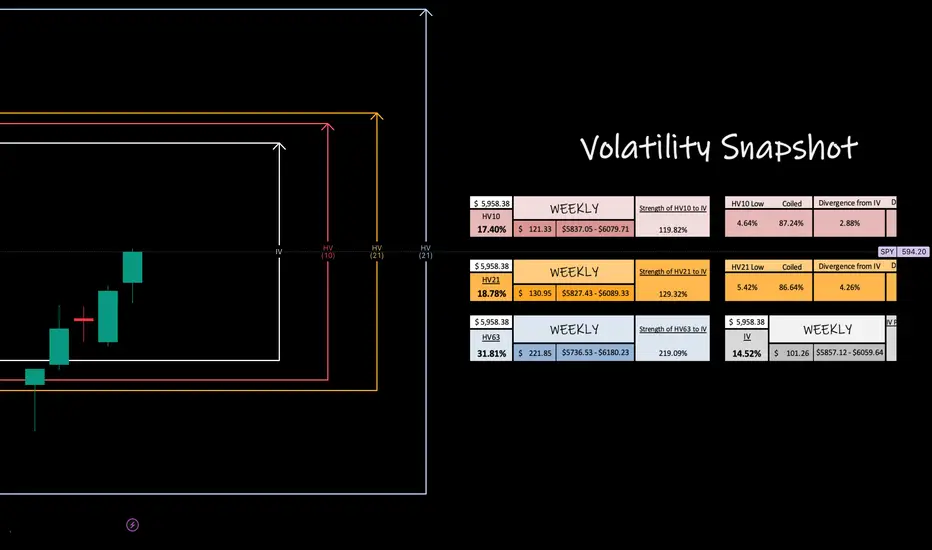
Weekly Volatility SnapshotVolatility, expressed through standard deviation, quantifies market elasticity and presents a level of probability and precision that humbles us all.
In my analysis, I track trending volatility to discern historical patterns (HV) and utilize them to anticipate future outcomes (IV). This weighted indicator provides a comprehensive and accurate range for observation.
When trending historical volatility expands or contracts around implied volatility, price action can be interpreted as positively or negatively compounded within the predicted implied range.
I measure this concept using the ‘strength’ of IV and calculate my implied range based on the current market elasticity. This system is adaptable to any IV condition, as it allows for a fair assessment of market movements and potential outcomes.
__________________________________
Last week, volatility increased slightly as bi-weekly trends picked up over monthly values -- the same near term trends with the major indices show strength within 8% of IV into this next week.
One thing to note: NASDAQ:MSFT NASDAQ:NVDA and NASDAQ:TSLA all show near term contraction under stated IV within the magnificent 7 while the rest show shorter term volatility as expansive.
What do you think the CBOE:VIX will do this next week?
___________________________________
For those interested in volatility analysis and the application of my system using weighted HV ranges to IV, I encourage you to BOOST and share this post, leave a comment, or follow me to join me on this journey!
We will weekly analyze our ranges under the VIX and engage in discussions.
S&P 500 Weekly PotentialVolatility, expressed through standard deviation, quantifies market elasticity and presents a level of probability and precision that humbles us all.
This week with SP:SPX bi-weekly trends have risen to just below our monthly values and are currently expansive over the markets IV prediction. Right now as I see it, HV10 is going resonate alongside our monthly values showing continued strength over IV. We could full regression to quarterly means as we move our of corrective territory then see consolidation to cool the markets down.
BOOST the post, drop a follow and comment, BUT don't circle back at the end of the week to revisit and observe how our trending markets preformed!
SPY Weekly PotentialVolatility, expressed through standard deviation, quantifies market elasticity and presents a level of probability and precision that humbles us all.
This week with AMEX:SPY bi-weekly trends have risen to just below our monthly values and are currently expansive over the markets IV prediction. Right now as I see it, HV10 is going resonate alongside our monthly values showing continued strength over IV. We could full regression to quarterly means as we move our of corrective territory then see consolidation to cool the markets down.
BOOST the post, drop a follow and comment, BUT don't forget to circle back at the end of the week to revisit and observe how our trending markets preformed!
Russel 2000 Weekly PotentailVolatility, expressed through standard deviation, quantifies market elasticity and presents a level of probability and precision that humbles us all.
This week with AMEX:IWM you can see that last week trending bi-weekly markets were more volatile than our monthly trending values. This could indicate regression to quarterly means, but for now shows a 15.02% premium advantage over current IV per move.
Bi-weekly, is as of now, only 10.81% off it's quarterly trend. However, it's important to observe that volatility can still consolidate under monthly in a poetic dance to coil up the monthly more on it's path in regression.
This is why in my charts you will notice a 'coiling' value under both HV10 and HV21 values.
BOOST the post, drop a follow and comment, BUT don't forget to circle back at the end of the week to revisit and observe how our trending markets preformed!
QQQ Weekly PotentialVolatility, expressed through standard deviation, quantifies market elasticity and presents a level of probability and precision that humbles us all.
This week with NASDAQ:QQQ we see that the shorter term trending volatility is resonating like SP:SPX and AMEX:SPY just under our monthly values. Range seems to be expanding allowing for cheaper premium capture per move happening. With any luck, we reflect and increase in volatility with up to quarterly means.
BOOST the post, drop a follow and comment, BUT don't forget to circle back at the end of the week to revisit and observe how our trending markets preformed!
iBIT Weekly PotentialVolatility, expressed through standard deviation, quantifies market elasticity and presents a level of probability and precision that humbles us all.
Now we move on to the world of BTC with a look at NASDAQ:IBIT
Here, as we have been observing an ongoing regression, you see that HV10 has expanded past HV21 and now IV is predicting more range expansion leading toward the volatility at quarterly means. Stay tuned, and I hope this helps visualize what I do.
BOOST the post, drop a follow and comment, BUT don't forget to circle back at the end of the week to revisit and observe how our trending markets preformed!
BITx Weekly PotentialVolatility, expressed through standard deviation, quantifies market elasticity and presents a level of probability and precision that humbles us all.
Now we move on to the world of BTC with a look at CBOE:BITX
Here, as we have been observing an ongoing regression, you see that HV10 has expanded past HV21 and now IV is predicting more range expansion leading toward the volatility at quarterly means. Stay tuned, and I hope this helps visualize what I do.
BOOST the post, drop a follow and comment, BUT don't forget to circle back at the end of the week to revisit and observe how our trending markets preformed!
Microsoft, Inc -- Weekly PotentialVolatility, expressed through standard deviation, quantifies market elasticity and presents a level of probability and precision that humbles us all.
I wanted to take a look at at least one of the magnificent 7s with the community this weekend, so I decided on NASDAQ:MSFT because it had the lowest IV of them all.
Lowest IV = best premium value, right? Well it can, but it can also be leading onto more consolidation especially after a big move up like NASDAQ:MSFT has recently done.
Here, we see that HV21 has just come out of it's regression to quarterly means and now is consolidating lower with bi-weekly coiling towards it's yearly lows.
See what I'm doing? Ill be watching for HV21 dropping and HV10 bottoming..there we will find our volatility bounce again. Some of the coolest magic happens when HV10 is at lows at does the HUGE swing back up to quarterly means. SO STAY TUNED!!
BOOST the post, drop a follow and comment, BUT don't forget to circle back at the end of the week to revisit and observe how our trending markets preformed!
$BNB liquidity sweepScalping on M15, quite a number liquidity at 620-650 region, a potential long scalp seem to be opened after the downward correction. A sweet short.
1.5RR to 2RR is possible. this is what the STIC indicator is showing. using the institutional liquidity zone line plot.
NFA and DYOR by the way.
$INJ on WeeklyThe asset bounced within the Demand zone on the Weekly, creating room for a possible rally up to the $20-25 area.
Volatility is still open but with steadily decreasing bearish pressure.
A Daily FVG overlaps with the Weekly FVG so as to create possible room for maneuver.
The widely used RSI has broken the barrier of a bearish trendline that has lasted since December 2023. Whether it maintains the trajectory will only be seen at the close of this week.
Funding rates positive.
Open Interests slightly up.
Detail not to be overlooked in the coming days: the market cap line is rising, but the price is lagging slightly. Positive sign.
Stable volume, with an improvement in the last two days. Very mild data.
With the whole crypto sector seemingly showing signs of life, I am confident of its uptrend.
Remember: until proven otherwise.
AEGISLOG - Aegis Logistics Ltd. (45 minutes chart, NSE) - LongAEGISLOG - Aegis Logistics Ltd. (45 minutes chart, NSE) - Long Position; short-term swing research idea.
Risk assessment: High {volatility risk}
Risk/Reward ratio ~ 2.63
Current Market Price (CMP) ~ 880
Entry limit ~ 870 to 860 (Avg. - 865) on May 22, 2025
1. Target limit ~ 890 (+2.89%; +25 points)
2. Target limit ~ 915 (+5.78%; +50 points)
Stop order limit ~ 846 (-2.20%; -19 points)
Disclaimer: Investments in securities markets are subject to market risks. All information presented in this group is strictly for reference and personal study purposes only and is not a recommendation and/or a solicitation to act upon under any interpretation of the letter.
LEGEND:
{curly brackets} = observation notes
= important updates
(parentheses) = information details
~ tilde/approximation = variable value
-hyphen = fixed value
NQ Power Range Report with FIB Ext - 5/23/2025 SessionCME_MINI:NQM2025
- PR High: 21236.00
- PR Low: 21139.00
- NZ Spread: 217.0
Key scheduled economic events:
10:00 | New Home Sales
Early close Monday
- Previous session closed as daily inside print
- Overall sentiment unchanged
Session Open Stats (As of 12:45 AM 5/23)
- Session Open ATR: 447.96
- Volume: 29K
- Open Int: 277K
- Trend Grade: Neutral
- From BA ATH: -6.6% (Rounded)
Key Levels (Rounded - Think of these as ranges)
- Long: 22096
- Mid: 20383
- Short: 19246
Keep in mind this is not speculation or a prediction. Only a report of the Power Range with Fib extensions for target hunting. Do your DD! You determine your risk tolerance. You are fully capable of making your own decisions.
BA: Back Adjusted
BuZ/BeZ: Bull Zone / Bear Zone
NZ: Neutral Zone
Using Historical Volatility and HarmonicsI track bi-weekly, monthly, and quarterly volatility to have a feel for how trending markets elasticity is and I weight this volatility percentage to the ever sliding IV environment and calculate an implied range for the week.
This helps me gauge the weekly candle potential.
Here you see my HV10/21/63 implied ranges for the week listed from my spreadsheet and visualized on the daily perspective of CBOE:BITX -- What I would like to point out entering the week as this run will begin to cool off, is the confluence around $60.00 with HV63 regression and 'Point D' completion of my harmonic shown.
I hope everyone has a great week. If you like to talk volatility and enjoy fibonacci drop me a comment.
Crude Oil – Geopolitical Risks and Stockpiles Impacting PricesThe recent reduction in global trade tensions has helped Crude Oil (WTI) prices recover from lows of 55.64 seen on May 5th, to trade comfortably above 60 for the last 2 weeks. Traders have readjusted their thinking and positioning to account for a slightly more stable background for the global economy, and its potential influence on upcoming demand for Oil.
However, despite this, tests of the recent highs at 65.33, seen on April 23rd, have been few and far between, although yesterday saw a spike in Crude Oil prices up to a 1 month high of 64.60 on a CNN report that suggested that Israel has drawn up plans to attack Iran's nuclear facilities. While prices have since moved lower again, the market reaction to this news does highlight the sensitivity of traders to any potential escalation in geopolitical risks in the region.
It is also important to remember that traders are still awaiting updates on progress from US/Iran talks to curb Iran's nuclear activities. President Trump only a week ago said a deal was getting close, while Iran's top negotiator has seen shed some doubt over whether that's the case. Either way, updates on both of these crucial events may well influence Crude Oil prices moving forward.
Adding to yesterday's volatile moves was a weekly report providing an update on the size of US Oil inventories which always grabs the attention of traders. Yesterday's release quickly dashed any hopes of a fresh move to test higher levels as it outlined an increase in stockpiles to 10 month highs and a fall in gasoline demand, which saw prices fall back lower (61.71 low) into the recent trading range.
This extra volatility within the recent trading range sets up a potentially tense finish to the week for Crude Oil prices, so its often useful to check out the technical landscape for further insight.
Technical Update: Evidence Points to a Sideways Range
Since the sharp acceleration lower into the 55.20 April 9th 2025 low, Crude Oil has seen a consolidation emerge, with the mid-April recovery finding resistance at 65.15, which is equal to the 38.2% Fibonacci retracement of January 15th to April 9th 2025 weakness (see chart below).
This activity looks to have established both upper and lower extremes of a sideways range in price, especially as the latest price movement has been held within these levels, which are 65.15 to the upside and 55.20 to the downside.
Within technical analysis, this highlights something of a ‘battle’ between buyers and sellers, where price weakness is supported by buyers at or just above the 55.20 low, while price strength runs into resistance, as sellers continue to be found near the 38.2% retracement level at 65.15.
Adding Bollinger Bands To Support Trading Decisions
Now look at the chart below, where we include Bollinger bands alongside price action. This also appears to support an argument that a sideways trading range is forming.
The mid-average is currently flat with both the upper and lower Bollinger bands parallel to it, outlining that balanced price volatility is evident for now. This suggests the sideways range may well continue with the upper band, currently at 64.77 and the lower band, currently at 57.36.
We could argue that with the proximity of both the 65.15 Fibonacci retracement resistance to the upside, and the 55.20 April 9th low to the downside, upper extremes of the current range are 64.77/65.15, and lower levels of the current range are between 55.20/57.36.
What Could This Mean for Crude Oil?
For now at least, from a technical perspective the risks appear for the price of Crude Oil to remain within the confines of the current 55.20/57.36 up to 64.77/65.15 trading range, as there is no evidence emerging of an imminent breakout yet.
A closing breakout from the current range is required to suggest potential for a more extended phase of price movement,.
Of course, while any closing break is not a guarantee of a sustained move in the direction of the eventual break, any closes above 65.12/15 might see traders anticipate a further recovery in price towards 68.13, which is equal to the 50% Fibonacci retracement, even 71.17, the higher 61.8% level.
To the downside, closes below the 55.20/57.30 lower daily Bollinger band and April 9th price low, might now be needed to skew possibilities towards a more extended phase of weakness.
Such activity might then suggest potential for further downside, towards 51.38, which was a price low established in January 2021.
The material provided here has not been prepared in accordance with legal requirements designed to promote the independence of investment research and as such is considered to be a marketing communication. Whilst it is not subject to any prohibition on dealing ahead of the dissemination of investment research, we will not seek to take any advantage before providing it to our clients.
Pepperstone doesn’t represent that the material provided here is accurate, current or complete, and therefore shouldn’t be relied upon as such. The information, whether from a third party or not, isn’t to be considered as a recommendation; or an offer to buy or sell; or the solicitation of an offer to buy or sell any security, financial product or instrument; or to participate in any particular trading strategy. It does not take into account readers’ financial situation or investment objectives. We advise any readers of this content to seek their own advice. Without the approval of Pepperstone, reproduction or redistribution of this information isn’t permitted.
NQ Power Range Report with FIB Ext - 5/22/2025 SessionCME_MINI:NQM2025
- PR High: 21177.00
- PR Low: 21113.75
- NZ Spread: 141.25
Key scheduled economic events:
08:30 | Initial Jobless Claims
09:45| S&P Global Manufacturing PMI
- S&P Global Services PMI
10:00 | Existing Home Sales
Value decline follow-through following morning bull run
- Auction holding at Monday's lows
Session Open Stats (As of 12:45 AM 5/22)
- Session Open ATR: 460.09
- Volume: 31K
- Open Int: 276K
- Trend Grade: Neutral
- From BA ATH: -6.6% (Rounded)
Key Levels (Rounded - Think of these as ranges)
- Long: 22096
- Mid: 20383
- Short: 19246
Keep in mind this is not speculation or a prediction. Only a report of the Power Range with Fib extensions for target hunting. Do your DD! You determine your risk tolerance. You are fully capable of making your own decisions.
BA: Back Adjusted
BuZ/BeZ: Bull Zone / Bear Zone
NZ: Neutral Zone