AUDJPY – SHORTA short position is proposed upon price rejection from the key resistance area. This area is defined by the confluence of the Supply Zone's POC level and a Dynamic Gann Resistance angle. The target is at the POC level within the next significant Demand Zone.
AUDJPY – SHORT
ENTRY PRICE - 98.150
SL - 99.400
TP - 94.400
Always follow the 6 Golden Rules of Money Management:
1. Protect your gains and never enter into a position without setting a stop loss.
2. Always trade with a Risk-Reward Ratio of 1 to 1.5 or better.
3. Never over-leverage your account.
4. Accept your losses, move on to the next trade and trust the software.
5. Make realistic goals that can be achieved within reason.
6. Always trade with money you can afford to lose.
Please leave your comment and support me with like if you agree with my idea. If you have a different view, please also share with me your idea in the comments.
Have a nice day!
Volumeanalysis
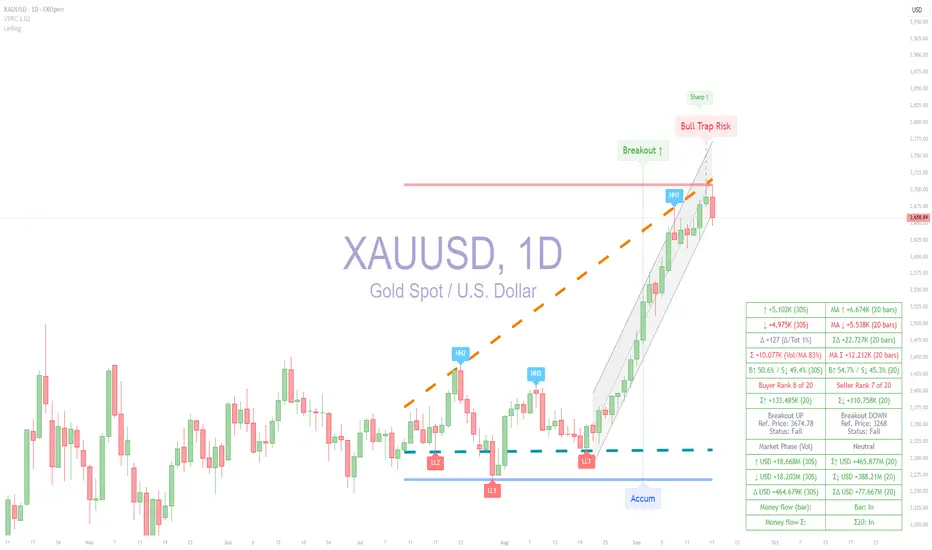
GOLD ANALYSIS TODAY – CURRENT PRICE 3681 I SEP/17/2025(Uptrend still in control)
- Gold continues its bullish momentum after breaking the short-term downtrend, forming clear support zones at Demand 3675–3661 and still aiming for the upside target of 3700–3705.
✅ Scenario 1: BUY at Demand zone 3675–3677
📌 Entry condition: Wait for price to retrace to the Demand zone 3675–3677 and form a bullish confirmation candle (e.g., bullish pin bar, engulfing on H1/M30).
🎯 Target: 3700–3705 (H1 VaH zone)
🛑 Stop Loss: 3660
🧭 Reason:
- Price is still maintaining the main uptrend with Higher High – Higher Low structure.
- The 3675 zone is a strong Demand zone, likely to attract liquidity before another rally.
- Volume Profile shows this as a Low-Volume Node (LVN) – ideal for a bounce reaction.
⚠️ Scenario 2: BUY at Val Zone 3661–3663
📌 Entry condition: If price breaks below 3675 and continues to drop toward Val Zone 3661–3663, wait for buying pressure/Volume increase.
🎯 Target: 3685–3700
🛑 Stop Loss: 3650
🧭 Reason:
- This is the lower edge of the value area, fitting the strategy “Buy low in an uptrend”.
- Also aligns with H1 trendline and VAL zone from Volume Profile.
- A low-risk BUY setup if price “wicks” down and bounces back.
⚔️ Scenario 3: SELL reaction from VaH 3689–3703
📌 Entry condition: If price retests the Supply zone / VaH 3689–3703 and forms rejection signals such as a fakey or bearish pin bar.
🎯 Target: 3670–3665
🛑 Stop Loss: 3708
🧭 Reason:
This zone had strong selling pressure earlier – potential for sellers to re-enter.
Volume Profile confirms this is VaH (upper edge of value area) → prone to short-term rejection.
Counter-trend SELL setup → requires clear confirmation signals.
🚀 Scenario 4: BUY on strong Breakout above 3705
📌 Entry condition: Price breaks strongly above 3705 with an H1 candle close on high volume and no rejection signs.
🎯 Target: 3720–3725
🛑 Stop Loss: 3695
🧭 Reason:
- If price breaks the strong resistance at 3705, further upside expansion is likely.
- This area previously triggered strong selling – if broken, the bullish trend gains more confirmation.
- High volume + H1 close above supply zone = valid breakout sig
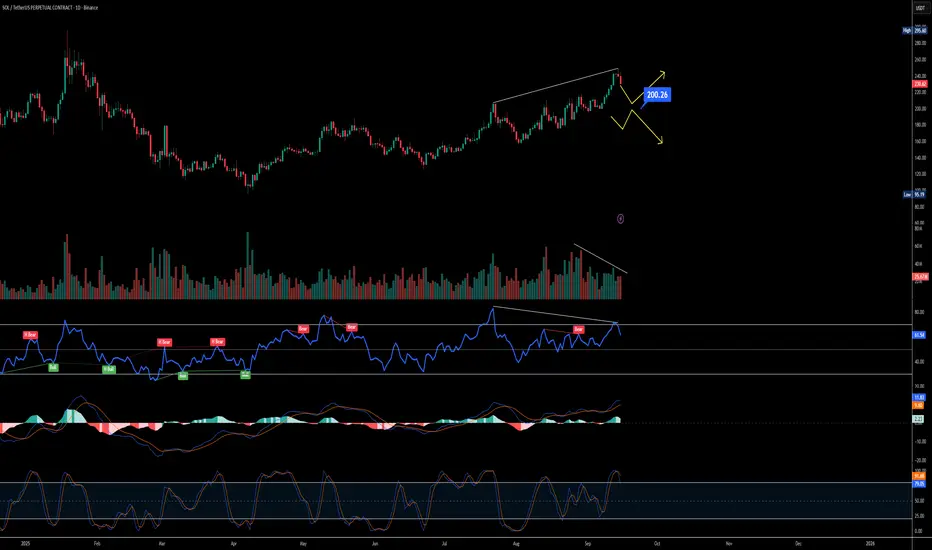
$Sol Daily Bearish Divergence with Key Supports at $220Solana is flashing some important signals across multiple timeframes right now.
On the daily chart, a clear bearish divergence has formed while buying volume is steadily declining. This setup usually points toward a healthy correction phase. At the moment, SOL looks like it could slide toward the $225–$220 zone, where we might see the first reaction.
If SOL manages to hold above $200 support, this pullback could simply turn into a higher low, setting the stage for continuation upward. But here’s the caution: losing $200 means breaking the last structural support, which could flip the trend and open the doors for a new lower low — potentially triggering a much larger dump.
👉 In short: Watch the $225–$220 range for short-term correction targets. Keep a close eye on the $200 level, because that’s the line between a healthy pullback and a bearish breakdown.
Trade safe and don’t chase candles — let the levels confirm the story.
VTI 1D: breakout on the daily within a long-term weekly uptrend On the daily chart, VTI (Vanguard Total Stock Market ETF) has broken through the key $303.5 resistance level with strong volume. This breakout occurs within a larger weekly uptrend channel, highlighting a continuation of the long-term bullish structure.
Volume profile shows a clear path ahead: $321.7 (1.272 Fibo) and $345 (1.618 Fibo). The golden cross (MA50 crossing MA200 from below) further supports the bullish case.
Fundamentally, VTI represents the entire U.S. equity market - large to small caps - and benefits from economic resilience, declining inflation, and passive inflows. It’s a logical macro play for trend continuation.
Tactical plan:
— Entry by market or after retest $303.5
— TP1: $321.7
— TP2: $345
— Invalidation below $300
The whole market breaking out? That’s not noise — it’s the signal.
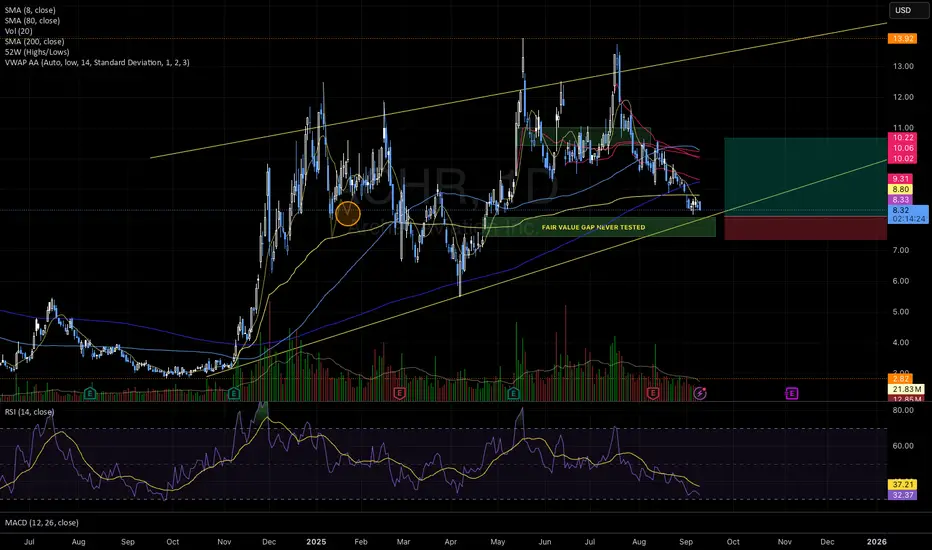
Bullish Setup Forming: Approaching Untested FVG + Oversold RSIACHR is setting up for a potential bounce based on multiple confluences:
Price is heading straight into a fair value gap that was never tested — could be a solid bounce spot;
Daily RSI is oversold (~32), often a sign the move down is stretched;
It’s also right on top of a rising trendline that has held for almost a year;
Volume is drying up, which might mean sellers are losing steam;
🎯 First target: $10.91
🏁 Final target: $12.00
❌ Stop-loss: just under the FVG zone, in case it breaks down.
Watching closely 👀
And remember: respect both your stop loss and position sizing.
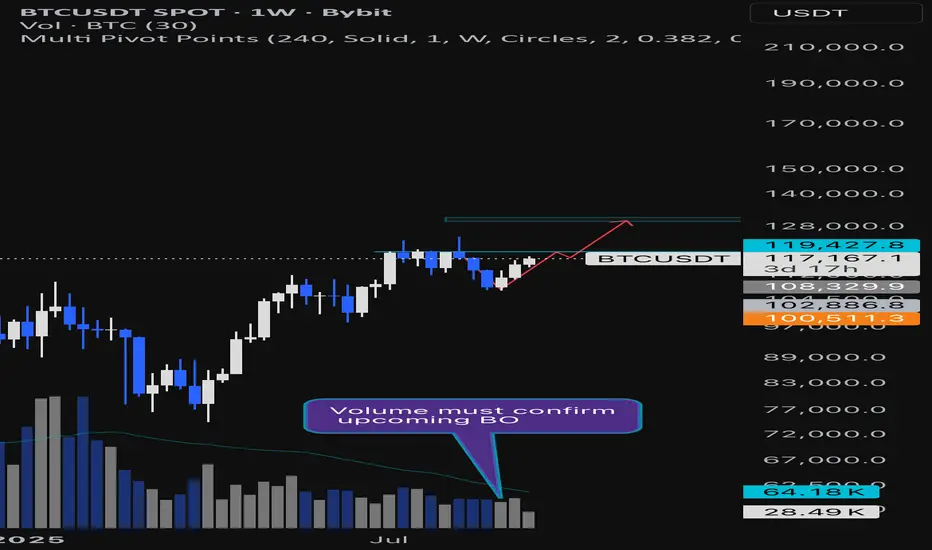
Bitcoin: Pullback Expected Into Prior Consolidation Zone
After a strong markup phase, Bitcoin has now formed a buying climax near the $113K level. Price action shows signs of distribution, with stacked imbalances above acting as a liquidity magnet. I expect price to first sweep this overhead liquidity, trapping breakout buyers and creating the conditions for a reversal.
Once the sweep is complete, confirmation will come if price fails back below the buying climax zone. This would indicate true seller pressure and a shift in market structure. At that point, I will be watching for a retest of the prior POC (Point of Control) to establish short positions.
Trade Plan:
Entry trigger: Sweep of buying climax → bearish rejection → retest of supply / POC.
Stop loss: Above the sweep high (invalidates distribution scenario).
Targets: Previous consolidation levels and liquidity pools below ($111K–$110K zones).
This setup aligns Wyckoff distribution structure with orderflow and liquidity logic. As long as the sweep fails and sellers regain control, I expect a pullback into the prior consolidation zone.
⚠️ Invalidation: Sustained acceptance above the buying climax would cancel the short bias.
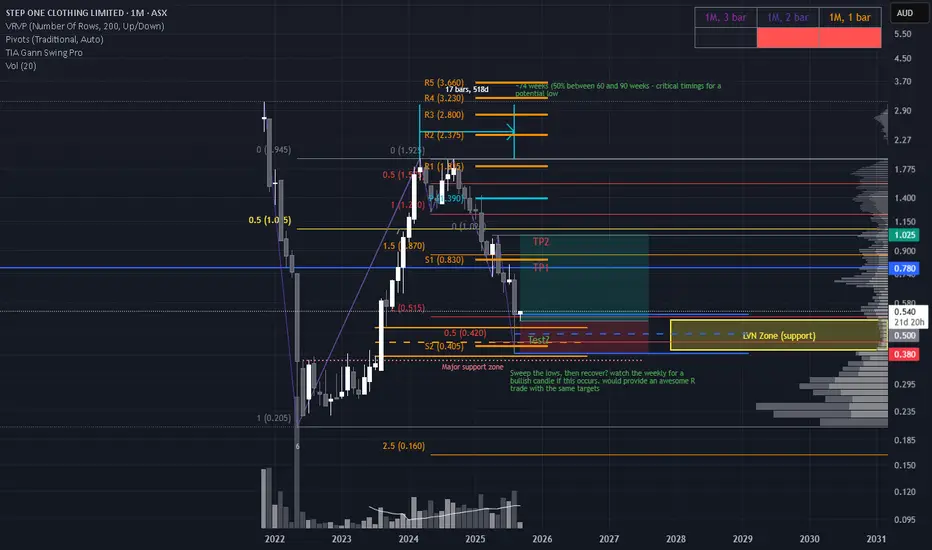
High-Risk, High-Reward Setup at Critical Confluence ZoneSTP is offering a compelling—but extremely high-risk—opportunity. As a nanocap stock with no confirmed uptrend, risk management must be the top priority.
Price has retraced into a major Fair Value Gap (FVG) from August 2023, and notably, the August 2025 candle printed a strong demand wick on elevated volume. This zone aligns with:
The 200% Fibonacci extension from the double top at 1.940
The 50% extension from the 1.900 swing high to the April 25 low
A 74-week decline from the 1.950 high, marking a significant Gann time support—a detail seasoned time-cycle traders will appreciate
This confluence suggests a structurally significant support zone where price may be preparing for a reversal.
Trade Scenarios
Option 1: Wait for a Wick Retest Price may revisit the demand wick/yearly s2 pivot, offering a more refined entry with improved risk-to-reward. Look for a strong daily or weekly bullish candle off the retest, with the stop-loss placed just below the wick.
Option 2: Enter Now with Wick as Anchor Aggressive entry at current levels, using the base of the large demand wick as your stop-loss. This approach allows price to develop organically while maintaining a defined risk profile and if there is a retest of the wick then could add more to the position (must be in line with your risk appetite) but just food for some thought.
Option 3: Liquidity Sweep & Reversal Price could sweep the lows of the demand structure, triggering stop-losses and trapping late shorts. A sharp reversal from this move would confirm a classic liquidity grab—ideal for reactive entries once momentum shifts.
This setup is rich with technical nuance and timing precision. Whether you're trading the wick, the sweep, or the structure itself, the key is disciplined execution and respect for volatility.
MPWR | Another Long Term Runner | LONGMonolithic Power Systems, Inc. designs, develops, and markets integrated power semiconductor solutions and power delivery architectures for computing and storage, automotive, industrial, communications, and consumer applications markets. It offers direct current (DC) to DC integrated circuits (ICs) that are used to convert and control voltages of various electronic systems, such as portable electronic devices, wireless LAN access points, computers and notebooks, monitors, infotainment applications, and medical equipment. The Firm also provides lighting control ICs for backlighting that are used in systems, which provide the light source for LCD panels in notebook computers, monitors, car navigation systems, and televisions, as well as for general illumination products. The company was founded by Michael R. Hsing, and James C. Moyer on August 22, 1997, and is headquartered in Kirkland, WA.
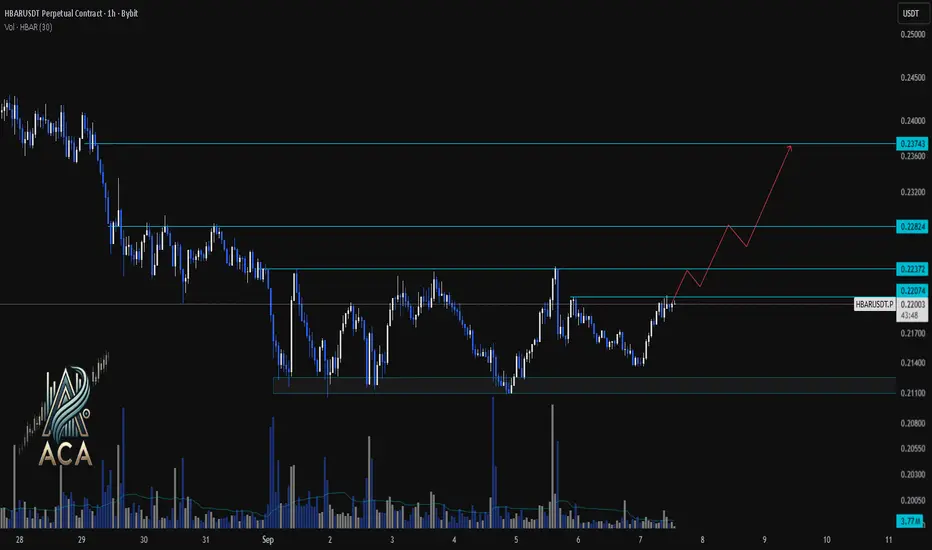
HBARUSDT 1H Chart Analysis | Bullish Structure in PlayHBARUSDT 1H Chart Analysis | Bullish Structure in Play
🔍 Let’s break down the recent price action for the HBAR/USDT perpetual contract and outline the roadmap for potential bullish continuation.
⏳ 1-Hour Overview
The 1-hour chart shows HBAR recovering from a strong demand zone near $0.21100, pushing upward with notable momentum. Price action is now challenging immediate resistance at $0.22372, with higher levels at $0.22824 and $0.23743 presenting the next bullish targets.
🔺 Long Setup:
A decisive close and hold above $0.22372 could fuel further upside, targeting the $0.22824 resistance next. Sustained bullish volume and higher lows may pave the way for an extension up to $0.23743, aligning with the drawn projection path.
📊 Key Highlights:
- Strong defense of the $0.21100 support region led to a sharp rebound.
- Immediate resistance stands at $0.22372, with the bullish path mapped toward $0.22824 and $0.23743.
- Volume spikes on upward candles indicate increasing buyer interest and potential for trend follow-through.
🚨 Conclusion:
HBARUSDT is building a bullish structure above local support, with momentum favoring continued upside if $0.22372 flips into support. Watching volume and reaction at key resistance areas remains crucial for confirming the next leg higher.
Gold potential long From the daily chart, Gold has been in a tough squeeze that has just popped to the upside.
Bullish on Gold and there is never a high price to buy gold.
I have described the setup on the chart, now we wait. Though today is labour day.
I have found good edge with Price and volume and a decent win rate on gold. Now we wait.
A million things could happen. But I can't promise you that any of them will. I can't
give you any reasons and I can't tell fortunes
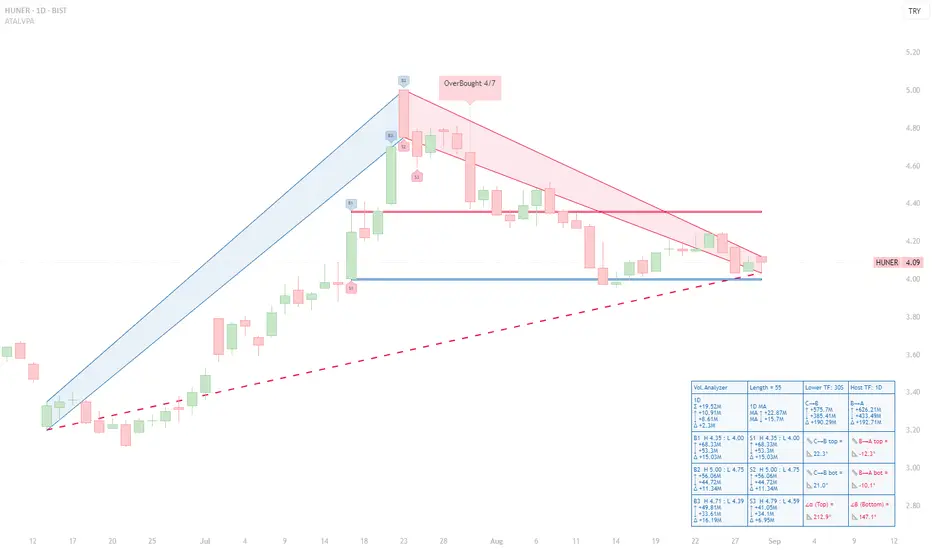
HUNER (1D) — Seller Bias After OB Cluster; Descending BA SlopesHUNER (1D) — Seller Bias After OB Cluster; Descending BA Slopes, 4.00 Support Under Test
Executive read (VPA, 55-bar window)
◉ OB/OS: An OverBought 4/7 tag printed at the apex; no confirmed OS on the right edge. That OB cluster preceded the entire red B→A leg and frames the current risk.
◉ Ranked volume peaks (Top-3):
- B1 (H 4.35/L 4.00) ↑ 68.33M, ↓ 53.3M, Δ +15.03M.
- B2 (H 5.00/L 4.75) ↑ 56.06M, ↓ 44.72M, Δ +11.34M.
- B3 (H 4.71/L 4.39) ↑ 49.81M, ↓ 33.61M, Δ +16.19M.
- S3 (H 4.79/L 4.59) ↑ 41.05M, ↓ 34.1M, Δ +6.95M.
Takeaway: Buying peaks were heavy, but subsequent price action failed to sustain higher highs; sellers have since controlled the B→A leg.
◉ Segment diagnostics:
- C→B advance: top/bottom slopes +22.3° / +21.0° → mature but constructive.
- B→A decline: top/bottom slopes –12.3° / –10.1° → persistent downside pressure.
- Orientation at B: α 212.9° (red) / β 147.1° (red) confirm the bearish state of the current swing geometry.
◉ Levels & structure:
- Support: the S1 low ≈ 4.00 is the active horizontal shelf repeatedly defended.
- Resistance: 4.35 (B1/S1 pivot), 4.71–4.79 (B3/S3 band), then 5.00 (B2). The descending B→A trendline caps bounces before these levels.
Actionable interpretation (educational):
Bias stays bearish-to-neutral while price trades beneath the B→A upper line and below 4.35. A credible shift would require (i) a fresh B-ranked bar with positive Δ near the right edge, and (ii) a close back above the B→A top. Failure to reclaim 4.35 after bounces leaves 4.00 vulnerable; a daily close below 4.00 would validate extension into the S-zones. Conversely, an OS print near 4.00 coupled with flattening BA slopes would set up a tactical mean-reversion toward 4.35 → 4.71/4.79.
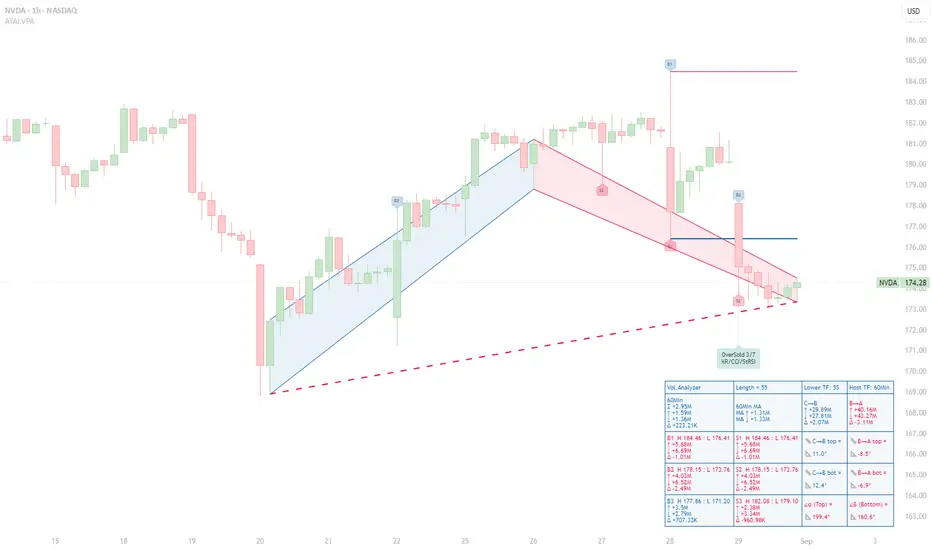
NVDA Under Pressure: Sellers Dominate as Volume Spikes Fail NVDA Under Pressure: Sellers Dominate as Volume Spikes Fail to Sustain Price Gains
Context – This 60‑minute NVDA chart uses the ATAI Volume Pressure Analyzer (VPA) on a 55‑bar window. The indicator plots an A→B→C structure: the blue C→B segment tracks the preceding advance and the red B→A segment the subsequent pull‑back. Up‑volume and down‑volume are calculated on a lower time frame and then aggregated into host‑time‑frame bars to expose buying and selling pressure.
Volume ranking – Within this window the indicator labels the three largest buying and selling bars (B1–B3 and S1–S3) and reports their statistics in a HUD. The most prominent bar, B1, spans H 184.46 to L 176.41 and shows 5.68 M up‑volume versus 6.69 M down‑volume, producing a –1.01 M delta. B2 (H 178.15–L 173.76) is even more bearish, with 4.03 M up‑volume and 6.52 M down‑volume (delta –2.49 M). B3 (H 177.86–L 171.20) is the only buying bar with a positive delta: 3.50 M up‑volume, 2.79 M down‑volume and a +0.71 M surplus. On the sell side, S1 and S2 coincide with B1 and B2 and mirror their negative deltas. S3 (H 182.08–L 179.10) registers 2.38 M up‑volume against 3.34 M down‑volume for a –0.96 M delta. Collectively, the pattern shows that peaks in buying volume have not yielded higher closes; sellers control all but one of the ranked bars.
Segment behaviour – The C→B rally accumulated roughly 29.89 M up‑volume versus 27.81 M down‑volume, a modest +2.07 M delta. In contrast, the B→A decline logged 40.16 M up‑volume against 43.27 M down‑volume, giving a –3.11 M deficit. The slopes of the trend lines accentuate the story: the advance has gentle positive slopes (~+11° top, +12.4° bottom), whereas the pull‑back slopes downward (–8.5° and –6.9°). Sellers have pushed prices lower more decisively than buyers previously drove them higher.
Price structure and implications – Price currently trades around 174.28 USD. Resistance sits near 178.15 (B2/S2) and 184.46 (B1/S1). As long as price remains beneath these pivot highs and subsequent B‑ranked bars fail to show a positive delta, the selling bias persists. The red dashed guide, connecting recent lows, continues to slope downward, confirming the bearish tilt. Only a flattening or reversal of this guide—coupled with a new B‑ranked bar sporting a positive delta—would hint at a shift in momentum.
Risk management – This analysis is intended for educational purposes. It illustrates how separating up‑ and down‑volume on lower time frames can reveal hidden pressures in intraday charts. It is not a recommendation to buy or sell NVDA stock. Always consult your own trading plan and risk tolerance before acting.
Seller Strength Evident as Volume Peaks Fail to Propel Price HigAnalysis
Context – This 1D chart uses the ATAI Volume Pressure Analyzer to study the A→B→C structure over the last 11 trading sessions. Segment C→B captures the advance (blue), while B→A captures the subsequent decline (red). Each bar’s up‑ and down‑volume is measured on a lower timeframe to detect buying and selling pressure.
Volume ranking – Within this 11‑bar window, the indicator identifies the three largest buying (B1–B3) and selling (S1–S3) bars. Although the B1 bar shows the highest buying volume (~10.29 M units), its selling volume (~12.52 M) exceeds buying, resulting in a negative delta of ‑2.23 M. B2 is the only buyer bar with a positive delta (+1.87 M), while B3 again shows sellers in control (‑0.90 M). The seller bars S1–S3 all display net negative deltas, with S3 registering the heaviest selling (‑4.03 M). This pattern shows that peaks in buying volume are not producing higher closes and that sellers are consistently overwhelming buyers.
Segment behaviour – The C→B segment (the rally) totals approximately +28.9 M up‑volume versus +36.7 M down‑volume, a net deficit of about ‑7.74 M. The subsequent decline (B→A) is even more one‑sided: +26.9 M up‑volume versus +41.4 M down‑volume, yielding a ‑14.5 M delta. The slopes of the segment trend lines reinforce this narrative: the rise from C to B has a shallow positive slope (~ 5° on the upper line), whereas the decline from B to A has a steeper negative slope (‑12° on the upper line). Sellers are pushing the price lower more aggressively than buyers previously pushed it higher.
Price structure – Price currently trades near TRY 3.45,where resistance resides near the recent pivot highs around TRY 3.65 and TRY 3.73 (where B1 and S1 occur). As long as the price remains below these levels and buying peaks fail to translate into higher highs, the bearish bias remains. The red dashed line is not a fixed support; it dynamically connects the lows of the current C→A leg and updates with each new candle’s low. Its red colour confirms the bearish slope of this segment. As long as this guide remains red and slopes downward, the downtrend is intact. A meaningful sign of shifting momentum would be a flattening or reversal of this guide (e.g., changing colour) accompanied by a new B‑ranked bar that shows a positive delta.
Risk management – This analysis is provided for educational purposes and does not constitute investment advice. Always consider your own risk tolerance and trading plan before entering a position.
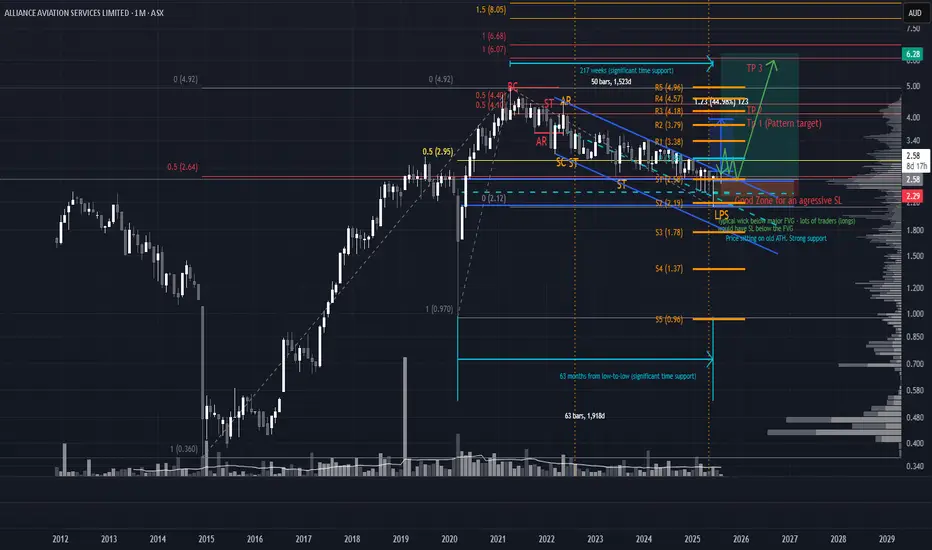
Don’t Sleep on AQZ: Smart Money May Already Be PositionedAQZ — 4-Year Reaccumulation + Bullish Doji = Strategic Long Setup
AQZ is looking primed for a long play. Price has been reaccumulating for ~4 years, and June printed a bullish monthly doji—a classic liquidity sweep. Price pierced the major fair value gap (FVG) from the May 2020 pump candle, tested the yearly S2 pivot, and found support right on the EQ of the range. That’s a trifecta of demand confluence.
Entry Scenarios Based on Risk Profile
Aggressive Entry Enter now with a tighter stop loss around $2.29, which aligns with two EQ zones: the June 2025 demand structure and the channel EQ. This setup suits high conviction traders looking to front-run the breakout.
Conservative Entry Use a wider stop beneath the Last Point of Support (LPS) for more breathing room. This protects against deeper retests while still respecting the bullish structure.
Preferred Entry (Low Risk, High Confluence) Wait for price to break and retest the channel, then consolidate above it. This would also confirm a break of the major 50% resistance projected from the all-time low to all-time high—a powerful signal of trend continuation.
Strategic Overlay
This setup blends long-term structural strength with tactical precision:
4-Year Base = Institutional accumulation
Doji Sweep = Smart money absorption
Multi-level confluence = High-probability AOI
If price rallies from this zone, expect momentum to build quickly. But as always—one step at a time. Let price confirm before scaling in.
*please note, arrows are not time analysis just pathing
RELAXO FOOTWEARS A GOOD 2X CANDIDATE Relaxo Footwears Ltd, one of India’s leading footwear companies
👟 Brand Portfolio
Relaxo operates under several well-known sub-brands:
- Sparx – Sporty and casual shoes
- Flite – Lightweight slippers and sandals
- Bahamas – Youth-centric flip-flops
- Schoolmate – School shoes
- Boston, Belle, Mary Jane, Kid’s Fun – Niche and seasonal offering
🌍 Market Position
- Largest footwear manufacturer in India by volume
- Second-largest by revenue
- Ranked among India’s Top 500 Most Valuable Companies
- Strong presence in value segment (non-leather products like EVA/rubber slippers and canvas shoes)
TECHNICAL
- Momentum: Strong short-term bullish breakout
- Trend: Above key moving averages with RSI and MFI confirming strength
- Watch Zone: 500–510 for resistance; 470–480 as support
SHORT TERM TGT- 575-600
LONG TERMG TGT- 750-900
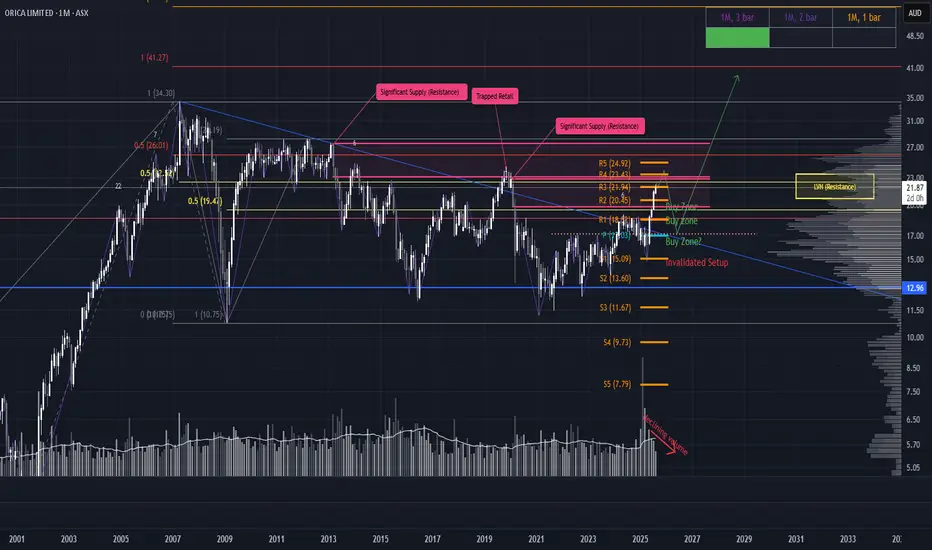
ORI Setup: Watching for Pullback into Accumulation ZonesOn the weekly timeframe, ORI has printed a 10-week rally straight into a key supply zone—aligning cleanly with Gann’s 7–10 bar exhaustion principle within a single swing. This move suggests we’re nearing a potential inflection point. There’s still room for a final extension toward the second major supply structure around $25, but any push into that zone would likely be met with selling pressure and a corrective phase.
On the monthly, price has been advancing aggressively—but notably on declining volume, hinting at underlying weakness and possible buyer fatigue. If price stalls or rejects around current levels, it sets the stage for a layered accumulation opportunity at the zones highlighted on the chart.
Should price consolidate and absorb supply in these areas, the setup opens the door for a breakout to all-time highs, offering a compelling Risk-to-Reward profile for strategic positioning.
Setup Invalidation: A decisive break and close below $14.89 would invalidate the thesis, confirming a macro higher low breakdown. However, wicks into this zone are acceptable as part of a liquidity sweep or shakeout.
Denison Mines: A very bullish chartDenison Mines is on the verge of breaking a 14 years consolidation.
The whole sector of uranium has been very strong in 2025 but the price of uranium itself hasn't moved that much and neither most of the small and mid cap names in the space. I'm expecting those to start waking up soon and when they do, their moves can be very powerful.
"The longer the range, the bigger the breakout" is a famous quote in trading. Let say how this one plays out above $2.45.
SUSDT 4H Chart Analysis | Channel Breakdown LoomsSUSDT 4H Chart Analysis | Channel Breakdown Looms
🔍 Let’s break down the recent price action on the S/USDT 4-hour chart, focusing on the pivotal ascending channel structure and its implications for the next move.
⏳ 4-Hour Overview
S/USDT has been moving within a well-defined ascending channel, marked by higher highs and higher lows. Price is now testing the lower boundary of this channel, making the 0.3127 support a crucial level. The recent uptick in volume during the downward leg hints at mounting bearish pressure.
🔻 Short Setup:
A confirmed breakdown (BO) below 0.3127 would signal an exit from the ascending channel, opening the door to accelerated downside. With channel support breached, the next key target sits at 0.2710, in line with historical liquidity and the channel’s projected lower range.
📊 Key Highlights:
- Price action is currently at the channel’s lower boundary, with a breakdown below 0.3127 required to confirm bearish momentum.
- Volume has increased on the recent downward move, supporting the idea of a channel exit and follow-through selling.
- Downside target stands at 0.2710 if the channel fails, providing a clear roadmap for action.
🚨 Conclusion:
Bulls must defend the ascending channel at 0.3127, or risk seeing S/USDT cascade toward 0.2710. Watch for volume confirmation—an exit below channel support could shift sentiment quickly.
NAS100USD Analysis – POC Magnet, Demand Zone🔎 Context
Price action on NAS100USD is currently trading within a clearly defined range between the Value Area High (VAH) and Value Area Low (VAL) . Volume Profile highlights a key Point of Control (POC) around 23150 – the price level where the highest amount of trading volume has accumulated in this range.
In Smart Money terms, we also have a refined demand zone forming below, with the proximal line aligning closely above the POC. This overlap strengthens the case for the POC acting as a "magnet" and a potential support base.
⚡ Key Levels
Value Area High (VAH) : ~23880 – range resistance.
Value Area Low (VAL) : ~23010 – range support.
POC : ~23150 – high-volume node, magnetic level.
Proximal Line : Sitting just above POC, marking the edge of demand.
Refined Demand Zone : 22950 – 23050 region.
🏗 Structural Insights
A major structural failure occurred earlier near 23880, confirming supply above.
Price swept liquidity below 23050 before aggressively reclaiming the range.
Current trading sits just above POC and proximal, showing buyers defending.
A break and acceptance above 23510 (mid-range) opens the path back to VAH at 23880.
✅ Trade Scenarios
Bullish Case (Continuation to VAH)
If price sustains above 23516 and holds above the proximal/POC cluster, we can expect a continuation toward VAH (23880).
Targets: 23880 (VAH) → potential extension toward swing high.
Bearish Case (POC Magnet + Demand Retest)
Failure to hold above proximal/POC may drag price back into the POC magnet zone at 23150.
If momentum weakens further, a retest of the refined demand zone (22950 – 23050) is likely.
Below VAL (23010), imbalance could drive a deeper correction.
📌 Conclusion
The confluence of POC (fair value) and proximal demand (structural support) makes 23150 a pivotal level. Holding above it favors a continuation toward 23880 VAH , while a rejection would likely see price revert back to demand.
This setup showcases how Volume Profile levels (POC/VAH/VAL) can be combined with SMC concepts (demand zones & structural breaks) to create a high-probability framework.
💡 Trade safe, manage risk, and always wait for confirmations around these key levels before execution.
WTI Crude Oil Trading Analysis: June-August 2025 - 25-AugustWTI Crude Oil Trading Analysis: June-August 2025 Review & Week of August 25th Recommendations
Analysis Date : August 23, 2025
Market : WTI Crude Oil Futures (CL1!)
Methodology : Dual Renko Chart System ($0.25/15min + $0.50/30min)
Volume Profile : 3-Month Monthly Analysis (June-August 2025)
Executive Summary
Market Regime: Oil has completed a major corrective phase from $72 highs to $61 lows, establishing a clear bottoming pattern with strong institutional accumulation. Current setup presents high-probability bullish swing opportunity with excellent risk/reward characteristics.
Current Status : Bullish reversal confirmed with multiple technical confluences at critical support zone. Recommended positioning for upside targets with systematic risk management protocols.
3-Month Market Structure Analysis (June-August 2025)
Phase 1: Distribution & Breakdown (June-July)
Price Action: $72 → $61 (-15% decline)
June Peak: Heavy red volume distribution at $71-72 level indicated institutional selling
July Decline: Clean Renko downtrend with sustained selling pressure
Volume Profile: Minimal volume during decline, suggesting limited buying interest until $63-64 zone
Phase 2: Accumulation & Reversal Setup (Late July-August)
Price Action: $61 → $63.50 (+4% recovery)
Institutional Buying: Massive green volume accumulation at $63-65 level
Support Establishment: $62-63 zone showing strong buying interest
Technical Reversal: DEMA crossover confirmed bullish momentum shift
Volume Profile Key Levels (3-Month Analysis)
Major Support Zones :
$62-63: Primary institutional accumulation (heaviest green volume)
$60-61: Secondary support with moderate green volume
$58-59: Ultimate support level (limited historical volume)
Resistance Zones:
$66-67: First institutional resistance (mixed volume)
$69-70: Major distribution zone (heavy red volume from June)
$71-72: Ultimate resistance (peak selling pressure)
Current Technical Analysis (August 23, 2025)
Dual Chart Assessment
$0.50 Chart (Structure Analysis):
Trend: Clear bottoming pattern completed at $61 low
Current Position: Testing above major institutional accumulation zone
Volume Confirmation: Trading within heaviest 3-month green volume cluster
Structure: Higher lows pattern emerging since $61 bottom
$0.25 Chart (Execution Analysis):
DEMA Status: Bullish crossover confirmed (Black above Red at $63.00)
DMI/ADX: +DI gaining momentum, ADX rising through 25 level
Donchian Position: Price above basis, testing toward upper band
Recent Action: 3 consecutive green bricks confirming upward momentum
Technical Confluences Supporting Bull Case
Volume Profile: Massive institutional support at current levels
DEMA Crossover: Clear trend reversal signal confirmed
Momentum: DMI showing bullish shift with strengthening ADX
Structure: Higher low pattern vs. $61 bottom
Risk/Reward: Excellent positioning near major support zone
Market Context & Macro Considerations
Current Oil Market Dynamics
Supply: OPEC+ spare capacity at 5.9 million b/d (bearish)
Demand: China slowdown offset by US resilience (neutral)
Inventories: Below 5-year average (bullish)
Refining: Margins supporting crude demand (bullish)
Federal Reserve Impact
Policy Stance: Potential September rate cut (bullish for commodities)
Dollar Weakness: Could support oil prices
Inflation Expectations: Rising energy costs could influence policy
Seasonal Factors
Driving Season: Peak summer demand ending (bearish)
Hurricane Season: Atlantic activity potential (bullish)
Refinery Maintenance: September turnaround season (mixed)
Conclusion & Strategic Outlook
Near-Term Assessment (1-2 weeks): The current setup represents a high-probability swing trading opportunity with exceptional risk/reward characteristics. The combination of institutional volume support, technical reversal signals, and favorable market structure creates optimal conditions for bullish positioning.
Medium-Term Outlook (1-3 months): Successful navigation through the $66-68 resistance zone could establish a broader recovery toward $70-72 levels. However, macroeconomic headwinds and seasonal factors require careful position management and profit-taking discipline.
Risk Assessment: While the setup is compelling, traders must respect the institutional accumulation levels as ultimate support. Any violation of the $62 zone would invalidate the bullish thesis and require immediate position liquidation.
Strategic Advantage: The dual Renko chart system provides both structural clarity and tactical precision, enabling confident position sizing and systematic risk management. The monthly volume profile offers institutional-level insight typically unavailable to retail traders.
Document Classification: Trading Analysis & Recommendations
Risk Disclaimer: Past performance does not guarantee future results. All trading involves risk of loss.
Microcap Coil: MSV Poised for a Spring UnwindMSV is shaping up beautifully — potential spring in play. Price action suggests a classic Wyckoff Phase C moment, with signs of absorption and a possible reclaim on deck. But let’s be clear: this is a microcap, and that means elevated risk.
High caution required — thin liquidity, fast moves, and headline sensitivity make this one a sniper’s game, not a swing-for-the-fences setup. If the spring confirms, it could offer a sharp asymmetric move — but only if you’re disciplined with size and execution.
possible swing point on GBPJPY Alright, let’s dive into the exciting world of trading, shall we?
So, here's the scoop: we’re on the lookout for potential swing points, those sweet spots where the market might just take a turn. It's like waiting for the perfect wave while surfing—the key is to recognize the signs before riding it out. Typically, one of the best indicators we have is a classic momentum drop. Picture it: as the price rises, there’s a little dip in momentum that signals a shift is on the horizon.
Now, once we spot that drop, we keep our eyes peeled for a lovely shift in price action. That’s our cue! When we see everything aligning just right, we can jump in with a smooth swing entry on this pair. It’s all about catching that rhythm and flowing with the market's natural ebb and flow.
So, dust off those charts and let your creative side take control! Map out your strategies, draw your lines, and visualize your plan of action. Trading is as much an art as it is a science, and every eye you lay on the charts brings you closer to mastering it.
Remember, though, as tempting as it is to get swept away by the possibilities, nothing in trading is guaranteed. Embrace the journey; it's all part of the fun and learning. Let’s see how this plays out together! Happy trading!
Two Ranges, One Breakout: TCL’s Wyckoff-Gann ConfluenceCurrently tracking two distinct Wyckoff ranges on TCL, each color-coded for clarity. The structure is clean despite a few lines—each range tells a story.
Accumulation Zones
Key buying opportunities are emerging at the LPS (Last Point of Support), marked by higher lows. These are classic signs of strength and absorption.
Resistance & Breakout Potential
Expect notable resistance around $15.55, but a breakout is likely. We’re approaching a Gann 4th-time breakout setup, which historically carries strong momentum. If price reaches this zone with expanding volume and wide candle spreads, it adds conviction for a Sign of Strength (SOS) and a potential pullback to retest.
Targets & Confluence For take-profit zones, I’m watching:
Yearly pivots
Range extensions from both Wyckoff structures (100%, 150%, 200%)
Gann extensions for harmonic targets
This setup blends structure, volume dynamics, and time-price symmetry. If the breakout confirms, TCL could offer a textbook Phase E markup.
*please note no time analysis is done, just looking at pathing