MACD minutesIt´s a multiple (3) Moving Average Convergence Divergence (MACD) indexes. It was created to help traders to identify trend changes in multilple time frames, in the same graph.Pine Script® indicatorby Aldovitch4436
P-MACD by DGTPrice and Moving Averages Convergence/Divergence, shortly named as P-MACD P-MACD is a trend-following momentum indicator that shows the relationship between Price and Long-term Moving Average (PMACD), and the relationship between two Moving Averages (MAMACD). P-MACD is composed of two lines, and an histogram, showing price distance (convergence/divergence) to its Long-term MA (PMACD), showing short-term MA distance (convergence/divergence) to long-term MA (MAMACD), and a histogram showing the difference (momentum) between the PMACD and MAMACD The PMACD is calculated by dividing the Price to Long-term Moving Average (200-period SMA/EMA) and finally smoothed with 9-period SMA/EMA - PMACD Line Formula : (Price / SlowMovingAverage -1) * 100 and smoothed with 9-period SMA/EMA The MAMACD is calculated by dividing the Short-term Moving Average (such as 20 SMA/EMA) to the Long-term Moving Average (such as 200-period SMA/EMA) - MAMACD Line Formula : (FastMovingAverage / SlowMovingAverage -1) * 100 The Histogram is calculated by subscripting PMACD and MAMACD - Formula : PMACD - MAMACD Optional Trend Cloud calculated based on fast and slow version of MAMACD What to look for: - Line Crosses : PMACD Line can function as a trigger(signal) for buy and sell signals. Buy when the PMACD crosses above the MAMACD line and sell - or short - when the PMACD crosses below the MAMACD line - Base Crosses : PMACD and/or MAMACD crosses above or below Baseline is another way to indicate the trend and momentum. MAMACD crosses of Baseline, MAMACD positive or negative, reflects short-term moving average crosses the long-term moving average and similarly, PMACD crosses of BaseLine, PMACD positive or negative, reflects price crosses a long-term moving average - Momentum : P-MACD helps investors understand whether the bullish or bearish movement in the price is strengthening or weakening displayed with a histogram which graphs the distance between the PMACD and MAMACD. Additionally, upward momentum is confirmed with a bullish crossover, which occurs when PMACD and/or MAMACD crosses above Baseline. Conversely, downward momentum is confirmed with a bearish crossover, which occurs when PMACD and/or MAMACD crosses below Baseline - Distance : Prices high above the moving average (MA) or low below it are likely to be remedied in the future by a reverse price movement. The more distant the PMACD is above or below its baseline indicates that the distance between the Price and its SMA is growing (regarding PMACD, You may find a detailed article explained in “Price Distance to its MA” indicator by DGT) . Similarly the more distant the MAMACD is above or below its baseline indicates that the distance between the two SMAs is growing - Trend : A rising P-MACD indicates an uptrend, while a declining P-MACD indicates a downtrend MACD vs. P-MACD MACD measures the relationship between two MAs, while the P-MACD measures both the relationship between price and its MA, and the relationship between two MAs. MAMACD Line of P-MACD If set to same moving average type and same lengths as in MACD will produce the same line as MACD line, only values are represented as percentage with MAMACD. Both measure momentum in a market, but, because they measure different factors, they differentiate from each other even if they have similarities in presentation. P-MACD provides additional insights, not only to MA relation but also to Price and MA relation Warning : Moving Average are calculated based on past prices, so they are lagging. The longer the time period for the moving average, the greater the lag as well as less sensitive to price changes. This study implements usage of 200-period long-term moving average, which implies that the P-MACD will provide insight especially for long-term trades, more suited for long-term trades, usage of P-MACD for short-term trades is recommend with lower timeframes (1H or lower). Indicators aim to generate a potential signal/indication of an upcoming opportunity, but, the Indicators themselves do not guarantee the future movement of a given financial instrument, and are most useful when used in combination with other techniques. Trading success is all about following your trading strategy and the indicators should fit within your trading strategy, and not to be traded upon solely Disclaimer : The script is for informational and educational purposes only. Use of the script does not constitutes professional and/or financial advice. You alone the sole responsibility of evaluating the script output and risks associated with the use of the script. In exchange for using the script, you agree not to hold dgtrd tradingview user liable for any possible claim for damages arising from any decision you make based on use of the script Pine Script® indicatorby dgtrdUpdated 1313739
Price Distance to its MA by DGTPrices high above the moving average (MA) or low below it are likely to be remedied in the future by a reverse price movement as stated in an Article by Denis Alajbeg, Zoran Bubas and Dina Vasic published in International Journal of Economics, Commerce and Management Here comes a study to indicate the idea of this article, Price Distance to its Moving Averages (P/MA Ratio) The analysis expressed in the paper indicates that there is a connection between the distance of the prices to moving averages and subsequent returns : portfolios of stocks with lower prices to moving averages generally outperformed portfolios of stocks with higher prices to moving averages. This “overextended” effect is more pronounced when using shorter moving averages of 20 and 50 days, and is especially strong in short-term holding periods like one and two weeks. The highest annual returns are recorded when buying in the range of 0-5% below shorter moving averages of 20/50 days, and 0-10% below longer moving averages of 100/200 days. However, buying very far below almost all moving averages on almost all holding periods produces the lowest returns. The concept of this study recognizes three different modes of action. In a clearly established upward trend traders should be buying when prices are near or below the MA line and selling when prices move too far above the MA. Conversely, in downward trend stocks should be shorted when reaching or going above the moving average and covered when they drop too far below the MA line. In a sideways movement traders are advised to buy if the price is too low below the moving average and sell when it goes too far above it Short-term traders can expect to outperform in a one or two week time window if buying stocks with lower prices compared to their 20 and 50 SMA/EMA, one to two-week holding periods is quite high, ranging from 72,09% to 90,61% for the SMA(20, 50) and 85,03% to 87,5% for the EMA(20, 50). The best results for the SMA 20 and 50, on average, are concentrated in the region of 0-5% below the MA for the majority of holding periods. Buying very far below almost all MA in almost all holding periods turns out to be the worst possible option Candle patterns, momentum could be used in conjunction with this indicator for better results. Try Colored DMI and Ichimoku colored SuperTrend by DGT Pine Script® indicatorby dgtrdUpdated 4141 1.6 K
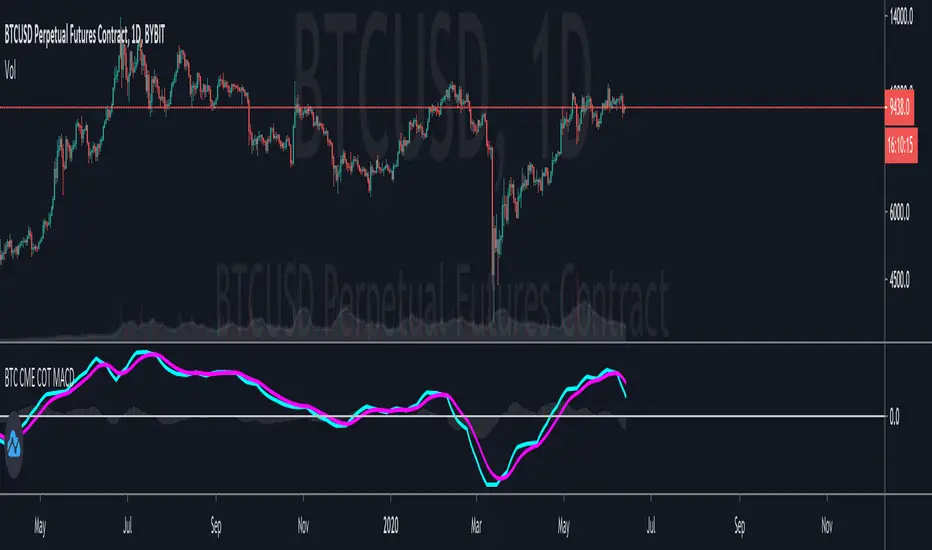
Bitcoin CME Retail vs Professionals MACD This is an interesting study using the data provided by the Bitcoin CME Commitment of Traders report. The MACD plot the difference between the Retail Traders positions and the Professional Traders positions. The general idea is that Professional Traders have a better read on the market than Retail Traders. The signal line helps to identify the trend that it is moving in. I believe that this plot helps to visualize the overall market sentiment better than the raw COT data. Try it out and let me know what you think! Pine Script® indicatorby AzureKn1ght2268
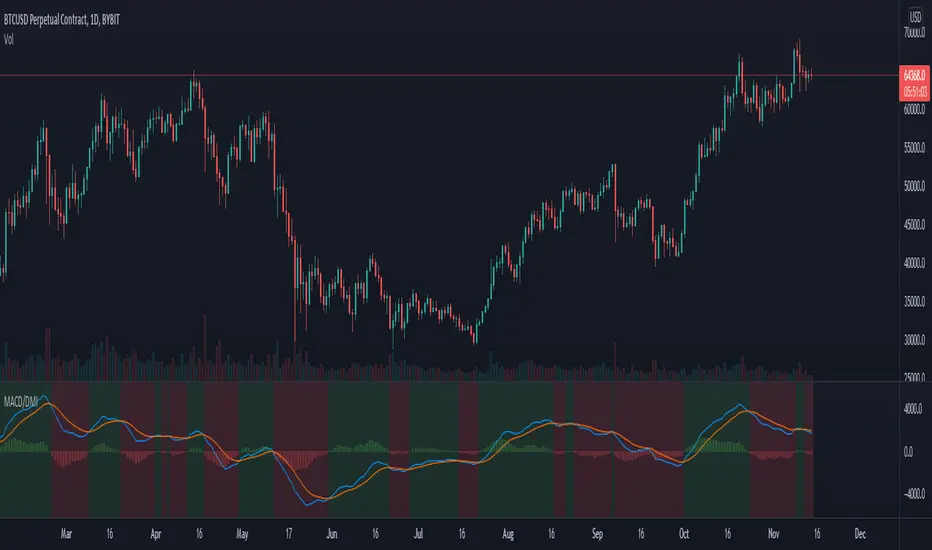
MACD with BGThis is a standard MACD indicator with Background colour and the option to draw the Background colour of the next higher timeframe.Pine Script® indicatorby ramsay09Updated 22309
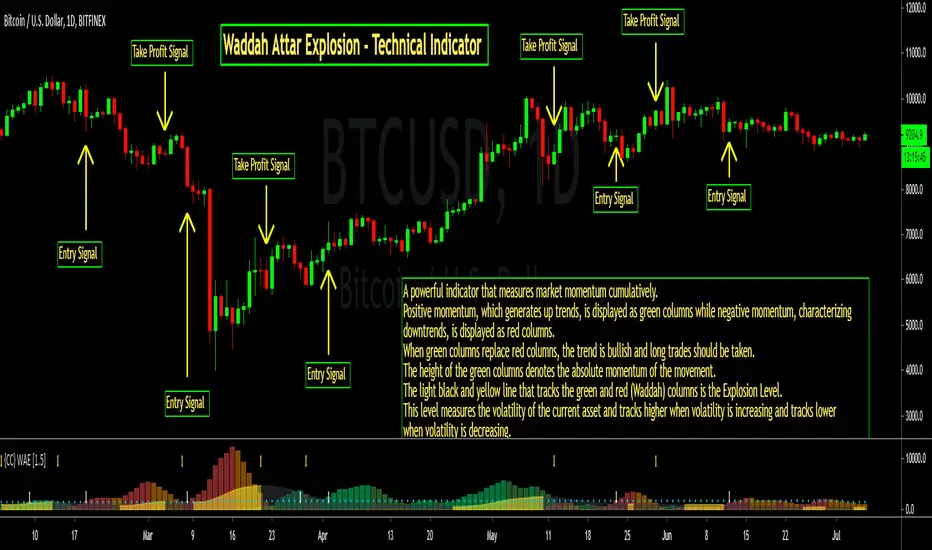
Cracking Cryptocurrency - Waddah Attar Explosion Cracking Cryptocurrency - Waddah Attar Explosion An entry indicator that analyzes momentum and volume . This indicator is very sensitive and works very well on lower time frames for scalping, and higher time frames for confirming explosive movements or shifts in trend or rising directional momentum in the market. This indicator can be used as an Initiator, Confirmer, or Vol. Filter. It's multiple components make it an extremely effective tool in any trader's tool belt. Features & Functions This indicator can be customized by adjusting the sensitivity levels, lengths, and multiplier. However, I find that the settings that I have made as default work very well. However, as with all indicators, nuance and customizing your settings to your asset class and time frame will yield greater results. False Positive Filter - Enabling this, as it is by default, will dramatically change this indicator's sensitivity. This is designed to analyze long-term momentum and reduce the occurrence of "false positives". However, the trade off will be reduced reaction speed. Entry Strategy - Print alerts and trading signals for many different permutations of entry strategies available with this indicator. Explosion Level Crossovers, Color Flips, Rising Explosion Level Cross, and Rising Explosion Level. Exit Strategy - Print alerts and trading signals for many different permutations of exit strategies available with this indicator. Explosion Level Cross, Receding Delta, Color Flip, Falling Explosion Level. Bar Coloring - This indicator colors the bars to indicate a buy or sell signal, as well as printing Up and Down arrows in the indicator pane itself. This can be disabled in the settings window. Alerts - This indicator is programmed with Buy and Sell alerts, available from the Alerts Window. --- Purpose To identify likely turning points in the market, the existence of powerful momentum to confirm a directional bias, or the introduction of high volume or volatility into the market. Pine Script® indicatorby CrackingCryptocurrencyUpdated 1212551
Yorks Mac 2This indicator fires trade entry based upon overall trend (Price above/below EMA), MACD Cross, and the MACD value being greater than or less than zero. When all conditions are true, the signal fires. Please PM me for accessPine Script® indicatorby fiveminutemomo334
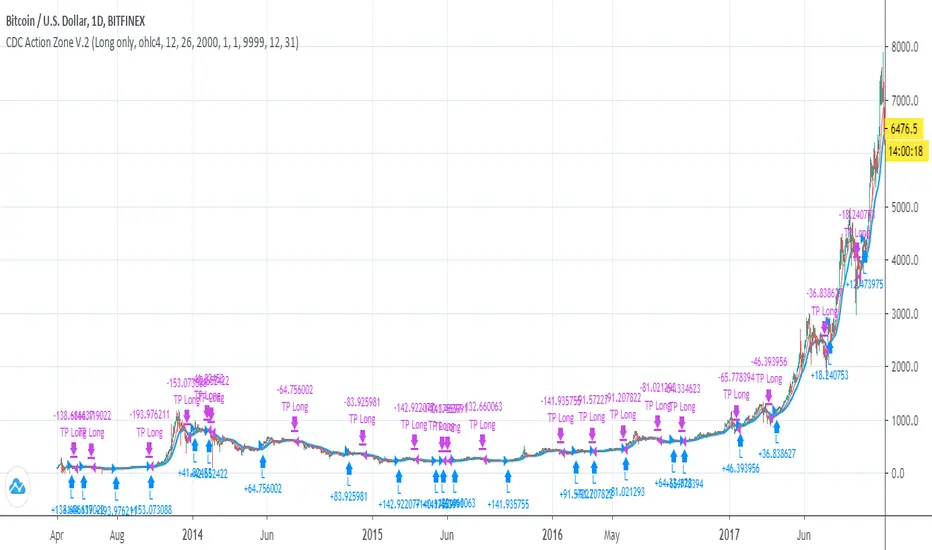
CDC Action Zone V.2 Strategy BacktestPublished for backtest purpose All credit to : CDC Action Zone V.2 by piriya33 จัดทำขึ้นเพื่อการดูผล Backtest เขียวซื้อแดงขาย ตัวสคริปท์มีการเพิ่ม - Strategy Long/Short/Both // ปรับได้ใน Setting - Back test range // ปรับได้ใน SettingPine Script® strategyby DeMindSET11140
3. AutoBots Trading - BACKTEST: MACDBACKTEST: Moving Average Convergence Divergence - MACD 1. Description: a trend-following momentum indicator that shows the relationship between two moving averages of a security’s price. The MACD is calculated by subtracting the 26-period Exponential Moving Average ( EMA ) from the 12-period EMA . 2. Strategy rules: defined based on the component, signal count, entry prices, open order count, position check, position averages, conditional closes and close signals. 3. Risk management: system was defined based on the choice of only long, only short or both sides. Defining the choice of take profit, stop loss and trailing stos (no repaint). 4. Symbol: PETR4 (only) 5. Suggested Timeframe: 2H 6. Parameter for optimization: 12, 8, 9, side: long, tp: 3%, sl: 1%, ts: na 7. Walk forward simulation 7.1. In sample period: jan/2018-jan/2020 7.2. Out of sample period: jan/2020 - ago/2020 ** For purpose educate onlyPine Script® strategyby AutoBots_Trading25
MACD Trend Following Strategy How it work ? Work like normal MACD because this is MACD without any modify but i add color of candlestick and strategy. The color meaning : Green= macd > signal and macd>0 (Buy) Red= macd < signal and macd<0 (Sell) Yellow= macd > signal and macd<0 (Maybe reversal point) Blue= macd < signal and macd>0 (Maybe reversal point) Feature - Back test range - Long/Short option - Modifiable MACD Setting Pine Script® strategyby DeMindSETUpdated 1175
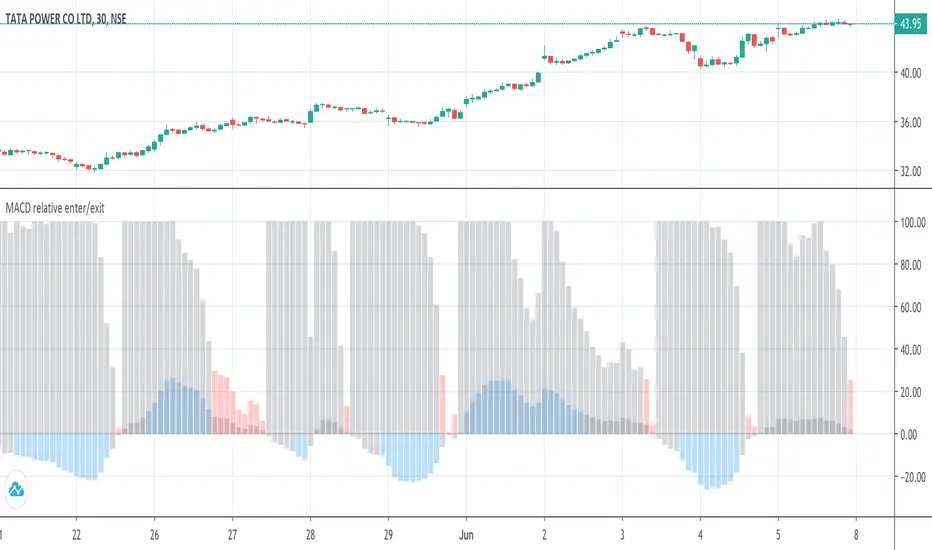
MACD histogram relative open/closePrelude This script makes it easy to capture MACD Histogram open/close for automated trading. There seems to be no "magic" value for MACD Histogram that always works as a cut-off for trade entry/exit, because of the variation in market price over time. The idea behind this script is to replicate the view of the MACD graph we (humans) see on the screen, in mathematics, so the computer can approximately detect when the curve is opening/closing. Math The maths for this is composed of 2 sections - 1. Entry - i. To trigger entry, we normalize the Histogram value by first determining the lowest and highest values on the MACD curves (MACD, Signal & Hist). ii. The lowest and highest values are taken over the "Frame of reference" which is a hyperparameter. iii. Once the frame of reference is determined, the entry cutoff param can be defined with respect to the values from (i) (10% by default) 2. Exit To trigger an exit, a trader searches for the point where the Histogram starts to drop "steeply". To convert the notion of "steep" into mathematics - i. Take the max histogram value reached since last MACD curve flip ii. Define the cutoff with reference to the value from (i) (30% by default) Plots Gray - Dead region Blue - Histogram opening Red - Histogram is closing Notes A good value for the frame of reference can be estimated by looking at the timescale of the graph you generally work with during manual trading. For me, that turned out to be ~2.5 hours. (as shown in the above graph) For a 3-minute ticker, frame of reference = 2.5 * 60 / 3 = 50 Which is the default given in this script. Ultimately, it is up to you to do grid search and find these hyperparams for the stock and ticker size you're working with. Also, this script only serves the purpose of detecting the Histogram curve opening/closing. You may want to add further checks to perform proper trading using MACD. Pine Script® indicatorby devxpyUpdated 11106
Bitcoin Dominance MomentumThis is a simple study of Bitcoin Dominance vs Altcoin Performance. The general idea, is that as Bitcoin Dominance falls, Altcoins rise, and vice versa. So, I decided to plot a MACD indicator of CRYPTOCAP:BTC.D to judge macro turning points in the cryptocurrency markets. Pine Script® indicatorby AzureKn1ght1177
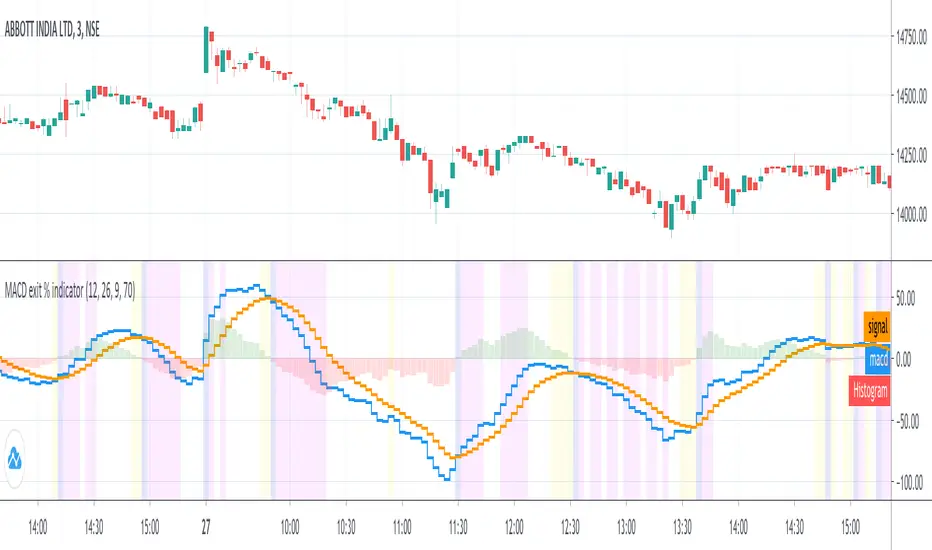
MACD exit % indicatorIntroduction An exit indicator for MACD, good for triggering order exit via MACD. It works by considering and the . Then, it just exits when the % change in these values surpasses a threshold. Indicators blue line - MACD orange line - Signal green/red columns - Histogram aqua background - Last Histogram Flip fuchsia background - Max abs(Histogram) value after last flip orange Background - Exit region Pine Script® indicatorby devxpyUpdated 77445
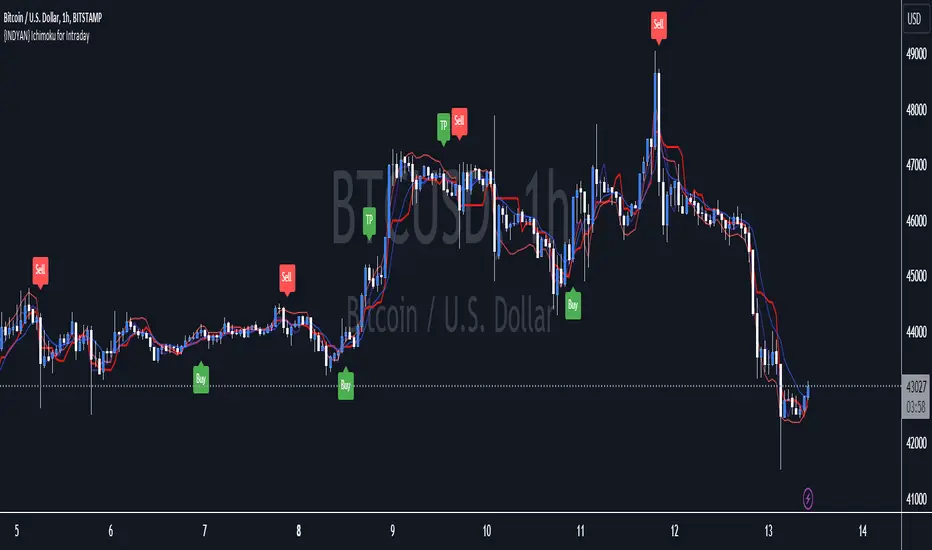
{INDYAN} Ichimoku for IntradayIts based on ichimoku, i removed cloud and mod some changes for better use in intraday trading. It can be used in stocks and index as well.Not tested on MCX and Forex. Just watch at crossover of tenkan and kijun that RSI macd is above 60 and zero or not? If all three parameters meet go for long... exit when again another cross happen or rsi go below 40.for sell side watch for rsi below 40 and macd below zero line while crossover of kijun tenkan. Better to use it with RSI+Macd Fast to get more accurate results. #for better confirmation look value of VWAP and decide accordingly Do back test before using it. Happy Trading Love INDyAN #change line color as per ur wish but value should be same as it was default entered. Pine Script® indicatorby IndyanUpdated 1212430
Crypto Monitor / DashboardI created a Crypto Monitoring Dashboard! Here is the idea behind it: Monitor up to 4x Symbols on one chart Monitor 2x Time Frames at once Monitor 3x indicators So to get into the details a bit more and how to use it. There are 4 separate rows for each symbol Row 1: Shows the status of the MACD indicator on the higher and lower time frame and color codes them accordingly. Row 2: Shows the higher time frame RSI value compared to pre-determined values for bullish , oversold, and overbought. Row 3: Shows the lower time frame RSI value compared to pre-determined values for bullish , oversold, and overbought. Row 4: Shows the status of the price compared to the moving average. Price greater then the MA is considered bullish ; below is bearish Since things get rather cramped with the multiple symbols on all at once, the intention is that you enlarge this and look at just ( aka not with the bar chart) this for your favorite 4 coins and then when you see the conditions you want, you close it and open the chart of your coin. Please feel free to leave a comment if you have questions or suggestions on how to improve it! Appreciate the feedbackPine Script® indicatorby thereisnopepesilvia24
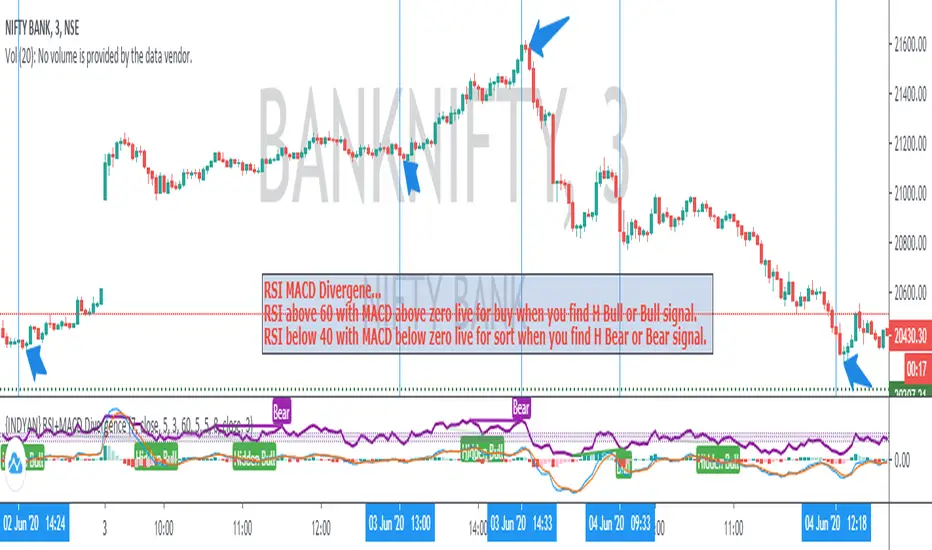
{INDYAN} RSI + MACDModded RSI and MACD for intraday use. If rsi above 60 and macd is above zero line then go for buy and if rsi is below 40 and macd below zero line then go for sell side. use it in small timeframe i.e. 3 minute or less. better for scalp trading Happy Trading Love INDYAN #It can be used best with INDYAN Go With Trend Pine Script® indicatorby IndyanUpdated 7373 4 K
MACD Bull Crossover and RSI Oversold 5 Candles Ago-Long StrategyHello everyone, I've been having a great time perfecting this strategy for a few weeks now. I finally feel like it's time to release it to the public and share what I have been working on. This strategy only enters a long trade when the MACD crosses over the signal line and the RSI was oversold looking back 5 candles ago. The logic behind this is to wait for RSI to enter the oversold territory, and then when the market starts to recovery the MACD will crossover telling us the sell off is over. This strategy will close once these 2 conditions are met. 1. MACD Histogram is above 0 and MACD crosses under the signal line. 2. RSI was overbought 5 previous candles ago. In the strategies settings, you'll be able to enable visual stop-loss and profit levels and change those levels to what you like, enable up to 5 EMA'S, ADDONS That Affect Strategy: * Enable visual stop-loss and profit levels as soon as a buy signal is triggered. * Modify stop-loss and profit levels. * Modify RSI oversold and RSI overbought levels. * Modify MACD Fast and Slow moving average. ADDONS That Do Not Affect Strategy: * Enable up to 5 EMA's. (This will not affect strategy, and is the only purpose is for people who like following EMA's.) Thank you for taking the time to try my strategy. I hope you have the best success. I will be making a short strategy, and alerts for this strategy soon. Follow me for updates!Pine Script® strategyby Trebor_NamorUpdated 189189 16.8 K
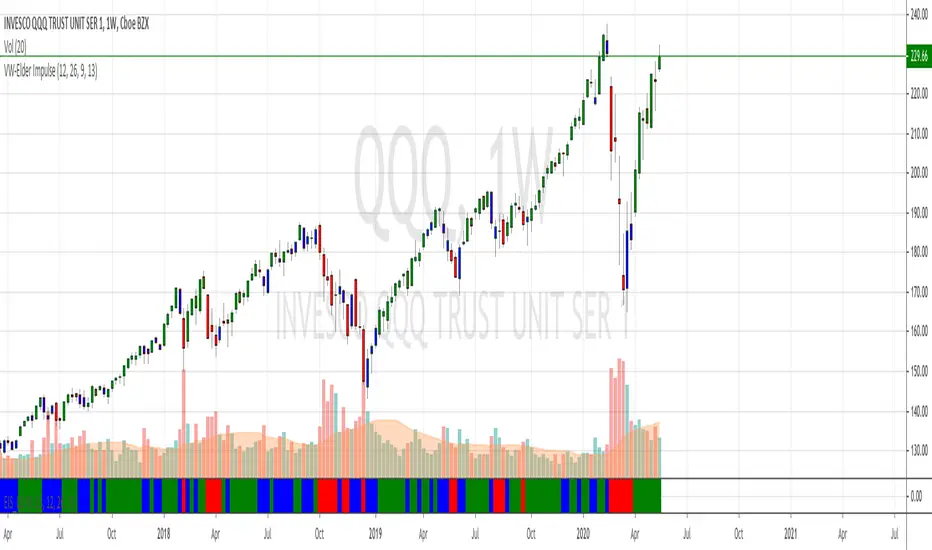
Volume-Weighted Elder Impulse SystemThis is a volume-weighted version of the Elder Impulse System. The Elder Impulse System utilizes the MACD along with EMA13(in general) to find the optimal entry and exit points. In this version, the MACD and EMA have both been changed into a Volume-weighted version. With volume involved, the indicator is, in general, faster than the original Elder Impulse system, in showing entry and exit points.Pine Script® indicatorby xbj33178
DMA: Moving Average of OscillatorTechnical Indicator Moving Average of Oscillator (Moving Average of Oscillator OsMA) is the difference between the oscillator and oscillator smoothing. In this case, an oscillator is used the basic MACD line and the smoothing of the signal. Calculate: OSMA = MACD - SIGNAL MACD = EMA(CLOSE, 12) - EMA(CLOSE, 26) SIGNAL = EMA(MACD, 9)Pine Script® indicatorby baiturinUpdated 33538
DiNapoli MACD MTFSimple oscillator, based on formula from Joe Dinapoli for MACD oscillator. Simply it's analysing current timeframe (bottom row) and 2 higher timeframes.Pine Script® indicatorby skyline-trader33125
MACD ColorMACD with color in Histogram and Signal to easily spot a potential change of trend.Pine Script® indicatorby David_GDL66 1 K
Combing in MACD and MTFHi all, I'm trying to wedge in the MACD into a multiple timeframe. Scope is to create: 1) an alert when the MACD across all timeframes is positive, 2) an alert when the MACD across all timeframes is negative, and 3) one when neither of them is applicable. Would anyone be so kind to give it some thoughts, please? //@version=2 strategy(" Easy MTF Strategy", overlay=false) TF_1_time = input("3", "Timeframe 1") TF_2_time = input("5", "Timeframe 2") TF_3_time = input("15", "Timeframe 3") TF_4_time = input("30", "Timeframe 4") fastLen = input(title="Fast Length", type=integer, defval=12) slowLen = input(title="Slow Length", type=integer, defval=26) sigLen = input(title="Signal Length", type=integer, defval=9) = macd(close, fastLen, slowLen, sigLen) width = 5 upcolor = green downcolor = red neutralcolor = blue linestyle = line TF_1 = security(tickerid, TF_1_time, open) < security(tickerid, TF_1_time, close) ? true:false TF_1_color = TF_1 ? upcolor:downcolor TF_2 = security(tickerid, TF_2_time, open) < security(tickerid, TF_2_time, close) ? true:false TF_2_color = TF_2 ? upcolor:downcolor TF_3 = security(tickerid, TF_3_time, open) < security(tickerid, TF_3_time, close) ? true:false TF_3_color = TF_3 ? upcolor:downcolor TF_4 = security(tickerid, TF_4_time, open) < security(tickerid, TF_4_time, close) ? true:false TF_4_color = TF_4 ? upcolor:downcolor TF_global = TF_1 and TF_2 and TF_3 and TF_4 TF_global_bear = TF_1 == false and TF_2 == false and TF_3 == false and TF_4 == false TF_global_color = TF_global ? green : TF_global_bear ? red : white TF_trigger_width = TF_global ? 6 : width plot(1, style=linestyle, linewidth=width, color=TF_1_color) plot(5, style=linestyle, linewidth=width, color=TF_2_color) plot(10, style=linestyle, linewidth=width, color=TF_3_color) plot(15, style=linestyle, linewidth=width, color=TF_4_color) plot(25, style=linestyle, linewidth=4, color=TF_global_color) exitCondition_Long = TF_global_bear exitCondition_Short = TF_global longCondition = TF_global if (longCondition) strategy.entry("MTF_Long", strategy.long) shortCondition = TF_global_bear if (shortCondition) strategy.entry("MTF_Short", strategy.short) strategy.close("MTF_Long", when=exitCondition_Long) strategy.close("MTF_Short", when=exitCondition_Short)Pine Script® strategyby marcoderoniUpdated 1111249
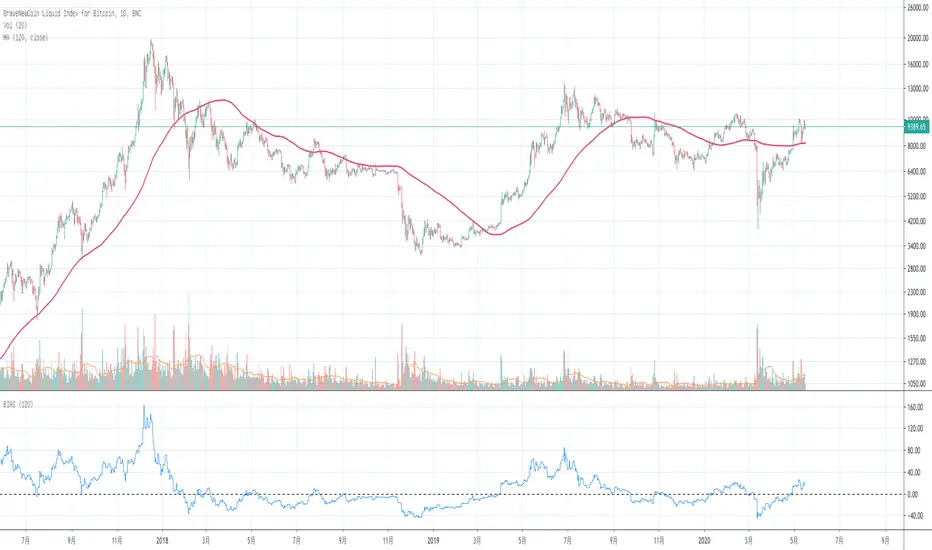
Basic BIASBasic BIAS Deviation rate (bias), also known as deviation rate, or y-value for short, is an indicator to reflect the deviation degree between the price and MA in a certain period of time by calculating the percentage difference between the market index or closing price and a moving average, so as to obtain the possibility that the price will reverse or rebound due to deviation from moving average trend in case of severe fluctuation, and that the price will move within the normal fluctuation range Form the credibility of continuing the original potential. The deviation rate is a percentage of the deviation degree (gap rate) between the price and ma. The departure rate curve (bias) is a curve that connects the values of each bias into a line and obtains a wave extension curve with the value of 0 as the horizontal axis.Pine Script® indicatorby LinxuanAn11211