Scalping Acciones PRO (Entradas + TP + SL) leo
How to use it correctly
• Timeframe: 1m or 5m
• High-volume stocks (SPY, AAPL, TSLA, NVDA…)
• Take Profit (TP): VWAP or EMA 21
• Stop Loss (SL): low/high of the signal candle
⸻
If you want, in the next message I can:
• 🔧 add automatic Stop Loss and Take Profit
• 🚀 convert it into a strategy (Strategy Tester)
• 🎯 filter only strong reversals (fewer false signals)
Indicators and strategies

ZLSMA AO Session Strategy by kernchentradingStrategy Logic
Trend Filter:
The ZLSMA is used to determine the prevailing short-term direction. Long signals are only considered when price is above the ZLSMA, while short signals are only considered when price is below it.
Momentum Confirmation:
The Awesome Oscillator is used to detect momentum shifts. Entries occur only when a multi-period sequence of rising or falling AO values is present, indicating the start of a new impulse.
Entries:
Long: Positive momentum in the AO combined with price trading above the ZLSMA
Short: Negative momentum in the AO combined with price trading below the ZLSMA
Only one position per direction is held at any time.
Exits:
Positions are closed when momentum weakens according to the AO or when a predefined pip threshold is reached.
Trading Hours:
The strategy uses a time filter and trades only during specified hours to avoid periods of low liquidity.
Parameters
ZLSMA length and offset
Position size (volume)
Timeframe and Notes:
I trade Gold using this strategy on the 5-minute and 15-minute charts. In flat, sideways market conditions, the ZLSMA has weaknesses. In such cases, it can be helpful to use an additional trend strength indicator (e.g., TSI). In general, the greater the distance between price and the ZLSMA, the more reliable the signal tends to be.

Gold Smart Scalper AI V21. The "Red Zone" (News Management)
The strategy logic does not "know" when the Federal Reserve is speaking.
Rule: Disable the strategy or stop taking signals 15 minutes before and after high-impact news (CPI, NFP, FOMC).
Why: During these times, Gold can move $30 in seconds. Slippage will cause your $1.50 Stop Loss to execute much further away, leading to massive drawdown.
2. Session Selection
Gold "Scalping" requires high liquidity and tight spreads.
Discretionary Filter: Only trade during the London/New York overlap (13:00 – 17:00 UTC).
Avoid: The late Asian session or Sunday market open. Spreads often widen to $0.50–$1.00, meaning you are already down 30-50% of your Stop Loss the moment you enter.
3. Market "Mood" (Trend vs. Range)
Trend Context: If the 50 EMA (the White line) is completely flat, the market is in a "Bracket." In this state, EMA crossovers generate many false signals.
The Adjustment: Discretionary traders wait for the 50 EMA to show a clear slope (up or down) before trusting the 9/21 crossover signals.

HSI Long & Short: BG + EMA330Strategy: HSI 5-min mean-reversion with EMA10/20 crossover and EMA330 filter.
Background green (EMA10 > EMA20) or red (EMA10 < EMA20).
Long entry: Background turns green AND price below EMA330.
Short entry: Background turns red AND price above EMA330.
Exit long: Background turns red.
Exit short: Background turns green.
No new entries 15:01–16:00 HKT.
Reverses position on signals; 100% equity per trade.

10>20,p>50 DEMARenders daily EMA, 10, 20 and 50 on any timeframe below 1D
30m timeframe works well.
Use trend of 10 > 20 + price > 50 for long and 10 < 20 + price < 50 for shorts or exits.

Hosoda ZHosoda’s Clouds is a trend-following strategy designed to trade only long positions in traditionally trending markets with a strong bullish bias: SPY(D); DJI (D); NDX (D); XAUUSD (D); Tesla (D, H4, H1); AAPL (D, H4, H1); GOOG (D, H4); META (D, H4); NVDA (D, H4); AMZN(D, H4).
Strategy Parameters
Initial Capital: $10,000 USD.
Position Size: Risks 10% of your equity per trade.
Commission: 0.1%
Indicators
The strategy combines two main technical tools:
A. Ichimoku Cloud This is the core of the strategy. It calculates the classic lines:
• Tenkan-sen (Fast Line): Average of the highest high and lowest low of the last 9 periods.
• Kijun-sen (Base Line): Average of the last 26 periods.
• Cloud (Senkou Span A and B): Projects future support/resistance.
B. EMA 500 (Trend Filter)
• A 500-period Exponential Moving Average is calculated.
• Function: Serves as a very long-term trend filter. If the price is above the EMA 500, the market is considered bullish in the long term.
Entry Rules
• Bullish Cross (Bull Cross): The fast line (Tenkan) crosses above the base line (Kijun). This is the classic Ichimoku entry signal.
• Trend Filter (Optional):
•If you check the "Enable EMA Filter" box in the options, the system will only buy if the closing price is above the EMA 500.
•If the box is unchecked, it will ignore the EMA and buy based solely on the Ichimoku cross.
Exit Rules
A. Stop Loss (Loss Protection) It is a dynamic Stop Loss based on market structure, not a fixed percentage.
• At the moment of entry, the code looks back 12 bars (configurable in sl_bars_back) and finds the lowest price (low).
• It places the Stop Loss at that minimum level.
• Visual: Draws a dotted red line on the chart showing where your Stop Loss is.
B. Technical Take Profit (Exit due to Weakness) Lets profits run until the trend shows weakness.
• Condition: Closes the trade if the Tenkan line crosses below the bottom of the Cloud .
• This means short-term momentum has been lost and the price has entered or crossed below the cloud.
Statistics Panel
In the top right corner, the code draws a table (Panel) that updates in real-time or at the end of Backtesting. It shows:
• Total P&L: Net profit or loss in dollars.
• Win Rate: Percentage of winning trades.
• Trades: Total number of trades executed.
Summary
1. The script waits for the blue line (Tenkan) to cross over the red line (Kijun).
2. It verifies if the price is above the orange line (EMA 500) (if the filter is active).
3. If so, it BUYS.
4. It immediately places a Stop Loss at the low of the last 12 candles (red dotted line).
5. It keeps the trade open until the Stop Loss is hit or until the Tenkan line drops below the Cloud.
Customizable Settings
• Whether to use the EMA filter or not.
• The EMA length (default is 500).
• The Ichimoku periods (9, 26, 52 are standard).
• How many bars to look back to set the Stop Loss.

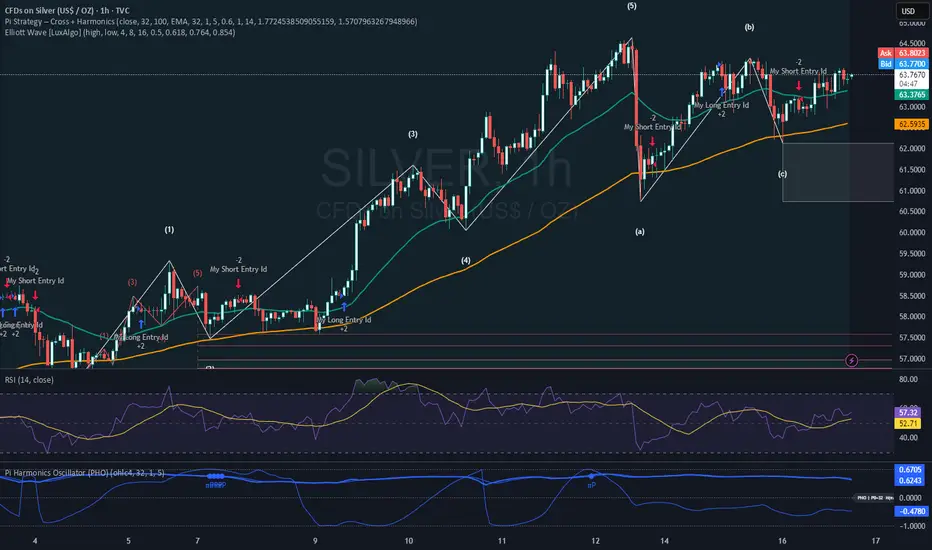
Pi Strategy Cross Harmonicsstill customizing this one, buy and sell seems to off on alternate time settings.
a work in progress, see if this works for anyone.
thanks again.
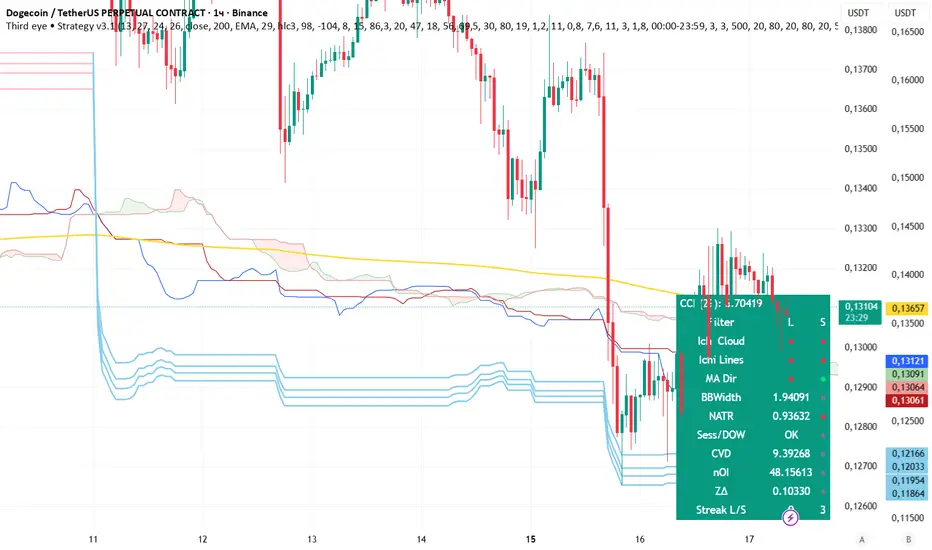
Third eye Strategy v3.1Third eye Strategy v3.1 DogeThird eye Strategy v3.1 DogeThird eye Strategy v3.1 Doge

rj's temu perp pair tradeOverview
rj’s temu perp pair trade is a simple, robust pairs-trading strategy designed for crypto perpetual futures, implemented directly on ratio charts (A / B) in TradingView.
The strategy trades mean reversion in relative price using Bollinger Bands, while keeping sizing, execution logic, and diagnostics intentionally simple and transparent.
This script is designed primarily for signal research and pair selection, not for fully accurate two-leg PnL simulation inside TradingView.
Strategy Concept
The strategy operates on a ratio chart:
Asset A / Asset B
The ratio represents relative performance between two assets.
Core idea
When the ratio deviates significantly from its recent mean, it tends to revert. (if you pick stuff that has very similar drivers and little insider trading flows.
Bollinger Bands provide a simple, robust way to define “too far”.
Entry Logic
Using Bollinger Bands on the ratio price:
Long ratio
Ratio crosses below the lower band
Interpreted as A cheap vs B
Short ratio
Ratio crosses above the upper band
Interpreted as A expensive vs B
Entries are generated on bar close, with fills occurring on the next bar open (TradingView’s internal behavior).
Exit Logic
Positions are closed when any of the following occurs:
Ratio crosses back through the Bollinger midline
Position held longer than maxBarsInTrade (optional)
Fixed % stop based on ratio price (optional)
Each exit is explicitly labeled on the chart:
C → mean reversion
TS → time stop
SL → stop loss
Position sizing and margin
Positions are sized as a percentage of Strategy Tester equity
Default: 10% of equity per trade
This ensures consistent risk within TradingView, even on ratio charts
Mating requirements are set to 1% for long/short to disable margin rejections for research purposes.
What TradingView PnL means (important)
When trading ratio charts, TradingView treats the ratio as a single synthetic instrument.
PnL is reported in the denominator (quote) unit e.g. on UNI / SUSHI, PnL is in SUSHI
Strategy Tester does not simulate two legs
Absolute PnL, Sharpe, and drawdowns are not USDT-accurate
This script intentionally does not attempt to convert PnL into USDT inside TradingView.
Instead:
TradingView is used for signal behavior, regime analysis, and pair comparison
Accurate two-leg USDT PnL should be computed externally
Summary Table
The on-chart summary table reports Strategy Tester-aligned metrics only:
Total PnL (%)
Number of closed trades
Win rate
Average PnL per trade
Sharpe ratio (annualized, based on Strategy Tester equity)
PnL units (syminfo.currency)
These metrics are internally consistent but should be treated as indicative, not execution-accurate.
Recommended workflow
Inside TradingView
Use this script to:
Explore pair behavior
Validate mean-reversion dynamics
Study regime dependence
Compare relative signal quality across pairs
Outside TradingView
Use exported trade data to:
Aggregate daily PnL
Normalize by initial capital
Apply portfolio weights
Vol-target and analyze drawdowns
Add funding, fees, and execution logic
Limitations
This script does not:
Simulate two-leg execution
Account for funding rates
Model fees or slippage per leg
Provide USDT-accurate PnL
It is not a trading system. It is a clean, robust research and signal-generation tool.

BXTrender Strategy Option Test bxtrender strategy.
- shows daily weekly and monthly bxtrender indicator in one go
- monthly and weekly crossover strategy

Supertrend + EMA + RSI Algo (Low Risk High Accuracy)This is a trend-following + momentum confirmation strategy designed to reduce false signals and control loss.
Supertrend (10,3) → Identifies overall market direction (Buy in uptrend, Sell in downtrend)
EMA 50 & EMA 200 → Confirms strong trend and avoids sideways market
Buy only when EMA 50 is above EMA 200
Sell only when EMA 50 is below EMA 200
RSI (14) → Confirms momentum
Buy when RSI > 55 (strong bullish momentum)
Sell when RSI < 45 (strong bearish momentum)
---
🔹 Entry Logic
BUY: Market is in uptrend + strong momentum
SELL: Market is in downtrend + strong bearish pressure
---
🔹 Risk Management (Most Important)
Stop Loss: Based on ATR (adapts to volatility)
Target: Fixed Risk-Reward ratio (example: 1 : 2.5)
This keeps loss small and profits larger
---
🔹 Best Use Case
Works best in trending markets
Ideal timeframes: 15m, 1h, 4h
Suitable for crypto futures & swing trading
Beginner-friendly if used with low leverage

Third eye Strategy v3.1 DogeThird eye • Strategy v3.1 Doge Third eye • Strategy v3.1 Doge Third eye • Strategy v3.1 Doge

ICT FVG + BPR + Liquidity StrategyICT-Based Strategy combining:
• 4H Fair Value Gaps (FVG) for directional bias
• Balanced Price Range (BPR) zones for entry refinement
• PDH/PDL liquidity sweeps for confirmation
• Daily swing high/low structure
• London session time windows (07:45-11:45 & 14:00-14:45 GMT)
• High-volume liquidity zone detection
• Trailing stops at 1R increments
Features:
✓ 15+ years backtested (2010-2025)
✓ Works on GBPUSD, GBPJPY, USDCAD
✓ Asymmetric risk/reward (1R-10R winners vs -1R losses)
✓ Automated entry/exit signals
✓ Full risk management (1% per trade)
Best for: Personal accounts, swing trading, education
Prop firm modifications included in comments.
Free to use & modify - Share improvements!
Created by: BacktestBay

EURUSD | Yield Curve Flip Strategy (2s10s State Flips)Strategy Core (Concept)
The strategy trades EURUSD exclusively when the US yield curve regime (2Y/10Y) flips into a new, clearly bullish or bearish regime. The core assumption is that re-pricing in the US yield curve (rather than individual data points) is a robust driver of USD strength or weakness and can act as a structural trigger for trend changes.
⸻
Data Basis
• Uses US 2Y Yield (TVC:US02Y) and US 10Y Yield (TVC:US10Y).
• The 2s10s curve is calculated as:
curveUS = US10Y – US2Y
• Regime assessment is based on the N-day change (default: 5 days), calculated on true rates bars (not intraday noise).
⸻
Regime Detection (Correct Bond Logic)
First, the strategy checks whether the curve has significantly steepened or flattened over the lookback period:
• Steepener if Δ(2s10s) > thrCurve (default: +0.10 percentage points = 10 bp)
• Flattener if Δ(2s10s) < −thrCurve
Next, a leg confirmation determines the specific type of steepener/flattener (default thrLeg = 5 bp):
Bull Steepener
• Curve steepens because yields fall, with the 2Y falling more (risk-off / rate-cut pricing)
Bear Steepener
• Curve steepens because yields rise, with the 10Y rising more (reflation / term-premium move)
Bull Flattener
• Curve flattens because yields fall, with the 10Y falling more (growth shock / long-end rally)
Bear Flattener
• Curve flattens because yields rise, with the 2Y rising more (hawkish repricing / front-end up)
Important: By default, a Bear Steepener is not treated as a bearish signal, unless allowBearSteepForShort is enabled.
⸻
State Machine (Memory + Flip Triggers)
The strategy maintains a persistent state variable curveState:
• +1 = bullish
• −1 = bearish
• 0 = neutral
The state is updated only on a new rates bar (daily rates when tfRates = "D"), avoiding intraday noise.
A trade is generated only on a true regime flip:
• flipToBull: new state turns bullish and the previous state was bearish (or neutral, if allowed)
• flipToBear: new state turns bearish and the previous state was bullish (or neutral, if allowed)
The option enterFromNeutral controls whether the first clear regime emerging from neutral is traded.
The option onlyOnNewRatesBar ensures signals occur only when a new rates bar is printed, providing clean timing.
⸻
Trading Rules (Entry / Exit)
There are no stops, targets, or trailing mechanisms. The strategy is a pure regime-switching / reversal system:
• On flipToBull
• Close short (“S”)
• Open long (“L”)
• On flipToBear
• Close long (“L”)
• Open short (“S”)
Positions are therefore held until the next regime flip.
⸻
Parameter Interpretation
• N: Smoothing / inertia. Smaller = faster but noisier; larger = more stable but later.
• thrCurve: Minimum curve move required to define a regime.
• thrLeg: Minimum move of the confirming leg (2Y or 10Y) to reduce misclassification.
• allowBearSteepForShort: Makes the system more aggressive (more bearish signals), but represents a different macro case.
• enterFromNeutral: Increases trade frequency by trading the first regime impulse.
⸻
What You See on the Chart
• Background shading:
• Green for bullish state
• Red for bearish state
• The curve and Δ-curve are plotted but hidden (display=none), mainly for debugging and analysis.

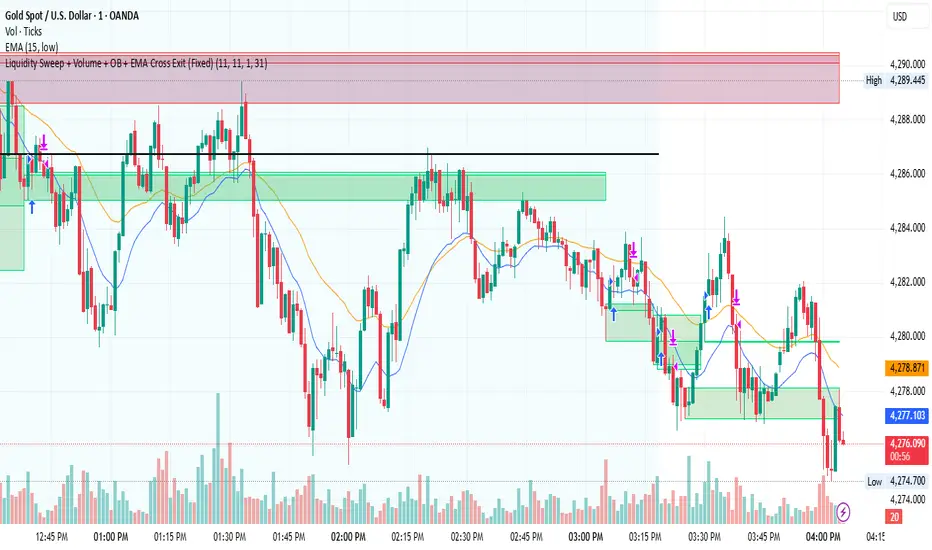
Liquidity Sweep + Volume + OB + EMA Cross Exit This strategy is a smart-money–inspired trading system designed to capture high-probability reversals after liquidity is taken from the market.
It combines liquidity sweeps, volume confirmation, order block validation, and a dynamic EMA-based exit to control risk and let profits run.
Core Concept
Institutions first take liquidity, then move price in the real direction.
This strategy aims to enter after liquidity is swept and price shows confirmation.
1️⃣ Liquidity Sweep Detection
2️⃣ Volume Confirmation
3️⃣ Order Block Identification
4️⃣ EMA Trend Filter (Optional Entry Bias)
5️⃣ Trade Entry Logic
6️⃣ Exit Strategy – EMA Cross Exit
Benefits:
Lets strong trends run
Exits automatically when momentum weakens
Adapts to different market conditions
🛡 Risk & Trade Management
One trade at a time (anti-overtrading logic)
Early exit if trade moves against position after a few bars
Opposite signal forces exit
EMA cross provides trend-based exit
GOLD 5m PA ScalperXAUUSD 5-Minute Price Action Scalper with HTF Confirmation
This Pine Script is a trend-following scalping strategy designed specifically for XAUUSD (Gold) on the 1,3,5-minute timeframe.
Its main goal is to reduce noise and false signals by combining lower-timeframe price action with higher-timeframe (15-minute) structure.
CORE IDEA
Trade only in the direction of the dominant trend and only when price reacts from a strong higher-timeframe Order Block.

225 SMA CrossoverWell-known strategy from Zahlengraf from the Mauerstrassenwetten subreddit for you to test yourself.
You can change the length of the SMA and whether to trade long, short or both directions.

HMA1//@version=5
strategy("黄金 HMA + SuperTrend 趋势增强策略", overlay=true, initial_capital=10000, default_qty_type=strategy.percent_of_equity, default_qty_value=10)
// --- 1. 输入参数 ---
// HMA 参数
hmaLen = input.int(55, "HMA 长度", minval=1, group="HMA 设置")
// SuperTrend 参数
stFactor = input.float(3.0, "SuperTrend 乘数", step=0.1, group="SuperTrend 设置")
stPeriod = input.int(10, "SuperTrend ATR 周期", group="SuperTrend 设置")
// 离场设置
useAtrSl = input.bool(true, "启用 ATR 动态止损", group="风险管理")
atrSlMult = input.float(2.0, "止损 ATR 倍数", step=0.1, group="风险管理")
// --- 2. 指标计算 ---
// 计算 HMA
hmaValue = ta.hma(close, hmaLen)
// 计算 SuperTrend
= ta.supertrend(stFactor, stPeriod)
// 计算 ATR(用于止损)
atr = ta.atr(14)
// --- 3. 绘图 ---
plot(hmaValue, "HMA 趋势线", color=hmaValue > hmaValue ? color.green : color.red, linewidth=2)
plot(stValue, "SuperTrend 线", color=stDirection < 0 ? color.new(color.teal, 0) : color.new(color.maroon, 0), linewidth=2)
// --- 4. 交易逻辑 ---
// 做多条件:
// 1. 价格在 HMA 之上 且 HMA 正在向上拐头
// 2. SuperTrend 变为看涨方向 (stDirection < 0)
longCondition = close > hmaValue and hmaValue > hmaValue and stDirection < 0
// 做空条件:
// 1. 价格在 HMA 之下 且 HMA 正在向下拐头
// 2. SuperTrend 变为看跌方向 (stDirection > 0)
shortCondition = close < hmaValue and hmaValue < hmaValue and stDirection > 0
// --- 5. 执行与止损逻辑 ---
var float longStop = na
var float shortStop = na
// 入场逻辑
if (longCondition)
longStop := close - (atr * atrSlMult)
strategy.entry("Long", strategy.long, comment="HMA+ST 多")
if (shortCondition)
shortStop := close + (atr * atrSlMult)
strategy.entry("Short", strategy.short, comment="HMA+ST 空")
// 离场逻辑:当 SuperTrend 反转或触及 ATR 止损时离场
if (strategy.position_size > 0)
strategy.exit("Exit Long", "Long", stop=longStop, limit=na, when=stDirection > 0, comment="多单离场")
if (strategy.position_size < 0)
strategy.exit("Exit Short", "Short", stop=shortStop, limit=na, when=stDirection < 0, comment="空单离场")
// 填充背景色以示趋势
fill(plot(stValue), plot(open > close ? open : close), color = stDirection < 0 ? color.new(color.green, 90) : color.new(color.red, 90))


IVB - Institutional Volume Blast在加密貨幣市場中,價格可以被操縱,但**「成交量」無法說謊。 IVB (Institutional Volume Blast) 是一套專門針對 Ethereum (ETH) 設計的量價分析系統,它不依賴滯後的技術指標,而是直接鎖定「機構進場的瞬間」**。
核心邏輯:
量能異常偵測 (Volume Anomaly): 系統自動掃描市場成交量。當出現超越歷史平均 2.5 倍 的巨量買盤時,視為巨鯨 (Whales) 或機構進場的訊號。
機構資金驗證: 單純的爆量可能是假突破。本策略結合 Coinbase 機構溢價 作為雙重濾網。只有當美國機構投資者也在買入時,這個爆量訊號才會被確認有效。
起漲點捕捉: 與傳統突破策略不同,本策略在爆量 K 棒收盤即進場,往往能買在行情的起漲點,而非追在半山腰。
In the crypto market, price can be manipulated, but Volume never lies. IVB (Institutional Volume Blast) is a Volume-Price Analysis (VPA) system specifically optimized for Ethereum (ETH). It bypasses lagging indicators to lock onto the exact moment of Institutional Entry.
Core Logic:
Volume Anomaly Detection: The system scans for volume spikes exceeding 2.5x the historical average. This signifies a major capital commitment from Whales or Institutions.
Institutional Verification: A volume spike alone can be a trap. This strategy integrates a Coinbase Institutional Premium Filter. A signal is only valid if US institutions are also accumulating.
Early Entry: Unlike breakout strategies that buy after the pump, IVB enters at the close of the "Blast Candle," often capturing the inception of the trend rather than chasing it.
免責聲明:
以上策略分享僅供學術研究、回測實驗與邏輯參考,並不代表對未來獲利的保證。 過往的回測績效不代表未來的行情表現。本文內容不構成任何投資建議。加密貨幣交易具有高度風險,使用者應自行評估風險承受能力並自負盈虧,本人不承擔任何因使用此策略而產生的資金損失。
Disclaimer :
The strategy presented above is for academic research, backtesting experiments, and logical reference only. It does not constitute a guarantee of future performance. Past backtest results are not indicative of future outcomes. This content does not represent any investment advice. Cryptocurrency trading involves substantial risk, and users should assess their own risk tolerance and assume full responsibility for any gains or losses. The author bears no liability for any financial losses incurred from the use of this strategy.

