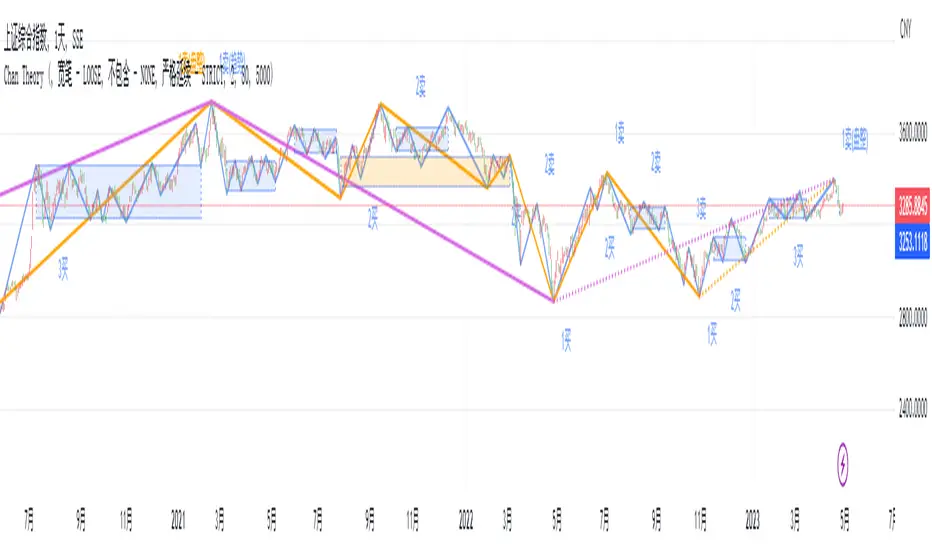
ChanLun ProChanLun, also known as Entanglement Theory or "缠论", is a highly regarded technical analysis methodology that originated in China. Since its introduction in 2006, ChanLun has rapidly gained significant attention and a strong following within the Chinese trader community due to its exceptional ability to navigate complex market dynamics.
ChanLun places great emphasis on market structure, price action, momentum, and the intricate interplay between market forces. It recognizes that the market operates in cyclical patterns and aims to capture the underlying structure and rhythm of price movements. Through meticulous analysis of the intricate relationships between price and time, it provides traders with a unique perspective on market trends, potential reversals, and critical turning points.
This indicator offers a meticulous and comprehensive implementation of the ChanLun theory. It facilitates in-depth analysis and visual representation of all essential components, encompassing “Candlestick Conversion”, "Candlestick Standardization", "Fractal", "Stroke", "Segment", "Pivot", and "Buying/Selling Point".
🟠 Algorithm
🔵 Step 1: Candlestick Conversion
In ChanLun, candlestick analysis focuses less on the opening/closing prices and wicks, but rather emphasizes the price range at which the stock price has reached. As a result, the initial step in ChanLun involves converting each candlestick to contain solely the high and low prices, disregarding other elements.
🔵 Step 2: Candlestick Standardization
In the second step, the converted candlesticks are standardized to ensure strict directional consistency and eliminate the presence of inner bars or outer bars. For any adjacent two candlesticks A and B where one’s price range completely encompasses another, A and B are merged into a new candlestick C. If A is trending up from its previous candle, then C will be defined such that high(C) = max(high(A), high(B)) and low(C) = max(low(A), low(B)). If A is trending down from its previous candle, then C will be defined such that high(C) = min(high(A), high(B)) and low(C) = min(low(A), low(B)).
After completing these steps, when considering any adjacent candlesticks A and B, we can always observe either of the following conditions:
1. high(A) > high(B) and low(A) > low(B)
2. high(A) < high(B) and low(A) < low(B)
The chart below illustrates how the candlesticks would appear after this step.
🔵 Step 3: Fractals
A "Fractal" refers to the pattern formed by three consecutive "standardized" candlesticks, where the middle candlestick shows a clear higher or lower value compared to the surrounding candlesticks. When considering three adjacent candlesticks, A, B, and C, we have either of the two conditions:
1. high(B) > high(A) and high(B) > high(C) and low(B) > low(A) and low(B) > low(C)
2. high(B) < low(A) and high(B) < low(C) and low(B) < low(A) and low(B) < low(C)
For #1 above, we refer to the combination of A, B, and C as a “Top Fractal”, whereas for #2 we designate it as a “Bottom Fractal”.
The chart below illustrates all the fractals, with the red triangles indicating the Top Fractals and the green triangles indicating the Bottom Fractals.
🔵 Step 4: Strokes
A “Stroke” is a line connecting a top fractal and a bottom fractal, subject to the following rules:
1. There must be at least one "free" candlestick positioned between these fractals, meaning it is not part of either the top or bottom fractal. This guarantees that a stroke encompasses a minimum range of five candlesticks from beginning to end.
2. The top fractal must have a higher price compared to the bottom fractal.
3. The endpoint fractals should represent the highest or lowest point throughout the entire span of the stroke. (There is an option within this indicator to enable or disable this rule.)
Strokes enable traders to identify and visualize significant price swings or trends while effectively filtering out minor fluctuations.
🔵 Step 5: Segments
A "Segment" is a higher-level line that connects the starting and ending points of at least three consecutive strokes, reflecting the current trend of the market structure. It continues to extend as new strokes emerge, until there is a break in the market structure. The break occurs when an uptrend forms a lower high and lower low, or when a downtrend forms a higher high and higher low. It's worth noting that during trading ranges, it is common for strokes to exhibit a higher high and lower low or a higher low and lower high pattern (similar to inner bars and outer bars). In such cases, the strokes will be merged in a similar manner as described earlier for candlesticks, until there is a distinct break in the market structure. Segments provide a relatively stable depiction of the market trend in a higher timeframe, as opposed to strokes.
It is important to note that the algorithm used to calculate segments from strokes can be recursively applied to the generated segments again, forming higher-level segments that represent the market trend on a even larger timeframe.
🔵 Step 6: Pivots
In ChanLun, the term "Pivot" does not indicate a price reversal point. Instead, it represents a trading range where the price of a security tends to fluctuate. Within a given "Segment," the pivot is determined by the overlap of two consecutive strokes moving in the opposite direction of the segment. When two downtrend strokes A and B form a pivot P within an uptrend segment S, the upper and lower bounds of the pivot are defined as follows:
1. upper(P) = min(high(A), high(B)
2. lower(P) = max(low(A), low(B))
The pivot range is typically where consolidation occurs and where there is a high trading volume.
If a future stroke, moving in the opposite direction of the current segment, overlaps with the upper and lower bounds of the pivot, it is merged into the existing pivot and extends the pivot along the x-axis. A new pivot is formed when two consecutive strokes moving in the opposite direction of the current segment, intersect with each other without overlapping the previous pivot.
Likewise, pivots can also be recursively identified within the higher-level segments. The blue boxes below represent the "Segment Pivots" that are identified within the context of higher-level segments.
🔵 Step 7: Buying/Selling Points
There are three types of buying/selling points defined in ChanLun.
1. Type 1 Buying and Selling Points: Also known as trend reversal points. These points are where the old segments terminate and new segments are generated.
2. Type 2 Buying and Selling Points: Also known as trend continuation points. These points occur while the price is in the midst of a trend and signify the continuation of the trend. In an uptrend, the Type 2 buying point is the rebound point after the price retraces to a previous low or support level, indicating that the price may continue to rise. In a downtrend, the Type 2 selling point is the pullback point after the price rallies to a previous high or resistance level, indicating that the price may continue to decline.
3. Type 3 Buying and Selling Points: These points indicate the retests of breakouts from pivot ranges. The presence of these retest points suggests that the price has the potential to continue its upward/downward movement above/below the pivot levels.
A discerning reader may notice that these buying/selling points are lagging indicators. For example, by the time a new segment is confirmed, multiple candlesticks have already occurred since the type 1 buying/selling point of that segment.
Indeed, it is true that the buying/selling points lag behind the actual market movements. However, ChanLun addresses this issue through the utilization of multi-timeframe analysis. By examining the confirmed buying/selling points in a lower timeframe, one can gather additional confidence in determining the overall trend of the higher timeframe.
🔵 Step 8: Divergence
Another core technique in ChanLun is the application of divergence to anticipate the emergence of type 1 buying/selling points. While MACD is the most commonly employed indicator for detecting divergence, other indicators such as RSI can also be utilized for this purpose.
🟠 Summary
In essence, ChanLun is a robust approach to technical analysis that integrates the careful examination and interpretation of price charts, the application of technical indicators and quantitative tools, and a keen attention to multiple timeframes. Its objective is to identify prevailing market trends and uncover potential trading prospects. What sets ChanLun apart is its holistic methodology, which blends both qualitative and quantitative analysis to facilitate informed and successful trading decisions.
🟠 NOTE
The freely available "ChanLun | AlgoTrader" script, published by the same account, incorporates only a limited set of fundamental concepts from ChanLun.
In contrast, this script is a premium invite-only version that represents a comprehensive implementation of the complete ChanLun methodology, specifically tailored for more experienced and professional traders.
________________________________________________________________________________
该指标严格按照缠论原文实现了包括“K线标准化”、“分型”、“笔”、“线段”、“中枢”和“买卖点”在内的所有关键元素。它旨在为缠友们提供一个准确可靠的缠论实现,以便快速而精准地分析市场,从而获得更优秀的交易业绩。
该指标的主要特点如下:
1. 实时标记所有缠论元素:该指标具备实时识别和标记分型、笔、线段、中枢和买卖点的功能,提供清晰的信号和准确的趋势判断。
2. 多种笔段算法选择:提供三种不同的笔算法(“老笔”、“新笔”和“4K”)以及两种线段算法(“特征序列”和“1+1终结”),满足不同交易者个性化需求,可根据偏好和策略选择最适合的算法。
3. 三级别联立:指标同步计算并显示笔、线段和递归高级段,提供更全面的市场动态分析。
4. 自定义颜色:用户可以根据个人喜好和需求自定义指标的颜色方案,与图表风格和视觉需求完美匹配。
5. 完美实现K线回放功能:指标充分利用了K线回放功能,让交易者能够回顾和分析历史市场数据,提高对市场趋势的研究和理解,增强市场洞察力和决策能力。
Search in scripts for "CHANLUN"

ChanLun [AlgoTrader]ChanLun, also known as Entanglement Theory or "缠论," is a highly regarded technical analysis methodology that originated in China. Since its introduction in 2006, ChanLun has rapidly gained significant attention and a strong following within the Chinese trader community due to its exceptional ability to navigate complex market dynamics.
ChanLun places great emphasis on market structure, price action, momentum, and the intricate interplay between market forces. It recognizes that the market operates in cyclical patterns and aims to capture the underlying structure and rhythm of price movements. Through meticulous analysis of the intricate relationships between price and time, it provides traders with a unique perspective on market trends, potential reversals, and critical turning points.
This indicator incorporates three fundamental components of the ChanLun methodology, namely "Candle Standardization," "Fractal," and "Stroke."
- "Candle Standardization" is a process in which the candles are standardized to ensure strict directional consistency and eliminate the presence of inner bars or outer bars.
- "Fractal" refers to the formation of three consecutive "standardized" bars, with the middle bar demonstrating a definitive higher or lower value compared to the bars surrounding it.
- "Stroke" is a line connecting a top fractal and a bottom fractal, subject to the strict condition that there is a minimum of one free bar positioned between them. This requirement ensures that a stroke encompasses a minimum span of five bars from end to end. It is crucial to emphasize that the top fractal consistently maintains a higher value than the bottom fractal.
Within the ChanLun algorithm, these components are processed meticulously and sequentially. The initial step involves candle standardization, where the candles are harmonized to adhere to strict criteria. Subsequently, the identification of fractals takes place by examining the standardized candles. Finally, the stroke component is applied, establishing connections between top and bottom fractals while ensuring the defined conditions are met.
The final component, stroke, enables traders to identify and visualize significant price swings or trends while effectively filtering out minor fluctuations. This functionality proves particularly valuable in recognizing major support and resistance levels, trend reversals, and chart patterns, enhancing the overall analysis process.
__________________________________________________________________________________________________________
本指标严格按照缠论原理实现了三个核心要素,分别为“K线标准化”、“分型”和“笔”。它旨在为缠友们提供准确而可靠的市场分析工具,以在交易中获得更好的表现。
该指标的特色如下:
1. 实时标记分型和笔:本指标具备实时识别和标记分型和笔的功能,以提供清晰的信号和准确的趋势判断。
2. 多种笔算法选择:本指标提供三种不同的笔算法,包括“老笔”、“新笔”和“4K”。这样的设计能够满足不同缠友的个性化需求,让大家根据自己的偏好和策略选择最适合的算法。
3. 自定义颜色:缠友们可以根据自己的喜好和需求,自定义指标的颜色方案。这样的灵活性使得指标能够与图表风格和视觉需求完美匹配。
4. 完美实现K线回放功能:本指标充分利用了K线回放功能,使缠友们能够回顾和分析历史市场数据,从而可以更好地研究和理解市场趋势,提高对市场的洞察力和决策能力。

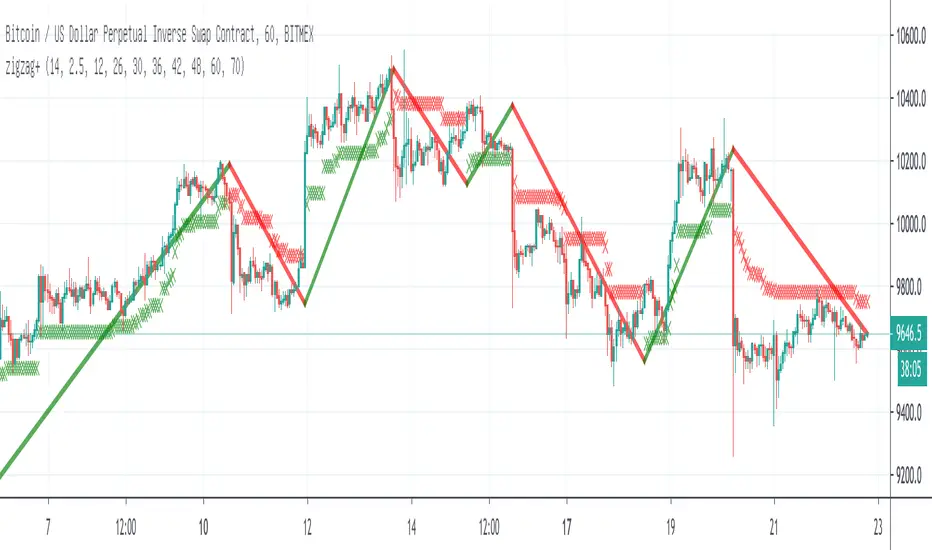
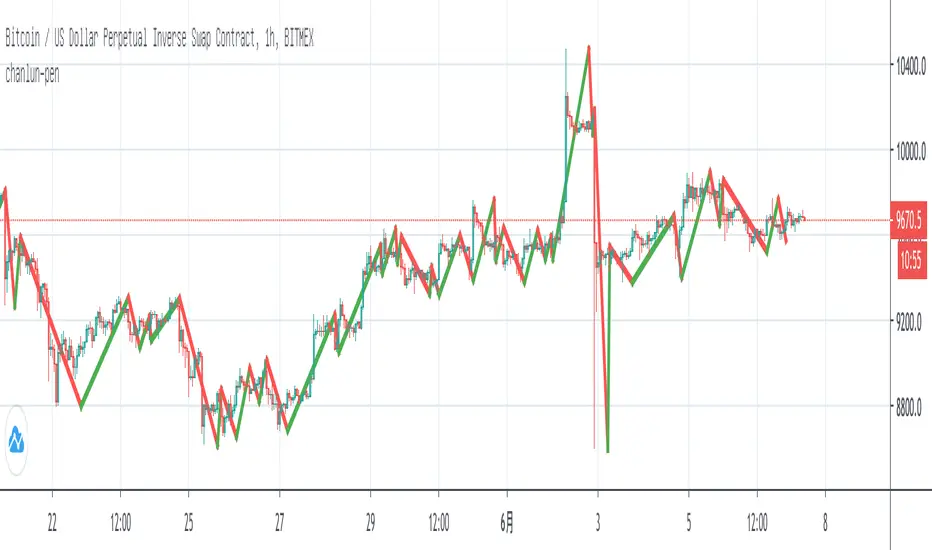
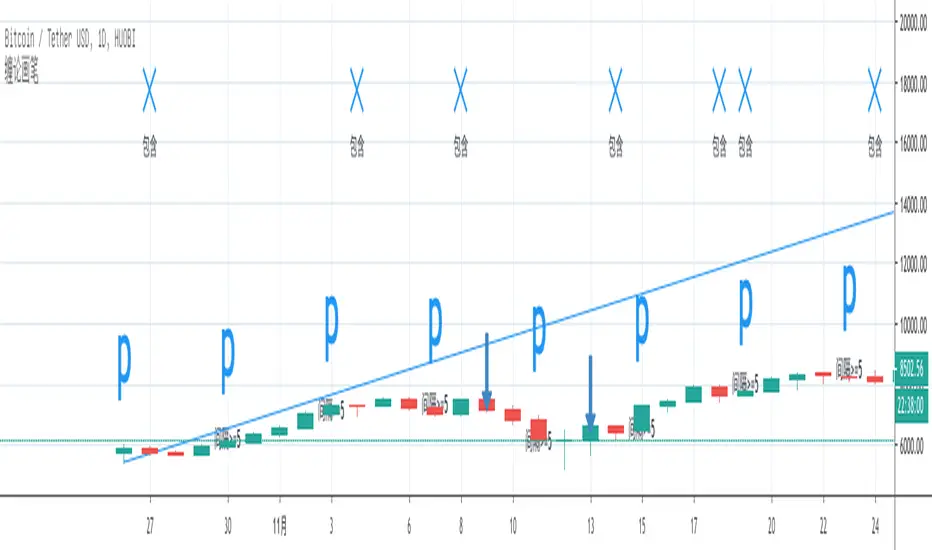
chanlun_penthe strong line call 'pen' in chanlun.it is build from the thin line,and the thin line is about kline trend. when you see the red line(strong or thin) ,that's mean down trend has been complete,at the same time,up trend has start.
缠论分笔.当你看到红色线段时,说明下跌的一笔已经完成(下跌趋势结束),同时是上涨的一笔开始(上涨趋势开始)
chanlun can Identify charpatterns,and not only that
Chanlun FBFD pen czsc Channel Chan Theory
🏆 Chan Zhong Shuo Chan FBFD Pure Segment Version Indicator - Flagship Edition
Background
A decade of craftsmanship, a significant upgrade
This Chanlun indicator has undergone nearly 10 years of meticulous refinement and continuous optimization. Since its initial design in 2015, it has been validated through actual trading. Now newly upgraded and launched on TradingView, it offers more comprehensive functions and superior performance.
It truly implements all core theories from the original Chanlun text, including a complete system of K-line inclusion, fractal recognition, pen and segment analysis, center theory, pure pen and segment division (classification of the first and second cases in the original text), divergence and reversal, providing professional and comprehensive technical analysis tools for Chanlun enthusiasts in the industry.
Chinese Translation for User Indicator Interface:
● 顶背离: Top Divergence
● 底背离: Bottom Divergence
● 顶背驰: Top Divergence Including Trend Structure
● 底背驰: Bottom Divergence Including Trend Structure
📦 Parameter Settings
● Number of K-lines to calculate: Up to 5000, which is the maximum data available even for free TradingView users
● Pen detail parameters: Old/new pens, sub-high/low pens, high/low pens, strict pens can be adjusted and selected according to the target numbers
● Segment detail parameters: Adjustable
● MA and Bollinger Bands display parameters: Check to display, uncheck to hide as needed
● Center price and pen/segment price display: Check to display, uncheck to hide as needed
● MACD parameters: Can be adjusted as needed, including fast, slow, and signal line period settings
● MA parameters: Default parameters can be manually adjusted
● Pen divergence, segment divergence, pen-segment reversal display: Check to display, uncheck to hide as needed
● Pen-segment divergence and reversal alerts: Disabled by default, can be enabled by checking. Then in TradingView's alert interface, select the indicator in conditions, set "Any alert() function call", set notification type, and create the alert to receive notifications
🔥 Integration of other commonly used indicators and reasons:
✅ Moving Averages: Since Chanlun uses MA overlay analysis, this makes it more convenient for users to analyze trends from different perspectives, so it's essential to add
✅ Bollinger Bands: Bollinger Bands channel, combined with Chanlun, can also provide more perspectives for trend analysis and improve accuracy, so it's also added
✅ MACD: This is an indispensable indicator for analyzing trend strength in Chanlun theory, so it must be integrated for convenient analysis
✅ Chanlun ZSLX pen czsc Channel Chan Theory and Chanlun FBFD pen czsc Channel Chan Theory scripts share some underlying source code and must be integrated because:
The underlying K-line inclusion, MACD divergence and reversal, K-line objects, and pen parts in the original Chanlun text are the same, but the top-level segment and trend recursion division principles, display effects, and functions are significantly different. Additionally, TradingView community has source code quantity restrictions, making it impossible to fully integrate the two versions into one. Therefore, the kxian object returned by the Start_kxian function, the bi object returned by the Start_bi function, the source code for drawing K-line centers in showKxianzsfunc, and the MACD divergence and reversal judgment code in this script will have integrated parts with the same source code.
🎯 Technical Principles
🔥 1. Comprehensive coverage of original Chanlun functions
✅ Multi-level center combination - pen centers, K-line centers, segment centers
● Chanlun K-line centers: The lowest level Chanlun centers
● Chanlun pen centers: Pen center division intervals from the original text, taking the lowest point of the overlapping part as the high point and the highest point of the overlapping part as the low point
● Chanlun segment centers: Segment center division intervals from the original text, taking the lowest point of the segment overlapping part as the high point and the highest point of the segment overlapping part as the low point
✅ Divergence and reversal warning - divergence and reversal algorithm
● Principle: Adopts MACD strength statistics from the original Chanlun text, distinguishes between divergence/reversal in pen structures and segment structures, marks specific values on the graph, differentiates MACD strength between pens and segments. This will be further upgraded with more complex statistics in the future, but currently serves as a reference for the current cycle. Specific analysis still requires multi-cycle strength analysis.
✅ Original two-level pure segmentation - exclusive algorithm
● Principle: Strictly follows segment division from the original text, distinguishing between the first and second cases, as well as special fractal inclusion processing for the second case, and segment rules. Some segments may not end at the highest or lowest points.
✅ Real-time K-line inclusion processing - intelligent recognition of inclusion relationships
● In rising K-lines, take the higher high and higher low values (take the higher among highs)
● In falling K-lines, take the lower high and lower low values (take the lower among lows)
✅ Accurate fractal marking - automatic recognition of top and bottom fractals
● By setting the old/new pen parameter to 2, the high and low points of each top and bottom fractal will be drawn
● Top fractal: Among three K-lines, the middle K-line has a higher high and a higher low than both sides
● Bottom fractal: Among three K-lines, the middle K-line has a lower low and a lower high than both sides
✅ Multi-dimensional pen and segment analysis - complete system of pens and segments
● Old pens: Traditional strict pen definition in Chanlun, consistent with the original text
● New pens: Traditional new pen definition in Chanlun, meeting the relaxed pen conditions in the original text
● Fractal pens: Pens formed by top and bottom fractals, with sensitive price response (many peers mark fractal pens of this cycle as sub-level)
● Segments: This version adopts a recursive approach, treating some pens as segments in certain places. Most places are the same as pure segmentation, but with different line-drawing principles
✅ Multi-level center combination - K-line centers, pen centers, segment centers
● K-line centers: The smallest level Chanlun centers
● Pen centers: Adopt pen center division intervals from the original text, taking the lowest point of the overlapping part as the high point and the highest point of the overlapping part as the low point
● Segment centers: Adopt segment center division intervals from the original text, taking the lowest point of the segment overlapping part as the high point and the highest point of the segment overlapping part as the low point
⚙️ Indicator Features
⚙️ 1. Diversified pen and segment algorithm engine
🎨 Three pen algorithms: "Chanlun old pen", "Chanlun new pen", "top-bottom fractal pen", with more custom pen types to be added later
🔧 Common parameter adjustments: Equal high/low points, highest/lowest point pens, sub-high/low pens, fractal interval judgment, and other refined controls
📊 Dual segment division: Original pure segmentation + large-level segmentation
🎯 Multiple personalized parameter adjustments: Many other different parameters to meet different Chanlun enthusiasts' understanding needs and trading styles
🌟 2. Multi-level intelligent combination system
📈 Synchronous calculation and display: K-line centers, pens, pen centers, segments, large-level segments, segment center linkage analysis
🏗️ Exclusive pure segmentation algorithm: Accurately identifies first and second case segment divisions
🎪 Multi-level center system: Complete coverage of three center levels
📊 Panoramic market analysis: Provides comprehensive market dynamic insights
🎨 3. Professional visual customization
🌈 Custom color schemes - perfectly matching personal chart styles
💰 Price label display - marking of key price levels for pens, segments, and centers
📐 Professional auxiliary tools - practical functions such as moving averages and Bollinger Bands
🎁 MACD - supporting indicator in the sub-chart
⏰ 4. Perfect K-line replay support
🔄 Historical data review - perfectly supports TradingView replay function
📚 Market research tool - enhances historical trend analysis capabilities
🧠 Decision-making ability enhancement - deepens market insight and judgment level
📦 Product Versions
🥇 Version 1: Professional Segmentation Edition
Suitable for: Traditional Chanlun enthusiasts pursuing classic segmentation algorithms
Core functions:
🔸 Multiple pen algorithms: Fractal pens, new pens, old pens, sub-high/low pens, highest/lowest pens
🔸 Pen and segment detail adjustments: Massive parameters supporting various pen division schemes
🔸 Complete center system: K-line centers, pen centers, segment centers
🔸 Intelligent warning system: Divergence and reversal prompts and alarm functions
🔸 Recursive large levels: Current level and large-level segmentation analysis
**📊
💡 Peer comparison: The "professional version" functions of other platforms are just basic configurations here
🎊 Experience now and start your professional Chanlun analysis journey!
Pre-sales note: The Chan Zhong Shuo Chan theory is relatively complex. The software tries its best to implement the functions described in the original text, but there may still be some flaws that cannot be handled perfectly. These will be gradually improved in the future. Customers who are concerned about this can try it for a few days first, purchase it if they find it suitable, or treat it as a test if not. We welcome everyone to feedback problems and bugs, and the shopkeeper will update, modify, and optimize in the future when available.
1. K-line inclusion from the original text
2. Pen and segment multi-level divergence and reversal prompts
3. More than three types of pens that can be adjusted
4. Including pen and segment area strength statistics + center high and low price display
5. Three-level center (K-line center, pen center, segment center) detailed analysis
6. Multiple moving averages display
7. Commonly used superimposed Bollinger Bands
8. Original text segment division rules with 2-level segments
9. Some alarm functions designed, including divergence and reversal, with more to be added in the future
10. A total of dozens of optional parameter settings
11. Free trial
🏆 缠中说禅FBFD 纯分段版指标 - 旗舰版
背景
十年匠心,重磅升级
这套缠中说禅指标历经近10年的精心打磨与持续优化,从2015年初版设计至今,已经过实战验证。现全新升级登陆TradingView,功能更加完善,性能更加卓越。
真正实现了缠论原文中的所有核心理论,包括K线包含、分型识别、笔段分析、中枢理论、 纯分笔分段(原文第一种和第二种情况分类)、背离背驰等完整体系,为缠论爱好者提供业界专业、全面的技术分析工具。
📦参数设置
- 计算K线数量:最多计算5000根,免费tradingview用户也只能这么多数据
- 笔细节参数:新旧笔、次高低点笔、最高低点笔、严格笔 可以调整可按标的数字选
● - 线段细节参数: 调整
- 显示均线和布林线参数:根据需要设置打钩就是显示,取消打钩就是隐藏
- 显示中枢价格和笔段价格:根据需要设置打钩就是显示,取消打钩就是隐藏
- macd参数:可以根据自己需要调整参数 快 慢 信号线周期设置
- 均线参数:默认参数可以自己手动调整
- 显示笔背离、段背离、笔段背驰:根据需要设置打钩就是显示,取消打钩就是隐藏
- 笔段背离背驰报警:默认关闭可以设置打钩开启,然后在tradingview的警报界面,条件里选择指标,设置:任何alert()函数调用,再设置通知类型,然后创建报警就可以收到报警
🔥整合其他常用指标和原因:
✅均线:因为缠论里是有使用均线叠加分析,这种更方便用户从不同视角分析走势,所以必须增加
✅布林线:布林线通道,结合缠论,也可以更多的视角分析走势,提高准确度,所以也增加了
✅macd:这个是缠论分析理论里必不可少的分析走势力度的指标,所以也必须整合进来方便分析
✅Chanlun ZSLX pen czsc Channel Chan Theory这个脚本和Chanlun FBFD pen czsc Channel Chan Theory这个脚本有些底层的源码是一样的必须整合原因:
因为缠论原文底层的K线包含、macd背离背驰、K线对象和笔部分都是一样的,但是顶层的线段和走势递归两种划分原理和显示效果和功能是有很大区别,并且tradingview社区的源码量有限制,导致也无法两个版本划线完全整合成一个,所以,这个脚本里的Start_kxian函数返回的kxian对象、 Start_bi函数返回的bi 对象 、showKxianzsfunc画K线中枢部分的源码、macd背离背驰判断部分代码,会有一样的整合部分源码
🎯 技术原理
🔥 1. 全方位缠论原文功能覆盖
● ✅ 多级中枢联立 - 笔中枢、K线中枢、线段中枢
○ - 缠论K线中枢:最低级别的缠论中枢
- 缠论笔中枢:原文的笔中枢划分区间,高点取重叠部分的最低点,低点取重叠部分最高点
- 缠论线段中枢:原文的线段中枢划分区间,高点取线段重叠部分的最低点,低点取线段重叠部分最高点
● ✅ 背离背驰预警 - 背离背驰算法
○ - 原理:采用缠论原文的macd力度统计,区分笔结构的背离背驰和段结构的背离背驰,并且在图形上标上具体数值,区分笔和段的macd力度,后期这个还要继续升级更复杂的统计,仅做本周期的参考,具体也是要多周期力度分析
● ✅ 原文两级别纯分段 - 独家算法
- 原理:严格按原文的线段划分,区分第一种情况和第二种情况,以及特殊的第二种情况分型包含处理,线段规则,有的地方可能不是结束在最高最低点
● ✅ 实时K线包含处理 - 智能识别包含关系
○ - 上涨K线中取高点高值、低点高值,高高取高
- 下跌K线中取高点低值、低点低值,低低取低
● ✅ 精准分型标记 - 顶底分型自动识别
○ - 通过新旧笔参数设置2,会画出每个顶底分型高低点
○ - 顶分型:三根k线中,中间K线高点高于两侧K线,低点也高于两侧
- 底分型:三根k线中,中间K线低点低于两侧K线,高点也低于两侧
● ✅ 多维笔段分析 - 笔、线段完整体系
○ - 老笔:传统缠论严格笔定义,符合原文
- 新笔:传统缠论新笔定义,符合原文宽松笔条件
- 分型笔:顶底分型就成笔,价格反应比较敏锐(同行很多人把本周期分型笔标成次级别)
○ - 线段:这个版本采用递归思路,有的地方一笔处理成段,大部分地方跟纯分段一样,但是划线原理不同
● ✅ 多级中枢联立 - K线中枢、笔中枢、线段中枢
○ - K线中枢:最小级别的缠论中枢
- 笔中枢:采用原文的笔中枢划分区间,高点取重叠部分的最低点,低点取重叠部分最高点
- 线段中枢:采用原文的线段中枢划分区间,高点取线段重叠部分的最低点,低点取线段重叠部分最高点
⚙️ 指标特点
⚙️ 1. 多样化笔段算法引擎
● 🎨 三种笔算法: "缠论旧笔"、"缠论新笔"、"顶底分型笔",以及后面会增加更多自定义类型笔选择
● 🔧 常见参数调节: 等高低点、最高低点笔、次高低笔、分型区间判断等精细化控制
● 📊 双重段划分: 原文纯分段 +大级别分段
● 🎯 超多个性化参数调整: 还有很多其他不同参数,满足不同缠友的理解需求与交易风格
🌟 2. 多级别智能联立系统
● 📈 同步计算显示: K线中枢、笔、笔中枢、线段、大级别线段、线段中枢联动分析
● 🏗️ 独家纯分段算法: 精确识别第一种、第二种情况线段划分
● 🎪 多级中枢体系: 三重中枢级别完整覆盖
● 📊 全景市场分析: 提供全面的市场动态洞察
🎨 3. 专业视觉定制
● 🌈 自定义配色方案 - 完美匹配个人图表风格
● 💰 价格标识显示 - 笔、段、中枢关键价位标注
● 📐 专业辅助工具 - 均线、布林线等实用功能
● 🎁 MACD - 配套附图指标
⏰ 4. 完美K线回放支持
● 🔄 历史数据回顾 - 完美支持TradingView回放功能
● 📚 市场研究利器 - 提升历史走势分析能力
● 🧠 决策能力增强 - 深化市场洞察与判断水平
📦 产品版本
🥇 版本一:专业分段版
适合:传统缠论爱好者,追求经典分段算法
核心功能:
● 🔸 多种笔算法: 分型笔、新笔、旧笔、次高低点笔、最高低点
● 🔸 笔段细节调整: 海量参数支持各种笔划分方案
● 🔸 完整中枢体系: K线中枢、笔中枢、段中枢
● 🔸 智能预警系统: 背离背驰提示及报警功能
● 🔸 递归大级别: 本级别、大级别分段分析
**📊
💡 同行对比: 其他平台的"专业版"功能,在我们这里只是基础配置
🎊 立即体验,开启专业缠论分析之旅!
售前说明:缠中说禅理论,相对比较复杂,软件尽量实现原文的功能,但是也难免有些瑕疵地方,无法处理到位,这边后期会陆续完善,介意的客户可以先试用几天,觉得合适再买,不合适就当测试下,欢迎大家反馈问题和bug,掌柜有空会后期更新修改和优化
1.原文的K线包含
2.笔段多级别背离背驰提示
3.超过三种笔可以调整
4.包含笔段面积力度统计+中枢高低点价格显示
5.三级别中枢(K线中枢 笔中枢 段中枢)精细分析
6.多个均线显示
7.常用叠加布林
8.原文线段划分规则,并且做2级别段
9.设计了一些报警功能,背离背驰等,后期还会陆续完善
10.总共几十个可选参数设置
11.免费试用

Chanlun ZSLX pen czsc Channel Chan Theory🏆 Chanzhongshuochan (CZSC) ZSLX Recursive Version Indicator - Flagship Edition
Background
A Decade of Craftsmanship, a Major Upgrade
This Chanzhongshuochan (Chan Theory) indicator has undergone nearly 10 years of meticulous refinement and continuous optimization. Since its initial design in 2015, it has been validated through real trading practice. Now, it makes its debut on TradingView with a brand-new upgrade, featuring more comprehensive functions and superior performance.
It truly implements all core theories from the original Chan Theory texts, including a complete system covering candlestick containment processing, fractal identification, pen-segment analysis, pivot zone theory, trading signal (buy/sell point) positioning, and divergence analysis. It serves as a professional and all-encompassing technical analysis tool for Chan Theory enthusiasts in the industry.
🎯 Chinese Translation for User Indicator Interface:
● 顶背离: Top Divergence
● 底背离: Bottom Divergence
● 顶背驰: Top Divergence Including Trend Structure
● 底背驰: Bottom Divergence Including Trend Structure
● 趋势: Trend
● 盘整: Consolidation
● 扩张: Expansion
● 大级别盘整: Higher-Timeframe Consolidation
● 一买: First Buy Signal
● 二买: Second Buy Signal
● 类二买:Quasi-Second Buy Signal
● 三买: Third Buy Signal
● 一卖: First Sell Signal
● 二卖: Second Sell Signal
● 类二卖:Quasi-Second Sell Signal
● 三卖: Third Sell Signal
📦 Parameter Settings
● Number of Candlesticks for Calculation: Up to 5,000 candlesticks. Even free TradingView users are limited to this data volume.
● Pen Detail Parameters: Adjustable options include "Old Pen", "New Pen", "Pen Based on Secondary High/Low", "Pen Based on Absolute High/Low", and "Strict Pen". Select via numerical options corresponding to each type.
● MA (Moving Average) and Bollinger Bands Display Parameters: Check the box to enable display; uncheck to hide (configure as needed).
● Pivot Zone Price & Pen-Segment Price Display: Check the box to enable display; uncheck to hide (configure as needed).
● MACD Parameters: Adjustable according to personal needs (set the periods for fast EMA, slow EMA, and signal line).
● MA Parameters: Default values can be manually adjusted.
● Pen Divergence, Segment Divergence, & Pen-Segment Divergence Display: Check the box to enable display; uncheck to hide (configure as needed).
● Pen-Segment Divergence Alert: Disabled by default. Enable by checking the box. To set up alerts:
a. Go to TradingView’s "Alerts" interface.
b. Under "Condition", select this indicator.
c. Choose "Any alert() function call".
d. Set the notification type, then create the alert to receive notifications.
🔥 Integration of Other Common Indicators & Rationale
● ✅ Moving Average (MA): Chan Theory inherently uses MA overlay for analysis. Adding MA here allows users to analyze price trends from multiple perspectives, making it an essential inclusion.
● ✅ Bollinger Bands: Combining Bollinger Bands (a price channel tool) with Chan Theory provides additional perspectives for trend analysis and improves accuracy, hence its integration.
● ✅ MACD: A 不可或缺 (indispensable) indicator for analyzing trend strength in Chan Theory. It is integrated to facilitate seamless analysis.
● ✅ Rationale for Integrating Shared Core Code between Two Scripts:
The scripts Chanlun ZSLX pen czsc Channel Chan Theory and Chanlun FBFD pen czsc Channel Chan Theory share some underlying code. Here’s why integration is necessary:
○ The core logics of the original Chan Theory — including candlestick containment processing, MACD divergence analysis, candlestick objects, and pen-related calculations — are identical in both scripts.
○ However, significant differences exist in the top-level logics for segment division, trend recursion, display effects, and functions.
○ Additionally, TradingView imposes limits on script code size, making it impossible to fully integrate the two versions’ line-drawing features into one.
○ Therefore, this indicator reuses shared code components, including:
■ The Start_kxian() function (returns candlestick objects),
■ The Start_bi() function (returns pen objects),
■ The showKxianzsfunc() function (draws candlestick-based pivot zones),
■ MACD divergence judgment code.
🎯 Technical Principles
🔥 1. Comprehensive Coverage of Original Chan Theory Functions
● ✅ Real-Time Candlestick Containment Processing – Intelligent Recognition of Containment Relationships
○ In uptrends: Select the higher high and higher low values (prioritize higher extremes).
○ In downtrends: Select the lower high and lower low values (prioritize lower extremes).
● ✅ Accurate Fractal Marking – Automatic Identification of Top/Bottom Fractals
○ When the "Old/New Pen" parameter is set to 2, the high/low points of each top/bottom fractal are plotted.
○ Top Fractal: Among three consecutive candlesticks, the middle candlestick has a higher high and a higher low than the adjacent two.
○ Bottom Fractal: Among three consecutive candlesticks, the middle candlestick has a lower low and a lower high than the adjacent two.
● ✅ Multi-Dimensional Pen-Segment Analysis – Complete System for Pens & Segments
○ Pens:
■ Old Pen: Strictly follows the traditional Chan Theory definition of "pen".
■ New Pen: Adheres to the more flexible "new pen" definition from the original Chan Theory.
■ Fractal Pen: Forms a pen directly from top/bottom fractals (responds to price changes; many peers misclassify this as a "sub-timeframe pen").
○ Segments: This version adopts a recursive logic. While some single pens are treated as segments (differing from pure segment division), most segment-drawing results align with standard methods — the core difference lies in the line-drawing logic.
● ✅ Multi-Level Pivot Zone Integration – Candlestick-, Pen-, & Segment-Based Pivot Zones
○ Candlestick Pivot Zone: The smallest-level pivot zone in Chan Theory.
○ Pen Pivot Zone: Follows the original Chan Theory for division — the zone’s high is the lowest high of overlapping pens; the zone’s low is the highest low of overlapping pens.
○ Segment Pivot Zone: Follows the original Chan Theory for division — the zone’s high is the lowest high of overlapping segments; the zone’s low is the highest low of overlapping segments.
● ✅ Intelligent Trading Signals – Accurate Positioning of Three Types of Buy/Sell Points
○ Type 1 Buy/Sell Signal
■ Principle: Based on Chan Theory’s "trend divergence" — momentum weakens when a trend structure forms.
■ Analysis Method: Identify bottom divergence (for buys) or top divergence (for sells) in the final pivot zone of a trend structure.
■ Application: For reference only. Comprehensive analysis requires combining momentum decay across multiple timeframes.
○ Type 2 Buy/Sell Signal
■ Principle: The first pullback low (for buys) or rebound high (for sells) after a Type 1 signal concludes.
■ Analysis Method: After a Type 1 structure forms, prices may occasionally break previous lows/highs.
■ Application: For reference only. Comprehensive analysis requires combining momentum decay across multiple timeframes.
○ Type 3 Buy/Sell Signal
■ Principle: A standard Type 3 buy signal occurs when prices break above the first pivot zone after a Type 1 buy, then pull back to test the zone. For ease of monitoring, all "breakout + pullback" patterns are marked as Type 3 signals here.
■ Identification Method: Beginners are advised to trade standard Type 3 structures (post-Type 1 signals), though such structures are relatively rare.
■ Application: For reference only. Comprehensive analysis requires combining momentum decay across multiple timeframes.
● ✅ Divergence Alert – Exclusive Divergence Algorithm
○ Principle: Uses MACD momentum statistics from the original Chan Theory to distinguish between "pen-structure divergence" and "segment-structure divergence". Specific values are labeled on the chart to differentiate MACD momentum for pens vs. segments. More complex statistical features will be added in future updates. For reference on the current timeframe only — multi-timeframe momentum analysis is still required.
● ✅ Trend Structure Recursion – Exclusive Trend Recursion Function
○ Principle: This is a "same-timeframe decomposition" version of trend types. Trends end as close to absolute highs/lows as possible. Some single pens may be treated as segments, resulting in more natural-looking trend structures.
⚙️ Indicator Features
🌟 1. Diverse Pen-Segment Algorithm Engines
● 🎨 Three Pen Algorithms: "Traditional Old Pen", "New Pen", "Top/Bottom Fractal Pen".
● 🔧 Extensive Parameter Adjustments: Fine-grained control over "secondary high/low pens", "fractal range judgment", etc.
● 📊 Dual Recursive Division: Recursion starting from pens + higher-timeframe recursion.
● 🎯 Customizable Parameters: Adapts to different Chan Theory interpretations and trading styles.
🌟 2. Multi-Level Intelligent Integration System
● 📈 Synchronized Calculation & Display: Linked analysis of pens, segments, and advanced recursive segments.
● 🏗️ Exclusive Recursion Algorithm: Accurate identification of advanced recursive segments.
● 🎪 Multi-Level Pivot Zone System: Full coverage of three pivot zone levels (candlestick, pen, segment).
● 📊 Holistic Market Analysis: Provides comprehensive insights into real-time market dynamics.
🎨 3. Professional Visual Customization
● 🌈 Custom Color Schemes: Perfectly matches personal chart styles.
● 💰 Price Label Display: Marks key prices for pens, segments, and pivot zones.
● 📐 Professional Auxiliary Tools: Practical features like MA and Bollinger Bands.
● 🎁 Included MACD: A supporting indicator for the sub-chart.
⏰ 4. Seamless Candlestick Replay Support
● 🔄 Historical Data Review: Fully compatible with TradingView’s replay function.
● 📚 Powerful Market Research Tool: Enhances the ability to analyze historical price trends.
● 🧠 Improved Decision-Making: Deepens market insights and judgment.
📦 Feature & Interface Showcase by Product Version
Advanced Recursive Version ⭐ Exclusive Algorithm
Suitable for: Advanced Chan Theory users seeking precise trend analysis.
Exclusive Features:
● 🚀 Rare Algorithm: A pure recursive version (most competitors only reach segment-level analysis, which is their limit).
● 🎯 Optimized High/Low Points: Trend endpoints are accurately positioned at absolute highs/lows.
● 🏆 Natural Trend Structures: More natural and rational distribution of high/low points.
● 💎 Complete Chan Theory Elements: Covers all core components of Chan Theory.
● ⚡ Rich Pen Details: Extremely detailed processing of pen structures.
User Feedback: The preferred version among many senior Chan Theory users, with excellent real-trading performance.
Screenshot:
---
🎊 Experience Now & Start Your Professional Chan Theory Analysis Journey!
Pre-Purchase Notes
Chanzhongshuochan (Chan Theory) is relatively complex. While this software strives to implement all functions from the original texts, minor imperfections or unaddressed details may exist — these will be gradually improved in future updates.
● Users with concerns are advised to test the indicator for a few days first. Purchase only if it meets your needs; otherwise, treat the test as a trial.
● Feedback on issues or bugs is welcome. The developer will update, modify, and optimize the indicator in their spare time.
Key Function Screenshots
1. Multi-Level Recursion
2. Candlestick Containment Processing
3. Area Statistics + Pivot Zone High/Low Price Display
4. Multi-Level Consolidation Divergence
5. Overlaid Practical Moving Averages
6. Fractal Pens
7. Candlestick-Based Pivot Zones
8. Dozens of Adjustable Parameters
9. Optional Alert Functions (More to be Added in Future Updates)
10. Trend Structure Markers
🏆 缠中说禅ZSLX 递归版指标 - 旗舰版
背景
十年匠心,重磅升级
这套缠中说禅指标历经近10年的精心打磨与持续优化,从2015年初版设计至今,已经过实战验证。现全新升级登陆TradingView,功能更加完善,性能更加卓越。
真正实现了缠论原文中的所有核心理论,包括K线包含、分型识别、笔段分析、中枢理论、买卖点定位、背离背驰等完整体系,为缠论爱好者提供业界专业、全面的技术分析工具。
📦参数设置
- 计算K线数量:最多计算5000根,免费tradingview用户也只能这么多数据
- 笔细节参数:新旧笔、次高低点笔、最高低点笔、严格笔 可以调整可按标的数字选
- 显示均线和布林线参数:根据需要设置打钩就是显示,取消打钩就是隐藏
- 显示中枢价格和笔段价格:根据需要设置打钩就是显示,取消打钩就是隐藏
- macd参数:可以根据自己需要调整参数 快 慢 信号线周期设置
- 均线参数:默认参数可以自己手动调整
- 显示笔背离、段背离、笔段背驰:根据需要设置打钩就是显示,取消打钩就是隐藏
- 笔段背离背驰报警:默认关闭可以设置打钩开启,然后在tradingview的警报界面,条件里选择指标,设置:任何alert()函数调用,再设置通知类型,然后创建报警就可以收到报警
🔥整合其他常用指标和原因:
✅均线:因为缠论里是有使用均线叠加分析,这种更方便用户从不同视角分析走势,所以必须增加
✅布林线:布林线通道,结合缠论,也可以更多的视角分析走势,提高准确度,所以也增加了
✅macd:这个是缠论分析理论里必不可少的分析走势力度的指标,所以也必须整合进来方便分析
✅Chanlun ZSLX pen czsc Channel Chan Theory这个脚本和Chanlun FBFD pen czsc Channel Chan Theory这个脚本有些底层的源码是一样的必须整合原因:
因为缠论原文底层的K线包含、macd背离背驰、K线对象和笔部分都是一样的,但是顶层的线段和走势递归两种划分原理和显示效果和功能是有很大区别,并且tradingview社区的源码量有限制,导致也无法两个版本划线完全整合成一个,所以,这个脚本里的Start_kxian函数返回的kxian对象、 Start_bi函数返回的bi 对象 、showKxianzsfunc画K线中枢部分的源码、macd背离背驰判断部分代码,会有一样的整合部分源码
🎯 技术原理
🔥 1. 全方位缠论原文功能覆盖
● ✅ 实时K线包含处理 - 智能识别包含关系
○ - 上涨K线中取高点高值、低点高值,高高取高
- 下跌K线中取高点低值、低点低值,低低取低
● ✅ 精准分型标记 - 顶底分型自动识别
○ - 通过新旧笔参数设置2,会画出每个顶底分型高低点
○ - 顶分型:三根k线中,中间K线高点高于两侧K线,低点也高于两侧
- 底分型:三根k线中,中间K线低点低于两侧K线,高点也低于两侧
● ✅ 多维笔段分析 - 笔、线段完整体系
○ - 老笔:传统缠论严格笔定义,符合原文
- 新笔:传统缠论新笔定义,符合原文宽松笔条件
- 分型笔:顶底分型就成笔,价格反应比较敏锐(同行很多人把本周期分型笔标成次级别)
○ - 线段:这个版本采用递归思路,有的地方一笔处理成段,大部分地方跟纯分段一样,但是划线原理不同
● ✅ 多级中枢联立 - K线中枢、笔中枢、线段中枢
○ - K线中枢:最小级别的缠论中枢
- 笔中枢:采用原文的笔中枢划分区间,高点取重叠部分的最低点,低点取重叠部分最高点
- 线段中枢:采用原文的线段中枢划分区间,高点取线段重叠部分的最低点,低点取线段重叠部分最高点
● ✅ 智能买卖点 - 三类买卖点精准定位
○ 1类买卖点
- 原理:基于缠论趋势背驰原理,形成趋势结构时候,力度减弱
- 分析方法:通过判断趋势结构中最后中枢形成底背驰
- 应用:只是参考,具体分析需要多周期力度衰减结合判断
2类买卖点
- 原理:基于1类买卖点结束后,第一个回调低点
- 分析方法:在形成一类结构后,有时候也会破低点
- 应用:只是参考,具体分析需要多周期力度衰减结合判断
3类买卖点
- 原理:标准的三买是在1买形成后,突破第一个中枢的第一个回踩,这边为了方便看盘,统一突破回踩就标三买
- 识别方法:新手建议选择一类买点后的标准三买结构操作,但是可能这种结构比较少
- 应用:只是参考,具体分析需要多周期力度衰减结合判断
● ✅ 背离背驰预警 - 独家背离背驰算法
○ - 原理:采用缠论原文的macd力度统计,区分笔结构的背离背驰和段结构的背离背驰,并且在图形上标上具体数值,区分笔和段的macd力度,后期这个还要继续升级更复杂的统计,仅做本周期的参考,具体也是要多周期力度分析
● ✅ 走势结构递归 - 独家走势递归功能
- 原理:走势类型版本,这个是同级别分解版本,走势尽量结束在最高最低点,有的地方可能一笔成段,· 走势更为自然
⚙️ 指标特点
🌟1. 多样化笔段算法引擎
○ 🎨 三大笔算法: "传统旧笔"、"新笔"、"顶底分型笔"
○ 🔧 海量参数调节: 次高低笔、分型区间判断等精细化控制
○ 📊 双重递归划分: 笔开始递归 + 大级别递归
○ 🎯 个性化参数调整: 满足不同缠友的理解需求与交易风格
🌟 2. 多级别智能联立系统
○ 📈 同步计算显示: 笔、线段、递归高级段联动分析
○ 🏗️ 独家递归算法: 高级递归段精准识别
○ 🎪 多级中枢体系: 三重中枢级别完整覆盖
○ 📊 全景市场分析: 提供全面的市场动态洞察
🎨 3. 专业视觉定制
○ 🌈 自定义配色方案 - 完美匹配个人图表风格
○ 💰 价格标识显示 - 笔、段、中枢关键价位标注
○ 📐 专业辅助工具 - 均线、布林线等实用功能
○ 🎁 附带MACD - 配套附图指标
⏰ 4. 完美K线回放支持
○ 🔄 历史数据回顾 - 完美支持TradingView回放功能
○ 📚 市场研究利器 - 提升历史走势分析能力
○ 🧠 决策能力增强 - 深化市场洞察与判断水平
📦 产品版本功能界面展示
高级递归版 ⭐ 独家算法
适合:高阶缠友,追求极致走势分析
独家特色:
● 🚀 全网罕见算法: 纯递归版本,其他家最多只能设计到分段级别就是极限了
● 🎯 优化高低点: 走势结束点精准定位最高最低点
● 🏆 自然走势结构: 高低点分布更加自然合理
● 💎 完整缠论元素: 涵盖所有缠论核心要素
● ⚡ 超丰富笔细节: 笔的处理细节极其丰富
🌟 客户反馈: 众多资深缠友首选版本,实战效果卓越
快照
---
🎊 立即体验,开启专业缠论分析之旅!
售前说明:缠中说禅理论,相对比较复杂,软件尽量实现原文的功能,但是也难免有些瑕疵地方,无法处理到位,这边后期会陆续完善,介意的客户可以先试用几天,觉得合适再买,不合适就当测试下,欢迎大家反馈问题和bug,掌柜有空会后期更新修改和优化
1.多级别递归
2.K线包含
3.面积统计+中枢高低点价格显示
4.多级别盘整背离背驰
5.叠加实用均线
6.分型笔
7。k线中枢
8.几十个可选参数调整
9,可选的一些报警功能,后期陆续完善,更丰富
10.走势结构标志

Chanlun clmacd MACDThe commonly used MACD version in China has default parameters of 12, 26, 9. It is slightly different from the built-in MACD on the official TradingView website but generally similar. This MACD version is tailored to the usage habits of domestic users and is mainly designed to be used in conjunction with my Chanlun Theory indicators.
国内常用的macd版本,默认参数12,26,9,跟tradingview官网自带的有些不同,总体差不多,适合国内用户习惯的版本的macd,主要是配套我这边缠论指标使用

Chan Theory - CHANLUN | CZSCChan Theory (CHANLUN) is a technical analysis theory created by Chinese analyst CZSC, primarily applied in the analysis and decision-making of financial markets such as stocks, futures, forex, and crypto.
It is a technical analysis method based on price and time, including candlestick patterns, fractal theory, box theory, trend theory, divergence theory, multiple time frame analysis, and more.
"Chan" means zen, indicating that the fluctuations in the market are rooted in human nature, such as greed, anger, ignorance, slowness, and suspicion.
"Chan" is also the pinyin of the Chinese character '缠', which means entanglement or entwining. as the fluctuations in the stock market were intertwined like a spiral.
Concepts
Fractal - fractal is formed by three candlesticks, with the middle one being the highest for a top fractal and the lowest for a bottom fractal. In Chan Theory, the first step is to traverse all candlesticks to find all valid fractals.
Stroke - stroke is usually composed of multiple fractals, with a top fractal and a bottom fractal at both ends, and the connection between them forms a stroke with clear high and low points. This is the smallest unit of composition in Chan Theory, similar to the zigzag algorithm.
Segment - segment is generated from strokes based on the feature sequence algorithm, and a segment contains at least three strokes. a segment is a higher level of period, indicating the trend of the market at a higher level,similar to period 5M to period 30M.
Box - box is the overlapping area of multiple segments, and a box contains at least three segments. A box represents a densely traded area and a temporary consensus price range,the bull-bear battle has not produced a clear outcome, it means that the market is in a state of uncertainty and that the direction of the trend is unclear.
Trend - In Chan Theory, two or more boxes in the same direction form a trend,If the box position are gradually rising, it is defined as an uptrend,conversely, it is a downtrend.
Differences with ZigZag
Both the Chan Theory Stroke and the ZigZag are formed by connecting the high and low points to create a line. But in Chan Theory, there are strict additional requirements:
There must be at least five candlesticks between the high and low points, Otherwise it does not form a Stroke.
The high and low fractal cannot share the same candlestick,Otherwise it does not form a Stroke.
There must be at least three candlesticks between the high and low fractal,these three candlesticks must move in the same direction.
There may be complex situations where there are multiple top or bottom patterns in a single Stroke, requiring special handling to determine the connection rules for the lines.
Chan Theory is a complex theory that includes not only Stroke, but also other theories such as Box、Recursion and Divergence.
Recursion
The processing flow of the Chan Theory is similar to a ternary algorithm, It organizes chaotic candlestick into an orderly system (Fractal -> Stroke -> Segment -> Box -> Trend),levels gradually increase from small to large. We can let the levels develop continuously to obtain the appropriate level for analysis and trading, In Chan Theory, it is called "recursion". This method allows us to observe the structure of smaller levels to make trading decisions at the current level,and it allows us to combine multiple levels to determine specific trading points.
Divergence
Chan Theory uses MACD to infer the strength of the trend as momentum analysis. Chan Theory calculates the MACD area of the K-line to quantify the strength of a trend, and compares the areas of the front and back two sections of the same level box to determine whether the trend is exhausted,it is called "divergence". this is one of the important part to determine trading points.
缠论是一种技术分析理论,由中国分析师 "缠中说禅"所创立,主要应用于股票、期货、外汇、加密货币等金融市场的分析和决策。
市场哲学和禅
以股市为基础。缠者,价格重叠区间也,买卖双方阵地战之区域也;禅者,破解之道也。以阵地战为
中心,比较前后两段之力度大小,大者,留之,小者,去之。
以现实存在为基础。缠者,人性之纠结,贪嗔疾慢疑也;禅者,觉悟、超脱者也。以禅破缠,上善若
水,尤如空筒,随波而走,方入空门。
技术分析简解
以走势中枢为中间点的力度比较,尤如拔河,力大者,持有原仓位,力小者,反向操作。
把走势全部同级别分解,关注新的走势之形成,以前一走势段为中间点与再前一走势段比大小,大者,
留之,小者,去之。
进行多重赋格性的同级别分解操作,尤如行船、尤如开车,以不同档位适应不同情况
技术分析量化组件
形态学 - 笔、线段、走势中枢、走势类型
动力学 - 背驰、走势中枢、走势的能量结构
壹缠脚本是以缠论为核心理论,实现的技术分析指标系统
功能说明
基于缠论分析 实时笔段走势画线、自动中枢标识、多级别K线递归走势、实时标注缠论三类买卖点
支持配置多种笔、段、走势规则 满足交易者的笔段习惯和风格
支持TradingView警报机制 实时推送各级别买卖点通知到邮箱或Webhook
脚本图例说明
笔段走势 - 蓝线为当前级别K线构成的笔,紫色线为基于笔级别特征序列处理生成的段,紫线为基于当前级别段生成的走势
中枢级别 - 各级别画线、中枢、买卖点提示信息采用同一颜色。即笔级别中枢同为浅蓝色、段级别中枢为橙色。
MACD面积 - 笔段走势的末端数字为对应笔段的MACD面积, 蓝色为笔MACD面积,橙色为段MACD面积,紫色为走势MACD面积。
ChanLun Pro|HL标准化与分形 (v6) — 主图ChanLun Pro
There are multiple automatic drawing modes for the candlestick pattern in Chan Theory, including the sub-high/sub-low mode and the high/low mode.

chanlunDescription
"Chan Lun" is a kind of investment in the market made by Internet celebrities "Chan Zhong Shuo Zen". Chan Lun is suitable for the investment market of stock securities theory, such as stocks, securities warrants and futures . "Chan Shi" June 7, 2006 From the beginning of writing the first "Teaching You How to Invest in Stocks" series of articles, this theory of investment "entanglement theory" has officially appeared. The gradual derivation of the trend structure, scientific and accurate classification of various trends in the market, so as to guide actual operations.
I used the pine script of tradeview to construct the type, pen, and center in the chanlun. Through these icons, you can find the buying and selling points.
缠论指标支持对分型、笔、中枢的绘制,并且可以在新笔与旧笔之间切换,根据图中所示,可以看到买卖点
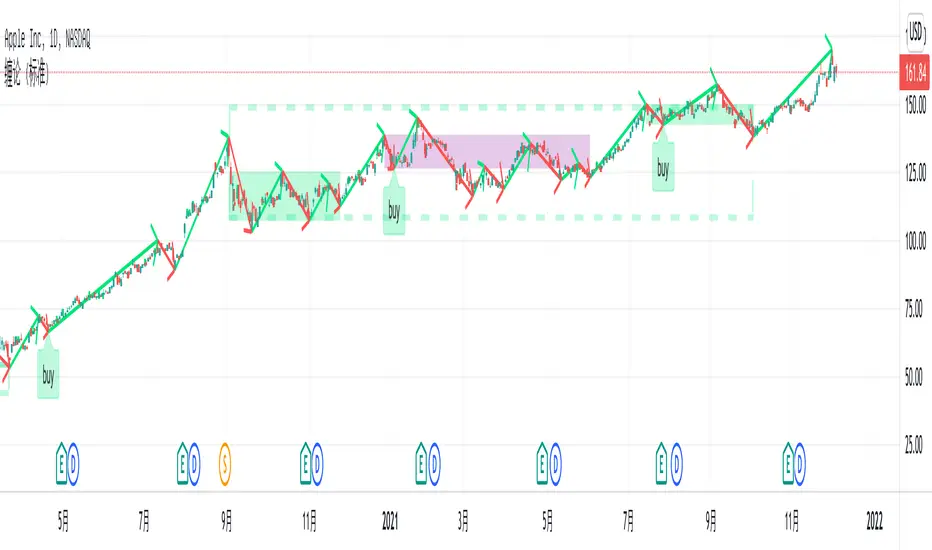
chanlunGenerate a small line according to the pattern of the K-line, where green represents long and red represents short; (we call it pen)
then according to the small line segment, a large line(we call it line) is generated according to the new high or new low rule; (we call it line)
finally, a rectangle is generated according to the overlap interval of the large line.(we call it zhongshu)

chanlun penthe strong line call 'pen' in chanlun.it is build from the thin line,and the thin line is about kline trend. when you see the red line(strong or thin) ,that's mean down trend has been complete,at the same time,up trend has start.
chanlun can Identify charpatterns,and not only that
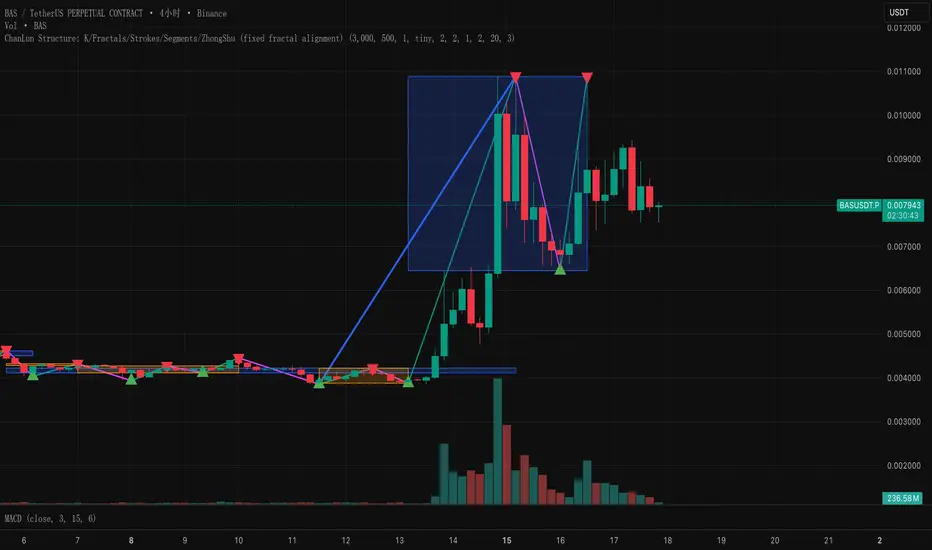
ChanLun Structure: K/Fractals/Strokes/Segments/ZhongShuThis script implements the "line and center" concept of CHANLUN.
chanlun缠论 - 笔与中枢Overview
The Chanlun (缠论) Strokes & Central Zones indicator is an advanced technical analysis tool based on Chinese Chan Theory (Chanlun Theory). It automatically identifies market structure through "strokes" (笔) and "central hubs" (中枢), providing traders with a systematic framework for understanding price movements, trend structure, and potential reversal zones.
Theoretical Foundation
Chan Theory is a sophisticated price action methodology that breaks down market movements into hierarchical structures:
Local Extremes: Swing highs and lows identified through lookback periods
Strokes (笔): Valid price movements between opposite extremes that meet specific criteria
Central Hubs (中枢): Consolidation zones formed by overlapping strokes, representing key support/resistance areas
Key Components
1. Local Extreme Detection
Identifies swing highs and lows using a configurable lookback period (default: 5 bars)
Only considers extremes within the specified calculation range
Forms the foundation for stroke construction
2. Stroke (笔) Identification
The indicator applies a multi-stage filtering process to identify valid strokes:
Stage 1 - Extreme Consolidation:
Merges consecutive extremes of the same type (high or low)
Keeps only the most extreme value (highest high or lowest low)
Stage 2 - Stroke Validation:
Ensures minimum bar gap between strokes (default: 4 bars)
Alternative validation: 2+ bars with >1% price change
Eliminates noise and insignificant price movements
Color Coding:
White Lines: Regular up/down strokes
Yellow Lines: Strokes that form part of a central hub
Customizable width and colors for different stroke types
3. Central Hub (中枢) Formation
A central hub forms when at least 3 consecutive strokes have overlapping price ranges:
Formation Rules:
Stroke 1:
Stroke 2:
Stroke 3:
Hub Upper = MIN(High1, High2, High3)
Hub Lower = MAX(Low1, Low2, Low3)
Valid if: Hub Upper > Hub Lower
Hub Extension:
Subsequent strokes that overlap with the hub extend it
Hub ends when a stroke no longer overlaps
Creates rectangular zones on the chart
Visual Representation:
Green rectangular boxes: Mark the time and price range of each central hub
Dashed extension lines: Show the latest hub boundaries extending to the right
Price labels on axis: Display exact hub upper and lower boundary values
4. Extreme Point Markers (Optional)
Red markers for tops (▼)
Green markers for bottoms (▲)
Marks every validated stroke extreme point
Useful for detailed structure analysis
5. Information Table (Optional)
Displays real-time statistics:
Symbol name
Current timeframe
Lookback period setting
Minimum gap setting
Total stroke count
Parameter Settings
Performance Settings
Max Bars to Calculate (3600): Limits historical calculation to improve performance
Local Extreme Lookback Period (5): Bars used to identify swing highs/lows
Min Gap Bars (4): Minimum bars required between valid strokes
Display Settings
Show Strokes: Toggle stroke line visibility
Show Central Hub: Toggle hub box visibility
Show Hub Extension Lines: Toggle dashed boundary lines
Show Extreme Point Marks: Toggle top/bottom markers
Show Info Table: Toggle statistics table
Color Settings
Full customization of:
Up/down stroke colors and widths
Hub stroke colors and widths
Hub border and background colors
Extension line colors
Trading Applications
Trend Structure Analysis
Uptrend: Series of higher highs and higher lows connected by strokes
Downtrend: Series of lower highs and lower lows connected by strokes
Consolidation: Formation of central hubs indicating range-bound movement
Support and Resistance Identification
Central Hub Zones: Act as strong support/resistance areas
Hub Upper Boundary: Resistance level in consolidation, support after breakout
Hub Lower Boundary: Support level in consolidation, resistance after breakdown
Price tends to react at these levels due to market structure memory
Breakout Trading
Bullish Breakout: Price closes above hub upper boundary
Previous resistance becomes support
Entry on retest of upper boundary
Stop loss below hub zone
Bearish Breakdown: Price closes below hub lower boundary
Previous support becomes resistance
Entry on retest of lower boundary
Stop loss above hub zone
Reversal Detection
Hub Formation After Trend: Signals potential trend exhaustion
Multiple Hub Levels: Create probability zones for reversals
Stroke Count: Excessive strokes within hub suggest weakening momentum
Position Management
Use hub boundaries for stop loss placement
Scale out positions at hub edges
Re-enter on retests of broken hub levels
Interpretation Guide
Strong Trending Market
Long, clear strokes with minimal overlap
Few or no central hubs forming
Strokes consistently in same direction
Wide spacing between extremes
Consolidating Market
Multiple central hubs forming
Short, overlapping strokes
Yellow hub strokes dominate the chart
Narrow price range
Trend Transition
Hub formation after extended trend
Stroke direction changes frequently
Hub boundaries being tested repeatedly
Potential reversal zone
Advanced Usage Techniques
Multi-Timeframe Analysis
Higher Timeframe: Identify major hub zones for overall market structure
Lower Timeframe: Find precise entry points within larger structure
Alignment: Trade when lower timeframe strokes align with higher timeframe hub breaks
Hub Quality Assessment
Wide Hubs: Strong consolidation, higher probability support/resistance
Narrow Hubs: Weak consolidation, may break easily
Extended Hubs: More strokes = stronger zone
Isolated Hubs: Single hub = potential pivot point
Stroke Analysis
Stroke Length: Longer strokes = stronger momentum
Stroke Speed: Fewer bars per stroke = explosive moves
Stroke Clustering: Many short strokes = indecision
Best Practices
Parameter Optimization
Adjust lookback period based on timeframe and volatility
Lower periods (3-4): More strokes, more noise, faster signals
Higher periods (7-10): Fewer strokes, cleaner structure, slower signals
Confirmation Strategy
Don't trade on strokes alone
Combine with volume analysis
Use candlestick patterns at hub boundaries
Wait for breakout confirmation
Risk Management
Always place stops outside hub zones
Use hub width to size positions (wider hub = smaller position)
Exit if price re-enters broken hub from wrong direction
Avoid Common Pitfalls
Don't trade within central hubs (range-bound, unpredictable)
Don't ignore higher timeframe hub structures
Don't chase strokes after they've extended far from hub
Don't trust single-stroke hubs (need 3+ strokes for validity)
Performance Considerations
Max Bars Limit: Set to 3600 to balance detail with performance
Safe Distance Calculation: Only draws objects within 2000 bars of current price
Object Cleanup: Automatically removes old drawing objects to prevent memory issues
Efficient Arrays: Uses indexed arrays for fast lookup and processing
Ideal Market Conditions
Best Performance:
Liquid markets with clear structure (major forex pairs, indices, large-cap stocks)
Trending markets with periodic consolidations
Medium to high volatility for clear stroke formation
Less Effective:
Extremely choppy, directionless markets
Very low timeframes (< 5 minutes) with excessive noise
Illiquid instruments with erratic price action
Integration with Other Indicators
Complementary Tools:
Volume Profile: Confirm hub significance with volume nodes
Moving Averages: Use for trend bias within stroke structure
RSI/MACD: Momentum confirmation at hub boundaries
Fibonacci Retracements: Hub levels often align with Fib levels
Advantages
✓ Objective Structure: Removes subjectivity from market structure analysis
✓ Visual Clarity: Color-coded strokes and clear hub zones
✓ Multi-Timeframe Applicable: Works on all timeframes from minutes to months
✓ Complete Framework: Provides entry, exit, and risk management levels
✓ Theoretical Foundation: Based on proven Chan Theory methodology
✓ Customizable: Extensive parameter and visual customization options
Limitations
⚠ Learning Curve: Requires understanding of Chan Theory principles
⚠ Lag Factor: Strokes confirm after price movements complete
⚠ Parameter Sensitivity: Different settings produce significantly different results
⚠ Choppy Market Struggles: Can generate excessive hubs in range-bound conditions
⚠ Computation Intensive: May slow down on lower-end systems with max bars setting
Optimization Tips
Timeframe Selection
Scalping: 5-15 minute charts, lookback period 3-4
Day Trading: 15-60 minute charts, lookback period 4-5
Swing Trading: 4-hour to daily charts, lookback period 5-7
Position Trading: Daily to weekly charts, lookback period 7-10
Volatility Adjustment
High volatility: Increase minimum gap bars to reduce noise
Low volatility: Decrease lookback period to capture smaller moves
Visual Optimization
Use contrasting colors for different market conditions
Adjust line widths based on chart resolution
Toggle markers off for cleaner appearance once familiar with structure
Quick Start Guide
For Beginners:
Start with default settings (5 lookback, 4 min gap)
Enable "Show Info Table" to track stroke count
Focus on identifying clear hub formations
Practice waiting for price to break hub boundaries before trading
For Advanced Users:
Optimize lookback and gap parameters for your instrument
Use hub strokes (yellow) to identify key consolidation zones
Combine with multiple timeframes for confirmation
Develop entry rules based on hub breakout/retest patterns
This indicator provides a complete structural framework for understanding market behavior through the lens of Chan Theory, offering traders a systematic approach to identifying high-probability trading opportunities.

Chanlun ChannelThe black line is the current real price, and it's middle of the channel. when close price is in the channel,it means that the market is in balance.
the market need a lot of energy to leave the channel,if the price can leave the channel,the channel will become support or pressure.
缠论中枢(简化版),没有行情时价格围绕黑色线上下波动,价格离开中枢需要较大的量能,一旦成功离开中枢,这个中枢将会变成支撑(压力).
同时他可以用作横盘位置识别

Unentangle – Probability‑Based Trend Indicator using Chan TheoryUnentangle – Probability‑Based Trend Indicator using Chan Theory
**Overview:**
Unentangle is a custom TradingView indicator inspired by Chan Theory (Chanlun).
It automatically detects and visualizes market structures such as Bi (Trend Stroke), Xian (Line Segment), and Pivot.
By combining structural recognition with statistical analysis of historical patterns, the script provides traders with probability-based buy/sell signals.
This helps traders make more confident, data-driven decisions rather than relying solely on alerts.
Why "Unentangle"?
Market data often looks tangled and chaotic, making it hard to see clear structures and its trend.
This indicator is designed to "un-entangle" the data, revealing Chan Theory patterns and its trend probability so traders can view the market more clearly and make confident decisions.
**Key Features:**
- Automatic recognition of Chanlun structures Bi(Trend Stroke), Xian(Line Segment), Pivot
- Visual drawing of Chanlun elements directly on the chart
- Probability calculations for up and down trends based on historical Chanlun top and bottom patterns
**How It Works:**
The script analyzes price movements to identify Chanlun structures.
It then visually draws Chanlun elements, making it easier to follow Chan Theory without manual plotting.
Once structures are detected, it calculates the statistical probability of signals based on similar historical Chanlun top and bottom setups.
This allows traders to evaluate the confidence level of trades based on current price action.
**Usage:**
Apply the indicator to a clean chart.
The script will automatically display Chanlun structures and probability-based signals.
Traders can use these signals as part of their decision-making process, combining them with their own strategies and risk management rules.
On the chart, a green box indicates an uptrend and a red box indicates a downtrend.
The percentage inside the box shows how much of the current trend has progressed.
For example, “83%” in a green box means the uptrend has already advanced 83%, with only 17% potential space remaining for up trend.
**Notes:**
- This script is closed-source, but its logic is based on Chan Theory principles and statistical analysis of historical Chanlun top/bottom price patterns.
- It is intended for educational and analytical purposes, not as financial advice.
Unentangle – 基于缠论结构的趋势概率指标
**概述:**
Unentangle 是一个基于缠论的 TradingView 自定义指标。
它能够自动识别并可视化市场结构,包括笔、线段和中枢。
通过结合结构识别与历史数据的统计分析,该脚本可以生成基于概率的买卖信号,
帮助交易者在决策时更有依据,而不仅仅依赖提示。
为什么叫 “Unentangle”?
市场数据常常像一团乱麻,难以看清结构。
这个指标的目的就是“解缠”,让缠论的结构及其概率清晰呈现,
帮助交易者更直观地理解市场并做出更有依据的决策。
**功能亮点:**
- 自动识别缠论结构(笔、线段、中枢)
- 在图表上直观绘制缠论元素
- 基于历史顶底数据的趋势概率计算
- 提供信号可信度评估,辅助交易决策
**工作原理:**
脚本会分析价格走势以识别缠论结构。
识别完成后,它会自动绘制缠论元素,使得学习和应用缠论更加直观,无需手动绘制。
同时,脚本会基于历史顶底形态计算趋势的统计概率,
帮助交易者评估当前价格下的交易可信度。
**使用方法:**
将指标应用到干净的图表上。
脚本会自动显示缠论结构和基于概率的信号。
交易者可以将这些信号作为决策参考,并结合自己的策略与风险管理规则。
在图表中,绿色方框表示当前处于上升趋势,红色方框表示下降趋势。
方框中的百分比表示当前趋势的进展程度。
例如,绿色方框显示“83%”意味着当前上升趋势已经完成了 83%,仅剩 17% 的上涨空间。
**注意事项:**
- 本脚本为闭源,但逻辑基于缠论原理与历史数据的统计分析。
- 本脚本仅用于教育与分析目的,不构成任何投资建议。

Chan Theory - Chanlun UltraChan Theory -Chanlun Ultra
Overview
This script is based on the core technical framework of Chan Theory, transforming complex market fluctuations into a multi-layered, quantifiable structural analysis system. Through real-time dynamic computation, it automatically parses key components in price movements such as fractals, pens, segments, and pivot zones. Integrated with momentum analysis and trading signal alerts, it provides traders with comprehensive market insights from micro to macro perspectives. The core distinction of Chan Theory from traditional technical indicators lies in its rigorous recursive logic and human-centric market philosophy. This script faithfully restores Chan Theory's essence of "using Zen to resolve market complexity," decomposing spiral price movements into an orderly trading decision system.
Technical Principles
This indicator implements the complete recognition process from candlesticks to fractals, pens, segments, and pivot zones using pure Pine Script under Chan Theory's framework. Core technical implementations include:
1. Candlestick Containment Processing
Employs specific algorithms to handle candlestick containment relationships, eliminating random noise:
In uptrends: Select the higher high and higher low values
In downtrends: Select the lower high and lower low values
Ensure complete elimination of containment through recursive processing
2. Fractal Identification System
Performs strict fractal judgment on processed candlesticks:
Top Fractal: The middle candlestick's high is higher than both adjacent candlesticks
Bottom Fractal: The middle candlestick's low is lower than both adjacent candlesticks
Validate fractal effectiveness via the filterOperateType function
3. Pen Construction Mechanism & Type Selection
Connects valid top/bottom fractals to form pen structures, offering four pen types:
Classic Pen: Traditional Chan Theory definition, strictly following classic rules
Optimized Pen: Enhanced algorithm for short-term volatility recognition
4K Pen: Builds pens based on fractals formed by at least 4 candlesticks (improves stability)
Strict Pen: Employs the most stringent validation conditions for reliability
4. Segment Partitioning Algorithm
Applies segment rules to pen sequences with three modes:
- Dynamic Real-time Progressive Correction: Adjusts forming segments continuously with new data
- Strict Mode: Fully complies with Chan Theory definitions
- Extension Mode: Flexible handling of trend developments
5. Pivot Zone Recognition Technology
Identifies pen-level and segment-level pivot zones
Calculates pivot zone price ranges and time durations
Analyzes pivot zone evolution characteristics
Supports display of pivot zones across different levels
Trading Signal System & Filters
Trading Signal Filtering System
This indicator provides comprehensive filtering functions:
Fractal Validity Filter: Verifies fractal patterns and post-fractal developments
Basic Fractal Filter: Eliminates non-compliant fractals through basic feature checks
Type I MACD Divergence Filter: Enhances Type I signal reliability via MACD divergence analysis
Type II Signal Filter: Custom conditions for Type II signals
-False Signal Trap Avoidance: Detects and bypasses deceptive price patterns
Chan Theory Trading Signal Principles
Type I Signals (Trend Reversals)
Principle: Forms when price makes new highs/lows with weakening internal momentum (divergence)
Identification: Compares structural features of adjacent same-direction pens
Application: Early trend reversal signals for swing trading
Type II Signals (Pullback Entries)
Principle: Occurs during retracements as sub-level reversal signals
Identification: Determined by pivot zone support/resistance and fractal combinations
Application: Optimal positions for pullback trades with controlled risk
Type III Signals (Breakout Confirmations)
Principle: Confirms pivot zone breakouts
Identification: Price breaks prior pivot zone boundaries with valid fractals
Application: Trend continuation signals for trend-following strategies
Indicator Features
Multi-Level Structural Analysis
Distinguishes structures across levels via level parameters
Higher-level trends guide lower-level operations
Implements cross-level collaborative logic
Displays sub-level pivot zones
Structural Visualization
Pens: Displayed per selected pen type
Segments: Rendered according to chosen segment mode
Pivot Zones: Color gradients indicate consolidation strength
Technical Implementation
Data Structure Design
Pen Object: Stores direction, timestamps, and price attributes
Segment Object: Manages segments and constituent pens
Pivot Object: Defines pivot zone ranges and characteristics
Grade Object: Organizes analysis results across levels
User Guide
Parameter Settings
Pen Type: Classic/Optimized/4K/Strict (adapt to analysis needs)
Segment Mode: Dynamic/Strict/Extension (match trading strategies)
Signal Filters: Enable/disable specific filters
Pivot Display: Toggle sub-level pivot zones
Divergence Settings: Configure types (regular/hidden) and display styles
Strategy Settings: Set trading rules linked to signals
Strategy Configuration
Follow Segments: Trade in alignment with segment direction
Signal Participation: Enable/disable Type I/II/III signals
Signal Conditions: Require signals to appear post-pivot zone formation
Prevent Early Entries:
Type I signals require ≥1 pivot zone or 5 pens
Type II Safety Control: Participate only if Type III signals are absent
Practical Recommendations
Select pen types/segment modes per market conditions
Adjust filters for different instruments and timeframes
Enhance accuracy through multi-level analysis
Confirm Type I signals with divergence indicators
Choose strategy parameters aligned with risk tolerance
Value Proposition
Systematizes Chan Theory into computable structures
Multiple pen/segment methods adapt to diverse markets
Advanced filtering significantly improves signal quality (historically validated)
Multi-level analysis provides holistic market insights
This tool is for technical analysis only. It does not constitute investment advice. Users must exercise independent judgment based on personal risk tolerance and objectives.
概述
本脚本基于缠论核心技术框架,将复杂的市场波动转化为多层次、可量化的结构分析系统。通过实时动态演算,自动解析价格走势中的分型、笔、线段、中枢等核心组件,并融合动量分析与交易信号预警功能,为交易者提供从微观到宏观的全方位市场透视。缠论区别于传统技术指标的核心在于其严格的递归逻辑与人性化市场哲学,本脚本忠实还原缠论"以禅破缠"的思想精髓,将螺旋缠绕的价格运动分解为有序的交易决策体系。
技术原理
本指标基于缠论技术分析框架,通过纯Pine Script实现了从K线到分型、笔、线段和中枢的完整识别流程。核心技术实现包括:
1. K线包含处理
采用特定算法处理K线包含关系,消除随机波动干扰:
- 上涨趋势中取高点高值、低点高值
- 下跌趋势中取高点低值、低点低值
- 通过递归处理确保包含关系完全消除
2. 分型识别系统
在处理后的K线基础上实现严格的分型判断:
- 顶分型:中间K线高点高于两侧K线
- 底分型:中间K线低点低于两侧K线
- 通过`filterOperateType`函数实现分型有效性验证
3. 笔的构建机制与类型选择
连接有效顶底分型形成笔结构,提供四种笔类型选择:
- **老笔**:传统缠论笔定义,严格遵循经典规则
- **新笔**:优化算法,增强对短期波动的识别能力
- **4K**:基于至少4根K线形成的分型构建笔,提高稳定性
- **严笔**:采用最严格的条件验证,确保形成的笔结构可靠
4. 线段划分算法
基于笔序列应用线段划分规则,支持三种线段模式:
- **当下延伸后修正**:实时计算当前形成中的线段,并随新数据更新修正
- **严格模式**:要求线段完全符合缠论定义,减少假信号
- **延伸模式**:更灵活地处理线段延伸情况,适合趋势分析
5. 中枢识别技术
- 实现笔中枢和线段中枢识别
- 计算中枢价格区间与时间范围
- 分析中枢演变特征
- 支持显示不同级别中枢功能
买卖点系统与过滤机制
买卖点过滤系统
本指标提供全面的买卖点过滤功能:
- **买卖点分型过滤**:检验分型形态有效性,验证分型后续发展
- **买卖点分型基础过滤**:针对分型基本特征进行验证,排除不合格分型
- **1买卖macd背驰过滤**:通过MACD判断背驰情况,提高一类买卖点可靠性
- **2买卖点过滤**:专门针对二类买卖点的过滤条件
- **防狼术**:避免陷阱式买卖点,提高交易安全性
缠论买卖点原理
1. **一类买卖点**
- 原理:基于趋势背驰原理,当价格创新高/低但内部结构力度减弱时形成
- 识别方法:通过比较相邻同向笔的结构特征判断力度变化
- 应用:提供趋势可能反转的早期信号,适合波段操作
2. **二类买卖点**
- 原理:发生在回调过程中,属于次级别转折信号
- 识别方法:通过中枢支撑位与分型组合判断
- 应用:回调买入或做空的较佳位置,风险相对可控
3. **三类买卖点**
- 原理:中枢突破确认信号
- 识别方法:价格突破前中枢边界并形成有效分型
- 应用:趋势延续的确认信号,适合追踪趋势
指标特点
多级别结构分析
本指标支持多级别联动分析:
- 通过级别参数区分不同级别结构
- 高级别趋势指导低级别操作
- 实现级别间的协同判断逻辑
- 支持显示次级别中枢功能
结构可视化
- 笔结构:根据选择的笔类型显示
- 线段结构:按照选定的线段模式呈现
- 中枢区域:颜色渐变标识不同强度
技术实现说明
数据结构设计
指标设计了完整的面向对象结构:
- Pen结构:存储笔的方向、时间、价格等属性
- Segment结构:管理线段及其组成笔
- Pivot结构:表示中枢范围和特性
- Grade结构:区分不同级别的分析结果
使用指南
参数设置
- 笔的类型:选择老笔、新笔、4K或严笔以适应不同分析需求
- 线段模式:根据交易策略选择合适的线段计算方式
- 买卖点过滤:根据需要启用不同的过滤机制
- 中枢显示:选择是否显示次级别中枢
- 背离设置:选择背离类型、显示方式和样式
- 策略设置:配置与买卖点相关的交易策略选项
策略应用配置
- 跟随线段:根据线段方向进行交易
- 买卖点参与设置:可选择性参与一类、二类和三类买卖点
- 买卖点条件限制:可设置买卖点需要在中枢形成后出现
- 防止过早进场:可要求一类买卖点至少出现一个中枢后或至少5笔后才参与
- 二类买卖点安全性控制:可选择仅在未出现三类买卖点的情况下参与
实际应用建议
- 结合市场环境选择合适的笔类型和线段模式
- 针对不同品种和时间周期调整过滤设置
- 通过多级别分析提高判断准确性
- 使用背离指标确认一类买卖点的有效性
- 根据策略风格选择适合的策略配置参数
技术特点与价值
本指标通过系统化实现缠论结构分析,提供了一种客观的技术分析工具。它的核心价值在于:
1. 将复杂的缠论理论系统化为可计算的结构
2. 提供多种笔、线段判断方法以适应不同市场环境
3. 完善的买卖点过滤系统大幅提高信号质量
4. 多级别联动分析提供全面市场视角
*本指标仅提供技术分析参考,不构成投资建议。用户应根据自身风险承受能力和投资目标进行判断。*


缠中禅V6Pro"ChanLun" is a highly regarded technical analysis method originating in China. Since its introduction in 2006, ChanLun has quickly gained significant attention and a strong following in the Chinese trading community due to its remarkable ability to navigate complex market dynamics.
ChanLun places great emphasis on market structure, price action, momentum, and the intricate interactions between market forces. It recognizes that the market operates in cyclical patterns and aims to capture the underlying structure and rhythm of price movements. Through detailed analysis of the intricate relationship between price and time, it provides traders with a unique perspective on market trends, potential reversals, and key turning points.
🟠 Algorithm
🔵 Step 1: Candlestick Conversion
In ChanLun, candlestick analysis pays less attention to the opening/closing prices and wicks, focusing instead on the range that the stock price reaches. Therefore, the first step in ChanLun involves converting each candlestick to include only the high and low prices, ignoring other elements.
🔵 Step 2: Candlestick Standardization
In the second step, the converted candlesticks are standardized to ensure strict directional consistency and to eliminate the presence of inner or outer bars. For any two adjacent candlesticks A and B, if one price range completely contains the other, A and B are merged into a new candlestick C. If A is in an uptrend from the previous candlestick, C is defined as High(C) = max(High(A), High(B)) and Low(C) = max(Low(A), Low(B)). If A is in a downtrend from the previous candlestick, C is defined as High(C) = min(High(A), High(B)) and Low(C) = min(Low(A), Low(B)).
After completing these steps, when considering any adjacent candlesticks A and B, we can always observe one of the following conditions:
1. High(A) > High(B) and Low(A) > Low(B)
2. High(A) < High(B) and Low(A) < Low(B)
The diagram below illustrates how the candlesticks are displayed after this step.
🔵 Step 3: Fractals
A "fractal" refers to a pattern formed by three consecutive "normalized" candlesticks, where the middle candlestick shows significantly higher or lower values compared to the surrounding candlesticks. When considering three adjacent candlesticks A, B, and C, we have one of two conditions:
1. High (B) > High (A) and High (B) > High (C) and Low (B) > Low (A) and Low (B) > Low (C)
2。 High (B) < Low (A) and High (B) < Low (C) and Low (B) < Low (A) and Low (B) < Low (C) For
In #1 above, we refer to the combination of A, B, and C as the "top fractal", while for #2 we specify it as the "bottom fractal".
The image below illustrates all fractals, with the red triangle indicating the top fractal and the green triangle indicating the bottom splitting.
🔵 Step 4: Strokes
A "stroke" is a line that connects the top fractal and the bottom fractal, following these rules:
1. There must be at least one "free" candlestick between these fractals, which means it is not part of the top or bottom split. This guarantees that the stroke contains at least five candlesticks from start to finish.
2. The top fractal must have a higher price compared to the bottom fractal.
3. The end fractal should represent the highest or lowest point within the entire stroke range. (There is an option in this indicator to enable or disable this rule.)
Brushstrokes enable traders to identify and visualize significant price movements or trends while effectively filtering out minor fluctuations.
🔵 Step 5: Segmentation
A "subdivision" is a higher-level line that connects the start and end points of at least three consecutive strokes, reflecting the trend of the current market structure. As new strokes emerge, it continues to extend until there is a break in the market structure. A breakout occurs when an uptrend forms lower highs and lower lows, or when a downtrend forms higher highs and higher lows. It is important to note that within the trading range, the brushstrokes typically exhibit higher highs and lower lows or higher lows and lower highs patterns (similar to the inner and outer bars). In this case, the brushstrokes will merge in a similar manner to the candlesticks described earlier until there is a clear breakout in the market structure. Contrary to brushstrokes, segments provide a relatively stable depiction of market trends on higher time frames.
It is important to note that the algorithm used to calculate line segments from strokes can again be applied recursively to the generated line segments, forming higher-level line segments that represent market trends over a larger time frame.
🔵 Step 6: Pivot
In ChanLun, the term "pivot" does not represent a price reversal point. Instead, it refers to a trading range where the security's price tends to fluctuate. Within a given "Segment," a pivot is determined by the overlap of two consecutive strokes moving in opposite directions along the segment. When two downward trend strokes, A and B, form a pivot P within an upward trend segment S, the upper and lower boundaries of the pivot are defined as follows:
1. Upper limit (P) = min(high(A), high(B))
2. Lower limit (P) = max(low(A), low(B))
The pivot range is usually where consolidation and high trading volume occur.
If future strokes moving in the opposite direction along the current segment overlap with the upper and lower boundaries of the pivot, those strokes will merge into the existing pivot, extending it along the x-axis. A new pivot is formed when two consecutive strokes moving in the opposite direction along the current segment intersect each other without overlapping the previous pivot.
Similarly, pivots can be recursively identified in higher-level segments. The blue boxes below indicate "Segment Pivots" identified in the context of higher-level segments.
🔵 Step 7: Buy/Sell Points
ChanLun defines three types of buy/sell points.
1. Type 1 Buy and Sell Points: Also called trend reversal points. These points mark where an old segment ends and a new segment begins.
2. Type 2 Buy and Sell Points: Also called trend continuation points. These points occur when the price is in a trend, indicating trend continuation. In an uptrend, Type 2 buy points are rebound points after the price retraces to previous lows or support levels, signaling a likely continuation of the upward movement. In a downtrend, Type 2 sell points are pullback points after the price bounces to previous highs or resistance levels, signaling a likely continuation of the downward movement.
3. Type 3 Buy and Sell Points: These points represent retests of a pivot range breakout. The presence of these retest points indicates that the price may continue to move up/down above/below the pivot level.
Astute readers may notice that these buy/sell points are lagging indicators. For example, multiple candlesticks will have occurred by the time a new segment is confirmed at a Type 1 buy/sell point in that segment. In fact, buy/sell points do lag behind actual market movements. However, ChanLun addresses this issue through multi-timeframe analysis. By examining buy/sell points confirmed in lower timeframes, additional confidence can be gained in determining the overall trend of higher timeframes.
🔵 Step 8: Divergence
Another core technique in ChanLun is using divergence to predict the occurrence of Type 1 buy/sell points. While MACD is the most commonly used indicator for detecting divergence, other indicators like RSI can also serve this purpose.
🟠 Summary
Essentially, ChanLun is a powerful technical analysis method that combines careful examination and interpretation of price charts, the application of technical indicators and quantitative tools, and keen attention to multiple timeframes. Its goal is to identify current market trends and uncover potential trading opportunities. What sets ChanLun apart is its holistic approach, which integrates both qualitative and quantitative analysis to facilitate informed and successful trading decisions.
“缠论”是一种起源于中国的备受推崇的技术分析方法。自 2006 年推出以来,ChanLun 凭借其驾驭复杂市场动态的非凡能力,迅速在中国交易社区中获得了极大的关注和强大的追随者。
ChanLun 非常重视市场结构、价格行为、动量以及市场力量之间错综复杂的相互作用。它认识到市场以周期性模式运作,旨在捕捉价格变动的底层结构和节奏。通过对价格和时间之间错综复杂的关系的细致分析,它为交易者提供了关于市场趋势、潜在逆转和关键转折点的独特视角。
该指标提供了 ChanLun 理论的细致而全面的实施。它有助于对所有基本组成部分进行深入分析和可视化表示,包括 “Candlestick Conversion”, “Candlestick Standardization”, “Fractal”, “Stroke”, “Segment”, “Pivot” 和 “Buying/Selling Point”。
🟠 算法
🔵 1 步:烛台转换
在 ChanLun 中,烛台分析较少关注开盘价/收盘价和灯芯,而是强调股价达到的价格范围。因此,ChanLun 的第一步涉及将每根烛条转换为仅包含最高价和最低价,而忽略其他元素。
🔵 第 2 步:烛台标准化
在第二步中,对转换后的烛台进行标准化,以确保严格的方向一致性,并消除内柱线或外柱线的存在。对于任何相邻的两根烛条 A 和 B,其中一根的价格范围完全包含另一根,A 和 B 被合并为新的烛条 C。如果 A 从前一根蜡烛开始呈上升趋势,则 C 将被定义为最高价 (C) = 最大值(最高价 (A), 最高价 (B)) 和最低价 (C) = 最大值(最低价 (A), 最低价 (B))。如果 A 从前一根蜡烛开始呈下降趋势,则 C 将被定义为最高价 (C) = min(最高价 (A), 最高价 (B)) 和最低价 (C) = min(最低价 (A), 最低价 (B))。
完成这些步骤后,在考虑任何相邻的烛条 A 和 B 时,我们始终可以观察到以下任一条件:
1. 最高价 (A) > 最高价 (B) 和最低价 (A) >最低价 (B)
2。最高价 (A) <最高价 (B) 和最低价 (A) <最低价 (B)
下图说明了此步骤后烛台的显示方式。
🔵 第 3 步:分形
“分形”是指由三个连续的“标准化”烛台形成的形态,其中中间的烛台与周围的烛台相比显示出明显的更高或更低的值。当考虑三个相邻的烛台 A、B 和 C 时,我们有以下两个条件之一:
1. 最高价 (B) > 最高价 (A) 和高点 (B) >最高价 (C) 和最低价 (B) >最低价 (A) 和最低价 (B) >最低价 (C)
2。高 (B) < 低 (A) 和高 (B) < 低 (C) 和低 (B) < 低 (A) 和低 (B) < 低 (C)对于
上面的 #1,我们将 A、B 和 C 的组合称为“顶部分形”,而对于 #2,我们将其指定为“底部分形”。
下图说明了所有分形,其中红色三角形表示顶部分形,绿色三角形表示底部分形。
🔵 第 4 步:笔画
“笔画” 是连接顶部分形和底部分形的一条线,遵循以下规则:
1. 在这些分形之间必须至少有一个 “自由” 烛台,这意味着它不是顶部或底部分形的一部分。这保证了笔画从头到尾至少包含五根烛条。
2. 与底部分形相比,顶部分形必须具有更高的价格。
3. 端点分形应表示整个笔画范围内的最高点或最低点。(此指示器中有一个选项用于启用或禁用此规则。
笔触使交易者能够识别和可视化重大的价格波动或趋势,同时有效地过滤掉微小的波动。
🔵 第 5 步:细分
“细分”是一条更高级别的线,连接至少连续三个笔画的起点和终点,反映了当前市场结构的趋势。随着新笔触的出现,它继续延伸,直到市场结构出现中断。当上升趋势形成较低的高点和较低的低点,或者当下降趋势形成更高的高点和更高的低点时,就会发生突破。值得注意的是,在交易区间内,笔触通常表现出更高的高点和更低的低点或更高的低点和更低的高点形态(类似于内柱和外柱)。在这种情况下,笔触将以与前面描述的烛台类似的方式合并,直到市场结构出现明显的突破。与笔触相反,分段在更高的时间范围内提供了对市场趋势的相对稳定的描述。
需要注意的是,用于从笔画计算线段的算法可以再次递归地应用于生成的线段,形成更高级别的线段,代表更大时间范围内的市场趋势。
🔵 第 6 步:枢轴
在 ChanLun 中,“枢轴”一词并不表示价格反转点。相反,它代表证券价格趋于波动的交易区间。在给定的 “Segment” 中,枢轴由沿线段相反方向移动的两个连续笔画的重叠决定。当两个下降趋势笔触 A 和 B 在上升趋势段 S 内形成枢轴 P 时,枢轴的上限和下限定义如下:
1. 上限 (P) = min(最高 (A), 最高 (
pein:
B)
2. 下限 (P) = 最大值(最低 (A), 最低 (B))
枢轴范围通常是发生盘整和交易量高的地方。
如果沿当前线段的相反方向移动的未来笔触与枢轴的上限和下限重叠,则该笔划将合并到现有枢轴中,并沿 x 轴延伸枢轴。当沿当前线段的相反方向移动的两个连续笔触彼此相交而不与前一个轴重叠时,将形成新的枢轴。
同样,也可以在更高级别的 segment 中递归识别 pivots。下面的蓝色框表示在更高级别区段的上下文中标识的“Segment Pivots”。
🔵 第 7 步:购买/出售积分
ChanLun 中定义了三种类型的购买/出售积分。
1. 类型 1 买入和卖出点:也称为趋势反转点。这些点是旧路段终止和生成新路段的位置。
2. 类型 2 买入和卖出点:也称为趋势延续点。这些点发生在价格处于趋势中时,标志着趋势的延续。在上升趋势中,类型 2 买点是价格回撤至先前低点或支撑位后的反弹点,表明价格可能会继续上涨。在下跌趋势中,类型 2 卖点是价格反弹至前高点或阻力位后的回调点,表明价格可能会继续下跌。
3. 类型 3 买入和卖出点:这些点表示对枢轴范围突破的重新测试。这些重新测试点的存在表明,价格有可能在枢轴水平上方/下方继续向上/向下移动。
挑剔的读者可能会注意到这些买入/卖出点是滞后指标。例如,当确认新区段时,自该区段的类型 1 买入/卖出点以来已经发生了多根烛台。
事实上,买入/卖出点确实落后于实际市场走势。然而,ChanLun 通过使用多时间框架分析解决了这个问题。通过检查较低时间框架中确认的买入/卖出点,可以在确定较高时间框架的整体趋势方面获得额外的信心。
🔵 第 8 步:背离
ChanLun 的另一个核心技术是应用背离来预测 1 型买入/卖出点的出现。虽然 MACD 是检测背离最常用的指标,但 RSI 等其他指标也可用于此目的。
🟠 总结
从本质上讲,ChanLun 是一种强大的技术分析方法,它结合了对价格图表的仔细检查和解释、技术指标和定量工具的应用以及对多个时间框架的敏锐关注。其目标是确定当前的市场趋势并发现潜在的交易前景。ChanLun 的与众不同之处在于其整体方法,该方法融合了定性和定量分析,以促进明智和成功的交易决策。

古诗缠论-10.2版ChanLun---gushi
Strokes (笔): Identifies the foundational directional movements (upward and downward strokes) that form the basis of all price action.
Segments (线段): Automatically combines strokes into more significant trend structures, representing a complete directional move.
Pivots / Centers (中枢): Detects and draws "pivots," which are overlapping price ranges created by three consecutive segments. Pivots are the core of the theory, representing market equilibrium or consolidation zones. The interaction of price with these pivots is crucial for analysis.
Buy & Sell Points (买卖点): Automatically identifies and labels the three distinct types of trading signals according to the theory:
1st Type Buy/Sell Points: Based on MACD divergence after a trend creates a new price high or low. These are primary trend-reversal signals.
2nd Type Buy/Sell Points: The first pullback after a 1st Type signal that does not create a new price extreme. These are confirmation entry points for a new trend.
3rd Type Buy/Sell Points: The first pullback that occurs after price leaves a pivot area without re-entering it. These signals confirm the continuation of the current trend.
Dashboard: A clean on-screen panel displays key statistics, including the number of strokes, segments, and pivots identified, as well as the current trend direction and the last trading signal detected.

Kingdom SMCThis indicator combines Smart Money concept, chanlun, and multiple divergence technical analysis to construct a visual market analysis system.
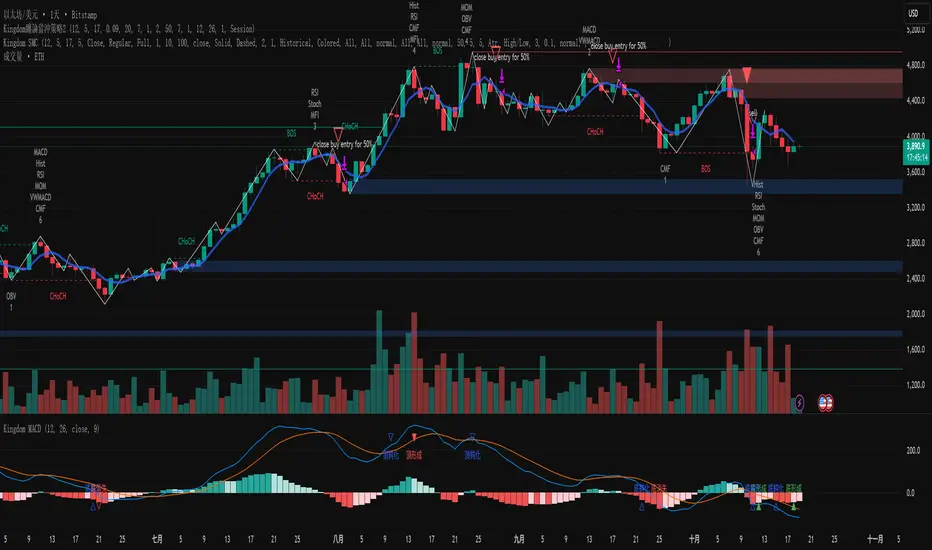
Qabas systemQabas System — Multi-Layered Smart Trading Framework
The Qabas System is an advanced all-in-one Pine Script indicator designed to combine institutional-grade analysis, smart entry/exit detection, and adaptive risk management into a single framework. It integrates multiple professional trading concepts into one ecosystem, making it suitable for intraday, swing, and position trading.
⸻
Core Components
1. VSA Engine (Volume Spread Analysis)
Detects institutional footprints (accumulation, distribution, no-demand, supply tests) by analyzing the relationship between candle spread, volume, and close location.
2. Order Blocks (Supply & Demand Zones)
Automatically highlights bullish and bearish order blocks with customizable transparency, showing where institutions left unfilled orders.
3. Smart Traps (Liquidity Traps)
Identifies bull and bear traps by detecting abnormal wicks and volume exhaustion near highs/lows — a common reversal signal.
4. Fibonacci Golden Levels
Draws adaptive retracement levels (23.6%, 38.2%, 50%, 61.8%, 78.6) aligned with the current market trend.
5. CPR (Central Pivot Range)
Daily pivot zones acting as magnets for price, helping detect high-probability reversal and breakout areas.
6. Liquidity Zones
Detects liquidity sweeps above highs and below lows combined with strong volume confirmation.
7. Market Structure (Chanlun Waves)
Tracks higher-highs / lower-lows to outline bullish or bearish structural waves.
8. Breakout Engine (Duanxian Gate)
Confirms valid breakouts using EMA/Donchian/Linear Regression baselines with ATR and volume filters.
9. Adaptive Resonance Oscillator (ARO)
A proprietary entry/exit system based on Hilbert transform and RSI resonance, plotting BUY/SELL arrows only when conditions are valid and alternating (to avoid duplicate signals).
⸻
Risk & Trade Management
• Smart ATR / Fibonacci / Structure-based stop loss options.
• Fibonacci / Risk-Reward / Structure-based take profit logic.
• Built-in auto-risk engine with position sizing (% risk per trade).
• ATR-based adaptive targets for breakout scenarios.
⸻
Visualization & Dashboard
• Multiple color themes (Neon, Professional, Matrix, Gold).
• Smart candle coloring for volume spikes and weak drops.
• Order Block boxes with custom transparency.
• A dynamic Arabic/RTL dashboard showing:
• Decision (Buy/Sell/Strong Buy/Strong Sell/Wait)
• Trend strength (across multiple timeframes)
• Volume pressure (Accumulation / Distribution / Neutral)
• Range & Breakout probabilities
⸻
Dynamic Probabilities Engine
The system records historical outcomes near supply/demand boundaries and continuously adapts breakout probability calculations. This enables it to dynamically project probability of ranging vs breaking out, and update targets accordingly.
⸻
How It Works (Step-by-Step)
1. Market Context: Multi-timeframe EMAs define overall trend score.
2. Institutional Clues: VSA, order blocks, traps, CPR, liquidity, and Fibonacci generate signals.
3. Structural Confirmation: Breakouts and wave analysis validate directional bias.
4. Decision Engine: Weighted scoring system fuses all signals into a single decision (BUY / SELL / WAIT) with confidence level.
5. Execution: ARO entry/exit signals provide precise timing inside the broader context.
6. Risk Management: Adaptive stop loss and take profit methods are applied automatically.
⸻
👉 In summary:
The Qabas System acts like an institutional trading toolkit inside one indicator — combining price action, smart volume, liquidity, structure, and adaptive risk to deliver context-aware, probability-driven trade signals with a clear visual dashboard.

Zen ProThe Trading Theory of Entanglement (缠论), developed by a Chinese trading Master in 2006, is the single most complete and comprehensive trading theory known today. Although the theory remains ‘mysterious’ among traders outside China, millions and millions of Chinese traders study this theory everyday, and the theory has been proven to provide the closest description of market behaviors for all types of market including forex, stocks, derivatives, commodity, and cryptocurrency etc., and for all time frames no matter monthly, daily, 30m, 1m or even in seconds. The theory’s philosophy is based on human greed, hatred, delusion, arrogance and doubt, which reveal the most fundamental aspects of any market. For this reason, other trading theories or techniques such as the Dow theory, the Elliott Wave theory, and the Gann theory etc. can all find their explanations as well as their limitations from the Theory of Entanglement.
Fractals, strokes, line segments and pivots are basic elements in the Theory of Entanglement, and only by accurately drawing them on a chart can one find the most accurate buying and selling points. However, manually drawing these elements on an ever-changing chart is both challenging and time consuming, and may lead to incorrect interpretation of the market trend. Our Zen Pro indicator aims to provide the most accurate drawings of strokes, line segments, and pivots, as well as to automate the drawing process for three consecutive levels such as 1m, 5m, and 30m (similar to time frames but not necessarily the same). Buying and selling points are also labeled on the chart to provide users with appropriate trading guidance.
Note that different from the ZigZag indicator or its related ones which mainly connect high and low points on a chart, our developed Zen Pro is a highly structured and well organized technical indicator, and the elements defined in the theory are constructed step by step in the following manner: a pair of top and bottom fractals form a stroke, a minimum of three consecutive strokes form a line segment, and the overlapping area of three consecutive line segments defines a pivot (indicated by the rectangular area). The pivot is the key component to help identify trend continuation or reversal, based on the so-called trend divergence. More importantly, distinguished from other similar indicators implementing the Theory of Entanglement, our Zen Pro perfectly realizes recursions of multiple levels (time frames). For example, a stroke at a higher timeframe of 30m coincides with a line segment in a lower timeframe of 5m, and also coincides with a ‘trend type’ (see below definition) at an even lower timeframe of 1m. This feature is essential for multi-timeframe trading and provides confluence of buying and selling signals at multiple timeframes.
It is important to emphasize that users are strongly recommended to apply the Theory of Entanglement to analyze the current trend (whether it will continue or reverse) based on the drawings provided by the indicator, rather than blindly follow the labels of buying and selling points as signals. For acquiring more information on our Zen Pro, getting tips on how to use it more effectively in trading, as well as learning the Theory of Entanglement from basic concepts, interested users are encouraged to contact the author directly.
Zen Pro缠论指标应用了一套严格的数学递归运算逻辑,能够自动处理k线包含关系,识别顶、底分型,实现自动画笔、笔中枢、线段、线段中枢、走势类型等完美缠论走势图中的基础组成元素。
本指标的强大之处在于其可以做到走势结构的选择性递归生长,做到完美的区间套定位,高级别笔与低级别线段、走势类型的表里关系对应,以及接近做到高级别的任意标准笔、任意标准线段在低级别均具有内部结构和有理由地成立!
本指标用强大的数学递归运算逻辑,解决了千人千缠的难点,对走势进行清晰地逻辑划分,并可自动识别本级别与次级别背驰和盘整背驰,从而准确地标注本级别1、2、3类买卖点,为使用缠论交易的用户在交易上提供了最有效的帮助,让缠论不再高不可攀!
注:自前期的Zen指标发布一年多以来,我们收到了很多用户的良好反馈,但同时也深知其所存在的不足,因此我们听取了用户的宝贵意见,经过上万次的编译、调试与修改,现已在新发布的Zen Pro指标中解决了Zen指标的所有问题,例如需要手动设置单笔成线段的比例,以及手动设置成笔条件等等。Zen Pro无需用户自行设置,实现了根据当前条件完全自动划分走势。其对于走势的分析更加精确,展现出更加清晰的走势结构,从而使用户可以更有效和准确地判断当前走势的延续与转折。目前Zen Pro已达到我们对缠论指标用于准确描述市场行为的所有预期。
另:当前市场上有很多缠论指标供用户选择,而判断一个指标是否有效的标准不仅仅是该指标能否在大周期(≥ 4小时)或某个时间阶段对走势划分准确,而更是其能否清晰展现小周期(< 30分)的走势结构,以及更加重要的一点,是否能够实现多级别联立(即递归)。目前几乎所有其他的指标均未能实现对于走势结构的递归,从而仅适合于单一周期的操作。
而我们开发的Zen Pro以实现级别递归为基础,但又不仅仅局限于严格递归(若严格递归则可达到 > 99%),而是为更好地适应走势,依据走势的多义性对线段及走势类型进行调整,从而使生成的走势图更加利于分析,大大增加了用户对未来走势判断的准确程度,也同时极大程度上增强了用户的交易信心。
Relations between fractal, stroke, line segment, pivot, and some important definitions:
• Stroke: Connecting two adjacent top and bottom fractals with at least one candlestick in between.
• Line segment: Consists of an odd number of strokes, at least three strokes are required, and the first three strokes must have overlapping portions.
• Level: Levels generally correspond to time frames of the chart, such as 1w, 1d, 4h, 30m, 5m, 1m etc. Sub-level: The above levels are respectively the sub-levels of the previous level.
• Pivot: The part of a trend type at a certain level that is overlapped by at least three consecutive sub-level trend types.
• Trend type: There are two trend types: trend and range. In trend, there are also two types: rising trend and falling trend.
• Range: At any level, a completed trend type contains only one pivot.
• Trend: At any level, a completed trend type contains at least two pivots in the same direction in sequence, which is called a trend at this level.
List of drawings on the chart (for default color settings):
1. Thick blue lines: Strokes at the current level.
2. Thick orange lines: Strokes at a higher level, also line segments at the current level.
3. White dotted lines: Line segments at a higher level, also strokes at two levels higher from the current one.
4. Blue shaded rectangles: Pivots at the sub-level in a trend or a range.
5. Green shaded rectangles: Pivots at the current level in a rising trend or a range.
6. Orange shaded rectangles: Pivots at the current level in a falling trend or a range.
List of labels on the chart (above the candle: sell signal, below the candle: buy signal)
1. Small "1" label below the candle: The lower-level 1st buying point due to the bottom trend divergence or range divergence calculated from MACD: Buy signal
2. Small "1" label above the candle: The lower-level 1st selling point due to the top trend divergence or range divergence calculated from MACD: Sell signal
3. Large "1", "2", "3" labels below the candle: The current-level 1st, 2nd, and 3rd buying points due to the bottom trend divergence or range divergence calculated from MACD: Buy signal
4. Large "1", "2", "3" labels above the candle: The current-level 1st, 2nd, and 3rd selling points due to the top trend divergence or range divergence calculated from MACD: Sell signal
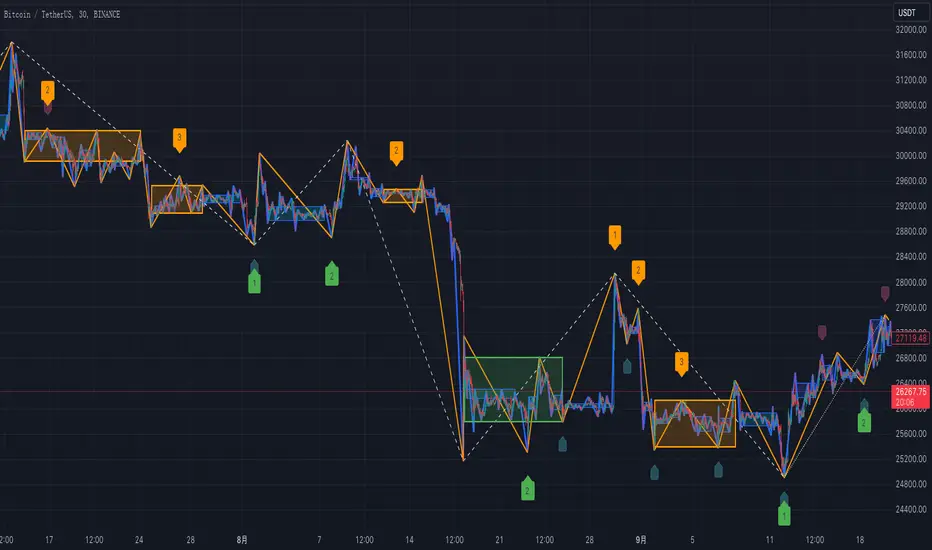
zigzag+When the k-line is at the red line, it is a short trend, and the price breaking through the red cross pressure with a large volume is reversed, and vice versa