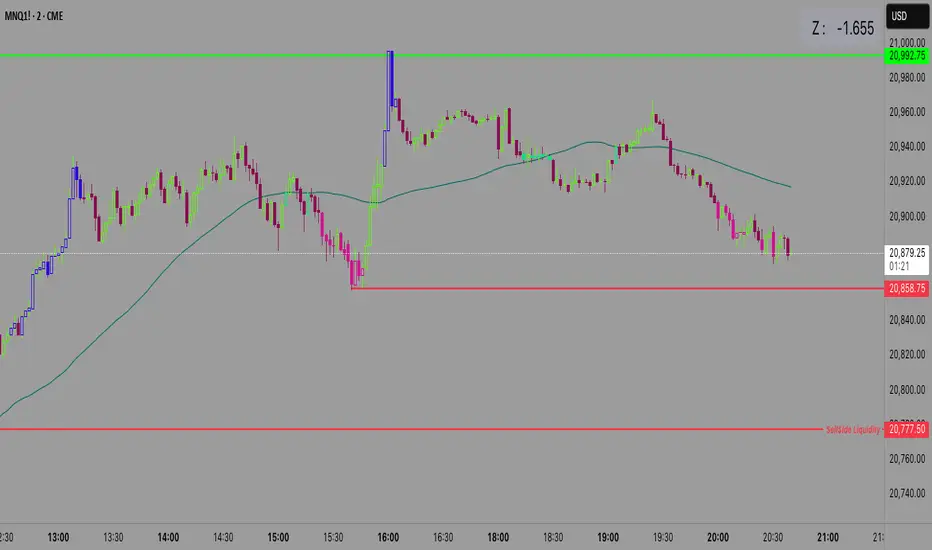
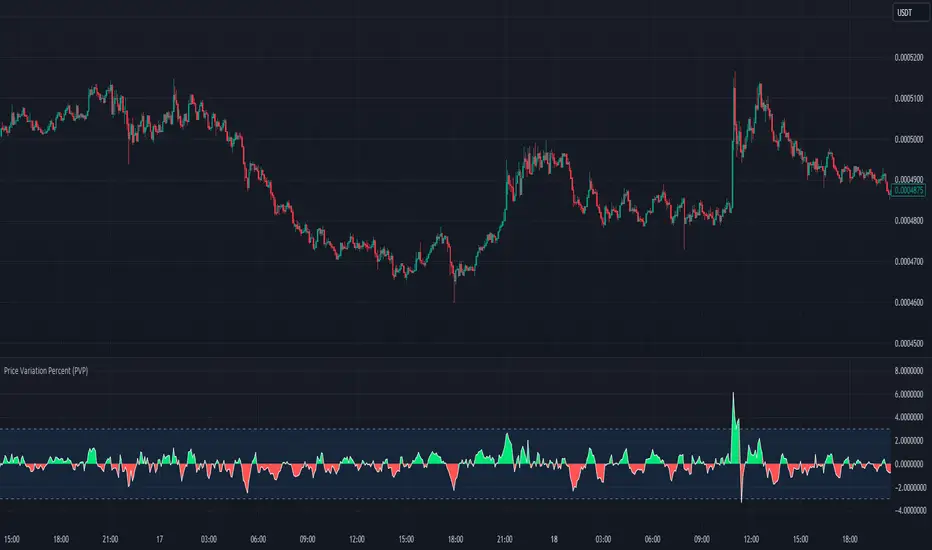
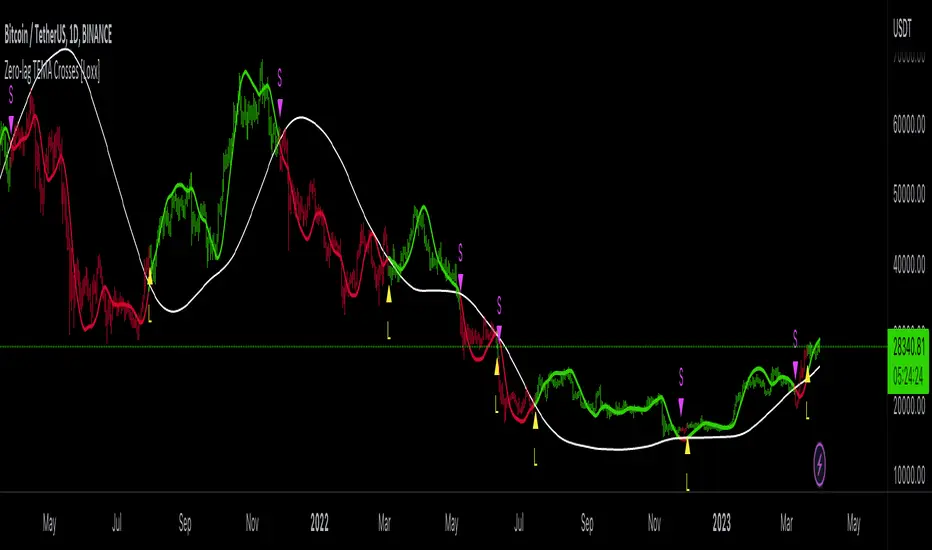
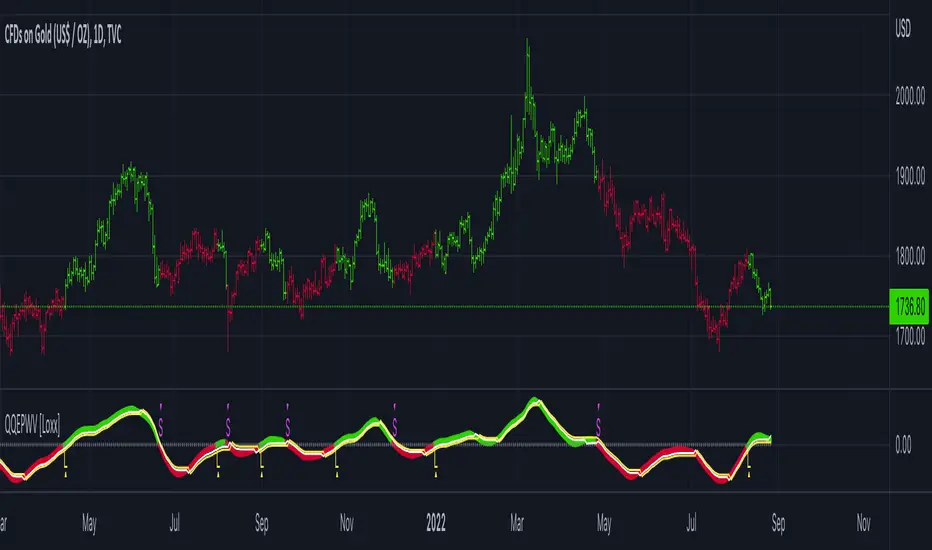
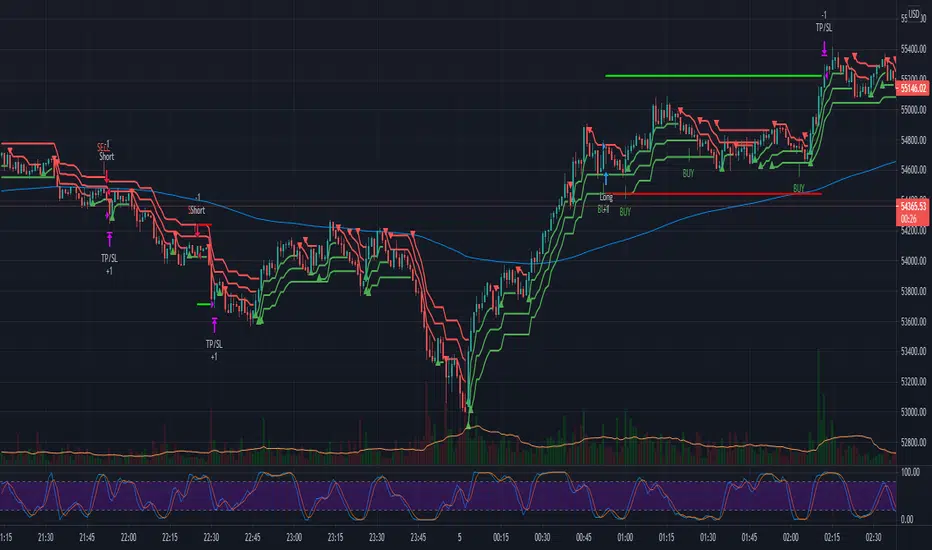
Trend Risk Indicator (TRI)The Trend Risk Indicator is a simple bands indicator made of 2 custom averages of candlesticks ranges calculated within the variable “ BandBars ” period.
Upper and lower channel bands width can be adjusted with the “ Deviation ” variable, which act as a simple factor to enlarge the spread between them.
When Close crosses over the upper band, it is a bearish signal and candlesticks are painted in Red.
When Close crosses under the lower band, it’s a bullish signal and candlesticks are painted in Green.
One of the most interesting indicators for 1 minute scalping. Recommended to use on Renko bars.
*drag to chart and pin to scale, also remove borders from candlesticks.
Search in scripts for "scalping"
CHK FOLLOW THE STAIRSCHK FOLLOW THE STAIRS....
The stairs are nothing but HIGH LOW CHANNEL at HTF or LTF
I observed 10 Period Moving Average an optimum length for the Staircase
you can change it to 8 or 13, one will generate noise, other will generate lag
Tinker with the Staircase Time Frame to get an optimum fit
The script also shows Strength of the Trend.
If there is a gap between the price and the stairs, that is relection of the strength
The script can also be used for scalping.
The Vostro Indicator by KIVANÇ fr3762The VOSTRO indicator is a trend indicator that automatically provides buying and selling signals. The indicator marks in a window the potential turning points. The indicator is recommended for scalping.
The Vostro indicator determines the overbought zones (value greater than +80) and the oversold zones (less than the -80 level)
BUY signal: The Vostro curve moves below the -80 level and forms a trough – Turnaround of the upward trend
SELL signal: The Vostro curve moves above the +80 level and forms a peak – Downward trend
further info:
www.prorealcode.com
Here's the link to a complete list of all my indicators:
t.co
Yazar: KıvanÇ @fr3762 twitter
Şimdiye kadar paylaştığım indikatörlerin tam listesi için: t.co
Relative Vigor IndexHere we are looking at a trend strength indicator based on the Relative Vigor Index(RVI). The RVI measures trend strength by comparing the open-close and high-low ranges for the current and three most recent periods. As a zero-centered oscillator, the RVI oscillates above and below zero to signal the strength of the trend.
As there are different ways to interpret the RVI, we have included 3 different modes for traders to choose from in the input option menu:
1. Zero-Crossing:
The RVI Histogram will turn green when it crosses above zero and red when it crosses below. Therefore, a green RVI means the trend is bullish and red means bearish. This mode is better for longer-term swing trading in comparison to the other 2 modes.
2. Increasing / Decreasing:
The RVI histogram will turn green when it is increasing(rvi >= rvi ) and red when it is decreasing. A green RVI is viewed as a bullish signal and red means bearish. This mode is a good middle-ground between the Zero-Crossing and Signal Comparison modes.
3. Signal Comparison:
Here, the RVI is compared to its signal line. If the RVI is greater than its signal line, the histogram is green, indicating a bullish trend, while red means bearish. This mode is preferred for scalping.
Hope everyone finds this one useful!
You can check out our other invite only studies/strategies at our website: profitprogrammers.com
[M10] Quad MA Trend ScalperFour adjustable moving averages set in order to produce buy and sell signals, works best on smaller timeframes from my backtesting, 10M - 30M seems optimal for scalping.
The idea behind this script is to only enter positions that are following the trend in order to minimise drawdown and decrease risk when using leverage.
The script will only enter long positions when MA crossover occurs above the Long MA 2.
The script will exit a long position when MA Short crosses below Long MA 1.
The script will only enter short positions when MA cross under occurs below the Long MA 2.
The script will exit a short position when MA Short crosses below Long MA 1.
Key Levels [@treypeng]Draws horizontal lines for Daily, Hourly (1) and Weekly levels. Really handy to switch on quickly when scalping.
Light blue: Previous hour OHLC
Thick light blue: Previous hour Close / current hour Open
Dark blue: Yesterday OHLC
Thick dark blue: Yesterday Close / today Open
Purple: Weekly Open
It's a bit ugly, I'd prefer horizontal rays instead of lines stretching back across the chart but I couldn't figure out how to do this in PineScript. If I get it sorted, I'll publish an update.
SHERRIFx (variation) IN TRENDI share this script where I made some modifications to the SHERRIF strategy to perform trend scalping.
I use:
- Bollinguer Bands (20)
- CCIs (14 and 40)
- EMAS (20, 57, 100, 200)
- Stochastics (13,3,3) in 70, 30.
I apply in low temporalities, especially M15 and M1, it can also be used to make binaries or in higher temporalities by modifying the constants.
If you improve this program, share it.
Greetings.
Two Bar Break Line Alerts R1.0 by JustUncleLThis indicator with default settings is designed for BINARY OPTIONS trading. The indicator can also be used for Forex trading with some setting changes. The script shows Two Bar Pullback Break lines and alerts when those Break lines are Touched (broken) creating a short term momentum entry condition.
For a Bullish Break (Green Up Arrow) to occur: first must have two (or three) consecutive bear (red) candles which is followed by a bull (green) candle creating a pivot point. The breakout occurs then the High of the current Bull (green) exceeds the highest point of the previous two (or three) pivotal bear candles. The green channel Line shows where the current Bullish BreakOut occurs.
For a Bearish Break (Red Down Arrow) to occur: first must have two (or three) consecutive bull (green) candles which is followed by a bear (red) candle creating a pivot point. The breakout occurs when the Low of the current Bear (red) drops below the lowest point of the previous two (or three) pivotal Bull candles. The red channel Line shows where the current Bearish BreakOut occurs.
The break Line Arrows can optionally be filtered by the Coloured MA (enabled by default), a longer term directional MA (disabled by default) and/or a MACD condition (enabled by default) as a momentum filter.
You can optionally select three Bar break lines instead of two. The three bar break lines are actually equivalent to Guppy's Three Bar Count Back Line method for trade entries (see Guppy's video reference below).
Included in this indicator is an ability to display some basic Binary Option statistics, when enabled (enabled by default) it shows Successful Bars in Yellow and failed Bars in Black and the last Nine numbers on the script title line represent the Binary option Statistics in order:
%ITM rate
Total orders
Successful Orders
Failed Orders
Total candles tested
Candles per Day
Trades per Day
Max Consecutive Wins
Max Consecutive Losses
You can start the Binary Option statistics from a specific Date, which is handy for checking more recent history.
HINTS:
BINARY OPTIONS trading: use 5min, 15m, 1hr or even Daily charts. Trade after the price touches one of the Breakout lines and the Arrow first appears. Wait for the price to come back from Break Line by 1 or 2 pips, the alert arrow must stay on and candle change to black, then take Binary trade expiry End of Candle. If price pull back and arrow turns off, don't trade this candle, move on you probably don't have momentum, there will be plenty of other trigger events. The backtesting results are good with ITM rates 65% to 72% on many currency pairs, commodities and indices. Realtime trading has confirmed the backtesting results and they could even be bettered, provided you are selective on which signals to trade (strong MACD support etc), that you are patient and disciplined to this trading method.
FOREX trading: the default settings should work with scalping. For longer term trades try with settings change to a more standard MACD filter or slower to catch the longer term momentum swings and the idea would be to trade the first Break Line alert that occurs after a decent Pullback in the direction of the trend. Setting the SL to just above/below the Pivot High/Low and set target to two or three times SL.
References:
"Fundamentals of Price Action Trading for Forex, Stocks, Options and Futures" video:
www.youtube.com
Other videos by "basecamptrading" on Naked Trading.
"Taking Profits in Today's Market by Daryl Guppy" video:
www.youtube.com
NG [Multi-Stochastics]Multiple stochastic script with trend direction.
* Each base shows 3 lines multiplied by 1.618
* Possible to chose how to calculate MA of stochastics SMA, EMA, DEMA, TEMA.
* Possible to chose how to calculate trend.
* Trend adjustment is to adapt to current situation not for signals
Fast stochastics gives a lot of noise but some times good for scalping.
Pivot Boss 4 EMA Summary:
Creates one indicator with four exponential moving averages based off the central pivot point
which assists you in trading pure price action using floor pivots.
This also helps you to avoid getting chopped up during price confluence.
How to use:
When T-Line cross Green Short EMA it can be used for scalping.
When Short EMA pulls back to Medium EMA you can buy more or sell more
without having to exit your position prematurely before trend direction changes.
This can also be used as position entry points to make sure you are getting the best possible price.
When T-Line, Short EMA and Medium EMA cross over Long EMA you go long or short.
Crypto Scalper: Hybrid Fixed/Trailing RRStrategy Overview: Scalping Hybrid — Trend Pullback with ATR-Driven Trailing Profit
This strategy is a high-precision systematic scalping framework engineered specifically for volatile assets like BTC. It leverages a dual-EMA architecture to define market structure, while employing a sophisticated "hybrid" exit logic that allows traders to choose between a classic fixed reward or a dynamic trailing system.
1. Market Regime & Trend Identification
The strategy utilizes two primary anchors to ensure it remains on the correct side of the market:
The Trend Anchor (EMA 200): Acts as the definitive filter. Longs are only permitted when price is above the 200 EMA; shorts only below it.
The Value Zone (EMA 20): Instead of chasing breakouts, the strategy waits for Mean Reversion. It identifies a "pullback" when price returns to touch or penetrate the 20 EMA, offering a superior entry price compared to momentum-chasing systems.
2. Multi-Dimensional Execution Filters
To eliminate "fakeouts" and low-probability setups, the strategy cross-references three critical data points before triggering an entry:
Institutional Alignment (VWAP): Ensures entries are occurring at or near the Volume Weighted Average Price, confirming institutional participation.
Volatility Threshold (ATR Filter): Prevents trading in "dead" or flat markets. The strategy only activates if current volatility is higher than its 50-period average.
Momentum Confirmation (Close Strength): A trade is only opened if the signal candle closes with high conviction (top 60% of the range for longs), proving that the reversal from the pullback is real.
3. Precision Risk Management (ATR-Based)
Risk is mathematically standardized using the Average True Range (ATR). By calculating stops based on current volatility rather than fixed pips/dollars, the strategy automatically loosens during high-volatility spikes and tightens during stable moves.
Stop Loss (SL): Fixed at the moment of entry at 1.0x ATR.
Cooldown Period: A mandatory 5-bar pause after every exit prevents "revenge trading" or entering twice during the same choppy consolidation.
4. Hybrid Exit Architecture (Fixed vs. Trailing)
This is the core innovation of the strategy. Users can toggle between two modes:
Fixed TP Mode: Uses a standard 1:2 Reward-to-Risk ratio (or user-defined) for consistent, predictable outcomes.
Trailing TP Mode: This is a "Runner" logic. The trailing stop remains dormant until the trade reaches a profit threshold (e.g., +1R). Once activated, it follows the price at a distance defined by ATR or a percentage. This allows the strategy to capture massive trending moves while protecting the initial risk.
EMA 9 & 26 Crossover by SN TraderEMA 9 & 26 Crossover by SN Trader – Clean Trend Signal Indicator |
The EMA 9 & 26 Cross (+ Marker) indicator is a lightweight and effective trend-direction and momentum-shift tool that visually marks EMA crossover events using simple “+” symbols placed directly above or below price candles.
This indicator is ideal for scalping, intraday trading, and swing trading across Forex, Crypto, Stocks, Indices, and Commodities.
🔹 Indicator Logic
EMA 9 (Green) → Fast momentum
EMA 26 (Red) → Trend direction
🟢 Green “+” (Below Candle)
Appears when EMA 9 crosses ABOVE EMA 26
Indicates bullish momentum or trend continuation
🔴 Red “+” (Above Candle)
Appears when EMA 26 crosses ABOVE EMA 9
Indicates bearish momentum or potential trend reversal
📈 How to Use
✔ Look for Green “+” for bullish bias
✔ Look for Red “+” for bearish bias
✔ Trade in the direction of higher-timeframe trend
✔ Combine with RSI, UT Bot, VWAP, MACD, Support & Resistance for confirmation
✅ Best For
Trend identification
Momentum confirmation
Scalping & intraday entries
Swing trade timing
Multi-timeframe analysis
⚙️ Features
✔ Clean & minimal design
✔ Non-repainting crossover signals
✔ Works on all timeframes & markets
✔ Pine Script v6 compliant
✔ Beginner & professional friendly
⚠️ Disclaimer
This indicator is for educational purposes only and does not provide financial advice. Always use risk management and additional confirmation before trading.
RLPS -Simplified Long-Term Support/Resistance Levels (Shelters)// Introduction //
RLPS (Simplified Long-Term Shelters) is a streamlined indicator designed for traders who have already identified the preponderant long-term phase of their assets and want to efficiently track multiple assets using pre-calculated Fibonacci levels.
IMPORTANT: Before using this indicator, you need to have determined the date-price coordinates of the preponderant phase (i0→i1 pivots) for your asset(s). These coordinates can be obtained using our master RLP indicator (Long-Term Shelters), which automatically helps to calculates them, or through your own research and analysis.
// Theoretical Foundation //
Many traditional institutional investors use the latest higher-degree market phase that stands out from others (longest duration and greatest price change on daily timeframe) to base a Fibonacci retracement on whose levels they open long-term positions. These positions can remain open to be activated in the future even years in advance. The phase is considered valid until a new, more preponderant phase develops over time.
RLPS allows you to manually input these pre-identified phase coordinates and draw Fibonacci levels that serve as Long-Term Shelter Levels—marking future trading points (entries, exits, risk management) that remain valid for months and even years.
// Key Features //
• Supports up to 5 different assets with permanently stored phase coordinates
• Dropdown selector to quickly switch between configured assets
• No ZigZag calculation required—user provides pre-calculated coordinates
• Timeframe-agnostic: levels remain constant across all timeframes
• Works with any price source (exchange) regardless of historical data availability
• Asset Information table with visual validation (✅ Match / ❌ No Match)
• Long-Term Historical Prices (LTHP): add up to 5 psychological price levels per asset (historical highs/lows, annual opening prices, etc.)
• Customizable Fibonacci levels, colors, styles, and label formatting
• Logarithmic scale support for volatile assets like cryptocurrencies
// Quick Start Guide //
STEP 1: In TradingView, select "Bitcoin / U.S. dollar" from Bitstamp Exchange (BITSTAMP:BTCUSD).
STEP 2: Configure the chart to Daily (D) timeframe.
STEP 3: Load the RLPS indicator. Initially no drawing appears (fields are empty by default).
STEP 4: Open indicator settings and activate "Practice Asset Data Table" in the GENERAL section.
STEP 5: A table appears with sample data for 5 assets. Locate "Bitcoin on Bitstamp":
- i0 Date: 2020-03-13 18:00 | i0 Price: 3850.0
- i1 Date: 2021-11-10 18:00 | i1 Price: 69000.0
STEP 6: Copy this data to "ASSET 1 - IDENTIFICATION AND DATE-PRICE PIVOT COORDINATES".
STEP 7: Verify "Asset 1" is selected in the dropdown and close settings.
STEP 8: You should now see the yellow diagonal phase line, horizontal Fibonacci levels, and the validation table showing "✅ Match".
STEP 9: Navigate the chart to verify how Fibonacci levels align with historical support/resistance zones.
// Important Notes //
• The sample data in the Practice Table was validated in 02/2026 and serves as reference only.
• It is your responsibility to validate or update the preponderant phase of your assets over time.
• Use our master RLP indicator to automatically find and calculate preponderant phases, then transfer the coordinates here for permanent tracking.
• You can deactivate the Practice Table once you've copied the data you need.
// Shelter Indicators Ecosystem //
RLPS is part of a comprehensive ecosystem of indicators for price action analysis based on shelter levels:
RLPS (Simplified Long-Term Shelters): This indicator. Simplified version of RLP that allows manual input of previously identified preponderant phase coordinates. Ideal for permanent operations with multiple assets across different timeframes.
RLP (Long-Term Shelters): Automatically identifies the preponderant Zigzag phase that institutional investors use as a reference to project Fibonacci levels. These levels determine order placement over the following months and years.
RMP (Mid-Term Shelters): Provides the psychological shelter and resistance levels that institutional investors establish at the beginning of each year. These form the main framework that professionals use to plan entry and exit operations throughout the year.
RS (Weekly Shelters): Tactical structural analysis indicator designed to precisely track price action and manage positions during current weeks.
RID (Intra-Day Shelters): For intraday operations based on levels calculated from the daily opening price. Designed for 1H timeframes or lower, including scalping strategies.
By combining RLPS, RLP, RMP, RS, and RID, you obtain a multi-timeframe framework that provides certainty and clarity to apply strategies grounded in price action, across any time horizon: from scalping to long-term investments.
// Final Notes //
We sincerely regret to inform you that we have not included the Spanish translation previously provided in our indicators, due to our significant concern regarding the ambiguous rules on publication bans related to indicators.
Sharing motivates. Happy hunting in this great jungle!
Ross GPT - Momentum Scalp 1mThis strategy is a long-only momentum scalping system designed for the 1-minute timeframe, combining VWAP, EMA trend alignment, MACD momentum, volume confirmation, and session filtering to identify high-probability intraday entries for pre-market session and U.S small cap stocks with high % change compared to previous day. Apply only for stock price between $2-$20.
⸻
1️⃣ Date Range Filter
The strategy trades only within a user-defined date range.
• Default range: Feb 1, 2026 – Dec 31, 2069
• Trades are ignored outside this period
• Useful for controlled backtesting and forward testing
⸻
2️⃣ Indicators Used
VWAP
• Used as a trend and mean-reversion filter
• Only long trades are allowed when price is above VWAP
MACD (12, 26, 9)
• Momentum confirmation
• Entry requires MACD line > Signal line
• Exit is triggered if MACD crosses below Signal
Exponential Moving Averages
• EMA 9
• EMA 20
• EMA 50
• EMA 200 (visual reference)
Trend Bias Requirement
• Bullish alignment:
• EMA 9 > EMA 20 > EMA 50
Volume Strength (Price Action Proxy)
• Counts bullish candles over the last 5 bars
• Entry requires at least 3 green candles
• Used as a confirmation of buying pressure
⸻
3️⃣ Session Filter
Trades are allowed only during a specific intraday session:
• 06:59 – 09:00 (exchange time)
• Designed to focus on high-liquidity morning momentum
⸻
4️⃣ Entry Conditions (Long Only)
A buy signal is generated when all of the following are true:
• Price is above VWAP
• MACD line is above Signal line
• EMA alignment confirms bullish trend
• Bullish candle count condition is met
• Current bar is within the allowed session
• Current bar is within the selected date range
• No existing open position
Only one position at a time is allowed.
⸻
5️⃣ Trade Execution
• Market entry when all conditions align
• Fixed position sizing (default: 500 units)
• Commission and slippage are included for realism
⸻
6️⃣ Exit Logic
Primary Exit (Bracket Order)
• Take Profit: +0.25
• Stop Loss: -0.10
• Managed using strategy.exit for intra-bar accuracy
Indicator-Based Exit
• If MACD crosses below the Signal line, the position is closed immediately at market
This dual exit system allows both quick scalps and early momentum failure exits.
⸻
7️⃣ Visual Aids
The strategy plots all key indicators used in decision-making:
• EMA 9, 20, 50, 200
• VWAP
This allows easy visual verification of entries and exits directly on the chart.
⸻
⚠️ Notes
• Designed for scalping and short-duration trades
• Best suited for high-liquidity instruments
• Results may vary depending on symbol, spread, and market conditions
• This script is for educational and research purposes only
ROC-WMA bull bear indicatorROC-Weighted MA Oscillator
By Ludovic B
Modified source code of SeerQuant
The ROC-Weighted MA Oscillator (ROCWMA) is a momentum-driven oscillator designed to expose hidden acceleration and deceleration phases in price action by dynamically weighting a moving average with the normalized Rate of Change (ROC).
Instead of treating all price deviations equally, this indicator amplifies meaningful moves and suppresses low-energy noise, making it particularly effective in scalping, intraday trading, and momentum reversals.
🔧 Core Concept
A base moving average (SMA, EMA, TEMA, DEMA, HMA, ALMA, etc.)
Weighted by normalized ROC
Transformed into a Z-score oscillator for comparability across assets
Smoothed with a signal line for timing precision
Result: a context-aware oscillator that adapts to market intensity.
📊 What the Oscillator Shows
Bullish momentum when histogram is positive and expanding
Bearish momentum when histogram is negative and expanding
Neutral zone to filter chop and avoid over-trading
Automatic color logic to highlight regime changes
Optional candle coloring reflects the active momentum state.
🎯 Signal-Based Price Markers (Advanced Feature)
This script includes price-chart markers when:
The signal line retraces to X% of the maximum oscillator bar of the current momentum phase
AND the signal slope confirms exhaustion (rising or falling)
Key characteristics:
Adaptive thresholds (relative, not fixed)
Separate logic for bullish and bearish phases
Reset on each neutral-zone transition
Configurable number of markers per momentum cycle
This makes the indicator particularly useful for:
Pullback entries
Momentum fading
Timing partial exits
⚙️ Customization
Fully adjustable ROC length, MA type, signal length
Neutral zone threshold control
Multiple color schemes
Optional candle coloring
Adaptive signal-to-oscillator percentage logic
🧠 Best Use Cases
Scalping (M1–M5)
Intraday momentum confirmation
Pullback and exhaustion detection
Cross-asset trading (FX, indices, crypto, metals)
ROCWMA is not a lagging oscillator.
It is a momentum intensity detector built to reveal when price moves matter.
ROC-WMA bull bear indicatorROC-Weighted MA Oscillator
based on Seequant indicator
The ROC-Weighted MA Oscillator (ROCWMA) is a momentum-driven oscillator designed to expose hidden acceleration and deceleration phases in price action by dynamically weighting a moving average with the normalized Rate of Change (ROC).
Instead of treating all price deviations equally, this indicator amplifies meaningful moves and suppresses low-energy noise, making it particularly effective in scalping, intraday trading, and momentum reversals.
🔧 Core Concept
A base moving average (SMA, EMA, TEMA, DEMA, HMA, ALMA, etc.)
Weighted by normalized ROC
Transformed into a Z-score oscillator for comparability across assets
Smoothed with a signal line for timing precision
Result: a context-aware oscillator that adapts to market intensity.
📊 What the Oscillator Shows
Bullish momentum when histogram is positive and expanding
Bearish momentum when histogram is negative and expanding
Neutral zone to filter chop and avoid over-trading
Automatic color logic to highlight regime changes
Optional candle coloring reflects the active momentum state.
🎯 Signal-Based Price Markers (Advanced Feature)
This script includes price-chart markers when:
The signal line retraces to X% of the maximum oscillator bar of the current momentum phase
AND the signal slope confirms exhaustion (rising or falling)
Key characteristics:
Adaptive thresholds (relative, not fixed)
Separate logic for bullish and bearish phases
Reset on each neutral-zone transition
Configurable number of markers per momentum cycle
This makes the indicator particularly useful for:
Pullback entries
Momentum fading
Timing partial exits
⚙️ Customization
Fully adjustable ROC length, MA type, signal length
Neutral zone threshold control
Multiple color schemes
Optional candle coloring
Adaptive signal-to-oscillator percentage logic
🧠 Best Use Cases
Scalping (M1–M5)
Intraday momentum confirmation
Pullback and exhaustion detection
Cross-asset trading (FX, indices, crypto, metals)
ROCWMA is not a lagging oscillator.
It is a momentum intensity detector built to reveal when price moves matter.
Gold Sniper Pro: Trend & Reversal SystemTitle: Gold Sniper Pro: Trend & Reversal System
Headline: Stop choosing between "Buying the Dip" and "Chasing the Trend." Now you can do both.
Introduction: Most indicators fail because they only work in one market condition. Reversal indicators fail during strong breakouts (selling too early), and Trend indicators fail during ranging markets (buying the top).
Gold Sniper Pro solves this by running two separate algorithms simultaneously to cover every phase of price action on Gold (XAUUSD).
How It Works (The Dual-Core Logic):
1. 🟢 SNIPER MODE (The "Buy Low" Logic)
Goal: Catch the exact bottom of a pullback.
Logic: Detects when price sweeps a liquidity low but is trading at a "discount" (below the EMA 20).
Signal: Displays a Green "SNIPER" label.
Best for: Ranging markets and deep corrections.
2. 🔵 TREND MODE (The "Breakout" Logic)
Goal: Catch the high-momentum runaway moves (like the 16:40 pump).
Logic: Detects when price is holding above the EMA 20 with strong momentum. It buys the strength, not the weakness.
Signal: Displays a Blue "TREND" label.
Best for: News events and strong directional rallies.
Key Features:
⚡ Dynamic EMA Filter: Replaces laggy RSI with real-time price action relative to the EMA 20.
🛡️ Multi-Timeframe Safety: Built-in 30m Trend Filter to prevent trading against the major trend (can be toggled OFF for aggressive scalping).
🎯 Auto TP/SL Lines: Automatically plots your Risk:Reward (2:1) targets on the chart.
🚀 "Force Trade" Switch: A new feature that allows you to bypass safety filters during high-volatility news events to catch fast breakouts.
How to Use:
Timeframe: Best on 1m or 5m (Designed for XAUUSD/Gold).
Aggressive: Check "Ignore 30m Filter" in settings to catch every scalping opportunity.
Conservative: Uncheck "Ignore Filter" to only trade when the 30m trend is aligned.
Exit: Close trade when price hits the Green TP line or Red SL line.
Settings:
EMA Length: 20 (Standard Institutional Trend).
Reward Ratio: 2.0 (Default).
EMA 8 Break & Retest ScalperEMA 8 Break & Retest, Candle Close und Wick
BUY / SELL Signale
Scalping
EMA 8 Break & Retest, Candle Close and Wick
BUY / SELL Signals
Scalping
Litronix Liquidity BlocksLitronix Liquidity Blocks is a session-based market structure indicator designed to highlight high-liquidity periods where institutional activity is most likely to occur.
The indicator plots price-anchored liquidity blocks based on key intraday sessions, automatically capturing each session’s high and low range and displaying it directly on the chart. All blocks are fully synchronized with price and time, ensuring precise interaction when navigating the chart.
Included Liquidity Blocks:
Asian Block – Asian session range
EU Block – Frankfurt liquidity window
NY Kill Block – High-volatility manipulation window
NY Block – New York session range
Lunch Block – Low-liquidity consolidation period
Key Features:
Session-based liquidity ranges (High / Low)
Price-anchored blocks that move precisely with the chart
Fully customizable session times and colors
Optional session labels
Clean, non-repainting logic
Optimized for intraday and scalping strategies
Best Use Cases:
Liquidity sweeps and stop-hunt detection
ICT / Smart Money Concepts
Intraday bias and session transitions
Scalping and day trading
Litronix Liquidity Blocks is built for traders who focus on where liquidity is taken, not where price is going.
Paulo - Volume Scalp AutoIndicator Name:
Paulo – Volume Scalp Auto (Crypto)
Description:
This indicator was developed for aggressive crypto scalping, with a focus on 1-minute charts and highly volatile altcoins.
It combines volume analysis, price action, and ATR-based volatility, automatically adjusting signal sensitivity depending on whether the market is in a normal or volatile regime.
The script detects relevant volume spikes relative to the moving average, helping filter out weak entries and highlighting potential short-term participation of large market players.
When volatility increases, the indicator automatically raises the volume threshold, reducing false signals that are common in fast-moving altcoins.
Key features:
• Automatic Normal vs. Volatile mode
• Dynamic volatility detection
• Visual buy and sell signals
• Native TradingView alerts
• Optimized for 1-minute crypto scalping
Disclaimer: This indicator is a decision-support tool only and does not constitute financial advice. Always use proper risk management.
Apex Wallet - MTF Trend Monitor: Unified Indicator DashboardOverview The Apex Wallet MTF Trend Meter is a powerful Multi-Timeframe (MTF) dashboard designed to provide a bird's-eye view of market conditions across several time intervals simultaneously. Instead of switching between charts, this tool presents a clean, real-time table directly on your workspace, allowing you to identify high-probability trade setups through timeframe alignment.
Multi-Layered Analysis The dashboard monitors and categorizes technical data into actionable color-coded cells:
Timeframe Master Trend: Tracks the core market direction using EMA filters (adjustable for Scalping, Day, or Swing trading).
Oscillator Confluence: Instant status of Stochastic (STO), RSI, MACD, and TDI.
Andean Oscillator: Specialized tracking for market states including Bullish, Bearish, Consolidating, or Reversing.
Market Volume Delta: Real-time institutional flow tracking with customizable modes (Buy/Sell, Neutral, or Auto).
Key Features:
Fully Customizable Grid: Toggle individual timeframes (from 1m up to 4h) and specific indicators to match your trading strategy.
Smart Adaptive Presets: One-click selection for Scalping, Day-Trading, or Swing-Trading automatically updates all internal indicator periods for optimized performance.
Trend-Filtered Signals: Momentum indicators are filtered by the master trend EMA to ensure signals are displayed only when aligned with the broader market direction.
Compact UI: Designed for efficiency, the dashboard sits discreetly on your chart while providing maximum data density.
How to Use: Identify "Vertical Confluence" where multiple timeframes align with the same color, indicating a high-conviction trend continuation or breakout.
Ultra-Fast Scalp Predictor - By Herman Sangivera ( Papua )Ultra-Fast Scalp Predictor - By Herman Sangivera ( Papuan Trader )
Overview
Ultra-Fast Scalp Predictor is a high-speed technical indicator specifically engineered for scalpers and day traders. Built on Pine Script V6, this tool specializes in identifying "Squeeze" phases—periods of market compression—and predicting the direction of the upcoming "explosion" before it happens.
The Problem It Solves
Most scalping indicators suffer from two issues: they are either too slow (Lagging) or too sensitive (Fake Signals). This script solves both by using a "Preparation -> Prediction -> Execution" workflow.
How It Works
Phase 1: Squeeze Detection (The Setup) The script monitors the volatility "coil" using Bollinger Bands and Keltner Channels. A Gray Background indicates a Squeeze. This is where the market is sideways, building energy.
Phase 2: Momentum Velocity (The Prediction) While the price is still sideways, the script uses Linear Regression Momentum and Price Velocity.
Aqua Circle (Early Ready Up): Momentum is shifting bullish inside the squeeze.
Orange Circle (Early Ready Down): Momentum is shifting bearish inside the squeeze.
Phase 3: Fast Breakout (The Execution) Once the squeeze "fires" and price crosses the bands, the script triggers a FAST BUY or FAST SELL signal.
Key Features
No-Lag HMA: Uses a 12-period Hull Moving Average for ultra-responsive trend tracking.
Squeeze Logic: Prevents you from overtrading in a "dead" market.
Predictive Signals: The "Early Ready" dots give you a split-second advantage over other traders.
Visual Clarity: Clean labels and shapes designed for 1-minute and 5-minute timeframes.
How to Trade with This Indicator
Step 1 (The Wait): Wait for the gray background (Squeeze).
Step 2 (The Hint): Look for the Aqua or Orange dots. These are your "get ready" warnings.
Step 3 (The Entry): Enter as soon as the FAST BUY (Lime) or FAST SELL (Red) triangle appears.
Step 4 (The Exit): Exit when the HMA line changes color or use a 1:1.5 ATR-based risk/reward ratio.
Settings Explained
Fast HMA Length: Default is 12. Lower = Faster, Higher = Smoother.
Squeeze Length: Default is 20. Controls how sensitive the sideways detection is.
Multipliers: Adjust the BB and KC multipliers to tighten or loosen the breakout sensitivity.
Disclaimer: Scalping involves significant risk. This tool is designed to assist your analysis, not replace sound risk management. Always backtest on a demo account before trading live.
Super OscillatorSuper Oscillator – Intraday Momentum
Super Oscillator is a momentum-based oscillator designed for intraday trading, optimized for 1-minute charts and fast market conditions.
The indicator uses a zero-centered momentum model with dynamic smoothing and clearly defined zones to help traders identify exhaustion, pullbacks, and momentum shifts without excessive noise.
Key Features
Zero-centered oscillator for immediate directional bias
Dynamic overbought and oversold zones
Neutral “dead zone” to avoid low-probability trades
Smoothed momentum line with signal line for timing entries
Optimized for scalping and short-term intraday trading
Fully compatible with TradingView Pine Script v6
How to Use
Overbought zone: Look for bearish reactions or momentum exhaustion
Oversold zone: Look for bullish reactions or pullbacks
Dead zone: Avoid trades when momentum is unclear
Use the oscillator as a confirmation tool, always with price action and structure
Best Use Case
Intraday scalping (1M–5M)
Futures markets (indices, metals)
NY session trading
Disclaimer
This indicator does not predict price direction. It measures momentum and exhaustion and should be used as part of a complete trading plan with proper risk management.