Why Traders Lose More Money on Monday MorningsWhy Traders Lose More Money on Monday Mornings
A trader opens a position at 9:35 AM on Monday. An hour later, closes with a stop loss. Same trader, same strategy, but Wednesday afternoon. Opposite result.
Coincidence? No.
The market changes not just in price. It changes in mood, speed, and aggression of participants. And this depends on time.
Monday Morning: When Emotions Rule
The weekend is over. Traders have accumulated news, opinions, fears. The first hour of trading resembles a crowd at a sale. Everyone wants to enter first.
The problem is decisions are made on emotions, not analysis. Volatility spikes. Spreads widen. False breakouts happen more often.
Research shows: Monday brings traders the highest proportion of losing trades for the week. Psychology works against you from the start.
Asian Session vs American
At 3 AM Moscow time, Tokyo opens. Movements are smooth, predictable. Ranges are narrow.
Then London joins. Speed increases. Volumes triple.
New York adds chaos. From 4:30 PM to 6:00 PM MSK, the market becomes a battlefield. US news overlaps with European position closures.
Different sessions require different psychology. Asia loves patience. Europe demands speed. America tests nerves.
Friday Afternoon: Trap for the Greedy
By Friday, traders are tired. More decisions made than the entire week. Willpower reserves are depleted.
After lunch, many just want to close the week. Mass position closing begins. Trends break. Patterns stop working.
But the most dangerous thing: the desire to "recover for the week." A trader sees the last chance to fix results. Enters risky trades. Increases lot size.
Broker statistics confirm: Friday after 3 PM MSK collects more stop losses than any other time.
Ghost Hours
There are periods when the market technically works, but better not to trade.
From 10 PM to 2 AM MSK, America closed, Asia still sleeping. Liquidity drops. One large order can move price 20 pips.
European lunch time (1 PM-2 PM MSK) is also treacherous. Volumes freeze. Price marks time. Then suddenly shoots in any direction without reason.
Trading these hours resembles fishing in an empty pond. You can sit long and catch nothing.
How Time Affects Your Thinking
Fatigue accumulates. In the morning you analyze each trade. By evening you just click on the chart.
Biorhythms dictate concentration. Peak performance for most people falls at 10 AM-12 PM. After lunch comes a decline. By 5 PM, risk assessment ability drops 30%.
Add caffeine, sleep deprivation, personal problems. Your state changes perception of the same situation on the chart.
Wednesday: The Golden Middle
Statistics say: Wednesday gives the most stable results.
Monday emotions passed. Friday fatigue hasn't arrived yet. Market works in normal mode without surprises.
Most professional traders concentrate activity right in the middle of the week. Less noise, more patterns.
Find Your Time
No universal recipe exists. Some trade Asian session excellently. Others catch New York volatility.
Keep a journal not just on trades, but on time. Mark when you make the best decisions. When you make impulsive mistakes.
After a month you'll see a pattern. Perhaps your brain works clearer in the evening. Or Mondays really bring only losses.
Adapt your schedule to biology, not to the desire to trade 24/7.
Time as a Filter
Experienced traders use time as an additional entry filter.
Good setup on Monday morning? Skip it. Same setup on Wednesday? Take it.
Buy signal at 11 PM? Wait for Tokyo opening. No point risking with low liquidity.
Time doesn't cancel strategy. But it adds probability in your favor.
What the Numbers Say
Data from thousands of accounts show clear patterns:
Monday: minus 2-3% to average profitability
Tuesday-Thursday: stable results
Friday: minus 1-2% after 3 PM
Night sessions: unprofitable for 78% of traders
London-New York overlap: maximum profit for scalpers
Numbers don't lie. Psychology is real.
Final Word
You can have the best strategy in the world. But if you trade at the wrong time, results will be average.
The market doesn't change. People trading in it change. Their fatigue, fear, greed, inattention.
Time of day and day of week determine who is in the market now and in what state. And this determines how price will move.
Choose trading time as carefully as you choose entry point. Many traders add time filters to their strategies or use indicators that help track session activity.
Market insights
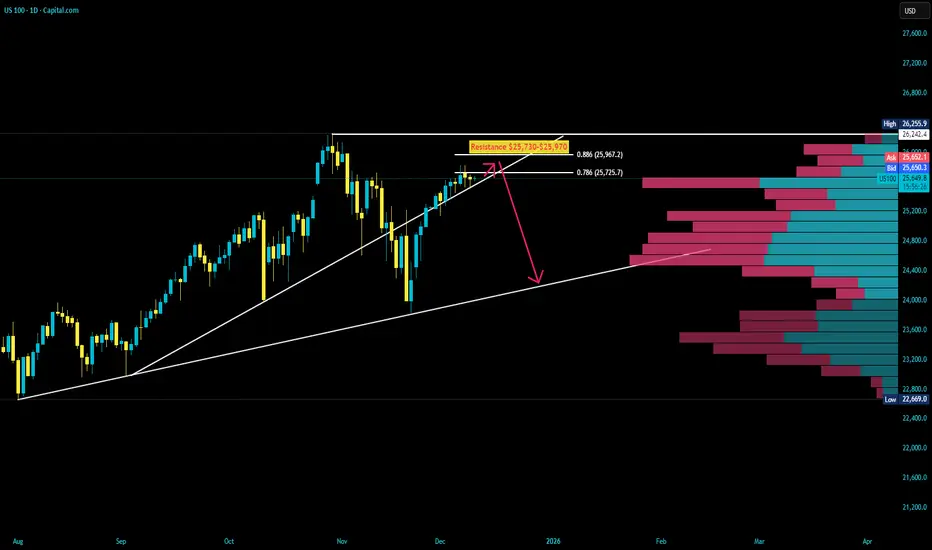
US100 Liquidity Reaction at Accumulation Box Volume ProfileThis analysis is based on a Volume Profile anchored to the most recent accumulation box in order to isolate the active auction. The goal is to understand whether price is accepting value or rejecting it, rather than attempting to predict direction.
US100 recently attempted to trade above the upper value region but failed to hold acceptance. Price is now rotating back into the composite range, suggesting a transition from expansion to balance.
Volume Profile Perspective
The anchored Volume Profile highlights where the majority of recent transactions occurred. These levels define fair value and serve as decision points for continuation or rotation.
Price is currently interacting with a key acceptance area that has previously acted as both support and resistance. This makes it a critical zone for determining short-term control.
Key Reference Levels
Upper distribution and rejection zone from prior highs
Value acceptance area defined by the anchored profile
Lower value boundary and high-volume support
Lower composite distribution below value
These levels are treated as reaction zones, not precise turning points.
Expected Market Paths
Path One: Continued Rejection and Rotation Lower
If price fails to reclaim acceptance above the value area and continues to form lower highs, rotation toward the lower value boundary becomes the higher probability outcome. Acceptance below value would open the path toward the next lower composite distribution.
Path Two: Reacceptance Into Value
If price reclaims the value area and holds above it with acceptance, rotation back toward the upper distribution becomes likely. In this case, the prior rejection zone would act as the next area to evaluate for continuation or rejection.
Execution Considerations
This environment favors patience and reaction over anticipation. Trades are best evaluated at value boundaries rather than inside the range. Acceptance and rejection should be confirmed through structure and follow-through, not single candles.
This is a contextual market analysis, not a trading signal.
Summary
US100 is currently trading within a decision zone defined by an accumulation-based Volume Profile. The next directional move depends on whether price accepts back above value or continues to reject and rotate lower. Letting the market confirm intent at these levels is critical.
US NAS 100DO YOU KNOW WHATS BEHIND THIS OR OTHER IDEAS?? in bio..
Preferably suitable for scalping and accurate as long as you watch carefully the price action with the drawn areas.
With your likes and comments, you give me enough energy to provide the best analysis on an ongoing basis.
And if you needed any analysis that was not on the page, you can ask me with a comment or a personal message.
Enjoy Trading ;)
NASS100 - Bias BearishThe bias for NAS100 today is bearish.
Yesterday’s daily candle met the bearish bias condition, signaling weakness and potential continuation to the downside. Price action shows that buy-side liquidity has been engaged, followed by a bearish daily close, which aligns with sell-side delivery.
As long as price remains below yesterday’s high and continues to respect lower structure, the market favors downside expansion.
Bias Summary:
Daily bias: Bearish
Expectation: Lower prices
Focus: Sell-side liquidity targets
Best entries: Retracements into premium zones
Stay patient and trade in alignment with the daily narrative. 🧠🔥
NASDAQ Awaits Breakout After Support ReboundUSNAS100 – Technical Overview
The price recently reached the 24820 support zone and rebounded exactly as expected.
At the moment, the market is trading in a short-term bullish correction phase, with upside potential toward 25420.
To shift into a full bullish structure, the price must break and close above 25420, which would open the path toward:
→ 25570 → 25830
However, if the price fails to hold above 25100, the bearish scenario will reactivate, targeting:
→ 24820 → 24570
Volatility may remain elevated following the recent macroeconomic releases.
Pivot Line: 25210
Resistance: 25420 · 25570 · 25830
Support: 25100 · 24820 · 24570
US100 Free Signal! Sell!
Hello,Traders!
US100 taps into a well-defined horizontal supply zone after a strong bearish displacement, confirming smart money distribution. Price failed to reclaim the supply cluster and is now respecting bearish order flow, with downside liquidity resting below recent lows.
--------------------
Stop Loss: 25,283
Take Profit: 24,891
Entry: 25,123
Time Frame: 4H
--------------------
Sell!
Comment and subscribe to help us grow!
Check out other forecasts below too!
Disclosure: I am part of Trade Nation's Influencer program and receive a monthly fee for using their TradingView charts in my analysis.
Nasdaq - The final blow-off top!⚰️Nasdaq ( TVC:NDQ ) can rally a final +25%:
🔎Analysis summary:
Just this month, we witnessed quite some volatility on the Nasdaq with a correction of about -10%. However, bulls immediately stepped in and clearly pushed price higher. Since there is still bullish pressure, a final blow-off top rally in the near future is quite likely.
📝Levels to watch:
$25,000 and $30,000
SwingTraderPhil
SwingTrading.Simplified. | Investing.Simplified. | #LONGTERMVISION
US Tech 100 NASDAQ Structural Bearish Shift
IG:NASDAQ
Structural Bearish Shift Explained
Multi-Timeframe Price Action Breakdown (1D → 4H)
This analysis focuses purely on market structure, liquidity, and intention.
🔹 1D CONTEXT — MARKET STRUCTURE SHIFT
On the Daily timeframe, the market printed a clear bearish Market Structure Shift (MSS):
• The prior bullish sequence (HH → HL) was invalidated
• Price broke the key HL, officially changing the higher-timeframe flow
• This confirms a bearish structural bias on 1D
The critical detail is where the shift originated.
⸻
🔹 ORIGIN OF THE 1D MSS (KEY DETAIL)
The Daily MSS was caused by an internal high, not by a macro LH:
• This internal high was the impulsive driver that broke the Daily HL
• Once the HL failed, that internal high became:
• The origin of the bearish shift
• A high-probability liquidity pool
This distinction matters.
The market is not reacting randomly — it is respecting structural causality.
⸻
🔹 1D LIQUIDITY SWEEP = MITIGATION, NOT BREAKOUT
After the MSS, price returned precisely to that internal high and:
• Swept liquidity above it
• Took stops from:
• Early shorts
• Late breakout longs
• Failed to accept above the level
• Closed back below the sweep zone
This move is best defined as:
Daily mitigation of the MSS origin, not an attempt at bullish continuation.
No acceptance = no bullish intent.
🔹 4H CONFIRMATION — INTERNAL ALIGNMENT
Dropping to 4H, the lower-timeframe behavior aligns perfectly with the Daily narrative:
• A 4H bearish MSS printed
• Followed by a 4H BOS to the downside
• A clean bearish Fair Value Gap (FVG) was left behind
• Price expanded impulsively away from that imbalance
This tells us:
• The Daily mitigation triggered internal distribution
• Lower timeframes accepted the bearish flow
• Momentum is now aligned top-down
⸻
🔹 WHAT THIS TELLS US ABOUT MARKET INTENT
Putting it all together:
• ✅ Daily bearish MSS defines bias
• ✅ Liquidity above the MSS origin has been fully mitigated
• ✅ 4H structure confirms bearish continuation
• ❌ No bullish acceptance or expansion above key levels
This is not a failed breakout
This is a structural transition from accumulation to distribution
⸻
🔹 KEY TAKEAWAY
After a Daily Market Structure Shift, the market revisited the exact internal high that caused the shift, swept liquidity, failed to accept higher prices, and aligned lower-timeframe structure to the downside.
Bias: Bearish
Framework: Structure → Liquidity → Acceptance
Not financial advice.
AI Generated.
NAS100 H4 | Potential Bearish DropMomentum: Bullish
The price has reacted off the sell entry, which is a pullback resistance
Sell entry: 25,569.52
Pullback resistance
Stop loss: 25,787.46
Multi swing high resistance
Take profit: 25,216.31
Overlap support
High Risk Investment Warning
Stratos Markets Limited (tradu.com ), Stratos Europe Ltd (tradu.com ):
CFDs are complex instruments and come with a high risk of losing money rapidly due to leverage. 70% of retail investor accounts lose money when trading CFDs with this provider. You should consider whether you understand how CFDs work and whether you can afford to take the high risk of losing your money.
Stratos Global LLC (tradu.com ): Losses can exceed deposits.
Please be advised that the information presented on TradingView is provided to Tradu (‘Company’, ‘we’) by a third-party provider (‘TFA Global Pte Ltd’). Please be reminded that you are solely responsible for the trading decisions on your account. Any information and/or content is intended entirely for research, educational and informational purposes only and does not constitute investment or consultation advice or investment strategy. The information is not tailored to the investment needs of any specific person and therefore does not involve a consideration of any of the investment objectives, financial situation or needs of any viewer that may receive it. Past performance is not a reliable indicator of future results. Actual results may differ materially from those anticipated in forward-looking or past performance statements. We assume no liability as to the accuracy or completeness of any of the information and/or content provided herein and the Company cannot be held responsible for any omission, mistake nor for any loss or damage including without limitation to any loss of profit which may arise from reliance on any information supplied by TFA Global Pte Ltd.
NASDAQ100 Technical Roadmap for Swing Traders📈 NASDAQ100 Bullish Swing Setup — Pullback to Power Move?
Asset:
NAS100 / US100 — NASDAQ 100 Index 💻📊
Market Type: Index
Trade Style: Swing Trade
📌 Market Plan (Bias):
🟢 Bullish structure confirmed
Price is respecting the Triangular Moving Average (TMA) pullback, signaling continuation strength within the broader uptrend.
🎯 Entry Strategy:
✅ Any Price Level Entry (Layered Approach Allowed)
Layering / Scaling-In Method:
This plan uses a multiple limit order (layering) strategy to optimize average entry during pullbacks.
Buy Limit Layers:
24900
25000
25100
📌 (You may increase or adjust layers based on your own risk and capital allocation)
🛑 Stop Loss (Risk Control):
🔴 Thief SL: 24700
📢 Adjust your stop loss according to your personal risk management and strategy.
This level invalidates the bullish pullback structure if broken.
🎯 Target / Exit Plan:
🟠 Primary Target: 25800
📌 Rationale:
Strong resistance zone
Overbought conditions may appear
Trap potential near highs
Possible corrective move from resistance
💡 Action: Secure profits near resistance — don’t overstay.
⚠️ Risk Disclaimer:
📢 Stop loss and target levels are for educational purposes only.
📢 Always manage risk independently and trade responsibly.
🔗 Related Markets to Watch (Correlation & Confirmation):
📊 US Indices (Direct Correlation):
US30 (Dow Jones) 🏭
→ Strength confirms broad US equity participation
SPX500 (S&P 500) 📈
→ Institutional flow confirmation for NASDAQ strength
💵 USD Index & Rates (Inverse / Indirect Impact):
DXY (US Dollar Index) 💲
→ Strong USD can slow tech upside; weakness supports NAS100
US10Y Treasury Yield 📉
→ Falling yields = bullish for growth & tech stocks
🧠 Risk Sentiment Assets:
BTC/USD ₿
→ Risk-on flows often align with NASDAQ momentum
VIX (Volatility Index) ⚡
→ Rising VIX = caution; falling VIX = trend continuation
💬 Final Note:
📈 Follow structure, respect risk, scale wisely.
🧠 Let price confirm — don’t chase.
👍 If this plan helps your analysis, boost with a like and share your view.
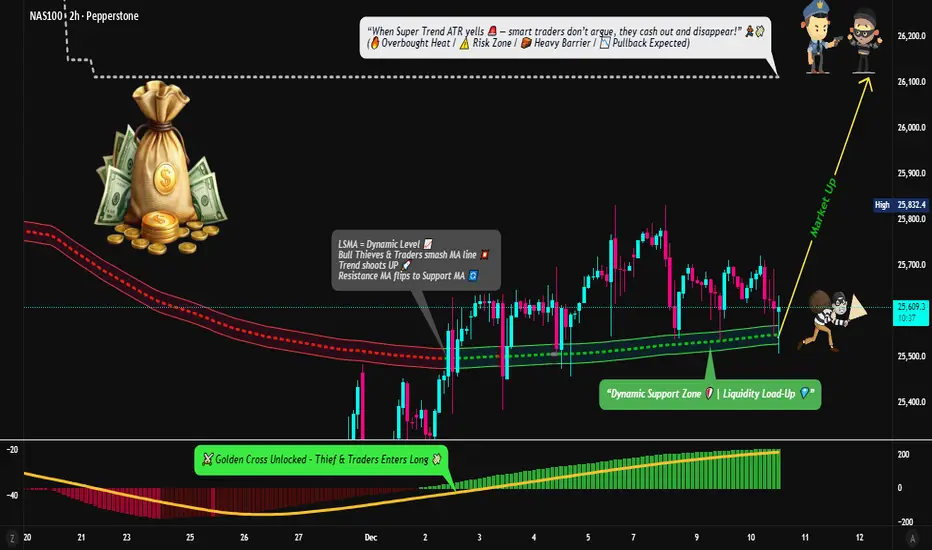
NASDAQ100 Strong Bullish Momentum — Clean Entry & Exit Blueprint⚡ THIEF STRATEGY ALERT: Golden Cross Breakout Setup
📈 TRADE PLAN OVERVIEW
Asset: NAS100 (NASDAQ 100 Index)
Timeframe: Day/Swing Trade
Market Bias: 🟢 BULLISH (Moving Average Breakout + MACD Golden Cross Confirmed)
Strategy Type: Layered Entry Approach (Multi-Level Limit Orders)
🎯 ENTRY STRATEGY - "THIEF LAYERING METHOD"
Multiple Limit Order Entry Points (Build Position Gradually):
📍 Layer 1: 25,400 (First Entry)
📍 Layer 2: 25,500 (Second Entry)
📍 Layer 3: 25,600 (Third Entry)
💡 Pro Tip: Adjust layer levels based on your capital allocation & risk tolerance. This pyramiding approach reduces average entry cost and limits downside risk.
Why This Method? The layered entry reduces emotional trading, averages down your entry price, and ensures you're not all-in on one level.
🛑 STOP LOSS - "THIEF OG PROTECTION"
Suggested SL Level: 25,200
⚠️ IMPORTANT DISCLAIMER: This is a reference level only. Adjust your stop loss based on:
Your personal risk tolerance
Account size & position sizing
Technical support levels on your timeframe
🔴 Remember: Risk management is YOUR responsibility. Set stops that protect YOUR capital.
🎁 PROFIT TARGET - "POLICE BARRICADE RESISTANCE"
Primary Target: 26,100
📊 Technical Confluence:
SUPERTREND ATR Line = Strong Dynamic Resistance
Overbought Zone Alert = Potential Reversal Risk
Resistance Trap = Take profits before reversal occurs
⚠️ CRITICAL NOTE: Partial profit-taking recommended. Don't be greedy at target levels—accumulate gains gradually:
🟢 Take 30-40% profit at 26,100
🟢 Move SL to breakeven, trail remaining position
🟢 Exit second half on additional resistance or SUPERTREND reversal
💰 YOUR DECISION: Profit targets are YOUR choice. Trade at your own risk and manage your exit strategy.
🔗 CORRELATED PAIRS TO WATCH (Risk/Opportunity Indicators)
1. SPY (S&P 500 ETF) - USD Strong Correlation (0.95)
Key Point: Leads or confirms NAS100 moves
Watch For: If SPY breaks below key support, NAS100 pullback likely
Action: Use SPY strength to confirm NASDAQ100 breakout validity
2. QQQ (NASDAQ 100 ETF) - Perfect Mirror (1.0 Correlation)
Key Point: Direct tracker of your asset
Watch For: Volume spikes, divergence patterns
Action: Cross-reference QQQ volume with NAS100—lack of volume = weak breakout
3. DXY (US Dollar Index) - Inverse Correlation (-0.75)
Key Point: Strong dollar = tech selloff risk
Watch For: DXY rejection at key levels
Action: If DXY rallies hard, NAS100 bullish bias weakens—be cautious
4. TLT (20-Year Treasury ETF) - Indirect Inverse (-0.60)
Key Point: Rising rates pressure growth stocks (NASDAQ)
Watch For: TLT breakdown = rate hike concerns = tech pressure
Action: Monitor TLT support; if breaks, expect NAS100 resistance
5. GLD (Gold ETF) - Risk-On Indicator (0.40)
Key Point: Flight-to-safety alternative
Watch For: Sharp gold strength = risk-off environment forming
Action: Gold spike with NAS100 move down = sell signal confirmation
6. VIX (Volatility Index) - Fear Gauge (-0.80)
Key Point: Rising VIX kills bullish momentum
Watch For: VIX above 20 = caution on long positions
Action: If VIX spikes during entry, wait for stabilization before scaling in
✅ CHECKLIST BEFORE ENTRY
Moving Average crossover confirmed (golden cross visible)
MACD histogram turned positive
Price closed above key moving average
Volume supporting the move
Correlated pairs (QQQ/SPY) confirming bullish setup
DXY not in strong uptrend (tech-unfriendly)
VIX stable or declining
🎯 TRADE MANAGEMENT RULES (THIEF OG STYLE)
Scale In: Use limit orders—don't chase price
Protect Profits: Move stop to breakeven after first target hit
Trail Stops: Let winners run while protecting gains
Take Partials: Secure profits incrementally—greed kills traders
Monitor Correlations: Watch correlated pairs for early warning signals
Respect Risk: NEVER risk more than 2% per trade
⚠️ RISK DISCLAIMER
This is an Educational Guide Only for trading strategy examples.
🔴 NOT Financial Advice: I am not a financial advisor, and this does NOT constitute investment advice.
🔴 Your Responsibility: All entry, exit, and stop-loss decisions are YOUR choice and YOUR responsibility.
🔴 Past Performance ≠ Future Results: Market conditions change; strategies may fail.
🔴 Risk Capital Only: Trade only with money you can afford to lose completely.
Trade at your own risk. Always do your own research (DYOR).
💪 THIEF OG'S MINDSET
Dear Ladies & Gentlemen (Thief OG's),
Success in trading isn't about following someone else's exact setup—it's about understanding the WHY behind each decision, adapting to YOUR risk tolerance, and executing with DISCIPLINE.
This guide provides the framework. You provide the execution. Make your profits, protect your capital, and trade smart. 🎯
Now go earn those tendies, OG's! 💰📈
Last Updated: December 2025
Strategy Type: Day/Swing Trade | Timeframe: 4H-Daily
$NQ NASDAQ/US100 Bearish W Pattern Target Hit, Next Quick UpdateHi
The W pattern completed as expected and after that it fell. It reached the first bearish target. I personally am not looking for any more bearishness. I an bullish from the current levels. However I trade what I see and will plan after seeing the latest price action.
There was a big gap let. All these gaps may or may not get filled but they are important levels. So if the markets becomes bullish again, it may try to go higher from the current levels o fill that gap to the upside.
These is a previous gap level which can also provide support if the market falls from the current levels.
Trade what you see, wait for the confirmations and manage the risk as always.
Follow for more. Please support this analysis by liking, commenting, and sharing with friends, colleagues, traders, and trading communities. Thanks👍🙂
Nas 100Overall Market Context
The Nasdaq 100 (US 100 Cash CFD) is in a strong uptrend on the 4H chart, trading around 25,161 with recent gains. Price has broken above previous resistance and is extending higher after a consolidation phase in Nov–early Dec. The chart shows bullish momentum, with higher highs and higher lows since October.
Indicator Key Insights
Higher Timeframe Bias
Bullish (green background shading from daily EMA 20/50 crossover)
This favors longs on pullbacks. Shorts would be counter-trend unless bias flips.
Anchored VWAP & SD Bands
Current AVWAP: 24,932.66 (+0.92% from price) — price is above VWAP, confirming bullish control.
SD Bands:
±1σ: ~24,328–25,536
±2σ: ~23,724–26,140
±3σ: ~23,120–26,744
Price is near the upper ±2σ band (~26,140 area in recent swing), suggesting mild overextension. Pullbacks to VWAP or lower bands are common mean-reversion opportunities in uptrends.
Volume Profile (Fixed Range from Recent Swing)
POC (Point of Control): 25,114.63 — highest volume node, acting as magnet/support. Price is just above it, reinforcing strength.
Value Area: Wide yellow shading on left — high-volume zone from ~24,800–25,600.
HVN (High Volume Nodes): Yellow highlighted clusters show institutional interest around current levels.
Low-volume nodes below suggest quick drops on breakdowns, but bulls defending POC.
Fibonacci Levels
From recent swing low to high (anchored automatically).
Price near 0.618–0.65 Golden Pocket extension? (orange shading visible). This zone often acts as resistance in extensions or support on pullbacks.
Key retracement levels (dashed lines) for potential pullbacks: 0.382 and 0.5 likely around 25,000–24,800.
Signals & Confluence
Recent signals: Multiple green triangles (buys) with scores of 3 (solid medium confluence).
Last signal: 3 (buy) — triggered on AVWAP cross + proximity to POC/Fib.
No recent red/sell signals visible — all pointing bullish.
Confluence scoring: These "3" signals include AVWAP cross + POC/Fib proximity + HTF alignment, but missing one factor for A+ (score 4–5).
Current Setup & Trade Ideas
Bullish Bias (Primary Scenario)
Long on pullback: Wait for dip to POC (25,114) or AVWAP (24,932) with new buy signal (score ≥3).
Entry: On green triangle near support.
Targets: Upper ±2σ (~26,140) or ±3σ stretch (~26,744).
Stop: Below lower ±1σ or recent swing low.
RR: 2–3:1 easy in trend.
Why strong: Bullish HTF bias + price above VWAP/POC + volume supporting higher.
Bearish Counter-Trend (Lower Probability)
Only if red signal appears at upper ±3σ overextension.
Potential short if price rejects ~26,744 and scores ≥4 sell.
Target: Back to POC or VWAP.
Risky — against HTF bias.
Risks & Notes
Overextension: Price near upper bands — watch for rejection or consolidation.
News catalysts: Nasdaq sensitive to tech earnings, rates, AI hype.
Best trades: Wait for score 4+ with HTF alignment for highest edge.
Timeframe synergy: Check Daily for confirmation — bias remains bullish.
The indicator shows clear bullish control with room for extension, but a healthy pullback to POC/VWAP would offer excellent long entries. Focus on quality over quantity — these confluence setups have delivered consistent edges.
Trade safe!
US NAS 100DO YOU KNOW WHATS BEHIND THIS OR OTHER IDEAS?? in bio..
Preferably suitable for scalping and accurate as long as you watch carefully the price action with the drawn areas.
With your likes and comments, you give me enough energy to provide the best analysis on an ongoing basis.
And if you needed any analysis that was not on the page, you can ask me with a comment or a personal message.
Enjoy Trading ;)