Key stats
About State Street SPDR S&P 500 ETF
Home page
Inception date
Jan 22, 1993
Structure
Unit Investment Trust
Replication method
Physical
Dividend treatment
Distributes
Distribution tax treatment
Qualified dividends
Income tax type
Capital Gains
Max ST capital gains rate
39.60%
Max LT capital gains rate
20.00%
Primary advisor
SSgA Funds Management, Inc.
Distributor
ALPS Distributors, Inc.
Identifiers
3
ISIN US78462F1030
SPDR S&P 500 ETF Trust is an Exchange traded fund. The fund seeks to provide investment results that, before expenses, correspond generally to the price and yield performance of the S&P 500® Index. The S&P 500® Index is composed of five hundred selected stocks. SPDR S&P 500 ETF Trust was founded on January 22, 1993 and is headquartered in New York, NY.
Related funds
Classification
What's in the fund
Exposure type
Electronic Technology
Technology Services
Finance
Stock breakdown by region
Top 10 holdings
02-06 SPY Forecast and Perspective NOW!!! With Gamma Additives**RESISTANCE (Above):**
- U5: $684.32 (HVN, gamma, top target)
- ORBH: $683.69 (HVN, gamma cluster)
- PM High: $682.82 (HVN, premarket confirm)
- U4: $681.75 (HVN, strong band)
- **⚡ U3: $679.63 (Gamma Node)**
- **⚡ U2: $678.96**
- **⚡ ORBL: $678.76 (LVN, cluster edge)**
- **⚡ U1: $678.32**
**ANCHO
SPY Weekly Outlook – Week 5 of 2026 (Feb 02–06)SPY Weekly Outlook – Week 5 of 2026 (Feb 02–06)
Weekly Recap
Last week, SPY respected our bullish framework perfectly, resulting in a clean and profitable execution. The market opened with a gap up and reached Bullish Target 1, where we took partial profits and reduced exposure.
We then carried
$SPY 15m - Fibonacci Confluence at Decision Point - TRADE SETUPAMEX:SPY 15m - Fibonacci Confluence at Decision Point
Price sitting at 0.618 retracement ($689.04) after rejecting descending trendline resistance.
Structure:
- Swing low: $684.14 (1.0 fib)
- Current: $689.44 (golden pocket)
- Trendline resistance: ~$690 declining
- Bearish target: $676.16 (1.618
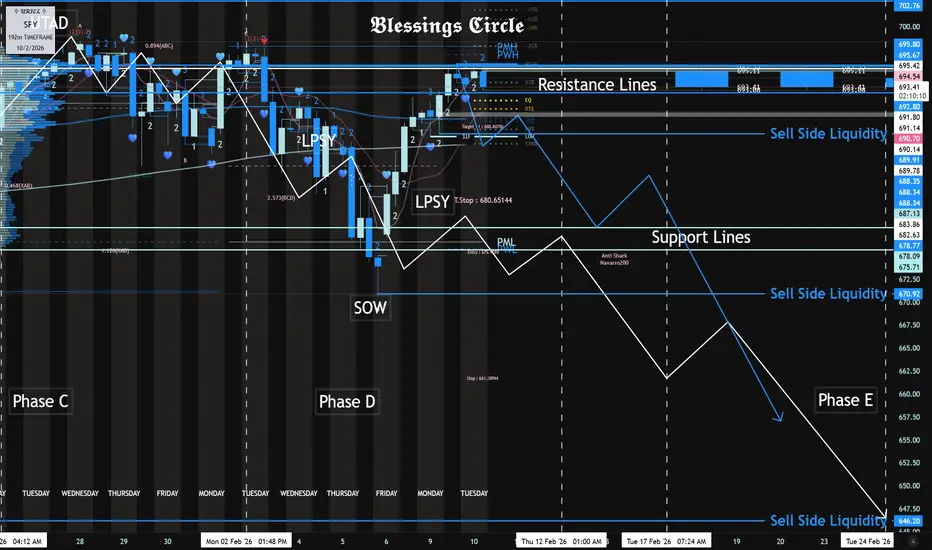
SPY CONSTRUCTIVE BEAR THESIS | FEB 2026SPY CONSTRUCTIVE BEAR THESIS | FEB 2026
STRUCTURE:
Price tagged 1.0 Fib extension (697.84) — full retracement of the 2024-2025 impulse. CHoCH signals clustering at highs within Premium zone per SMC framework. Classic distribution characteristics forming.
TARGET ZONE: 627-631 (0.702 Fib / Equilibri
SPY. Key Decision Zone After Strong Bounce for Feb 9-13What I’m Watching
SPY put in a solid recovery after selling off earlier in the week, but price is now pushing into a zone where things usually slow down. The bounce was clean, momentum improved, and buyers clearly stepped in — but we’re no longer in “easy upside” territory. From here, it’s about wh
SPY Constructive Bear Thesis | Macro + SMC + Catalyst Alignment SPY Constructive Bear Thesis | Macro + SMC + Catalyst Alignment | Feb 2026
Structure
Price swept the previous swing high, printed a Change of Character (CHoCH), and is now sitting in premium at $690.62. Classic Smart Money Concepts distribution setup on the 15-minute timeframe.
The projected path f
most signs still pointing lowerWe broke the 100 daily and the 18 weekly ma's today. It still looks like 6500 is possible but it may or may not not be a straight line. Gold and silver may get a bid soon. BTC is at monthly target but it may continue to drop a bit more first. Oil still looks good. VIX closed above 20 and probably te
SPY: The chart no one wants to talk about.The chart no one wants to talk about.
AMEX:SPY just completed a textbook 5-wave impulse from the March 2020 lows.
Wave (5) tagged the 2.0 Fibonacci extension near $720 — and we're now rolling over at $690, below channel resistance.
If you know your Elliott Wave theory, you know what comes next.
Co
See all ideas
Summarizing what the indicators are suggesting.
Oscillators
Neutral
SellBuy
Strong sellStrong buy
Strong sellSellNeutralBuyStrong buy
Oscillators
Neutral
SellBuy
Strong sellStrong buy
Strong sellSellNeutralBuyStrong buy
Summary
Neutral
SellBuy
Strong sellStrong buy
Strong sellSellNeutralBuyStrong buy
Summary
Neutral
SellBuy
Strong sellStrong buy
Strong sellSellNeutralBuyStrong buy
Summary
Neutral
SellBuy
Strong sellStrong buy
Strong sellSellNeutralBuyStrong buy
Moving Averages
Neutral
SellBuy
Strong sellStrong buy
Strong sellSellNeutralBuyStrong buy
Moving Averages
Neutral
SellBuy
Strong sellStrong buy
Strong sellSellNeutralBuyStrong buy
Displays a symbol's price movements over previous years to identify recurring trends.
Frequently Asked Questions
An exchange-traded fund (ETF) is a collection of assets (stocks, bonds, commodities, etc.) that track an underlying index and can be bought on an exchange like individual stocks.
SPY assets under management is 706.46 B USD. AUM is an important metric as it reflects the fund's size and can serve as a gauge of how successful the fund is in attracting investors, which, in its turn, can influence decision-making.
Since ETFs work like an individual stock, they can be bought and sold on exchanges (e.g. NASDAQ, NYSE, EURONEXT). As it happens with stocks, you need to select a brokerage to access trading. Explore our list of available brokers to find the one to help execute your strategies. Don't forget to do your research before getting to trading. Explore ETFs metrics in our ETF screener to find a reliable opportunity.
SPY invests in stocks. See more details in our Analysis section.
SPY expense ratio is 0.09%. It's an important metric for helping traders understand the fund's operating costs relative to assets and how expensive it would be to hold the fund.
No, SPY isn't leveraged, meaning it doesn't use borrowings or financial derivatives to magnify the performance of the underlying assets or index it follows.
Yes, SPY pays dividends to its holders with the dividend yield of 1.05%.
SPY shares are issued by State Street Corp.
SPY follows the S&P 500. ETFs usually track some benchmark seeking to replicate its performance and guide asset selection and objectives.
The fund started trading on Jan 22, 1993.
The fund's management style is passive, meaning it's aiming to replicate the performance of the underlying index by holding assets in the same proportions as the index. The goal is to match the index's returns.