State Street Financial Select Sector SPDR ETFState Street Financial Select Sector SPDR ETFState Street Financial Select Sector SPDR ETF

State Street Financial Select Sector SPDR ETF

No trades

Key stats


Assets under management (AUM)
Fund flows (1Y)
‪−882.60 M‬
Dividend yield (indicated)
Discount/Premium to NAV
−0.03%
Shares outstanding
Expense ratio

About State Street Financial Select Sector SPDR ETF


XLF offers efficient exposure to the heavyweights in the US financials segment. Its cap-weighted, S&P 500-only portfolio means that its concentrated in large banks and avoids small-caps. For many investors and traders, XLF has been the go-to ETF for financials exposure, although there are more comprehensive funds out there for long-term exposure. Note: XLF spun off its real estate exposure in September 2016, consistent with the GICS reclassification that elevated real estate to sector-level status. The change was material: Real estate comprised about 20% of the fund at the time. For each share held, XLF shareholders as of 9/16/16 received 0.139146 shares of XLRE, State Street Global Advisors' real estate ETF. (Immediately prior to the distribution, XLF had swapped its REITs for shares of XLRE.) Prior to Dec. 1, 2025, the fund name did not include the Issuer's name, State Street.

Broaden your horizons with more funds linked to this ETF via country, focus, and more.

See all ideas 

Summarizing what the indicators are suggesting.
Oscillators
Neutral
SellBuy
Strong sellStrong buy
Strong sellSellNeutralBuyStrong buy
Oscillators
Neutral
SellBuy
Strong sellStrong buy
Strong sellSellNeutralBuyStrong buy
Summary
Neutral
SellBuy
Strong sellStrong buy
Strong sellSellNeutralBuyStrong buy
Summary
Neutral
SellBuy
Strong sellStrong buy
Strong sellSellNeutralBuyStrong buy
Summary
Neutral
SellBuy
Strong sellStrong buy
Strong sellSellNeutralBuyStrong buy
Moving Averages
Neutral
SellBuy
Strong sellStrong buy
Strong sellSellNeutralBuyStrong buy
Moving Averages
Neutral
SellBuy
Strong sellStrong buy
Strong sellSellNeutralBuyStrong buy
Displays a symbol's price movements over previous years to identify recurring trends.

Frequently Asked Questions


An exchange-traded fund (ETF) is a collection of assets (stocks, bonds, commodities, etc.) that track an underlying index and can be bought on an exchange like individual stocks.
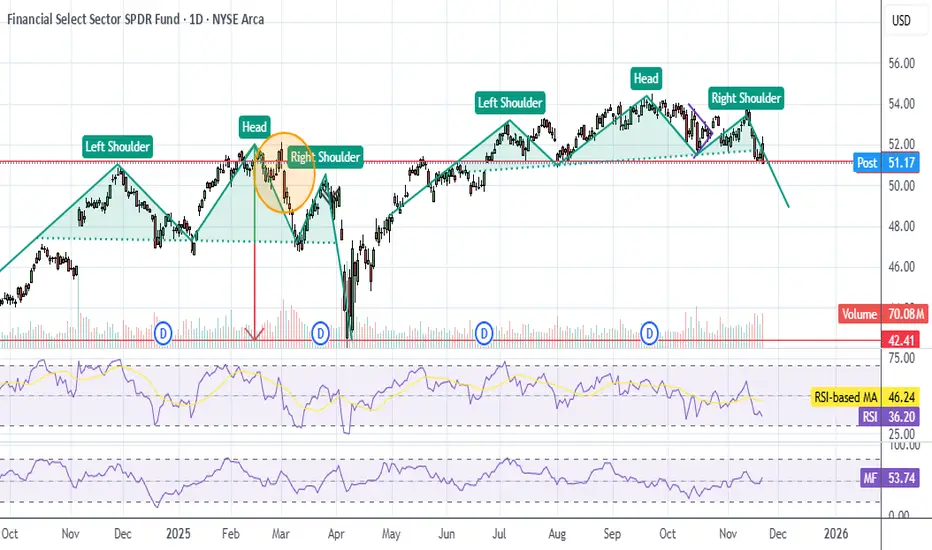
XLF trades at 51.65 USD today, its price has fallen −0.08% in the past 24 hours. Track more dynamics on XLF price chart.
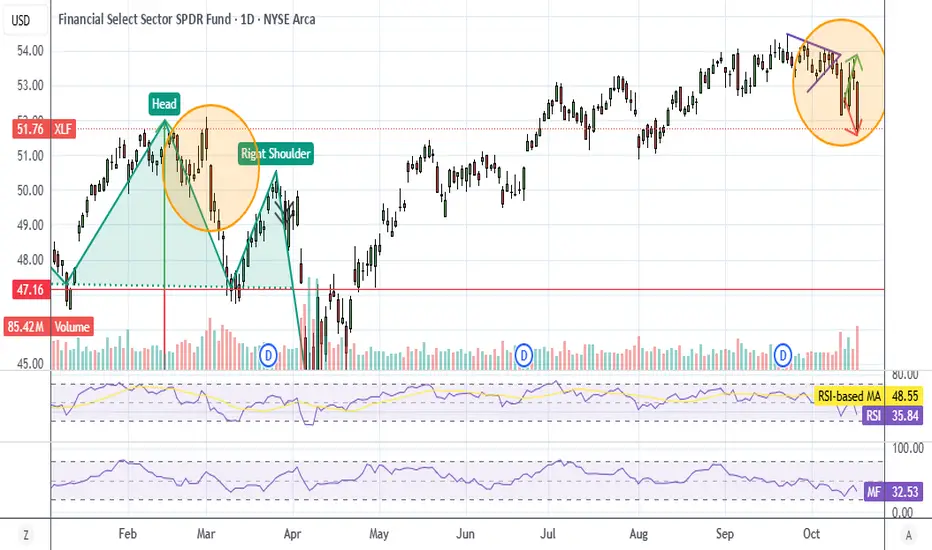
XLF price has fallen by −5.00% over the last month, and its yearly performance shows a −0.23% decrease. See more dynamics on XLF price chart.
NAV returns, another gauge of an ETF dynamics, have fallen by −6.54% over the last month, showed a −3.39% decrease in three-month performance and has increased by 1.30% in a year.
Since ETFs work like an individual stock, they can be bought and sold on exchanges (e.g. NASDAQ, NYSE, EURONEXT). As it happens with stocks, you need to select a brokerage to access trading. Explore our list of available brokers to find the one to help execute your strategies. Don't forget to do your research before getting to trading. Explore ETFs metrics in our ETF screener to find a reliable opportunity.
In some ways, ETFs are safe investments, but in a broader sense, they're not safer than any other asset, so it's crucial to analyze a fund before investing. But if your research gives a vague answer, you can always refer to technical analysis.
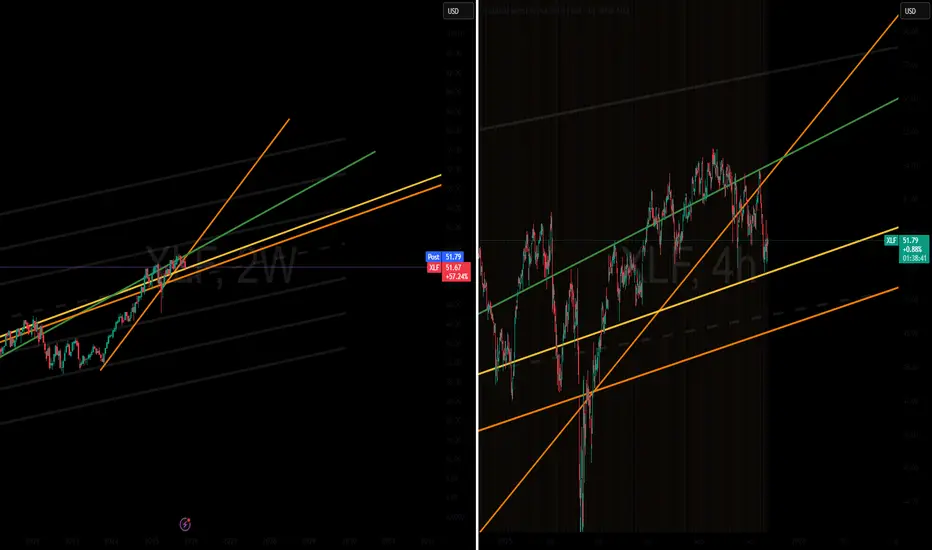
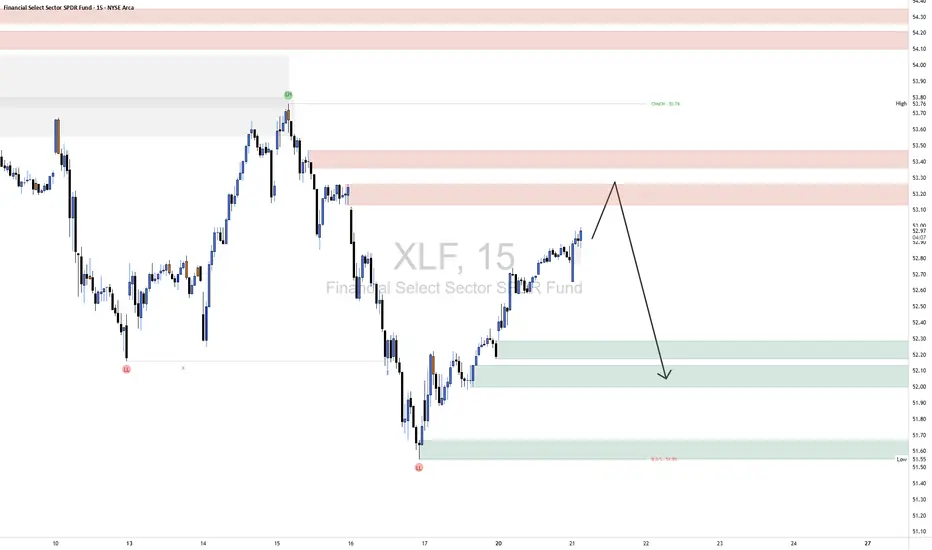
Today, XLF technical analysis shows the sell rating and its 1-week rating is sell. Since market conditions are prone to changes, it's worth looking a bit further into the future — according to the 1-month rating XLF shows the buy signal. See more of XLF technicals for a more comprehensive analysis.
No, XLF doesn't pay dividends to its holders.
XLF trades at a premium (0.03%).
Premium/discount to NAV expresses the difference between the ETF’s price and its NAV value. A positive percentage indicates a premium, meaning the ETF trades at a higher price than the calculated NAV. Conversely, a negative percentage indicates a discount, suggesting the ETF trades at a lower price than NAV.