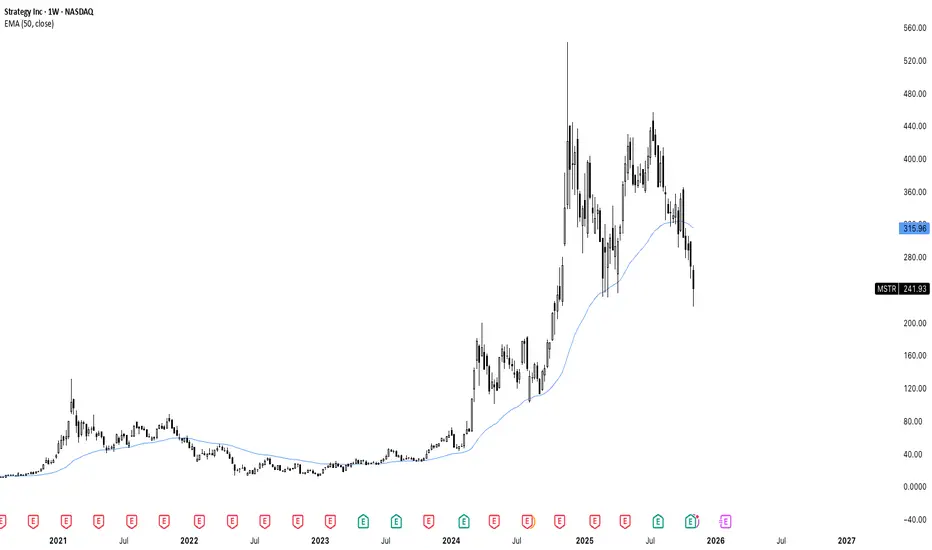
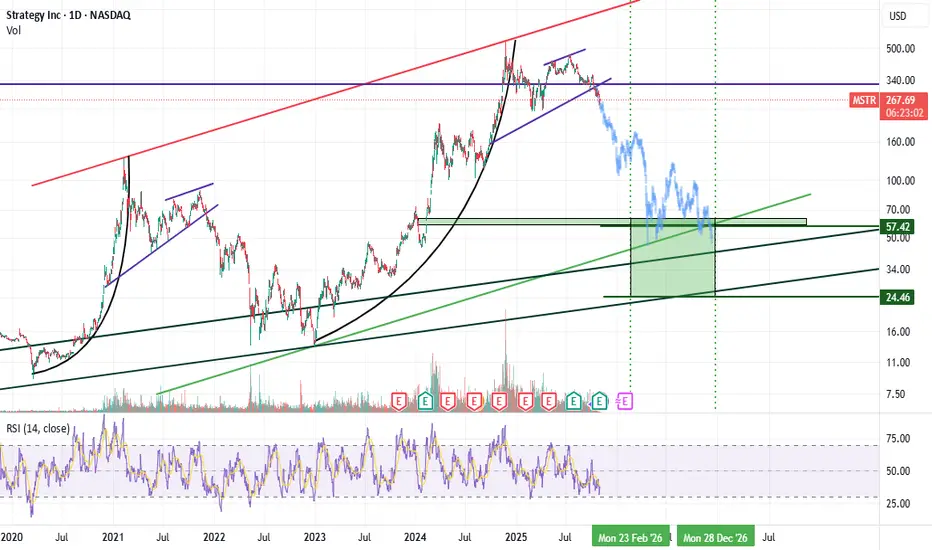
Microstrategy is who Satoshi warned us about. MSTR has broken below the 50 day moving average and is now at 52 weeks low. All while they hold the most bitcoin they ever have, now at 641,000 BTC. Some would even say they are trying to corner the market, using debt - while they claim they will never sell, but also they are not even earning any yield on their holdings. They will owe over $600 million in dividend payments next year. You simply can not create value out of thin air. NASDAQ:MSTR
Trade ideas
Challenges and Risks in Global Investing1. Introduction to Global Investing
Global investing refers to the practice of allocating capital across international markets, including stocks, bonds, mutual funds, and other financial instruments from different countries. While it offers opportunities to capture growth from emerging economies and diversification benefits, it also exposes investors to risks that stem from global interdependence. These risks may arise due to variations in political systems, market maturity, taxation, and macroeconomic conditions. Therefore, a well-informed global investor must carefully assess the potential threats and rewards before investing abroad.
2. Currency Risk
One of the most significant challenges in global investing is currency risk or exchange rate risk. When investors hold assets denominated in foreign currencies, fluctuations in exchange rates can affect investment returns.
For example, if an Indian investor invests in U.S. stocks and the Indian rupee strengthens against the U.S. dollar, the investor’s returns in rupee terms will decrease even if the stock’s price rises in dollar terms. Similarly, if the rupee weakens, the investor may benefit from favorable exchange rate movements.
Currency volatility is influenced by inflation, interest rate differentials, trade balances, and geopolitical factors. Investors can mitigate this risk through hedging strategies, such as currency futures or options, but these come with additional costs and complexities.
3. Political and Geopolitical Risks
Political instability is another major challenge in global investing. Changes in government, social unrest, corruption, or political uncertainty can severely affect the performance of investments in certain countries.
For example, political tensions between countries can lead to trade restrictions, sanctions, or expropriation of assets, directly impacting multinational companies. The Russia-Ukraine conflict in recent years, for instance, has led to economic sanctions that affected investors with exposure to those regions.
Similarly, sudden policy changes such as nationalization of industries, tax reforms, or foreign investment restrictions can negatively impact returns. Hence, political risk assessment is crucial when investing in developing or politically unstable nations.
4. Economic and Market Risks
Different economies move through cycles of expansion and contraction at varying times. This creates economic risk, which can impact the performance of international investments.
Emerging markets often offer high growth potential but may also experience sharp downturns due to weak economic structures, inflationary pressures, or currency devaluations. Developed markets, on the other hand, may provide stability but lower growth prospects.
Moreover, global market risks—such as recessions, interest rate hikes, or financial crises—can have widespread effects. The 2008 Global Financial Crisis demonstrated how interconnected financial markets are, as a collapse in the U.S. housing market triggered a worldwide recession.
5. Regulatory and Legal Risks
Each country operates under its own regulatory framework, which governs business practices, financial reporting, and investor protections. Differences in accounting standards, disclosure requirements, and corporate governance practices can pose serious challenges for global investors.
For example, while the U.S. follows GAAP (Generally Accepted Accounting Principles), many other countries use IFRS (International Financial Reporting Standards). These variations can make it difficult to compare companies across borders.
Legal systems in some countries may also lack transparency or enforceability. In extreme cases, investors may face fraud, corruption, or lack of legal recourse when disputes arise. Therefore, understanding the local legal and regulatory landscape is essential before making any international investment.
6. Cultural and Communication Barriers
Cultural differences play a subtle but significant role in global investing. Business practices, negotiation styles, corporate culture, and consumer behavior vary across regions. Misunderstanding these cultural nuances can lead to poor investment decisions.
For instance, a company operating successfully in the U.S. might not achieve the same results in Japan or India due to differences in consumer preferences, labor laws, or management styles. Similarly, language barriers can lead to misinterpretation of financial information or communication errors with local partners and institutions.
Investors need to account for these soft factors when analyzing global markets to ensure that cultural misalignment does not undermine business potential.
7. Liquidity Risk
Liquidity risk arises when investors are unable to buy or sell an asset quickly without affecting its price. In many foreign markets—especially in developing nations—financial instruments are less liquid than in major global exchanges.
For example, while shares on the New York Stock Exchange (NYSE) can be traded almost instantly, stocks listed on smaller exchanges in emerging economies may take days or weeks to execute. This can pose problems during times of market stress when investors need to exit positions quickly.
Investors must, therefore, assess the liquidity levels of foreign markets before investing and avoid overexposure to illiquid assets.
8. Information and Transparency Challenges
Access to reliable and timely information is a cornerstone of sound investment decisions. However, in many countries, financial transparency and disclosure standards are not as rigorous as in developed markets.
Incomplete or inaccurate data can lead to mispricing of assets and poor investment choices. Furthermore, language differences, lack of research coverage, and limited access to company executives can make it difficult for foreign investors to fully understand the market environment.
Global investors often rely on local analysts, financial news, or international advisory firms to bridge this information gap.
9. Taxation and Repatriation Issues
Each country has its own tax laws, including capital gains tax, dividend tax, and withholding tax. Navigating these differences can be complicated, especially when double taxation treaties are not in place.
Additionally, repatriating profits from foreign investments can be difficult due to restrictions on currency transfers or unfavorable exchange rate conditions. Investors must consult international tax experts and understand cross-border tax implications to avoid unexpected liabilities.
10. Technological and Cybersecurity Risks
As global investing increasingly relies on digital platforms, cybersecurity threats have become a significant concern. Online trading platforms, digital banking systems, and financial data networks are all vulnerable to hacking and data breaches.
Moreover, technological disparities between countries may also impact efficiency and transparency. In less developed markets, outdated trading infrastructure or lack of digital safeguards can increase operational risks.
Investors must prioritize cybersecurity and ensure their brokers or financial institutions follow robust digital protection standards.
11. Environmental, Social, and Governance (ESG) Risks
The growing importance of ESG factors in global investing introduces another dimension of risk. Companies that fail to comply with environmental regulations, labor rights, or ethical practices may face boycotts, fines, or reputational damage.
Investors must evaluate not only financial performance but also the sustainability practices of international firms. Ignoring ESG considerations can result in long-term losses as global markets increasingly reward responsible and transparent businesses.
12. Global Systemic Risks
Certain risks, such as pandemics, climate change, and global recessions, affect the entire world simultaneously. The COVID-19 pandemic, for instance, caused massive disruptions across industries and countries, showing that no market is entirely insulated from global shocks.
Such systemic risks highlight the importance of maintaining flexibility, diversification, and proper risk management strategies in global portfolios.
13. Strategies to Mitigate Global Investment Risks
While global investing carries challenges, investors can manage these risks through prudent strategies:
Diversification: Spreading investments across regions, sectors, and asset classes reduces exposure to any single market.
Hedging: Using derivatives like options or futures to protect against currency or commodity price fluctuations.
Research and Due Diligence: Conducting in-depth analysis of political, economic, and financial environments before investing.
Professional Guidance: Consulting international fund managers or advisors with local expertise.
Regular Monitoring: Continuously tracking geopolitical and economic developments that may impact returns.
14. Conclusion
Global investing offers immense opportunities for wealth creation and diversification, but it comes with complex challenges and risks. Factors such as currency volatility, political instability, regulatory differences, and global crises can significantly impact investment outcomes. Successful global investors must adopt a disciplined approach that combines research, diversification, and risk management. By understanding and navigating these challenges wisely, investors can unlock the full potential of global markets while safeguarding their capital against unforeseen global shocks.
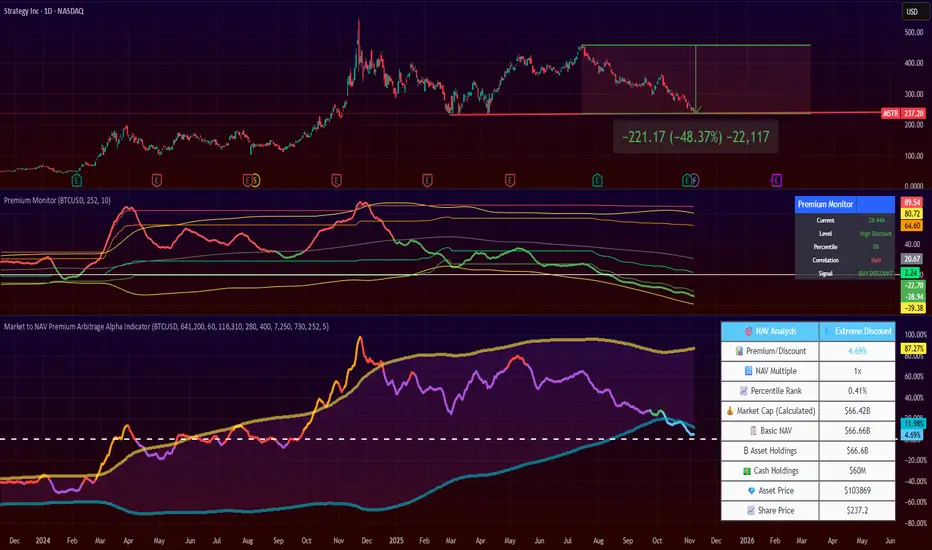
Strategy's Premium is Gone. Time to Load? 4 months ago, I posted that NASDAQ:MSTR premium was unsustainable and the stock price would drop.
Since then, the price dropped by 50%!!
Now, Strategy's is close to zero, and I flip my views on it.
If you like this kind of trade, it might be a good time to start DCA'ing it.
Note that Strategy continues to be a highly volatile stock, more volatile than Bitcoin itself.
Finally, the stock is now at a technical resistance level.
You can keep an eye on the premium/discount of this stock by looking at my 2 indicators:
Market to NAV Premium Arbitrage Alpha Indicator , and
Asset Premium/Discount Monitor
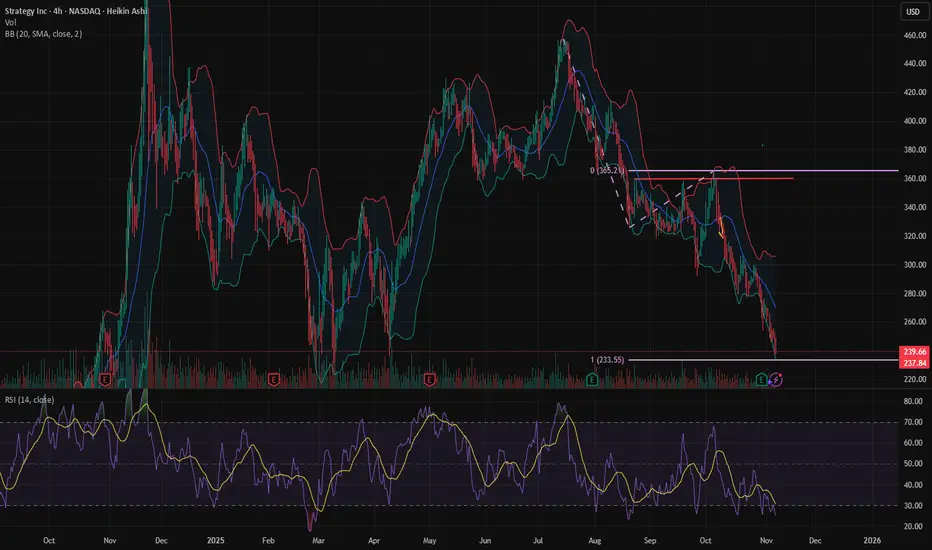
$MSTR: AB = CD target almost reachedNASDAQ:MSTR : the AB = CD targets $233 and today's low is $236.86. Very close. If NASDAQ:MSTR can bounce here, or fake breakdown to 233 or lower than bounce back, it would be good for Bitcoin. I don't own NASDAQ:MSTR shares and don't plan to trade this name. I'm looking at NASDAQ:MSTR as another data point to gauge bitcoin.
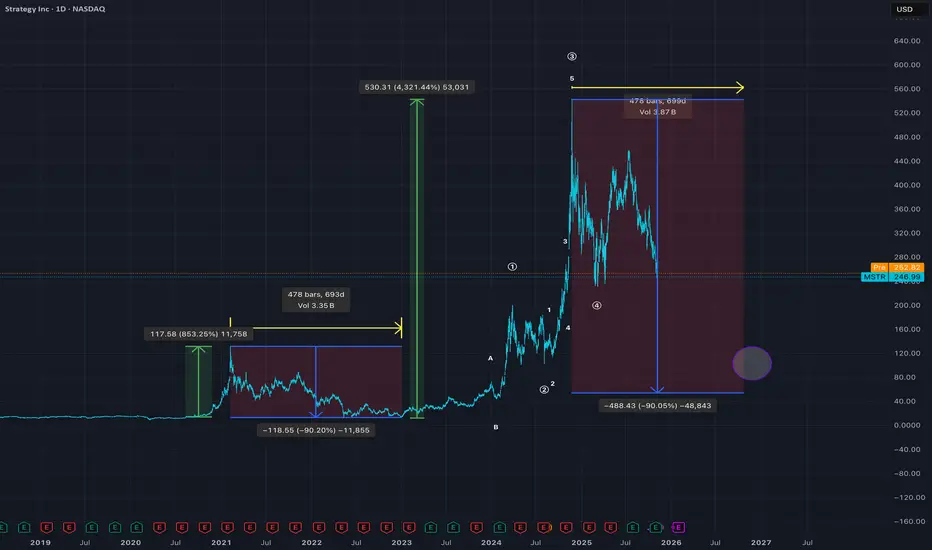
History Seems to Be Repeating on MSTR
Lately, I’ve been noticing something interesting on MicroStrategy (MSTR) — the price action appears to be forming a structure very similar to what we saw earlier in the chart.
⸻
🟨 Repeating Consolidation Zones
Looking back, the first highlighted zone (around early 2024) shows how price moved sideways for a while after a strong rally. That consolidation eventually resolved in a sharp move upward once momentum returned.
Now, if we look at the current structure (mid-to-late 2024 into 2025), the setup looks quite familiar. After another strong upward phase, price has again been consolidating in a broad range roughly between $250 and $450.
⸻
🧩 Observing the Fractal Behavior
This kind of repeated structure—where a period of consolidation follows a strong expansion—often suggests that market participants are adjusting to previous volatility and finding equilibrium before the next major phase.
While past movements don’t predict future outcomes, it’s interesting to note how similar the rhythm of this current range is compared to the previous one. It almost feels like the market is “echoing” its earlier behavior.
⸻
🔍 Key Points I’m Watching
• The lower area of this range (around $230–$250) has acted as an important zone of interest before.
• The upper boundary near $425–$450 has repeatedly capped upward movement.
• How price behaves between these levels may give insight into the broader structure of the trend.
⸻
🕰️ Final Thoughts
This analysis isn’t a prediction or a recommendation — just an observation of how patterns sometimes reappear in the market.
Whether or not this current range resolves in a similar way to the last one remains to be seen, but the repetition in structure and timing is fascinating from a technical perspective.
Markets often rhyme, and MSTR might just be showing another verse of a familiar song. 🎵
MSTR further downside but looking exhaustedNASDAQ:MSTR Price continues range bound in a complex wave 4 correction, notoriously hard to analyse. The trend is down but looks exhausted.
Wave Y can complete any time in this flat correction pattern but is approaching the previous swing low and the 0.236 Fibonnacci retracement.
Daily RSI has printed bullish divergence but price continues lower. IF pice breaks down further the next target is $185 where price may find a bottom.
Recovering the daily 200EMA is the first goal.
Will Microstrategy $MSTR follow the 2021 cycle?
Top was around the most greedy time in the market per Election '24. As bitcoin put in new all time highs MSTR continued lower highs, just like in '21. Last line of support around $230, it should continue putting in lower highs as the cycle comes to an end.
MSTR - How to profit from a $140 short target🔱 The MS ponzi is taking its toll. 🔱
I’m not laughing, because it’s genuinely unfortunate for everyone who believed in this scam.
But today, I don’t want to rant about that.
I want to show how one could profit from a potential drop of more than $100.
As an Andrews Pitchfork trader, I know there’s roughly an 80% chance that price will reach the centerline. From there, price either reverses in the opposite direction or breaks through the centerline to continue its journey.
That’s exactly what happened with MSTR.
You can see how the price first reached the centerline, held there a few times, and then broke it. Since then, it’s been following the rulebook by moving further to the downside.
Now, there’s another rule worth remembering:
price often tests or retests the line it just broke.
In our case, that line is the centerline.
This means we could be lucky enough to get a pullback to the centerline, and that would be a good level to consider shorting.
The target is usually the opposite line of the centerline, which in our case is the L-MLH (Lower Median Line Parallel).
👉 If you want to learn the full framework and its rules, check the links for free material.
I hope this helps many of you, and I wish you all good profits.
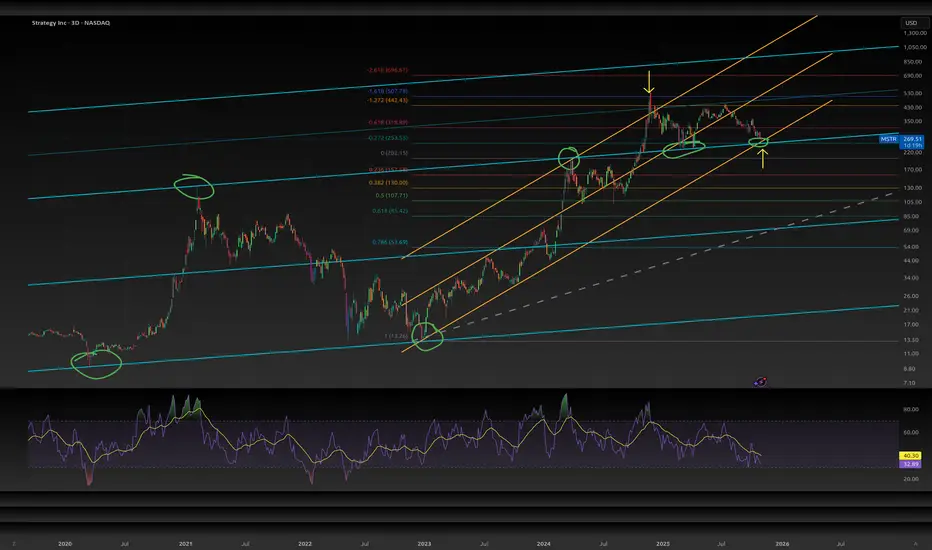
MSTR is on a point of significant confluenceMSTR is on a point of three major confluences. To lose this level would mean we are going much lower. However, I expect at least a significant bounce from here.
we have the blue channel that previously acted as resistance and recently turned into support.
we have the current orange channel
we have the -.272 fib level, after hitting the -1.618 Nov 2024
RSI also looks like a bottoming pattern, but that needs to play out some more to be confident.
I would not be surprised if we retest the underside of the -.618 around $315 in short order. If we lose this level, it could get really nasty to the downside.
Strategy Inc (MSTR) – High-Beta Bitcoin Proxy at Key SupportStrategy Inc NASDAQ:MSTR has delivered another strong quarterly report, underscoring its continued commitment to aggressive Bitcoin accumulation. With over 158,000 BTC on the books, MSTR has firmly positioned itself as a leveraged proxy for Bitcoin, offering equity traders indirect crypto exposure. This bold balance sheet strategy has also pushed MSTR into alignment with S&P 500 inclusion criteria — a potential catalyst if index inclusion materializes.
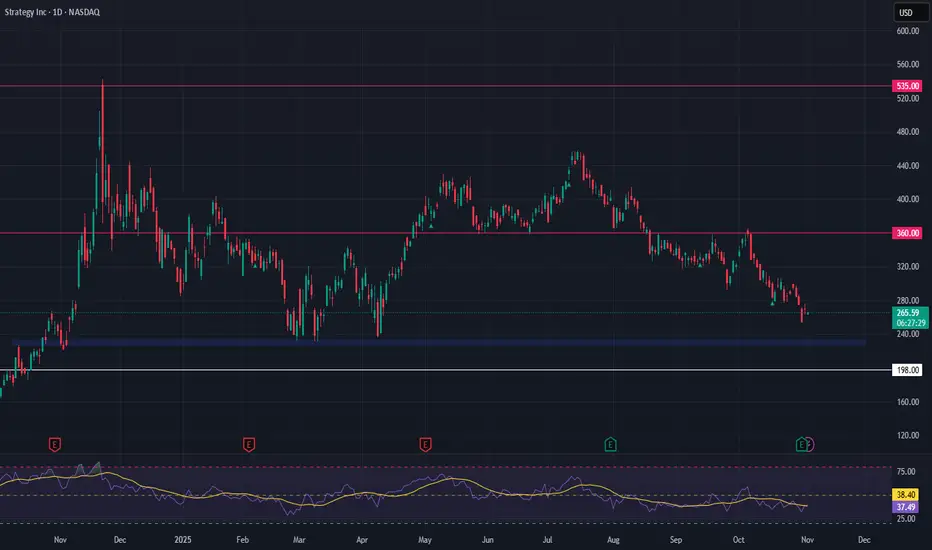
Technically, the stock is now retesting a key support zone between $228 and $233. This level has historically held well and may offer a high-conviction entry for those anticipating a BTC rebound. Should Bitcoin aim for new highs, MSTR could respond with outsized upside, though traders must account for the volatility and downside risks that come with crypto-correlated equities.
🎯 Trade Setup:
Entry Zone: $228 – $233
Take Profit Targets: $360 and $535
Stop Loss: $198
This setup offers a high-risk, high-reward opportunity. As always, manage position size carefully and watch BTC price action for confirmation.
S&P 500 Inclusion QuantSignals V3 Screener 2025-11-01S&P 500 Inclusion QuantSignals V3 Screener 2025-11-01
🎯 S&P 500 Inclusion QuantSignals V3 Screener - 2025-11-01
Elite AI-powered S&P 500 inclusion candidate scanner
---
📊 S&P 500 Inclusion Criteria
• Market Cap: $14B+ (current threshold)
• Profitability: 4+ consecutive profitable quarters
• Public Float: 50%+ of shares publicly traded
• Liquidity: Adequate trading volume
• Sector Balance: Committee considers sector weights
🔥 Top Inclusion Candidates
📈 NYSE:BRK.B - Inclusion Score: 53/100
Confidence: 60.0% | Risk: Medium
Market Cap: $47.8B | Profitable Qtrs: 4 | Float: 65%
Days to Rebalance: 60 | Price: $477.54
Key Factors:
• 💰 Well Above Threshold ($47.8B, +15.0 pts)
• ✅ Meets Profitability (4Q, +7.0 pts)
• 🌐 Good Public Float (65%, +6.0 pts)
• 💧 Good Liquidity (1.5M vol, +3.0 pts)
• 📊 Sector Balanced (+0.0%, +2.0 pts)
📈 NYSE:TSM - Inclusion Score: 47/100
Confidence: 60.0% | Risk: Medium
Market Cap: $30.0B | Profitable Qtrs: 4 | Float: 65%
Days to Rebalance: 60 | Price: $300.43
Key Factors:
• 💰 Well Above Threshold ($30.0B, +15.0 pts)
• ✅ Meets Profitability (4Q, +7.0 pts)
• 🌐 Good Public Float (65%, +6.0 pts)
• 💧 Good Liquidity (1.5M vol, +3.0 pts)
• 📊 Sector Balanced (+0.0%, +2.0 pts)
📈 NYSE:SPOT - Inclusion Score: 44/100
Confidence: 45.0% | Risk: Medium
Market Cap: $65.5B | Profitable Qtrs: 4 | Float: 65%
Days to Rebalance: 60 | Price: $655.32
Key Factors:
• 💰 Well Above Threshold ($65.5B, +15.0 pts)
• ✅ Meets Profitability (4Q, +7.0 pts)
• 🌐 Good Public Float (65%, +6.0 pts)
• 💧 Good Liquidity (1.5M vol, +3.0 pts)
• 📊 Sector Balanced (+0.0%, +2.0 pts)
📈 NYSE:BABA - Inclusion Score: 40/100
Confidence: 45.0% | Risk: Medium
Market Cap: $17.0B | Profitable Qtrs: 4 | Float: 65%
Days to Rebalance: 60 | Price: $170.43
Key Factors:
• 💵 Meets Threshold ($17.0B, +8.0 pts)
• ✅ Meets Profitability
Image
(4Q, +7.0 pts)
• 🌐 Good Public Float (65%, +6.0 pts)
• 💧 Good Liquidity (1.5M vol, +3.0 pts)
• 📊 Sector Balanced (+0.0%, +2.0 pts)
Conflicts:
• ⚠️ High volatility (53%)
📈 NASDAQ:MSTR - Inclusion Score: 30/100
Confidence: 45.0% | Risk: Medium
Market Cap: $27.0B | Profitable Qtrs: 4 | Float: 65%
Days to Rebalance: 60 | Price: $269.51
Key Factors:
• 💰 Strong Market Cap ($27.0B, +12.0 pts)
• ✅ Meets Profitability (4Q, +7.0 pts)
• 🌐 Good Public Float (65%, +6.0 pts)
• 💧 Good Liquidity (1.5M vol, +3.0 pts)
• 📊 Sector Balanced (+0.0%, +2.0 pts)
Conflicts:
• ⚠️ Weak price action (-30.8%)
• ⚠️ High volatility (56%)
• ⚠️ CONFLICT: Recent price collapse (-25.1%, -10 pts)
---
💡 S&P 500 Inclusion Impact
• Passive Inflows: $12-15T tracks S&P 500, forces systematic buying
• Average Pop: 5-8% on announcement day
• Sustained Premium: Inclusion often creates lasting demand
• Index Rebalancing: Quarterly reviews create windows of opportunity
⚠️ Risk Management
• Inclusion is not guaranteed - these are probabilistic candidates
• Committee decisions can be unpredictable
• Use proper position sizing (max 2-5% per position)
• Set stop losses 10-15% below entry
💡 Remember: Buy the rumor, sell the news. Consider taking profits post-announcement.
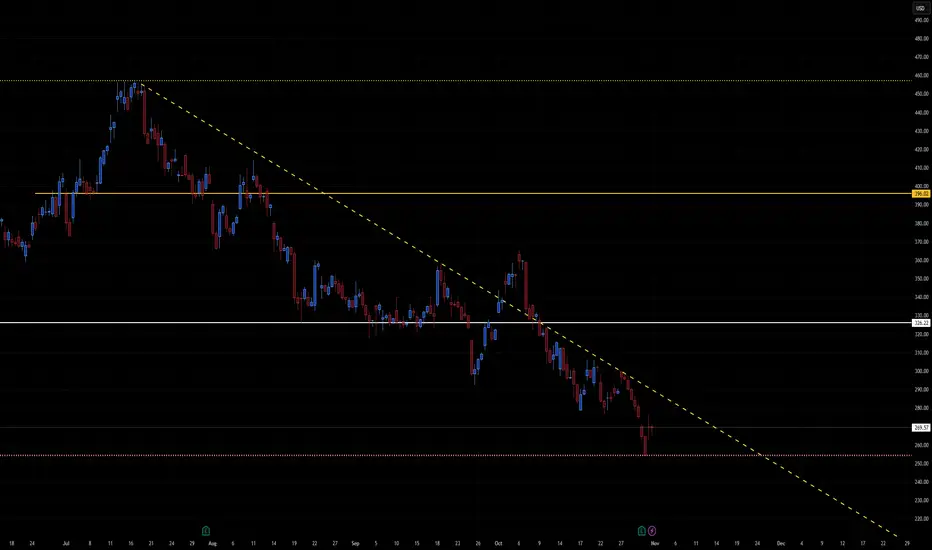
MSTR clear trendline well behaved chartA long-term descending trendline (yellow dashed line) acting as dynamic resistance since July highs.
Major horizontal support around 265 USD (recent low and yellow dotted line).
Resistance levels near 325 USD and 395–400 USD.
Overall pattern: extended downtrend with lower highs and lower lows, but price nearing a strong confluence zone (trendline + horizontal support).
This setup suggests MSTR is in a make-or-break area — either a short-term reversal bounce or continuation to new lows.
📈 Bullish Scenario
Setup:
Price has reached oversold levels near 265, aligning with historical support. A technical bounce is possible if Bitcoin stabilizes or rallies, given MSTR’s correlation.
Confirmation Triggers:
Close above 280–285 USD (short-term confirmation).
Break and close above descending trendline (~295–300).
Short-Term Targets:
325 USD — former support turned resistance.
395–400 USD — key horizontal level and top of prior range.
Bullish Catalysts:
Bitcoin recovery or strength toward $70K+.
Institutional or ETF-related flows benefiting BTC proxies.
Technical short-covering rally.
Invalidation:
Daily close below 260 USD with strong volume.
Probability: Moderate (~40%), as reversal setups often require confirmation after long downtrends.
📉 Bearish Scenario
Setup:
Price continues to respect descending resistance and fails to reclaim 285–295 zone, maintaining downward momentum.
Confirmation Triggers:
Breakdown below 265 USD support.
Expansion in sell volume below that level.
Short-Term Targets:
250–255 USD → minor horizontal level (recent pivot area).
230–235 USD → next structural support.
210–215 USD → measured move from current descending channel.
Bearish Catalysts:
Bitcoin correction below $65K.
Continued macro tightening or risk-off environment.
Market rejection of BTC-linked equities.
Invalidation:
Breakout above 300 USD with sustained buying pressure.
Probability: Slightly higher (~60%) as trend remains clearly bearish.
⚖️ Neutral / Accumulation View
If MSTR remains range-bound between 265 and 300, this indicates accumulation before next major move.
Expect choppy price action with short squeezes and weak rallies until a breakout direction emerges.
🧩 Summary Table
Bias Confirmation Target Zone Invalidation Notes
Bullish Close > 300 325 → 395 <260 Trendline breakout
Bearish Close < 265 250 → 230 >300 Trend continuation
Neutral Range 265–300 — — Sideways accumulation
🕒 2–3 Week Projection
Bullish path: Bounce from 265 → breakout above 300 → target 325–330 by mid-November.
Bearish path: Fail at 285–295 → breakdown below 265 → slide to 235 by mid/late November.
MSTR weekly bull divergence on low sentimentSentiment is low, the asset is hated and misunderstood by TradFi and retail. It’s a recipe for a bottom!
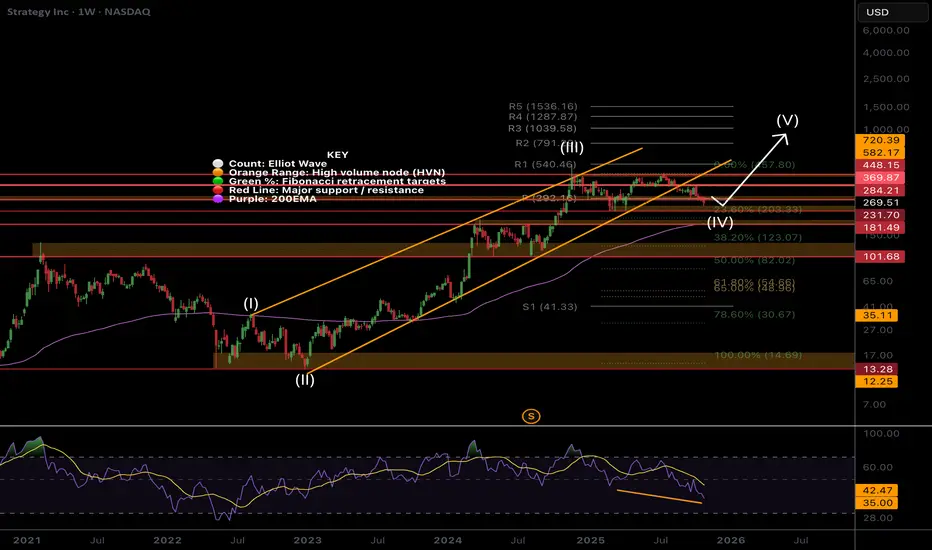
Price is still in a wave (IV) which are expected to be long and drawn out, driving investors into shallow capitulation through boredom into patient hands. I don’t expect wave (V) to kick in until Bitcoin moves. Wave (V) has an expected target of the R3 daily pivot at $1039 but will overextend if Bitcoin does.
Price has fallen out of the lower channel boundary and sitting below the weekly pivot, still above the weekly 200EMA so the outlook is bullish. Wave (4) may complete at the 0.236 Fibonacci retracement at $230. For now I am waiting to see what happens before entering. Good opportunities are setting up.
🎯 Terminal target for the business cycle could see prices as high as $1000 based on Fibonacci extensions
📈 Weekly RSI has bullish divergence
👉 Analysis is invalidated if we close back below $82