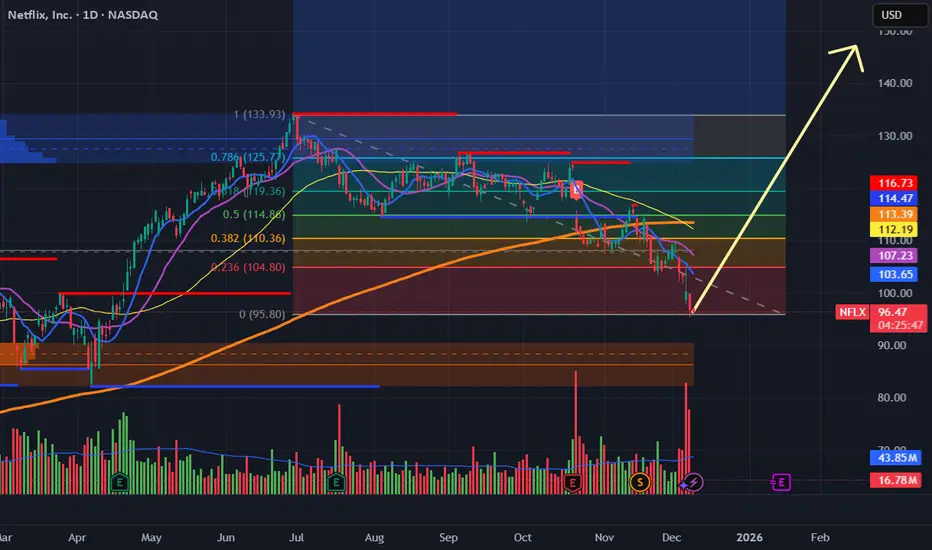
Netflix Paramount - Acquisition war - What You need to know. Netflix is selling off because it announced a massive, high‑risk acquisition of major Warner Bros. Discovery assets — and the market hates the price, the leverage, and the regulatory risk.
The bid is in the range of $72-$82 Billion.
Trump tweeted last night putting the deal under scrutiny.
This tweet comes on the back of Paramount Skydance announcing a hostile take over bid $108B of warner bros discovery. Trumps son in law Jared Kushner hold private equity in Para and would benefit from the takeover.
Netflix is sitting pretty as the stock has sold off in anticipation of higher cap ex. If the deal doesn't go through it will likely rebound.
Netflix wont have to pay the 5.8 Billion break up fee if WBD board votes down their deal. In fact Netflix will receive $2-$3 Billion.
Netflix, Inc. Shs ert Deposito Arg Repr 0.0208333 Sh
No trades
Trade ideas
NETFLIX ($NFLX): Key Technical Zone With Strong ConfluenceNETFLIX ( NASDAQ:NFLX ): Key Technical Zone With Strong Confluence
Netflix has retraced to a notable support area after reaching an all-time high on June 30th, 2025. The current structure suggests a potential continuation of the long-term bullish trend, supported by technical and fundamental developments.
Why This Zone Matters
The current price region aligns with multiple significant technical factors:
1. Ascending Trendline Support
This trendline originated in mid-October 2023 and has repeatedly acted as a strong support throughout the uptrend.
2. $100 Psychological Price Level
Round numbers often serve as key decision zones for market participants, influencing order flow and trader sentiment.
3. Fibonacci 61.8% Retracement Zone
This level aligns closely with the trendline and psychological level, adding strength to the support.
4. Multi-Factor Confluence
The combination of the trendline, Fibonacci level, and psychological support creates a high-value technical confluence area, often associated with trend continuation or major reversals.
Market Catalyst
Recent reports of Netflix acquiring Warner Bros. Discovery add a potential fundamental driver supporting bullish momentum.
Trade Plan
Entry $100
Take Profit 1 $126
Take Profit 2 $133
Stop Loss $92
Risk-to-Reward (TP1) 1:3.3
Risk-to-Reward (TP2) 1:4
This trade plan is based on the TA that price respects the current support confluence and resumes upward momentum.
Trade with care. Please like, share your thoughts, and kindly follow me.
Netflix Buys Warner Bros in Historic $82.7B TakeoverNetflix’s $82.7B Warner Bros Discovery Takeover Signals a Historic Power Shift in Hollywood
Netflix (NASDAQ: NFLX) has officially struck a landmark deal to acquire the film and streaming divisions of Warner Bros. Discovery (WBD) in a transaction valued at $82.7 billion, including debt — the biggest entertainment acquisition in modern history. The deal, approved unanimously by both boards, will hand Netflix ownership of HBO, Warner Bros studios, HBO Max’s extensive library, and key franchises like Harry Potter, Game of Thrones, and DC. The agreement excludes cable channels such as CNN and TNT, which WBD will spin off into a separate entity called Discovery Global before the sale is completed.
Netflix co-CEO Ted Sarandos emphasized that the merger is a “rare opportunity” to reshape content dominance for decades, projecting $2–$3 billion in synergies through operational efficiencies. HBO’s premium brand will remain intact, although Netflix hinted at future integration strategies. Meanwhile, Warner Bros executives noted that joining forces with Netflix ensures the industry’s most compelling storytelling remains globally accessible.
However, the acquisition is expected to face significant regulatory scrutiny. Analysts warn the merger could reduce industry-wide film and TV output, pressure cinemas, and eventually raise subscription costs for consumers. Despite these concerns, Netflix remains confident the deal will clear regulatory hurdles within 18 months.
Technical Outlook
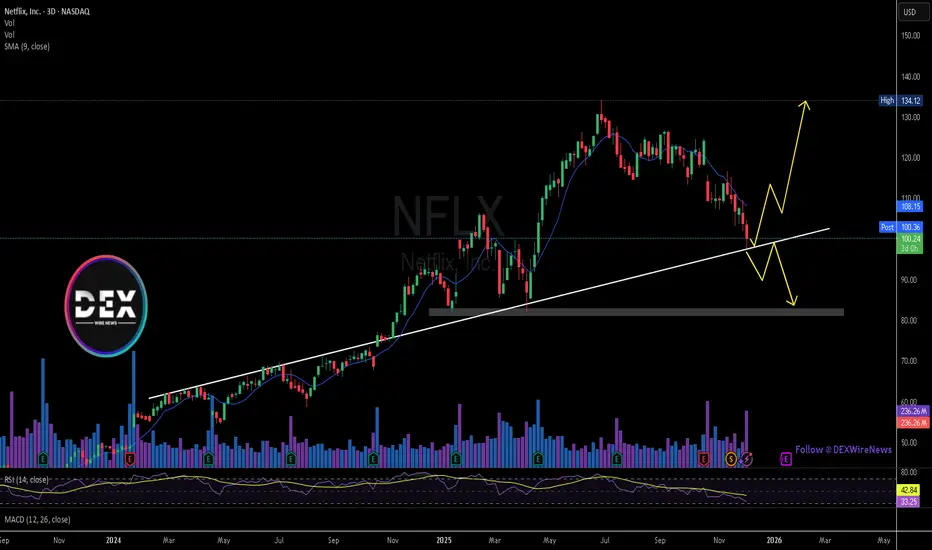
NETFLIX is currently trading near $100, sitting directly on a long-term ascending trendline that has acted as a major support for over a year. Price has retraced sharply from the $134 high and is now testing this structural trendline along with the 9-SMA overhead. Two key scenarios emerge:
• Bullish case: A bounce from $100–$103 could trigger a recovery back toward $120–$134, resuming the broader uptrend.
• Bearish case: A clean break below the trendline opens a drop toward the $82–$88 demand zone, where heavy accumulation previously formed.
RSI remains weak, suggesting momentum favors sellers until a strong reversal candle forms.
NFLX: Flag Forming as Market Awaits Clarity on Warner Bros DealNetflix has broken into a wider flag structure as the market digests the recent announcement of its planned acquisition of Warner Bros. Discovery. The initial move lower reflects uncertainty rather than a judgment on long-term value — which is exactly what you typically see in the early stages of large M&A.
For now, we’re waiting for regulatory clarity.
Until there’s a credible signal that the deal is likely to be approved, the market will continue to price in an uncertainty discount.
If regulators turn less hostile, the next key stage is financing clarity.
This is where Netflix will need to show:
how the transaction will be funded (debt vs. equity split),
the impact on leverage and credit profile,
the expected paydown path,
how the combined entity affects forward margins and cash flow.
Once the market understands the financing structure, the major unknowns disappear — and that’s typically when investors begin front-running the upside of the deal.
We could then see a rerating back toward major levels such as $124, and potentially even a retest of the previous all-time highs near $133, if the narrative shifts from “uncertainty” to “strategic value creation.”
For now, the flag is setting up — but confirmation will only come once those fundamental catalysts begin to de-risk.
NETFLIX - Bottom is in?NASDAQ:NFLX
The bottom looks close based on this weekly chart.
- Deeply oversold RSI
- Bounced off the POC in anchored volume profile
- W%R deeply oversold and starting to curl up
Overall, the acquisition of WBD is expensive, but Netflix is playing the long game.
This provides content as far as the eye can see with the addition of DC, GoT series, and more.
Overall it's a blockbuster, but I feel NFLX reaching a $1T market cap is inevitable... currently sitting sub $500B.
Netflix to Acquire Warner Bros: Effect on NFLX SharesNetflix to Acquire Warner Bros: Effect on NFLX Shares
A major development in the stock market is the news that Netflix is buying the assets of Warner Bros. Discovery for $82.7 billion. How might this influence the price of NFLX shares?
To assess the outlook, context is essential.
In the second half of October, a bearish gap appeared on the NFLX chart following a disappointing earnings report. On 24 October, we noted that the price might find support near the lower boundary of the established trend channel. Indeed, the price staged a modest recovery (as shown by arrow 1), but the upper edge of the gap acted as resistance.
In mid-November, Netflix (NFLX) carried out a stock split – traditionally viewed as a bullish signal for retail investors. Splits typically make shares more affordable and often lift prices on expectations of fresh liquidity. However, the share price moved lower instead (as indicated by arrow 2).
As a result:
→ the ascending channel was extended downwards, giving greater prominence to the downward trajectory (marked in red);
→ Netflix shares continued to underperform the broader equity market.
Against this backdrop, the mega-deal to acquire Warner Bros. may raise serious concerns for NFLX shareholders:
→ Dilution effect. To finance the deal, Netflix will issue new shares, which dilutes earnings per share (EPS). Existing shareholders effectively receive a smaller portion of the company’s profits.
→ Financial strain. The vast cost of the acquisition worsens Netflix’s financial metrics, increases debt-servicing expenses, and reduces the overall attractiveness of NFLX shares.
→ Regulatory scrutiny. A Netflix–Warner Bros. merger creates a giant controlling nearly half of the streaming market. President Trump has already suggested it could raise antitrust issues.
Given the above, it is reasonable to assume that rising risks and uncertainty may continue to weigh on Netflix shares – and although the psychological $100 level may act as support, traders should not rule out the possibility that NFLX will continue to move within the downward channel.
This article represents the opinion of the Companies operating under the FXOpen brand only. It is not to be construed as an offer, solicitation, or recommendation with respect to products and services provided by the Companies operating under the FXOpen brand, nor is it to be considered financial advice.
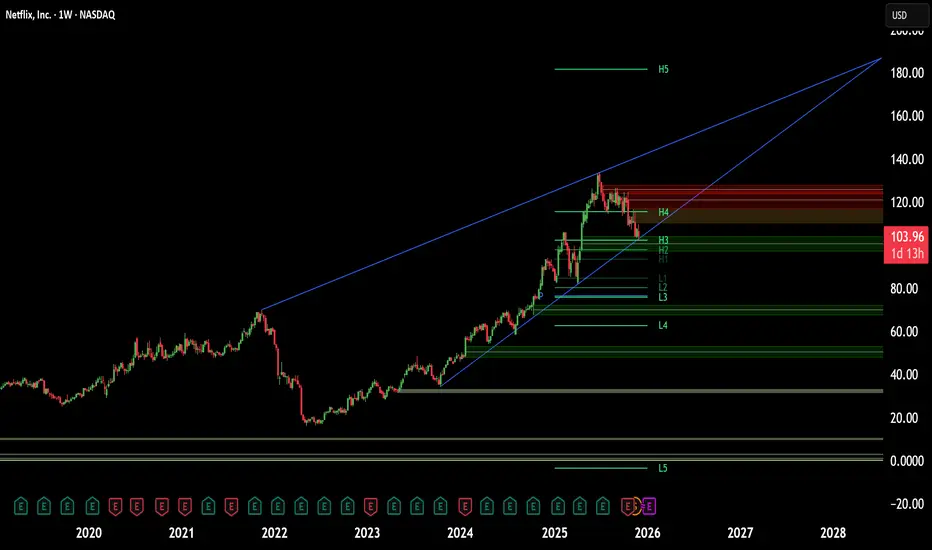
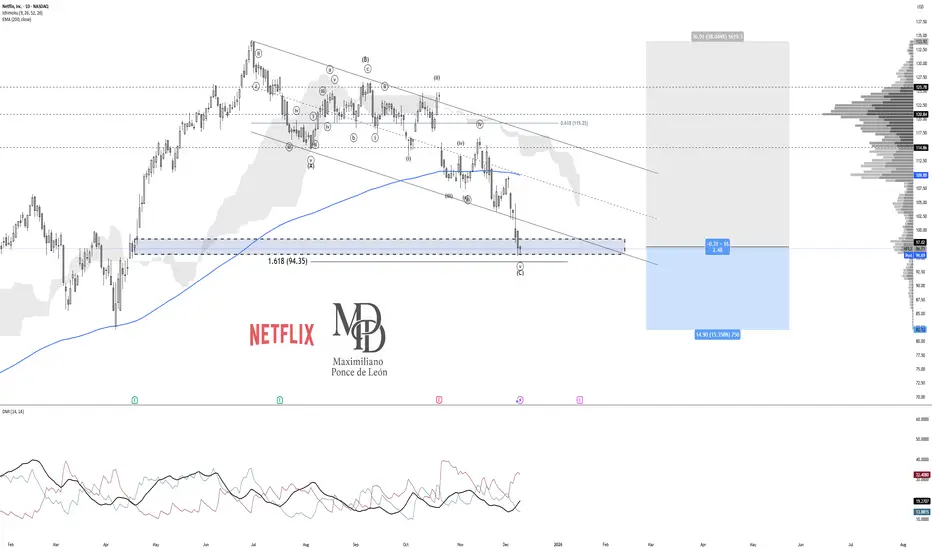
Eyes on NetflixAt the moment NASDAQ:NFLX , it is completing an ABC corrective pattern and has already tested and respected the major historical blue support line. Wave C is unfolding within a falling wedge, a structure that more often than not resolves to the upside and is typically bullish.
If the wedge breaks upward as expected, the stock should begin its move toward the upper trendline of the broader channel. Once price reaches that level, we will evaluate whether to take profits at resistance or anticipate a breakout above the channel, which would indicate a much larger bullish continuation.
Netflix’s $70B Bid: The End of the Streaming Wars?Netflix (NASDAQ: NFLX) is rewriting the global media playbook. The streaming titan has submitted a binding, predominantly cash offer to acquire Warner Bros. Discovery (NASDAQ: WBD). This $70 billion maneuver marks a definitive pivot from disruptive builder to dominant consolidator. Management now signals that securing the next decade of dominance requires buying the industry’s most established moats.
Macroeconomics: The Power of Cash
Financial maturity drives this aggressive acquisition strategy. In a high-interest-rate environment, cash offers reign supreme. Netflix utilizes its fortress balance sheet to outmaneuver the rival Paramount Skydance consortium. While competitors propose complex stock swaps, Netflix offers WBD shareholders immediate liquidity and a defined exit price. With a projected Free Cash Flow of $9 billion for 2025, the company can service the necessary bridge loans without jeopardizing operations.
Geostrategy: The Regulatory Battlefield
The acquisition’s greatest threat lies in Washington, not Wall Street. White House officials have flagged concerns regarding media consolidation. However, Netflix utilizes a sophisticated geostrategic argument. The company contends it competes against trillion-dollar ecosystems like Apple and Amazon, not just legacy studios. By framing the merger as essential for surviving against Big Tech, Netflix aims to navigate the Department of Justice’s antitrust maze.
Industry Trends: Buying Cultural Infrastructure
Netflix is purchasing history, not just content. The deal secures the DC Universe, Harry Potter, and the historic Warner Bros. Studio lot. These assets represent "cultural infrastructure" that original production spend cannot replicate. Data from WBD’s Q3 2025 earnings confirms the value here: theatrical revenue surged 74% driven by franchise hits. This allows Netflix to diversify revenue streams into box office and merchandising at an unprecedented scale.
Technology & Cyber: The Traffic Signal
Platform stability remains a key indicator of consumer demand. The recent premiere of *Stranger Things* Season 5 crashed the platform, causing widespread outages. While technically a failure, Wall Street interprets this cyber-stress test as a bullish signal. It proves organic engagement is explosive. Integrating WBD’s library into this high-traffic ecosystem leverages Netflix’s proprietary delivery architecture to maximize viewership of dormant assets.
Management & Leadership: The Strategic Pivot
Netflix leadership is executing a calculated evolution. For 15 years, the strategy focused on building IP from scratch. Now, the C-suite recognizes that acquiring established franchises is the fastest route to a defensible moat. This assertiveness reflects confidence. With a market cap of roughly $460 billion, they are acquiring WBD because they can, not because they must to survive.
Data Science & Innovation: The Algorithmic Multiplier
The true value unlocked lies in data science. Netflix’s proprietary recommendation algorithms will likely revitalize WBD’s deep library. Merging WBD’s content with Netflix’s user data creates a powerful feedback loop. This "algorithmic multiplier" ensures that back-catalog titles achieve higher engagement on Netflix than they ever could on standalone platforms. This technological synergy justifies the premium paid for the assets.
Conclusion: A New Media Era
Netflix is positioning itself to own the entire entertainment ecosystem. The deal eliminates a key competitor and secures irrefutable IP dominance. While the $109 stock price held firm, the long-term thesis has shifted. Netflix is no longer just a tech platform; it is becoming the definitive media empire of the 21st century.
Netflix: Long-Term Buy Zone in Focus Netflix shares have recently turned lower, moving towards our previously identified long-term entry zone between $96.27 and $75.19. Within this range, we expect the low of the turquoise wave 4 to form, setting the stage for the ongoing upward impulse in wave 5 to push past resistance at $134.11. In a new alternative scenario, there is a 30% probability that the beige wave alt.IV could establish a lower low below $81.27, though it would still remain within the long-term entry zone
$NLFX Dead Cat Bounce NASDAQ:NFLX looks like a Dead cat 😿 📉 bounce on the 15 min TF.
Price is currently at the .382; Which is the 1st retest area. The .0618 is the golden retracement and the .786 is the absolute discount however price must resist this level and go in the opposite direction. Target Price 101.32. And the rest of the levels is that Put in the bagggg money. As soon as I see price start stalling or a wick forming in these retest areas; I enter. I'm either Right or Righhhhhhhh.
Alerts Set, Happy Trading!
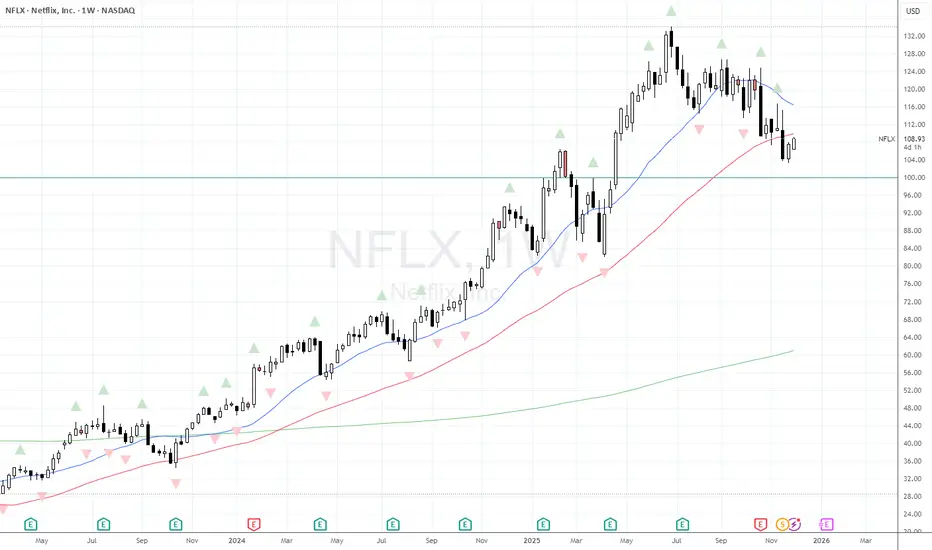
Next move for $NFLX down to $100?#NFLX had a great run until the summer of 2025 but has struggled since then. I'm sure there's many reasons for that - the concerns about the Warner Bros acquisition will undoubtedly be one of them. However from a technical standpoint the price has continued to make lower lows as it retreated from $132.
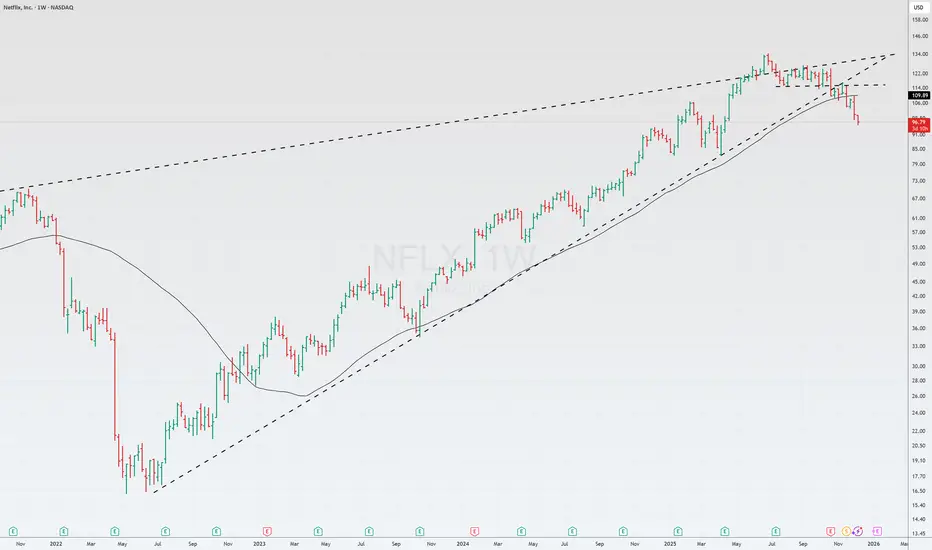
We know find ourself closing last week beneath the Weekly 50MA, which it hasn't done for approx 2 years. Is this an area for a bounce? There's been lots of positive news about the release of the final series of Stranger Things (I haven't watched it - but then I don't need to as I have a 14 year old niece who loves it, and insists on giving the family a complete run down of the show!)
Personally I would want to see price rally back into the area of the 20 & 50 Weekly MA's before rolling over and then moving lower to $100 - which could be a stronger level of support, and a real inflection point where price looks to make a decision.
Weekly Trend NFLXAfter a long upward move, the weekly chart is now showing a clear Head & Shoulders pattern. Price has broken below the neckline, which usually signals a trend change. The next major support is around the 60–62 zone. For now, the market bias remains bearish unless price moves back above the neckline.
$NFLX - Netflix Buys Warner Bros. Netflix is fresh off a Stock Split and recently purchased Warner Bros. for $82.7 Billion. I still think this stock is currently overvalued compared to its intrinsic value, but off a pure technical analysis play, this could be a nice spot for a move up if it stays in the channel and bounces off the Fib Golden zone.
Disclaimer:
I do not provide personal investment advice and I am not a qualified licensed investment advisor. I am an amateur investor.
All information found here, including any ideas, opinions, views, predictions, forecasts, commentaries, suggestions, or stock picks, expressed or implied herein, are for informational, entertainment or educational purposes only and should not be construed as personal investment advice. While the information provided is believed to be accurate, it may include errors or inaccuracies. I will not and cannot be held liable for any actions you take as a result of anything you read here.
Conduct your own due diligence, or consult a licensed financial advisor or broker before making any and all investment decisions. Any investments, trades, speculations, or decisions made on the basis of any information found on here, expressed or implied herein, are committed at your own risk, financial or otherwise.
Feel free to give us a follow and shoot us a like for more analysis updates
Netflix added to long account Finally an opportunity to get Netflix for my long term account. I have been working at diversifying away from mag 7 over time. I happily locked in some uber profits to add Netflix, I still hold uber. We are right at the golden pocket which is my favorite strategy for long term buys on high momentum stocks. I believe this Warner brothers acquisition would be a massive addition to their cash flows.
NFLX - time to pick a direction?I love a swing trade, so I've been watching NFLX drop and looking for an entry. And I think maybe it's time for an entry.
1. We're at a lower trendline which has been in tact for over a year, which seems bullish,
2. but, there's a volume gap exactly where the price action is right now.
3. HOWEVER, that old peak/resistance from February is also acting as a nice level of support.
4. but, I hate when there's a widening wedge pattern, it shows that momentum is building in the swings.
5. I also don't love that the RSI is still trending downward on the 1day chart.
6. but, it does seem to be turning around.
I don't want to straight up buy here because I am not confident that we won't break that trendline and at least go flat for a while.
So this looks like an options play. I'm going to write (sell) puts, and hopefully play off the idea that it will consolidate here and at least not drop below that volume gap.
The reason I like to sell puts is because I see them as good entry points. If the stock price goes up or consolidates, you profit. If the put hits, you buy the stock somewhere you'd probably have been interested in buying anyways. My #1 rule for selling puts: only sell puts on companies that you'd be happy to own - and become a long term investor.
I generally write puts 1 week ahead, and if the price consolidates, I just keep rolling. The entry I like for NFLX is 98-100. So when the market opens, I'll check the premium prices. If they seem good, I'll open my position.
NFLX LongBroader Market Structure
NFLX has been in a clean and persistent downtrend, making a sequence of lower highs and lower lows from November 18 onward. The latest BOS at 103.32 confirms that bearish momentum was still in control before the recent bounce. The first sign of potential structural change is the CHoCH at 111.08, where price broke a prior swing high after a long decline. This CHoCH signals weakening bearish pressure and opens the door for a short-term bullish correction, though the dominant higher-timeframe trend is still down.
Supply & Demand Zones
The upper supply zone between 109–111 is a strong distribution area because price previously dropped sharply from this level with clear displacement, showing sellers acted decisively. Above that, the deeper supply zone around 112.50–114.00 also reflects strong institutional selling, as that’s where the last major downward leg originated. The demand zone at 103.50–104.50 is showing reasonable strength—buyers stepped in aggressively here, forming a wick rejection and driving price up into the CHoCH. This zone is currently serving as the main base for bullish attempts.
Price Action Within Your Marked Region
Price recently tapped into demand at 103.5–104.5 and bounced, then stalled just under minor intraday supply around 106.00–107.00. Price is now pulling back again, suggesting a retest of the same demand zone is likely before any sustained move upward. If buyers defend this zone once more, the structure supports a move toward the lower supply at 109–111. However, if the demand at 103.5 breaks cleanly, the bullish scenario collapses and the downtrend resumes.
Trade Bias, Expected Direction & Invalidation
The current bias is short-term bullish as long as price stays above the 103.30 invalidation level. Expected direction is a dip into demand followed by a bounce targeting the 109–111 supply zone. A clean break below 103.30 would invalidate the bullish structure and suggest continuation lower toward the psychological 100 level.
Momentum & Candle Behavior
Momentum is shifting toward buyers—recent candles show strong upward displacement and shallow pullbacks, which is typical behavior when demand is gaining control. However, sellers are still reacting at nearby intraday supply, so the bounce will likely be staggered. No major reversal candles appear at supply yet, which keeps the bullish correction scenario valid for now.
NFLX Is Falling Into a Critical Zone — Rebound or Breakdown?Netflix is trading inside a descending channel, and the price has just touched the lower boundary, which is typically a zone of strong reaction—either a bullish reversal or a continuation breakdown.
The current price is around $104–105.
Bullish Scenario
If the lower channel holds and bullish candles form, a rebound toward the upper channel is likely.
Bullish Targets:
• Target 1: $112 (50-day SMA)
• Target 2: $118
• Target 3: $125 (top of the channel)
Bearish Scenario
If the price loses the $103–104 support, the downtrend may accelerate.
Bearish Targets:
• Target 1: $98
• Target 2: $92
• Target 3: $79 (major long-term support)
Stop Loss
• For long positions: Below $103
• For short positions: Above $112
NFLX📌 A real-life series has developed around the TV series production company.
December 5, 2025: Netflix formally agreed to acquire WBD's studio business and streaming service HBO Max for $82.7 billion (or $27.75 per WBD share). The deal is expected to close in the third quarter of 2026, pending regulatory approval.
December 8, 2025: Paramount Skydance made a hostile counteroffer directly to WBD shareholders. They want to buy the entire company, including cable channels (CNN, TNT Sports), for $108.4 billion ($30 per share).
This is $25-18 billion more than Netflix's offer.
Institutions Impact Stability1. Understanding Institutions and Stability
Institutions are not just buildings or government departments. They include formal systems like courts, central banks, legislatures, regulators, and law-enforcement bodies, as well as informal norms such as cultural values, social trust, and community expectations. Stability, on the other hand, means a condition where economic, political, and social systems operate smoothly without frequent shocks, conflicts, or disruptions.
Strong institutions create stability by:
Providing predictability
Reducing risk and uncertainty
Encouraging investment and innovation
Maintaining law and order
Ensuring fairness and accountability
Preventing fraud, corruption, and exploitation
Weak institutions produce the opposite: uncertainty, volatility, corruption, inequality, and conflict.
2. Political Institutions: The Foundation of Governance Stability
Political institutions include governments, parliaments, electoral systems, and administrative bodies. They shape how power is gained, exercised, and transferred.
Key Impacts on Stability:
a) Predictable Governance and Rule of Law
A stable political system enforces rules consistently. When laws apply equally to all—citizens, businesses, and politicians—confidence increases. Investors step forward, businesses expand, and citizens feel secure.
But when laws are arbitrary or frequently changed, societies experience unrest and economic stagnation.
b) Peaceful Power Transitions
Countries with strong electoral systems manage leadership changes smoothly. This reduces political shocks, coups, and civil unrest. Conversely, weak democratic mechanisms fuel instability, protests, and violence.
c) Reduced Corruption
Institutions like anti-corruption bureaus, independent media, and transparency laws help suppress misuse of power. Corruption erodes trust and creates social anger, which disrupts stability.
d) Effective Public Administration
Efficient bureaucracies ensure services like healthcare, education, infrastructure, and welfare programs reach people. When governments fail to deliver basic services, societies become vulnerable to crises and radicalization.
3. Economic Institutions: Ensuring Market Stability
Economic stability depends heavily on institutions like property rights frameworks, competition authorities, labour laws, taxation systems, and regulatory bodies.
a) Protection of Property Rights
When individuals and businesses are confident that their property, capital, and intellectual work will not be illegally taken or misused, they invest more. Secure property rights reduce uncertainty and support entrepreneurship.
b) Stable Regulatory Framework
Clear and consistent economic regulations prevent market manipulation and monopolistic practices. This protects consumers and ensures healthy competition, reducing economic volatility.
c) Sound Fiscal Policies
Institutions responsible for government budgeting and taxation maintain stability by controlling deficits, managing public debt, and preventing financial shocks. Mismanaged fiscal systems often lead to inflation, defaults, and economic collapse.
d) Labour and Employment Systems
Labour institutions—trade unions, employment laws, social security systems—balance the relationship between employers and workers. They protect workers from exploitation and ensure businesses retain flexibility.
4. Financial Institutions: Anchors of Economic and Market Stability
Financial institutions are the nerve centers of modern economies. They include central banks, commercial banks, securities markets, insurance regulators, and investment funds.
a) Central Banks: Guardians of Monetary Stability
A credible central bank ensures currency stability, controls inflation, and responds to financial crises. Predictable monetary policy boosts investor confidence and reduces economic shocks.
Weak central banks, on the other hand, create hyperinflation, currency collapse, and market panic.
b) Banking System Stability
Robust banking institutions maintain trust in the financial system. Strict regulations, risk-management standards, and deposit insurance prevent bank runs and protect savings.
c) Strong Capital Markets
Stock exchanges, bond markets, and mutual fund systems create liquidity and investment opportunities. Market regulators like SEBI, SEC, or FCA ensure transparency and prevent fraud, insider trading, and market manipulation—all essential for market stability.
d) Crisis-Management Institutions
Institutions such as financial-stability boards and resolution authorities help prevent systemic failures. They step in to support failing banks, restructure debt, and maintain market confidence during crises.
5. Legal Institutions: Protecting Rights and Ensuring Justice
The judiciary, law-enforcement agencies, arbitration systems, and dispute-resolution bodies form the core of legal institutions.
a) Contract Enforcement
A fair and efficient legal system enforces contracts reliably. Businesses operate smoothly when disputes are resolved quickly and justly, reducing uncertainty and transaction costs.
b) Human Rights Protection
Courts and constitutional bodies protect basic freedoms and prevent discrimination. A society with strong legal safeguards enjoys social stability because citizens feel protected from injustice.
c) Crime Control
Effective policing and law enforcement reduce crime, violence, and disorder. When legal institutions fail, societies experience insecurity, vigilantism, and social collapse.
6. Social Institutions: Strengthening Community and Cultural Stability
Social institutions include families, schools, religious organizations, community groups, media, and cultural norms.
a) Social Trust and Cohesion
Communities with high trust levels experience less crime, fewer conflicts, and stronger cooperation. Trust creates resilience during economic or political crises.
b) Education Systems
Educational institutions develop skilled individuals, reduce inequality, and support social mobility. A well-educated population is more productive and less vulnerable to manipulation or extremist ideologies.
c) Media and Information Institutions
Independent media promotes transparency, accountability, and informed citizenship. It exposes corruption and supports democratic stability. On the other hand, biased or captured media can spread misinformation, increasing polarization and instability.
7. Global Institutions and International Stability
Institutions like the IMF, World Bank, WTO, UN, and regional alliances promote global stability.
a) Financial Aid and Crisis Support
The IMF stabilizes currencies and helps countries overcome debt crises. The World Bank funds development, reducing poverty-related instability.
b) Trade Peace
WTO resolves trade disputes and ensures smooth global trade. Without such frameworks, global markets would face frequent conflicts and disruptions.
c) Peacekeeping Efforts
The UN and regional bodies prevent wars, mediate negotiations, and send peacekeeping forces to stabilize conflict zones.
These international institutions reduce systemic risk, promote cooperation, and maintain global economic and political stability.
8. How Institutional Weakness Leads to Instability
Weak or corrupt institutions cause:
High levels of corruption
Political turmoil
Currency devaluation
Investor flight
Poor economic growth
Civil unrest and riots
Social divisions and crime
Market collapses
Inefficient public services
Countries with weak institutions often experience recurring crises, regardless of their natural wealth or population size.
9. Conclusion: Institutions Are the Engines of Stability
Stability is not simply a product of strong leadership or economic growth; it is the result of robust, transparent, and accountable institutions that create order, protect rights, enforce laws, and support economic activity. From central banks to courts, from parliaments to schools, institutions shape the stability of nations.
Strong institutions create a cycle of:
Trust → Investment → Growth → Stability → Prosperity
Weak institutions generate the opposite:
Uncertainty → Corruption → Conflict → Instability → Decline
Therefore, the strength, credibility, and effectiveness of institutions are the single most important determinants of long-term stability in any society or economy.