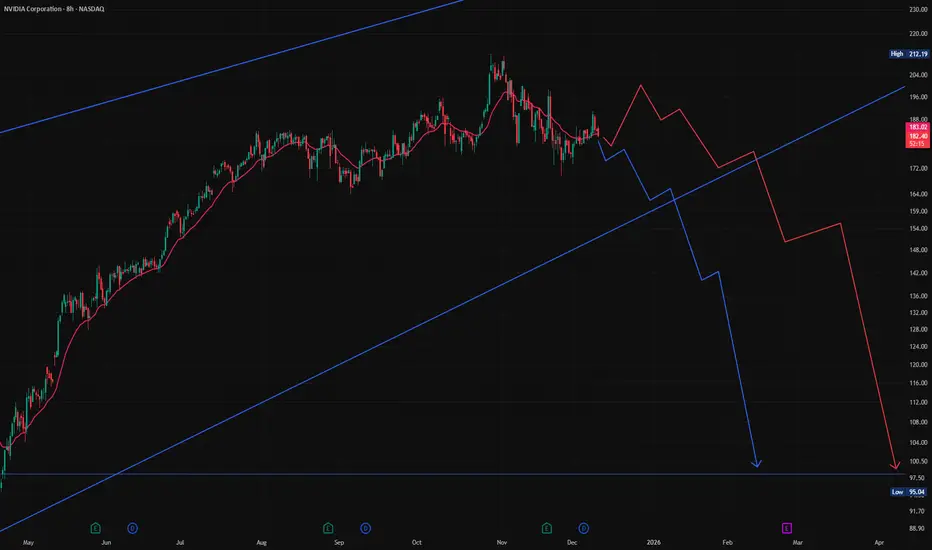
Nvidia - This is all still expected!🥊Nvidia ( NASDAQ:NVDA ) is heading for another -20%:
🔎Analysis summary:
Just last month, Nvidia created a massive bearish engulfing candle. This clearly shows that buyers are not willing to accept higher prices. Together with the retest of the major resistance trendline, Nvidia is heading lower. The next support will come at about -20%.
📝Levels to watch:
$150
SwingTraderPhil
SwingTrading.Simplified. | Investing.Simplified. | #LONGTERMVISION
NVIDIA Corporation Shs Cert Deposito Arg Repr 0.04166667 Sh
No trades
Market insights
NVDA Dec 12 Market Structure and Options. Driven Levels
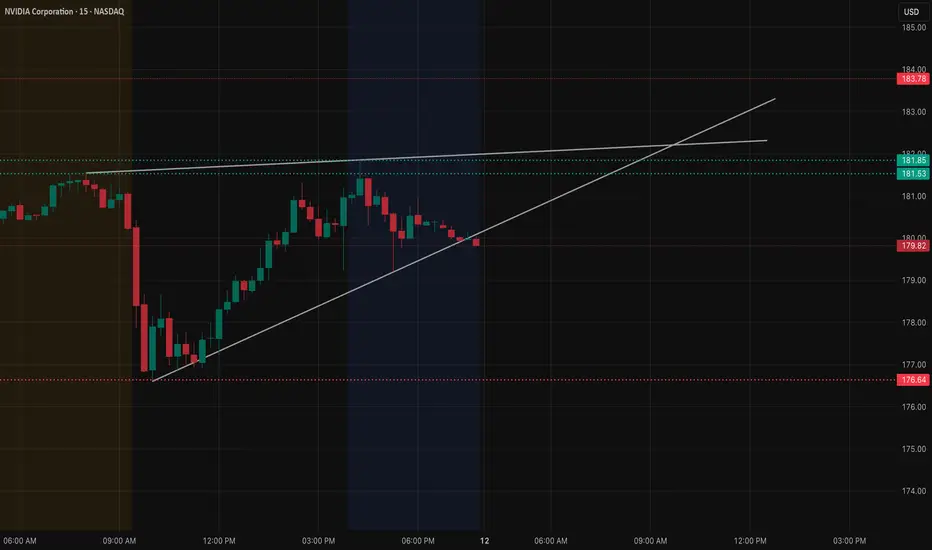
NVDA 15-Min Market Structure
NVDA has been riding a steady intraday trendline from the morning rebound, but the most recent candles show price slipping underneath that trendline. This shift tells us momentum is slowing, and the market is waiting for a key directional trigger.
Above price, the intraday resistance band near 181.50–182 has rejected multiple times. Until NVDA can claim and hold above that zone, the chart leans neutral-to-slightly-heavy.
Below current levels, the lower trendline (local rising support) interacts with 179.50–180 — a zone that has already acted as a short-term pivot. If this area breaks cleanly, a deeper correction becomes more likely.
Now Look at How Options Positioning (GEX) below That Aligns With the Chart:
Looking at the options landscape, NVDA shows concentrated call-side resistance stacked from 182.5 up toward 187.5–190. These levels often behave like “upper gravity zones” — price may approach them, but if call positioning is dense, dealers tend to hedge in a way that suppresses sharp upside.
This aligns well with the technical rejection seen around 181.50–182. The market had multiple chances to break through but failed, confirming that supply is reinforced by options positioning.
On the downside, the negative GEX region around 177–175 marks where put positioning thickens. These zones often act as stabilization areas during pullbacks because dealer hedging can slow the decline as price approaches them.
This creates a very clean structure:
* Resistance and upside hesitation: 181.5 → 182.5 → 187.5
* Neutral zone: 180–179.5
* Downside absorption: 177 → 175
Technically and options-wise, NVDA sits in a narrow decision range. Breakout above 182.5 could open room toward 185 and possibly 187.5 if momentum builds. Break below 179.5 puts 177 and 175 into play.
Directional Thoughts for Dec 12
* Bullish Case:
NVDA must break above 181.5–182.5 and hold. If achieved, the next push could target 185, with an extension toward 187.5 where another cluster of call resistance sits.
* Bearish Case:
A clean breakdown under 179.5 shifts momentum firmly downward. In that scenario, price may gravitate toward 177 first, then 175 where options positioning suggests downside may slow.
Why This Setup Is Interesting
NVDA’s chart is not moving on pure price action alone — the intraday reactions line up almost perfectly with the major GEX concentrations. When technical structure and options-based levels reinforce each other, markets often behave more predictably because both chart traders and hedging flows are interacting at the same spots.
This makes NVDA one of the cleaner names to watch on Dec 12.
Disclaimer
This analysis is for educational purposes only and does not constitute financial advice. Always perform your own research and manage risk according to your individual trading plan.
NVDA Sitting on a Decision Zone – Dec. 15 Could Be ExplosiveNVDA doesn’t look healthy right now. The structure has already rolled over, and what we’re seeing now feels more like damage control, not buyers stepping in with confidence.
After the breakdown from the prior range, price tried to bounce, but every push higher has been weak and quickly sold. That tells me sellers are still active, and buyers are mostly reactive.
Right now, NVDA is hovering around the 175 area, which is acting like a temporary pause. It’s holding for now, but it doesn’t feel like a strong base — more like the market catching its breath.
Levels that matter
The first level I care about is 175.
That’s where price is trying to stabilize. If NVDA loses this area, the downside opens up fast.
Below 175, I’m watching 172–170. That zone lines up with prior support and liquidity from earlier moves. If price gets there, I’d expect some reaction, but if it doesn’t hold, things can accelerate lower quickly.
On the upside, 178–180 is the first real resistance. This area has rejected price multiple times already. If NVDA can’t reclaim and hold above it, upside moves are likely just short-lived bounces.
Above that, 183–185 is the bigger test. That’s where the previous structure really broke down, and sellers are likely waiting again.
Let check GEX options positioning to see if it fits the picture
Options positioning lines up with the weakness on the chart.
There’s strong PUT interest below, which explains why price is pausing instead of free-falling. But overhead, CALL resistance is stacked, especially above 180, which makes sustained upside harder.
That’s why downside moves feel sharper, and upside moves feel slow and heavy.
How I’m approaching NVDA
As long as NVDA stays below 180, I’m cautious leaning long. That level needs to be reclaimed and held for the chart to start improving.
If price loses 175, I’d expect momentum to pick up toward 172–170.
For me:
* Below 175 → downside continuation risk
* Between 175–180 → chop and traps
* Above 180 with acceptance → relief rally attempt
Until proven otherwise, this still looks like bearish consolidation, not a reversal.
This analysis is for educational purposes only and does not constitute financial advice.
Early Call for NVDA: Overheated ChipsEarly Call for NVDA: Overheated Chips
Hello traders! 👋
I am kicking off a very personal, long-term series of posts today. For the first time, I am revealing the charts that truly guide my market vision, the deep-dive long-term analysis.
I usually share my tactics and daily patterns that are simpler to follow, but the reality is that there is a larger strategy behind the scenes that I haven't shown until today.
I am sharing this because it might help you prepare for a scenario I don't like . The first stock in this new series is NASDAQ:NVDA .
And that is no coincidence.
The Dangers of the Upper Channel 📉
The long-term NVDA chart is scary.
It is a rising channel that NVDA has respected for years without much trouble. However, if you have read anything about chart patterns, you know that hovering at the very top of such a steep channel is not a good sign, it usually implies corrections.
And I’m not the one saying it, NVDA is saying it. Every time we have been in this upper zone, the market has ended up correcting, and seriously. Look at the drops marked with orange arrows:
• 50% correction in 2018
• 65% correction in 2021
• 40% correction in 2024
And now, we are back in the danger zone . This alone should make you cautious. A return to the bottom of the channel would mean another 60% correction . Be very careful with this.
But that’s the "nice" part, my friend...
Volumes Have Vanished 👻
Look at 2018 and the monthly volumes during that first drop. Just before it happened, price kept rising while volume hit multi-month lows. It was the first warning that something was up—major market transactions disappeared. Institutional flows weren't there to fuel the rocket.
In 2021, the situation was similar: price approached the channel top, and volume evaporated again.
And recently, in 2024, we saw a very similar setup. With even lower and decreasing volumes.
Today, we are in a similar situation for the fourth time. We are at the top of the channel, and there is no volume . It has been missing since April and May, right when the price started recovering. We are going up on inertia , the big players have left the building.
And if that weren't enough, recent months have formed a Bearish Engulfing , a classic exhaustion pattern.
🎲 A Game of Probabilities
Now, you might say, "But this hasn't happened yet." Do we know for sure what will happen? True, anything is possible. But I’ll leave you with a few images so you can judge for yourself.
The trend-end case for NYSE:DG :
The trend-end case for NASDAQ:INTC :
The case for NYSE:NKE :
We could go on all day. As you know, the stock market is a game of probabilities , and being long NASDAQ:NVDA doesn't look like the best hand to play right now.
To better time this potential correction, I recommend watching the Daily timeframe , where a Head and Shoulders pattern could deal the final blow to NVDA if it loses the $165-$169 zone.
🔓 Unlocking the 2026 Watchlist
Next week, I am opening the vault on my personal long-term charts for the 2026 cycle . We are stepping away from the daily noise to look at the structural truth of the market.
I want this series to be valuable for your portfolio. You tell me and asset and I share with you the long term chart and all the insights. Feel free to slide into my DMs or leave a comment below.
🤝 Deal?
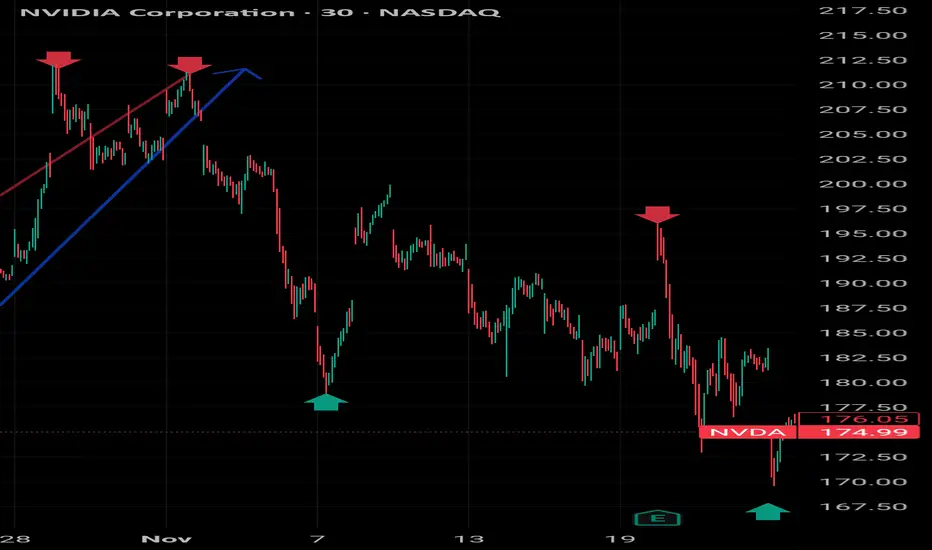
NVDA 30-Min – Beginner Structure & S/R PracticeI’m new to trading and still learning how to properly read market structure, trends, and support/resistance. This post is for feedback only, not a trade idea.
On this 30-minute NVDA chart, I marked:
Higher highs / higher lows during the uptrend (blue arrows)
Lower highs where price rejected and rolled over (red arrows)
Pullbacks and breakdown moves after resistance failed (yellow arrows)
Key reaction lows that appeared to act as temporary support (green arrows)
What I’m trying to understand:
Are my trend lines and structure shifts being identified correctly?
Do these rejection points actually qualify as resistance, or am I over-drawing?
Where would experienced traders simplify this chart?
At what point does structure clearly break instead of “just pulling back”?
No position taken.
No entries, targets, or stops planned.
Strictly working on reading price behavior and cleaning up my levels.
Looking for constructive feedback on:
Line placement
Market structure interpretation
Common beginner mistakes you see here
Appreciate the insight.
Mastering the Art of the Exit With a Simple Trick.Mastering the Art of the Exit With a Simple Trick.
Let me share a situation with you that has caused me more anxiety in the market than any other.
You buy a stock, a currency, or a cryptocurrency.
And this time... yes! It starts to climb. And climb. You are up 5%. Then 10%!! Suddenly, you are staring at a 15% gain!!!!
It feels brilliant. You have nailed the entry point, and your ego starts to whisper that you might just be a GENIUS.
But, my friend, this is the easy part of trading . Finding entry points is relatively simple.
The complexity of trading lies in the exit.
And this is exactly where our brain serves us a banquet of overwhelming anxiety.
Do we take that 15% and call it a win?
Do we get out?
But what if I sell and it shoots up to 30%? I entered so perfectly, I better stay.
I couldn’t bear missing the rally... But what if it suddenly turns around and we drop back to 0%?
If you have ever invested a single dollar, this internal dialogue must resonate deeply within you.
This anxiety is born from a lack of control.
Because we lack control over when to exit, our minds go wild, tossing scenarios into the air like someone plucking petals off a flower to decide their future.
REGAINING CONTROL
Today, I want to hand you a tool that will help you identify the precise moment it becomes interesting to reduce positions in a bull market, or even start considering a short position.
This strategy is incredibly simple to execute, and it works on any stock or listed market.
In the charts below, I have marked a few specific candles. These are magnificent candles for identifying when a bullish cycle is coming to an end, or at the very least, is about to take a significant pause.
What do you think they have in common?
Notice that these are charts from very different companies and sectors, in bullish, sideways, or bearish situations.
But all of them mark moments of change . They are highly interesting moments to sell.
What do you believe these candles share?
I am going to give you the answer in a moment, but whether you guessed right or not, I would love to know what went through your mind.
I’ll read you in the comments!
The answer, once you know it, is quite obvious, and it might even make you feel a little frustrated (my apologies!) .
But the truth is, the answer has always been right there in front of you.
It is like when you do not understand a language: you hear the sounds, but you do not comprehend the meaning. In this case, you have seen it, but perhaps you haven’t realized its significance.
Come on, let me give you one more clue.
Do you see it now?
Precisely.
The volume on those days is absolutely ridiculous.
When you compare it with the surrounding days, these days clearly fall below the average.
In fact, for those of you who love the data, we are talking about volumes in the 2nd or 3rd percentile maximum. That means out of every 100 trading days, we are looking for the 2 or 3 days with the least volume.
We are looking for the rare ones!
Important Note: You must NOT count public holidays or the days immediately preceding them. During Christmas, August, and other holidays or semi-holidays, volume is low per se. We are looking for low volume on normal trading days.
THE PSYCHOLOGY OF LOW VOLUME
The market moves based on the buying and selling of its participants.
When you buy, an immutable record remains of how many shares were bought and at what price. The sum of these shares and prices creates the trading volume.
When many people are interested in a stock, volume rises. Many shares change hands rapidly, causing the price to climb and climb, provoking even more transactions.
But sometimes, something incredible happens.
The price is making new highs, or is very close to them, yet the volume is ridiculous.
Why?
It means we have reached a point where we have run out of buyers. However, at the same time, the sellers do not want to "undersell" . They are waiting for that buying pressure to appear again.
When it doesn’t happen, and we see a day of low volume because buyers want it cheaper and sellers (for now) don’t want to lower their prices , we see a standoff.
No exchanges are achieved.
When the smartest sellers realize this, they begin to lower their prices in search of liquidity. As this drop in price initiates, the rest of the sellers begin to sell, entering into a progressively greater panic.
These candles indicate a lack of transactions due to a misalignment of supply and demand. The day following this misalignment, we typically see a forceful candle confirming that the price needs to be in a different zone, one where we are all willing to transact.
These days can signal both trend continuation and trend reversal, but that is a detail requiring a depth we won’t cover today.
Today, I will focus on the days of trend reversal.
Notice that in addition to working in bearish trends, this works equally well for bullish reversals. In fact, on the same chart, you can find opposite examples and make money in both directions, like this:
It even works well on higher timeframes like the Weekly, especially when combined with larger Chart Patterns, such as the Double Bottom.
HOW TO DETECT THEM
To spot these moments, TradingView offers a very interesting, and quite unknown free indicator.
It is called High/Low Volume.
It marks percentile lines, which helps you visualize the days with the lowest volume. Remember to be careful, many of these marks will be holidays, or days near Christmas or August. Discard those.
I hope that the next time you see a day of low volume, provided it isn’t a holiday, you will see the market through a different lens.
I invite you to start analyzing if this is happening at support or resistance levels , or if it fits with a larger chart pattern to guide your way.
🎁 Let’s make a simple deal.
I will handle the heavy lifting to create content like this for free, and you just HIT the 🚀 Rocket and Follow for more!
🤝 Deal?
Nvidia (NASDAQ: $NVDA) Eyes H200 Output Boost on China DemandNvidia (NASDAQ: NVDA) is weighing a major expansion of its H200 AI chip production after demand from Chinese companies exceeded current supply, according to Reuters sources. The surge in interest follows the U.S. government’s recent decision to allow Nvidia to export H200 processors to China under a 25% tariff, reigniting competition for access to high-performance computing hardware.
Chinese tech giants—including Alibaba and ByteDance—reportedly contacted Nvidia almost immediately after the announcement, eager to secure bulk orders of the H200. However, the situation remains fluid. The Chinese government has not yet approved inbound H200 shipments and held emergency meetings this week to determine whether to allow the chip into the country.
Limited supply is another complication. Nvidia is prioritizing production of its next-generation Blackwell and upcoming Rubin architectures, leaving only small quantities of H200 units available. This scarcity has intensified demand because the H200 is currently the most powerful AI chip legally accessible to Chinese companies—nearly six times stronger than the downgraded H20 version released in 2023.
Industry analysts warn that allowing the H200 into China could slow the growth of China’s domestic AI chip ecosystem. Chinese regulators are considering conditions such as requiring each H200 purchase to be bundled with locally produced chips to support homegrown semiconductor development.
Technical Analysis
The NVDA chart currently shows price consolidating below the recent high near $212. After a strong multi-month rally, the stock has pulled back into a key short-term support zone around $175–$185. Holding this range could position NVDA for a retest of its highs, supported by strong demand catalysts and ongoing AI infrastructure investment.
If price breaks below $175, a deeper correction toward the $150 demand zone becomes likely. Volume is stabilizing, and RSI sits mid-range, indicating a neutral momentum backdrop awaiting a directional catalyst. Traders should watch for reclaiming the $190–$195 area to confirm bullish continuation.
Nvidia - The correction just started!💉Nvidia ( NASDAQ:NVDA ) is now heading lower:
🔎Analysis summary:
Just recently, Nvidia once again retested the major rising channel resistance trendline. Together with November's bearish engulfing candle, Nvidia is slowly shifting bearish. And before Nvidia will retest the next major support area, we can see a drop of another -15%.
📝Levels to watch:
$150
SwingTraderPhil
SwingTrading.Simplified. | Investing.Simplified. | #LONGTERMVISION
NVIDIA Strengthens AI Stack With SchedMD AcquisitionNVIDIA (NASDAQ: NVDA) has expanded its software and infrastructure footprint with the acquisition of SchedMD, the developer of Slurm — the world’s most widely used open-source workload manager for high-performance computing (HPC) and AI. The move reinforces NVIDIA’s strategy of controlling not just compute hardware, but also the software layers that orchestrate large-scale AI workloads.
Slurm plays a critical role in scheduling, queuing, and allocating resources across massive compute clusters, and is currently used in more than half of the world’s top supercomputers. As AI model training and inference grow more complex and resource-intensive, efficient workload management has become essential. By acquiring SchedMD, NVIDIA gains deeper integration between its accelerated hardware and the software infrastructure that powers AI and HPC environments.
Importantly, NVIDIA confirmed that Slurm will remain open-source and vendor-neutral. This signals a clear effort to strengthen the broader AI ecosystem rather than lock customers into proprietary software. NVIDIA plans to continue investing in Slurm’s development while expanding its compatibility across heterogeneous clusters, cloud providers, and enterprise systems. This positions NVIDIA as a central enabler of next-generation AI infrastructure across industries such as healthcare, autonomous driving, finance, manufacturing, and government research.
From a technical perspective, NVDA is currently consolidating after a strong multi-month rally. Price has pulled back from recent highs near the $210 area and is trading below short-term resistance around $180–$185. The chart highlights a key demand zone near the $150 region, which previously acted as a breakout level and aligns with strong historical support. A deeper retracement toward this zone could offer a technical reset before the next leg higher.
If buyers successfully defend support and reclaim $185, NVDA could resume its broader uptrend toward prior highs. Overall, the fundamentals remain firmly bullish, with the SchedMD acquisition strengthening NVIDIA’s long-term AI dominance as the stock navigates a short-term technical consolidation.
NVIDIA (NVDA) H4 | Bullish Continuation Setup After ATH ReversalNVIDIA (NVDA) NASDAQ H4 Timeframe Analysis NVIDIA recently showed a reaction from its All-Time High (ATH), where a clear reversal was observed. After forming the top, the price moved down and swept the sell-side liquidity, indicating that smart money has completed the downside inducement. Currently, the price is trading around a key bullish order block, which aligns with the sell-side liquidity grab. This confluence significantly strengthens the chances of a bullish momentum continuation.
Market Structure Insight
ATH formed _ short-term reversal observed
Sell-side liquidity has been taken
Price respected the bullish order block
Momentum is shifting back.
This suggests that the market is preparing for a bullish expansion phase.
Buy Trade Plan
Entry Level: 177.52
Stop Loss: 168.00
Targets:
TP1: 187.00
TP2: 199.00
Major Target: 211.00
Disclaimer
This chart is for educational purposes only and does not constitute financial advice. Trading involves high risk; always conduct your own research and use proper risk management.
NVIDIA This is how it can reach $100 and the Supports involved.NVIDIA Corporation (NVDA) had a strong red 1M candle last month, the first one after a rally of 7 straight green months. This is not the first time we present you this 12-year Channel Up, in fact we used this in late October to give a sell signal.
The reason is that Nvidia almost reached the top of that pattern, a technical Higher High, successive if you count the late 2024 one. Such Double Tops have been previously consistent with the start of strong corrections (Bearish Legs) which in both cases (2018 and 2022) bottomed on the 1W MA200 (orange trend-line).
The key element that we added on the chart this time is the (green) Support Zone, which stemmed every time from the last consolidation (blue circle) before the Top.
It is no surprise that this time it also falls on the 1W MA200 and a potential contact with the price towards Q3 2026 and beyond. Even then, it will still be above the 0.382 Fibonacci retracement level as in December 2018 and quite close to the bottom of the Channel Up for the first time since October 2022.
Our long-term Target and thus next long-term Buy Signal, remains $100.
---
** Please LIKE 👍, FOLLOW ✅, SHARE 🙌 and COMMENT ✍ if you enjoy this idea! Also share your ideas and charts in the comments section below! This is best way to keep it relevant, support us, keep the content here free and allow the idea to reach as many people as possible. **
---
💸💸💸💸💸💸
👇 👇 👇 👇 👇 👇
NVDA🌎NVIDIA: At the Peak or the Brink?
Nvidia's record highs are accompanied by warning signs. A market cap of $4.37 trillion and a P/E ratio of 51 indicate inflated expectations.
Risks:
Speculative demand: The $23.7 billion investment looks like an artificial market pump.
Macro threats: The AI boom will face energy shortages.
Historical parallel: The scenario mirrors Cisco's pre-dot-com bubble.
Fierce competition: AMD, Intel, and cloud giants are creating their own chips.
Growth drivers:
Leadership in AI, a closed CUDA ecosystem, and 66% data center revenue growth.
Nvidia is a leader, but its shares have become a high-risk asset. Any slowdown in business performance will lead to a collapse in the stock price.
The baseline scenario is a broad sideways trend.
NVIDIA at a Critical Trendline: Bounce or Breakdown?Price is sitting exactly on a major long-term uptrend line. This area will decide whether the bullish trend continues or a deeper correction begins.
Bullish Scenario
If price holds above 182–185:
• Target 1: 195
• Target 2: 205–210
• Stop-loss: Daily close below 180
Bearish Scenario
If price closes below 180:
• Target 1: 165
• Target 2: 150
• Stop-loss: Close back above 187
Short Fundamental View
• NVIDIA remains the leader in AI chips.
• Demand from data centers remains high.
• But valuation is extremely stretched at all-time highs, so downside risk exists if growth slows.
Nvidia stands corrected & cooledBe aware that the Daily TF has a bearish head n shoulders.
But intraday is where price will move first and Nvidia has many bullish setups.
It puts a low in end of November recently which was a big 20% off its ATH months earlier. Price bounced at end of November and formed lower and retested at 61.2%.
Trading is about calculated good guesses.
It’s also about catching the start of market cycles and scaling into the cycle as it confirms a new uptrend.
The 2nd quarter of our century is knocking.
Thanks for dropping by.
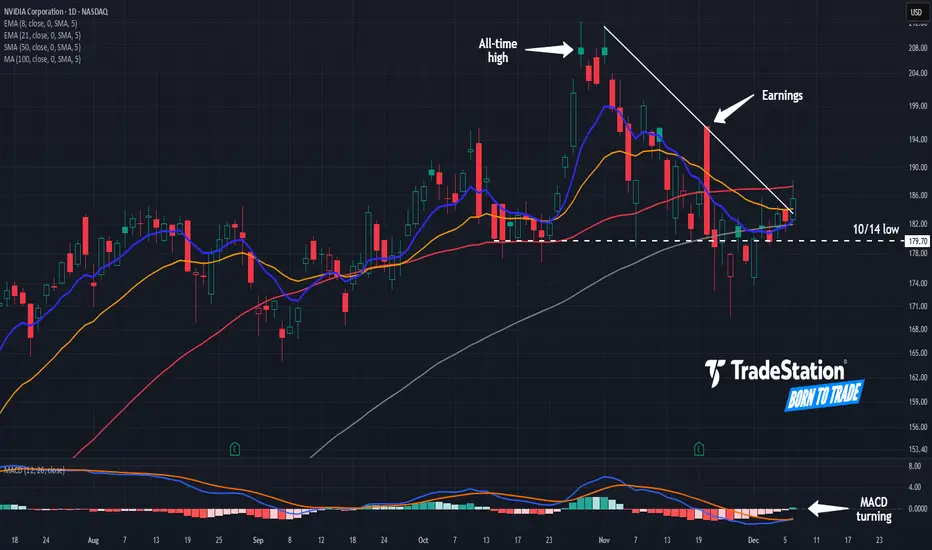
Is Nvidia’s Next Up Leg Coming?Nvidia has paused after a rally, and some traders may think the next up leg is coming.
The first pattern on today’s chart is the series of lower highs since November 3. The AI chip giant closed above that falling trendline yesterday, which could mean that the short-term resistance is fading.
Second is the failed rally on November 20 after earnings and revenue beat estimates. MACD was falling at the time, which prevented the shares from holding their gains. But now the oscillator has turned up, which may suggest that momentum has grown more favorable.
Third, prices have consolidated around their 50- and 100-day simple moving averages. That could reflect a bullish long-term trend.
Next, the 8-day exponential moving average (EMA) is rising toward the 21-day EMA. Crossing above may signal bullishness in the short term.
Finally, NVDA is a highly active underlier in the options market. (Its average daily volume of 3.6 million contracts ranks first in the S&P 500, according to TradeStation data.) That may help traders take positions with calls and puts.
TradeStation has, for decades, advanced the trading industry, providing access to stocks, options and futures. If you're born to trade, we could be for you. See our Overview for more.
Past performance, whether actual or indicated by historical tests of strategies, is no guarantee of future performance or success. There is a possibility that you may sustain a loss equal to or greater than your entire investment regardless of which asset class you trade (equities, options or futures); therefore, you should not invest or risk money that you cannot afford to lose. Online trading is not suitable for all investors. View the document titled Characteristics and Risks of Standardized Options at www.TradeStation.com . Before trading any asset class, customers must read the relevant risk disclosure statements on www.TradeStation.com . System access and trade placement and execution may be delayed or fail due to market volatility and volume, quote delays, system and software errors, Internet traffic, outages and other factors.
Securities and futures trading is offered to self-directed customers by TradeStation Securities, Inc., a broker-dealer registered with the Securities and Exchange Commission and a futures commission merchant licensed with the Commodity Futures Trading Commission). TradeStation Securities is a member of the Financial Industry Regulatory Authority, the National Futures Association, and a number of exchanges.
Options trading is not suitable for all investors. Your TradeStation Securities’ account application to trade options will be considered and approved or disapproved based on all relevant factors, including your trading experience. See www.TradeStation.com . Visit www.TradeStation.com for full details on the costs and fees associated with options.
Margin trading involves risks, and it is important that you fully understand those risks before trading on margin. The Margin Disclosure Statement outlines many of those risks, including that you can lose more funds than you deposit in your margin account; your brokerage firm can force the sale of securities in your account; your brokerage firm can sell your securities without contacting you; and you are not entitled to an extension of time on a margin call. Review the Margin Disclosure Statement at www.TradeStation.com .
TradeStation Securities, Inc. and TradeStation Technologies, Inc. are each wholly owned subsidiaries of TradeStation Group, Inc., both operating, and providing products and services, under the TradeStation brand and trademark. When applying for, or purchasing, accounts, subscriptions, products and services, it is important that you know which company you will be dealing with. Visit www.TradeStation.com for further important information explaining what this means.
(NVDA) Complex China Saga and Strategic ImplicationsRecent developments surrounding Nvidia’s ability to sell advanced chips in China highlight the profound geopolitical and commercial challenges facing the AI semiconductor leader. The announcement of a deal by the Trump administration to allow the sale of its H200 chip to "approved customers" in China represents a significant, yet highly conditional, policy shift.
The Shrinking China Footprint and Revenue Impact
The data underscores a dramatic contraction in Nvidia's China business, a direct result of successive U.S. export controls. For the latest quarter, Nvidia's revenue from China stood at $2.8 billion, accounting for just 5% of its total sales. This figure is starkly lower than:
The $8.4 billion Wall Street had projected for the quarter.
The 13% of overall revenue China represented in the previous fiscal year.
This decline illustrates the substantial financial toll of the regulatory environment. In contrast, Nvidia's revenue from the United States ($39.2 billion) and Taiwan ($13.8 billion) demonstrates where its growth momentum has decisively shifted, fueled by global demand for AI data center infrastructure outside of the restricted Chinese market.
A Rollercoaster of Regulatory Actions
The path to the current "approved customers" deal has been fraught with volatility:
The April Ban: An unexpected move by the Trump administration in April effectively banned sales of the H20 chip to China, causing a significant stock sell-off and an estimated $2.5 billion in lost Q1 revenue.
The August Deal: Following intensive lobbying by CEO Jensen Huang, President Trump agreed in August to grant export licenses. However, this came with an unprecedented condition: Nvidia would be required to share 15% of its China revenues with the U.S. government.
Chinese Retaliation: In a complicating twist, Chinese regulators subsequently moved to ban domestic tech firms from purchasing the very H20 chips Nvidia was now licensed to sell, reflecting the tit-for-tat nature of the tech war and potentially undermining the value of the U.S. concession.
Nvidia's CFO, Colette Kress, encapsulated the company's position, stating disappointment over being unable to ship "more competitive" products to China while committing to continued engagement with both governments to advocate for global competitiveness.
Strategic and Market Implications
This situation places Nvidia in a delicate balancing act. The new deal potentially opens a narrow channel for revenue, but under terms that cede a portion of profits and face demand-side uncertainty from Chinese buyers. The company's strategy appears to be one of resilient diversification, having successfully reallocated its immensely sought-after supply to other global markets, as evidenced by its monumental U.S. and Taiwan revenue figures. The long-term risk remains that prolonged restrictions could accelerate China's drive for semiconductor self-sufficiency, creating future competitors.
Technical Perspective and Key Levels
From a chart analysis standpoint, following the significant news-driven price movements, key Fibonacci retracement levels have emerged as critical technical supports for Nvidia's stock:
First Support Zone: $182.53 (0.236 Fibonacci Level)
This represents the initial level where buyers may step in to defend the prevailing trend during a pullback. Holding above this zone would suggest underlying strength remains intact.
Second & Stronger Support Zone: $164.20 (0.382 Fibonacci Level)
This is identified as a more significant support area. A test of this level would indicate a deeper correction, and its ability to hold would be a crucial test of the stock's structural bullish foundation amid ongoing geopolitical headlines.
Conclusion
Nvidia's navigation of the U.S.-China tech conflict is a masterclass in managing geopolitical risk. While the new "approved customers" deal provides a partial and costly relief valve, the company's financial performance proves its growth is no longer dependent on the Chinese market. Investors must weigh the incremental benefit of reopened, albeit diminished, China sales against the persistent risks of regulatory whiplash from both nations and the long-term strategic decoupling of the tech ecosystems. The stock's trajectory will likely continue to be influenced by these macro forces, with the identified technical support levels serving as important gauges of market sentiment through the volatility.
NVIDIA - AI Child Poster Goes Lower as Hindenburg Omen AliveThe Hindenburg Omen is a technical indicator of stock market breadth, or "breathing," that is believed to be a harbinger of a major market crash.
It is known to have received its name from the disaster of the German passenger airship Hindenburg, which burned to the ground in just over 30 seconds on May 6, 1937.
This became a dramatic and widely known omen of the end of the airship era and the beginning of the motorized era, which escalated into the all-encompassing "Motor War" — war conflict also known as "World War II" in which motorized technology such as airplanes, tanks, and automobiles, as well as aviation and naval forces, played a key role.
How the indicator works
The Hindenburg Omen indicator is based on an analysis of market breadth—the ratio of stocks reaching new highs and new lows over a given period (usually 52 weeks) on a stock exchange (e.g., the NYSE).
A "signal" occurs when certain conditions are met that suggest the market is experiencing hidden weakness (yet undetected by many market participants), even though the underlying index (S&P 500 or NYSE Composite) continues to rise, reaching its 52-week or even all-time highs.
The main technical chart says Hindenburg Omen has occured again.. and exactly on Nvidia NASDAQ:NVDA top, sending AI child poster to lower degree.