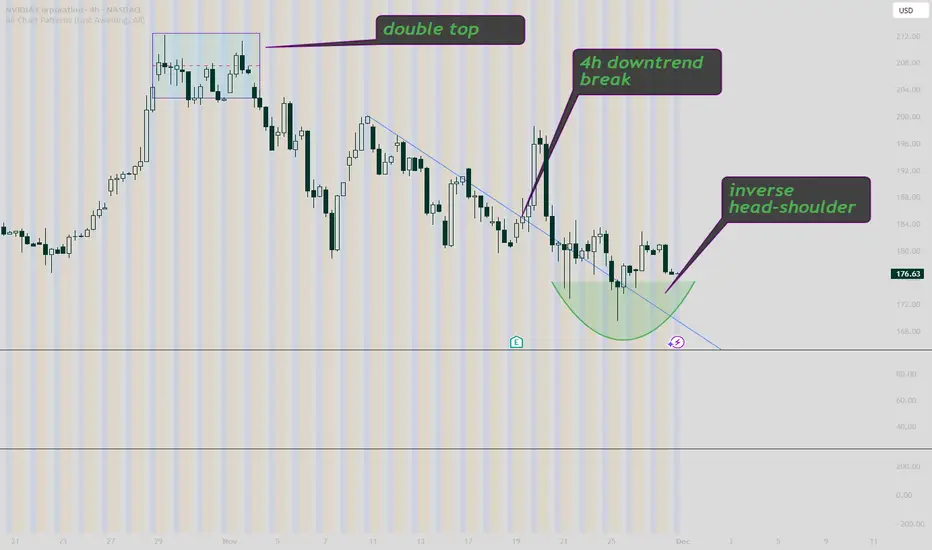
3H technical analysis Here we have the three hour and as you can see NVDA has created a double bottom with the breakout area above the red line. NVDA has provided a bullish setup, only time will tell, Go Bullsby Howm0
Nvidia stands corrected & cooledBe aware that the Daily TF has a bearish head n shoulders. But intraday is where price will move first and Nvidia has many bullish setups. It puts a low in end of November recently which was a big 20% off its ATH months earlier. Price bounced at end of November and formed lower and retested at 61.2%. Trading is about calculated good guesses. It’s also about catching the start of market cycles and scaling into the cycle as it confirms a new uptrend. The 2nd quarter of our century is knocking. Thanks for dropping by. Longby MusicalNight2
NVDA DIC-2025NVDA: Rejected 183-188; 212 distro (285B sell). Watch 165 gap/150. Tgt up 212, down 150. #NVDA #QQQ #SMH #SemiconductorsLongby TWMMPRO2
Understanding Global Governance and Strategic Decision-MakingThe Scope and Importance of International Policy Analysis The importance of international policy analysis has grown significantly in the 21st century due to globalization, technological advancements, and complex interdependence among states. Policies addressing climate change, trade, health crises, cybersecurity, and conflict resolution have far-reaching consequences that transcend national boundaries. Analysts in this field aim to evaluate not only the effectiveness of policies but also their ethical, political, economic, and social implications. International policy analysis provides policymakers and stakeholders with evidence-based insights that inform decision-making. It facilitates the identification of potential risks, benefits, and trade-offs associated with different policy options. In an increasingly interconnected world, where actions in one country can ripple globally, the role of international policy analysis is indispensable for promoting cooperation, reducing conflicts, and fostering sustainable development. Key Theoretical Approaches Several theoretical frameworks guide international policy analysis, providing structured ways to interpret complex global interactions: Realism: Rooted in political science, realism emphasizes the pursuit of national interest and power in an anarchic international system. Policy analysts using this approach focus on how states prioritize security, military strength, and strategic alliances. Realism is often applied in analyzing defense, security, and geopolitical policies. Liberalism: Liberal theories highlight cooperation, institutions, and the role of international law. From this perspective, policy analysis examines how international organizations, treaties, and multilateral agreements influence global outcomes. Liberalism is particularly relevant in trade policy, human rights, and environmental governance. Constructivism: Constructivist approaches stress the importance of ideas, norms, and identities. Analysts study how perceptions, cultural factors, and social norms shape policy decisions, highlighting that international relations are not merely dictated by material interests but also by shared understandings. Critical and Postcolonial Theories: These approaches challenge mainstream perspectives, focusing on power imbalances, historical legacies, and structural inequalities. They analyze how global policies can perpetuate economic or political dominance and often emphasize marginalized voices in global governance. Methodologies in International Policy Analysis International policy analysis employs a wide range of methodologies to assess policy effectiveness and implications: Qualitative Analysis: This involves the study of policy documents, treaties, speeches, and case studies. Interviews with policymakers and experts provide insights into decision-making processes and political dynamics. Qualitative approaches are essential for understanding the motivations, ideologies, and negotiations behind international policies. Quantitative Analysis: Analysts use statistical models, economic indicators, and large datasets to evaluate the outcomes of international policies. Quantitative approaches are particularly useful for assessing trade agreements, development aid effectiveness, and economic sanctions. Comparative Analysis: By comparing policies across different countries or regions, analysts can identify best practices, common challenges, and potential solutions. Comparative studies help in understanding how varying political, economic, and cultural contexts influence policy outcomes. Scenario and Risk Analysis: This method projects potential future developments, assessing how current policies might perform under different global conditions. It is crucial for long-term planning in areas such as climate change, security threats, and technological advancements. Key Areas of Focus Global Security and Defense Policy: Analysts examine issues like conflict prevention, peacekeeping, arms control, and counterterrorism. Understanding how states and international organizations manage security threats helps in designing effective policies that minimize the risk of conflict. International Trade and Economic Policy: Trade agreements, tariffs, foreign investment regulations, and economic sanctions are central to global economic governance. Policy analysis evaluates the impacts of these measures on economic growth, employment, inequality, and global markets. Environmental and Climate Policy: Climate change is a global challenge requiring coordinated policy responses. Analysts assess international treaties like the Paris Agreement, evaluate the effectiveness of carbon reduction strategies, and explore the economic and social implications of environmental policies. Global Health Policy: International policy analysis in health examines responses to pandemics, access to vaccines, and global health governance structures. Effective health policies require coordination between national governments, the World Health Organization, and other global health actors. Human Rights and Social Policy: Policies addressing human rights, migration, and humanitarian aid are evaluated to ensure compliance with international law and ethical standards. Analysis identifies gaps, implementation challenges, and the role of civil society in influencing policy outcomes. Challenges in International Policy Analysis Analyzing international policy presents unique challenges due to the complexity of global governance: Diverse Stakeholders: International policies often involve multiple actors with conflicting interests. Balancing these interests requires careful negotiation and strategic compromise. Data Limitations: Access to reliable and timely data across countries can be challenging. Analysts must often work with incomplete or biased information. Dynamic Global Context: International relations are fluid, influenced by economic shifts, technological change, and geopolitical tensions. Analysts must adapt their frameworks to account for rapid developments. Cultural and Normative Differences: Policies may have varying impacts in different cultural contexts, making universal policy prescriptions difficult. Impact and Applications International policy analysis plays a pivotal role in shaping global governance. It informs the strategies of governments, international organizations, and NGOs, guiding decisions in diplomacy, trade, security, and development. By identifying unintended consequences and proposing evidence-based alternatives, analysts contribute to more effective and ethical policymaking. Furthermore, international policy analysis fosters collaboration across borders. It helps build consensus on pressing global issues like climate change, human trafficking, and financial crises. By integrating insights from multiple disciplines, including economics, political science, sociology, and law, analysts provide comprehensive solutions that address both immediate challenges and long-term goals. Conclusion International policy analysis is an essential field in a world characterized by interconnectedness and complexity. It equips decision-makers with the knowledge and tools to navigate global challenges, promoting cooperation, stability, and sustainable development. By combining theoretical frameworks, methodological rigor, and practical insights, international policy analysis enhances our understanding of global governance and contributes to the creation of policies that are equitable, effective, and forward-looking. In an era of global crises—from pandemics and climate change to geopolitical conflicts—international policy analysis is not just an academic exercise; it is a vital instrument for shaping a more secure, just, and prosperous world.Educationby GlobalWolfStreet1
NVDA OutlookNot going in-depth on any macros here. For that you can check my BTC Outlook. For NVDA my expectation is to play the range for now (yellow line). Looking for entries around $173.01, back to 50% of the range, vwap, etc. If we do break down our last hope is the grey-ish box below to bring us back up. As to why these levels are important or how I get them I don't wanna go into detail here. If the grey box does not hold we'll see $130.17 - $148.39 again. If that happens, I will personally, load up heavy as that's insane discount. Bubble or not, this thing wont pop for another good while. If we manage to break above $182.61 and see acceptance, we can expect another test of the ATH, unless any unforeseen economic events happen. Pay yourself along the way my friends. As always, just my two cents. by bip_142
NVDA 2D Bearish Divergence Short SetupDescription Structure: Rising bullish channel with regular bearish divergence on Stochastic Entry: $173.84 aligned with channel structure and Stochastic death cross Stop Loss: $190.18 above recent high with structure-based placement Take Profit: Breakout of the bullish channel or touch of EMA 200 System Note: 2‑day chart setup based on channel structure, regular divergence, and momentum shiftShortby massrine271
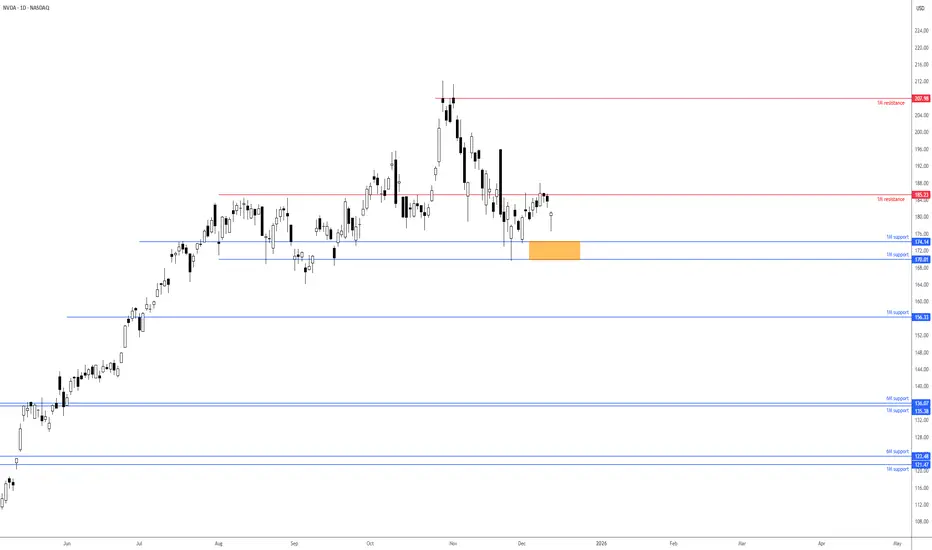
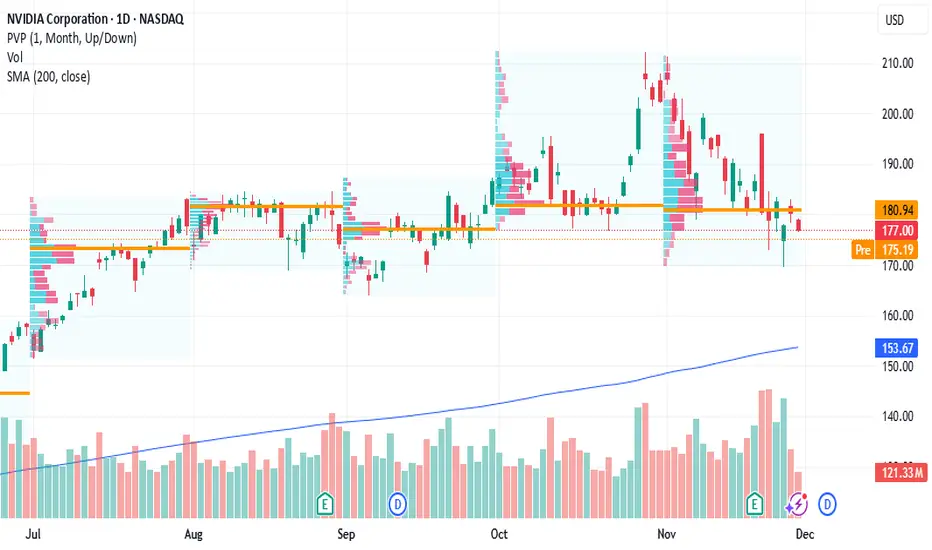
NVDA breakout will help determine near-term direction Shares of Nvidia took a hit during Thursday’s session, losing about 1.5%. Technically, the trend remains northbound, though near-term price action has shown a few lower lows and lower highs: early signs of a downtrend. 1M resistance recently made a show at US$185.23 and withstood a few upside attempts. 1M support is nearby between US$170.01 and US$174.14, with a break under here unbolting the door to another layer of 1M support from US$156.33. Alternatively, pushing above US$185.23 would help bolster the long-term trend, and potentially attract fresh buying to 1M resistance at US$207.98, closely shadowed by the all-time high of US$212.19. Ultimately, the direction of travel for this Stock will depend on whether it breaks above resistance at US$185.23, encouraging buying, or below the support zone between US$170.01 and US$174.14, which could prompt further underperformance. Written by the FP Markets Research Team by FP Markets1
Commodity Market Analysis1. Fundamental Analysis of Commodities Fundamental analysis focuses on demand and supply. Unlike stocks, commodities have no earnings or balance sheets — they are influenced by production, consumption, and global events. Below are key fundamental factors that move different commodities: A. Energy Commodities (Crude Oil, Natural Gas) Crude Oil Crude oil prices depend mainly on: OPEC+ decisions (production cuts or increases) US crude inventory reports Middle East geopolitical tensions Global economic growth (energy consumption) US Dollar Index (inverse relation) Example: If OPEC announces a production cut, supply decreases → crude oil prices rise. Natural Gas Natural gas is influenced by: Weather conditions (winter increases heating demand) Storage inventory levels Gas production & LNG exports High summer temperatures also increase electricity demand (air conditioners), boosting gas usage. B. Precious Metals (Gold, Silver) Gold is not just a commodity — it's a safe-haven asset. Factors affecting gold: Inflation data (higher inflation → higher gold) Interest rate decisions (Federal Reserve) Dollar Index (strong dollar → weak gold) Global uncertainties (wars, recession fears) Silver moves with: Industrial demand (solar panels, electronics) Gold correlation Economic cycles C. Base Metals (Copper, Aluminium, Zinc, Nickel) Base metals depend heavily on global economic activity. Key drivers: China’s economic data (largest consumer of industrial metals) Infrastructure spending worldwide Manufacturing & construction demand Mining output and strikes Example: If China announces a stimulus package → copper demand rises → copper prices increase. D. Agricultural Commodities (Wheat, Soybean, Cotton, Sugar) Agri-commodities depend on: Weather (rainfall, drought, frost) Government MSP policies Crop cycles Exports & imports Example: A weak monsoon in India → lower wheat production → wheat prices rise. 2. Technical Analysis in Commodity Markets Technical analysis studies price action, chart patterns, volume, market structure, and indicators to identify trade setups. Traders commonly use: A. Candlestick Patterns Bullish engulfing at support in gold Shooting star in crude oil after a rally Hammer in natural gas at bottom levels Candlestick analysis helps identify market psychology. B. Chart Patterns Popular patterns in commodities: Double tops (crude oil reversal) Triangles (gold consolidation during FOMC weeks) Channels (copper trending phases) Head and Shoulders (major reversals) Patterns show potential breakout and breakdown zones. C. Indicators Used in Commodity Trading Moving Averages (20, 50, 100, 200 MA) Used to identify the trend direction. RSI Identifies overbought/oversold conditions. MACD Shows momentum shifts. Bollinger Bands Useful in gold and silver for breakout entries. Volume Profile Helps identify high-volume zones (strong support/resistance). Since you like volume profile, this becomes important in crude & metals. D. Market Structure Analysis Study of: Higher highs / higher lows Supply and demand zones Break of structure (BOS) Liquidity zones Commodities often respect clean market structure because institutions heavily participate. Example: Crude oil forms HH-HL structure above 50 EMA → bullish trend confirmed. 3. Sentiment & Intermarket Analysis Commodity markets react strongly to sentiment and cross-asset relationships. A. Dollar Index (DXY) Impact Gold and silver move opposite to DXY Crude also weakens when dollar strengthens Reason: Commodities are priced in USD globally. B. Bond Yields High bond yields → gold falls Low bond yields → gold rises Gold is a zero-yielding asset, so yields compete with gold. C. Risk-On vs Risk-Off Sentiment Risk-off: War, recession fear → gold ↑ Risk-on: Economic growth → crude, copper ↑ Sentiment plays a huge role in short-term movements. D. Inventory Reports Weekly reports that move markets sharply: EIA Crude Oil Inventory API Inventory Natural Gas Storage Report Lower inventories → prices rise Higher inventories → prices fall 4. How to Do Practical Commodity Market Analysis Here’s a simple but powerful approach you can use daily: Step 1: Check Global News & Macroeconomic Events Look for: Fed speeches Inflation data OPEC announcements Weather updates War-related headlines These set the market bias. Step 2: Identify Trend Using Technicals Use: 50 & 200 EMA Market structure Volume profile zones Mark supply-demand areas. Step 3: Use Sentiment Indicators Check: Dollar Index Bond yields Equity market sentiment VIX (volatility index) These help you understand whether safe-haven commodities or industrial commodities will move. Step 4: Wait for Price Action Confirmation Look for: Breakouts Retests Reversal candlestick patterns Volume confirmation This protects you from false moves. Step 5: Apply Risk Management Commodity markets are volatile. Keep: Proper stop-loss Limited position sizing Avoid over-trading during news events 5. Why Commodity Market Analysis Is Important High Volatility = Good Opportunities Commodities give wide movements, helpful for intraday and swing traders. Hedge Against Inflation Gold, silver, and crude move sharply during inflation cycles. Global Market Connectivity Commodity prices influence stock sectors like: Oil & gas Metals & mining FMCG and agriculture Useful for Investors and Traders Both Whether you trade MCX, futures, or ETFs, analysis gives clarity. 6. Conclusion Commodity market analysis is a powerful combination of fundamentals, technicals, sentiment and intermarket relationships. A successful commodity trader understands how global events, economic trends, weather patterns, and institutional activity influence price movements. By studying: Supply–demand fundamentals Chart structure and volume profile Dollar index and bond yields Inventory reports and geopolitical news …you can predict commodity market trends more accurately and make informed trading decisions.Educationby GlobalWolfStreet2
Nvidia - Now is the time to go short!💣Nvidia ( NASDAQ:NVDA ) is now creating a top: 🔎Analysis summary: Just a couple of days ago, Nvidia perfectly retested a major resistance trendline. Always in the past, such a retest was followed by a major move towards the downside. Therefore, Nvidia is preparing for a major drop, which could lead to another -25% drop in the future. 📝Levels to watch: $180 and $140 and $100 SwingTraderPhil SwingTrading.Simplified. | Investing.Simplified. | #LONGTERMVISIONShort04:46by SwingTraderPhilUpdated 3636145
NVDA QuantSignals Alert: High-Volatility Bearish Move IncomingNVDA QuantSignals Katy 1M Prediction 2025-12-02 QuantSignals Katy AI Stock Analysis Analyzed 1 stock(s): NVDA NVDA Analysis Current Price: $183.28 Final Prediction: $181.20 (-1.14%) 30min Target: $180.13 (-1.72%) Trend: BEARISH Confidence: 57.6% Volatility: 37.9% 🎯TRADE SIGNAL: Direction: SHORT Entry: $183.28 Target: $181.62 Stop Loss: $186.03 Expected Move: -1.14% Summary: Generated 1 trade signals from 1 successful analyses out of 1 symbols.Shortby quantsignals2
$NVDA — WEEK 49 TREND REPORT (COILING?)NASDAQ:NVDA — WEEK 49 TREND REPORT Ticker: NASDAQ:NVDA — 12/02/2025 @ 185$ Timeframe: WEEKLY This is a reactive structural classification of NVDA based on the weekly chart as of this timestamp. Price conditions are evaluated as they stand — nothing here is predictive or forward-assumptive. ⸻ 1) Current Trend Condition • Trend Duration: +5 weeks (bearish) • Trend Reversal Level (Bullish): 190.87$ • Trend Reversal Level (Bearish): 176.52$ • Pullback/Correction/Structure Support: 167.75$ ⸻ 2) Structure Health • Retracement Phase: • Pullback (approaching 78.6%) • Position Status: • Caution (interacting with structural layers) ⸻ 3) Temperature: Cooling Phase ⸻ 4) Momentum: Coiling ⸻ 5) Market Sentiment: Neutral ⸻ Author’s Note This analysis is fully reactive, not predictive. Market conditions, trend structure, and behavior are classified as they appear in real time. The objective is to identify where directional shifts first occurred, where structural integrity remains intact, and where it would begin to weaken if key levels were breached. Predictive analysis projects outcomes that do not exist yet. Without price confirmation, prediction is built on baseless assumptions. This framework avoids that entirely by responding only to verified structural changes and live conditions. The levels shown simply identify where the current trend structure first shifted and where it would begin to lose integrity if breached. Recognizing these boundaries allows for clearer interpretation of market behavior without relying on forward guarantees, speculative projections, or unsupported assumptions. ⸻ Methodology Overview This classification framework evaluates directional conditions using internal trend-interpretation logic that references price behavior relative to its structural layers. These relationships are used to identify when price movement aligns with the framework’s criteria for directional phases, transition points, or regime shifts. Visual elements or structural labels reflect these internal interpretations, rather than explicit trading signals or preset indicator crossovers. This framework is observational only and does not imply future outcomes.Longby GURULifeline8
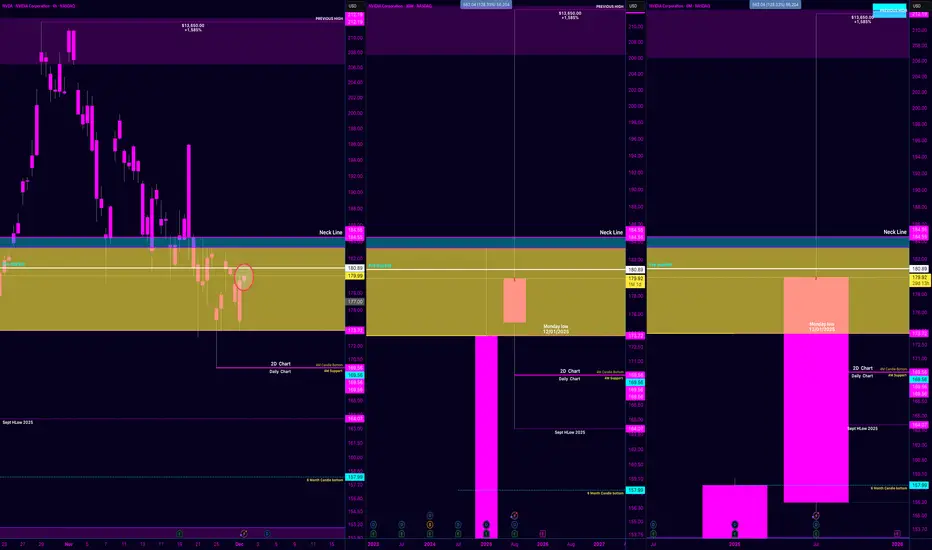
Are we going to the Moon with NVDA?Analysis breakdown based on your 15M, 4H, 30W, 6M, and 4H Pyth chart stack: 15M + 4H (Top Left & Bottom Left) Price is coiling in a tight consolidation range between ~$177.08 and $179.99 ( yellow zone). This oval region circled on the 15M is a classic compression pattern—looks like it's building energy for a breakout. It's sitting just under the Neckline at $184.55, which aligns with historical resistance. Implication: If this flag or range resolves bullish, it could trigger a rapid move to test that neckline (short-term target zone). Weekly (30W) & Biannual (6M) – Top Middle/Right These candles are inside the key yellow structure block as well. The current price is reacting off the bottom of my yellow box, now pressing into the midpoint of the structure. And why this stands out is the biannual candle (6M) shows a potential reversal candle forming off support—rare signal at this TF if confirmed. Price targets 1st $184.55 (Neckline) High (structure alignment) 2nd $195–200 (gap fill above neckline) Medium 3rd $212.19 (Magnet Zone / Prev High) I need to see some momentum happing THIS MONTH and for the looks of it price is looking like its gearing up and ready . Longby MoNi_MoN9927
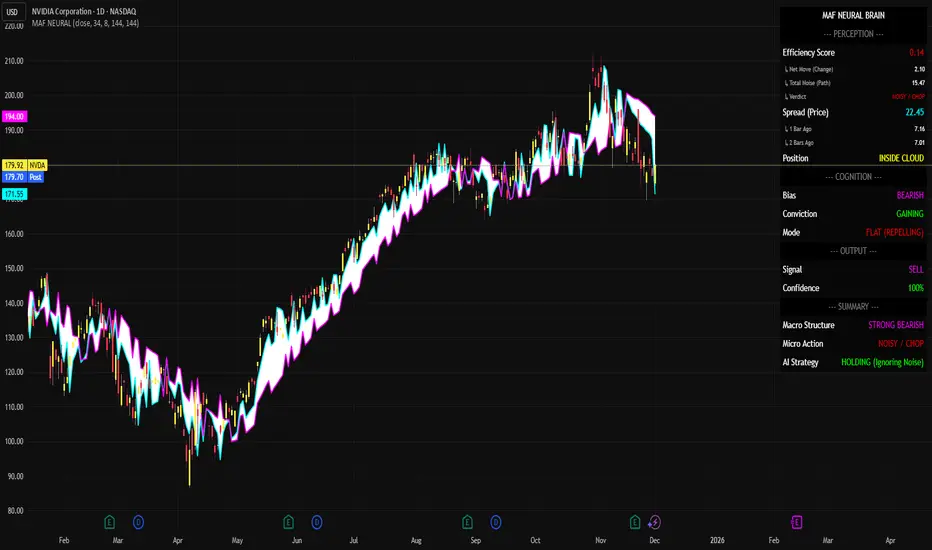
Trade Summary: Bearish Continuation with High ConfidenceYou are looking at the Daily chart for NVDA (NVIDIA Corporation). The broader trend is clearly bearish, and the MAF Neural Brain indicator has identified a high-probability continuation setup. 1. Perception (The Eyes): What the Indicator Sees Efficiency Score: 0.14. This is very low, indicating "Noisy/Chop" price action. The daily candles are overlapping significantly, showing a struggle between buyers and sellers rather than a smooth trend. Spread (Price): 22.45. Volatility is present but contained within the bearish structure. Position: INSIDE CLOUD. Price is trading within the indicator's bands, confirming that this is a consolidation phase within the larger downtrend. Trade Summary: Bearish Continuation with High Confidence 2. Cognition (The Mind): How the Indicator Interprets It Bias: BEARISH. Despite the choppy daily action, the system maintains a negative bias. Conviction: GAINING. This is the key insight. While the market looks messy to the naked eye, the algorithm's internal confidence in the downtrend is actually increasing. It sees the current chop as a pause before another drop, not a reversal. Mode: FLAT (REPELLING). The market is stuck in a range that is resisting upward breakouts. 3. Narrative (The Story): The Strategic Output Signal: SELL. A hard sell signal is active. Confidence: 100%. The system is fully aligned. Every metric (Bias, Conviction, Structure) points to lower prices. 4. Summary (The Execution) Macro Structure: STRONG BEARISH. The dominant force is selling. Micro Action: NOISY / CHOP. The daily candles are messy. AI Strategy: HOLDING (Ignoring Noise). Trade Analysis: This setup represents a "Bear Flag" or Consolidation in a Downtrend. The Opportunity: Traders often get shaken out during "Noisy" consolidations like this because they mistake the sideways movement for a bottom. The Neural Brain is explicitly telling you to ignore that noise. The Action: If you are short, HOLD. If you are flat, this is a valid entry for a Short position, anticipating a breakdown from the current "Inside Cloud" consolidation. The Verdict: The 100% confidence level combined with "Gaining Conviction" suggests the path of least resistance remains strictly downward. In plain English: "NVDA is taking a breather after dropping, and the price action is messy. However, the internal data says sellers are still in total control and getting stronger. Don't buy the dip; expect the drop to continue."Shortby CustomQuantLabs115
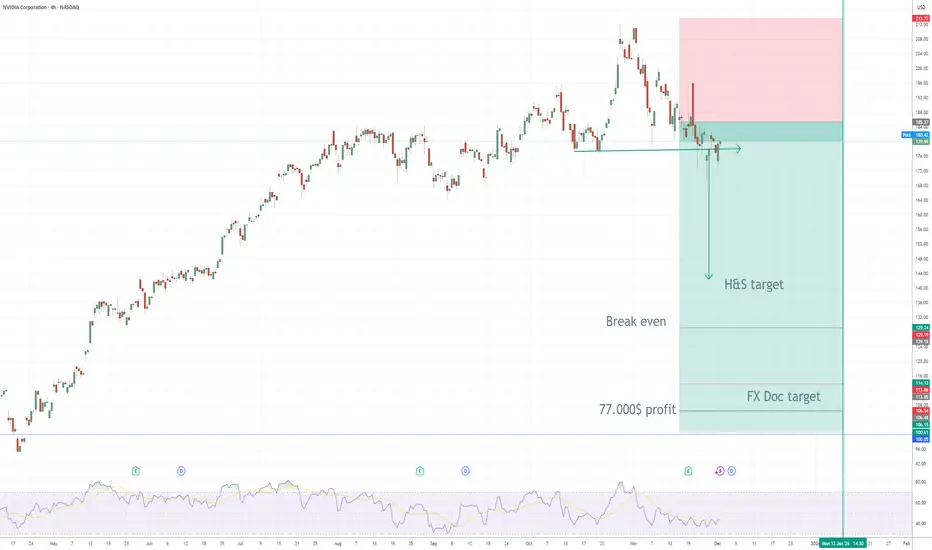
NVIDIA (NVDA) – My PUT Options Position ExplainedI opened a medium-term bearish position on NVDA by purchasing PUT options. Here’s the full breakdown of the idea, entry logic, and projected targets. 🧠 Why I Entered the Trade NVDA formed a clear Head & Shoulders (H&S) reversal pattern on the 4H chart — one of the strongest technical reversal signals after an extended bullish trend. The neckline has now been broken, validating the structure and confirming bearish momentum. The rejection from the right shoulder, combined with weakening RSI and loss of key market structure, provides additional confirmation. 🎯 My PUT Options Position I purchased PUT contracts with a defined risk and leveraged downside exposure. Break-Even Price: ~129 USD This is the key level where: the option premium is fully recovered the position shifts from “loss” to “profit” As long as NVDA trades below 129 USD before expiration, the position begins generating profit. 💰 Profit Projection My profit target zone is around 102 USD. At that level, the trade yields approximately: ➡️ +77,000 USD profit This aligns with: the measured target of the Head & Shoulders pattern previous demand zone turning into resistance Fibonacci extensions a full correction of the last impulsive leg 📌 Technical Breakdown H&S target: ~160 → ~130 → projected extension toward 102 Break-even: 129 USD FXDoctor target: 102 USD Trend structure: Major lower lows forming Momentum: RSI breakdown and bearish continuation signals The chart clearly shows a potential shift from a hyper-parabolic bullish phase into a deeper correction — a move that benefits PUT buyers with asymmetric risk/reward. 🧨 Summary I’m holding PUT options on NVDA Break-even: 129 USD Projected profit: ~77,000 USD at 102 USD The trade is based on a clean and validated Head & Shoulders reversal NVDA is showing early signs of a much larger bearish correctionShortby Broceta5
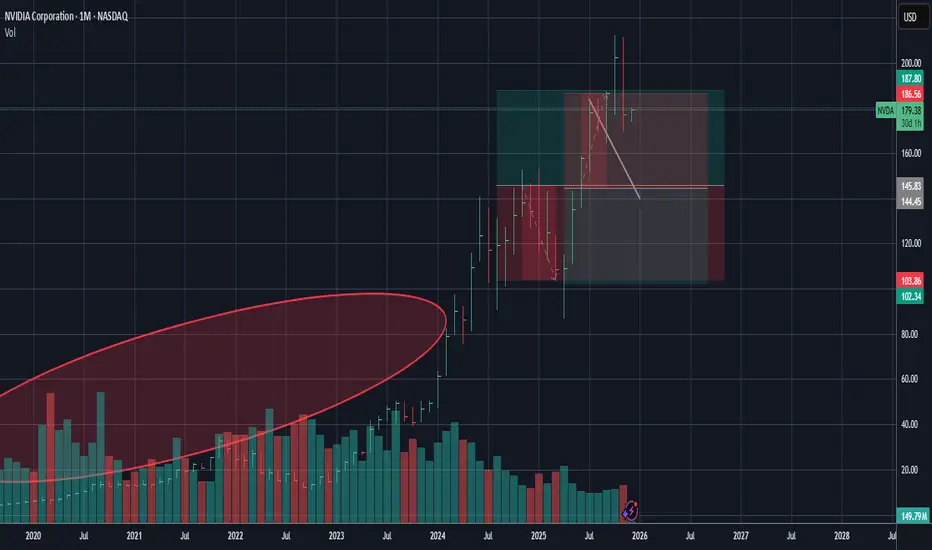
$NVDA - $140 Target - Short Position - AI Bubble About to BurstIn my opinion, Nvidia does not have much to continue the next needed support for a pro-longed bull run, at least in terms of sentiment. The AI bubble has gone on for too long and the actual multiples of valuations in comparison to revenue and profit generations do not seem to have strong support when considering traditional investing strategies. Also, the next wave seems getting closer and closer to a red trend. Retracement potential is possible after hitting $140, but Nvidia needs to do far more benefit for the public good and have a differentiation that doesn't rely on trends such as crypto mining and the boost of LLMs. As always, none of this is investment or financial advice. Please do your own due diligence and research.Shortby gamer4561485
Market Conditions are the Cycle of a Bull or Bear MarketEverything you are learning is beneficial to your trading so long as the information is factual and accurate and NOT hype, scams, fraud, misinformation or manipulative information. One way to determine if what you are learning is accurate or not is to understand the CYCLEs of the Bull Market and Bear market which are entirely different. A Great Bull Market is all about new technologies that will and are displacing old technology and are disruptive forces for the older companies whose once new technology is aging and out of date. Bull Markets have 6 primary market conditions. Each market condition is unique in how you trade that with your trading style, how you find stocks to trade, risk inherent in that market condition and profit opportunities. We are in the early years of a Great Bull Market. Bull Markets do not just go upward. Retracements, Short Term Corrections, and Intermediate Trend corrections and Flash Crashes, occur periodically when the price of a stock is too far above the fundamental level for that stock. This impacts the indexes. If a correction causes a sudden collapse of the stock price to be below the fundamental level which is a horizontal price level, then Dark Pools will start bargain hunting and buy the stock to move it back into their Buy Zone.Education10:13by MarthaStokesCMT-TechniTrader3326
NVDA long-term TANvidia is still keeping up the long-term uptrend but the mid-term is currently in distribution since the last couple of weeks, so let the news won't surprise you, it's healthy for Nvidia to fall lower and that's what it been doing recently. Some time is needed for Nvidia to bottom out, while long-term remains bullish, the mid-term is yet bearish.Longby MoxGo_AnalyticsUpdated 5
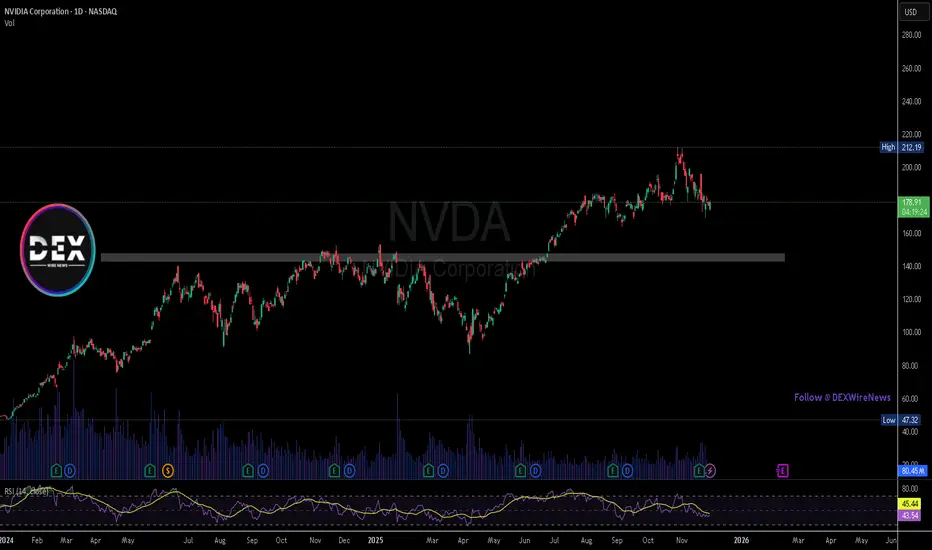
Nvidia ($NVDA) Stock: $2B Synopsys Deal Expands AI Design PowerNvidia has taken another major step to secure its dominance in AI infrastructure by investing $2 billion in Synopsys, one of the world’s leading chip design software companies. The investment instantly makes Nvidia one of the top shareholders and deepens the long-term collaboration between the two firms. The deal strengthens Nvidia’s control over key parts of the AI value chain, from hardware to software tools used in designing new chips across multiple industries. This partnership gives Synopsys access to Nvidia’s advanced developer tools and GPU-accelerated libraries to boost its electronic design automation (EDA) processes. These improvements aim to speed up chip development cycles at a time when demand for advanced AI hardware continues to surge. For Nvidia, the move ensures it stays positioned at the center of AI innovation and benefits financially from the growth of the entire ecosystem—not just from selling GPUs. The timing also matters. Synopsys recently reported weakness in its intellectual property segment due to export restrictions tied to China and slower activity from a major foundry customer. Nvidia’s investment restores confidence in Synopsys' long-term outlook while offering Nvidia a strategic foothold in the tools that design the chips running global AI infrastructure. Technical Analysis Nvidia’s overall trend remains bullish despite a slight pullback. Price currently trades around $178, holding above a key support zone at $145, which becomes the level to watch if broader tech stocks weaken. Upside momentum resumes if price pushes toward the $212 resistance area—its previous major high. A confirmed breakout above $212 would signal continuation of the broader bullish structure. With a strong fundamental catalyst and firm long-term trend, Nvidia remains one of the leading names powering AI’s next wave.Longby DEXWireNews10
Forex Trading Options1. What Are Forex Options? A forex option is a derivative contract whose value is derived from an underlying currency pair such as EUR/USD, GBP/INR, USD/JPY, or AUD/USD. The buyer of a forex option pays a premium to the seller (writer) in exchange for the right—not the obligation—to buy or sell the currency pair at a predefined price, known as the strike price. Options help traders manage risk, hedge exposures, and take advantage of directional or non-directional forecasts about the forex market. Because global currencies constantly fluctuate due to interest rates, inflation, monetary policies, geopolitical factors, and macroeconomic data, options give traders flexibility and control over how much they stand to lose or gain. 2. Types of Forex Options Forex options are broadly divided into two categories: vanilla options and exotic options. a) Vanilla Options These are the most basic and widely used options. They come in two forms: Call Option A call option gives the buyer the right to buy a currency pair at the strike price. Example: Buying a EUR/USD call at 1.0800 means you profit if EUR/USD rises above 1.0800 before expiry. Put Option A put option gives the buyer the right to sell a currency pair at the strike price. Example: Buying a USD/JPY put at 150.00 means you profit if USD/JPY falls below 150.00. Vanilla options are straightforward and behave similarly to stock options. b) Exotic Options Exotic forex options are complex instruments tailored for advanced hedging or speculative plays. Popular types include: Binary (digital) options – payoff is fixed if a condition is met. Barrier options (knock-in, knock-out) – activate or deactivate based on price movement. Asian options – payoff depends on average price over a period. Chooser options – allow the holder to choose later whether it is a call or put. These options are commonly used by institutions rather than retail traders. 3. How Forex Options Work To understand how options work in forex, you need to understand a few essential terms. a) Strike Price The pre-agreed price at which the currency can be bought or sold. b) Premium The cost of buying the option. It is non-refundable. c) Expiry Date The date when the option contract ends. d) In-the-Money (ITM) Option currently has intrinsic value. e) Out-of-the-Money (OTM) Option has no intrinsic value and expires worthless unless price moves. f) At-the-Money (ATM) Spot price equals the strike price. 4. Option Pricing – What Determines Premium? The price (premium) of an option is influenced by multiple factors: 1. Spot Price The current market price of the currency pair. 2. Strike Price The closeness of the strike to the spot affects intrinsic value. 3. Implied Volatility (IV) Higher volatility = higher premium. Forex markets with instability or news events have high IV. 4. Time to Expiry More time = more premium, since more time means more opportunity for the trade to become profitable. 5. Interest Rate Differentials Different national interest rates influence currency pair forward values and options pricing. 6. Market Liquidity Major pairs like EUR/USD have cheaper, more liquid options compared to exotic pairs like USD/TRY. These factors combine via pricing models like the Garman-Kohlhagen model (a modification of Black-Scholes for forex). 5. Why Traders Use Forex Options Forex options provide unique advantages not available in spot trading. 1. Limited Risk The worst-case scenario for option buyers is losing only the premium. 2. Unlimited Upside (for Call Buyers) If the currency skyrockets, the trader profits significantly. 3. Hedging Tool Businesses hedge currency risk using options to protect against exchange rate fluctuations. Example: An Indian importer expecting to buy goods in USD may buy a USD/INR call option to lock in cost. 4. Flexible Strategies Options can be combined in creative ways to profit from trending, stagnant, or volatile markets. 5. No Mandatory Execution If the market goes opposite, the trader can simply let the option expire. 6. Popular Forex Option Trading Strategies 1. Long Call Expect the currency pair to rise. 2. Long Put Expect the currency pair to fall. 3. Straddle Buy both a call and a put at the same strike. Used when expecting high volatility. 4. Strangle Cheaper version of a straddle; strikes are wider apart. 5. Bull Call Spread Buy one call and sell a higher strike call. Used when expecting moderate upside. 6. Bear Put Spread Buy put at higher strike, sell put at lower strike. Used when expecting moderate downside. 7. Protective Put Used by investors holding forex futures or large spot exposures. 8. Risk Reversal Combine a long call and a short put to express directional views at lower cost. Each strategy serves a different market scenario—trend, range, or high-volatility environment. 7. Forex Options vs. Spot Forex Trading Feature Forex Options Spot Forex Risk Limited to premium Unlimited (stop-loss needed) Flexibility Very flexible Less flexible Cost Requires premium No upfront cost Profit Potential Unlimited (calls) High but risky Expiry Yes No expiry Complexity High Simple Options are ideal when uncertainty is high, while spot forex is better for immediate price speculation. 8. Risks Involved in Forex Options Trading Despite protections, options are not risk-free: 1. Time Decay (Theta) Options lose value as expiration approaches. 2. Complex Pricing Requires understanding volatility and Greeks. 3. Low Liquidity on Minor Pairs Wider spreads = less efficient execution. 4. Premium Cost High volatility = expensive options. 5. Seller’s Risk Option sellers can face unlimited losses. Therefore, beginners should focus on buying options rather than writing them. 9. Who Should Trade Forex Options? Forex options are suitable for: Intermediate to advanced traders Businesses hedging currency exposure Investors wanting limited risk Traders expecting volatility spikes during events (Fed policy, inflation, elections) Swing and positional traders who want controlled leverage Beginners should start with vanilla calls and puts before experimenting with complex structures. 10. Conclusion Forex options are powerful instruments that provide flexibility, leverage, and limited risk potential. By understanding the mechanics of calls and puts, pricing factors, strategies, and risks, traders can use options to hedge against uncertainties or speculate on currency movements with precision. While more complex than spot trading, forex options offer sophisticated possibilities—especially in volatile global markets driven by economic data, central bank policies, geopolitical events, and macroeconomic trends. With proper knowledge and disciplined strategy, forex options can significantly enhance a trader’s toolkit and open new avenues for profitable trading.Educationby GlobalWolfStreet4
Nvidia breakdown signals further downside this weekCurrent Price: $183.11 Direction: SHORT Confidence Level: 68% (The majority of professional traders highlight ongoing weakness, technical downtrend channels, and critical support at $174.15 as being at risk. Sentiment leans bearish despite some long-term bullish bets.) Targets: - T1 = $175.00 - T2 = $164.00 Stop Levels: - S1 = $187.00 - S2 = $190.00 **Wisdom of Professional Traders:** I'm seeing consistent caution among the professional traders tracking Nvidia this week. Several traders point out that the price action remains stuck in a downtrend, with multiple mentions of resistance around $185–$187 and support sitting near $174.15. The consensus from the trading community is that Nvidia's inability to regain the 50-day moving average is keeping the momentum tilted toward the downside, especially with competitive threats from Google's TPU chips pressuring sentiment. **Key Insights:** The key point here is the near-term weakness that follows Nvidia's last earnings release. Despite strong results, traders observed a “gap and crap” setup, where the initial post-earnings rally quickly reversed. Many traders are watching the $174.15 level closely; a decisive break here could trigger a sharper sell-off toward the May lows around $164. In this short-term context, long-term call leaps into 2028 don't outweigh the immediate technical vulnerability. The repeated failure to hold above $185 shows sellers are defending that zone aggressively. Another factor to consider is sector rotation. Several traders noted that other semiconductor names like AMD, Broadcom, and Qualcomm are showing relative strength while Nvidia lags. This divergence suggests capital is moving away from Nvidia into peers, which could exacerbate near-term pressure. **Recent Performance:** This all played out in recent sessions as Nvidia declined over 12% last month, breaking key technical levels and underperforming both the Philly Semiconductor Index and Nasdaq. Last week’s price closed down 1.8% even as many tech names bounced, underscoring persistent weakness. **Expert Analysis:** Multiple professional traders' analysis points to clear downside setups. Several mentioned Nvidia being “bearish unless it breaks 185” with lower-high patterns forming. Support zones at $174.15 and $164 are in play if the trend continues. Many traders highlighted heavy institutional selling, potentially linked to AI bubble concerns. Even those with long-term bullish views admit the near-term chart is unattractive, and that the downtrend channel remains intact. **News Impact:** What's interesting is the competitive pressure narrative gaining traction — especially reports about Meta considering Google TPUs in future data centers. This kind of news has already triggered multiple single-day drops exceeding 6%, adding fuel to the bearish case. While the Fed’s policy pivot could help broader markets, traders are pointing out that Nvidia’s specific headwinds—valuation, technical breakdowns, and competitive threats—are more pressing in the short-term. **Trading Recommendation:** Putting it all together, I’d look for short setups below $183, targeting $175 first and then $164 if bearish momentum accelerates. Stops should be placed above $187 to limit losses, with a wider emergency stop at $190 in case of a sharp reversal. Position sizing should reflect moderate confidence, with risk kept tight until Nvidia reclaims and holds above the 50-day moving average. This looks like a tactical short for the week, taking advantage of persistent weakness and well-defined technical levels. Shortby CrowdWisdomTrading7
NVDA 4H TECHNICAL ANALYSIS NVDA has broken a downtrend triggered by a double top, and has now formed a inverse head and shoulders by Howm9
Forex Trading Secrets1. Price Action Is the Real King (Not Indicators) Most beginners clutter their charts with dozens of indicators hoping to find a perfect buy–sell formula. Professionals know the truth: price itself gives the most reliable information. Indicators lag because they represent past price data, not current market intent. What professionals focus on: Support and resistance zones Market structure (higher highs, lower lows) Liquidity levels (areas where stop-loss clusters exist) Candlestick strength (rejection wicks, engulfing candles) When a trader learns to read price action—how candles react to zones, how momentum builds or fades—they can trade profitably even with a clean chart. Indicators become secondary confirmation tools, not primary decision drivers. 2. Liquidity Is What Moves the Market Here’s a hidden truth: forex markets move to fill liquidity, not because of random price swings. Big players like banks and institutional traders execute massive orders, and they need liquidity to fill those orders efficiently. That means: Price hunts stop-loss clusters Price sweeps highs and lows before reversing Spikes occur to capture pending orders This is why you often get stopped out right before the market moves in your favor. Understanding liquidity behavior gives traders a powerful edge. Liquidity concepts include: Stop hunts Fake breakouts Order block zones Liquidity grabs Smart traders expect these moves and position themselves accordingly. 3. The Trend Is Stronger Than Your Analysis One of the biggest secrets is deceptively simple: Trading with the trend dramatically increases win probability. Many traders try to catch tops and bottoms, but institutional players rarely fight the trend—they ride it. Characteristics of trend-following success: Higher time-frame confirmation Entering on pullbacks, not chasing Using simple trend continuation patterns Keeping trades open longer during strong trends The trend holds more weight than any indicator or news event. Fighting the trend is one of the fastest ways to blow up an account. 4. Risk Management Is the Most Guarded Secret Ask any long-term successful trader their biggest edge, and the answer won’t be a strategy—it will be risk management. Key risk management secrets: Never risk more than 1–2% per trade Position sizing is more important than entries A trader with moderate accuracy and strong risk rules often outperforms a trader with high accuracy but poor risk control Understanding when not to trade is also a powerful risk strategy. Not trading low-quality setups protects your capital and mental energy. 5. Trading Psychology Outweighs Strategy This is the hardest secret for beginners to accept: Your mindset determines your results more than your system. The psychological traits professionals share: Patience to wait for ideal setups Discipline to follow rules consistently Neutrality—no emotional attachment to wins or losses Resilience after a losing streak Confidence built on data, not hope A trader can have the world’s best strategy, but fear, greed, revenge trading, and impulsiveness will destroy the account. This is why psychology books are more valuable than indicator tutorials. 6. Higher Time Frames Reduce Noise and Increase Accuracy A hidden secret among consistently profitable traders is that they rely heavily on higher time frames like the daily or 4-hour. Why higher time frames work: Clearer market structure Stronger trend visibility Fewer false signals Trades require less screen monitoring Better risk-to-reward setups Scalping looks attractive, but it magnifies emotions and often leads to over-trading. Higher time-frame trading reduces mental stress and increases consistency. 7. Fundamental Catalysts Drive Major Moves Forex is deeply influenced by macroeconomic factors. Professionals use fundamentals to understand why the market is trending and where major volatility will occur. Major catalysts include: Central bank interest rate decisions Inflation data (CPI, PCE) Employment data (NFP, unemployment rates) GDP figures Geopolitical events Fiscal policies Ignoring fundamentals means ignoring the very forces that create trends. But the secret is: You don’t need to be an economist—just know when news is happening and how it affects risk. 8. Smart Money Concept (SMC) Edge Institutional-style concepts, once hidden from retail traders, are now increasingly discussed. These include: Order blocks Fair value gaps (FVG) Market structure shifts (MSS) Imbalance zones Buy-side and sell-side liquidity These concepts explain how institutions accumulate and distribute positions. Traders who master SMC often experience a major breakthrough in accuracy. 9. Consistency Beats Intensity This secret is rarely acknowledged. Successful traders: Follow a structured routine Practice the same strategy repeatedly Keep a trading journal Backtest regularly Set trading sessions and stick to them Failure in forex often comes from randomness—random indicators, random entries, random time frames. Success comes from consistency, not constant experimentation. 10. Forex Is a Business, Not Gambling Treating forex like a business means: Maintaining a trading plan Logging trades Tracking performance metrics Identifying weak areas Improving process instead of chasing profits Traders who approach forex like gambling lose money. Traders who approach it like a business grow gradually and sustainably. Conclusion: The “Secrets” Are Not Hidden—They Are Underrated The real secrets of forex trading are not magic formulas or mysterious tools. They are principles that professionals use every day but beginners often overlook in search of shortcuts. To summarize: Price action matters most Liquidity drives the market Trend-following improves probability Risk management is the true edge Psychology determines consistency Higher time frames simplify trading Fundamentals guide long-term trends SMC offers an advanced structural view Consistency builds mastery Treating trading as a business ensures longevity Mastering these secrets takes time, discipline, and patience. But once internalized, they form the foundation of sustainable forex success.Educationby GlobalWolfStreet2
NVDA at a Decision Level – Dec 1–5 OutlookWeekly – Trend Still Up, But Losing Strength NVDA has been riding a strong multi-month uptrend, but the last few weekly candles show the first real slowdown. A clear CHoCH formed near the recent highs, and sellers stepped in aggressively. The weekly candle closed with a long upper wick and a heavier body — signaling momentum cooling. Important weekly zones: * $198–200: previous weekly supply * $176–178: weekly support where buyers stepped in * $153–160: deeper weekly demand * $120s: major demand if the market rolls over hard Weekly tone → still bullish on the big structure, but fading momentum with the first signs of deeper pullback potential. Daily – Inside a Pullback After Supply Rejection Daily shows a sharp rejection from the supply zone near $210–215. Price broke structure downward (CHoCH), then bounced from a lower demand zone but hasn’t reclaimed the supply above. Daily key levels: * Resistance: $198 → $212 * Support: $177 → $172 Until price fully reclaims and holds above $198–200, NVDA stays at risk for lower continuation. Daily tone → trapped underneath supply, struggling to regain upside momentum. 1-Hour – Sideways Grind After Breakdown The 1H shows clean weakness: * BOS downward * Multiple failed retests of $182–183 * Price repeatedly rejecting the underside of the broken trendline * Buyers only defending short-term at $176–178 The more NVDA keeps getting rejected at the same 1H resistance, the more pressure builds for a deeper dip. Short-term 1H levels: * Breakout: above $183 → retest $188–190 * Breakdown: below $176 → flush toward $172–170 1H tone → consolidation after rejection, leaning bearish unless buyers reclaim $183. 15-Minute – Compression Before the Next Move The 15m chart is compressing inside a tight range after the clean BOS move earlier. This type of structure usually leads to an impulsive move. The repeated rejection at $182–183 shows sellers defending aggressively. Buyers are only holding the short-term demand around $176–178. 15m tone → leaning bearish unless it breaks above $183 with real strength. GEX – Options Positioning Shows the Real Pressure Points On the NVDA GEX chart: * Highest positive GEX: $185–187 → magnet + resistance * 3rd CALL wall: near $190 → extension if momentum flips * PUT walls: * $172–175: heavy PUT support * $160: large negative gamma zone * $145–150: deep support if the market panics What GEX is saying: * Below $183, market makers lean bearish and push toward $176–172. * A clean break above $185 can snap the chart upward into $188–190 fast due to positive gamma. * A breakdown below $176 opens a straight path to $170–172 with momentum. GEX aligns perfectly with the TA: * All timeframes showing pressure from above * GEX walls lining up with the exact levels on the 1H and 15m * A bigger move waiting as soon as NVDA loses or reclaims the key areas Trading Thoughts – Dec 1–5 Bullish Setup NVDA needs a clean break + hold above $183–185. Targets: * Target 1: $188 * Target 2: $190 (CALL wall) Stop zone → below $176 Call idea (only if breakout happens): NVDA 185C / 190C, short-dated — ONLY after confirmation. Bearish Setup If NVDA loses $176, downside opens quickly. Targets: * Target 1: $172 * Target 2: $170 * Target 3: $160 (deep support on GEX) Put idea (safer): NVDA 172P or 170P — only valid if breakdown happens. Overall Outlook for Dec 1–5 NVDA is sitting right at a squeeze point. Key alignments: * Weekly: losing momentum * Daily: stuck under major supply * 1H: rejecting underside of broken trendline * 15m: compression before a direction * GEX: clear resistance above $185 and clear support at $176 → perfect pressure map The next move will be clean once direction confirms. This is the type of setup where option traders shouldn’t guess — just wait for the breakout or breakdown and ride the move. Disclaimer This analysis is for educational purposes only, not financial advice. Always trade with proper risk management and confirmation. by BullBearInsights6656